As you know, very few things matter to me — and to this organization and to the planet we all hope our future generations can continue to inhabit — as much as a just transition to clean energy. That’s why we support communities fighting on the frontlines against harmful extractive projects, like the Standing Rock Nation and the Reno-Sparks Indian Colony as they resist the Dakota Access pipeline (DAPL) and Thacker Pass lithium mine, respectively. It’s also why we continue to ally with Native-led groups promoting climate solutions which encompass Indigenous knowledge and respect tribal sovereignty.
To that end, this week I traveled to the Muscogee Nation near Tulsa, OK, to attend the second annual Tribal Energy Equity Summit. I was honored to speak at this important gathering, hosted by the Alliance for Tribal Clean Energy. It brought leaders from tribes and organizations across Turtle Island together with representatives from the federal government to share our viewpoints and advance equitable clean energy solutions. As part of my attendance, I sat down with Chéri Smith, the alliance’s president and CEO, to talk about the importance of Indigenous agency in creating a clean energy future for tribes. Please watch our short video, meet Chéri, and learn more about her organization’s mission.
Watch: I sat down with Chéri Smith, President and CEO of the Alliance for Tribal Clean Energy, to talk about the importance of Indigenous agency in creating a clean energy future for tribes.
It’s been — if you’ll pardon the pun — an energizing week! The summit afforded me a great opportunity to network with like-minded people and organizations, meet new friends, and reconnect with old ones. I was especially happy to share space with Dennis “Bumpy” Pu‘uhonua Kanahele, head of the Nation of Hawai’i, which maintains its status as a sovereign government under international law, independent of the United States.
As our presence at the same summit that also hosted a pair of representatives from the White House indicates, this was a diverse gathering which welcomed a multitude of perspectives on how we can solve tribal energy issues in a just way and begin to remediate the climate crisis. As you know — and as exemplified by DAPL’s violation of our treaty lands, which hold so much potential for renewable energy development — those two issues are inextricably linked. I’m excited to see where we’ll go from here!
Speaking of DAPL: many of you have reached out to us after reading about my participation in the ongoing trial to determine whether the federal government should reimburse the State of North Dakota for exorbitant costs it alleges it incurred by over-policing our peaceful NoDAPL movement in 2016 and 2017. This article and this one can provide you a bit more of my perspective. I’ll also plan to report back to you with further thoughts once we hear of a judgment.
Wopila tanka — as always, thank you for supporting environmental justice! Chase Iron Eyes Director and Lead Counsel The Lakota People’s Law Project
CINCINNATI, Ohio — They came to protect the water.
Nearly 200 people traveled from Michigan to Cincinnati on Thursday, March 21, to support the state of Michigan’s efforts to stay out of federal court with its legal case calling for a partial shutdown of Enbridge Line 5.
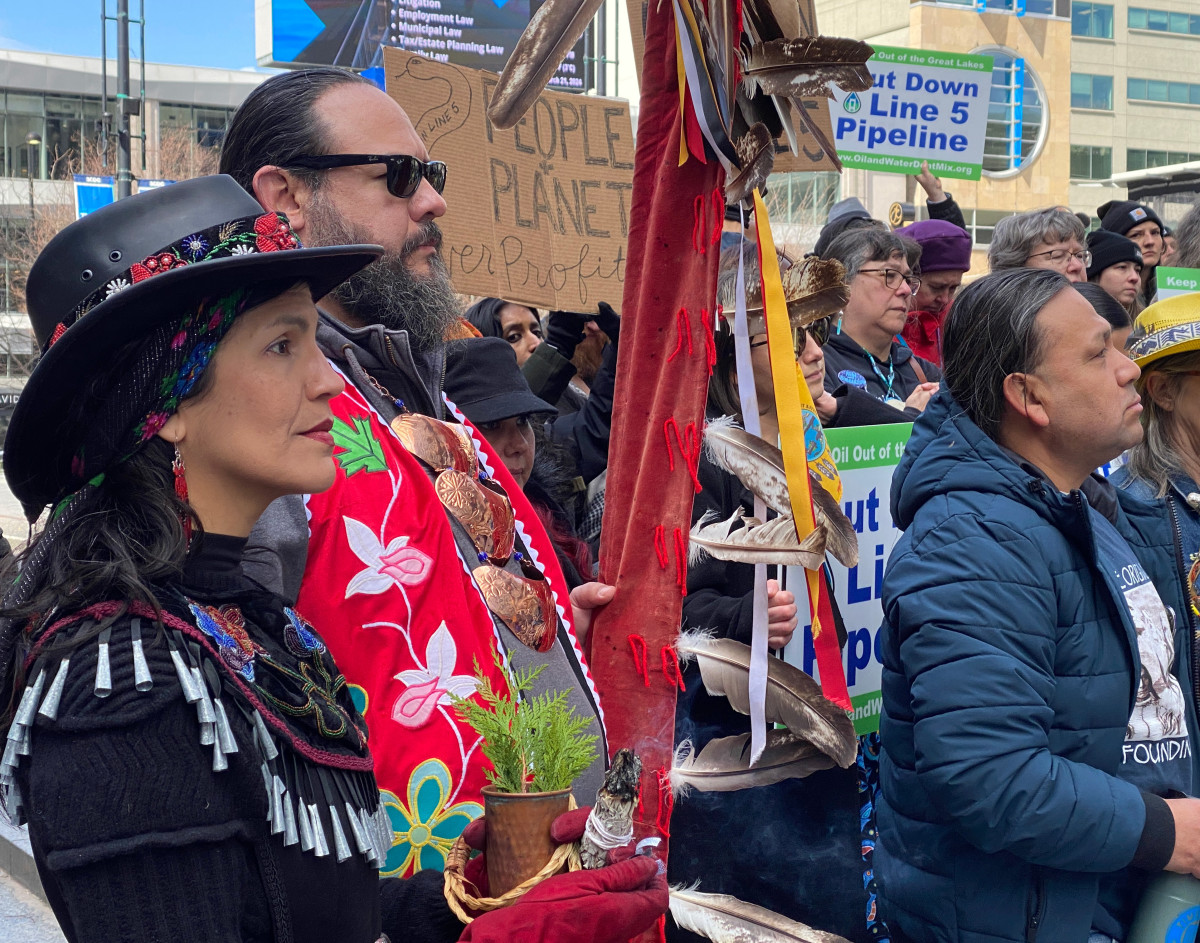
Several citizens and leaders of Michigan tribes were among those who joined the rally at Fountain Square, a major public space in downtown Cincinnati near the U.S. Court of Appeals for the Sixth Circuit.
The crowd waved banners and signs calling for the shutdown of the Line 5 pipeline, with some calling for “people and planet over profits.”
Inside the courthouse, Michigan officials asked the federal appeals court to allow the lawsuit filed by the state attorney general’s office to remain in state court – a move supported by a coalition led by the Bay Mills Indian Community of more than 60 tribes from the Great Lakes region and beyond.
“I’m from the Bear Clan. My job is to protect the forest and make sure our water is safe,” Andrea Pierce told the crowd Thursday. Pierce, of the Little Traverse Bay Bands of Odawa Indians, is part of the Michigan Environmental Justice Coalition.
Nicole Keyawbiber and Joe VanAlstine of the Little Traverse Bay Band of Odawa Indians in Michigan join a rally in Cincinnati, Ohio, on March 21, 2024, supporting Michigan Attorney General Dana Nessel’s efforts to keep her office’s lawsuit seeking shutdown of Enbridge line 5 in Michigan state court. (Photo by Mary Annette Pember/ICT)
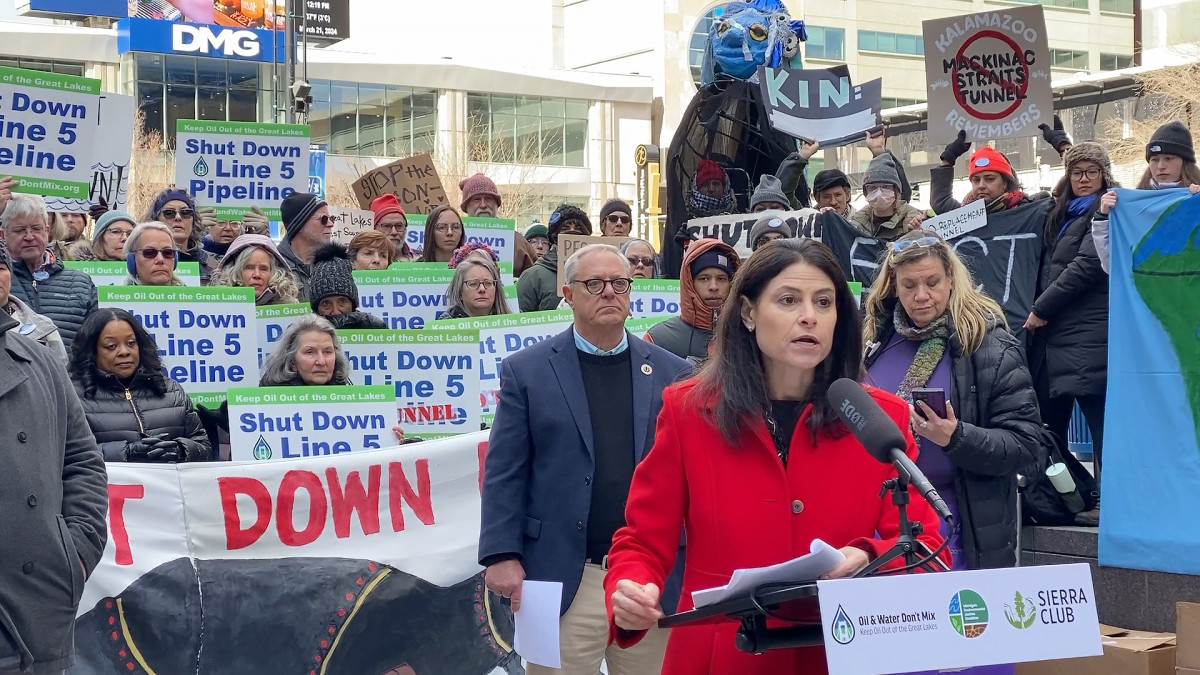
Michigan Attorney General Dana Nessel, who filed the legal action to shut down the pipeline, addressed the crowd during the rally at Fountain Square on why she wants to keep the issue in state court.
“This is a Michigan case brought under Michigan law by Michigan’s chief law enforcement officer on behalf of the people of Michigan on behalf of our Great Lakes and it belongs in a Michigan court,” she told the cheering crowd.
The Bad River Band of Lake Superior Chippewa in Wisconsin, which is litigating to keep Line 5 off of reservation lands, also signed onto the brief. All 12 of Michigan’s federally recognized tribes passed resolutions calling to decommission Line 5.
‘Public nuisance’
Line 5, constructed in 1953, runs 645 miles from Superior, Wisconsin, east through Michigan’s Upper Peninsula and under the Straits of Mackinac before it terminates in Sarnia, Ontario, Canada.
In the original 2019 lawsuit filed in Michigan circuit court, Nessel sought a shutdown of four miles of Line 5 pipeline that ran under the Straits of Mackinac. The lawsuit contends that the pipeline is a public nuisance and that allowing Enbridge to continue operating it is a violation of the public trust doctrine and the Michigan Environmental Protection Act.
The Straits of Mackinac link Lake Michigan and Lake Huron, and constitute one of the most ecologically sensitive areas in the world, according to Oil and Water Don’t Mix, an advocacy organization based in Michigan.
Michigan Attorney General Dana Nessel tells a crowd of supporters in Cincinnati, Ohio, on March 21, 2024, that her case seeking shutdown of Enbridge Line 5 belongs in Michigan state court rather than federal court. (Photo by Mary Annette Pember/ICT)
Nessel won a restraining order from a state judge in June 2020, but Enbridge successfully moved the case into federal court in December 2021.
Nessel asked U.S. Circuit Judge Janet Neff to shift the case back into state court, but Neff refused, prompting Nessel to appeal to the Sixth Circuit appeals court.
Enbridge filed a separate federal lawsuit in 2020 arguing the state’s attempt to shut down the pipeline interferes with federal regulation of pipeline safety, and could interfere with interstate and international trading of petroleum, driving up oil prices. That case is still pending in Neff’s court.
Enbridge has insisted the section of pipeline that runs beneath the Mackinac Straits is in good condition and could operate indefinitely. Enbridge has proposed encasing the pipes in a protective tunnel.
Assistant Attorney General Daniel Bock told the three-judge panel of the court in Cincinnati Thursday that the challenge to Enbridge’s Line 5 deals with the public trust doctrine, a legal concept in which natural resources belong to the public. He said that concept is rooted in state law.
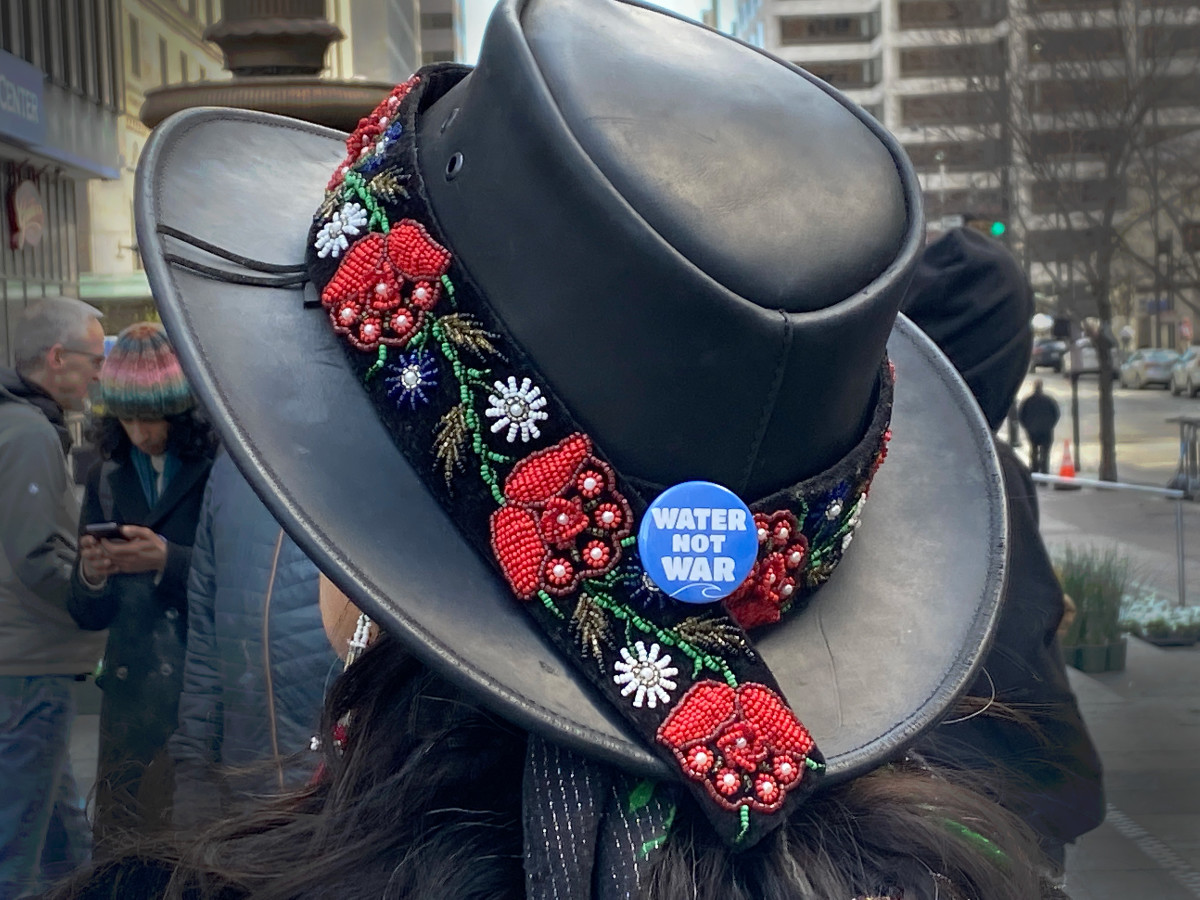
Water protector Nicole Keyawbiber wears a “Water not War” button on her hat at a rally on March 21, 2024, in Cincinnati, Ohio, supporting efforts to keep a Michigan state lawsuit seeking shutdown of Enbridge Line 5 out of federal court. (Photo by Mary Annette Pember/ICT)
Bock went on to assert that Enbridge, the Canadian company that owns the pipeline, missed its deadline to shift the case from state to federal court.
Enbridge attorney Alice Loughran countered that the case should remain in federal court because it affects international trade. She said the company didn’t have to comply with the standard 30-day deadline for requesting removal to federal court because it lacked enough information to formulate the request.
In an email sent to ICT, Enbridge spokesperson Ryan Duffy accused Nessel of forum-shopping in an effort to secure a favorable outcome.
“We are confident that ultimately the Sixth Circuit Court will agree with the lower court’s decisions from August 2022 and November 2021 that this dispute—which has generated a US foreign policy controversy—properly belongs in federal court,” Duffy wrote.
Protests continue
The protesters outside the courthouse were among thousands in recent years to protest the pipeline in Michigan, Wisconsin, Minnesota and even in Canada.
“Near and far, Anishinaabe people have united to protect the Great Lakes,” said Whitney Gravelle, president of the Bay Mills Indian Community, in a statement released Thursday to Earthjustice, a nonprofit environmental law organization.
“We stand behind Attorney General Nessel because we know that shutting down Line 5 is the only way to protect everyone who depends on the land, water, and natural resources within the Great Lakes,” Gravelle said, “including Anishinaabe people exercising our treaty rights.”
This article contains material from The Associated Press.




 Water is Life