Pactola Action by June 20

Lakota Law

Last year, we helped mobilize support around a planned gold mine’s imminent threat to Jenny Gulch, the Pactola Reservoir, and the Rapid Creek watershed in South Dakota. Today, it’s time to act once again. The U.S. Forest Service is taking public comments on a proposed mineral withdrawal, and there’s a real and imperative opportunity for us to save one of the most beautiful and special places in Lakota Country.

Please click here to tell the U.S. Forest Service you support the Pactola area mineral withdrawal! We encourage you to say you also support expanding the area covered by the withdrawal to include all federal lands in the Black Hills. Tell the Forest Service that these sacred lands, which nourish so many Native and non-Native communities downstream with clean water, should be preserved and pristine forever.

Take Action!

The Pactola Reservoir provides fresh water and a beautiful place for South Dakotans to experience natural wonders. Please act now to ensure this area of the sacred He Sapa isn’t polluted by mining.

The deadline for all public feedback is June 20, so this is as urgent as it gets! As you know, we usually like to provide you with easy-to-send, pre-filled form emails. However, because the Forest Service has its own form and values individually crafted messages, please use your own words on this one. Here are some effective talking points when sending your message:

  1. Most importantly, say you want the Forest Service to say YES to the Pactola Reservoir-Rapid Creek Watershed Withdrawal.
  2. Ask the Forest Service to do an Environmental Assessment (EA).
  3. Ask for a Finding of No Significant Impact (FONSI) when the EA has been completed. This may seem counterintuitive, but there will, in fact, be no significant impact to the land once the miners are forced to withdraw!
  4. Choose and give at least one primary reason for your support of the mineral withdrawal. Focus on water quality and cultural values, such as keeping the water free of toxic pollutants, respecting the sacred lands of the Lakota People, and preserving the site for recreation.

Here are two other important notes to keep in mind. First, we are NOT asking for a full Environmental Impact Statement (EIS). Instead we want an EA, which is a much faster process. If, when we messaged you before about Jenny Gulch, you already submitted a comment and asked for an EIS, you can and should make another comment and ask for an EA and FONSI now. Earlier comments written about Jenny Gulch don’t count in the new mineral withdrawal process.

Numbers, however, do count. If you’d like to expand your commentary with additional detail, you can visit the Black Hills Clean Water Alliance (BHCWA) website to learn more. In solidarity with our friends at the BHCWA and every person in South Dakota who values clean water, sacred lands, and beautiful expressions of the natural world, I humbly ask that you act right now to protect the Rapid Creek watershed.

Wopila tanka — thank you for your attention and action!
Chase Iron Eyes
Co-Director and Lead Counsel
The Lakota People’s Law Project

Outside/In Podcast

Lakota Law

It’s important that enterprising reporters cover Native issues in the right way. Today, I’m happy to highlight a solid example of such reporting. When protest is a crime, part one: the Standing Rock effect is the first of a multi-part podcast from the talented team at Outside/In, a division of New Hampshire Public Radio. It examines the criminalization of protest in America through the lens of Indigenous resistance. Both my father, Lakota Law co-director Chase Iron Eyes, and I sat down with reporter and producer Justine Paradis to lend our perspectives. I encourage you to listen to what we had to say.

Click to listen to our appearance on the Outside/In podcast from New Hampshire Public Radio. Photo of Oceti Sakowin Camp by Irina Groushevaia on Flickr.

In 2016 and 2017, when we formed the resistance camps at Standing Rock to stop the Dakota Access pipeline (DAPL), it quickly became apparent that our movement was going to have an unusual kind of impact. Other tribes showed up in force. Alexandria Ocasio-Cortez traveled to our homelands and decided while there to run for office. U.S. veterans arrived on the scene in support of our cause, rattling the established order. In all, tens of thousands of people helped us make worldwide news, and we succeeded in raising public consciousness to the point that President Obama actually shut DAPL’s construction down.

You probably know what happened next. Newly elected, Donald Trump quickly overturned Obama’s decision and fast-tracked the pipeline. And then, the conservative backlash really kicked in. Over the next several years, states began creating policies meant to chill citizens’ right to free expression under the guise of infrastructure protection. The federal government even tried to make it legal for law enforcement to kill protestors. Thankfully, after people like you sent thousands of messages to legislators, that particular bill didn’t make it out of the Senate.

Nevertheless, things remain tenuous today, and that’s why we must keep shining our lights on nefarious efforts to silence our voices and roll back our rights. Using clips and a series of interviews that include personal stories — like my own about watching my mother get arrested — Justine and her team deftly do just that. They examine the NoDAPL movement, various forms of direct action, and the history of Indigenous resistance. Please give the podcast a listen, and share it with your network. Then keep your eye out for the second episode, slated to drop later this week!

Wopila tanka — thank you for being a part of our resistance.
Tokata Iron Eyes
Organizer
The Lakota People’s Law Project

Let's Green CA!

Lakota People’s Law Project
547 South 7th Street #149
Bismarck, ND 58504-5859

The Lakota People’s Law Project is part of the Romero Institute, a nonprofit 501(c)(3) law and policy center. All donations are tax-deductible.

Action Needed at Thacker Pass, Nevada

Lakota Law

Warm greetings to you. Today, I share with you my story of a very important experience. Earlier this month, I joined my father, Lakota Law co-director Chase Iron Eyes, and our videographer, Chuck Banner, on a trip to Thacker Pass in Nevada — or Peehee Mu’Huh, as it’s known in the Paiute language. We were there to support our Paiute and Shoshone relatives in a direct action to stop a massive lithium mine, which threatens a sensitive ecosystem and disturbs sacred burial grounds. Upon my return, I wrote a blog and shot a video, which I encourage you to read and watch.

Watch: In my new video, I’m joined by my father and Reno-Sparks Indian Colony’s Michon Eben to talk about what’s happening at PeeHee Mu’Huh.

I won’t go into a ton of detail for you here, because the blog and video do that. Suffice to say that the Indigenous People of Nevada need our attention and support. Just like Standing Rock with the #NoDAPL struggle, they’re on the frontlines of extractive capitalism, and their homelands are being desecrated without their consent. 

It hasn’t yet reached the same extremes as the coordinated effort by law enforcement and Big Oil at Standing Rock, but once again, activists on the frontlines are being targeted. My colleague Chuck was among several people hit with Temporary Protective Orders; another was Dorece Sam, a Fort McDermitt Paiute-Shoshone tribal member and Nevada President of the Native American Indian Church. These actions by law enforcement are meant to stifle our ability to exercise First Amendment rights to free speech and protest.

We must not stand down. We should use this moment to grow the movement. It’s time to recognize and reinforce the latest front in the battle to protect Indigenous People, defend sacred lands, and preserve precious, life-giving water.

Wopila tanka — thank you for standing with our Paiute and Shoshone relatives!
Tokata Iron Eyes
Organizer
The Lakota People’s Law Project

Lakota Law Project Annual Report

Lakota Law

Kola iyuha iciciyapi. As you know, Lakota Law’s team protects Indigenous sovereignty in myriad ways, including defending ICWA, supporting #NoDAPL efforts at Standing Rock, and amplifying vital Native perspectives. And while there’s much left to do on our shared journey toward justice, it’s important to periodically reflect back on some of our key accomplishments together. In that spirit, I encourage you to review the impact we made during 2022 by reading through our just-released Annual Report.

Read the Report!

To view the full 2022 report, click the banner above.

As you may know, the Lakota People’s Law Project is part of the Romero Institute, a 501(c)3 umbrella organization with a 45-year record of fighting in the courts for social justice. The Institute also runs Let’s Geen CA!, a groundbreaking climate initiative in California. Thanks to big-hearted generosity and friendship from you and so many others, we’re able to take on big, strategic challenges with precision. You have our deep gratitude for all you’ve given, and the best is yet to come!

The report details a range of the Romero Institute’s efforts, financials, and accomplishments. In the Lakota Law section, you’ll see an outline of our history, mission, and highlights from last year. Then, we break down some key impacts you helped make possible. I’m happy to say that includes more than 220,000 actions signed by friends like you — including advocacy campaigns to protect ICWA, demand an end to whitewashing of history in schools, and defend PeeHee Mu’Huh (Thacker Pass) and the sacred He Sapa (Black Hills) from mining.

Thank you, always, for supporting the Lakota People’s Law Project. We’re grateful you continue to walk with us, and we look forward to keeping you informed. The actions you take have real meaning and impact, with far-reaching effects here in Lakota country, across Turtle Island, and around our world.

Wopila tanka — thank you for your support of Indigenous and environmental justice!
Chase Iron Eyes
Co-Director and Lead Counsel
The Lakota People’s Law Project

Stop DAPL: Call To Action

Lakota Law

As you’ve seen over the course of the past several months through our Dakota Water Wars video series, the Oceti Sakowin (Great Sioux Nation) has reunited to stop the Dakota Access pipeline (DAPL). Our latest chapter, which you’ll find by scrolling down to the topmost video on the series page, takes you inside a recent pipeline strategy meeting at Standing Rock. Produced as always by us in partnership with the Great Plains Tribal Water Alliance and the Standing Rock Nation, the video shows tribal leaders and water protectors gathering to discuss a coordinated offensive, including a lawsuit and public comments campaign to challenge the soon-to-be-released Environmental Impact Statement (EIS) for DAPL. 

Watch: Standing strong together, tribes are preparing a new legal offensive to stop DAPL.

You likely remember when tens of thousands of people gathered at Standing Rock’s resistance camps in 2016 and ‘17. That indelible moment in time demonstrated the power of standing strong together, capturing worldwide attention and giving rise to a powerful movement for Native and environmental justice. Suddenly, our Indigenous struggle to protect water on the frontlines of the climate crisis became frontpage news.

Now, the tribes are preparing to renew our legal fight to end DAPL. Once again, we must act with unity and purpose. Just last week, Standing Rock held another meeting with Michael Connor, Assistant Secretary of the Army for Civil Works, and we now know the EIS will become available for online public comment toward the end of June.

Just like the formation of the original camps, this moment will be pivotal. We hope you’ll join us and take action by flooding the Army Corps with demands for a new, valid EIS. As we’ve communicated to you previously, we don’t even need to see the current EIS to know it’ll be deeply flawed. After all, the company hired to prepare it, a member of the American Petroleum Institute, previously argued against Standing Rock at a hearing and recommended expansion of the pipeline’s capacity.

It’ll be up to all of us to pressure the government to make the oil company comply with the National Environmental Policy Act and end this illegal pipeline’s operations. Our battle here in the Dakotas is the same one Indigenous communities face all over the world. We are here to protect our natural surroundings, and it’s no coincidence that Big Extraction targets our lands for exploitation. Centuries of genocide have, at times, left us short of the resources necessary to fight — but this time we’re punching back! United, we must protect our communities and the Earth we share. Please continue to stand strong together with Standing Rock and the Oceti Sakowin.

Wopila tanka — thank you always for standing with us!
Chase Iron Eyes
Co-Director and Lead Counsel
The Lakota People’s Law Project

Action: Indian Child Welfare Act (ICWA)

Lakota Law

As the current, ultra-conservative U.S. Supreme Court continues its deliberations in the Backeen v. Haaland case, it’s all too clear that the Indian Child Welfare Act (ICWA) is in serious jeopardy. While we remain hopeful it won’t, the High Court could easily overturn ICWA or portions of the law, eroding tribal sovereignty and eliminating the federal mandate to keep Native children in kinship care with their relatives.

That’s why it’s critical we protect all the important tenets of ICWA — and, in turn, the heath, safety, and cultural identities of our youngest and most vulnerable — at the state level. As we approach Mother’s Day, in solidarity with Native moms, uncis, and caretakers across this land, please tell your state leaders to codify ICWA at the state level

Take Action!

Please click above to tell your state to codify ICWA and enforce current ICWA-like laws on the books, where they exist.

Should the Supreme Court overturn or gut this critical law, not only will our children suffer from being placed with non-Native foster care families, but a critical blow will have been struck against our tribal sovereignty. Foster care and adoption is the new method for conservative states to prolong our history of forced assimilation, with evangelical Christianity often motivating Department of Social Services (DSS) workers and foster families to reshape the minds and hearts of our children. 

To this day, 90 percent of Native children seized by South Dakota’s DSS are placed into non-Native homes and institutions, and similar statistics exist in Native nations throughout the rest of the country. Dismantling ICWA would take us backward, continuing the genocidal pattern of broken treaties, land grabs, and Indian boarding schools. In this era of judicial overreach, we must exhaust every method to protect Native youth, so please do your part to assist us in this important endeavor!

Wopila tanka — thank you for your solidarity!
Chase Iron Eyes
Co-Director and Lead Counsel
The Lakota People’s Law Project

P.S. It’s critical we use all avenues at our disposal to protect the tenets of the Indian Child Welfare Act. Please tell your state leaders to codify ICWA and protect Native children, families, and sovereignty.

Let's Green CA!

Lakota People’s Law Project
547 South 7th Street #149
Bismarck, ND 58504-5859

The Lakota People’s Law Project is part of the Romero Institute, a nonprofit 501(c)(3) law and policy center. All donations are tax-deductible.

Return of Cultural Items

Richard Arlin Walker
Special to ICT

There was something wrong, Victoria Compton thought, about the items being sent out into the world in a Store-Closing-Everything-Must-Go sale.

The ancestral objects shouted “Indigenous” in “very British” Victoria, the capital of the Canadian province of British Columbia, whose opulent Empress Hotel, Parliament building and street names are reminders of the British Empire’s expansion in the 19th century.

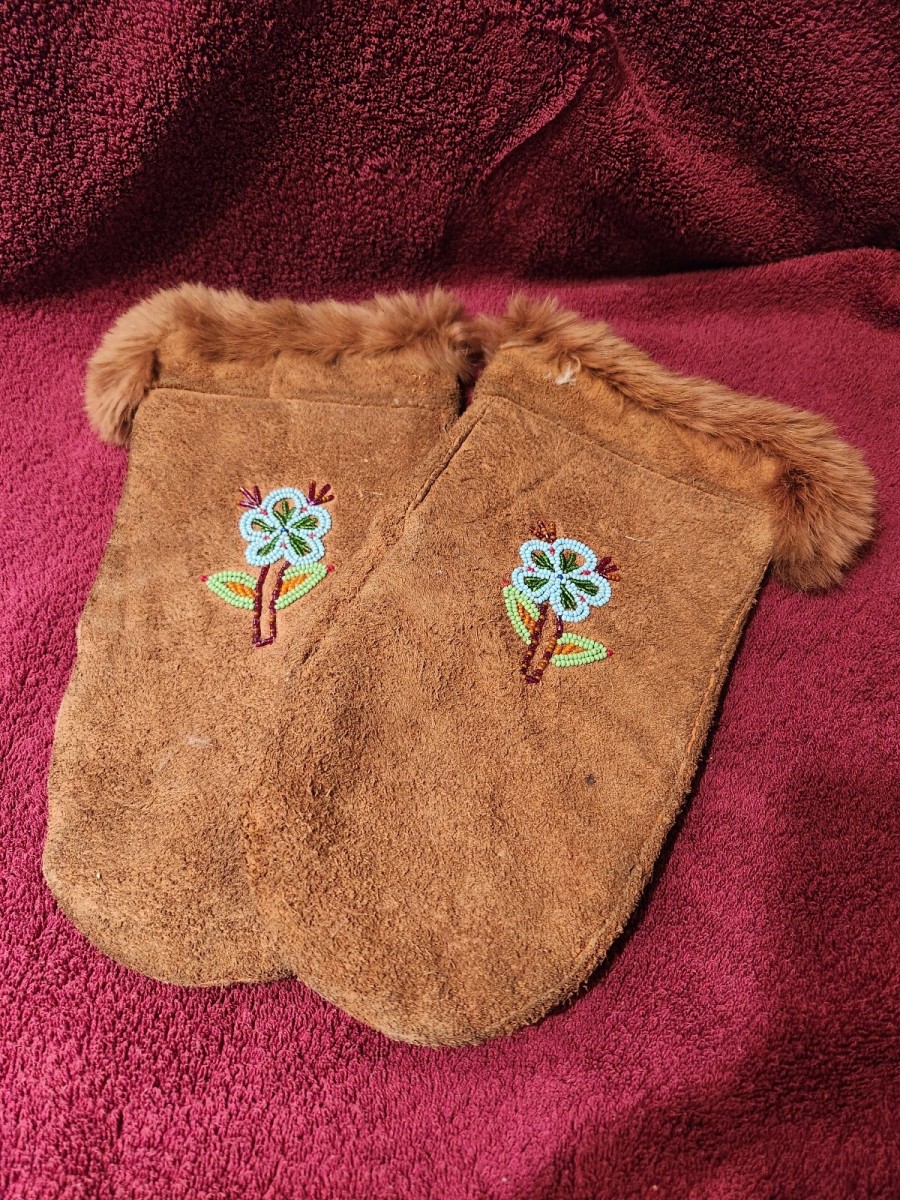
Among the ancestral objects up for sale: hand-woven baskets, one a century old and made using tule, feathers and porcupine quills; moccasins with an intricate, beaded flower design; fur-lined leather mittens; a carved serving spoon; and a baby carrier.

These beaded, fur-lined mittens were among several Indigenous artifacts that Victoria Compton of Washington State bought at a store going out of business in Victoria, British Columbia. She is now working to repatriate the items to their tribes of origin as early as May 2023. (Photo courtesy of Victoria Compton)

These beaded, fur-lined mittens were among several Indigenous artifacts that Victoria Compton of Washington State bought at a store going out of business in Victoria, British Columbia. She is now working to repatriate the items to their tribes of origin as early as May 2023. (Photo courtesy of Victoria Compton)

Each object was a work of art, intricately woven or carved using techniques and materials that had been employed by Indigenous people in the Northwest for millennia, Compton said.

“As a mom, the baby carrier was particularly heartbreaking to me,” said Compton, about seeing the objects in the soon-to-be-shuttered store.

“This antique object had been one family’s way of caring for their baby,” she said. “It was loved, well-used, well-crafted. Someone clearly worked hard to make this into a beautiful and durable object. It resonated with me …

“The baby carrier represented to me the unimaginable loss of generations of Native American children, and their mothers’ grief,” she said.

SUPPORT INDIGENOUS JOURNALISM. CONTRIBUTE TODAY.

Compton, an economic development agency director on San Juan Island in northwest Washington state who is not Native, said she was able to buy 12 objects. Once home, she said she realized she couldn’t keep them.

“They don’t want to live here,” she told ICT. “They want to live with the people who crafted them.”

Compton then embarked on a journey to return the objects to their Indigenous nations of origin, one of a growing number of private collectors seeking to repatriate objects of cultural, historic, or traditional importance.

Some collectors, like Compton, want to repatriate the items because they believe ancestral objects belong with the cultures from which they originated. Some want to repatriate objects that have no clear provenance — or history of ownership — leaving open the possibility they were obtained by unscrupulous or illegal means.

Under the 1990 federal law, the Native American Graves Protection and Repatriation Act, known as NAGPRA, museums, universities and government agencies that receive federal funds are required to return human remains and culturally significant and sacred objects to the tribal nations or lineal descendants.

So far, more than 83,000 human remains and 1.7 million funerary objects have been repatriated, according to a February 2022 report from the Government Accountability Office.

But for private collectors and others who have no obligation under NAGPRA to return ancestral objects to their cultures of origin, knowing how or where to start can be a puzzle.

“I understand that repatriation is a huge issue and expense for tribes and I don’t want to add to that burden if it’s not an item that should be returned,” said Mary Klinkel, a non-Native resident of Green Valley, Arizona who is seeking to repatriate a beaded leather case, believed to be from the Southwest, that she has in her possession.

“If there is a group of Indigenous experts that can look at photos and make decisions about whether items need to be repatriated or not, that could be a big help in the process.”

Seeking guidance

A good place to start is a local tribal museum, said Emily Miller, senior curator of the Tulalip Tribes’ Hibulb Cultural Center and Natural History Preserve on the Tulalip Reservation near Seattle.

The National Association of Tribal Historic Preservation Officers website, has an online directory of 74 tribal museums and cultural centers in 23 states, and museums may be able to consult by email using photographs and background information about the object, Miller said.

The Power of Indigenous Knowledge

Lakota Law

Greetings from Pine Ridge. I’ll keep this email short and sweet — but only because I want you to spend your reading time on today’s blog! I’ve also recorded a short video, which you’ll see near the top of the blog page. What’s my topic? I’m highlighting the importance of Indigenous knowledge in tackling the climate crisis in the wake of the latest Intergovernmental Panel on Climate Change report and convening of the United Nations Permanent Forum on Indigenous Issues.

Click above to watch a short video and read my blog about the importance of Indigenous knowledge when it comes to solving the climate crisis.

Please do read the blog, but here’s one of my key points. The climate crisis is real, it’s serious, and it’s existential — but that’s not a reason for pessimism. In order to win this fight, we must listen to one another, celebrate the good work being done, and tap into our resilience as human beings. We should recognize the victories we’re achieving now and incorporate both science and the understanding Indigenous communities have had for Unci Maka — our grandmother Earth — for thousands of years. 

We know about resilience, and we aren’t scared of the apocalypse. In the era of colonization, we’ve already been living through it for generations. We haven’t lost our faith or our capacity for optimism, and we’re not going to give those up now. I invite you to hear my perspective and take on this challenge with me so the generations to come can tell an inspiring story of reconnection and recovery.

Wopila tanka — thank you for caring for Unci Maka!
Tokata Iron Eyes
Organizer
The Lakota People’s Law Project

No More Native Mascots

Lakota Law

I’m Lily Joy Winder, and I write to you today to introduce myself as a friend and dedicated advocate for Indigenous health, joy, and excellence. I bring good news! As a 20-year-old Diné and Southern Ute activist currently attending Stanford University, I also focus on my campaign #PeopleNotMascots to enact policies that retire racist Native mascots in United States public schools. A few months back, knowing our goals were aligned, I reached out to Lakota Law — and from there, an exciting partnership was born. I’m happy to announce that in 2023 and beyond, we’ll support one another’s efforts to end appropriation, increase Native agency in media, and win Indigenous justice.

Thanks to Teen Vogue for this joyful article and triptych!

Just this week, New York officially banned Native mascots in K-12 schools that do not have specific tribal consent! This is an incredible victory for the Native children of New York and the growing national movement for Native mascot bans across the country. Currently, People Not Mascots is working toward introducing federal legislation and also working in Massachusetts, Minnesota, and with the Lakota Law team in California to pass Native mascot removal policies. We are at a real opportune and crucial moment in continuing to build this movement. We’re in the midst of exciting change!

People Not Mascots holds a special place in my heart as it also touches on other Indigenous issues I’m passionate about. All the work I do strives to create an America that sees my Native kin as human beings. At school, I research environmental racism through an Indigenous lens, which contributes to my passion for ending the Missing and Murdered Indigenous People epidemic. As you likely know, clear ties exist between Big Oil and violence against my Indigenous relatives. 

I also share what I know about Indigenous issues on my social media platforms — most notably on my TikTok (@sheshortnbrown), which has gathered around 300k followers. My budding acting career lends yet another platform. Ultimately, I hope not only to remove negative imagery of Native folks, but to create imagery and media where we are centered and cared for. I hope you’ll follow along, and I’m grateful to you for your compassion and advocacy.

Ahéhee’ — thank you for your friendship!
Lily Joy Winder
Via the Lakota People’s Law Project