Our team here in Lakota Country hopes you are enjoying a safe and happy holiday season. Thank you for standing with the Lakota people this year!
2020 brought challenges and changes, showing us all the importance of joining together to stand strong in support of equality and justice. We believe that, now more than ever, Native voices must be heard. You can ensure that Indigenous people continue to rise. Will you contribute a year-end donation in 2020? One, final tax-deductible gift can go a long way toward accomplishing our shared mission to protect sacred lands, safeguard human rights, promote sustainability, reunite Indigenous families, and much more.
I encourage you to watch our new video, in which I detail our many, impressive shared accomplishments in 2020 — and our vision for progress together in the year to come.
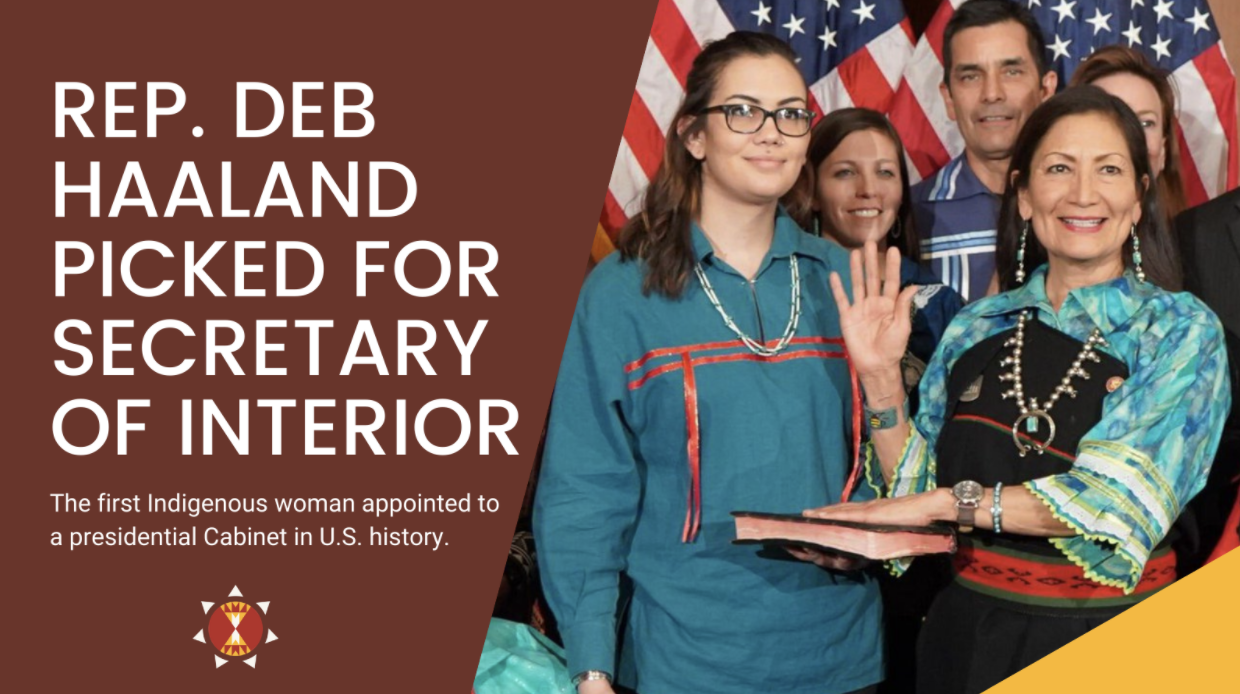
Thanks to you, the Lakota People’s Law Project made life better for so many this year. You helped us support Standing Rock’s legal fight against DAPL and partner with the tribe to activate Native and swing state voters. You kept tribal health and safety checkpoints operational, protecting Cheyenne River and Pine Ridge during the COVID-19 pandemic. You sent nearly 10,000 petitions urging president-elect Joe Biden to appoint the first Indigenous Cabinet member — a fight we won when he picked Rep. Deb Haaland for Secretary of the Interior!
We have so much more to accomplish together in 2021. Please continue to stay with us so we can permanently end DAPL and KXL, get the vote out for the Georgia Senate run-off elections, and expand our kinship care program at Standing Rock, ensuring that the next generation of Lakota youth is cared for and given every opportunity to succeed.
This is your last chance to give a tax-deductible gift in 2020. Please give a year-end gift from the heart to help accomplish all this and more. 2020 showed us that life can bring unexpected challenges at any time. We plan to be there to meet them in 2021. Please continue to support our mission for justice. We can’t do any of this without you!
Wopila Tanka — we’re so grateful for your friendship.
Chase Iron Eyes Lead Counsel Lakota People’s Law Project
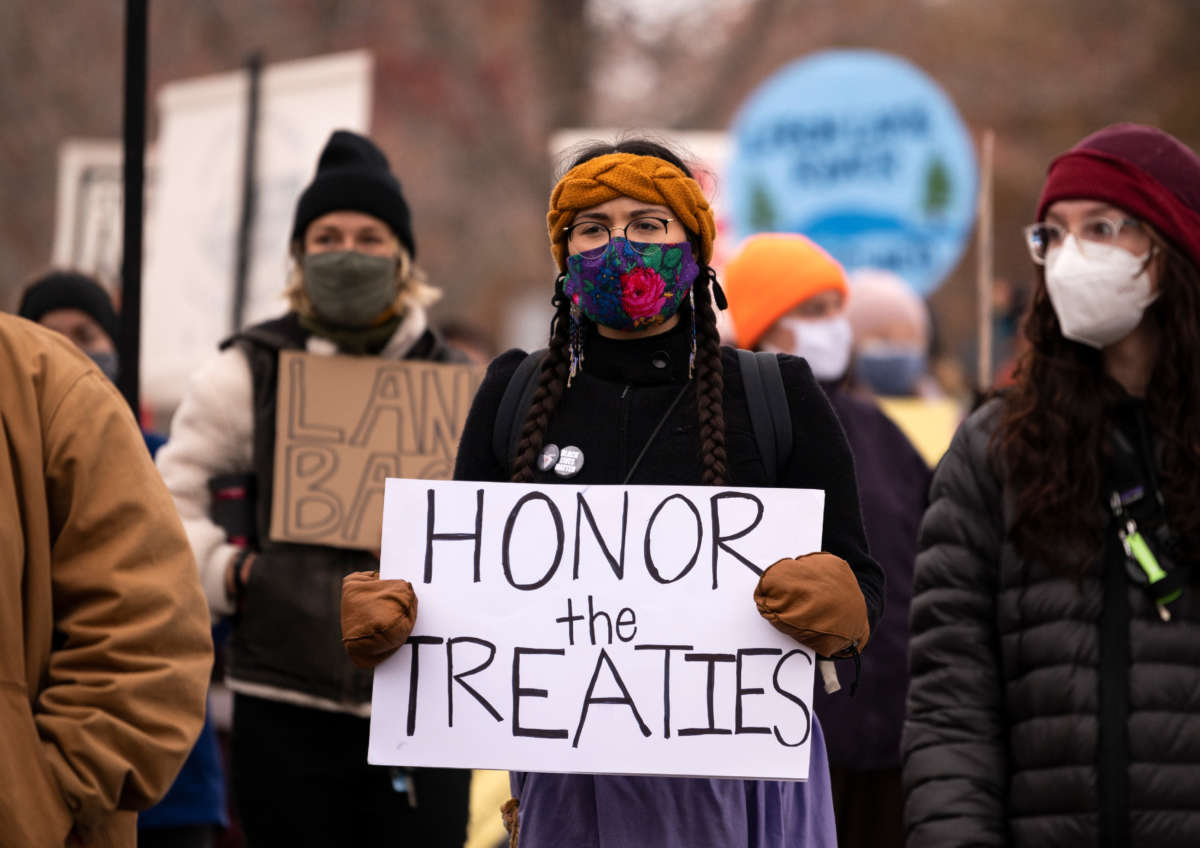
People protest against the Enbridge Energy Line 3 pipeline project outside the governor’s mansion on November 14, 2020, in St. Paul, Minnesota.Stephen Maturen / Getty Images
Mike Ludwig talks to Whitney Gravelle, an attorney for the Bay Mills Indian Community, about the fight against Enbridge’s Line 5 pipeline.
TRANSCRIPT
Climate Front Lines
To Protect Great Lakes, Michigan Tribes Oppose Enbridge Line 5 Pipelines
Note: This a rush transcript and has been lightly edited for clarity. Copy may not be in its final form.
Mike Ludwig: Welcome to Climate Front Lines, the podcast exploring the people and places on the front lines of the climate crisis. My name is Mike Ludwig. I’m a reporter for Truthout.org. President-elect Joe Biden announced this week that former environmental protection agency administrator Gina McCarthy will serve as his top climate advisor.
The actions from environmentalists have been mixed to say the least on one hand McCarthy was the EPA administrator during the Obama administration. When regulators attempted to put caps on the energy sector’s greenhouse gas emissions for the first time, of course, the Trump administration crushed all these efforts and then some, and on the other hand, McCarthy was EPA administrator during the Obama administration.
When the word fracking became a household term for years, fracking opponents accused the EPA under Obama and McCarthy of suppressing research. Showing that fracking for oil and gas is a threat to drinking water. Still fracking caused an explosion of fossil fuel production across the U.S., and Canada was pushing to export more oil and gas at the same time.
All of these fossil fuels needed places to go in ways to get there and suddenly fights against new oil and gas pipelines erupted across the nation. The Keystone XL pipeline, for example, became a political hot potato under president Obama as tribal governments and environmental activists launched fierce campaigns against the project.
During the last days of the Obama administration. Law enforcement moved to crush the uprising at standing rock where the standing rock, Sioux tribe and other indigenous led activists resisted the Dakota access pipeline for months and drew international attention to the legacy of colonialism in the Americas.
Activists continue to take direct action to stop oil and gas pipelines under President Trump, who made it clear that the fossil fuel industry had a friend in the White House. Those days are coming to an end, the campaigns to prevent the industry from establishing new infrastructure and locking in decades of fossil fuel production will continue under president Biden.
Like other struggles on the front lines of climate change, many of these campaigns are led by indigenous activists. One such campaign can be found in Northern Michigan where the Canadian firm Enbridge wants to extend the life of line five to underwater oil and gas pipelines that have operated for decades in the straits of Mackinac, the narrow body of water between Michigan’s lower and upper peninsula. In 2018, a ship’s anchor struck line five causing damage and alarming the public lion five runs under what it’s essentially headwaters for much of the great lakes and oil spill in this region could spell disaster for ecosystems and fresh water supplies. Enbridge wants to build a quote unquote tunnel over line five so the pipelines can continue operating for years to come. But the company is facing opposition from a coalition of tribal governments, along with Michigan’s democratic governor Gretchen Whitmer. To learn more, I spoke with Whitney Gravelle, an attorney for the Bay Mills Indian community, a Northern Michigan tribe that has fished the waters flowing above Line 5 for generations.
Whitney Gravelle: So Bay Mills Indian community is a federally recognized Indian tribe located in the upper peninsula of Michigan. So we’re in the Northern most part of the state. Um, and as I mentioned earlier, uh, closer to Canada than the rest of the state, but we have been here since time immemorial.
So this is where the Aboriginal people of the Bay Mills Indian community, Ojibwe Anishinaabe, have always resided and lived and been a part of the environment and culture here within the state of Michigan.
ML: Can you give us a little bit of background on the Enbridge line five? Um, how much construction has been completed, maybe where you all are at, in the permitting process?
WG: Yeah. So Enbridge line five, the dual pipelines that run beneath the straits of Mackinac have actually been in existence since 1953. That is when Enbridge first saw an easement from the state of Michigan and actually placed the pipelines into the water. Since then in early 2018, there was actually an anchor strike that struck the pipelines in caused some severe damage.
And that was the first time that the tribes or the public in the state of Michigan were actually made aware of the pipelines. So they had been around, you know, for almost 60 years and all of a sudden, everyone was made aware of what was actually going on beneath the water. Uh, Which was really surprising, not only to the tribe, but to the public.
And then it started raising all of these concerns of why did we have an oil and natural gas pipeline running through the straits of Mackinac, running through the Great Lakes, which is the largest freshwater body in the world. And a critical part of not only the environment of the state of Michigan, but also our economy up here.
ML: Right, and I was watching the video you sent me, that fishing is a big part of the economy where, where you live or for your community.
WG: Yes, that is correct. So Bay mills is actually a signatory of the 1836 treaty of Washington. And in that treaty, there were five different tribes. Females included that seeded 14 million acres to the United States government for the creation of the state of Michigan.
If we had not signed that treaty back in 1836, uh, the state of Michigan would not have. Um, become part of the union, essentially during that time, what we did when we signed the treaty of Washington, however, is we reserved rights on reservation and offers a ration to fish hunt and gather throughout the seed and territory, which is essentially that 14 million acres, that 14 million acres also includes the waters of the great lakes.
And in reserving the. The right to fish in the great lakes, what our ancestors were doing was actually preserving a way of life for our people. That is something that we have always done commercially as well as subsistently in order to provide and feed our community.
ML: And you mentioned earlier, other pipelines, have you drawn inspiration or, uh, maybe some tactical knowledge just from seeing other indigenous led fights against pipelines in the U S.
WG: Absolutely. Um, you know, the most. The largest example that comes to mind was the No DAPL that took place in the Dakotas against that pipeline. That was the first time that the, the indigenous community had come together and rallied around one another in order to stop a pipeline. And there were a lot of atrocities that occurred in the no dapple protest, but they ultimately succeeded.
Now that pipeline is still in litigation. Uh, over there in the Dakotas, they’re still figuring out what those issues, but the strength that those indigenous communities found amongst each other. We also had citizens from the mills Indian community that went out to the Dakotas to support them. We had donations coming from our own tribal community.
It made us realize that if we could draw upon the same strength that we might be able to then get line five, the dual pipelines out of the straits of Mackinac.
ML: And they’re there. Enbridge is trying to extend these lines, right? That is what you’re fighting right now.
WG: Yeah. So originally this has actually been a really rapid and moving process here in the state of Michigan, but originally in 2018, when those anchor strikes had occurred, that. As I mentioned brought awareness to the general public and the state of Michigan of the dangers of these pipelines. Uh, what Enbridge started doing then was coming up with other alternatives in a way to keep the pipeline going underneath the streets of Mackinaw and what the mills Indian community is actively fighting right now is a proposed tunnel project.
So essentially Enbridge wants to build a tunnel beneath the straits of Mackinac that would then house these dual pipelines, still keeping them. You know, underneath the water, underneath the soil, but endangering our Great Lakes.
ML: Right. And as, um, and as a community, I imagine there, isn’t just the sense of you. You want to preserve and protect the water for fishing and, uh, for the area that you live, but you’re also fighting to protect the entire great lakes system, really that, that flows from that area. And also the climate.
WG: Absolutely. You know, you hear the term often that tribal communities are often the first stewards of the environment, the first stewards of the land, and that is an obligation and a duty that our communities and the different indigenous populations take very seriously.
We actually have a teaching amongst our people. It’s called the seven generations teaching. But what it asks you to do is to look seven generations into the future for every action that you take. So whether it be a pipeline or driving a car, you know, or constructing something or polluting or recycling, you are supposed to examine that decision that you do and determine how.
Are the actions that I am taking today, having an impact on my children’s children and their children, seven generations into the future. And that teaching is so ingrained into our society. That what it really. Has us do and requires of us is to reflect upon the impacts that we are doing towards the future, which is a direct correlation to climate change, you know, to global warming, uh, to being a steward for the environment.
What are we doing today that will provide the most sustainable future for our children?
ML: And where are we with the fight? I know that. Enbridge filed a lawsuit recently. I think it was against governor. Whitmer correct for, um, attempting to block the pipeline. And then there’s also some permits that are in the air.
WG: Yeah. So most recently, just a few weeks ago, Governor Whitmer actually revoked the easement for the dual pipelines in the streets and Makena first, the governor and the attorney general filed litigation on the easements. In state court, state of Michigan court, and then Enbridge responded by filing an action in federal court, essentially stating that the governor has no right to revoke the easement and that federal regulations over pipelines actually preempt any state law that may apply in terms of easement or regulation of water and lands.
Uh, dual and running along that there’s actually a litigation taking place before the Michigan public service commission, which females is directly involved in. And the Michigan public service commission is the governing body that will decide whether or not Enbridge can move the duel. Pipelines in the streets of Mackinaw into the tunnel.
Also running adjacent to that is there are two permits that are going before Eagle, which is a state regulatory agency in Michigan and also the United States army Corps of engineers to actually build and construct the tunnel. So first and bridge must receive permission from the Michigan public service commission to place the pipelines into the tunnel. And then they also need two permits approved by both the army Corps and Eagle in order to build the tunnel.
ML: And so, and those permits are, um, the decisions on those are going to be made next month I read. Is that correct? So you’re kind of like, this is a crucial time for your campaign.
WG: Yes, um, Eagle the environment, great lakes and energy division actually extended the deadline until January, 2021.
And then the army Corps is also evaluating that permit. Their process is a little bit longer, but they typically run very parallel to one another. So once we just see a decision from the Eagle state side, we will also see a decision come from the army Corps as well.
ML: One thing we’ve seen internationally. In the past few years is climate negotiators of the United nations and other intergovernmental organizations that are working on climate have come to recognize the leadership that indigenous people have in, in the movement for climate justice. And also in the effort to just preserve the planet, um, that indigenous knowledge, not just the United States, but across the world can be a guiding. For us in determining how to preserve land, to manage forests, to create carbon sinks, um, to do these things that can help us mitigate at least some of the impacts of climate change. Do you feel like when you’re, when you’re opposing this pipeline, that that does have climate implications, that you are part of a bigger movement and international recognition of, the, I guess, indigenous knowledge about land and about the areas that need to be preserved.
WG: Not at this moment in time. And I think that it is because our focus is so narrowed and lasered-in on the issues that we’re confronting here on the ground, in the state of Michigan. Um, but definitely the inspiration that we have seen from other indigenous communities, not only within the United States, but around the globe.
Have lent us strength in the, in the battles that we are engaging here on the front lines, we learn from their mistakes. We learn from their achievements. We learn from them as communities and how they engage their state or federal regulatory agencies. And we try to apply that here because I think as a people and looking at the teachings from indigenous communities, we’re all aligned that we’re here.
Uh, again, you know, reflecting upon that seven generation principle to continue to provide for our communities who have bet on this land since the beginning of time.
ML: Thanks for listening to Climate Front Lines. If you’ve enjoyed this podcast, give us a like, and a share. You can also sign up for our free daily email newsletter@truthout.org. Stay safe out there, friends.
We have incredible news! Today, for the first time in U.S. history, a Native American person was nominated to fill a Cabinet position when Joe Biden tapped Rep. Deb Haaland (D-NM) to serve as his Secretary of the Interior. We all share in this victory for Indigenous rights, and I can’t thank Lakota Law supporters like you enough for lending your voices. Nearly 9,500 of you signed our petition to Biden’s transition team in support of Congresswoman Haaland! Today, they made the right call.
Once she’s confirmed, Rep. Haaland will bring valuable experience to the executive branch as both a legislator and an Indigenous woman. A 35th-generation New Mexican and member of the Pueblo of Laguna Tribe, she’s already served in Congress on a committee overseeing the Department of the Interior. As a Native person, she’ll bring a new perspective to the position, which is responsible for the federal government’s relationship with tribal nations and has a large role in determining domestic environmental and land use policy.
We could not have hoped for a better person to fill this role at this time. We have so much work to do to heal our nation — from COVID-19, the disastrous environmental rollbacks of the outgoing administration, and the historical disregard of Indigenous people. So, today, we celebrate a new day and a better direction for America. We heartily congratulate our friend, Congresswoman Haaland, and we look forward to working even more closely with her to win justice for the Lakota and tribal nations across the land.
Wopila tanka — Thank you for helping us make history!
Madonna Thunder Hawk Cheyenne River Organizer The Lakota People’s Law Project
You’re likely aware of the Standing Rock Sioux Tribe’s partnership with the Lakota People’s Law Project to reach and activate voters in Georgia between now and Jan. 5. Today, I have some great news for those of you who’d like to be even more involved. We’re excited to offer you an opportunity to join the calling team!
If you can volunteer to help ensure that underrepresented voices are heard in Georgia’s Senate run-off elections, please join our Standing Rock members in calling Native American voters and others in Georgia who care about the issues so important to us.
2) Be available for training via Zoom this Friday Dec. 18th at 5 p.m EST.
You can help Standing Rock make a difference in the Georgia run-offs!
You’ll need a laptop, computer, or tablet, a good internet connection, a phone, and preferably a headset. We’ll provide you everything else, including the names and contact info for the voters and a script that you can follow!
Once you’ve completed the training, you’ll be free to make calls any day of the week (except Friday) between 1 p.m. and 8:30 p.m. EST. We’ll also exclude some holidays, which we’ll clarify at the training. We do ask, if you sign up and go through the training, that you commit to completing at least one four-hour volunteer calling shift.
Now that early voting has begun in Georgia, we’re calling potential voters and asking them to make a solid plan to vote. This is extremely important, because turnout in special elections is always lower than in presidential elections, and studies show that many people who intend to vote may fail to follow through due to lack of planning.
We must help each voter determine whether they’ll vote by mail, vote early, or vote on Election Day. Can you join Standing Rock and help Georgia voters make their plans? There’s so much at stake in this election — including whether we’ll be able to effectively protect our rights to clean air and water in the years to come. Mni wiconi — water is life.
Wopila tanka — your attention, and your participation, are very much appreciated!
Chase Iron Eyes Lead Counsel The Lakota People’s Law Project
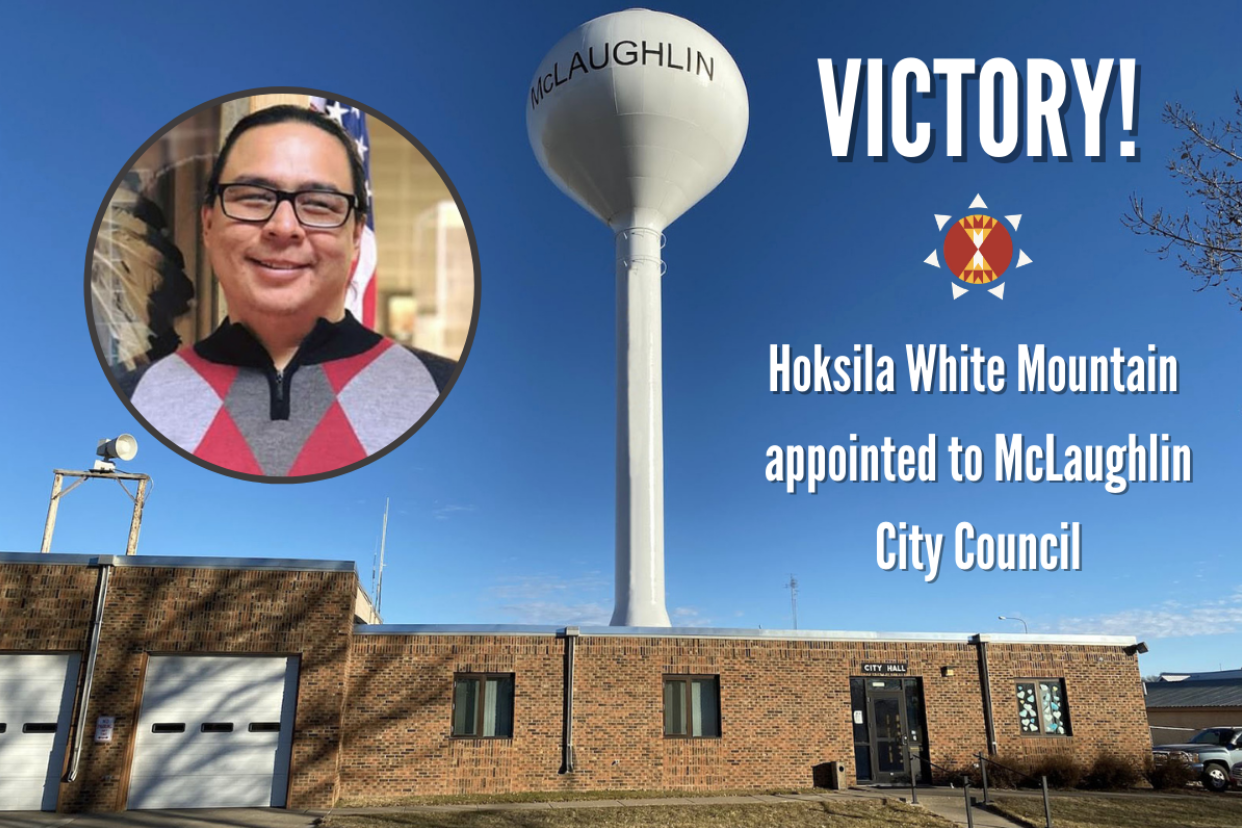
We won! Due in part to your support, Hoksila White Mountain is now sitting in his rightful place on the McLaughlin City Council. On Monday night, equipped with 80 signatures my team gathered from townsfolk and more than 4,500 from Lakota Law supporters like you, we showed out in force. We demanded that promises made be promises kept — and we shifted the balance of power in Standing Rock’s second largest town
Hoksila White Mountain will now represent his people at McLaughlin City Hall
After Hoksila was unjustly removed from the mayoral race in McLaughlin, the mayor agreed to appoint him to city council — but then reneged on his promise. That’s why Lakota Law’s Phyllis Young and Chase Iron Eyes joined a host of my town’s Native residents in pressuring our leadership to do the right thing. The Campaign Legal Center in Washington, D.C. also provided us valuable research into the Voting Rights Act so we could articulate a credible threat of litigation.
Faced with this overwhelming pressure, the majority of the council passed an emergency resolution to appoint Hoksila, on the spot, to fill the empty seat in his ward. He then joined the deliberations as a member of city government. This momentous event means that we Native people, who make up well over half McLaughlin’s population, will now have badly needed representation from one of our own.
Hoksila is the definition of a good man. He honors our ways, he goes to ceremony, and he gives back to the community. He will use his training as a social worker to serve those in need, especially our youth.
While racial tensions persist in McLaughlin — a town named after the man who killed Sitting Bull, and a place we prefer to call “Bear Soldier” — Hoksila’s appointment and presence can help bridge the divide. It is my sincere hope that we will eventually stop looking at the color of people’s skin and start looking at the temerity of their consciences. Until that day, it’s comforting to have Hoksila in position to give voice to our concerns.
Thank you for your action on behalf of my people. Only by laying strong foundations within our local communities can we be effective advocates globally for climate action, fair governance, and other issues of broader concern.
Wopila tanka — thank you for making a difference at Standing Rock!
Honorata Defender Standing Rock Organizer Lakota People’s Law Project
Native Americans mostly on their own in COVID fight
IHS Pine Ridge Hospital in South Dakota. (Indian Health Service via Twitter)
Mary Annette Pember
In states without mask mandates or other policies, tribes suffer most
Davidica Littlespottedhorse didn’t really feel terribly sick; at first she thought she had the flu or a sinus infection.
Soon, however, she developed a frighteningly painful headache. Almost immediately, her entire family of 10 living together in a three-bedroom home fell ill; nearly everyone complained of similar distinctive headaches.
Littlespottedhorse’s son-in-law Carl tested positive for COVID-19 a week earlier. Despite their best efforts at sanitizing the house and ensuring Carl quarantined in his room, the virus quickly spread through the household, affecting members who range in age from 7 months to 47 years old.
The family quickly went to the Indian Health Service hospital in the town of Pine Ridge to get tested; the nurse, however, told Littlespottedhorse that since she’d been tested a week ago, she’d have to wait another month to get retested.
“I told her I’m symptomatic and need to be tested again. Finally I contacted the CEO of the hospital, and he intervened,” she said.
The adults in the home all tested positive. Hospital staff told Littlespottedhorse the babies, all under 2 years, didn’t need to be tested; the family should just assume they are positive and treat their symptoms as needed.
“If I hadn’t insisted on getting us tested, we might have thought we just had the flu and gone on as usual; we could be out there infecting people,” she said.
Davidica Little Spotted Horse of Pine Ridge. (Photo by Mary Annette Pember)
Littlespottedhorse, of the Oglala Sioux Tribe, wondered if that might be the case with others in the community.
“It seems like we have a bad flu. We’re not completely debilitated, although my daughter who is 7 months pregnant is feeling really bad,” she said.
In response to an email regarding testing protocols at the Pine Ridge hospital and other facilities, Indian Health Service public affairs staff wrote, “Patients who have had a previous negative COVID-19 may be retested if they start to have symptoms of COVID-19.”
According to the FAQ pages for both the Indian Health Service and U.S. Department of Health and Human Services, however, “IHS facilities generally have access to testing for individuals who may have COVID-19; however, there are nationwide shortages of supplies that may temporarily affect the availability of COVID-19 testing at a particular location.”
The Indian Health Service has received over $2.4 billion in new funding to provide resources that will support a wide range of COVID-19 activities, according to an agency news release.
The agency has also expanded to deliver 470 rapid point of care analyzers to 342 federal, tribal and urban sites, according to releases from the Indian Health Service and Health and Human Services. But for an agency that is so chronically underfunded and staffed, a one-time infusion of cash may not be enough to shore up an inadequate infrastructure.
Littlespottedhorse and her family are now quarantined in their home in Oglala, on the vast Pine Ridge reservation, where grocery stores are few; Walmart and other large shopping centers are located hours away, in Rapid City and Nebraska.
Littlespottedhorse’s household is dependent on deliveries of food and cleaning supplies from family members and the Oglala Sioux Tribe’s Covid Task Force. Her situation is not unique to Pine Ridge.
Mercedese Littlespottedhorse, daughter of Davidica Littlespottedhorse, stays hydrated while fighting the COVID-19 virus. (Photo courtesy of Davidica Littlespottedhorse)
Housing is scarce on most reservations, and poverty rates are high so more than one family often occupies a single home, making Native people here especially vulnerable. Underlying poverty-related health conditions such as diabetes, obesity, asthma and high blood pressure add to the risk of developing serious complications, noted South Dakota Rep. Peri Pourier during an interview with MSNBC.
Pourier and Sen. Red Dawn Foster, both Lakota, recently sent a letter to South Dakota Gov. Kristi Noem asking her to impose a mask requirement.
“This letter is written with grave urgency to appeal to your rational sensibilities as a person, looking above and beyond political party lines and political obstructions,” they wrote.
“We write to implore you to try and think of those who are vulnerable and need our protection, not to get bogged down in petty politics.”
Maggie Seidel, senior advisor and policy director for Noem wrote in an email response to the legislators’ letter, “I think our answer has been well covered.”
“Mask mandates don’t work — they haven’t worked anywhere in the world. We respectfully request the news media cover the facts,” Seidel wrote to Forum News Service regarding Pourier and Foster’s letter.
To date, Noem has declined to enact any COVID-related restrictions and continues to downplay the seriousness of the disease.
According to the Centers for Disease Control and Prevention, South Dakota is among the worst states in the country for measures of per capita deaths and hospitalizations.
Both South and North Dakota are near capacity at all hospitals. In general, rural hospitals in the U.S. are not equipped to handle critically ill patients, according to the Wall Street Journal. The pandemic has laid bare these shortcomings for the entire population.
Native Americans on remote reservations in the Dakotas are effectively on their own.
As they have for generations, however, Native people are organizing to provide care for themselves and their families.
No time off since June
“It’s unreal how busy we’ve been,” said Patrick Swallow, public health investigator for the Oglala Sioux Tribe.
Swallow works with two other investigators and eight contact tracers who notify tribal members who have tested positive for the virus and determine how many others with whom they may have been in contact.
“We first try to contact positive cases by phone, but many times their phone numbers have been disconnected; we’re finding a lot of people have prepaid phones and can’t afford to pay the bill,” Swallow said.
Investigators must then drive to peoples’ homes, don protective gear and notify them in person.
“I’ve been putting on over 300 miles a day driving around; we haven’t had a day off since June,” he said.
“We get anywhere between 30 and 50 cases per day; it’s been hard on us, but everybody on our team is so dedicated. Thankfully, none of our staff has gotten sick so far.”
Predicting the virus’ spread and progression has been almost impossible, according to Swallow.
“In some homes, one person gets sick and then everyone gets infected. In others, only one person gets sick,” Swallow said. “As soon as we think we have this thing figured out, it just changes.”
Swallow speculates that there are likely far more cases of the virus that have gone untested because some patients have no symptoms.
“You can be running around and not even know you have it and still be contagious,” he said.
Unfortunately, the many funerals now taking place for those who have died from the virus are contributing to its spread, according to Swallow.
“It’s a real touchy subject; how do you tell people they can’t have a funeral or wake if their loved one passes away?”
Littlespottedhorse and her family are recovering. Although she has a number of underlying health conditions such as diabetes and high blood pressure, she is beginning to feel better.
Eschewing over-the-counter medications, Littlespottedhorse relies instead on traditional herbal remedies. She credits her teas and supplements with her family’s recovery.
“Thankfully the fevers have passed for everyone. We’re staying true to only herbal remedies, being gentle with ourselves, eating healthy and staying hydrated. We smudge and pray every day,” she said.
“This healing is definitely a process. Luckily our family and the tribe have been stepping up to help us; I’m humbled and eternally grateful to have such compassionate, generous people in our lives. Pilamiya Tunkasila for courage and patience.”
Mary Annette Pember, citizen of the Red Cliff Ojibwe tribe, is national correspondent for Indian Country Today. On Twitter: @mapember. Based in Cincinnati, Ohio. Pember loves film, books and jingle dress dancing.
Indian Country Today is a nonprofit news organization. Will you support our work? All of our content is free. There are no subscriptions or costs. And we have hired more Native journalists in the past year than any news organization ─ and with your help we will continue to grow and create career paths for our people. Support Indian Country Today for as little as $10.
This formline design is by Crystal Worl, Athabascan and Tlingit, of Juneau, Alaska, who said it symbolizes the importance of balance, which underpins Tlingit kinship and society. (Photo courtesy of Wells Fargo)
Indian Country Today
An online guide to shopping Indigenous this holiday season
Looking to shop from Indigenous artists and small businesses this holiday season? Here is a list of sites where you can find these products online.
(Side note: Also consider buying something from local artists, your auntie’s food stand or small businesses on social media)
Indian Country Today is a nonprofit news organization. Will you support our work? All of our content is free. There are no subscriptions or costs. We have hired more Native journalists in the past year than any news organization ─ and with your help we will continue to grow and create career paths for our people. Support Indian Country Today for as little as $10.
If you’ve been following our work on Standing Rock for the past year, you won’t be surprised to hear that the white-dominated city council in my hometown of McLaughlin, South Dakota is displaying its usual biased treatment of Native residents. First they cut power to homes during the early, cold months of COVID-19. Then they blocked my friend, Hoksila White Mountain, from running for mayor of the Standing Rock’s reservation’s second largest town. Now, they’ve reneged on the mayor’s promise to appoint Hoksila to city council. Unacceptable!
Our friend, Hoksila White Mountain, should be on the McLaughlin City Council.
On Monday, we’ll attend the council meeting and, in a show of force by the Native people of this community, deliver our message directly to our local lawmakers. I’m also leading a team of five people going door to door collecting signatures around town, and I’m happy to report that our lead counsel, Chase Iron Eyes, will be there on Monday to represent Hoksila.
As an additional pressure point, we’re in dialogue with the Campaign Legal Center in D.C. (the law firm that successfully joined the Native American Rights Fund in suing North Dakota in 2018 over its voter suppression law) about this matter. I’m confident the power of our combined voices can achieve the change we need.
We have leverage. McLaughlin’s mayor is on record, multiple times, saying Hoksila will fill the vacant seat in his own ward. The mayor has no valid reason to back off from this public promise — only fear and/or racism. Hoksila would be just the second Native person on the city council in Standing Rock’s second largest town, which was once a KKK stronghold. (My friends and I call it the “Deep North”.)
But I grew up on this land, and I know the power it — and its original inhabitants — have. This November, we at Standing Rock helped generate the largest electoral turnout in U.S. history, and the Native vote had an undeniable impact. So we refuse to stand down and accept election irregularities like this at Standing Rock. Petition the City of McLaughlin, and let them know you stand with us in demanding Hoksila’s appointment to council. It’s past time for Native representation and justice in our homelands.
Wopila tanka — your action empowers our people!
Honorata Defender Standing Rock Organizer Lakota People’s Law Project
‘Strong hearts to the front!’: Indigenous water protectors take direct action against Minnesota tar sands pipeline
‘Strong hearts to the front!’: Indigenous water protectors take direct action against Minnesota tar sands pipeline
“Clean water and unpolluted land capable of providing sustenance is essential to our survival… [and] Line 3 poses an existential threat to our well-being.” By Brett Wilkins – December 7, 2020 46 SOURCECommon DreamsShare on FacebookTweet on Twitter
Indigenous-led water protectors on Friday engaged in multiple direct actions against Enbridge’s highly controversial Line 3 tar sands pipeline in Minnesota, on the same day that state regulators denied a request from two tribes to stop the Canadian company from proceeding with the project.
Water protectors blocked pipeline traffic and climbed and occupied trees as part of Friday’s actions. Urging other Indigenous peoples and allies to “take a stand,” the Anishinaabe activists at one of the protests told other Native Americans that “your ancestors are here too.”
“Take a moment to speak to her, our Mother Earth is crying out for the warriors to rise again,” they said. “Strong hearts to the front!”
“The state of Minnesota does not have the consent of many tribes that will be impacted by construction and spills,” the group added. “Last week, the Red Lake Band of Chippewa and the White Earth Band petitioned the Minnesota Public Utilities Commission to pause its approval of Line 3 construction while challenges to the permits are considered by the Minnesota Court of Appeals.”
On Thursday, the Minnesota Chippewa Tribe (MCT) appealed directly to Walz:
Indian people have lived along the lakes, rivers, and streams of northern Minnesota since time immemorial. The people of the MCT have flourished in the area for centuries due to the careful conservation of our resources. Clean water and unpolluted land capable of providing sustenance is essential to our survival… [and] Line 3 poses an existential threat to our well-being.
The vote and the water protectors’ latest act of resistance come just two days after construction began on the $2.9 billion, 1,100-mile extension.
According to Indigenous-led environmental group Honor the Earth, the pipeline will have the daily capacity to transport 760,000 barrels of tar sands oil—known as the world’s dirtiest fuel—from Alberta, Canada to a port in Superior, Wisconsin. Stop Line 3 says the pipeline will run “through untouched wetlands and the treaty territory of Anishinaabe peoples.”
“We have the right to practice our treaty rights,” stressed Gitchigumi Scout member Taysha Martineau, one of the Indigenous leaders at the Friday action. “We ask you to bear witness and protect our right to do so.”
The Cherokee Nation has agreed to purchase Will Rogers’ historic home and family ranch in northeastern Oklahoma, promising restoration and repairs to the birthplace of the renowned actor and humorist.
A signing ceremony formalizing the purchase from the Oklahoma Historical Society was held on Nov. 4, Rogers’ birthday.
(L-R): Principal Chief Chuck Hoskin Jr., District 12 Tribal Councilor Dora Patzkowski, District 14 Tribal Councilor Keith Austin, District 15 Tribal Councilor Janees Taylor and Deputy Principal Chief Bryan Warner. (Courtesy Cherokee Nation)
“Will Rogers’ humor and his unique ability to make complicated political and economic issues easy to understand made him a powerful social critic and commentator,” said Principal Chief Chuck Hoskin Jr., in a written statement released by the tribe. “He captivated audiences around the nation because his humor never insulted or belittled anyone – he was simply telling the truth about people in positions of power.
“He was called ‘The Cherokee Kid’ in his early entertainment career and always embraced his culture and his tribe. No matter how popular he was, Will Rogers was always a Cherokee, and he talked about it. He reminded people every day that there are Native people of this land still alive and who remain a vibrant part of America’s tapestry. It is quite fitting that the Cherokee Nation will now have an opportunity to continue telling this story from such a unique perspective,” Hoskin said.
“Will Rogers’ humor and his unique ability to make complicated political and economic issues easy to understand made him a powerful social critic and commentator,” said Principal Chief Chuck Hoskin Jr., in a written statement released by the tribe. (Courtesy photo)
The sales price was not disclosed.
Dr. Bob Blackburn, the executive director of the Oklahoma Historical Society, a state agency that owns the Will Rogers Memorial Museum in nearby Claremore, said the investment by the Cherokee nation will help secure the legacy of the Rogers family ranch.
“The Oklahoma Historical Society and the Cherokee Nation have a long history of mutual respect, cooperation and shared resources,” Blackburn in a statement. “Every penny earned from this transfer will be invested in the Will Rogers Memorial Museum, located in the Cherokee Nation. Together, we will make sure the world will always remember the life and legacy of this famous Cherokee cowboy.”
The Cherokee Nation, which oversees seven other museums, two welcome centers and other retail operations, will manage the property through the tribe’s cultural tourism department.
William Penn Adair Rogers was born Nov. 4, 1879, on the family ranch in Oologah, Oklahoma, northeast of Tulsa, the youngest of eight children of Clement Vann Rogers and Mary America Schrimsher.
The ranch started as a 20-acre site but grew to about 60,000 acres at its peak. In the late 1890s, however, the ranch was reduced through allotments created by the Curtis and Dawes acts. The family worked to purchase back land and was able to reclaim approximately 2,000 acres. Today, the property, which includes the ranch-style home and three buildings, is approximately 162 acres.
He became known throughout Hollywood and the film industry as “The Cherokee Kid” and “Oklahoma’s Favorite Son.”
Perhaps his most famous line was, “I never met a man I didn’t like.” He also poked fun at political conventions, declaring, “I am not a member of any organized political party. I am a Democrat.”
Rogers died at age 56 in a plane crash with well-known Oklahoma aviator Wiley Post on Aug. 15, 1935, in Point Barrow, Alaska. He is buried at the Will Rogers Memorial Museum in Claremore, along with other members of his family.
His legacy has endured. On his birthday in 2019, Google honored him with a Google Doodle on the Google home page.
Preserving his legacy
At the signing ceremony in early November, Cherokee Nation Deputy Chief Bryan Warner emphasized the importance of Rogers’ legacy as a citizen of the tribe.
“Today is a good day to celebrate this historic site and all that has been accomplished here by those who acted as caretakers of the land for many decades, including the Oklahoma Historical Society,” said Warner. “The story of Will Rogers is such an integral part of Oklahoma history and Cherokee Nation history. I want to thank the Oklahoma Historical Society for preserving this site and allowing folks from all across the world to get a glimpse of the famed Cherokee humorist who left a lasting impression on so many of us.”
Keith Austin, Cherokee Nation Tribal Councilor, said he grew up just a few miles from the family’s ranch.
“This is a proud moment for [the] Cherokee Nation and the beginning of what I know will be a promising future for this treasured site,” Austin said. “The Will Rogers birthplace was an important part of my childhood. I spent a lot of time here, and it is a true honor to have the opportunity to share the Cherokee story of Will Rogers and the Rogers family ranch.
“Today, we celebrate part of our Cherokee roots being returned to the Cherokee people, and I’m proud and humbled to be part of it,” he said.
Vincent Schilling, Akwesasne Mohawk, is associate editor at Indian Country Today. He enjoys creating media, technology, computers, comics, and movies. He is a film critic and writes the #NativeNerd column. Twitter @VinceSchilling. TikTok @VinceSchilling. Email: vschilling@indiancountrytoday.com.





 Hoksila White Mountain will now represent his people at McLaughlin City Hall





 Water is Life