As we close in on the submittal deadline for public comments on Nov. 13, please send yours to the Army Corps of Engineers demanding the shut-down of the Dakota Access pipeline (DAPL) and a new Environmental Impact Statement. I also encourage you to use the buttons below (or on our action page) to inspire your fellow activists in your networks to join the movement. It’s going to take all our voices to stop this dangerous, illegal pipeline.
To more fully understand exactly the real and present threat DAPL poses to the sacred waters of the Mni Sose (Missouri River), watch the latest chapter in our Dakota Water Wars video series. Produced by the Lakota People’s Law Project in partnership with the Standing Rock Nation and Great Plains Tribal Water Alliance, this video features important testimony from meetings with the U.S. Army Corps of Engineers about its mismanagement of the river and the consequences for Lakota people.
Watch: Standing Rock has had enough of the Army Corps’ mismanagement of the sacred Mni Sose.
As you likely know, this could be a critical moment in history. It’s possibly our best chance to protect the water, health, and safety of Standing Rock’s people from DAPL — and we’re already making ourselves heard. So far, with the help of Standing Rock and activists like you, we’ve generated more than 55,000 comments to the Corps. Our press campaign also inspired an Associated Press story, subsequently picked up by major news outlets including PBS, FOX, and ABC.
That’s a good start, but we can’t let up until the deadline is behind us. We must keep building momentum and pressure over the coming few weeks to sway the government to act in the best interest of the tribe. It’s our job as friends of the Lakota people to fight with everything we’ve got for clean water, unspoiled land, and a liveable future. Please continue to stand with Standing Rock.
Wopila tanka — thank you, always, for your activism and attention. Chase Iron Eyes Co-Director and Lead Counsel The Lakota People’s Law Project
Over the past year and a half, Lakota Law has worked in support of the Paiute and Shoshone peoples near Peehee Mu’huh (Thacker Pass) in so-called Nevada. In those sacred homelands of our relatives, a lithium mine planned to become Turtle Island’s largest poses a grave threat to Unci Maka (Grandmother Earth) and the Indigenous communities who need clean water, air, and soils to live safely in balance with their natural surroundings.
I hope you agree that our society must transition to clean energy, and quickly. Our future generations depend on it. I hope you also agree that, as we make that transition, we must always center environmental justice. As with oil pipelines, lithium mines shouldn’t endanger frontline Black and Brown communities — or their land and water sources. As Thacker Pass water protector and Ox Sam Camp grandmother Justina Paradise shares in our latest short video, the relationship between Mother Earth and the water that flows through her rivers is akin to the blood in our veins.
Watch: Grandmother Justina Paradise discusses the importance of water to our Mother Earth in our new short video.
When the mine is built — and a hasty approval process that failed to seek permission from all the affected Native frontline communities means that, sadly, that will likely soon come to pass — it will destroy local ecosystems. Lithium Americas plans to extract more than 1.7 billion gallons of water annually from an aquifer in the Quinn River Valley. Uranium, antimony, sulfuric acid, and other dangerous substances will likely contaminate the groundwater. The cumulative effects of that would be disastrous for not just the nearby human beings, but for rare and protected species like the critically endangered spring snail (which only lives in the Thacker Pass area), the greater sage-grouse, and the Lahontan cutthroat trout.
The rush to build this mine is yet another indication that the federal government’s stated commitment to tribal consultation (a problematic term) is hollow, at best. It also means that dangerous man camps, temporary housing for extraction workers which often lead to an uptick in the epidemic of Missing and Murdered Indigenous Relatives, are on the horizon.
During his visit last week to Peehee Mu’huh, the Fort McDermitt Reservation, and Reno-Sparks Indian Colony, my colleague, Lakota Law attorney Dov Korff-Korn, heard loud and clear that local Native communities consider the project to be a dishonest slap in the face carried out by an alliance of government and extractive industry. No matter how uphill the battle, we must ensure that Indigenous peoples’ safety and wellbeing are prioritized and that Native communities retain access to the sacred places their families have visited since time immemorial.
There’s much more we plan to do and say about that — and what it all means for tribal health and safety and the ongoing relationship between the federal government and tribal nations. Please stay tuned.
Wopila tanka — thank you for standing for environmental justice! Chase Iron Eyes Co-Director and Lead Counsel The Lakota People’s Law Project
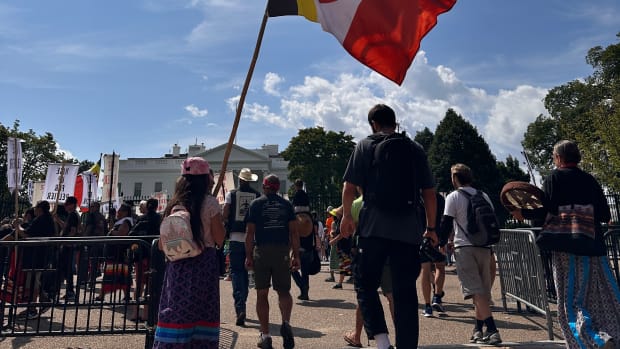
WHITE HOUSE — A young Indigenous girl walked through Lafayette Park in front of the White House with an American Indian Movement flag. Her tiny frame held the six-foot bamboo stake steady as the flag blew in the wind. A stark reminder of how many generations the movement to free Leonard Peltier from prison has gone on.
On Tuesday, NDN Collective, a national Indigenous-led organization, and Amnesty International, held the Free Leonard Peltier 79th Birthday Action in Washington, D.C., to demand clemency for the Native American rights activist who has been incarcerated for nearly five decades. Hundreds attended the peaceful rally where prayer songs echoed and at times people danced, but still thirty-five demonstrators were arrested, according to NDN Collective. At one point the U.S. Park Police brought out a sonic weapon and U.S. Secret Service created a barrier of agents on the sidewalk.
A young girl in a ribbon skirt holds an American Indian Movement flag during the Free Leonard Peltier 79th Birthday Action in front of the White House in Washington, D.C. on September 12, 2023. (Pauly Denetclaw, ICT)
“Our goal with this event is to raise awareness and bring attention to the plight of Leonard Peltier and his incarceration. Because we’re at a point in time where the Biden administration has made it a priority for Native American civil rights, and yet the longest living political prisoner in American history, who is Indigenous, is still in there,” said NDN Collective President and CEO Nick Tilsen, Oglala Lakota. “And so we’re calling upon (President Joe) Biden and the Biden administration to release Leonard. This is a priority for Indian Country.”
Leonard maintains he did not commit the 1975 murder of two FBI agents on Oglala Lakota land.
Context in this case matters. It happened during the Reign of Terror where dozens of Indigenous people were murdered, found dead or just disappeared from the Pine Ridge Indian Reservation. This happened in the years after the 71-day occupation of Wounded Knee where AIM leaders seized control of the area and declared it the Independent Oglala Nation. The stand off between AIM and the federal government was at times violent.
From 1973 to 1976, the FBI targeted and harassed Indigenous activists in the area. During these years there were more than 60 murders and Pine Ridge had the highest murder rate per capita in the country.
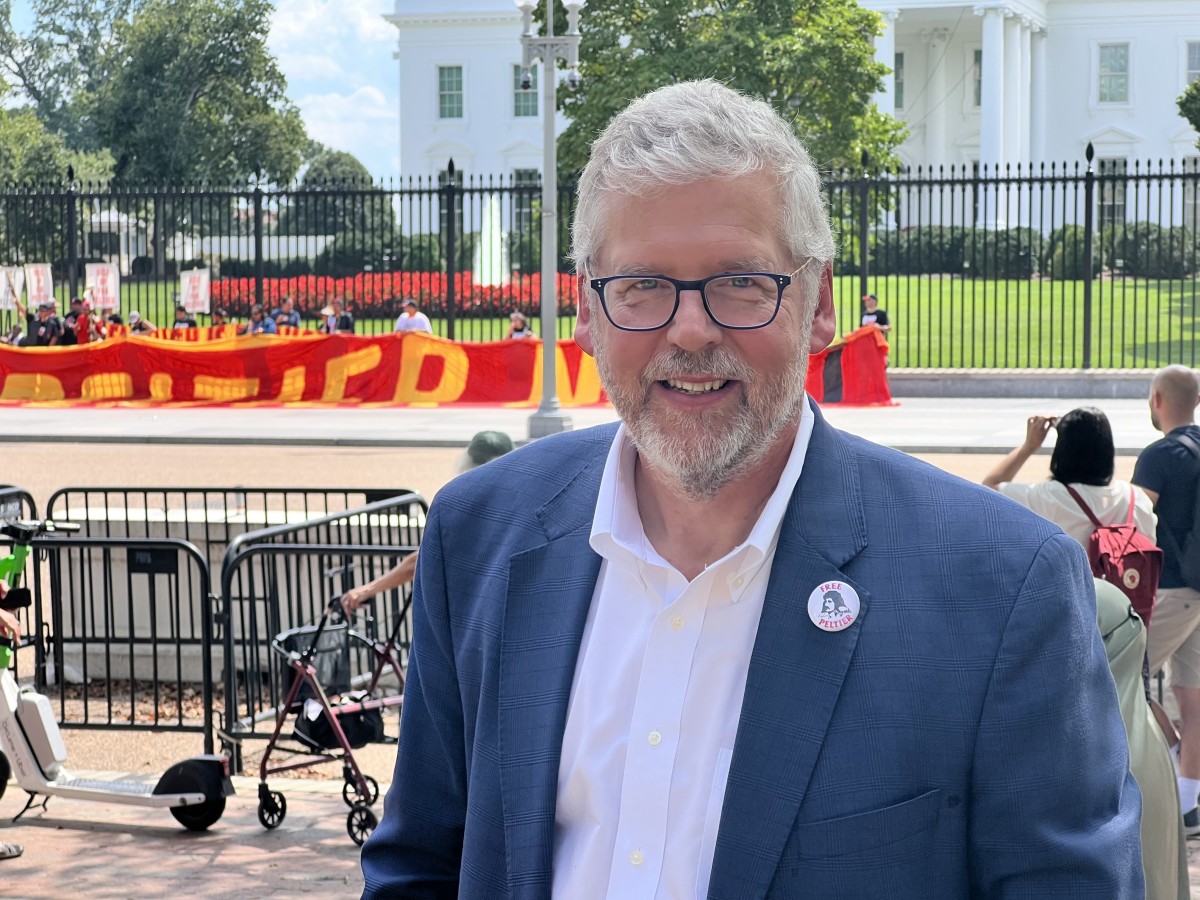
Kevin Sharp, former federal judge and Leonard Peltier’s legal representation, attended the Free Leonard Peltier 79th Birthday Action in Washington, D.C. on September 12, 2023. (Jourdan Bennett-Begaye, ICT)
The 1975 murders in question took place during a shootout between Indigenous activists and the two FBI agents. The federal government didn’t have enough evidence to charge Leonard with murder. He was charged with aiding and abetting the murder of federal officers and a seven-year sentence for an escape attempt.
“If he was tried today, no way he gets convicted,” Kevin Sharp, Leonard’s attorney and former federal judge, told ICT. “That is not the law today. The violations that law enforcement committed, that the US Attorney’s Office committed at that time, the threats, the intimidation is a constitutional violation.”
This is why many call Leonard, Turtle Mountain Ojibwe, a political prisoner and are demanding President Biden grant him clemency.
“We’re not asking for a pardon,” Sharp said. “Pardon would require someone to admit that he committed a crime, which he did not. But he is clearly a prisoner of politics. This is about politics. So, it’s the politics that keep him there. But I think it’s the politics that are going to free him.”
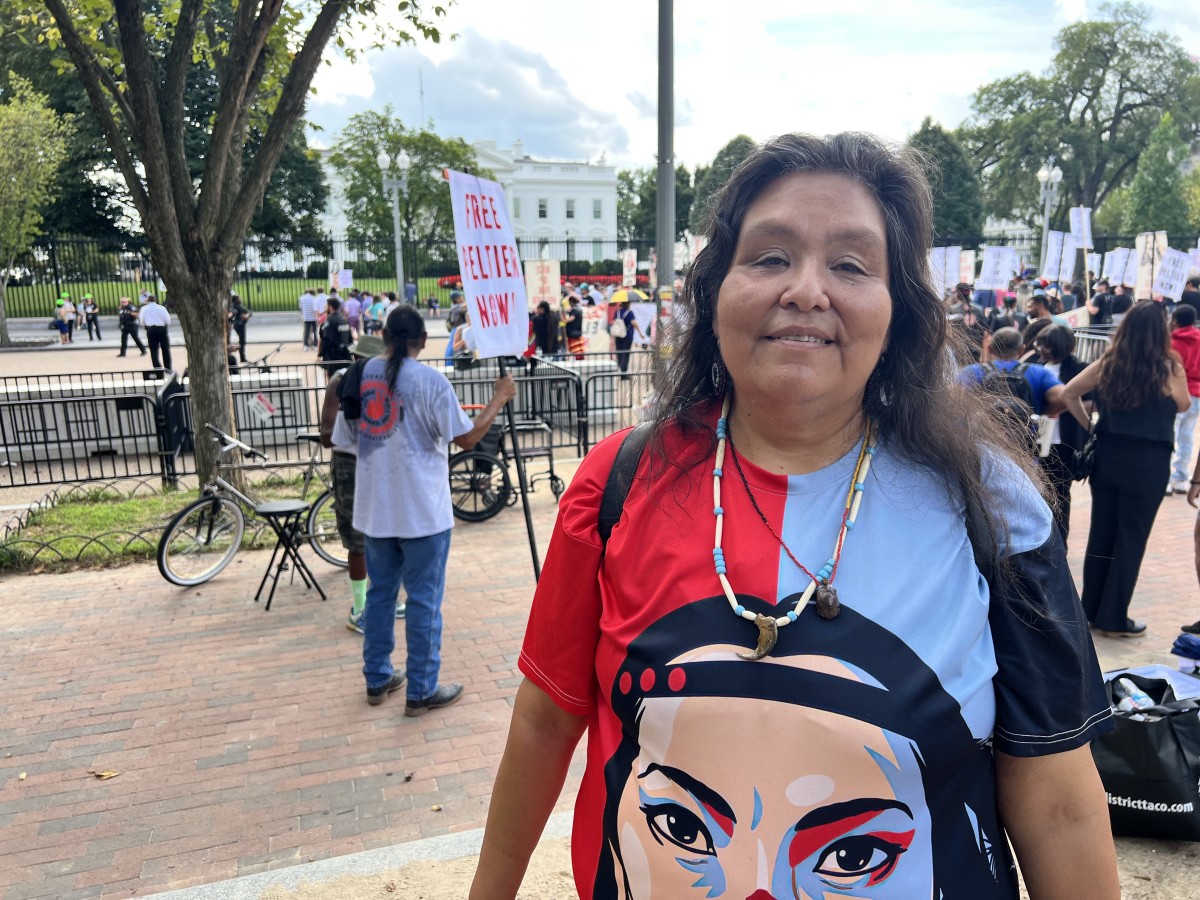
Kathy Peltier, daughter of Leonard Peltier, attended the the Free Leonard Peltier 79th Birthday Action in Washington, D.C. Kathy is Navajo and Turtle Mountain Ojibwe. (Jourdan Bennett-Begaye, ICT)
Leonard’s daughter, Kathy Peltier, attended the rally in Washington to demand freedom for her father, “a dad figure” she never had growing up. She advocates for his freedom to younger generations across the country and overseas.
Kathy, Navajo and Turtle Mountain Ojibwe, last saw her dad three years ago. It’s difficult for her to calculate how many times she’s seen him. She only knows that her and her siblings could only see him for a short time so most of the allotted visitor time for him could be spent with lawyers.
Leonard missed out on a lot of Kathy’s firsts, said her mom, Ann Begaye, Navajo.
He missed her high school graduation at 18. Kathy is now 47.
“I was hoping my dad would be there. So when that day came and left, I was like, ‘wow, he’s gonna miss many more unless we get him freed.’ So I just want to free my dad,” Kathy said as her voice cracked. “I feel like it’s too late for me, but get my dad freed for his grandkids. So they get to know who he is, as a person, and not just locked up behind those bars.”
She also wished he could’ve been at ceremonies with her.
“When I first sat down, I wished my dad was right beside me to protect me in that circle,” she said. “Just teachings of what I should know as a woman and him telling me this is your auntie. Those are the moments I wish he was able to do. A lot of my aunties have gone and are not too well. So I’m not able to learn about what they could teach me as a young Turtle Mountain woman. So I had to rely on my grandma’s side and my auntie to teach me the Navajo side.”
Kathy said she would have wanted to know both sides of who she is.
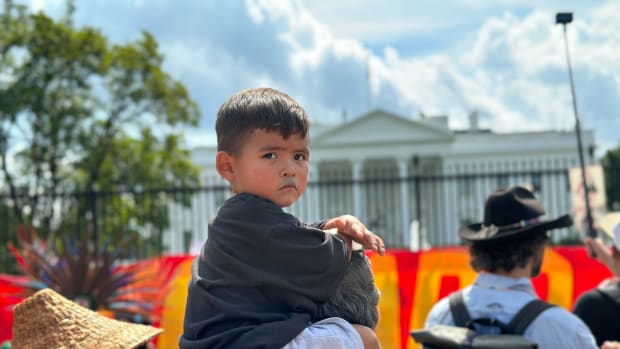
A young boy looks back at a demonstrator yelling “Free Leonard Peltier” during the Free Leonard Peltier 79th Birthday Action in front of the White House in Washington, D.C. on September 12, 2023. Peltier has been incarcerated for nearly 50 years. (Pauly Denetclaw, ICT)
Under the hot sun with plenty of humidity was famed Native American rights leader and advocate Suzan Harjo, Cheyenne and Hodulgee Muscogee, her presence still larger than life and with her signature smile. She arrived at Pennsylvania Avenue behind the White House after demonstrators displayed a red and yellow banner, nearly as tall as (and perhaps taller than) the White House gates, painted, “President Biden, Free Leonard Peltier Now!”
Her message to Biden: “To reach deep, deep deep inside your heart. My old friend, Mr. Biden, and have all the compassion you can muster for my brother, Leonard Peltier. I’m pleading for family. I’m pleading for a relative. He’s not just a cause to me. He’s my family. Please, show compassion to this one man, this one Native man who needs to be free now. He wants to get out and look at the sky. He doesn’t want to go out in a wooden box. He wants to go out where he can talk to people and breathe free air, he said. Let him do that. He’s had two-thirds of his life behind bars. It’s time. It’s time.”
Today, it’s the 79th birthday of American Indian Movement (AIM) activist Leonard Peltier, and I’m on the ground in Washington, D.C. supporting a direct action at the White House. We’re asking President Joe Biden to grant Leonard long overdue clemency after he’s spent nearly half a century in federal prison.
Today I ask that you stand in solidarity with Leonard, who was wrongfully accused in the mid-1970s and, trapped in his cell, hasn’t been able to enjoy much of the progress we’ve made together toward greater justice for Native people over the decades. Please tell President Biden: Free Leonard Peltier — then use the social share buttons on our page to keep the pressure on!
Please watch, act, and share: Leonard Peltier has been wrongfully imprisoned for nearly half a century. It’s time to #FreeLeonardPeltier
AIM was a huge deal in the 1960s and ‘70s. A radical, Native-led organization largely responsible for achieving the right for Indigenous people in the U.S. to practice our religion again, its leadership also helped inspire the creation of the Indian Child Welfare Act. Leonard, a citizen of the Turtle Mountain Band of Chippewa in North Dakota, was a key member of the movement — so the government went after him with everything they had the first chance they got. Now, he’s serving two life sentences as a scapegoat for the deaths of two FBI agents.
Here are the facts: After a shootout at the Jumping Bull Ranch on the Pine Ridge Indian Reservation in South Dakota in 1975, two of Leonard’s co-defendants were found not guilty on grounds of self-defense. Yet, Leonard was still convicted of two counts of first-degree murder in 1977. The trial was a sham, and even the prosecuting attorney has now gone on record saying Leonard should be freed. For just under half a century, an innocent man has been unjustly imprisoned.
Kaka (Grandpa) Leonard is getting older, and concerns for his health have only intensified the urgency of this call for his release. For his birthday this year, his allies and supporters from across Turtle Island and beyond have gathered at the White House to rally and demand his freedom. Many of us have traveled from incredibly far to be here, myself included. I came with a caravan organized by NDN Collective from Rapid City, South Dakota, and over the course of three days we made the journey to D.C.
Let’s be clear: Leonard Peltier is a political prisoner and a hostage on behalf of all Native justice movements. He’s a martyr for the climate justice movement, in that he’s been criminalized for AIM’s work to return land back to Indigenous hands and protect Indigenous sovereignty. He is a martyr for all of Native people in America today who get to practice our ceremonies and enjoy our traditional ways of life. And he’s a martyr for peace, in that there will be none while we still suffer under occupation of a colonizing regime. Leonard’s liberty is intrinsically connected to our own, and we owe him every effort to achieve it.
Wopila tanka — thank you for your action and solidarity! Tokata Iron Eyes Co-Director and Lead Counsel The Lakota People’s Law Project
Please read the article – then watch/read the Substack video and article.
There is a pattern here and all things are connected.
Over the last year, we’ve been sharing with you insights and updates from the frontlines of the Paiute and Shoshone Peoples’ resistance in Nevada. As many of you know, the fight is on at the massive Thacker Pass lithium mine in the northwestern part of the state. Despite the legitimate need to transition to renewable energy, under the guise of “innovation” and, increasingly, “green technology,” extractive industry continues to treat the earth and her ancient precious minerals as little more than profit-potential. Meanwhile, this self-dealing too often entails the wholesale exploitation of Indigenous Peoples and the destruction of the sacred lands and ecosystems upon which our communities depend.
Indigenous Peoples across northern Nevada are no strangers to this paradigm. In our newest video installment documenting the Ox Sam Camp resistance, our team interviewed Elvida Crutcher, an elder and citizen of the Fort McDermitt Paiute and Shoshone Tribe. She recounts how decades of open-pit mercury mining has poisoned the air, water, lands, and health of her relatives.
Click the image to watch our latest video from the resistance at Peehee Mu’huh
Today, there are over 270,000 active mining claims in NV. From the 1930s to the 1980s, Shoshone and Paiute communities faced a barrage of open-pit mercury mining. Two projects in particular, Cordero Mine and Fort McDermitt Mine, both adjacent to Shoshone and Paiute reservations, left behind a path of destruction — and they still haven’t been cleaned up. While the Cordero and Fort McDermitt Mines closed in the 1980s, fifty years of surface mining tragically polluted the waters, air, and ecosystems of the northwestern Great Basin.
At Peehee Mu’huh (Thacker Pass) the tactics are the same: short-sighted extractive industry authorized by federal and state agencies, who collectively disregard the interests and wellbeing of Indigenous Peoples. The Cordero Mine was built on lands overseen by the Bureau of Land Management (BLM); the Thacker Pass lithium mine is similarly situated on BLM lands.
One would expect that mining technology has improved to minimize extractive projects’ negative impacts on the earth, people, and our animal relatives. Unfortunately, this isn’t so. The Thacker Pass mine is a perfect illustration: to extract lithium at the open-pit site, the mining company plans to pump the earth full of sulfuric acid, a process that leaches lithium out of clay and stone. Sulfuric acid is highly toxic to all living beings. To put its toxicity into perspective, even one teaspoon is fatal to humans. Even worse, the mining company was approved to build a sulfuric acid processing plant at Peehee Mu’huh to convert molten sulfur into sulfuric acid. Molten sulfur is a principal waste byproduct of oil refining. Ironically, Lithium Nevada plans to transport hundreds of tons of molten sulfur acquired from oil refineries—with, you guessed it, trucks and trains powered by fossil fuels—to process into sulfuric acid for its “green energy” uses. Earlier this summer, just to the northeast in southern Montana, a freight train transporting molten sulfur derailed, falling into the Yellowstone River. If the Thacker Pass lithium mine and its sulfuric acid processing plant reach completion, these devastating incidents could increase in frequency.
The simple truth is this: the current narrative pushed by industry and government is that lithium mining is “green” and that it is justified in the name of innovation. However, we can’t allow innovation to come on the backs of Indigenous Peoples and at the expense of Unci Maka (Grandmother Earth). “Green” energy is not green if it entails environmental injustice. Open-pit mining, or any mining for that matter, has no place in or near our communities and sacred sites without full tribal consent.
Wopila tanka! Tokata Iron Eyes Spokesperson and Organizer The Lakota People’s Law Project
Catherine Austin Fitts is a legend that needs no introduction. She has an incredible amount of knowledge and experience, both as an investment banker and working in government, and then being prosecuted by the government (former Assistant Secy of Housing) for trying to uncover and fight corruption. She is currently the publisher of the Solari Report.
I set up this conversation because I wanted to learn about the tactics that the criminal mafia posing as US federal and state governments are currently using against the people. We focus on the US, but many of my readers can probably recognize these tactics being applied all over the world. The goal of the criminal cabal is well advertised: “save the planet, reduce carbon” by which they mean “we need all the real assets and resources for ourselves, and fewer of you plebs around”.
While this attitude toward the people has been consistent, they have been very careful in hiding the true intent behind nice sounding slogans. This is easy to do when the times are good, financially speaking. When the bubble is being inflated by the central banking hot air, few people will question it or look too closely at the financial machinations. CAF did and was prosecuted for it.
The times are different now. We are at the end of the financial musical chairs game. All that “leverage” is about to un-lever very rapidly, the fake money will turn out to be, well – fake! The cabal are desperate to grab the real stuff. Attractive land is some of the most “real” of the real stuff. They are quite willing to burn and murder for it, as we have seen in Lahaina, HI, Paradise, CA and elsewhere.
Below is a note from Catherine on the tactics the government typically uses to drive people off the land they want and into the “enclosures” they prepare for them. This approach has been uses consistently, starting with the Native Americans, continuing with the poor black and immigrant neighborhoods, and now into the middle class areas that billionaires desire:
Moving people to quarantine is good if you want to install things – but if you are stealing real estate it gets pretty obvious pretty quick. Better to scare them out so they pay their own expenses of going elsewhere. As much as possible, you want “free range” solutions.
Based on what I saw at HUD and during the pandemic, tactics depend on local jurisdictions (local laws, local resources) as well as the covert operations they choose to use locally at the same time. The success of the operations depend on several lines acting in concert: intelligence/surveillance, government in health area, banks and insurance companies, media, real estate developers and investors. This coordination already exists in the management of places, but it is hard for most people to see or fathom. The sweet spot is the amount of real estate that can be picked up and the capital gains this translated into for investors, public traded company etc and the political donations that flow to politicians from capital gains.
Tactics revolve around various options of getting fee title to land and real estate:
1. Force a sale: Do things that shut down private business and personal income and or lower the value of the real estate (including by radically increasing costs, like cost of remediation or requiring installation in new sewer systems or equipment etc) and/or permit the cancellation of insurance. A lot of helpful tactics can be applied through lenders, banks and insurance providers who are playing ball.
2. Condemnation to deal with “pathogens” [this is what WHO Pandemic Treaty aims to do among other enslavement things]
3. Eminent domain – prices will be much lower presumably after the “pathogens” are found
4. Emergency money to help – except all the money goes to “insiders” who are moving in or are playing local person helping the insiders move in and take over
6. Poisoning – poisoning of individuals or failures of water systems will cause disability and death which are likely to force sales
In all cases you want to keep things as complex as possible under the guise of “helping” – you will have heavy surveillance of all parties and your covert operations and media in combination can take care of isolating or compromising individual parties who are slowing you down or stopping you. Covert operations will by and large be done by or through corporate contractors and mob (drug cartels)
I suspect they have perfected a lot of the tactics using response to weather warfare “natural disasters”.
In closing, quoting Catherine, you have to be a wealth builder in your mind. You cannot succumb to the mentality of doom and victimhood, no matter what. I hope we have conveyed this in our discussion.
As always, please share with your friends and family. We discussed several approaches to stay safe and preserve your assets/rights. Do not get into “we are doomed” mindset. We are not doomed. We have solutions, we can work with what we have and build resilient support networks. Most importantly, as you shake the sleepers out of their stupor, the cabal loses more and more of its willing foot soldiers. Do not comply.
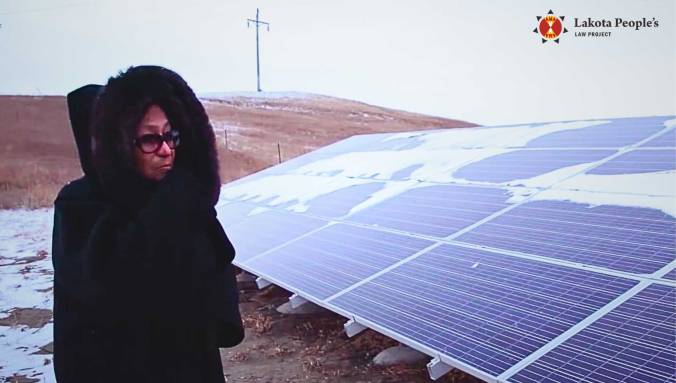
Since 2017, Lakota Law’s team has worked with leadership at the Standing Rock Nation to help bring clean energy to my homelands. We’ve now assessed solar potential on a dozen tribal government buildings, and for the past few months we’ve worked overtime to help my tribe prepare to apply for historic sums of grant money. President Biden’s Inflation Reduction Act has earmarked as much as $100 million for individual low income communities — including tribal nations — to transition to low-carbon technologies.
I’ve been working for years to increase solar and wind production on the Standing Rock Nation. High energy costs from our utility can leave our people without power during the Dakotas’ harsh winters. That’s not acceptable.
As part of the Inflation Reduction Act, a $7 billion solar grant called “Solar for All” will make up to five $25-100 million grants available to different tribes or tribal consortia. The Lakota People’s Law Project aims to ensure that Standing Rock and several other South Dakota tribes can make their best case to collect and use a portion of these funds to install solar panels that will help the people pay less and stay safe.
That last part is important. In yet another example of injustice toward Native communities, tribal members at Standing Rock pay 33 percent more for electricity than people living just an hour away in Bismarck, North Dakota. That’s money most can’t afford to pay, which can result in life-endangering power shut-offs during winter months when midwestern temperatures can dip well below zero.
By collecting and storing energy from the abundant sun above the plains, tribal governments and communities can save — and even earn by sending power back to the grid. And by building out a cohesive clean energy system, Standing Rock and other South Dakota tribes can demonstrate a sustainable model for other tribal nations and communities to follow. I consider this to be one of the most important things I’ve ever worked on, and I deeply value your continued solidarity as we pursue this plan.
Wopila tanka — my gratitude for all of your care and support, Phyllis Young Standing Rock Organizer The Lakota People’s Law Project
My name is Dov Korff-Korn and I’m the new staff attorney at Lakota Law. I write to you to both introduce myself and to provide some important context regarding the fires in Lāhainā, Maui. For the last two years I’ve worked closely with this organization as a volunteer law clerk, supporting a variety of projects. I recently joined full-time after graduating from law school and passing the bar exam. It has been a true privilege to be a part of this organization, and I’m excited for all that we can continue accomplishing together on behalf of Indigenous sovereignty and environmental justice.
One of the most formative experiences I’ve had in 10 years of work around Indigenous sovereignty was my time spent last year as a visiting student at the University of Hawaiʻi. The week we visited Maui to work with a team on water access for Native Hawaiian farmers and local residents, there was a large wildfire raging in the valley up in the hills behind Lāhainā. In my new blog post I share with you my reflections on that experience in light of the recent disastrous fires.
This image is from the time I spent in Lāhainā before the catastrophic fire. There was already a fire burning there at the time. Little did we realize what a foreshadowing it was.
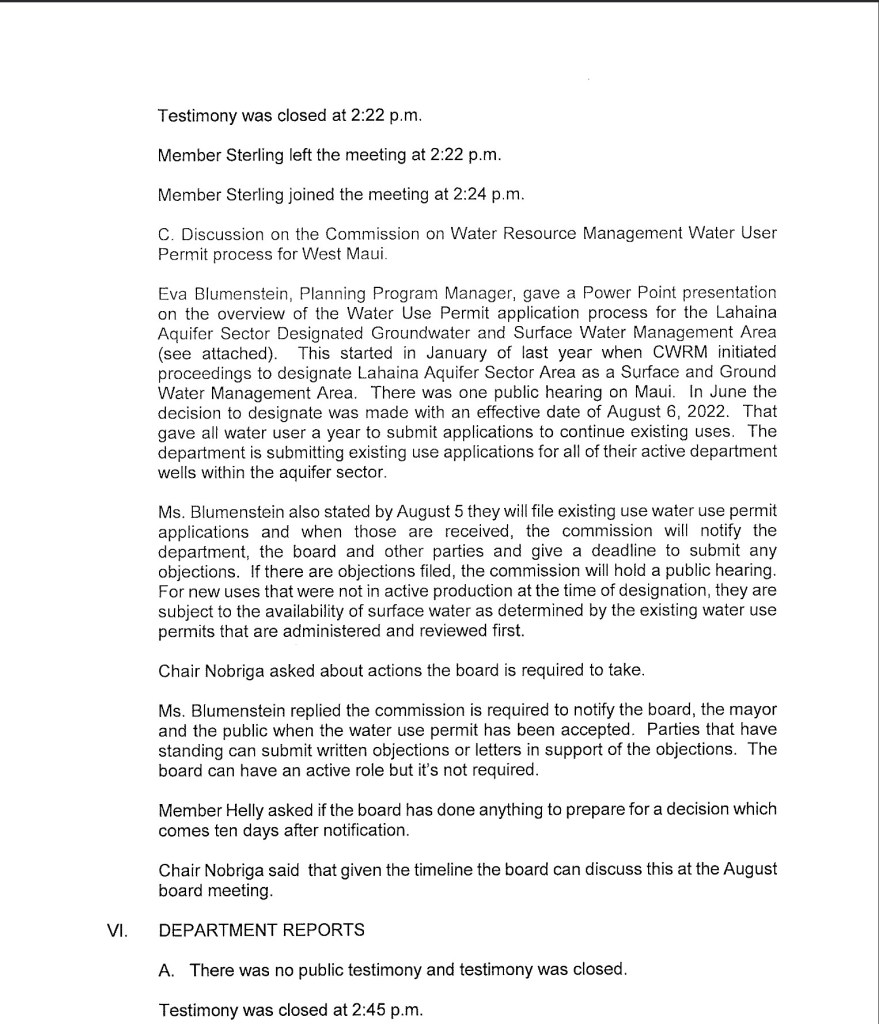
The short story is this: the news will tell you that the fires were caused by high winds, a downed power line, and/or climate change. These factors may have contributed to the tragedy. However, the underlying truth is that more than a century of systematic exploitation by wealthy colonizing interests, armed with the greenlight from federal, state, and military agencies, set the stage for this devastation. As I delve into the dynamics of dispossession in my blog post, decades of water diversions drained Maui of its water, evaporating ecosystems and suppressing sovereignty.
The Indigenous Peoples of Turtle Island are familiar with this marriage between wealthy interests and government. As was the case with the intentional slaughter of the Tatanka (buffalo) to drive the people of the Great Plains onto reservations against their will, greedy entities strike at the heart of Indigenous Peoples and their sovereignty by debilitating once-abundant natural ecosystems. The situation in Maui is no different. As Lāhainā starts out on a path of rebuilding, it is critical that we support our Kānaka Maoli relatives by ensuring that their voices are heard and their sovereignty is respected. Only that way can justice begin to be restored to Islands held sacred by so many.
In Solidarity, Dov Korff-Korn Staff Attorney, Lakota Law
Lakota People’s Law Project 547 South 7th Street #149 Bismarck, ND 58504-5859
The Lakota People’s Law Project is part of the Romero Institute, a nonprofit 501(c)(3) law and policy center. All donations are tax-deductible.
Here are also the links to the information in the Lakota Law Project article. I think it is important to look at all questionable disasters as if viewing a crime scene; what is the context? what interests are in play? Calling it a conspiracy puts up a wall against asking questions. I now view the words conspiracy theorist as a sign that some truth is about to be discovered.
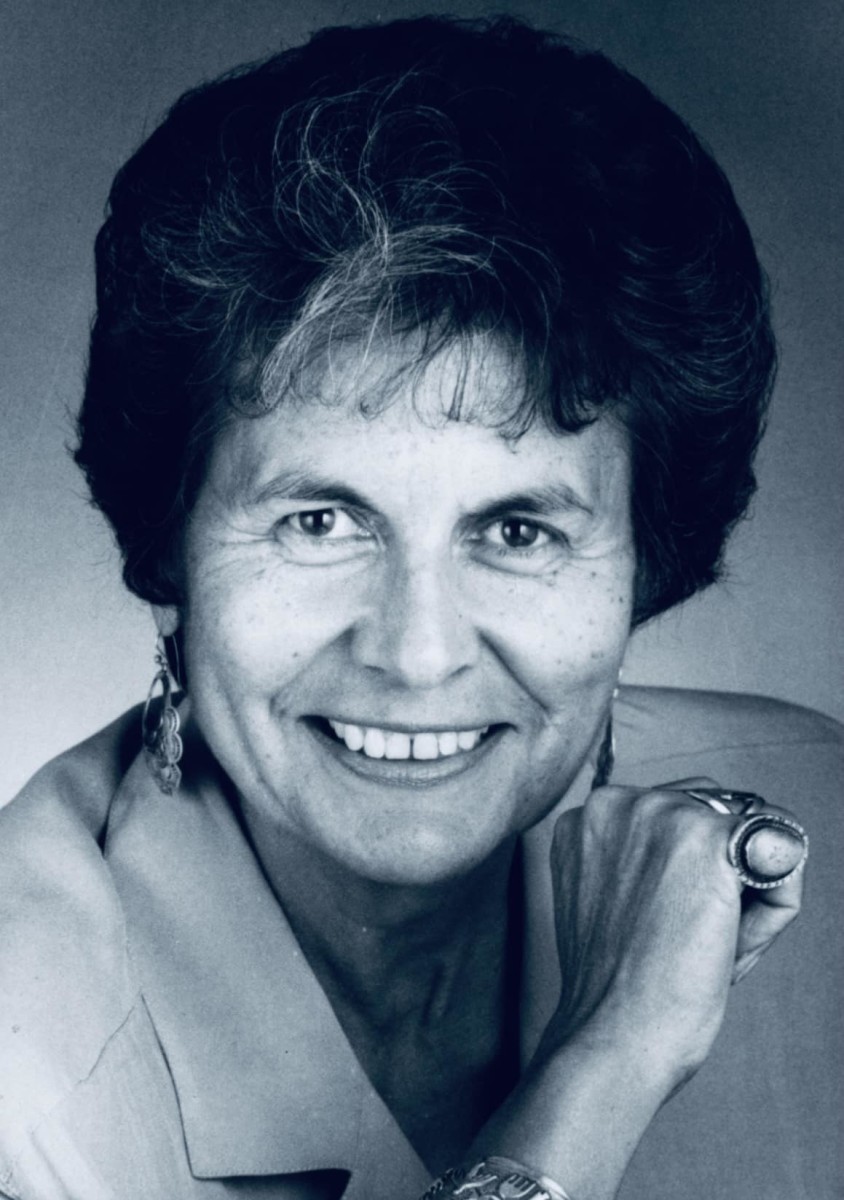
Ada Deer, a “force of nature” and a legendary figure whose life and accomplishments are woven into the social and political fabric of Indian Country, died Tuesday night.
Deer, 88, was the first Native American woman to run for statewide office and only the second to run for Congress. She was the first woman to serve as Assistant Secretary for Indian Affairs at the Interior Department. She was also the first woman chair of her tribe, the Menominee Indian Tribe of Wisconsin.
On Wednesday, the tribe issued a statement.
“It is with great sadness that we announce the passing of Ada Deer, a prominent leader of the Menominee Indian Tribe of Wisconsin,” the tribe wrote. “Ada was a true inspiration to many and her legacy will continue to live on through her contributions to the Menominee community and her tireless work in advocating for Native American rights.”
Deer was an instrumental figure in the 1973 restoration of her tribe following its termination 15 years earlier. She later served as the first chair of the Menominee Restoration Committee.
“Ada’s contributions to the Menominee community and her dedication to improving the lives of Native Americans will never be forgotten,” the Menominee Tribe said Wednesday. “As we mourn her loss, let us also celebrate her remarkable life and the profound impact she had on all of us.”
During termination, the Menominee Tribe became a county instead of a reservation.
Deer once told ICT: “This is the story of Indian land ownership throughout the history of this country. It was lost after certain pieces of legislation have passed to allot Indian land to private Indian owners who have little real estate know-how.”
In order to fight for restoration of the tribal government, Deer dropped out of law school.
“I moved to Washington, D.C., in 1972 to lobby … I talked to everyone I could,” Deer said. “I held meetings with reporters. I held meetings with legislative aides. I went around to receptions. I smiled. I shook hands. I prepared bumper stickers and fact sheets and made it look like there were thousands of Indians, screaming about termination. That’s part of what it takes to get a bill through the Congress.”
Gwen Carr, a longtime friend of Deer’s and executive director of the Carlisle Indian School Project, said the Menominee restoration was a milestone in the efforts of tribes to regain federal recognition following the Termination Era of 1950s and 1960s.
“For a Native person to get their tribe out of termination is a prodigious effort,” said Carr, a citizen of the Cayuga Nation. “Nobody had ever done that before.”
Deer had a way of convincing people to do what she wanted, not by arguing with them, but simply by talking to them until they agreed with her, Carr said.
“She was a force of nature who was as gentle as a breeze,” she said.
Born in Keshena, Wisconsin, Deer spent her childhood in a log cabin on the Menominee reservation without running water or electricity, attended Shawano High School and studied at the University of Wisconsin-Madison and later at Columbia University.
In 1978 and 1982, Deer ran for Wisconsin secretary of state, and then for Congress in 1992. Many remember her campaign slogan “Run Like a Deer.”
She was appointed by President Bill Clinton in 1993 as the Assistant Secretary for Indian Affairs at the Interior Department, a position that included overseeing the Bureau of Indian Affairs. In that capacity, she signed off on federal recognition of hundreds of Alaskan tribes that, for decades, had been fighting for sovereignty. Many saw the Alaska Native Claims Settlement Act as a termination bill. So Deer’s act fits a restoration of tribal government in that state.
She led the American Indian and Indigenous Studies Program at the University Wisconsin-Madison, chaired the board of the Native American Rights Fund and co-founded the Indian Community School in Milwaukee.
Carr said more than once she accompanied Deer to events where people would line up to meet her friend, but that recognition never inflated Deer’s ego. Instead, she had a profound gentleness and innocence about her, though she was nobody’s fool, Carr said.
She said Deer never married or had children, instead devoting her life to advancing the rights of Native people.
“A big page in Indian Country has turned,” she said.
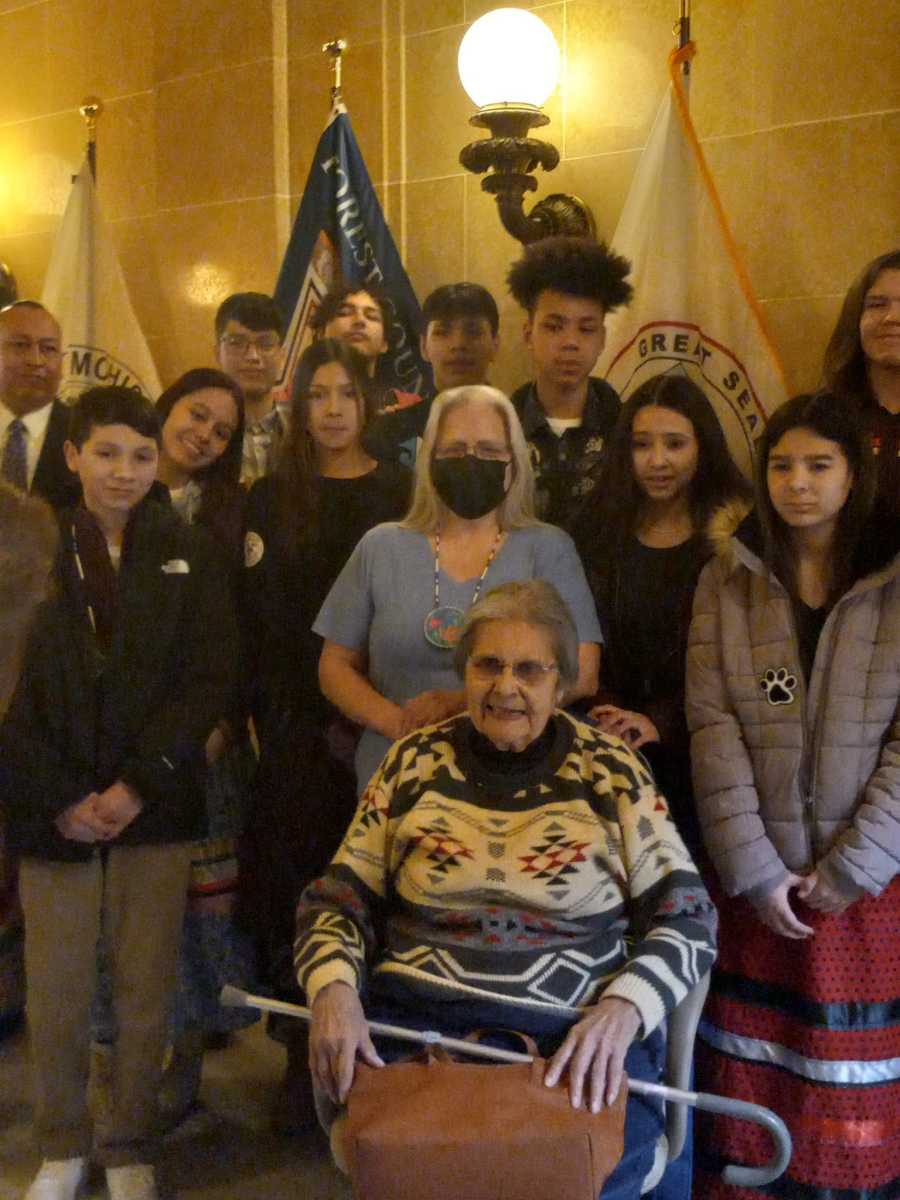
Ada Deer (sitting), Menominee Indian Tribe of Wisconsin. Deer died Tuesday, Aug. 15, 2023. She was 88. (Courtesy of Menominee Indian Tribe of Wisconsin)
On Aug. 7, Deer celebrated her 88th birthday, leaving hospice care to attend a celebration that drew Wisconsin state and Menominee tribal leaders, including Wisconsin Gov. Tony Evers, U.S. Sen. Tammy Baldwin and Menominee Chairwoman Gena Kakkak. All paid tribute to Deer’s legacy and influence in their lives.
The same day, Gov. Evers proclaimed Aug. 7, 2023, to be “Ada Deer Day.”
“It is my honor to proclaim today as ‘Ada Deer Day’ throughout Wisconsin to recognize her groundbreaking work as a champion for Tribal rights and Indigenous communities, an advocate for social justice, and a foundational changemaker in our state,” Evers wrote on social media.
Deer also spoke at the celebration.
Writing on social media recently, Ben Wikler, Deer’s godson and chair of the Wisconsin Democratic Party, summarized her final speech.
“She urged everyone, all of us — you reading this right now — to dedicate ourselves to advancing justice in this world.”
Our stories are worth telling. Our stories are worth sharing. Our stories are worth your support. Contribute $5 or $10 today to help ICT carry out its critical mission. Sign up for ICT’s free newsletter.
Today, I share with you a piece of good news on the mining and Native justice fronts! In case you missed it, earlier this week, President Biden and U.S. Secretary of the Interior Deb Haaland of the Pueblo of Laguna traveled to Arizona to announce a new national monument designed to protect Native homelands in the Southwest. Afterward, Secretary Haaland appeared on PBS News Hour to discuss the monument’s significance and its impact for Indigenous people. I encourage you to watch that segment here.
U.S. Secretary of the Interior Deb Haaland sat down with PBS News Hour to discuss the new national monument protecting Native homelands in the Southwestern United States.
We have rightly been critical of this administration and its failure to do more to stop mining in the Black Hills and at Peehee Mu-huh (Thacker Pass) in Nevada. Even as it has taken the most aggressive steps toward climate remediation that we’ve seen from the White House, the Biden administration is still falling short of its own climate goals. It’s just not enough. And, critically, Biden and Haaland must engage and adhere to the wishes of Indigenous communities on the frontlines of extractive industry — such as Standing Rock Nation with the Dakota Access pipeline and our Paiute and Shoshone relatives battling Lithium Americas at Thacker Pass.
Nonetheless, this near million-acre set-aside is a significant step in the right direction. We’re grateful that Baaj Nwaavjo I’tah Kukveni — Ancestral Footprints of the Grand Canyon National Monument in Arizona — will prevent new mining leases in this sacred and beautiful place.
According the administration’s fact sheet, the monument will protect “thousands of cultural and sacred sites that are precious to Tribal Nations in the Southwest – including the Havasupai Tribe, Hopi Tribe, Hualapai Tribe, Kaibab Band of Paiute Indians, Las Vegas Paiute Tribe, Moapa Band of Paiutes, Paiute Indian Tribe of Utah, Navajo Nation, San Juan Southern Paiute Tribe, Yavapai-Apache Nation, Pueblo of Zuni, and the Colorado River Indian Tribes.”
Still, it’s up to all of us to hold the administration’s feet to the fire. Props to PBS anchor Amna Nawaz for pressing Secretary Haaland for an explanation of why many voters still feel a lack of satisfaction in the administration’s handling of the climate crisis. This national monument is significant and cause for gratitude and celebration — but it can’t stop there. Going forward, Biden and Haaland must be better and do more to support Native and environmental justice issues.
Wopila tanka — We deeply appreciate your care for Native homelands. Chase Iron Eyes Co-Director and Lead Counsel The Lakota People’s Law Project
Today, I share with you our new blog and video delving into the long, disturbing history of mining on Indigenous lands on Turtle Island. As we’ve written to you previously, the sacred lands of our Paiute and Shoshone relatives at Peehee Mu’huh (or Thacker Pass) in Nevada are under imminent threat from a massive new lithium mine. They did not give their consent for this project, and now it could despoil sacred ceremonial grounds, historic massacre sites, and sensitive habitat home to several protected species.
In our new, short video — which you can find near the top of my blog — Paiute elder Dean Barlese discusses the importance of protecting our shared world.
Thacker Pass isn’t the only mining project currently endangering Native homelands. The Yaqui people are struggling to effectively resist another massive lithium mine in Sonora, Mexico, and according to the Associated Press, our southern neighboring nation has become the world’s deadliest location for environmental activists. And in our sacred Black Hills right here in the Dakotas, lithium is joining gold, uranium, and other precious elements on the list of mining interests we’ve been confronted by for 150 years.
I encourage you to read my blog to learn more, and watch the accompanying video to get additional perspective from Dean Barlese, a respected Paiute elder. Our thoughts today are also with all those on Maui in the Kingdom of Hawaii. We are praying for the safety of all living things in that beautiful place as they confront deadly fires powered by fast winds fueled by yet another hurricane.
This is, of course, all related. Storm frequency and intensity rise in conjunction with the out-of-balance relationship we have with Unci Maka, our Grandmother Earth. Our society’s failure to listen to Indigenous knowledge and plan ahead accordingly exacerbates the climate crisis and puts the future in peril for my generation and those to come. The youth say it. The elders are saying it. It’s time to make big changes before it’s too late. That’s why your advocacy with our cause is so important. It’s up to us — working together — to change the game.
Wopila tanka — thank you, always, for your care and attention. Tokata Iron Eyes Spokesperson The Lakota People’s Law Project




















 Water is Life