The Biden administration’s nominee for Secretary of Interior, Rep. Deb Haaland, D-N.M., speaks at The Queen Theater in Wilmington Del. (File photo: AP Photo/Carolyn Kaster)
Joe Biden nominated Haaland for the Interior’s top post in December
The Senate Committee on Energy and Natural Resources will consider the nomination of Rep. Deb Haaland as U.S. Department of the Interior secretary during a hearing scheduled for Feb. 23.
The news came Tuesday, nearly a month after President Joe Biden was sworn in — and nearly two months since her selection.
If confirmed by the Senate, the New Mexico Democrat would be the first Native American to serve as a Cabinet secretary.
The hearing will be live-streamed on the committee’s website beginning at 9:30 a.m. ET.
Rep. Deb Haaland’s Confirmation Hearing: Date: Tuesday, February 23, 2021 Time: 9:30 a.m. Eastern Time Location: Dirksen Senate Office Building in Washington, DC.
“A voice like mine has never been a Cabinet secretary or at the head of the Department of Interior,” Haaland said after being nominated by President Joe Biden in December.
If confirmed, Haaland will be sixth in line to the presidency as Interior secretary, according to the White House.
Members of the Energy and Natural Resources committee will participate online or in person.
The hearing will happen in the Dirksen Senate Office Building in Washington. According to Senate guidelines for health and safety, the office building will allow only official business visitors and credential press. No in-person visitors can attend the hearing.
This is a developing story.
Aliyah Chavez, Kewa Pueblo, is a reporter-producer at Indian Country Today. Follow her on Twitter: @aliyahjchavez or email her at achavez@indiancountrytoday.com.
Indian Country Today is a nonprofit news organization. Will you support our work? All of our content is free. There are no subscriptions or costs. We have hired more Native journalists in the past year than any news organization ─ and with your help we will continue to grow and create career paths for our people. Support Indian Country Today for as little as $10.
Many across the country are battling the aftermath of a Feb. 13 winter storm as nearly 3.4 million customers around the U.S. are still without electricity or heat. The demand for power overwhelmed power grids unprepared for climate change.
Temperatures hovered in the single digits as snow and ice storms hit parts of Texas where winter temperatures seldom fall below 40 degrees.
The latest storm front was expected to bring more hardship to Texas, Arkansas and the Lower Mississippi Valley before moving to the Northeast on Thursday, according to the Associated Press.
“Most people here have electric stoves so there’s no way to heat or cook food; they heat their homes with electric heat, so there’s no heat,” said Ashley Fairbanks, White Earth Nation.
Originally from Minnesota, Fairbanks lives in San Antonio, where winter temperatures usually hover around 70-80 degrees. On Wednesday morning the temperature was around 28 degrees, she said.
“It got down to 6 degrees during the storm; the week before it was like 80 degrees,” she said
“The ice on roads finally melted today so we left the house in search of food. It really is like the end times out here.”
Customer lines at fast food establishments snaked around city blocks and half of San Antonio’s restaurants were closed; grocery stores have run out of essential food and many are closed, Fairbanks said.
“There’s really no letup to some of the misery people are feeling across that area,” said Bob Oravec, lead forecaster with the National Weather Service, referring to Texas.
At least 30 people have died in the extreme weather this week, some while struggling to find warmth inside their homes. In the Houston area, one family succumbed to carbon monoxide from car exhaust in their garage. Another perished as they used a fireplace to keep warm.
City of Richardson worker Kaleb Love breaks ice on a frozen fountain Tuesday, Feb. 16, 2021, in Richardson, Texas. Temperatures dropped into the single digits as snow shut down air travel and grocery stores. (AP Photo/LM Otero)
Record low temperatures were reported in city after city. Scientists say the polar vortex, a weather pattern that usually keeps to the Arctic, is increasingly spilling into lower latitudes and sticking around longer, and global warming caused by humans is partly responsible.
Utilities from Minnesota to Texas and Mississippi have implemented rolling blackouts to ease the burden on power grids straining to meet extreme demand for heat and electricity. In Mexico, rolling blackouts Tuesday covered more than one-third of the country after the storms in Texas cut the supply of imported natural gas.
Tribes in Texas are working together and handling the challenges well, according to tribal leaders from the Alabama-Coushatta Tribe of Texas, the Tigua Ysleta Del sur Pueblo and the Lipan Apache Tribe contacted by Indian Country Today.
“Native people are extremely resilient. We’re all kind of tired of the cold weather, but we’re hunkered down and staying warm; at first it was beautiful but now we’re kind of done,” said Christi Sullivan, director of media and communications for the Alabama-Coushatta Tribe of Texas.
About 600 of the 1,375 tribal citizens live on reservation land about 90 minutes north of Houston.
“We urged people to prepare for the weather before it hit; one of our main concerns is our elders. We are calling and checking in on everyone making sure they’re okay,” said Sullivan.
Fortunately, only a portion of the reservation has been hit by the rolling electricity blackouts.
“So far, everyone is safe,” Sullivan said.
The worst U.S. power outages by far have been in Texas, where officials requested 60 generators from the Federal Emergency Management Agency and planned to prioritize hospitals and nursing homes.
The state opened 35 shelters to more than 1,000 occupants, the agency said.
Texas’ power grid manager, the Electric Reliability Council of Texas, said electricity had been restored to 600,000 homes and businesses by Tuesday night. Many, however, remain without power.
The weather also caused major disruptions to water systems in the Texas cities of Houston, Fort Worth, Galveston, Corpus Christi and in Memphis, Tennessee, and Shreveport, Louisiana, where city fire trucks delivered water to several hospitals and bottled water was being brought in for patients and staff, KSLA News reported. In Houston, residents were told to boil their water — if they had power to do so — because of a major drop in water pressure linked to the weather.
In Abilene, Texas, firefighters were hampered by low water pressure as they tried to extinguish a house fire this week, the Abilene Reporter News reported.
“They had to watch that house burn,” City Manager Robert Hanna said Tuesday at a news conference.
“Last night we were lying in bed without power and we could hear emergency sirens going all night long,” Fairbanks said.
The Texas power blackouts could be a glimpse of the future as climate change intensifies winter extremes that overwhelm utility infrastructures unable to handle unseasonable demands, according to the New York Times.
“Hey, we’re not built for this,” said Robert Soto, vice chair of the Texas state recognized Lipan Apache Tribe of Texas.
The tribe’s headquarters is based in McAllen, just north of Reynosa, Mexico, and near the Gulf of Mexico.
“Homes here aren’t built to handle the cold; for us a cold front is around 60 degrees. With this storm it’s been in the single digits and the 20s,” he said.
Thankfully everyone is safe, according to Soto.
The greatest needs for the tribe now are food and water. “We’re delivering food and water when and where we can; we don’t have a lot of funds but we’re doing the best we can,” Soto said.
Temperatures are expected to rise to the 70s by the weekend.
“We’ll be enjoying life and happy again; in the meantime please keep us in your prayers.”
Mary Annette Pember, a citizen of the Red Cliff Ojibwe tribe, is a national correspondent for Indian Country Today.
50 abandoned uranium mines + a mess = $220M from EPA
Klee Benally of the Navajo Nation at a 2016 protest outside the Environmental Protection Agency in Washington, demanding cleanup of abandoned uranium mines. Even though mining stopped decades ago – and was banned by the tribe in 2005 – the fight to clean up the toxic sites has lingered. (File photo by Danika Worthington/Cronkite News)
Cronkite News
The U.S. Environmental Protection Agency announced three contract awards for the clean-up of more than 50 abandoned uranium mine sites on the Navajo Nation
Haleigh Kochanski Cronkite News
WASHINGTON – The Environmental Protection Agency said Thursday it will award contracts worth up to $220 million to three companies for the cleanup of some of the hundreds of abandoned uranium mines on the Navajo Nation.
Work could start later this year following the completion of assessments for mining sites coordinated between the EPA and the Navajo Nation’s environmental agency, the federal agency said.
This week’s announcement is just the latest in years of efforts to clean up the mines, the toxic legacy of Cold War mining in the region. More than 30 million tons of uranium ore were mined in the region, according to the EPA, which said more than 500 mines were ultimately abandoned.
“From World War II until the end of the Cold War, millions of tons of uranium were mined on Navajo lands, exposing mine workers and their families to deadly radiation,” said Rep. Tom O’Halleran, D-Arizona, whose district includes the Arizona portion of the Navajo Nation.
“As a result, high rates of cancer, birth defects, and contaminated water sources remain a reality for residents of the Navajo Nation even now,” O’Halleran said in a statement on the contracts.
Navajo Nation President Jonathan Nez released a statement following the announcement.
“The Navajo people have endured decades of radiation exposure and contamination caused by uranium mining and production that has taken the lives of many former miners and downwinders and continues to impact the health of our children,” Nez said. “We appreciate the U.S. EPA’s efforts to create incentives and opportunities for Navajo Nation residents by working with the contracted companies to develop training programs for our people and businesses to promote professional growth related to abandoned mine clean-ups.”
The tribe said the cleanup sites are in New Mexico’s Grants Mining District and in 10 chapters located on the Navajo Nation, which was the primary focus of uranium extraction and production activities for several decades beginning in the 1950’s.
The Navajo Area Abandoned Mine Remedial Construction and Services Contracts were awarded to contractors that are classified as small businesses, two of which are owned by Native Americans, the EPA said. Contracts were awarded to the Red Rock Remediation Joint Venture, Environmental Quality Management Inc. and Arrowhead Contracting Inc.
Terms of the contracts require the companies to develop training programs “for Navajo individuals and businesses to promote professional growth” in areas related to the cleanup work. The companies have also partnered with local businesses on the project, the EPA said.
A 2016 Environmental Protection Agency map showing some of the hundreds of abandoned mines in and around the Navajo Nation. Tribal and federal officials have been working for years on cleanup plans for the mines. (Map courtesy the EPA)
The agency said it worked closely with Navajo Nation to develop contracts that would incentivize the creation of employment opportunities for Navajo residents in order to build local economic and institutional capacity.
The majority of funding for the contracts comes from a nearly $1 billion settlement made in 2015 with Kerr McGee Corp. for the cleanup of more than 50 mines in Nevada and on the Navajo Nation that the company and its successor, tronox, were responsible for.
From the late 1940s through the 1960s, Kerr-McGee mined more than 7 million tons of ore on or near the Navajo Nation, leaving behind uranium mine sites that included contaminated waste rock piles. Exposure to uranium in soil, dust, air, and groundwater, as well as through rock piles and structural materials used for building can pose risks to human health, according to the EPA.
Mining stopped for the most part decades ago, and the Navajo Nation banned uranium mining on its lands in 2005. But the cleanup effort has lingered. The EPA launched five-year programs in 2007 and 2014 to study the issue and identify the biggest risks, and the agency last year added abandoned Navajo uranium mines to its list of Superfund sites “targeted for immediate, intense action.”
Representatives of Indigenous environmental groups did not respond to requests for comment and an official with the Grand Canyon chapter of the Sierra Club said she was not familiar enough with the contracts to comment – but did express concerns that there is no federal standard for what mine cleanup entails.
A regional EPA official said that the “contract awards mark a significant step in this ongoing work.”
“EPA continues to work with the Navajo Nation EPA and local communities to address the legacy of abandoned uranium mines,” said Deborah Jordan, acting regional administrator for the EPA’s Pacific Southwest office, in Thursday’s statement.
O’Halleran welcomed the announcement.
“I am glad to see my oversight efforts have pushed the EPA to make these critical investments,” he said in a statement Friday.
On Tuesday, my colleague Madonna Thunder Hawk reported to you that President Biden had requested a 58-day delay for the hearing on the Dakota Access pipeline (DAPL), originally scheduled for Feb. 10. According to multiple reports, that hearing has now been moved to Apr. 9. Perhaps more importantly, the president will meet with Standing Rock Chairman Mike Faith and three other South Dakota tribal leaders this Friday.
In 2016 and ‘17, tens of thousands joined our NoDAPL protest camps near Standing Rock. In 2021, we must bring the same energy to get President Biden to shut down this illegal pipeline
From my perspective, this is all good news — but any joy we feel should be tempered with renewed vigor. As you’re likely aware by now, we’ve joined a host of other organizations and influencers in supporting the Standing Rock Sioux Tribe’s efforts to shut down DAPL through both legal and political means. So, while I am happy that the president appears to be listening and taking the issue seriously, I’m also aware that every day of delay means another 24 hours the pipeline could fail and contaminate Standing Rock’s water.
One thing is clear: we have time to grow our movement and increase the heat on the president. Once again, I ask that you sign (if you have not already done so) and share widely our NoDAPL petition to Biden.
We’re getting our message through, but we must keep pressing in greater and greater numbers!
Wopila — my thanks to you for standing with Standing Rock!
Chase Iron Eyes Lead Counsel Lakota People’s Law Project
It’s been a busy and inspiring two weeks at Standing Rock. As an ally of the tribe, you’ve helped us serve as a key part of a coalition of nonprofits telling President Biden to use his executive authority to shut down the Dakota Access pipeline (DAPL). The courts have not made a definitive decision to that effect, but the pressure on Biden seems to be working. The Army Corps, under his direction, has now asked for a 58-day delay to get the new administration up to speed on DAPL. A hearing is scheduled for Wednesday.
Bottom line, it’s increasingly likely that the timeline for a decision will be extended beyond this week, and victory is now more likely than it was just a few days ago. With your continued support, we’ll keep up our breakneck pace for the long haul. We’re in it to win it, no matter how long it takes. That’s why I urge you to become a Lakota Law member now. Your monthly gift will keep us going strong — and give you access to member benefits such as informative and fun online events with me and our other Lakota Law leaders!
Chase and I teamed up to have some amazing Zoom discussions with our Lakota Law members over the past year. We hope to see you at the next one!
Over the past two weeks, we haven’t stopped moving. So far, nearly 22,000 of you have signed our NoDAPL petition to the president and, in coordination with allied organizations, we’ll present Biden with a mountain of signatures. And a host of Hollywood celebrities have now also submitted a NoDAPL letter to the president.
Your support propelled us forward on the ground at Standing Rock. In the past 10 days, our organizing and media teams quickly produced an effective series of videos and educational content, shared with our sister orgs, that helped us reach tens of thousands via key social media channels.
It’s vitally important that you continue to stand with us over the days and months to come. In addition to confronting DAPL’s threat to our sacred water and lands, we’re improving our Native-run Standing Rock foster home, mounting a legal defense for a KXL water protector, continuing to support health and safety measures in Lakota Country, and so much more. Thank you, as ever, for making this work possible!
Wopila tanka — my deep gratitude for your sustained support.
Madonna Thunder Hawk Cheyenne River Organizer The Lakota People’s Law Project
Lakota People’s Law Project 547 South 7th Street #149 Bismarck, ND 58504-5859
I urge you to watch our new video, in which three Standing Rock Tribal Council members share their perspectives on why now is the time to end DAPL once and for all.
Growing up on Standing Rock Nation, I witnessed beauty and heartache. We have become accustomed to challenges. These days, of course, the fronts we fight on have only multiplied. In 2016, the Dakota Access pipeline (DAPL) arrived on our doorstep, then came the pandemic. Fortunately, the NoDAPL movement inspired a worldwide awakening, the beginning of a broader understanding of our struggle. Allies flooded in to join our protest camps, and our NoDAPL movement took root in the global consciousness. Now we find ourselves at another pivotal moment.
In our new video, Standing Rock Tribal Council members share their perspectives on this moment in the NoDAPL struggle.
The legal system has acknowledged the validity of our arguments against the pipeline’s incursion on our sacred lands and water, and yet, the courts have not stopped the oil. Now, many have come to our side once again to call upon President Biden to take executive action.
I’m proud to stand in solidarity with the Standing Rock tribal leaders featured in our video (and the many others) who know that the health of our people and our Grandmother Earth must outweigh the lust for corporate profits and continued operation of a pipeline emblematic of a dying fossil fuel industry.
Our rallying cry, mni wiconi — water is life — continues to embody the most immediate concern for the Standing Rock community. The threat that DAPL eventually spills and contaminates Lake Oahe, our sole source of drinking water, isn’t going away. But it’s also notable that 2020 tied 2016 as the hottest year on record, and we’re experiencing a queasily warm/dry winter here in the Dakotas. It’s a stark reminder that climate change is the existential challenge of our generation.
Standing Rock — and other Indigenous communities in the trenches fighting oil and gas, such as Line 3 — help to lead the world in creating the courage to protect all that is sacred and life-giving. Your participation in our struggle remains vital. Each and every voice that joins our chorus has the potential to tip the balance in favor of our Earth and future generations.
Wopila tanka — Thank you, as always, for standing with Standing Rock!
Chase Iron Eyes Lead Counsel Lakota People’s Law Project
Above photo: Youth & Allies planned and carried out a 2,000- mile run from North Dakota to Washington, D.C.
Announce 93-mile Relay Run.
Standing Rock – Today, Lakota youth from the Standing Rock and Cheyenne River tribal nations announced a plan to run over 93 miles back to the Oceti Sakowin Camp site to call on President Biden to shut down the Dakota Access Pipeline (DAPL). The youth are asking for everyone who stood with Standing Rock four years ago to participate by uploading their own #NoDAPL
The oil pipeline poses a grave threat to the safety and sanctity of the tribes’ water, hunting and fishing rights, and cultural and religious practices. Federal courts have sided with the tribes on the years-long litigation and have revoked DAPL’s federal easement required by the Mineral Leasing Act. The tribes have demanded that the United States Army Corps of Engineers (Corps) stop the continued operation of DAPL given that it has no easement. President Biden has made no comment on the issue since taking office.
“In 2016 a group of us youth from the Standing Rock and Cheyenne River Nations had the courage and were brave enough to stand up to the Dakota Access Pipeline that was going to cross our lands, threatening not only our drinking water supply but the land we have called home for generations. People from all walks of life stood with Standing Rock. Mr. President Joe Biden you have the opportunity to be brave and take courage; shut down the Dakota Access Pipeline.” Annalee Rain Yellowhammer, Standing Rock Sioux Youth Council Vice President
On January 7th, 2021 the Westchester Fire Insurance Company, a subsidiary of international insurance corporation Chubb, notified Energy Transfer Partners that it was cancelling a crucial $250,000 bond for the Dakota Access Pipeline (DAPL) segment in Iowa. Publication of this bond cancellation comes just days after a federal appeals court largely sided with the Standing Rock Sioux Tribe upholding lower court decisions that revoked a key permit for the line and required a federal agency to conduct a lengthy environmental review.
Surety bonds are used to protect the public from having to pay for any damages or pollution created by existing projects.
“We as the four bands of Lakota on the Cheyenne River Sioux Tribe will always stand up for our relatives to the west, north, east and south. We have stood with the grassroots people of Standing Rock in 2016 against the Dakota Access Pipeline and today we still stand by them today.” said Joseph White Eyes, Cheyenne River Grassroots Collective.” We cannot let Oil Corporations continue to attack our people on our doorstep. We demand that President Biden shut it down!”
After months of border wall construction, a look at the damage done
As President Biden takes the helm, conservation groups take stock of the border wall’s environmental impacts.
This story is the first of three installments in a series by High Country News and Arizona Public Media on the implications for Donald Trump’s border wall, now that his successor, President Joe Biden, has taken the helm.
In the last year and a half, crews have raced to complete the border wall promised by President Donald Trump. By the time his term ended, many of the construction projects across Arizona’s Borderlands were complete. As President Joe Biden takes office, environmental groups are taking stock of the environmental destruction caused by the wall as they make the case for restoration.
Much of Arizona’s international border with Mexico is made up of public lands, places set aside by the federal government for special protection because of their unique ecological value — Organ Pipe Cactus National Monument, the San Pedro National Riparian Conservation Area, and Cabeza Prieta and San Bernardino national wildlife refuges, among others. So when the Trump administration released its first plans for new border wall construction in Arizona in May 2019, environmentalists were horrified to see that nearly all the proposed wall segments were on those public lands.
“(The administration) really started to push out into remote, rugged terrain on public lands all across the borderline in Arizona, where the ecological value of those places is so much higher that the damage done by this construction is much more egregious,” said Randy Serraglio, Southwest conservation advocate with the Center for Biological Diversity.
For months now, construction crews have been dynamiting, drilling, pumping, excavating and clear-cutting public land. In places like Guadalupe Canyon in far eastern Arizona, simply building roads to bring in construction equipment involved blasting mountainsides and sending the rubble down to clog drainages. Previously wide-open landscapes where wildlife and water could move freely have been severed by the huge steel barrier. The Sonoran Desert’s iconic saguaros, protected by law, have been found lying in heaps next to construction sites.
“This is damage that will not ever be remediated or mitigated,” Serraglio said. “This is permanent.”
In Guadalupe Canyon, a lush riparian corridor spanning northern Mexico and the Southwestern United States, the U.S. Department of Homeland Security dynamited cliff sides and carved switchback roads up incredibly steep mountains to build a 30-foot-tall border wall.John Kurc
Under the Trump administration, contractors have replaced barbed wire or waist-high barriers with 30-foot-high steel beams, 6 inches wide, with only a 4-inch gap in-between. “Nothing larger than a cottontail rabbit could pass through there,” said Myles Traphagan, Borderlands program coordinator with the Wildlands Network. “So the common wildlife you see along the border, such as javelina, deer, mountain lion, bobcat, bighorn sheep, those are going to be completely impeded by this border wall.”
Traphagan’s organization works closely with ranches in Mexico that prioritize wildlife protection and cross-border migration corridors. He said their game cameras used to capture images of hundreds of animals per month traveling the drainages near San Bernardino National Wildlife Refuge. “But the last few times I’ve been down there, those numbers have just plummeted,” he said.
“This is damage that will not ever be remediated or mitigated.”
Then there’s the impacts of water use: In many places, contractors have pumped water from deep belowground for construction purposes, wetting roads to keep the dust down or to make cement. Because Arizona doesn’t require data on water usage from wells in these areas, there are no hard numbers on how much has been used, but some impacts are already clear.
Quitobaquito is a rare desert spring in Organ Pipe Cactus National Monument, located on the ancestral homelands of O’odham tribes. Despite promises from U.S. Customs and Border Protection that the builders would respect a five-mile buffer around the spring and its pond, hydrologists and ecologists who monitor the site said last year that the pond dropped to its lowest levels in years after pumping began for the border wall. Since February 2020, CBP has withdrawn 45 million gallons of water around Organ Pipe Cactus National Monument.
Endangered Sonoyta mud turtle tracks dot the drying pond bed in Quitobaquito Springs, Arizona, last June.Ash Ponders
In the southeast corner of Arizona, the San Bernardino National Wildlife Refuge is managed by the U.S. Fish and Wildlife Service. Its artesian-fed wetlands and springs support several threatened and endangered species, including the Yaqui topminnow, Yaqui chub, beautiful shiner and Yaqui catfish.
Last summer, documents obtained by the Center for Biological Diversity via the Freedom of Information Act revealed that nearby groundwater pumping for the border wall — as much as 700,000 gallons per day — was depleting the refuge’s wetlands. That ultimately forced staff to relocate fish and allow some wetlands to dry up in an effort to protect the species. Traphagan said the wall contractors installed higher-capacity pumps to keep the refuge wells from drying up completely.
“Right now, the refuge is on a ventilator. Because those flows would stop if they didn’t have the pumps installed,” Traphagan said.
“Right now, the refuge is on a ventilator. Because those flows would stop if they didn’t have the pumps installed.”
A year ago, hundreds of protesters gathered along the San Pedro River, one of the Southwest’s last free-flowing rivers and a jewel of southern Arizona, to protest the plan to build a border wall across the riverbed. But despite active opposition by environmentalists, local residents and members of Congress, construction continued.
By November, that wall was complete.
“That river is a lifeline for hundreds and hundreds of species; millions of migratory birds use it as a flyway every year,” Serraglio said. “And yet they have constructed a wall right across the riverbed that will almost certainly act as a dam and completely disrupt the normal ecological functioning of that river.”
Compounding the environmental impacts is the fact that 2020 was one of the driest and hottest years on record. For parts of the wall that cut across riverbeds and water crossings, Traphagan said, that means that some of the true impacts, such as flooding and erosion, have yet to be seen. The long-term impacts of severing wildlife corridors are also unknown, he said. “We have walled off 75% of the continent from the Rio Grande to (the) Pacific Ocean,” he said. “By doing so, we’re conducting an uncontrolled ecological experiment that is going to potentially alter the evolutionary history of North America for decades to come if these walls remain intact.”
Climate change also means that rare desert water sources are becoming even harder to find, so that animals need more room to roam, not less, said Emily Burns with the Sky Island Alliance, a conservation group. “In 2020, there was an incredible drought. It’s not over yet, and we’ve seen springs in the Borderlands completely dry up,” Burns said. “Animals now have this double insult of not being able to walk as far to find water because they’re cut off by the wall.”
In March, months before construction began in the wider region, her group installed a series of game cameras along part of the U.S.-Mexico border to gather data on cross-border animal migration. The initial results, which detected more than 100 different species, have been very encouraging, she said. That’s because the mountainous region where the cameras are located is an incredibly biodiverse area. Burns hopes her camera data can be used to convey a bit of what wildlife migration was like before the new wall was built.
Trail cam images show the many species that migrate across the U.S.-Mexico border in San Bernardino National Wildlife Refuge, Arizona. Myles Traphagen/Wildlands Network
“Each species is going to respond differently to the border wall. We need to understand how they’re being impacted so we can work on a multi-species conservation strategy to minimize the damage that’s already been done by the wall,” she said.
This is one of the fundamental problems with any recovery or restoration of the Borderlands now that wall construction has ended or been stopped, said Serraglio. In order to speed construction, the Trump administration waived dozens of federal environmental and cultural resource laws that normally apply to such projects — laws that were created to minimize or mitigate their impacts. Stay up to date on the West with our free newsletter
“We don’t really have the baseline science to be able to determine what all of the impacts are going to be, because all of the environmental laws that would have required that kind of analysis were waived,” he said.
Many environmental groups have begun to make their case to the Biden administration, suggesting ways to mitigate the impacts of the wall or even remove sections of it. But because those baseline studies never happened, many are worried we’ll never know exactly what was lost in the rush to build it.
Ariana Brocious is a reporter and producer covering water and the environment for Arizona Public Media in Tucson. Email High Country News at editor@hcn.org or submit a letter to the editor.
Criticism of Alaska article stirs broader discussion
*****Let´s go broader than this article.****
Manipulation 101
Why would native people want to be put first in line for an injection of something that is #1 experimental, #2 not fully safety tested, #3 has actually been responsible for reported serious adverse reactions and even some deaths, #4 does not stop infection. Because of the history of discrimination and racism, we are persuaded to think that NOW, during this pandemic, the powers that be are actually giving a care to indigenous people. We need to step back a moment and really look at what is being done and how things are spun into a narrative that puts people of color at the head of the line to being harmed.
I will add that one way to motivate people to do something is to play out the scenario that there is a scarcity – also to create the feeling that one group is getting something that others are not. So, you begin to see that this issue of indigenous getting better treatment actually is only a narrative that plays to the pharmaceutical companies´ agenda to persuade people who are reluctant to get the vaccine to race to get the vaccine.
A nurse administers the Pfizer-BioNTech COVID-19 vaccine at Guy’s Hospital in London, Tuesday, Dec. 8, 2020. U.K. health authorities rolled out the first doses of a widely tested and independently reviewed COVID-19 vaccine Tuesday, starting a global immunization program that is expected to gain momentum as more serums win approval. (AP Photo/Frank Augstein, Pool)
Joaqlin Estus
Vera Starbard: ‘Any time Native people are perceived to be ‘doing better’ than the dominant group in Alaska, there will absolutely, without fail be a backlash from individuals or large groups about how it’s not fair’
Alaska Public Media reporter Nathaniel Herz has done numerous stories on the fight against COVID-19 in Alaska in the past year.
His stories described historical pandemics that decimated Alaska Native populations, and the disproportionately high toll that COVID is taking on Indigenous peoples. He has reported on the tribal health system’s success in vaccinating tribal members despite logistical challenges.
Then last weekend Herz wrote and aired a story headlined: “Eligibility differences between state and tribal health systems frustrate some Alaskans waiting for vaccines.” The story said the Anchorage-based Southcentral Foundation was vaccinating people who work with Alaska Natives and for Native organizations. The story featured critics who saying the Native nonprofit should instead be giving shots to more vulnerable groups no matter what their relationship with Natives.
Nathaniel Herz, reporter. (Photo courtesy of Alaska Public Media)
The reaction after the story was aired and then posted on Alaska Public Media’s web page was immediate and on social media dozens of angry responses were posted on Twitter and Facebook. In the sometimes hyperbolic and profanity-laden style of social media, people saw the story as horrible, divisive, super-biased, whiney, colonialist, and reckless.
If Southcentral should be sharing its allotment beyond its clientele, will the same demand be made to the Department of Defense to share its allotment beyond the military, asked one commenter. “Or is the criticism reserved only for the most marginalized in our community?”
The story “feeds into ill will against Natives in an already super racist state,” and non-Natives will use the views expressed in the story as a “justification to their racism” that “feeds into their own victimhood,” read other Tweets.
Vera Starbard, Tlingit and Dena’Ina Athabascan, an author and playwright, wrote in her Writing Raven blog that she was surprised to see what she called, “an absolute hit job piece of poor journalism published with a disgraceful slant toward how the system is failing the Anchorage community,” given the tribal health system’s success in getting people vaccinated.
“Except it’s not surprising. Any time Native people are perceived to be ‘doing better’ than the dominant group in Alaska, there will absolutely, without fail be a backlash from individuals or large groups about how it’s not fair,” Starbard said.
“Never mind that instead of highlighting the state’s failed responsibility to the Pacific Islander community’s risk, and ask why it was not reaching this community more, this media organization chose to place the blame on an organization that is already serving those outside of its founding responsibility – and seeking to do more,” Starbard said.
Efficiency of distribution
The Alaska Public Media story questioned how Southcentral was distributing vaccines.
“Anchorage’s main tribal health provider is vaccinating employees of its affiliated for-profit company and nonprofit organizations, and their household members, without regard to their race, age or vulnerability,” Herz reported. “That’s frustrating some of the teachers, people with underlying conditions and others enduring an excruciating wait for shots from state government.”
“Southcentral Foundation’s vaccination framework has the effect of skipping over groups that face higher risk levels,” the story read, such as grocery store workers, the elderly and South Pacific Islanders, who are disproportionately affected by COVID.
One reason that Southcentral even had such a choice was its efficiency in distributing vaccines.
The number of doses provided to tribal health organizations is based on the same formula the Centers for Disease Control and Prevention uses to determine allotments to federal, state, and local governments. CDC considered 15 factors, including preparedness; critical populations; capacity for handling and managing the vaccine; and the number of providers to administer vaccinations.
While federal, state and tribal health systems are all limited by the number of doses allotted to them, the foundation has been able to get categories of people vaccinated more quickly than the state.
It’s had teams calling tribal members to come in for their shots, which it’s dispensing at the rate of 800 per day. By Feb. 1, it had administered more than 10,000 doses.
The foundation’s first priorities were health care workers and Native elders followed by the American Indian and Alaska Native “customer-owners” it serves. Next it vaccinated other employees and customers’ household members. Then it opened appointments to people who work for or with Native people.
Southcentral Foundation had no comment on the Alaska Public Media story.
Like this story? Support our work with a $5 or $10 contribution today. Contribute to the nonprofit Indian Country Today.
Alaska Public Media’s side of the story
Anchorage-based Alaska Public Media combines news stories of its own with those of reporters at public radio stations across Alaska, many of them located in rural communities that are as much as 75 percent Alaska Native. The resulting news shows regularly have Alaska Native issues in the forefront, and has for decades.
Alaska Public Media News Director Lori Townsend, said, “in the 18 years I’ve worked for the [Alaska public radio] network, I can think of no other time that we were accused of racist coverage by the Alaska Native community.”
Herz said the story was meant to prompt a conversation about the foundation’s distribution but erred in its presentation.
“…the story was framed in a way that was inflammatory and hurtful — and particularly to a lot of Native people but to plenty of white and non-Native people [too] — that didn’t allow anyone to engage with its content and with the question that we were trying to raise. It just caused hurt and pain and confusion about why we would do something like this,” Herz said.
Speaking for himself and the two editors who worked with him from concept to completion of the story, Herz said, “we thought we were being sensitive … we didn’t appreciate how sensitive and delicate the conversations around tribal healthcare are, and just sort of how much work and labor and explicating and justifying Indigenous people have to do around their healthcare whenever the subject comes up.
“This was absolutely… a personal and professional and human failure on my part. And I take full responsibility for that,” Herz said.
He said he and the editors “who considered ourselves to be sensitive and connected to the Alaska Native community and compassionate and aware of the sensitivity of these topics… had no sense of how the piece would hurt Alaska Native people, and how it would fail to connect with Alaska Native readers.” Herz said he and his institution are reflecting on the matter and are committed to making sure it doesn’t happen again.
Herz said, “the intensity of the reaction and just all of the different ways that people shared their feelings, I’ve never experienced anything like this in my entire life and it really hurt. But I am really hoping that this whole thing can be in the service of more responsible and complete and sensitive media coverage of Alaska Native people and really important personal lessons for me” and the institution where he works.
Townsend said a careful approach, talking through who should be in a story, and taking the time for careful editing is “so incredibly important. And having more diversity in our newsroom is crucial.” Herz said Alaska Public Media had already been taking steps to increase staff diversity.
Joaqlin Estus, Tlingit, is a national correspondent for Indian Country Today, and a long-time Alaska journalist.
Indian Country Today is a nonprofit news organization. Will you support our work? All of our content is free. There are no subscriptions or costs. And we have hired more Native journalists in the past year than any news organization ─ and with your help we will continue to grow and create career paths for our people. Support Indian Country Today for as little as $10.
Despite multiple court rulings denying its permit on valid environmental grounds, the Dakota Access pipeline continues to pump noxious oil through the heart of my homeland every day. As you know, this injustice has to be corrected. And if the courts won’t take the necessary steps to protect my relatives on the Standing Rock Nation, then once again it’s up to us — the grassroots — to use our voices and find a political solution.
Fortunately, as you can see in our new blog and video, our movement to stop DAPL has gained new traction. I feel echoes of the days when our protest camps filled with tens of thousands. Four Lakota tribal leaders, several organizations, and an online army of folks like you have taken up the call to tell President Biden to use his authority as the chief executive and stop this dangerous pipeline before it spills and kills.
Watch my video with Chase Iron Eyes to get caught up on our NoDAPL movement
We’ve got an organizing and media team on the ground here at Standing Rock — I’m so happy to be working hand-in-hand with my nephew, Chase Iron Eyes, on this — and we’re cooperating with members of our tribal council to help get the word out about the need to act now. We met at length on Tuesday with the full council, and we have been given a room in the tribal building to shoot interviews with tribal leaders and make videos featuring a range of knowledge and perspective.
We’re distributing all our videos to other concerned organizations via a sharing tool created by Earthjustice, the law firm representing the Standing Rock Sioux Tribe in its NoDAPL legal resistance effort. It’s an all-hands-on-deck moment, and many organizations — from the Sierra Club to one affiliated with actor Mark Ruffalo — have joined the effort to pressure the president and the Army Corps of Engineers to do right by my people.
I offer my gratitude to you for standing with us. The president has already made several positive decisions on pipelines and the environment, but he has yet to show that he understands the gravity of our plight here at Standing Rock. Our immediate goal is to make sure that he does — ideally before this Wednesday, the pipeline’s next day in court. By working together and by reforging our movement in bigger numbers, with more volume than ever, I believe we can do it.
Wopila tanka — I can’t thank you enough for your activism and your prayers!
Phyllis Young Standing Rock Organizer The Lakota People’s Law Project



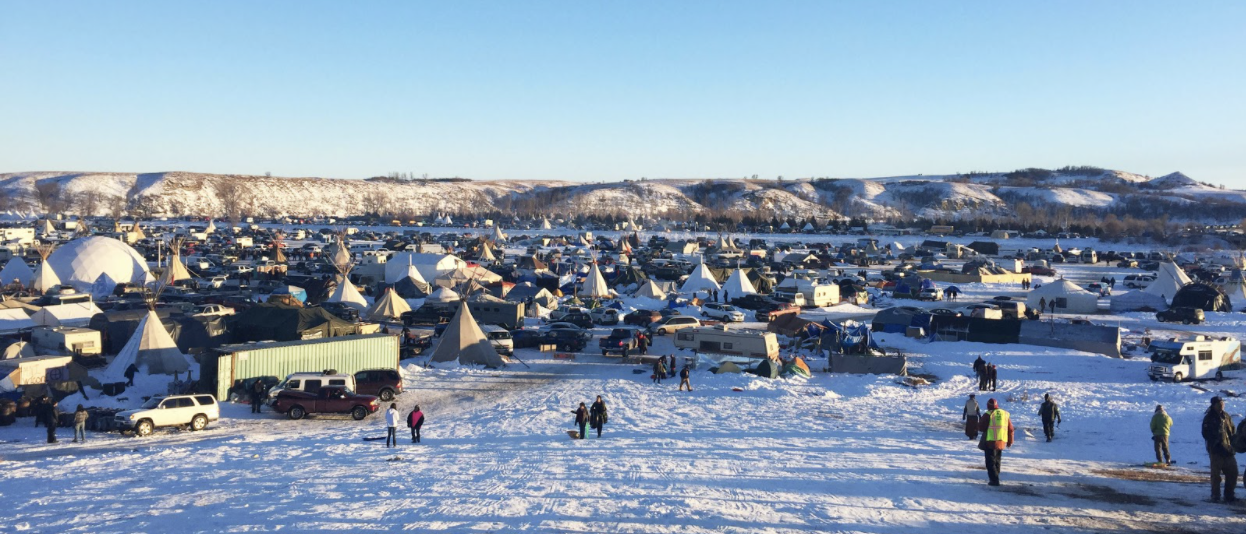 In 2016 and ‘17, tens of thousands joined our NoDAPL protest camps near Standing Rock. In 2021, we must bring the same energy to get President Biden to shut down this illegal pipeline