Over the past months, we’ve shared with you about our exciting partnership with the Muwekma Ohlone people of California’s Bay Area. We’ve helped the tribe create media and, together, we designed a call to action to assist the Muwekma — proud descendants of some of California’s original inhabitants — as they seek to restore their rightful status as a federally recognized tribe.
This week, we met with the Muwekma again to discuss and help amplify another of their important initiatives: namely, returning the Presidio to their caring hands. Giving this sacred and historic land back to its original stewards would be a huge win for Indigenous justice — and it’s a real possibility in this moment of change and opportunity. Please watch the new video from the Muwekma Ohlone Tribe, in which they lay out the reasons why it should happen.
Watch: The Muwekma Ohlone have the original right to the Presidio.
You may recall that, years ago, I helped to organize the #landback movement by calling to return the Black Hills to the Lakota. I was present at the protest action near Mount Rushmore when President Trump visited for American Independence Day during his first term. Today, we remain dedicated to the return of our own sacred lands — and we stand in strong solidarity with other Indigenous groups seeking the same.
Perhaps ironically, Trump’s return to office could present a new opportunity to achieve those goals. His administration’s efforts to gut the federal workforce, eliminate programs, and lessen the financial burden for the federal government could create openings for tribes to step into voids created around stewardship of federal lands. And while Lakota Law stands with needed federal workers who keep our society running smoothly, we also recognize Indigenous ownership and stewardship as the ultimate outcome for stolen, sacred lands.
As with many things these days, this is a rapidly evolving issue, and we’ll have more to say on it soon, including action opportunities and more messages directly from our friends at the Muwekma Ohlone Tribe. As always, I’m grateful for your solidarity with us and with Indigenous landback efforts across Turtle Island.
Wopila tanka — thank you for standing for the sacred. Tokata Iron Eyes Spokesperson & Organizer Lakota People’s Law Project Sacred Defense Fund
A few weeks ago, we let you know that our respected American Indian Movement (AIM) elder and activist Leonard Peltier was granted his release from federal prison after nearly 50 long years. Today, my daughter, Tokata, and I were present on the ground in Florida to witness this momentous event. Watch our new video to get more of our thoughts on what this means for our movement and what comes next.
Watch: Tokata and I discuss the significance of Leonard’s freedom.
Though former President Biden commuted his sentence, Leonard has not been granted a full pardon and remains on house arrest under the watchful eye of the federal government. If Leonard wishes it, we will remain active in helping him fully clear his name so he can live out his remaining days in true freedom. We’re so grateful to you and every one of our tens of thousands of supporters who demanded that Biden free him. And I want to credit Jenipher Jones and all the good folks at For the People, who have handled so much of the legal strategy on Leonard’s behalf.
Today, Leonard flew by private plane to his homelands among the Turtle Mountain Band of Chippewa on Anishinaabe territory in so-called Minnesota. This week, there will be a feed to honor him — a hero’s welcome home, thanks to our friends at NDN Collective. Our media relations director, Darren Thompson, will be onsite to report on that. We know you join us in wishing Leonard well. We’ll continue to honor his sacrifice as the USA’s (and its Native nations’) longest-serving political prisoner.
As we shared with you a few days back, we recognize AIM’s legacy as the genesis point for the modern Indigenous justice movement. We must continue to assert and defend Indigenous sovereignty and American constitutional sovereignty as key pillars of that movement. We’ll always be grateful to stand on the shoulders of giants like Leonard, Russell Means, Dennis Banks, The Bellecourt brothers, Pat Bellanger, Madonna Thunder Hawk, Phyllis Young, and so many more.
As this week’s headlines attest, we are now in a moment when fighting for justice is all-important. Our basic freedoms are under attack — and not just ours as Indigenous people. As key government agencies are gutted, as funding for vital programs is shut off, and as airplanes crash out of the skies, we’re all affected. Thus, the lessons of the AIM era should resonate stronger than ever before: we must rally together to protect one another. We must fight to restore sanity. Stay ready. We will have much more to say about what that will look like later this week.
Wopila tanka — thank you for supporting justice! Chase Iron Eyes Executive Director Lakota People’s Law Project Sacred Defense Fund
Note: Please look back at our posts over the years when we asked for justice for Leonard. He now needs a complete pardon, and the past injustices need to be exposed.
This is a great time to shine a light on all government agencies. As you see, that is what is being done, and like peeling off a bandage, it might hurt; however, we are living through a fantastic time of exposure. Sometimes, you need to get those agencies to get rid of the entrenched corrupt officials. Prepare yourself for new people with integrity to step in—get involved in the process. We have been knee-deep in corruption for decades.
The powers we are fighting want us to view what is happening as a threat. Ask yourself who the people are who are complaining and why they are complaining and in a panic.
A couple months back, amid the tail end of their “Trail of Truth” cross-country horseback ride to Washington, D.C., we introduced you to our partnership with the Muwekma Ohlone Tribe of the San Francisco Bay Area. For decades, these relatives — some of the original peoples of California — have been denied their rightful status as a federally recognized tribe. That’s unacceptable, and so through a partnership that involves our assistance with media creation and outreach, we aim to help them right this grievous wrong.
Today I remind you that your voice is critical in helping the Muwekma restore their federal recognition. If you have not done so, please send a message to your congressional reps demanding justice for the Muwekma. While you’re at the page, please also watch the new video we produced with their cooperation and on their behalf, then share the action on your preferred social media channels.
Watch, take action, and share! It’s long past time some of California’s original peoples had their federal recognition rightfully restored.
As Muwekma Chairwoman Charlene Nijmeh makes clear in the video, this is “about standing up and demanding justice for the Muwekma Ohlone.” It’s about creating a future for her people that appropriately recognizes their history — more than 10,000 years living in one of the world’s most beautiful, powerful, and wealthy places. San Francisco, the Silicon Valley, Stanford University, U.C. Berkeley, and I could go on and on: all of these places occupy land stolen from Ohlone ancestors.
Restoration of federal recognition is the very least the Muwekma deserve. The tribe previously held federally recognized status under its former name — the Verona Band of Mission Indians. Though this status was never officially terminated, the Muwekma were eventually, inexplicably, left off the government’s official rolls.
Federal recognition is tremendously important to Native People for a number of reasons. Those include access to key government funds that can provide educational opportunities for youth and elevate living conditions for entire communities, not to mention the abilities to establish new paths toward self-determination and repatriate artifacts and ancestral remains that should come home to Native care.
As Indigenous People, we understand how big a difference these things make. As I mentioned to you in our last message about the Muwekma, the horses Chairwoman Nijmeh and her companions rode those many miles came from Percy White Plume of the Horse Nation on the Oglala Sioux Tribe’s Pine Ridge Reservation. On the rez, we know we have to stand together, now more than ever.
That’s why, under Sacred Defense Fund, Lakota Law will continue to expand its mission to create and foster partnerships that elevate voices and address concerns far beyond Lakota Country. We support sovereignty efforts across Turtle Island and justice movements worldwide. We stand for equity, and we fight for fairness. And we remain extremely grateful to you for being there with us, every step of the way.
Wopila tanka — thank you for your friendship, courage, and activism. Chase Iron Eyes Executive Director Lakota People’s Law Project Sacred Defense Fund
“It’s Finally Over – I’m Going Home” ~Leonard Peltier
Greetings, Lekší Leonard is returning to his homelands of Turtle Mountain Anishinaabe territory! President Biden has granted Leonard Peltier commutation of his life sentence, to serve the remainder of his sentence at home, effective February 18, 2025. This grant of clemency resulted from 50 years of intergenerational grassroots organizing in Indian Country. Together we witnessed the unveiling of extensive evidence of prosecutorial misconduct and constitutional violations committed during Peltier’s case. “Leonard Peltier’s liberation is our liberation – and while home confinement is not complete freedom, we will honor him by bringing him back to his homelands to live out the rest of his days surrounded by loved ones, healing, and reconnecting with his land and culture,” said Nick Tilsen, NDN Collective Founder and CEO. Watch the NDN LIVE:
There is no real justice after losing 50 years of freedom, but today, our hearts are full of joy and gratitude that Lekší Leonard is returning home. “Today’s decision shows the combined power of grassroots organizing and advocacy at the highest levels of government. We are grateful to President Biden and the leadership of Secretary Deb Haaland. said Holly Cook Macarro, Government Affairs for NDN Collective. “All of us here today stand on the shoulders of three generations of activists who have fought for justice for Leonard Peltier. Today is a monumental victory – the day that Leonard Peltier finally goes home.” We remember the countless prayers that were said for Leonard. We remember and honor those who organized, mobilized, took to the streets, rallied, signed petitions, called representatives, lifted his story, and fought against Leonard’s unjust incarceration across Turtle Island and internationally— especially those who have traveled on and are witnessing this moment in the stars.
NDN delegation goes LIVE outside of the Coleman, FL Penitentiary where Leonard is being held. Photo credit: Angel White Eyes.NDN delegation speaks with Leonard Peltier outside of the Coleman, FL Penitentiary.Photo credit: Angel White Eyes.
To learn more about Leonard’s release, read NDN Collective’s press release here. For media inquiries contact: Cabot Petoia, cabot@ndncollective.org, 828-899-9239, and Sarah Manning, sarah@ndncollective.org, (208) 591-0672.
Our hearts are with our relatives who are still unjustly incarcerated and continue to be targets of police and state violence. The fight to release Leonard Peltier from prison is over, however, the fight for justice and the healing of our People from systems that continue to violate Indigenous rights globally, and target, criminalize, incarcerate, and murder our people, is a fight we continue to take on at NDN Collective. Please continue to hold Leonard in your hearts and say prayers for all that comes next for him. ✊🏽 In Gratitude, NDN Collective
From acknowledging the winter solstice to celebrating mainstream society’s holiday season, this time of year has always brought together gatherings of family and friends throughout Turtle Island. And every December, reminders of our history add to the difficulties faced by many families, and tribes, as some of their people’s most tragic memories all occurred during this month — the assassination of Chief Sitting Bull, Wounded Knee Massacre, and the Dakota 38 Hanging.
The day after Christmas is more widely known as “Boxing Day,” especially outside of Indian Country, but in the last several years there has been growing momentum for mainstream society to acknowledge the day after Christmas as the day when 38 Dakota “Sioux” men were hanged in Mankato, Minnesota in 1862. The hanging, the largest mass execution in United States history, was carried out in front of an estimated 4,000 people in downtown Mankato and remains largely hidden from classrooms and public knowledge.
As the year ends, and millions gather to celebrate and acknowledge the holiday season, some Indigenous communities acknowledge its tragic past through memorial ceremonies aimed at teaching and healing while building community.
The hangings were approved by former President Abraham Lincoln as a result of conflict between Dakota people and settlers in southwestern Minnesota. Dakota people were promised food and safety in exchange for ceding their lands, but they received neither, leading to attacks on white settlements in August 1862. The resulting widespread war in Minnesota lasted for five weeks, culminating in the hanging of 38 Dakota men in Mankato on Dec. 26, 1862.
Some say the Dakota War officially ended after the hanging, but the U.S. government’s oppression of the Dakota people, as well as other Indigenous groups, did not end with that atrocity. After the mass hanging, Dakota people were exiled and forcibly removed from Minnesota. Many sought refuge in Canada, South Dakota, Nebraska, and other communities willing to take them in. Memorializing such a painful history involves more than riding on horseback through blizzard-like conditions. While it remains a painful and tragic past, many have undertaken healing and positive efforts to repair relations with those in the places where history unfolded, hoping that such history will not repeat itself.
The movement to pay tribute to tragic times past is active healing in Indian Country. While memorials take time and tremendous effort, the initial memorial horse ride has caused great positive ripple. Today there are additional horse rides and a memorial run that begins at Ft. Snelling, the military fort where thousands of Dakota people were imprisoned during the Dakota War, and all convene at Reconciliation Park in Mankato, MN on Dec. 26. Many other Indigenous communities have begun to host memorial rides, runs, or walks, to pay their respects to their past, as well as to the land in hopes we continue to heal beyond times past.
Beginning in 2008, an annual memorial horse ride was organized to begin on the Lower Brule Reservation in central South Dakota and ride for 16 consecutive days, convening in Mankato, MN on Dec. 26. Their ride and ceremonial arrival to memorialize the Dakota 38 continues to this day — now under a new name — Mahkato Reconciliation and Healing Ride.
Forever riding forward, while sometimes looking back, is magic we all have to embrace in this work. We’re grateful and gain strength as we join together to honor the pain and sacrifices of the past by celebrating and supporting these ongoing healing movements.
Miigwech — thank you, always, for remembering with us! Darren Thompson Director of Media Relations Lakota People’s Law Project Sacred Defense Fund
Lakota People’s Law Project P.O. Box 27 Santa Fe, NM 87504
Warm greetings to you from the sacred (and chilly) He Sapa (Black Hills)! I’m here to witness and celebrate many young, Native runners on route from Fort Robinson, Nebraska to Busby, Montana, where — in solidarity with our Northern Cheyenne relatives, and on behalf of Lakota Law, Sacred Defense Fund, and the Standing Rock and Oglala Tribal Nations — I’m bringing you along for this year’s 29th Annual Fort Robinson Outbreak Spiritual Run.
I encourage you to watch my short video introduction to this important and deeply meaningful yearly event. It honors — with a 400-mile run over six days through subzero temperatures and some of the most beautiful, wild, and sacred territory in all of Turtle Island — Northern Cheyenne ancestors who broke free from captivity in Fort Robinson on January 9th, 1879. The run retraces their steps and allows their descendants to complete the journey they were unable to finish to their homelands nearly a century and a half ago.
Watch: Here I am at the Fort Robinson barracks. In my new video, I discuss the history behind this run, which promotes healing through acknowledgment of generational trauma and taking healthful action.
I want to give recognition to the Two Bulls family and Yellow Bird Foundation for hosting this powerful event. The runners — mostly youth from many tribal nations — began with an orientation on Thursday before hitting the trail yesterday from Fort Robinson to Hot Springs, SD. After crossing though the He Sapa into Deadwood today, they’ll have three remaining legs before reaching their final destination in Busby.
Our participation here — and yours, through your support — is important, not least because it raises more awareness (both within our communities and without) of how colonization and imprisonment in “frontier” forts impacted our Northern Cheyenne relatives. In some ways, being present for and supporting this run embodies what our work is all about. It gives us a real opportunity to acknowledge the painful past while alchemizing generational trauma through healthy activity to empower the next generation.
Wopila tanka — my gratitude for your solidarity with our youth and ancestors! Tokata Iron Eyes Spokesperson & Organizer Lakota People’s Law Project Sacred Defense Fund
P.S. A second reminder: We remain deeply grateful to all of you who give of yourselves to make the ongoing work of Lakota People’s Law Project possible under our new home at Sacred Defense Fund. For those of you who donate through checks, please send them to our new mailing address, listed below, and kindly make out your checks to: Sacred Defense Fund. Thank you so much!
Note our new mailing address (and please make any checks payable to: “Sacred Defense Fund”)
Lakota People’s Law Project c/o Sacred Defense Fund PO Box 27 Santa Fe, NM 87504
Apologies for the incorrect subject on this message a few minutes ago. I hope that won’t detract from this important content.
I wish you a happy holiday season! When most people think of December, what comes to mind might be the holidays we celebrate, gathering with family, and the turning of the page to a new year at month’s end. In Lakota Country, unfortunately, the end of the Gregorian calendar year is also inextricably linked with a pair of troubling anniversaries. In solidarity with us, I hope you’ll make a little room to remember them with me today.
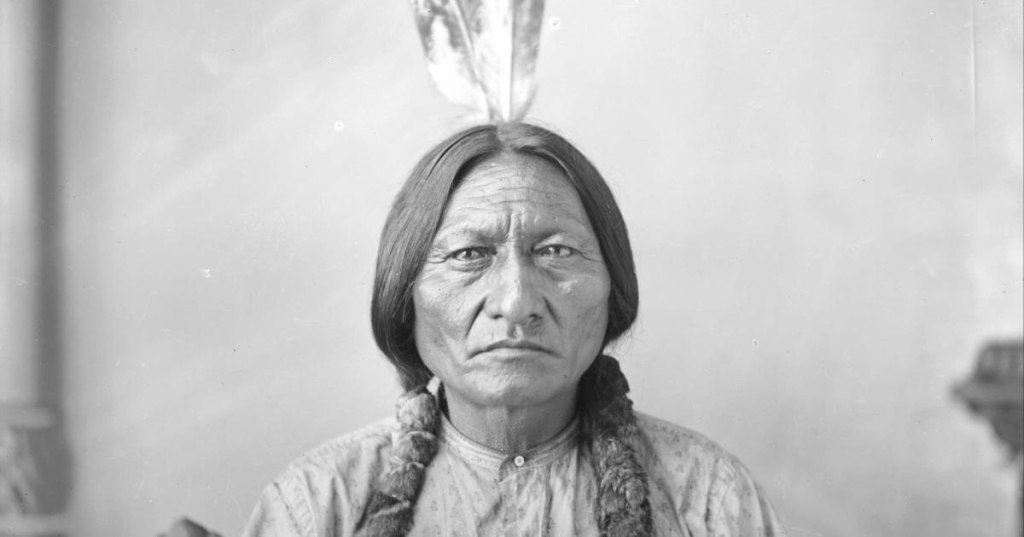
First, Dec. 15 was the 134th anniversary of the assassination of the great Hunkpapa Lakota Chief, Thatanka Iyotake, or Sitting Bull. I, too, am Hunkpapa Lakota, and I’ll say that Sitting Bull is one of our most celebrated ancestors for good reason. To learn more, I urge you to read (or reread) this blog, which I penned last year to give you more about Sitting Bull’s life, the context of his death, and an action you can take and share to rescind Medals of Honor granted to U.S. soldiers responsible for the second anniversary I referenced: the massacre of hundreds of Natives at Wounded Knee just days later, on Dec. 29, 1890.
Photograph of Sitting Bull by David Francis Barry, circa 1883.
Tied to both of those anniversaries, I’ve been doing research and thinking a lot about the unique, historic nature of policing in Indian Country. In general, cops have never been especially friendly to us — even when they are from our communities. They have always been in direct correspondence with and there to enforce rules made by American governmental officials and corporate institutions that we all face together, even today. In turn, those entities have frequently displayed genocidal intentions and undertaken endeavors, from the Wounded Knee Massacre and the murder of Sitting Bull to railroading pipelines through our sacred lands, meant to degrade or eliminate tribal nations (or, potentially, anyone demonstrating the will to defend American lands and waters).
In our last message to you, my father thanked U.S. Secretary of the Interior Deb Haaland (Pueblo of Laguna) for her service over the past four years. Let it not be lost on anyone the importance of a Native woman occupying that seat, because for many years, her department was (and sometimes still is) a great nemesis to our communities.
And that brings us back to Sitting Bull. In 1890, the Indian agent James McLaughlin, overseen by the U.S. military and the Secretary of the Interior, ordered him taken into custody. As 43 policemen and volunteers arrived that sad morning at the chief’s house and announced his arrest, a crowd of community members gathered at the commotion and began to protest. 150 Lakota arrived to protect him, and his son then led a group who attempted to free Sitting Bull from police custody.
Bureau of Indian Affairs police lieutenant Henry Bullhead and police sergeant Charles Shavehead, who bracketed Sitting Bull to prevent his escape, were shot. Mortally wounded, Bullhead then murdered Sitting Bull, shooting him in the ribs. Indian agent Red Tomahawk, who’d been behind Sitting Bull, then assumed command of the police. The ensuing fight resulted in the deaths of six police and eight Lakota protectors. After Thatanka Iyotake’s assassination, his people fled to join Spotted Elk (the brother of Iron Eyes, from whom my family takes its name). Then the band fled toward Red Cloud and the Oglala at the Pine Ridge Agency — and soon thereafter came the massacre at Wounded Knee.
These events live on with us — not just, unfortunately, as histories. As an Oglala who lives on Pine Ridge, I have witnessed police abuse in the modern day. And I have heard direct testimony and firsthand accounts of abuse of power and undue violence by Indian police over the past few decades. One example, and this is something I plan to expand on for you in subsequent messages, was the Reign of Terror on Pine Ridge in the early 1970s, which ultimately laid the foundation for the American Indian Movement’s occupation of Wounded Knee in 1973.
There is much more to say about that, and there’s so much more we can do moving forward. I promise you’ll hear more from me again soon. In the meantime, please hold us close, as you would all your loved ones at this time of year. I’m so grateful to be able to share with you, and I know that, together, we can continue to make progress. We can and we must use the often harsh lessons of the past to understand the present and create a future we can be proud of for all human beings.
Wopila tanka — thank you for your friendship! Tokata Iron Eyes Spokesperson & Organizer Lakota People’s Law Project Sacred Defense Fund
Rosie Clayburn is a descendant of the Yurok Tribe, which had its territory — called ‘O Rew in the Yurok language — ripped from them nearly two centuries ago.
“As the natural world became completely decimated, so did the Yurok people,” she said.
That decimation started when miners rushed in for gold, killing and displacing tens of thousands of Native Americans in California and ravaging the redwood trees for lumber.
“Everything was extracted that was marketable,” Clayburn said. “We’ve always had this really intricate relationship with the landscape. We’ve hunted, we’ve fished, we’ve gathered. And those are all management tools. Everything that we do has been in balance with the natural world.”
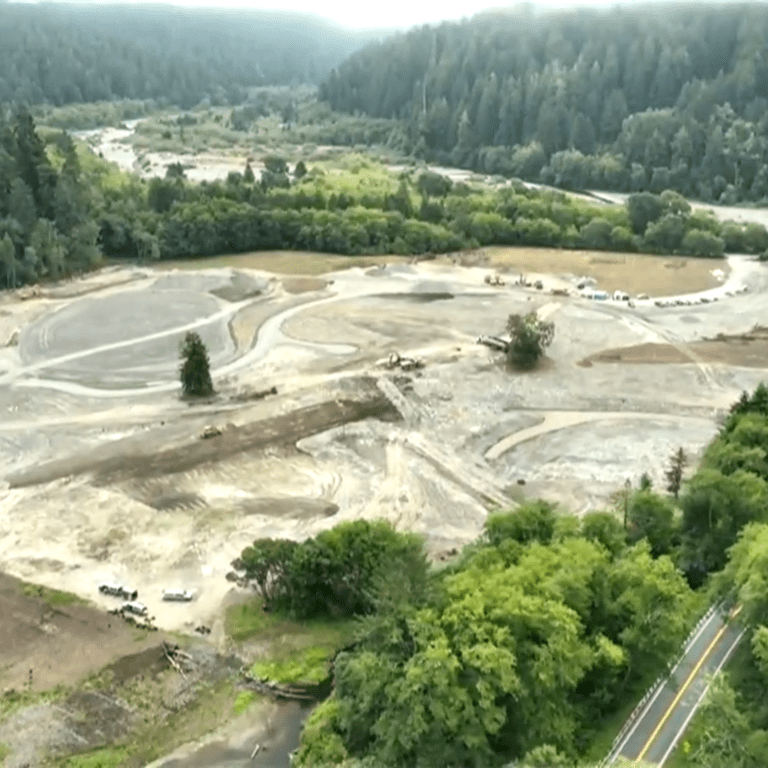
Now, generations later, 125 acres bordering Redwood National and State Parks will be handed back to the Yuroks.
The nonprofit Save the Redwoods League purchased the land in 2013 from an old timber mill, with the original goal of giving it to the National Park Service.
“As we continued conversations about the transfer of this land to the National Park Service, we began to realize that perhaps a better alternative would be to transfer the land back to the Yurok Tribe,” said Save the Redwoods League’s Paul Ringgold. “No one knows this land better. They’ve been stewarding this land since time and memorial”
Ringgold said that stewardship includes controlled burns to clear dead vegetation — a native practice once outlawed, but now recognized as essential in preventing catastrophic wildfires.
“Indigenous populations have been using fire as a management tool,” he said. “We’d like to see that kind of practice return.”
Redwoods serve as some of the largest stores of carbon on the planet. A single tree can capture up to 250 tons in its lifetime, the equivalent of removing nearly 200 cars from the road for an entire year.
But between logging and fires, 95% of California’s redwoods have been destroyed. Over the past decade, the Yurok have been helping restore the land.
Another forgotten jewel of the ecosystem is salmon. The fish were once so plentiful, they were eaten with most meals. The Yurok word for salmon even translates to “that which we eat.” But the salmon population has dwindled to about one-quarter of what it was 20 years ago, according to a coalition of state and federal agencies.
The tribe is working to bolster the fish’s population by building a stream channel, two connected ponds and about 20 acres of floodplain.
“You have salmon who provide for humans, but they also provide for other animals,” Clayburn said. “And then when they spawn and die, they put nutrients back in the ground. And so, everything just has this, this balance and this reciprocal way.”
That balance is returning. There’s been a rebound in the salmon population and the Yuroks also recently reintroduced the California condor — a scavenger that’s important to the ecosystem — back into the wild for the first time this century.
“It tells us that our land’s healing and that our people are gonna heal,” Clayburn said.
The Yuroks will take full control of ‘O Rew in 2026 and, in a first-of-its-kind partnership, receive help managing it from the Save the Redwoods League, California State Parks and The National Park Service.
“We understand some of the mistakes we made as a federal government, and it’s a chance to begin that healing with the native tribes all across the United States,” said National Park Service Director Chuck Sams.
For Sams, the first Native American to lead the agency, the partnership is personal.
“We’ve been writing our histories separately. There’s been the native history and then the American history. This is a chance when we’re doing co-stewardship and co-management to write history together,” he said.
Of the 431 parks managed by the National Park Service, 109 of them now have formal co-stewardship agreements with indigenous tribes, with 43 more on the way.
In addition to restoration work, plans for ‘O Rew include the creation of new trails, the construction of a traditional Yurok village and a state-of-the-art visitor center. The visitor center will display Yurok artifacts and highlight the tribe’s history and culture, with the goal of educating new visitors on the land’s history and significance from the perspective of those who have lived on it the longest.
“I really hope ‘O Rew symbolizes a coming home of the Yurok people and reconnecting with our landscape,” said Clayburn.


 NDN delegation goes LIVE outside of the Coleman, FL Penitentiary where Leonard is being held. Photo credit: Angel White Eyes.
 NDN delegation speaks with Leonard Peltier outside of the Coleman, FL Penitentiary. Photo credit: Angel White Eyes.