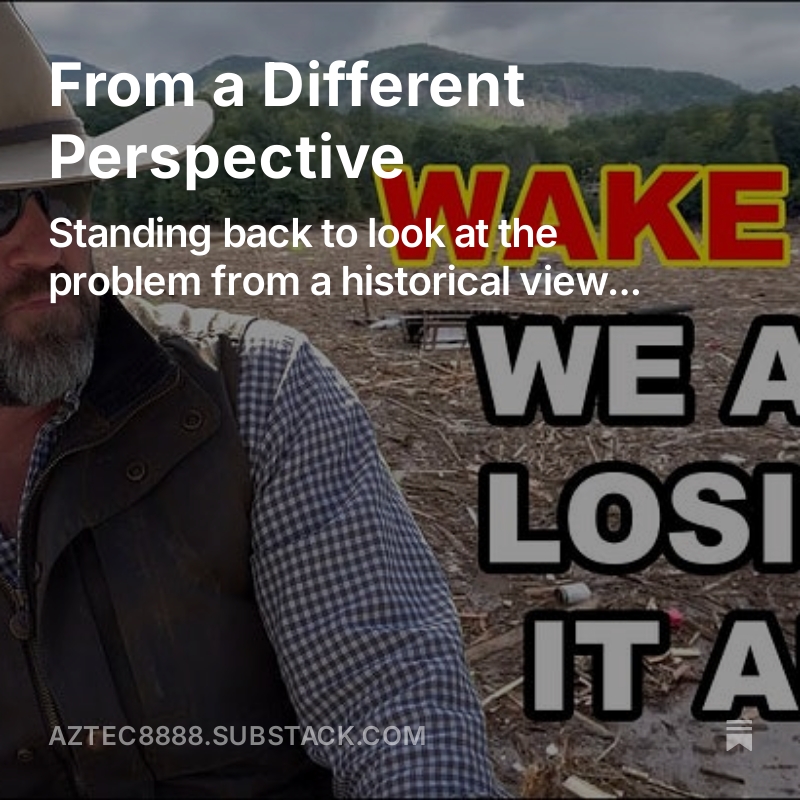
This is a very informative video that puts our current situation into a historical perspective. Watch the video, research the information, and make plans to prepare to change what is happening.
This is a very informative video that puts our current situation into a historical perspective. Watch the video, research the information, and make plans to prepare to change what is happening.
I was finally able to put together the book about my climate alteration exhibit in Second Life for Burning Man 2, back in October 2019. The years between 2019 and now have been totally chaotic, so much has happened. The topic is still appropriate and the points I made are still valid, even more so.
Please read and share.
https://galleryno8.exposure.co/metamorphoses?source=share-galleryno8


As you know, very few things matter to me — and to this organization and to the planet we all hope our future generations can continue to inhabit — as much as a just transition to clean energy. That’s why we support communities fighting on the frontlines against harmful extractive projects, like the Standing Rock Nation and the Reno-Sparks Indian Colony as they resist the Dakota Access pipeline (DAPL) and Thacker Pass lithium mine, respectively. It’s also why we continue to ally with Native-led groups promoting climate solutions which encompass Indigenous knowledge and respect tribal sovereignty.
To that end, this week I traveled to the Muscogee Nation near Tulsa, OK, to attend the second annual Tribal Energy Equity Summit. I was honored to speak at this important gathering, hosted by the Alliance for Tribal Clean Energy. It brought leaders from tribes and organizations across Turtle Island together with representatives from the federal government to share our viewpoints and advance equitable clean energy solutions. As part of my attendance, I sat down with Chéri Smith, the alliance’s president and CEO, to talk about the importance of Indigenous agency in creating a clean energy future for tribes. Please watch our short video, meet Chéri, and learn more about her organization’s mission.

Watch: I sat down with Chéri Smith, President and CEO of the Alliance for Tribal Clean Energy, to talk about the importance of Indigenous agency in creating a clean energy future for tribes.
It’s been — if you’ll pardon the pun — an energizing week! The summit afforded me a great opportunity to network with like-minded people and organizations, meet new friends, and reconnect with old ones. I was especially happy to share space with Dennis “Bumpy” Pu‘uhonua Kanahele, head of the Nation of Hawai’i, which maintains its status as a sovereign government under international law, independent of the United States.
As our presence at the same summit that also hosted a pair of representatives from the White House indicates, this was a diverse gathering which welcomed a multitude of perspectives on how we can solve tribal energy issues in a just way and begin to remediate the climate crisis. As you know — and as exemplified by DAPL’s violation of our treaty lands, which hold so much potential for renewable energy development — those two issues are inextricably linked. I’m excited to see where we’ll go from here!
Speaking of DAPL: many of you have reached out to us after reading about my participation in the ongoing trial to determine whether the federal government should reimburse the State of North Dakota for exorbitant costs it alleges it incurred by over-policing our peaceful NoDAPL movement in 2016 and 2017. This article and this one can provide you a bit more of my perspective. I’ll also plan to report back to you with further thoughts once we hear of a judgment.
Wopila tanka — as always, thank you for supporting environmental justice!
Chase Iron Eyes
Director and Lead Counsel
The Lakota People’s Law Project

Global Warming: a very passive title to address a very lethal problem.
Example: It is getting a little warm outside, nothing to worry about.
Climate Change: a perfect setup to generate perfect rebukes.
Example: The climate is always changing. climate is just doing what climate has always done and human activity has nothing to do with it.
Climate Crisis: a very selective term. It is only a crisis for the people immediately affected. Also falls into the maligned category of ¨alarmist¨
The term I adopted:
Climate Alteration: A very pointed terminology to address the impact human activity is having on the global climate. Our activities are altering climate systems on a global scale causing extreme weather events. Yes, temperatures on average across the globe are rising and this disturbance is causing extreme temperatures (hot and cold) extreme drought, extreme flooding, and extreme storms. The rise in global temperature has upset the balance. This alteration has been building up slowly as the oceans absorbed most of the extra heat. But now, plain to see for everyone paying attention to weather-related news or looking out their own windows, extreme weather is pushing organisms and plants to extinction. Our crops are being destroyed. The range of many insects, birds, and animals has shifted.
Here on this thread are the thousands of articles, references, and comments that illustrate Climate Alteration. We have documented how some are being innovative in developing mitigation strategies. Some are also being manipulative and stupid and we are intelligent enough to research and decide for our communities what we need to do if our governments do not act.
As animals and plants are forced to shift their range because of extremes in weather, so do people.

By now, you’re likely well aware of the climate crisis and its significant dangers to Indigenous communities the world over. The problem is especially magnified on islands and in coastal regions, where sea level rise can wipe away traditional homelands and make climate refugees of those who have been displaced. That’s true even right here on Turtle Island, where hundreds of Native communities — in South Dakota, Alaska, Florida, Hawai’i, Washington, and Louisiana — face existential threats.
And now, the first community to supposedly be moved from harm’s way — the Jean Charles Choctaw Nation — is facing a new set of problems. Just before the new year, the tribe filed a landmark civil rights complaint with the U.S. Department of Housing and Urban Development (HUD) against the state of Louisiana. In 2016, HUD granted Louisiana $48 million in aid to resettle the tribe. But, its complaint asserts, Louisiana failed to properly implement the grant and has ethnically and racially discriminated, violated tribal sovereignty, excluded cultural components central to a proper relocation program, and provided poor replacement housing.
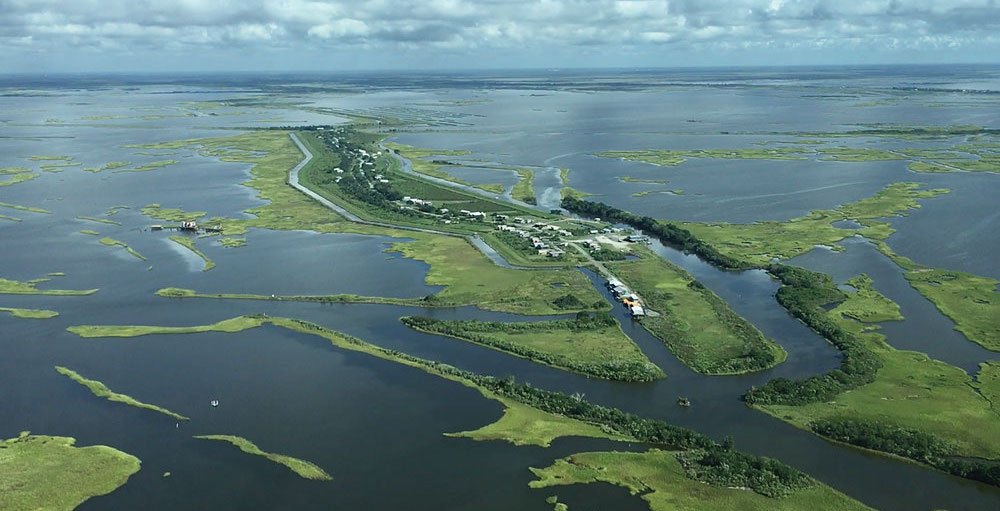
The Jean Charles Chactaw Nation has always lived here, on the Isle de Jean Charles. The climate crisis and resultant rising sea levels have endangered the tribe’s homeland and forced many members to move to inadequate replacement housing in a new location. Photo credit: Chantel Comerdelle.
The Jean Charles Choctaw Nation has resided on the Isle de Jean Charles for five generations, since the ancestors of its citizens escaped the Trail of Tears in the early 1830s amid President Andrew Jackson’s Indian Removal Act. Its homelands and burial grounds are located in a region facing perpetual devastation and erosion by storms and sea level rise. Since 1955, the Jean Charles Choctaw Nation has lost over 98 percent of its lands to the encroaching ocean.
It’s also worth noting that the tribe is located in Terrebonne Parish, a region notorious for oil extraction, high pollution rates, and environmental justice violations. The Parish and over 90 percent of its property are largely controlled by non-local fossil fuel and chemical companies. The infamous “Cancer Alley” is just upstream.

Watch this short documentary detailing the tribe’s relocation.
By filing its complaint with HUD, the Jean Charles Choctaw Nation is looking to the federal agency to investigate the grant-funded resettlement program, currently run by Louisiana’s Office of Community Development (OCD). The tribe hopes HUD will order OCD to respect tribal needs and authority as the program’s implementation proceeds.
The lawsuit is also significant in that, while the tribe has state recognition from Louisiana, it does not have federal recognition, which would extend access to more grants, disaster assistance, and various legal powers — including constitutional protections and self-governance recognized by the United States. Lakota Law will keep an eye on this case and report back to you. As always, we’re grateful to you for standing in solidarity with every community of color on the frontlines of environmental justice.
Wopila tanka — thank you for your unwavering dedication!
Chase Iron Eyes
Director and Lead Counsel
The Lakota People’s Law Project

“A lot of people from American society don’t understand our connection, our intergenerational connection, and how deep it runs within us to the land and the Earth,” Logan said.
Logan described a thanksgiving speech, or Ganö:nyök, that the Seneca recite to recognize the natural world around them.
“We start at the Earth and we go all the way up to the sky, to the creator, and it covers everything from the water, the plants, food, medicine, trees, birds, animals, everything in the natural environment,” Logan said. “If any one of those things goes away, eventually we will perish.”
https://insideclimatenews.org/news/22112023/new-york-clean-hydrogen-indigenous-nation-sees-threat/
Creating sustainable energy does not mitigate the problem.
I used to get into these tremendous arguments with my father about progress.
To summarize my stance: I used to take the bus because I did not have a car. I suffered through strange men groping me, people smoking, waiting in the rain for late busses, limiting my shopping because I could not carry a lot of stuff. It was sometimes unbearable.
I was able to buy a car and at first, it was incredible. I had freedom! I had safety! It was convenient and I could go shopping in many places and load everything in the trunk!
But then one rainy day I drove by a crowded bus stop and realized all I had done was trade some problems for other problems. I now had a vehicle in which I had a traffic accident: someone ran into me and the car had to be repaired. I could get parking tickets so I always had to hunt around for parking space, and in some places, I had to pay for parking. I had insurance to pay, and I had to spend my Sundays washing the car. I had maintenance and car repairs. Instead of a monthly bus pass, I now had a car loan to pay off. I had a driver’s license to renew at the DMV. I had a yearly car registration to renew. I had to have a car inspection to get the registration renewed. I worried about someone trying to steal the car, so I bought an expensive car alarm system. Instead of being able to dose off when riding in the bus, I had to stay alert at all times when driving the car. I now got stuck in traffic jams on the freeway and ended up taking a longer time to get home from work than if I had taken the bus!
When I added it up, I actually had more problems than when I rode the bus.
Energy is not created or destroyed – it just changes form.
https://energyeducation.ca/encyclopedia/Law_of_conservation_of_energy
IMHO
I think this law applies to everything we do. There is no such thing as progress. We just change out one set of actions for another, one set of problems for another. We are not getting anywhere from where we started. We are making things worse.
We used to know how to make the things we needed, but now we are dependent on people and systems for everything.
We used to be able to drink water from the rivers and fish/hunt for our food.
Now we use self-checkout at stores that sell us contaminated and processed unnutritious food.
We used to work in our fields growing the food from sun up to sundown.
Now we sit in cars in traffic for hours to get to work and then back home so we can afford a gym membership to try and stay fit.
We used to sit on our front porches on hot summer evenings because we had no air conditioning and would talk to our neighbors to get the daily gossip.
Now we are isolated in air-conditioned homes with security systems behind locked doors.
So, back to the article I cited. Little has changed in relation to the land and indigenous people. They have a pristine forest with old-growth trees. How are they able to still live there and the land has not been destroyed? – that is the big question.
We are clearly missing some knowledge.
We come along and want to build a potentially polluting ¨Green¨ plant right next to their land because, you know, progress.
We live an unsustainable, nonregenerative lifestyle. That is why their forest is beautiful and all the other land is polluted, exploited, and dead.

As we close in on the submittal deadline for public comments on Nov. 13, please send yours to the Army Corps of Engineers demanding the shut-down of the Dakota Access pipeline (DAPL) and a new Environmental Impact Statement. I also encourage you to use the buttons below (or on our action page) to inspire your fellow activists in your networks to join the movement. It’s going to take all our voices to stop this dangerous, illegal pipeline.
To more fully understand exactly the real and present threat DAPL poses to the sacred waters of the Mni Sose (Missouri River), watch the latest chapter in our Dakota Water Wars video series. Produced by the Lakota People’s Law Project in partnership with the Standing Rock Nation and Great Plains Tribal Water Alliance, this video features important testimony from meetings with the U.S. Army Corps of Engineers about its mismanagement of the river and the consequences for Lakota people.

Watch: Standing Rock has had enough of the Army Corps’ mismanagement of the sacred Mni Sose.
As you likely know, this could be a critical moment in history. It’s possibly our best chance to protect the water, health, and safety of Standing Rock’s people from DAPL — and we’re already making ourselves heard. So far, with the help of Standing Rock and activists like you, we’ve generated more than 55,000 comments to the Corps. Our press campaign also inspired an Associated Press story, subsequently picked up by major news outlets including PBS, FOX, and ABC.
That’s a good start, but we can’t let up until the deadline is behind us. We must keep building momentum and pressure over the coming few weeks to sway the government to act in the best interest of the tribe. It’s our job as friends of the Lakota people to fight with everything we’ve got for clean water, unspoiled land, and a liveable future. Please continue to stand with Standing Rock.
Wopila tanka — thank you, always, for your activism and attention.
Chase Iron Eyes
Co-Director and Lead Counsel
The Lakota People’s Law Project
Please view my video about Standing Rock here:

Over the past year and a half, Lakota Law has worked in support of the Paiute and Shoshone peoples near Peehee Mu’huh (Thacker Pass) in so-called Nevada. In those sacred homelands of our relatives, a lithium mine planned to become Turtle Island’s largest poses a grave threat to Unci Maka (Grandmother Earth) and the Indigenous communities who need clean water, air, and soils to live safely in balance with their natural surroundings.
I hope you agree that our society must transition to clean energy, and quickly. Our future generations depend on it. I hope you also agree that, as we make that transition, we must always center environmental justice. As with oil pipelines, lithium mines shouldn’t endanger frontline Black and Brown communities — or their land and water sources. As Thacker Pass water protector and Ox Sam Camp grandmother Justina Paradise shares in our latest short video, the relationship between Mother Earth and the water that flows through her rivers is akin to the blood in our veins.

Watch: Grandmother Justina Paradise discusses the importance of water to our Mother Earth in our new short video.
When the mine is built — and a hasty approval process that failed to seek permission from all the affected Native frontline communities means that, sadly, that will likely soon come to pass — it will destroy local ecosystems. Lithium Americas plans to extract more than 1.7 billion gallons of water annually from an aquifer in the Quinn River Valley. Uranium, antimony, sulfuric acid, and other dangerous substances will likely contaminate the groundwater. The cumulative effects of that would be disastrous for not just the nearby human beings, but for rare and protected species like the critically endangered spring snail (which only lives in the Thacker Pass area), the greater sage-grouse, and the Lahontan cutthroat trout.
The rush to build this mine is yet another indication that the federal government’s stated commitment to tribal consultation (a problematic term) is hollow, at best. It also means that dangerous man camps, temporary housing for extraction workers which often lead to an uptick in the epidemic of Missing and Murdered Indigenous Relatives, are on the horizon.
During his visit last week to Peehee Mu’huh, the Fort McDermitt Reservation, and Reno-Sparks Indian Colony, my colleague, Lakota Law attorney Dov Korff-Korn, heard loud and clear that local Native communities consider the project to be a dishonest slap in the face carried out by an alliance of government and extractive industry. No matter how uphill the battle, we must ensure that Indigenous peoples’ safety and wellbeing are prioritized and that Native communities retain access to the sacred places their families have visited since time immemorial.
There’s much more we plan to do and say about that — and what it all means for tribal health and safety and the ongoing relationship between the federal government and tribal nations. Please stay tuned.
Wopila tanka — thank you for standing for environmental justice!
Chase Iron Eyes
Co-Director and Lead Counsel
The Lakota People’s Law Project

Today, I share with you our new blog and video delving into the long, disturbing history of mining on Indigenous lands on Turtle Island. As we’ve written to you previously, the sacred lands of our Paiute and Shoshone relatives at Peehee Mu’huh (or Thacker Pass) in Nevada are under imminent threat from a massive new lithium mine. They did not give their consent for this project, and now it could despoil sacred ceremonial grounds, historic massacre sites, and sensitive habitat home to several protected species.

In our new, short video — which you can find near the top of my blog — Paiute elder Dean Barlese discusses the importance of protecting our shared world.
Thacker Pass isn’t the only mining project currently endangering Native homelands. The Yaqui people are struggling to effectively resist another massive lithium mine in Sonora, Mexico, and according to the Associated Press, our southern neighboring nation has become the world’s deadliest location for environmental activists. And in our sacred Black Hills right here in the Dakotas, lithium is joining gold, uranium, and other precious elements on the list of mining interests we’ve been confronted by for 150 years.
I encourage you to read my blog to learn more, and watch the accompanying video to get additional perspective from Dean Barlese, a respected Paiute elder. Our thoughts today are also with all those on Maui in the Kingdom of Hawaii. We are praying for the safety of all living things in that beautiful place as they confront deadly fires powered by fast winds fueled by yet another hurricane.
This is, of course, all related. Storm frequency and intensity rise in conjunction with the out-of-balance relationship we have with Unci Maka, our Grandmother Earth. Our society’s failure to listen to Indigenous knowledge and plan ahead accordingly exacerbates the climate crisis and puts the future in peril for my generation and those to come. The youth say it. The elders are saying it. It’s time to make big changes before it’s too late. That’s why your advocacy with our cause is so important. It’s up to us — working together — to change the game.
Wopila tanka — thank you, always, for your care and attention.
Tokata Iron Eyes
Spokesperson
The Lakota People’s Law Project

Greetings from Pine Ridge. I’ll keep this email short and sweet — but only because I want you to spend your reading time on today’s blog! I’ve also recorded a short video, which you’ll see near the top of the blog page. What’s my topic? I’m highlighting the importance of Indigenous knowledge in tackling the climate crisis in the wake of the latest Intergovernmental Panel on Climate Change report and convening of the United Nations Permanent Forum on Indigenous Issues.

Click above to watch a short video and read my blog about the importance of Indigenous knowledge when it comes to solving the climate crisis.
Please do read the blog, but here’s one of my key points. The climate crisis is real, it’s serious, and it’s existential — but that’s not a reason for pessimism. In order to win this fight, we must listen to one another, celebrate the good work being done, and tap into our resilience as human beings. We should recognize the victories we’re achieving now and incorporate both science and the understanding Indigenous communities have had for Unci Maka — our grandmother Earth — for thousands of years.
We know about resilience, and we aren’t scared of the apocalypse. In the era of colonization, we’ve already been living through it for generations. We haven’t lost our faith or our capacity for optimism, and we’re not going to give those up now. I invite you to hear my perspective and take on this challenge with me so the generations to come can tell an inspiring story of reconnection and recovery.
Wopila tanka — thank you for caring for Unci Maka!
Tokata Iron Eyes
Organizer
The Lakota People’s Law Project

Han, Mitakuyepi. I’ll start by thanking every one of you who supported our Oceti Vote event this past weekend. Your friendship helped to create something very special — a successful Native voter outreach campaign and also a true celebration of our Lakota culture. Today we’re submitting the many voter registrations we gathered, and we’ll have a lot more to share with you once we’ve all had a chance to look back at everything.
In the meantime, I’d like to draw your attention to something important from our sister org, Let’s Green CA! They’ve created a solidarity action to protect the Juristac — the ancestral lands of the Amah Mutsun Tribal Band, Indigenous People in what is now called Northern California. As Santa Clara County evaluates an environmental impact report on a proposed sand and gravel mining project, your input could help protect the sacred! So, because you live in California, today I ask you to stand with my relatives on the west coast of Turtle Island and tell the County: no mining at Juristac!
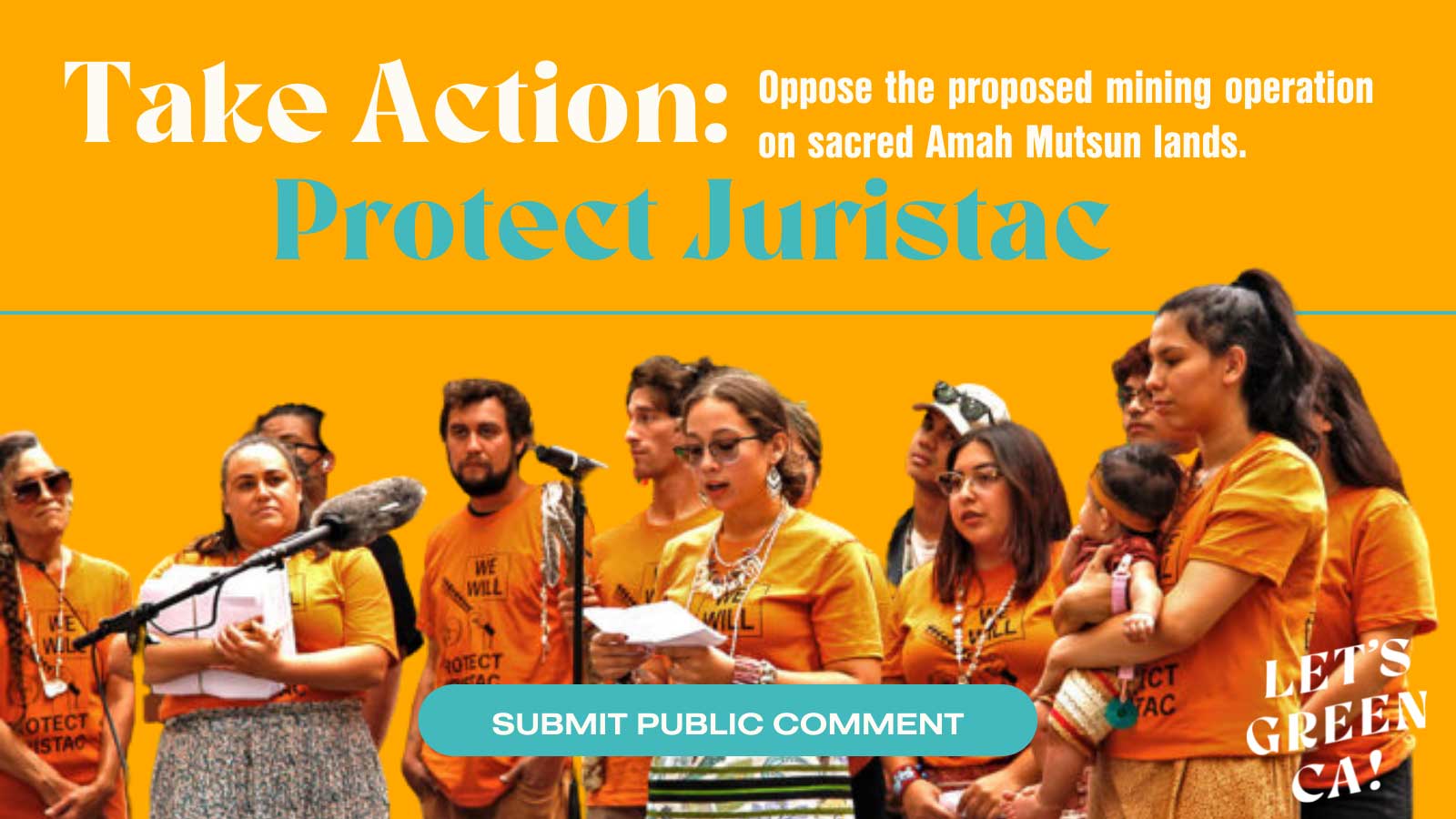
The Lakota People’s Law Project and Let’s Green CA! (which also just got a climate equity bill signed into law in California) take both environmental and Indigenous justice extremely seriously. The two are inextricably intertwined, because far too often, Indigenous communities wind up on the frontlines battling extractive industry which demonstrates no regard for Unci Maka, our Grandmother Earth, nor for us as this land’s first inhabitants and stewards.
The Amah Mutsun Band’s fight to protect the Juristac from being torn asunder by miners sounds a lot like our fight to stop gold, uranium, and lithium mining in our sacred He Sapa — the Black Hills. Our relatives in so-called Nevada have a similar fight on their hands with the lithium mining at Thacker Pass. And then there are all the oil pipelines — Dakota Access, Keystone XL, Line 3 — you have helped us resist.
It’s critical that we continue to stand in solidarity with one another every step of the way, each time any project imperils Unci Maka and the future we wish to create for the next seven generations. By widening our circle, we increase our power. So, please do keep tabs on the good work of Let’s Green CA! and show your support by submitting a comment to protect the sacred at Juristac. Rest assured that together, we can and will continue to win justice — for Indigenous People and for our Grandmother Earth.
Wopila tanka — thank you for your friendship and solidarity!
DeCora Hawk
Field Organizer
The Lakota People’s Law Project
 Water is Life