At Standing Rock in 2016, water protectors were labeled as domestic terrorists. I created this short video to counter that claim. We are just the common people out here defending our rights and our lives. The government is supposed to work FOR US. The corporations are business entities that are supposed to be producing things FOR US.
Today, water protectors from Standing Rock are still being prosecuted, and — in the troubling cases of Ruby Montoya and Jessica Reznicek — they’re still being labeled as terrorists. Because we cannot allow this dangerous precedent to be used against more people who care for our Grandmother Earth, we’re going to help defend Ruby. Our struggle against the Dakota Access pipeline (DAPL) didn’t end at Standing Rock in 2017, and it won’t be over until every water protector in the crosshairs of the criminal justice system is liberated.
In 2017, Ruby and Jessica engaged in a direct action that damaged an empty section of DAPL’s pipe. Jessica was recently found guilty, given a “terrorism enhancement,” and sentenced to eight years in prison. Ruby’s fate now hangs in the balance as her trial approaches. With litigation support from Lakota Law and the National Lawyers Guild, Ruby is going to fight. Her next hearing is scheduled for Wednesday, Sept. 1.
As Ruby says in this new video produced by our team, humanity is going through a reckoning. In the future, no one will fondly remember the names of corporations that represented the status quo; instead, many people will only wish they had fought harder to protect life on this planet. Nobody who takes a stand to stop extractive destruction should ever be charged with a felony, much less be labeled a terrorist.
Ruby told me that Jessica has never even held a weapon in her hands, and at one point she was considering entering a monastery. And Ruby is a Waldorf School teacher, who vividly remembers kids in her classes crying and losing sleep because Australia and the Amazon were on fire. Ruby’s resistance, like my own back in 2017 that earned me a felony charge, has been motivated only by a desire to give the next generations a destiny they can believe in.
Nothing any of us did comes close to a level of governmental coercion necessary to justify a terrorism enhancement. It’s fallacious to suggest we have that type of power. If the government is being coerced by anyone, it’s the fossil fuel barons who buy politicians to protect their profits. Ruby was invited by an Indigenous community to protect water and help safeguard sacred lands. She showed up. Now, we will have her back, just like she had ours. Please stay tuned as we continue to fight to prevent a grave miscarriage of justice.
Wopila tanka — thank you for standing for justice! Chase iron Eyes Co-Director and Lead Counsel via the Lakota People’s Law Project
It’s all about strategy and timing in Indian Country, especially in the legal system.
Shortly after a groundbreaking lawsuit was filed in the White Earth Nation’s tribal court defending the rights of wild rice to fight the construction of Enbridge’s Line 3 pipeline, the United Nations released its 6th Assessment on Climate Change.
The UN report includes an entire chapter dedicated to the powerful role that Indigenous knowledge can play in global development of adaptation and mitigation strategies aimed at addressing climate change.
According to the report, recognition of Indigenous rights, governance systems and laws are central to creating effective adaptation and sustainable development strategies that can save humanity from the impacts of climate change. In this first of three climate change reports, the working group focused primarily on physical science, providing evidence that a climate crisis caused mostly by human activities is upon us.
Boom. The report’s release created the perfect public moment to exert tribal sovereignty and advance the legal theory that nature itself, in this case wild rice, has the right to exist and flourish even in the face of the construction of a massive infrastructure transporting fossil fuel.
The so-called “rights of nature” argument recognizes that nature has rights just as human beings have rights; rather than treating nature as property under the law, rights of nature cases contend that nature, rivers, forests and ecosystems have the right to exist, flourish, maintain and regenerate their life cycles. Further, humans have a legal responsibility to enforce those rights.
According to the Global Alliance for the Rights of Nature, Indigenous cultures recognize the rights of nature as part of their traditions of living in harmony and recognition that all life is connected.
For Ojibwe, wild rice or manoomin, “good berry” in the Ojibwe language, is like a member of the family, a relative. Manoomin is more than food, it is a conveyor of culture, spirituality and tradition. Therefore, legally designating manoomin as a person in the White Earth Nation’s lawsuit against the Minnesota Department of Natural Resources aligns with the Ojibwe world view.
Manoomin is considered an indicator species; it is sensitive to changes in water levels and flow reflecting changes in the local climate. The Minnesota Department of Natural Resources reports that the 2021 wild rice harvest in the state’s waterways should be average this year but that low water levels caused by drought will make access difficult. Rice is harvested from a canoe.
Frank Bibeau, attorney for and citizen of the White Earth Nation, blames the Enbridge pipeline construction for exacerbating the lower water levels in neighboring rivers.
Frank Bibeau, citizen of and attorney for the White Earth Nation discusses his legal strategy at gathering at the Shell City campground in Wadena County, Minnesota, June 2021. (Photo by Mary Annette Pember)
“We are seeing rivers along Line 3 that are now essentially dry bottoms with rice growing out of the mud. We can’t get our canoes in to harvest,” he said.
On Aug. 6, manoomin was named as a plaintiff, along with several White Earth tribal citizens and Native and non-Native water protectors who have demonstrated against Line 3, in a complaint filed in White Earth Nation Tribal Court against the Minnesota Department of Natural Resources.
It is only the second “rights of nature” case to be filed in the U.S. and the first to be filed in tribal court. Several tribes, however, have incorporated rights of nature into their laws.
The lawsuit accuses the department of failing to protect the state’s fresh water by allowing Enbridge to pump up to 5 billion gallons of groundwater from construction trenches during a drought that itself is tied to climate change, which increases the pace of extreme weather swings and contributes to lags in the jet stream that keep heat waves, cold snaps and rain in an area for longer periods.
The suit also claims that the department has violated not only the rights of manoomin but also treaty rights for those who hunt, fish and gather wild rice off-reservations in ceded lands. The lawsuit seeks to establish the rights of manoomin, stop the extreme water pumping by Enbridge and stop arrests of water protectors opposing the pipeline at construction sites.
Juli Kellner, communications specialist for Enbridge, wrote an email responding to Indian Country Today’s request for the company’s reaction to the lawsuit.
“Line 3 construction permits include conditions that specifically protect wild rice waters. As a matter of fact, Enbridge pipelines have coexisted with Minnesota’s most sacred and productive wild rice stands for over seven decades,” she said.
“The current drought conditions in Minnesota are concerning to everyone. In response, the Minnesota Department of Natural Resources has suspended the use of some water sources due to low flow in specific watersheds. We are focused on protecting, conserving and reusing water on the Line 3 project. More than 50 percent of pipeline sections being tested on Line 3 by reusing water. We continue to work with agencies on next steps during these drought conditions.
“Enbridge has demonstrated ongoing respect for tribal sovereignty,” she wrote.
Department of Nature Resources spokesperson Gail Nosek said the agency is reviewing the lawsuit and had no comment.
‘Gaining traction’
Exerting tribal sovereignty by filing the lawsuit in tribal court rather than in state or federal court and advancing the legal theory of the rights of nature are unique, according to legal scholars.
“The rights of nature is quickly gaining traction in American legal law,” said Elizabeth Kronk Warner, dean of S.J. Quinney College of Law at the University of Utah. Warner is a citizen of the Sault Ste. Marie Tribe of Chippewa Indians.
“It’s already established in some other countries; the rights of nature is definitely a burgeoning area of law and I think we’ll continue to see it develop,” Warner said.
Courts in Bolivia, Columbia, Ecuador, India and New Zealand have litigated cases based on rights of nature.
The first “rights of nature” case filed in the U.S. came in April in Orange County, Florida, when the state’s waterways filed suit against a housing developer and the Florida Department of Environmental Protection. The suit says that a proposed residential development will destroy acres of wetlands.
But tribal courts have no authority to order the Minnesota Department of Natural Resources to rescind its water permit to Enbridge, according to Matthew Fletcher, a citizen of the Grand Traverse Band of Ottawa and Chippewa Indians and a law professor who is director of the Indigenous Law and Policy Center.
Fletcher agrees, however, that establishing the rights of manoomin as a legal entity in tribal court is a sound strategy.
“Those rights likely would not be recognized on their own in state or federal court; this suit may be a valuable exercise,” Fletcher said.
Attorneys chose to file the suit in White Earth’s tribal court as a means to quickly get the case heard in federal court. Tribal court civil cases involving non-Natives are permitted by consent of the defendant.
Legal scholars say that in this case, the state government would typically seek to have the case removed to the federal courts.
Bibeau said that the Minnesota Department of Natural Resources has already asked to file a motion to dismiss for lack of jurisdiction in the case. Although states and their agencies have their own sovereign immunity from lawsuits, Bibeau thinks that the department won’t be able to dodge the suit even if federal courts return the case to tribal court. The key is asking for a declaratory judgment and injunctive relief rather than monetary damages.
“I don’t think the state has immunity from declaratory judgment,” Bibeau said.
A declaratory judgment declares the rights of the plaintiff without any specific action or award for damages. Injunctive relief restrains a party from engaging in certain actions or requires them to do the actions in a certain way.
“I think that declaratory relief is within the boundaries of tribal court,” Bibeau said.
After the tribal court issues its order, regardless of the state’s participation, it will have created case law to which the federal court can refer when deciding to hear the case or return it to tribal court.
Manoomin or wild rice is more than food for Ojibwe; it conveys culture and tradition. 2020. (Photo by Mary Annette Pember)
“I don’t think anybody has tried to sue a state from a tribal court but I don’t think there’s any federal statute against it,” Bibeau said.
“They (the DNR) won’t be able to stop the tribal court order. When we go to federal court based on the simplicity of water and wild rice, we can go a long way because we already have those rights as a sovereign nation,” he said.
Either scenario, according to Bibeau, is a win for plaintiffs.
Looking ahead
Bibeau’s legal strategy, however, is not without pitfalls.
Treaties signed between the Ojibwe and the federal government in 1837 and 1854 guaranteed tribes the right to hunt, fish and gather on ceded lands. The 1855 treaty or Treaty of Washington, however, conspicuously lacks language spelling out this right. The bulk of the Line 3 pipeline runs through 1855 treaty lands.
In 2019, the Minnesota Court of Appeals ruled in favor of the state regarding 1855 treaty rights to hunt, fish and gather on ceded lands. Two Ojibwe men were cited by the state for illegally taking fish from Gull Lake located on off-reservation lands in the 1855 Treaty area. One judge, however, offered a dissenting opinion in the case saying that rights apply to treaties as the Indians at the time would have understood them.
Bibeau represented one of the defendants in this case. “There is nothing in the 1855 Treaty that relinquished rights to hunt, fish and gather on ceded lands,” Bibeau said.
This is known as the reserved rights doctrine; treaties describe the specific rights tribes gave up, not those they retain. In many cases, the federal court has interpreted treaties using the reserved rights doctrine.
The elements of White Earth’s lawsuit that depend on rights to hunt, fish and gather on ceded lands within the 1855 Treaty area are contingent on these rights being affirmed. For instance, plaintiffs claim that the state deprived them of their civil rights by charging them with trespass and other crimes as they protested Line 3 construction; they argue that they were lawfully engaged in exercising their treaty rights.
Minnesota treaty map. Courtesy Mitchell Hamline School of Law
Establishing that the 1855 treaty should be interpreted to include hunting, fishing and gathering rights on ceded lands could be a challenge, according to treaty scholars. At least one scholar, who preferred to be quoted anonymously, cautioned that each treaty is different.
Although Warner agreed that establishing treaty rights in this case might not be an easy argument, it would be consistent with existing Indian treaty law.
“Tribes have been having a lot of success in the current Supreme Court; all of the cases relying on treaty rights have been successful,” Warner said.
She pointed to the McGirt case in Oklahoma and the Boldt decision in Washington.
Most of these decisions have been led by Supreme Court Justice Neil Gorsuch. Although considered a conservative, Gorsuch has demonstrated a keen understanding and appreciation of tribal sovereignty and treaty rights expressing respect for the reserved rights doctrine. During his tenure, Gorsuch has ruled in favor of important treaty rights cases such as Herrera v. Wyoming, rejecting past theories of state sovereignty and Washington State Department of Licensing v. Cougar Den affirming the state’s obligations to tribes. Gorsuch served as federal judge on the 10th U.S. Circuit Court of Appeals where he gained extensive experience in Indian law.
“The interesting thing would be if White Earth’s right to nature claim could be incorporated into or run parallel to a treaty right,” Warner said.
The release of the UN’s climate report alongside White Earth’s lawsuit could be auspicious for both treaty rights claims and the rights of nature, according to Warner.
“The urgency of the UN findings make this litigation and advocacy work so much more important now because we literally have a window of time in which to make changes,” Warner said.
Our stories are worth telling. Our stories are worth sharing. Our stories are worth your support. Contribute $5 or $10 contribution today to help Indian Country Today carry out its critical mission. Sign up for ICT’s free newsletter.
Sending you best wishes from the Line 3 frontline in Minnesota. I’m encouraged to report that nearly 30 high-profile national lawmakers have responded to grassroots pressure and sent a joint letter to President Biden. It urges the White House to ensure a full environmental assessment of the Line 3 tar sands pipeline, which is damaging sensitive wetlands in the midst of the ever-worsening climate emergency. We on the frontlines are grateful we’re being heard. Our team is doing all we can to protect our sacred homelands — and your support is essential.
Please give to lift up our #StopLine3 resistance. We need food, fuel, equipment, and supplies to remain effective. We now have just a matter of weeks to convince the Biden administration to end the desecration of our lands and waterways. We won’t go away — but this pipeline must. Help us stay in its path every single day.
Lakota Law reached out to lawmakers it has relationships with to sign onto the Biden letter, and the progress in D.C. is partly a result of all the direct action occurring here in Minnesota. Just today, we at Camp Migizi led a march on the Army Corps of Engineers building in Duluth, Minnesota. Lakota Law co-director and lead counsel Chase Iron Eyes and more than 300 water protectors joined us in delivering a strong message of resistance.
Today’s direct action exemplifies the growing partnership between my Anishinaabe People and the Lakota who have come to stand with us. As expected, the police reacted aggressively, even detaining one Indigenous woman so forcefully that we felt it necessary to shut down a nearby bridge in response.
Next, on Saturday, we’re helping organize and publicize a direct action in D.C. In tandem with allied groups and influencers, Camp Migizi and Lakota Law will deliver more than 127,000 #StopLine3 petitions to Biden, hold a sacred ceremony, and engage with our fellow activists at the National Museum of the American Indian.
I want you to know that, even as we — and so many in the world — grapple with one existential crisis after another, there is much reason for hope. We must stay active and vigilant!
Miigwech — thank you for your solidarity with our Indigenous nations. Taysha Martineau Via the Lakota People’s Law Project
Pipes for the Keystone XL pipeline stacked in a yard near Oyen, Alberta, Canada, on Tuesday, Jan. 26, 2021. Credit: Jason Franson/Bloomberg via Getty Images
It was meant to be an express line from North America’s largest proven oil reserve to its biggest refining center and to deepen the bond between Canada and the United States as petroleum partners.
And it would have stood—or rather, lain—four feet underground, as a 1,700-mile steel monument to humanity’s triumph over the forces that at the time seemed to threaten the future of an oil-driven economy. Conventional oil reservoirs might be running out and alarms might be sounding over the damage that carbon dioxide pollution was doing to the atmosphere, but the Keystone XL pipeline would show America’s determination to carve out ever new oil corridors.
At least, that’s how it looked in 2008, when TransCanada and its partners announced plans to forge a $7 billion link between Alberta’s tar sands and the Texas Gulf Coast. By the time the company now known as TC Energy announced earlier this month that it was giving up the effort to build the pipeline, it was clear that oil could not so easily conquer the realities of the 21st century.
The 13-year fight over Keystone XL transformed the U.S. environmental movement, and dramatically shifted the political center of the American debate over energy and climate change. Instead of trying to get people to care about the future impact of a gas—carbon dioxide—that they couldn’t smell or see, environmentalists began focusing on the connection between climate change and the here-and-now effects of fossil fuel dependence: the takeover of land; the risk to air and water; and the injustice to those in the path of the fossil fuel industry’s plans. President Barack Obama’s presidency was a barometer of this change. Early on, his administration seemed poised to approve Keystone XL. Near the end of his second term, Obama became the first world leader to block a major U.S. oil infrastructure project over climate change.
But as Keystone XL’s brief revival under President Donald Trump demonstrated, the battle over oil’s future is far from over. Climate activists are pushing for President Joe Biden to stop Line 3, another Canadian tar sands pipeline now under construction in Minnesota. But the larger issue for the climate action movement is whether the United States can enact a comprehensive policy that truly reshapes energy use, as Biden has pledged to do, phasing out dependence on oil and its imprint on the American landscape.
‘Drill, Baby, Drill’
TransCanada announced its plan to build the Keystone XL in July 2008. In the oil and gas industry’s view it seemed impeccable timing, coinciding with a surging oil market. The price of crude soared past $140 a barrel that month; no one knew at the time that the record price was a peak the market would never hit again. It seemed like the world was entering an era of sustained high oil prices that would pump nothing but profit out of the energy-intensive production of thick, sticky bitumen from the sandy soil of remote Alberta.
Politically, a proposal to double the amount of Canadian oil coming into the United States also seemed well-timed. Even though both candidates for the 2008 presidential election said they favored action on climate change, there was no talk of it on the campaign trail or in debates. A bill to cut U.S. carbon emissions died in the Senate that summer, with neither Republican John McCain nor Democrat Barack Obama showing up to vote. People were worried about high gasoline prices. The chant that shook the rafters at the Republican convention was “Drill, Baby, Drill.”
But the timing of TransCanada’s project also made the pipeline a perfect target for a ferocious backlash against both the fossil fuel industry and government inaction on climate change.
After Obama won the election and Democrats gained control of Congress, there was at first little sign that Keystone XL was in trouble, certainly not over its climate impact. International climate talks in Copenhagen in 2009 failed to yield an agreement. And with Obama’s House-passed climate bill foundering in the Senate, the president sought to win support from moderate Democrats by making concessions on oil. In early April 2010, he announced a plan to reverse a long-standing ban on offshore drilling on the Atlantic coast. Secretary of State Hillary Clinton’s department then released a draft environmental impact statement that seemed to clear the way for Keystone XL, concluding that its environmental impact would be “limited.”
President Barack Obama speaks at the southern site of the Keystone XL pipeline on March 22, 2012 in Cushing, Oklahoma. Credit: Tom Pennington/Getty Images
Five days later, BP’s Deepwater Horizon oil rig exploded. And over the next 87 days, more than 200 million gallons of oil spewed into the Gulf of Mexico, threatening ecosystems and the fishing and coastal economies, in what is regarded as the worst accidental marine oil spill in the history of the oil and gas industry. An orange sheen on the water, tar balls washing up on beaches and oiled pelicans provided vivid evidence that despite its claims to safety, the oil industry made mistakes and took shortcuts. And its plans for controlling a catastrophe were inadequate.
While the Deepwater Horizon well was still gushing, another historic U.S. oil disaster began to unfold that got less attention, but had even more relevance to Keystone XL. More than 1 million gallons of diluted Canadian bitumen spilled into a tributary of the Kalamazoo River from a ruptured pipeline in Marshall, Michigan. The heavy oil didn’t float, as conventional oil would; it sank to the river bottom, fouling 36 miles of the river and forcing 150 families permanently from their homes. The pipeline company, Enbridge, never informed federal officials of the complexity of handling heavy oil. It became the costliest inland oil spill in U.S. history, with a clean-up price tag of more than $1 billion.
The Kalamazoo spill was a turning point for ranchers and other landowners in the path of the Keystone XL, as Sue Kelso of Oklahoma told Inside Climate News in 2012. “I live in fear that this pipeline will go through and ruin all the water,” she said at the time. Kelso took TransCanada to court to fight its effort to obtain a pipeline easement on her family farm using eminent domain. Scores of ranchers and other landowners followed suit.
The fear and anger of landowners on the Keystone XL corridor was mounting at the precise moment that climate activists were confronting the strength of the forces lined up against them in Washington, D.C. Obama failed to push the Democratic-controlled Congress to act on climate, and the window of opportunity shut when Republicans regained control over the House in the 2010 midterms. “The environmental movement was in a dismal place following years of failed inside-the-beltway strategy,” Bob Wilson, a Syracuse University geographer who studies the environmental movement, recalled several years ago.
Climate activists needed a new game plan, and they looked to the indigenous tribes and conservative ranching communities of the Great Plains who were fighting Keystone XL.
Building a Sense of Trust
No one did more to build common cause between local communities and environmental groups than Jane Kleeb, a professional organizer who had moved to Nebraska to raise a family. She founded a group, Bold Nebraska, that did more than lobby, litigate and protest. It planned creative events to connect citizens from diverse cultural and political backgrounds—a renewable energy barn-raising, a large crop art project and a Harvest of Hope concert, held on a family farm and featuring Willie Nelson and Neil Young. Defying the historic tension between ranchers and Native American tribes in northern Nebraska, Bold Nebraska helped forge a Cowboy Indian Alliance (CIA) to fight a common foe—Keystone XL.
“We had this responsibility and sense of trust with one another, so that the tactics of divide and conquer that they normally would use never worked on this fight,” said Kleeb. “We helped change the face of what an environmentalist or climate activist looks like. You had people who were directly impacted by the pain, or potential consequences of these projects coming forward, being the ones to speak out, rather than kind of highly educated, you know, more coastal environmentalists.”
Environmentalists changed their methods, too. This August will mark the 10th anniversary of the first of a series of sit-ins against Keystone XL at the White House, organized by environmental author-turned-activist Bill McKibben and the organization he co-founded, 350.org. More than 1,250 people were arrested, including McKibben, climate scientist James Hansen and Sierra Club executive director Michael Brune, who ended the group’s 120-year prohibition against acts of civil disobedience.
Protesters sit in front of the White House in Washington, D.C., on Aug. 30, 2011, during a protest against the construction of the Keystone XL pipeline. Credit: Saul Loeb/AFP via Getty Images
“This particular project—Keystone XL pipeline—is so horrendous, it’s so wrong, and it’s being proposed at such an important time that we don’t want to leave any tool on the table,” Brune said at the time.
Little by little, the Obama administration changed course. In 2015, the Environmental Protection Agency calculated that the energy required to process tar sands oil and transport it through Keystone XL would generate 1.3 billion more tons of greenhouse gas emissions over the pipeline’s 50-year lifespan than if it were carrying conventional crude. In November 2015, on the eve of Paris climate talks where Obama hoped to seal his legacy with a landmark global deal to cut carbon emissions, he rejected the Keystone XL as counter to the role of the United States as a global climate leader.
“Once the grass-roots movement on the Keystone pipeline mobilized, it changed what it meant to the president,” presidential historian Douglas Brinkley told The New York Times. “It went from a routine infrastructure project to the symbol of an era.”
Beyond the Keystone XL
The Keystone XL battle spawned other pipeline showdowns, altering the U.S. political landscape, with results that are still unfolding. Young activists visited the protest site in North Dakota where the Standing Rock Sioux tribe faced off against the Dakota Access pipeline in 2016. Among them was a former Bernie Sanders campaigner, Alexandria Ocasio-Cortez, who was inspired by the experience to run for office herself under the banner of environmental justice and climate action.
Dakota Access was completed, one of the few accomplishments of Trump’s drive to accelerate oil and gas infrastructure. But a judge ruled that Trump illegally sidestepped environmental review of the project, which is now in the Biden administration’s hands. In the face of unrelenting local opposition and low energy prices, Williams Company, an energy firm, canceled a planned natural gas pipeline in New York State, and Dominion Energy withdrew its plan for a pipeline cutting across the Appalachian Trail in Virginia.
As for Keystone XL, it was stalled by litigation throughout the Trump administration, and the economics also went south. With oil prices half of what they were in 2008, and banks and investors pulling out of Canadian tar sands projects, TC Energy was relying on the Alberta government for financing and loan guarantees. The pipeline was only 8 percent built when Biden canceled its border-crossing permit on his first day in office.
But even as pipelines were blocked, frackers were tapping new stores of oil in the shale rock beneath West Texas, North Dakota and New Mexico. Over the 13-year battle over Keystone XL, the United States regained its spot as the leading oil producer, in a world that is on track to consume a record 101 million barrels of crude per day by next year.
Keep Environmental Journalism Alive
ICN provides award-winning, localized climate coverage free of charge and advertising. We rely on donations from readers like you to keep going.Donate Now
You will be redirected to ICN’s donation partner.
Beyond the Keystone XL, Biden has sought to avoid getting pulled into pipeline battles. Instead, he has pursued what one analyst described as a “demand-side” policy: seeking to lay the groundwork for a clean energy future that would dry up demand for oil. To meet Biden’s Paris climate agreement pledge of cutting U.S. carbon emissions in half by 2030, an estimated half of new cars sold would by then have to be electric.
But Biden’s climate plan, including the funding of an electric vehicle charging network and other infrastructure essential for a clean energy future, is facing roadblocks in an evenly and deeply divided Congress. And while that inside-the-beltway fight continues, hundreds of climate activists are chaining themselves to construction equipment in Minnesota, seeking to stop Enbridge from replacing an aging Canadian tar sands pipeline. They are calling on Biden to withdraw Enbridge’s permits for Line 3, just as he did for Keystone XL, without waiting for policy that one day, in theory, will eliminate the need for oil pipelines.
“Biden has to make an aggressive step in saying if we’re going to hit these climate change goals that we’ve set out, that means we cannot continue to build fossil fuel projects,” said Kleeb.
But, she said, she worries about division. With her voice breaking, she recalled a confrontation at a bar in Minnesota between her group of climate and tribal activists and a huddle of local residents. Her group began to leave the bar, but Kleeb turned around and went back. “Knowing what I just spent a decade doing in Nebraska, I can’t leave with them thinking that we’re these out-of-touch liberal elites, and not know why we’re fighting this pipeline,” she said. The evening ended with laughter and high-fives, she said, after some discussion of eminent domain, and foreign tar sands oil crossing their state to head for export markets.
Kleeb said she feels that not enough time has been spent building bridges between the activist and rural communities. And she thinks that’s a lesson for Biden and the larger drive for a clean energy transition, which would require the build-out of renewable energy in red states.
“A lot of people are very skeptical of corporations pushing wind and solar because they haven’t been treated well, and they haven’t really been engaged in the conversations around climate,” Kleeb said. “So there’s a lot of work to do.”
Marianne Lavelle is a reporter for Inside Climate News. She has covered environment, science, law, and business in Washington, D.C. for more than two decades. She has won the Polk Award, the Investigative Editors and Reporters Award, and numerous other honors. Lavelle spent four years as online energy news editor and writer at National Geographic. She spearheaded a project on climate lobbying for the nonprofit journalism organization, the Center for Public Integrity. She also has worked at U.S. News and World Report magazine and The National Law Journal. While there, she led the award-winning 1992 investigation, “Unequal Protection,” on the disparity in environmental law enforcement against polluters in minority and white communities. Lavelle received her master’s degree from Columbia University Graduate School of Journalism, and is a graduate of Villanova University.
I have two pieces of wonderful news to share with you! As of yesterday, TC Energy at last canceled all remaining plans for the Keystone XL pipeline (KXL). The Zombie Pipeline is finally completely dead! At the same time, I was able to negotiate a deal with the South Dakota state’s attorney and avoid jail time for my KXL protest last year.
It was a good day not just for me, personally, but for all water protectors. This shows that — even as many states around the country continue to pass laws criminalizing protest — the people still have power. Our activism can make a real difference. As my fellow Cheyenne River protester, Oscar High Elk, said yesterday, “Respect our existence, or expect our resistance.”
Of course, as you know, our resistance still has much left to accomplish. I’m grateful that KXL’s immediate threats to our land and water are gone, along with the dangers its mancamps presented to Indigenous women and girls in Lakota Country. But Dakota Access still operates — without a legal permit — and Line 3 presents the same peril to the homelands of our Anishinaabe sisters and brothers in Minnesota.
Now, it’s time to #StopLine3 and continue our #NoDAPL fight. The cards are always stacked against us, but we have shown time and time again our resilience, the power of our movement, and our ability to triumph against the greatest odds.
Just this week, hundreds gathered at a pump station near the headwaters of the Mississippi River in Minnesota, led by my sisters in arms, for the largest Line 3 protest yet. Reports tell us that a Department of Homeland Security helicopter harassed them, kicking up dust and gravel in an attempt to deter my relatives. It didn’t work. More than 100 were arrested, and we aren’t done yet. Like Lakota Law’s team, I’m considering ways I can best support this movement going forward. Because — take it from me — we can win!
Wopila — I’m very grateful for your solidarity with our resistance. Jasilyn Charger via the Lakota People’s Law Project
The Keystone XL pipeline project is officially terminated, the sponsor company announced Wednesday.
Calgary-based TC Energy is pulling the plug on the project after Canadian officials failed to persuade President Joe Biden to reverse his cancellation of its permit on the day he took office.
The company said it would work with government agencies “to ensure a safe termination of and exit from” the partially built line, which was to transport crude from the oil sand fields of western Canada to Steele City, Nebraska.
“Through the process, we developed meaningful Indigenous equity opportunities and a first-of-its-kind, industry leading plan to operate the pipeline with net-zero emissions throughout its lifecycle,” said François Poirier, TC Energy’s president and chief executive officer in a statement.
The pipeline has been front and center of the fight against climate change, especially in Indigenous communities. Native people have been speaking out, organizing, and in opposition of the project for several years.
“OMG! It’s official,” Dallas Goldtooth, Mdewakanton Dakota and Diné, wrote on Twitter regarding Keystone XL’s termination. “We took on a multi-billion dollar corporation and we won!!”
Goldtooth is part of the Indigenous Environmental Network. The network said it has been organizing for more than 10 years against the pipeline.
“We are dancing in our hearts because of this victory!” wrote the network in a statement. “From Dene territories in Northern Alberta to Indigenous lands along the Gulf of Mexico, we stood hand-in-hand to protect the next seven generations of life, the water and our communities from this dirty tar sands pipeline. And that struggle is vindicated. This is not the end – but merely the beginning of further victories.”
The network noted that water protector Oscar High Elk still faces charges for standing against Keystone.
Construction on the 1,200-mile pipeline began last year when former President Donald Trump revived the long-delayed project after it had stalled under the Obama administration.
It would have moved up to 830,000 barrels of crude daily, connecting in Nebraska to other pipelines that feed oil refineries on the U.S. Gulf Coast.
Biden canceled it in January over long standing concerns that burning oil sands crude would make climate change worse.
In this Feb. 18, 2020, photo, a protester plays a drum and sings while joined by others opposing the Keystone XL Pipeline at the South Dakota Capitol. (AP Photo/Stephen Groves, File)
Canadian Prime Minister Justin Trudeau had objected to the move, although officials in Alberta, where the line originated, expressed disappointment in recent weeks that Trudeau didn’t push Biden harder to reinstate the pipeline’s permit.
Alberta invested more than $1 billion in the project last year, kick-starting construction that had stalled amid determined opposition to the line from environmentalists and Native American tribes along its route.
Alberta officials said Wednesday they reached an agreement with TC Energy, formerly known as TransCanada, to exit their partnership. The company and province plan to try to recoup the government’s investment, although neither offered any immediate details on how that would happen.
“We remain disappointed and frustrated with the circumstances surrounding the Keystone XL project, including the cancellation of the presidential permit for the pipeline’s border crossing,” Alberta Premier Jason Kenney said in a statement.
The province had hoped the pipeline would spur increased development in the oil sands and bring tens of billions of dollars in royalties over decades.
Attorneys general from 21 states had sued to overturn Biden’s cancellation of the pipeline, which would have created thousands of construction jobs. Republicans in Congress have made the cancellation a frequent talking point in their criticism of the administration, and even some moderate Senate Democrats including Montana’s Jon Tester and West Virginia’s Joe Manchin had urged Biden to reconsider.
Tester said in a statement Wednesday that he was disappointed in the project’s demise, but made no mention of Biden.
Wyoming Sen. John Barrasso, the top Republican on the Senate energy committee, was more direct: “President Biden killed the Keystone XL Pipeline and with it, thousands of good-paying American jobs.”
A White House spokesperson did not immediately respond to a request for comment on TC Energy’s announcement.
In case you missed it, a recent decision in the legal saga of the Dakota Access pipeline (DAPL) will keep the oil flowing while an Environmental Impact Statement (EIS) is done over the next nine months — and the courts have essentially stepped away from responsibility to shut operations down. Sadly, in his latest opinion, D.C. Judge James Boasberg has basically stated that his hands are tied by a higher court ruling.
Watch: Lakota Law chief counsel Danny Sheehan joined me to discuss the developments on Cut to the Chase.
As a reminder to you about what got us here, Boasberg (an Obama appointee) ruled last July to vacate federal permits for Dakota Access. He reasoned then that the Army Corps of Engineers failed to conduct a full EIS, as demanded in a lawsuit filed by the Standing Rock and Cheyenne River Sioux Tribes. Then, in August, an appeals court affirmed Boasberg’s decision to invalidate the permit, while simultaneously overturning his decision to empty the pipeline. DAPL has been operating unpermitted ever since — a completely unheard-of scenario, and a violation of the National Environmental Policy Act (NEPA).
Boasberg has since been essentially asking the Corps to make a political decision on whether it’s acceptable for this pipeline to operate without a valid permit on federal land. So far, the Corps (an executive branch agency now under president Biden’s leadership) has shown no desire to do the right thing. Rather than issuing an order to halt operations until proper environmental review is complete, Biden and the Corps are ducking responsibility.
Our legal analysis is that there’s still a potential path forward in the courts. At this stage, the tribes could go directly after the Army Corps under the Administrative Procedures Act. This could lead to a court-order forcing Biden and the Corps to make a decision on whether to continue allowing DAPL’s operation in violation of NEPA.
Lakota Law, its supporters, and a host of like-minded organizations and allies continue to ask Biden to step up and shut DAPL down. We’ll continue to closely examine all the legal and political angles, assessing potential leverage points to push the Corps. Stay tuned.
Wopila tanka — thank you, always, for standing with Standing Rock! Chase Iron Eyes Co-Director & Lead Counsel The Lakota People’s Law Project
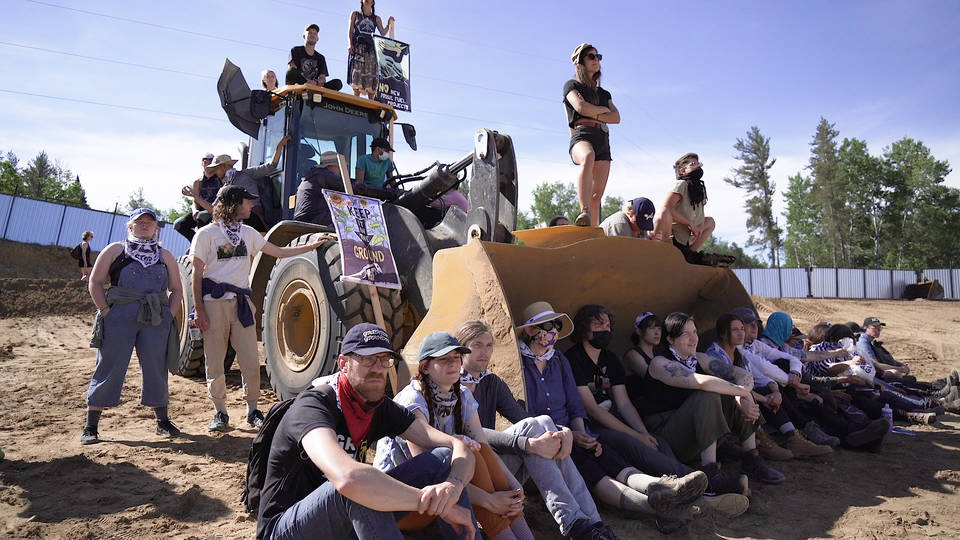
In northern Minnesota, over 100 water protectors were arrested Monday in the largest act of civil disobedience to date aimed at halting the Enbridge Line 3 pipeline. If completed, Line 3 would carry more than 750,000 barrels of Canadian tar sands oil a day through Indigenous land and fragile ecosystems, endangering lakes, rivers and wild rice beds. The day of action began when over 1,000 water protectors blockaded a pipeline pump station north of the town of Park Rapids. Many of the activists locked themselves together or to heavy machinery, including bulldozers and diggers.
Kerry Labrador: “I’m a mother of three children. I trooped out here from Boston. I’m a Mi’kmaq woman. And I’m here because they need backup. They need voices. There’s strength in numbers. You know? All these kids out here — I’m going to say it over and over and over again: All the kids out here deserve the future that we, as parents, promised our kids. And if this is how I have to fulfill that promise, then this is how I’m going to fulfill that promise, and not just for my kids, but for every kid sitting out here in this world.”
Protesters are calling on President Biden to shut down the pipeline.
Published on Thursday, March 18, 2021 by Common Dreams
With Deb Haaland Leading the Interior Department, Perhaps the United States Has Begun to Grow up Ecologically
It’s definitely time for an enormous shift in the consciousness of those who see themselves as exceptional and believe they’re in charge of the planet.byRobert C. Koehler
Is it possible that the country is truly rebuilding itself . . . from the soul up?
Deb Haaland has been confirmed as head of the Department of the Interior. A Native American congresswoman and, as she describes herself, 35th-generation New Mexican, has been given the reins of the department that has essentially been at war, not simply with her people but with the planet itself and, therefore, all of us, pretty much since its inception. That is to say, the department’s values are those the European colonialists brought with them to the new continent: steal the land from those who live there, then proceed to exploit it.
Many across the country are battling the aftermath of a Feb. 13 winter storm as nearly 3.4 million customers around the U.S. are still without electricity or heat. The demand for power overwhelmed power grids unprepared for climate change.
Temperatures hovered in the single digits as snow and ice storms hit parts of Texas where winter temperatures seldom fall below 40 degrees.
The latest storm front was expected to bring more hardship to Texas, Arkansas and the Lower Mississippi Valley before moving to the Northeast on Thursday, according to the Associated Press.
“Most people here have electric stoves so there’s no way to heat or cook food; they heat their homes with electric heat, so there’s no heat,” said Ashley Fairbanks, White Earth Nation.
Originally from Minnesota, Fairbanks lives in San Antonio, where winter temperatures usually hover around 70-80 degrees. On Wednesday morning the temperature was around 28 degrees, she said.
“It got down to 6 degrees during the storm; the week before it was like 80 degrees,” she said
“The ice on roads finally melted today so we left the house in search of food. It really is like the end times out here.”
Customer lines at fast food establishments snaked around city blocks and half of San Antonio’s restaurants were closed; grocery stores have run out of essential food and many are closed, Fairbanks said.
“There’s really no letup to some of the misery people are feeling across that area,” said Bob Oravec, lead forecaster with the National Weather Service, referring to Texas.
At least 30 people have died in the extreme weather this week, some while struggling to find warmth inside their homes. In the Houston area, one family succumbed to carbon monoxide from car exhaust in their garage. Another perished as they used a fireplace to keep warm.
City of Richardson worker Kaleb Love breaks ice on a frozen fountain Tuesday, Feb. 16, 2021, in Richardson, Texas. Temperatures dropped into the single digits as snow shut down air travel and grocery stores. (AP Photo/LM Otero)
Record low temperatures were reported in city after city. Scientists say the polar vortex, a weather pattern that usually keeps to the Arctic, is increasingly spilling into lower latitudes and sticking around longer, and global warming caused by humans is partly responsible.
Utilities from Minnesota to Texas and Mississippi have implemented rolling blackouts to ease the burden on power grids straining to meet extreme demand for heat and electricity. In Mexico, rolling blackouts Tuesday covered more than one-third of the country after the storms in Texas cut the supply of imported natural gas.
Tribes in Texas are working together and handling the challenges well, according to tribal leaders from the Alabama-Coushatta Tribe of Texas, the Tigua Ysleta Del sur Pueblo and the Lipan Apache Tribe contacted by Indian Country Today.
“Native people are extremely resilient. We’re all kind of tired of the cold weather, but we’re hunkered down and staying warm; at first it was beautiful but now we’re kind of done,” said Christi Sullivan, director of media and communications for the Alabama-Coushatta Tribe of Texas.
About 600 of the 1,375 tribal citizens live on reservation land about 90 minutes north of Houston.
“We urged people to prepare for the weather before it hit; one of our main concerns is our elders. We are calling and checking in on everyone making sure they’re okay,” said Sullivan.
Fortunately, only a portion of the reservation has been hit by the rolling electricity blackouts.
“So far, everyone is safe,” Sullivan said.
The worst U.S. power outages by far have been in Texas, where officials requested 60 generators from the Federal Emergency Management Agency and planned to prioritize hospitals and nursing homes.
The state opened 35 shelters to more than 1,000 occupants, the agency said.
Texas’ power grid manager, the Electric Reliability Council of Texas, said electricity had been restored to 600,000 homes and businesses by Tuesday night. Many, however, remain without power.
The weather also caused major disruptions to water systems in the Texas cities of Houston, Fort Worth, Galveston, Corpus Christi and in Memphis, Tennessee, and Shreveport, Louisiana, where city fire trucks delivered water to several hospitals and bottled water was being brought in for patients and staff, KSLA News reported. In Houston, residents were told to boil their water — if they had power to do so — because of a major drop in water pressure linked to the weather.
In Abilene, Texas, firefighters were hampered by low water pressure as they tried to extinguish a house fire this week, the Abilene Reporter News reported.
“They had to watch that house burn,” City Manager Robert Hanna said Tuesday at a news conference.
“Last night we were lying in bed without power and we could hear emergency sirens going all night long,” Fairbanks said.
The Texas power blackouts could be a glimpse of the future as climate change intensifies winter extremes that overwhelm utility infrastructures unable to handle unseasonable demands, according to the New York Times.
“Hey, we’re not built for this,” said Robert Soto, vice chair of the Texas state recognized Lipan Apache Tribe of Texas.
The tribe’s headquarters is based in McAllen, just north of Reynosa, Mexico, and near the Gulf of Mexico.
“Homes here aren’t built to handle the cold; for us a cold front is around 60 degrees. With this storm it’s been in the single digits and the 20s,” he said.
Thankfully everyone is safe, according to Soto.
The greatest needs for the tribe now are food and water. “We’re delivering food and water when and where we can; we don’t have a lot of funds but we’re doing the best we can,” Soto said.
Temperatures are expected to rise to the 70s by the weekend.
“We’ll be enjoying life and happy again; in the meantime please keep us in your prayers.”
Mary Annette Pember, a citizen of the Red Cliff Ojibwe tribe, is a national correspondent for Indian Country Today.