Return Lands

Lakota Law

Over the past months, we’ve shared with you about our exciting partnership with the Muwekma Ohlone people of California’s Bay Area. We’ve helped the tribe create media and, together, we designed a call to action to assist the Muwekma — proud descendants of some of California’s original inhabitants — as they seek to restore their rightful status as a federally recognized tribe.

This week, we met with the Muwekma again to discuss and help amplify another of their important initiatives: namely, returning the Presidio to their caring hands. Giving this sacred and historic land back to its original stewards would be a huge win for Indigenous justice — and it’s a real possibility in this moment of change and opportunity. Please watch the new video from the Muwekma Ohlone Tribe, in which they lay out the reasons why it should happen.

Watch: The Muwekma Ohlone have the original right to the Presidio.

You may recall that, years ago, I helped to organize the #landback movement by calling to return the Black Hills to the Lakota. I was present at the protest action near Mount Rushmore when President Trump visited for American Independence Day during his first term. Today, we remain dedicated to the return of our own sacred lands — and we stand in strong solidarity with other Indigenous groups seeking the same.

Perhaps ironically, Trump’s return to office could present a new opportunity to achieve those goals. His administration’s efforts to gut the federal workforce, eliminate programs, and lessen the financial burden for the federal government could create openings for tribes to step into voids created around stewardship of federal lands. And while Lakota Law stands with needed federal workers who keep our society running smoothly, we also recognize Indigenous ownership and stewardship as the ultimate outcome for stolen, sacred lands.

As with many things these days, this is a rapidly evolving issue, and we’ll have more to say on it soon, including action opportunities and more messages directly from our friends at the Muwekma Ohlone Tribe. As always, I’m grateful for your solidarity with us and with Indigenous landback efforts across Turtle Island.

Wopila tanka — thank you for standing for the sacred.
Tokata Iron Eyes
Spokesperson & Organizer
Lakota People’s Law Project
Sacred Defense Fund
Good Thinking: Return it All

California land to be returned to Yurok Tribe

Rosie Clayburn is a descendant of the Yurok Tribe, which had its territory — called ‘O Rew in the Yurok language — ripped from them nearly two centuries ago.

“As the natural world became completely decimated, so did the Yurok people,” she said.

That decimation started when miners rushed in for gold, killing and displacing tens of thousands of Native Americans in California and ravaging the redwood trees for lumber.

1734393805389.png© Credit: CBSNews

“Everything was extracted that was marketable,” Clayburn said. “We’ve always had this really intricate relationship with the landscape. We’ve hunted, we’ve fished, we’ve gathered. And those are all management tools. Everything that we do has been in balance with the natural world.”

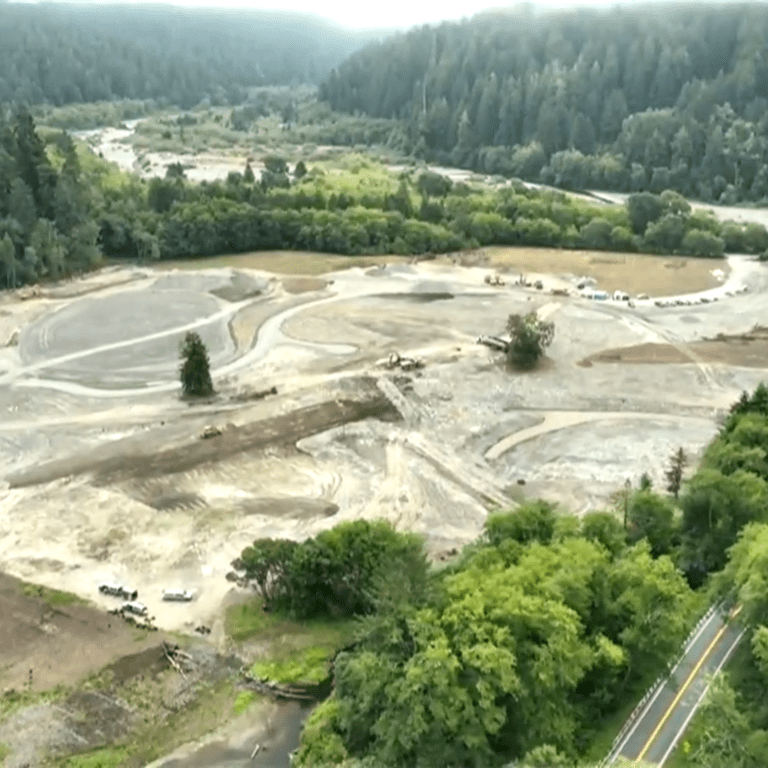
Now, generations later, 125 acres bordering Redwood National and State Parks will be handed back to the Yuroks.

The nonprofit Save the Redwoods League purchased the land in 2013 from an old timber mill, with the original goal of giving it to the National Park Service.

“As we continued conversations about the transfer of this land to the National Park Service, we began to realize that perhaps a better alternative would be to transfer the land back to the Yurok Tribe,” said Save the Redwoods League’s Paul Ringgold. “No one knows this land better. They’ve been stewarding this land since time and memorial”

Ringgold said that stewardship includes controlled burns to clear dead vegetation — a native practice once outlawed, but now recognized as essential in preventing catastrophic wildfires.

“Indigenous populations have been using fire as a management tool,” he said. “We’d like to see that kind of practice return.”

Redwoods serve as some of the largest stores of carbon on the planet. A single tree can capture up to 250 tons in its lifetime, the equivalent of removing nearly 200 cars from the road for an entire year. 

But between logging and fires, 95% of California’s redwoods have been destroyed. Over the past decade, the Yurok have been helping restore the land.

Another forgotten jewel of the ecosystem is salmon. The fish were once so plentiful, they were eaten with most meals. The Yurok word for salmon even translates to “that which we eat.” But the salmon population has dwindled to about one-quarter of what it was 20 years ago, according to a coalition of state and federal agencies.

The tribe is working to bolster the fish’s population by building a stream channel, two connected ponds and about 20 acres of floodplain.

“You have salmon who provide for humans, but they also provide for other animals,” Clayburn said. “And then when they spawn and die, they put nutrients back in the ground. And so, everything just has this, this balance and this reciprocal way.”

That balance is returning. There’s been a rebound in the salmon population and the Yuroks also recently reintroduced the California condor — a scavenger that’s important to the ecosystem — back into the wild for the first time this century.

“It tells us that our land’s healing and that our people are gonna heal,” Clayburn said.

The Yuroks will take full control of ‘O Rew in 2026 and, in a first-of-its-kind partnership, receive help managing it from the Save the Redwoods League, California State Parks and The National Park Service.

“We understand some of the mistakes we made as a federal government, and it’s a chance to begin that healing with the native tribes all across the United States,” said National Park Service Director Chuck Sams.

For Sams, the first Native American to lead the agency, the partnership is personal. 

“We’ve been writing our histories separately. There’s been the native history and then the American history. This is a chance when we’re doing co-stewardship and co-management to write history together,” he said.

Of the 431 parks managed by the National Park Service, 109 of them now have formal co-stewardship agreements with indigenous tribes, with 43 more on the way.

In addition to restoration work, plans for ‘O Rew include the creation of new trails, the construction of a traditional Yurok village and a state-of-the-art visitor center. The visitor center will display Yurok artifacts and highlight the tribe’s history and culture, with the goal of educating new visitors on the land’s history and significance from the perspective of those who have lived on it the longest.

“I really hope ‘O Rew symbolizes a coming home of the Yurok people and reconnecting with our landscape,” said Clayburn.