It’s time, once again, to protect a sensitive ecosystem in the He Sapa (Black Hills) from mining. A few days ago, the U.S. Forest Service (USFS) opened its 30-day public comment period for the Ponderosa gold mining project. If completed, this abomination will create 43 drill pads, each with the potential to wreak havoc 24 hours a day in Spearfish Canyon, a peaceful creekside and scenic byway right in our backyard.
We can’t let this happen. Please help us defend our homelands by sending your message to the USFS today. The proposed drilling project, just about a mile from a tribally-controlled area frequently used for ceremony, threatens to disrupt our way of life. Ponderosa should never endanger this beautiful area, which is also a haven for outdoor recreational activities and home to thousands of animal and plant species.
I can’t thank you enough for helping to protect our homelands and sacred sites. More than a thousand Lakota Law supporters like you responded to my last call to stop drilling near Pe’ Sla. I’m hoping for an even bigger response this time!
As always when sending to the Forest Service, please make sure to include your name, clearly register your objection, and state your reasons (environmental harm, preservation of peaceful recreational activities, and respect for Native ceremonial practice are good ones). In addition, on this one, please make sure you tell the USFS to conduct a thorough environmental review and create an Environmental Impact Statement (EIS).
We’ve only got a few weeks to weigh in and protect Spearfish Canyon! Please send your comment today. Thank you in advance on behalf of everyone who values our natural surroundings and all of us who call this beautiful region our home.
Wopila tanka — my gratitude to you for protecting our homelands! Tokata Iron Eyes Spokesperson & Organizer Lakota People’s Law Project Sacred Defense Fund
Warm greetings. Today, I share an urgent action. For many years, my family has helped lead the fight to protect Pe’ Sla, one of the most sacred places — located high in the Black Hills — to the Lakota People. In 2012, we helped make sure it returned to Indigenous care, but now it is threatened again by mining interests.
Fortunately, once again, we land defenders have the opportunity to stop the desecration of this ceremonial ground — but time is very short. May 16 — just days from now — is the deadline to tell the U.S. Forest Service it must not allow mining on this sacred ground! Please see below for the exact points to make, and I also invite you to watch my video and learn a little more about why I care so deeply about this special place.
Thankfully, the original May 9 deadline for comments was extended by one week — so let’s make our voices heard! We must not let the Rochford Mineral Exploratory Drilling Project tear up our sacred ground in its quest for graphite.
As our dear friends at the Black Hills Clean Water Alliance (BHCWA) have pointed out, this project is immediately adjacent to — and some proposed drill pads might encroach on — Pe’ Sla. Maps are vague, but, in their words, “by any definition, the project is too close!”
BHCWA’s research tells us that “the project would involve 18 drill pads. Exploration could contaminate water in the upper Rapid Creek watershed, with some proposed drill pads very close to streams. And there is also the potential for contamination or cross-contamination of underground water sources.”
BHCWA suggests that you include the following information when you submit your comment:
Your name and address
Why you care about this project and the Black Hills
The name of the project (Rochford Mineral Exploratory Drilling Project #67838)
Request for a 60-day extension of the “scoping” public comment period, so everyone has an opportunity to comment
A reason why you oppose the Rochford Mineral Exploratory Drilling Project. Use your own words, but two good ones are the potential negative environmental impacts and the disruption of traditional ceremonial practices for Lakotas
Tell the Forest Service to require an Environmental Impact Statement (EIS) for this project
This is an urgent request to protect sacred territory frequently used by many Lakota People for ceremonial practice. It is a pristine ecosystem and beautiful place. Please help us protect Pe’ Sla.
Wopila tanka — thank you, always, for your advocacy! Tokata Iron Eyes Spokesperson & Organizer Lakota People’s Law Project Sacred Defense Fund
BISMARCK, N.D. (AP) — The nearly 2,700-mile Keystone oil pipeline was shut down Tuesday morning after it ruptured in North Dakota, halting the flow of millions of gallons of crude oil from Canada to refineries in the U.S. and potentially leading to higher gasoline prices.
South Bow, a liquid pipeline business that manages the pipeline, said it shut down the pipeline after control center leak detection systems detected a pressure drop in the system. The company estimated that 3,500 barrels of oil were released and said the spill was confined to an agricultural field in a rural area, about 60 miles (97 kilometers) southwest of Fargo.
Rosie Clayburn is a descendant of the Yurok Tribe, which had its territory — called ‘O Rew in the Yurok language — ripped from them nearly two centuries ago.
“As the natural world became completely decimated, so did the Yurok people,” she said.
That decimation started when miners rushed in for gold, killing and displacing tens of thousands of Native Americans in California and ravaging the redwood trees for lumber.
“Everything was extracted that was marketable,” Clayburn said. “We’ve always had this really intricate relationship with the landscape. We’ve hunted, we’ve fished, we’ve gathered. And those are all management tools. Everything that we do has been in balance with the natural world.”
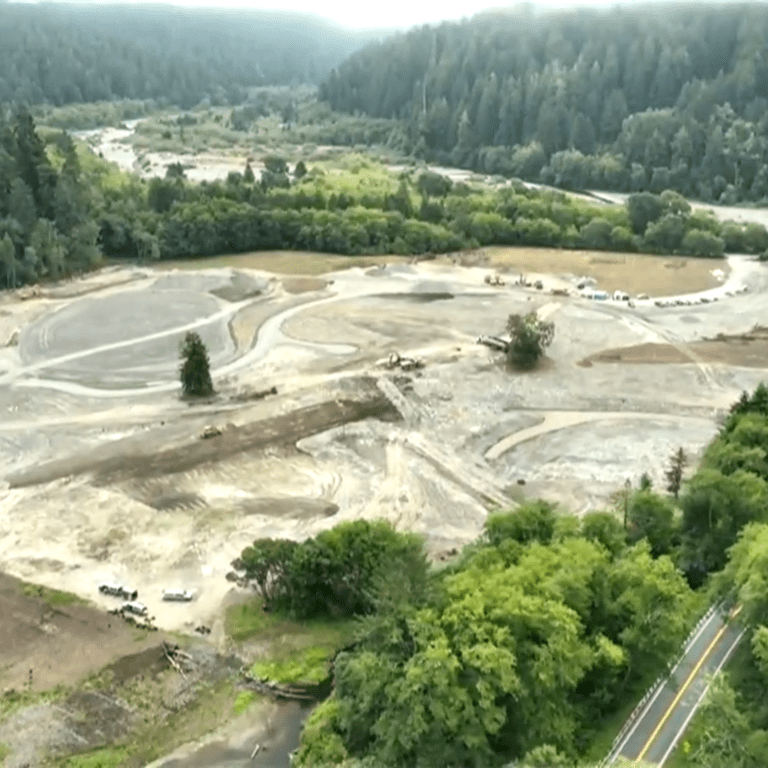
Now, generations later, 125 acres bordering Redwood National and State Parks will be handed back to the Yuroks.
The nonprofit Save the Redwoods League purchased the land in 2013 from an old timber mill, with the original goal of giving it to the National Park Service.
“As we continued conversations about the transfer of this land to the National Park Service, we began to realize that perhaps a better alternative would be to transfer the land back to the Yurok Tribe,” said Save the Redwoods League’s Paul Ringgold. “No one knows this land better. They’ve been stewarding this land since time and memorial”
Ringgold said that stewardship includes controlled burns to clear dead vegetation — a native practice once outlawed, but now recognized as essential in preventing catastrophic wildfires.
“Indigenous populations have been using fire as a management tool,” he said. “We’d like to see that kind of practice return.”
Redwoods serve as some of the largest stores of carbon on the planet. A single tree can capture up to 250 tons in its lifetime, the equivalent of removing nearly 200 cars from the road for an entire year.
But between logging and fires, 95% of California’s redwoods have been destroyed. Over the past decade, the Yurok have been helping restore the land.
Another forgotten jewel of the ecosystem is salmon. The fish were once so plentiful, they were eaten with most meals. The Yurok word for salmon even translates to “that which we eat.” But the salmon population has dwindled to about one-quarter of what it was 20 years ago, according to a coalition of state and federal agencies.
The tribe is working to bolster the fish’s population by building a stream channel, two connected ponds and about 20 acres of floodplain.
“You have salmon who provide for humans, but they also provide for other animals,” Clayburn said. “And then when they spawn and die, they put nutrients back in the ground. And so, everything just has this, this balance and this reciprocal way.”
That balance is returning. There’s been a rebound in the salmon population and the Yuroks also recently reintroduced the California condor — a scavenger that’s important to the ecosystem — back into the wild for the first time this century.
“It tells us that our land’s healing and that our people are gonna heal,” Clayburn said.
The Yuroks will take full control of ‘O Rew in 2026 and, in a first-of-its-kind partnership, receive help managing it from the Save the Redwoods League, California State Parks and The National Park Service.
“We understand some of the mistakes we made as a federal government, and it’s a chance to begin that healing with the native tribes all across the United States,” said National Park Service Director Chuck Sams.
For Sams, the first Native American to lead the agency, the partnership is personal.
“We’ve been writing our histories separately. There’s been the native history and then the American history. This is a chance when we’re doing co-stewardship and co-management to write history together,” he said.
Of the 431 parks managed by the National Park Service, 109 of them now have formal co-stewardship agreements with indigenous tribes, with 43 more on the way.
In addition to restoration work, plans for ‘O Rew include the creation of new trails, the construction of a traditional Yurok village and a state-of-the-art visitor center. The visitor center will display Yurok artifacts and highlight the tribe’s history and culture, with the goal of educating new visitors on the land’s history and significance from the perspective of those who have lived on it the longest.
“I really hope ‘O Rew symbolizes a coming home of the Yurok people and reconnecting with our landscape,” said Clayburn.
This is a very informative video that puts our current situation into a historical perspective. Watch the video, research the information, and make plans to prepare to change what is happening.
By now, you’ve no doubt become familiar with ongoing legal battles over the Dakota Access pipeline (DAPL). You may recall that I, myself, was targeted and faced years in prison. Fortunately, all serious charges against me were dropped as I prepared to present a comprehensive necessity defense outlining why I had no choice but to resist the pipeline and its threat to my homelands, our people, and Unci Maka, our Grandmother Earth. You might remember the Standing Rock Nation’s lawsuits to prevent the pipeline, and you also recently heard from me about my testimony in the trial between North Dakota and the federal government regarding who will split the costs of over-policing our peaceful protest camps.
Did you know that Energy Transfer, which operates the pipeline, has also targeted nonprofit organizations in the courts of law? Specifically — and preposterously — the oil company has gone after Greenpeace USA with a pair of lawsuits. Energy Transfer’s tactic is, unfortunately, increasingly popular. Extractive industry corporations seeking to suppress opposition to their exploitative projects file what’s known as a Strategic Lawsuits Against Public Participation (SLAPP). To give you another example, the lithium mine company operating at Thacker Pass is using SLAPP in an attempt to silence tribal activists, elders, and allies resisting the company’s destruction of Unci Maka and sacred sites on Paiute and Shoshone homelands.
A sign from a NoDAPL resistance camp perfectly sums up one reason why lawsuits against Greenpeace and other nonprofits are way off the mark. They discredit the Indigenous agency involved in frontline resistance movements.
Frankly, the latest lawsuit against Greenpeace is of a different magnitude — both in terms of the exorbitant amount of damages Energy Transfer is seeking and the specifics of the case. Greenpeace (and other entities resisting DAPL, including Standing Rock and other tribal nations) have evidence of clear legal violations committed by Energy Transfer in its rush to complete DAPL. Aware of the gravity of those violations and wanting to cast doubt on their veracity and rewrite the narrative, Energy Transfer has attacked Greenpeace with false allegations of defamation.
As Greenpeace has highlighted in this piece — which I strongly encourage you to read — none of the nine statements Energy Transfer claims as defamatory were originally made by Greenpeace. Rather, they were circulated publicly (and endorsed widely). I commend Greenpeace for hearing the call to join Native nations on the frontline of this fight and for accurately summarizing the problems with Energy Transfer’s SLAPP effort. Honestly, from our perspective, if you’re being sued for defamation by a major extractive industry corporation, you’re probably doing something right!
Of course, Native water protectors and land defenders are all too familiar with the oil company’s modus operandi. Our ancestors witnessed similar tactics when Indian agents exerted control over their lives in the wake of the Dawes Allotment Act. More recently, my parents, aunties, and uncles remember well the FBI’s attempt to infiltrate and destroy the American Indian Movement in the 1970s. Native Peoples understand deeply that a commitment to truth telling and justice invites backlash from wealthy and powerful interests — government, corporate, or both.
It’s extra important for us to have our allies’ backs now, as all of this is occurring against a stark backdrop: not only has DAPL already leaked many times, but it continues to operate without a valid Environmental Impact Study or easement to cross under the Missouri River upstream of Standing Rock. Furthermore, in 2022, Energy Transfer was convicted of criminal charges in connection to its disastrous operation of pipelines in Pennsylvania and Ohio. In other words, it’s essentially a criminal corporation committed to shifting blame onto activists fighting for environmental justice and tribal sovereignty. That’s why we’ll keep battling and shining the light of truth. We hope that despite all spurious and costly legal attacks, Greenpeace will, too. We are all in this fight together.
Wopila tanka — thank you for protecting water and advancing environmental justice! Chase Iron Eyes Director and Lead Counsel The Lakota People’s Law Project
I was finally able to put together the book about my climate alteration exhibit in Second Life for Burning Man 2, back in October 2019. The years between 2019 and now have been totally chaotic, so much has happened. The topic is still appropriate and the points I made are still valid, even more so.
As you know, very few things matter to me — and to this organization and to the planet we all hope our future generations can continue to inhabit — as much as a just transition to clean energy. That’s why we support communities fighting on the frontlines against harmful extractive projects, like the Standing Rock Nation and the Reno-Sparks Indian Colony as they resist the Dakota Access pipeline (DAPL) and Thacker Pass lithium mine, respectively. It’s also why we continue to ally with Native-led groups promoting climate solutions which encompass Indigenous knowledge and respect tribal sovereignty.
To that end, this week I traveled to the Muscogee Nation near Tulsa, OK, to attend the second annual Tribal Energy Equity Summit. I was honored to speak at this important gathering, hosted by the Alliance for Tribal Clean Energy. It brought leaders from tribes and organizations across Turtle Island together with representatives from the federal government to share our viewpoints and advance equitable clean energy solutions. As part of my attendance, I sat down with Chéri Smith, the alliance’s president and CEO, to talk about the importance of Indigenous agency in creating a clean energy future for tribes. Please watch our short video, meet Chéri, and learn more about her organization’s mission.
Watch: I sat down with Chéri Smith, President and CEO of the Alliance for Tribal Clean Energy, to talk about the importance of Indigenous agency in creating a clean energy future for tribes.
It’s been — if you’ll pardon the pun — an energizing week! The summit afforded me a great opportunity to network with like-minded people and organizations, meet new friends, and reconnect with old ones. I was especially happy to share space with Dennis “Bumpy” Pu‘uhonua Kanahele, head of the Nation of Hawai’i, which maintains its status as a sovereign government under international law, independent of the United States.
As our presence at the same summit that also hosted a pair of representatives from the White House indicates, this was a diverse gathering which welcomed a multitude of perspectives on how we can solve tribal energy issues in a just way and begin to remediate the climate crisis. As you know — and as exemplified by DAPL’s violation of our treaty lands, which hold so much potential for renewable energy development — those two issues are inextricably linked. I’m excited to see where we’ll go from here!
Speaking of DAPL: many of you have reached out to us after reading about my participation in the ongoing trial to determine whether the federal government should reimburse the State of North Dakota for exorbitant costs it alleges it incurred by over-policing our peaceful NoDAPL movement in 2016 and 2017. This article and this one can provide you a bit more of my perspective. I’ll also plan to report back to you with further thoughts once we hear of a judgment.
Wopila tanka — as always, thank you for supporting environmental justice! Chase Iron Eyes Director and Lead Counsel The Lakota People’s Law Project
CINCINNATI, Ohio — They came to protect the water.
Nearly 200 people traveled from Michigan to Cincinnati on Thursday, March 21, to support the state of Michigan’s efforts to stay out of federal court with its legal case calling for a partial shutdown of Enbridge Line 5.
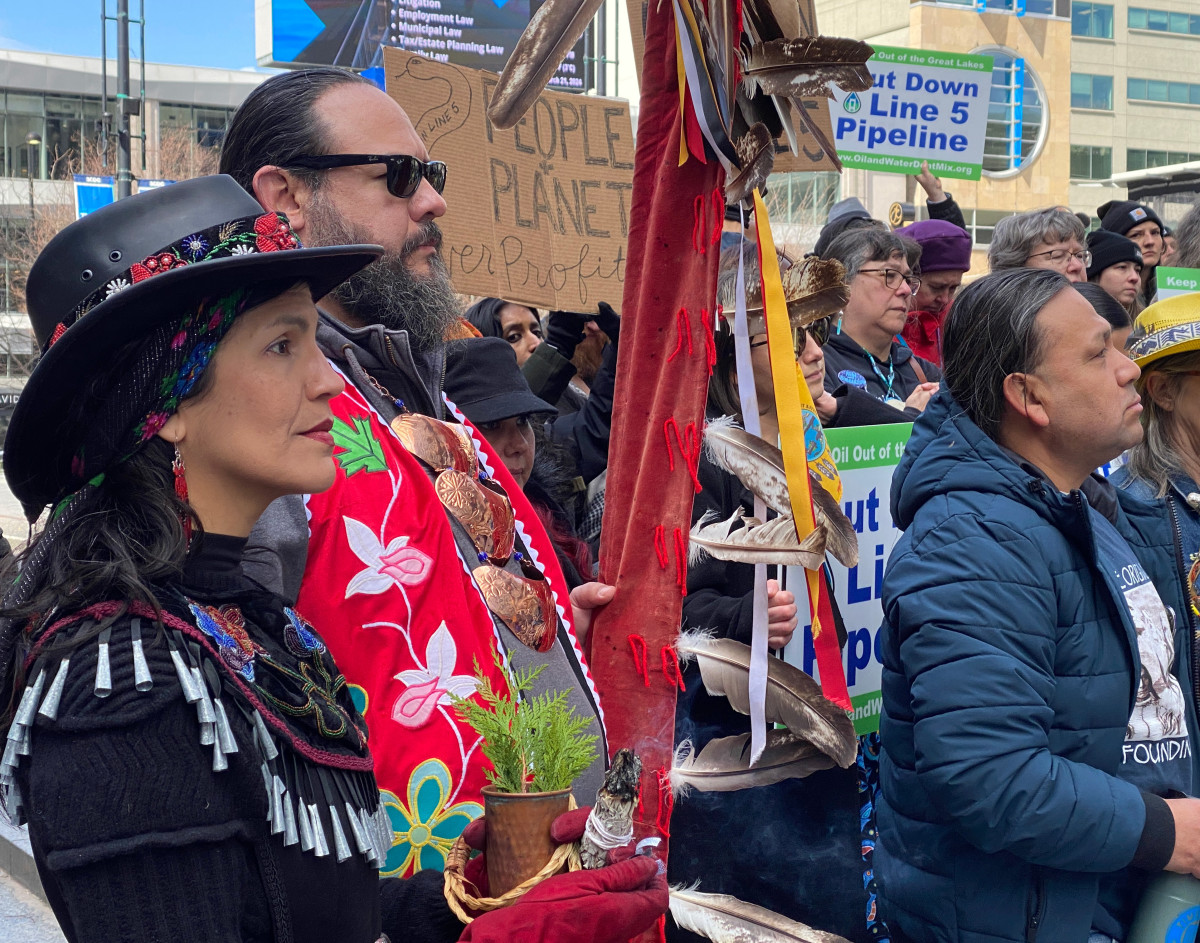
Several citizens and leaders of Michigan tribes were among those who joined the rally at Fountain Square, a major public space in downtown Cincinnati near the U.S. Court of Appeals for the Sixth Circuit.
The crowd waved banners and signs calling for the shutdown of the Line 5 pipeline, with some calling for “people and planet over profits.”
Inside the courthouse, Michigan officials asked the federal appeals court to allow the lawsuit filed by the state attorney general’s office to remain in state court – a move supported by a coalition led by the Bay Mills Indian Community of more than 60 tribes from the Great Lakes region and beyond.
“I’m from the Bear Clan. My job is to protect the forest and make sure our water is safe,” Andrea Pierce told the crowd Thursday. Pierce, of the Little Traverse Bay Bands of Odawa Indians, is part of the Michigan Environmental Justice Coalition.
Nicole Keyawbiber and Joe VanAlstine of the Little Traverse Bay Band of Odawa Indians in Michigan join a rally in Cincinnati, Ohio, on March 21, 2024, supporting Michigan Attorney General Dana Nessel’s efforts to keep her office’s lawsuit seeking shutdown of Enbridge line 5 in Michigan state court. (Photo by Mary Annette Pember/ICT)
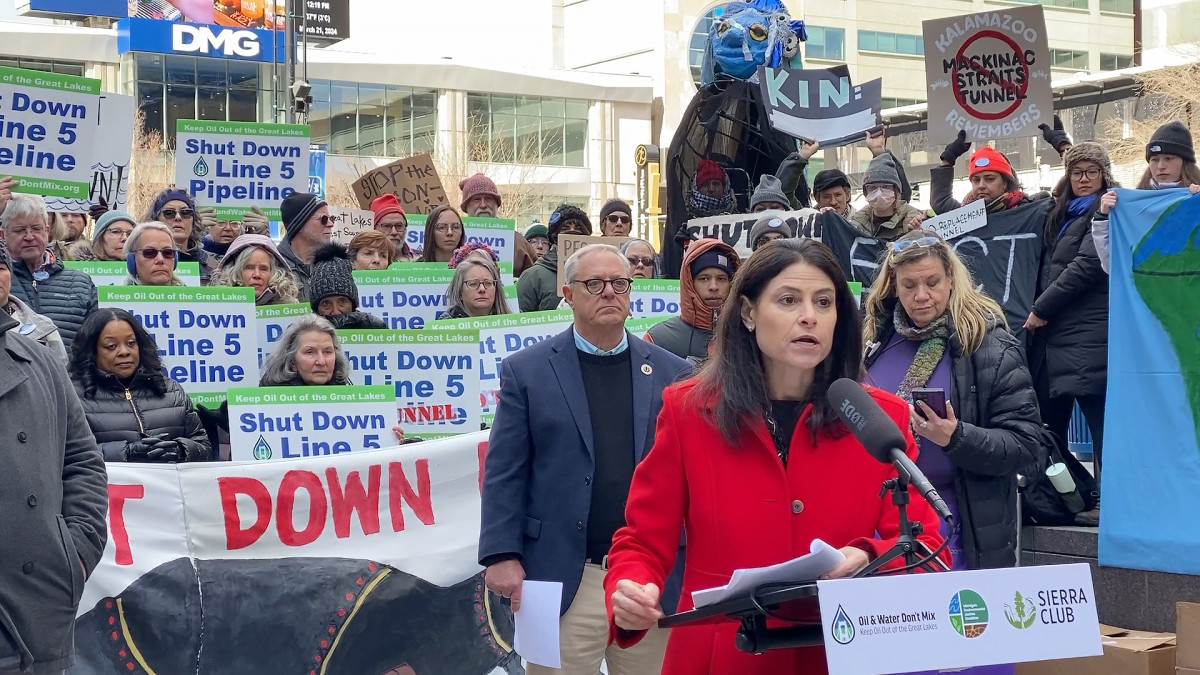
Michigan Attorney General Dana Nessel, who filed the legal action to shut down the pipeline, addressed the crowd during the rally at Fountain Square on why she wants to keep the issue in state court.
“This is a Michigan case brought under Michigan law by Michigan’s chief law enforcement officer on behalf of the people of Michigan on behalf of our Great Lakes and it belongs in a Michigan court,” she told the cheering crowd.
The Bad River Band of Lake Superior Chippewa in Wisconsin, which is litigating to keep Line 5 off of reservation lands, also signed onto the brief. All 12 of Michigan’s federally recognized tribes passed resolutions calling to decommission Line 5.
‘Public nuisance’
Line 5, constructed in 1953, runs 645 miles from Superior, Wisconsin, east through Michigan’s Upper Peninsula and under the Straits of Mackinac before it terminates in Sarnia, Ontario, Canada.
In the original 2019 lawsuit filed in Michigan circuit court, Nessel sought a shutdown of four miles of Line 5 pipeline that ran under the Straits of Mackinac. The lawsuit contends that the pipeline is a public nuisance and that allowing Enbridge to continue operating it is a violation of the public trust doctrine and the Michigan Environmental Protection Act.
The Straits of Mackinac link Lake Michigan and Lake Huron, and constitute one of the most ecologically sensitive areas in the world, according to Oil and Water Don’t Mix, an advocacy organization based in Michigan.
Michigan Attorney General Dana Nessel tells a crowd of supporters in Cincinnati, Ohio, on March 21, 2024, that her case seeking shutdown of Enbridge Line 5 belongs in Michigan state court rather than federal court. (Photo by Mary Annette Pember/ICT)
Nessel won a restraining order from a state judge in June 2020, but Enbridge successfully moved the case into federal court in December 2021.
Nessel asked U.S. Circuit Judge Janet Neff to shift the case back into state court, but Neff refused, prompting Nessel to appeal to the Sixth Circuit appeals court.
Enbridge filed a separate federal lawsuit in 2020 arguing the state’s attempt to shut down the pipeline interferes with federal regulation of pipeline safety, and could interfere with interstate and international trading of petroleum, driving up oil prices. That case is still pending in Neff’s court.
Enbridge has insisted the section of pipeline that runs beneath the Mackinac Straits is in good condition and could operate indefinitely. Enbridge has proposed encasing the pipes in a protective tunnel.
Assistant Attorney General Daniel Bock told the three-judge panel of the court in Cincinnati Thursday that the challenge to Enbridge’s Line 5 deals with the public trust doctrine, a legal concept in which natural resources belong to the public. He said that concept is rooted in state law.
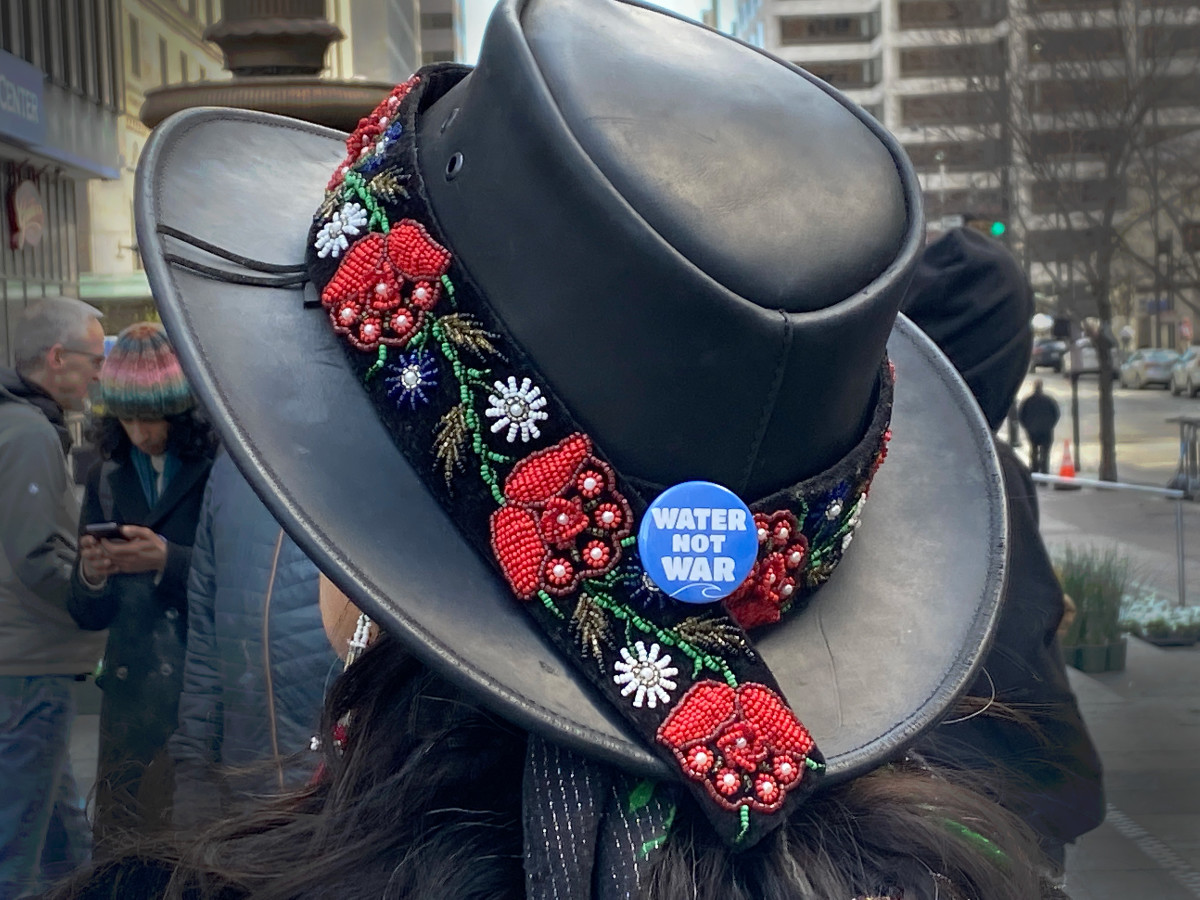
Water protector Nicole Keyawbiber wears a “Water not War” button on her hat at a rally on March 21, 2024, in Cincinnati, Ohio, supporting efforts to keep a Michigan state lawsuit seeking shutdown of Enbridge Line 5 out of federal court. (Photo by Mary Annette Pember/ICT)
Bock went on to assert that Enbridge, the Canadian company that owns the pipeline, missed its deadline to shift the case from state to federal court.
Enbridge attorney Alice Loughran countered that the case should remain in federal court because it affects international trade. She said the company didn’t have to comply with the standard 30-day deadline for requesting removal to federal court because it lacked enough information to formulate the request.
In an email sent to ICT, Enbridge spokesperson Ryan Duffy accused Nessel of forum-shopping in an effort to secure a favorable outcome.
“We are confident that ultimately the Sixth Circuit Court will agree with the lower court’s decisions from August 2022 and November 2021 that this dispute—which has generated a US foreign policy controversy—properly belongs in federal court,” Duffy wrote.
Protests continue
The protesters outside the courthouse were among thousands in recent years to protest the pipeline in Michigan, Wisconsin, Minnesota and even in Canada.
“Near and far, Anishinaabe people have united to protect the Great Lakes,” said Whitney Gravelle, president of the Bay Mills Indian Community, in a statement released Thursday to Earthjustice, a nonprofit environmental law organization.
“We stand behind Attorney General Nessel because we know that shutting down Line 5 is the only way to protect everyone who depends on the land, water, and natural resources within the Great Lakes,” Gravelle said, “including Anishinaabe people exercising our treaty rights.”
This article contains material from The Associated Press.
Greetings from Las Vegas, where I stopped to observe the mayhem of Super Bowl week. As my dad wrote to you a few days ago, we remain committed to changing the Kansas City Chiefs team name — and all racist characterizations of our people in the sports world. Also, I want to take a moment to say that because we are all human, and no matter how big our differences, I offer my sincere condolences to the Kansas City community in the wake of yet another instance of senseless gun violence. I pray for the day when we find better ways to listen to one another, discover common ground and understanding, and stop killing each other.
On a happier note, on my way to Vegas, I journeyed through some spectacular, sacred places. These included some of the Trail of the Ancients and traditional homelands of the Diné (Navajo) and Ute Peoples, including Monument Valley and Bears Ears National Monument — where something wonderful has occurred. I encourage you to watch my short video, recorded onsite, to hear about the recent gift of land back to Indigenous stewardship in Cottonwood Canyon.
Watch: I visited the sacred lands of the Ute and Diné Peoples to see Cottonwood Canyon and share with you about the importance of Landback efforts like the one in Cottonwood Canyon.
In many ways, the process undertaken with Cottonwood Canyon can serve as a model elsewhere across Turtle Island. A nonprofit organization bought available land and synched with a consortium of Native Peoples to preserve a beautiful place featuring rare views of spectacular rock formations and ancient dwelling sites. That’s something I dearly hope we can eventually replicate on a much larger scale with the Black Hills — but I’m also happy anytime we see the return of sacred lands to Indigenous care.
I’ll also say that the model isn’t perfect. Such transfers shouldn’t come with conditions. Isn’t the point of Native stewardship to respect our traditional knowledge systems regarding the land? So, while I appreciate the intent behind a condition of the transfer that will limit access to the site, I would also suggest that it shouldn’t be about eliminating human contact. Human beings should, in fact, have the opportunity to visit sacred places and relearn how to live in harmony with them, just as my relatives and ancestors have done for time immemorial. Even our allies can learn something here: please stop holding us to rules designed by colonizers.
In any case, a win is a win! Ultimately this gift will ensure that a special place displaying the ingenuity of our relatives’ ancestors and the vistas they loved will remain unspoiled for generations to come. And for that, I am truly grateful.
Wopila tanka — thank you for supporting landback efforts! Tokata Iron Eyes Spokesperson & Organizer The Lakota People’s Law Project
Lakota People’s Law Project 547 South 7th Street #149 Bismarck, ND 58504-5859
The Lakota People’s Law Project is part of the Romero Institute, a nonprofit 501(c)(3) law and policy center. All donations are tax-deductible.














 Water is Life