Today, I share with you a piece of good news on the mining and Native justice fronts! In case you missed it, earlier this week, President Biden and U.S. Secretary of the Interior Deb Haaland of the Pueblo of Laguna traveled to Arizona to announce a new national monument designed to protect Native homelands in the Southwest. Afterward, Secretary Haaland appeared on PBS News Hour to discuss the monument’s significance and its impact for Indigenous people. I encourage you to watch that segment here.
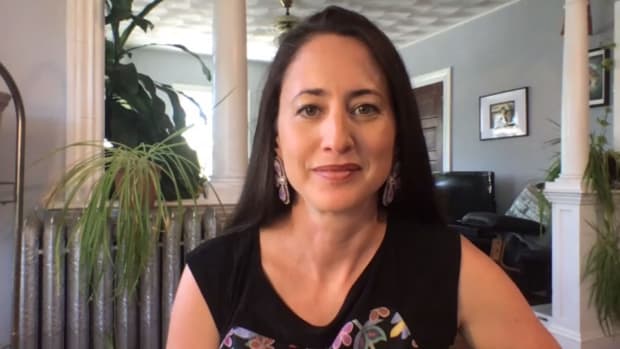
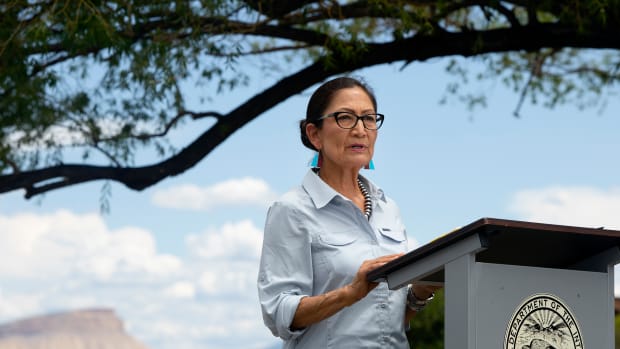
U.S. Secretary of the Interior Deb Haaland sat down with PBS News Hour to discuss the new national monument protecting Native homelands in the Southwestern United States.
We have rightly been critical of this administration and its failure to do more to stop mining in the Black Hills and at Peehee Mu-huh (Thacker Pass) in Nevada. Even as it has taken the most aggressive steps toward climate remediation that we’ve seen from the White House, the Biden administration is still falling short of its own climate goals. It’s just not enough. And, critically, Biden and Haaland must engage and adhere to the wishes of Indigenous communities on the frontlines of extractive industry — such as Standing Rock Nation with the Dakota Access pipeline and our Paiute and Shoshone relatives battling Lithium Americas at Thacker Pass.
Nonetheless, this near million-acre set-aside is a significant step in the right direction. We’re grateful that Baaj Nwaavjo I’tah Kukveni — Ancestral Footprints of the Grand Canyon National Monument in Arizona — will prevent new mining leases in this sacred and beautiful place.
According the administration’s fact sheet, the monument will protect “thousands of cultural and sacred sites that are precious to Tribal Nations in the Southwest – including the Havasupai Tribe, Hopi Tribe, Hualapai Tribe, Kaibab Band of Paiute Indians, Las Vegas Paiute Tribe, Moapa Band of Paiutes, Paiute Indian Tribe of Utah, Navajo Nation, San Juan Southern Paiute Tribe, Yavapai-Apache Nation, Pueblo of Zuni, and the Colorado River Indian Tribes.”
Still, it’s up to all of us to hold the administration’s feet to the fire. Props to PBS anchor Amna Nawaz for pressing Secretary Haaland for an explanation of why many voters still feel a lack of satisfaction in the administration’s handling of the climate crisis. This national monument is significant and cause for gratitude and celebration — but it can’t stop there. Going forward, Biden and Haaland must be better and do more to support Native and environmental justice issues.
Wopila tanka — We deeply appreciate your care for Native homelands. Chase Iron Eyes Co-Director and Lead Counsel The Lakota People’s Law Project
Today, I share with you our new blog and video delving into the long, disturbing history of mining on Indigenous lands on Turtle Island. As we’ve written to you previously, the sacred lands of our Paiute and Shoshone relatives at Peehee Mu’huh (or Thacker Pass) in Nevada are under imminent threat from a massive new lithium mine. They did not give their consent for this project, and now it could despoil sacred ceremonial grounds, historic massacre sites, and sensitive habitat home to several protected species.
In our new, short video — which you can find near the top of my blog — Paiute elder Dean Barlese discusses the importance of protecting our shared world.
Thacker Pass isn’t the only mining project currently endangering Native homelands. The Yaqui people are struggling to effectively resist another massive lithium mine in Sonora, Mexico, and according to the Associated Press, our southern neighboring nation has become the world’s deadliest location for environmental activists. And in our sacred Black Hills right here in the Dakotas, lithium is joining gold, uranium, and other precious elements on the list of mining interests we’ve been confronted by for 150 years.
I encourage you to read my blog to learn more, and watch the accompanying video to get additional perspective from Dean Barlese, a respected Paiute elder. Our thoughts today are also with all those on Maui in the Kingdom of Hawaii. We are praying for the safety of all living things in that beautiful place as they confront deadly fires powered by fast winds fueled by yet another hurricane.
This is, of course, all related. Storm frequency and intensity rise in conjunction with the out-of-balance relationship we have with Unci Maka, our Grandmother Earth. Our society’s failure to listen to Indigenous knowledge and plan ahead accordingly exacerbates the climate crisis and puts the future in peril for my generation and those to come. The youth say it. The elders are saying it. It’s time to make big changes before it’s too late. That’s why your advocacy with our cause is so important. It’s up to us — working together — to change the game.
Wopila tanka — thank you, always, for your care and attention. Tokata Iron Eyes Spokesperson The Lakota People’s Law Project
For the past six months, our co-director, law clerk, videographer, and organizers have all been in and out of Nevada, joining others in the effort to force the federal government to respect Indigenous sovereignty. By now, you’re probably well aware of the cause: Thacker Pass, or Peehee mu’huh, the site of the largest lithium deposit in the United States, anticipated to produce 25 percent of global lithium in the near term.
Today, I ask that you give to support our stand in solidarity with the Paiute and Shoshone peoples of Nevada in their fight to keep Big Green Extraction honest. We stand at a crossroads. As we press forward to replace fossil fuels with renewable energy, we must answer a question: will we show respect for Indigenous nations by honoring their right to self-determination and land possession, or will we allow the same tactics deployed by the fossil fuel industry for generations to sully our transition to green technology? Let’s make Elon Musk and other green entrepreneurs respect Indigenous sovereignty.
This beautiful area, home to multiple protected species and sacred to our Paiute and Shoshone relatives, is under threat from a massive lithium mining operation.
At Thacker Pass, the Ox Sam resistance camp has been active in recent months, and arrests and temporary restraining orders have been issued against our staff and other allies. Founding grandmother Josephine Sam has been forced to watch as her relative, Ox Sam founder Dorece Sam, faces a civil lawsuit. I’m the former official liaison for the Standing Rock Sioux Tribe to the resistance camps at Standing Rock in 2016 and ‘17. As such, I know something about what it takes to push back against the Destroyers of Unci Maka, our Grandmother Earth. One of the first principles of environmental justice is to show up when needed, and to not back down.
Peehee mu’huh (which means “Rotten Moon” in the Paiute language) got its name from a pair of massacres, including one in 1865 of at least 31 men, women, and children by U.S. soldiers. It’s now the place where the soul of the Green Revolution will be measured. In the coming weeks, we plan to publish a series of short videos telling the story of the resistance at Thacker Pass in the words of those on the ground. Please stay tuned.
We expect this struggle to be bruising, but it must be fought. In the current era of runaway climate change and rampant loss of biodiversity, playing defense is never enough. If we’re not on offense, we’re losing — and in this case, the cost could well be a healthy future for the people and other living things that call Peehee mu’huh home. Please join us in this struggle!
Wopila tanka — thank you for your friendship and solidarity. Phyllis Young Standing Rock Organizer The Lakota People’s Law Project
After a protracted series of delays, we continue to await the long-promised draft Environmental Impact Statement (DEIS) for the Dakota Access pipeline (DAPL). In today’s Water Wars video — produced as always by us in partnership with the Standing Rock Nation and Great Plains Tribal Water Alliance — we take you inside a May meeting between tribal leaders and the U.S. Army Corps of Engineers. You’ll see our frustration: none of Standing Rock’s serious concerns about DAPL have yet been addressed, and both the tribe and public must soon be given the ability to review and provide input on the environmental impacts of the dangerous and illegal pipeline.
Watch The Army Corps doesn’t have any answers for us. It’s time for them to face the music!
You probably know the history. Late in 2016, President Obama heard the call of thousands and halted construction on DAPL, citing the requirement of the National Environmental Policy Act that a full environmental assessment be done. But Trump greenlit the project in violation of federal law as soon as he took office. Now DAPL crosses the Missouri River and our treaty lands with no effective plan, as far as we’ve seen, for handling a spill.
And we know the current DEIS process is a sham. Environmental Resources Management (ERM), the company tapped by the Army Corps of Engineers to prepare the study, is a member of the American Petroleum Institute. And that body filed a legal brief in support of DAPL in Standing Rock’s lawsuit against the Army Corps. That’s an obvious conflict of interest.
The Army Corps has routinely ignored Standing Rock’s many critical concerns, and that’s why we’re counting on you when the public comment period finally opens. That could be any week now. No matter what, please stay ready to demand that the Army Corps procure a new EIS prepared by an impartial party — and shut this pipeline down.
Wopila tanka — thank you, as ever, for standing with Standing Rock. Chase Iron Eyes Co-Director and Lead Counsel The Lakota People’s Law Project
The U.S. Supreme Court said the United States is not required “to take affirmative steps to secure water for the Tribe” because that provision is not explicitly stated in the Navajo Treaty of 1868, according to its ruling in a 5-4 vote in Arizona v. Navajo Nation, released Thursday.
The case was the third and final federal Indian law case this term.
Thursday’s decision reverses a ruling by the U.S. Court of Appeals for the 9th Circuit. The tribe cannot proceed with a claim against the Department of the Interior to “develop a plan to meet the Navajo Nation’s water needs and manage the main stream of the Colorado River in the Lower Basin.”
The court also ruled that the tribe cannot present a cognizable claim of breach of trust.
Justice Brett Kavanaugh wrote the opinion and was joined by Chief Justice John Roberts and Justices Clarence Thomas, Samuel Alito and Amy Coney Barrett.
“And it is not the Judiciary’s role to rewrite and update this 155-year-old treaty,” Kavanaugh wrote. “Rather, Congress and the President may enact—and often have enacted—laws to assist the citizens of the western United States, including the Navajos, with their water needs.
Kavanaugh went on to write that the United States has no similar duty with respect to land on the reservation and it would be “anomalous to conclude that the United States must take affirmative steps to secure water.”
“For example, under the treaty, the United States has no duty to farm the land, mine the minerals, or harvest the timber on the reservation—or, for that matter, to build roads and bridges on the reservation,” Kavanaugh writes. “Just as there is no such duty with respect to the land, there likewise is no such duty with respect to the water.”
The Navajo Nation argued that securing water rights to the Colorado River for the tribe fell under the federal government’s trust obligations that were being unfulfilled.
Critics immediately reacted to the decision saying it is a virtual theft of water from the Navajo Nation.
Navajo Nation President Buu Nygren and Speaker of the 25th Navajo Nation Council Crystalyne Curley shared their disappointment in the decision in a joint press release.
As president, Nygren said it is his job to protect the people, land and future and that he remains “undeterred in obtaining quantified water rights for the Navajo Nation in Arizona.”
“The only way to do that is with secure, quantified water rights to the Lower Basin of the Colorado River,” Nygren said in the statement. “I am confident that we will be able to achieve a settlement promptly and ensure the health and safety of my people.”
“Today’s ruling will not deter the Navajo Nation from securing the water that our ancestors sacrificed and fought for — our right to life and the livelihood of future generations,” Curley added.
As he has done in the past, Justice Neil Gorsuch laid out the history of the tribe and the surrounding circumstances that led to this point in his dissenting opinion. He writes that it is known that the United States holds some of the tribe’s water rights in trust and the government owes the Navajo Nation “a duty to manage the water it holds for the Tribe in a legally responsible manner.”
In his concluding paragraphs, Gorsuch writes that the tribe has tried nearly everything and poses the question, “Where do the Navajo go from here?”
“The Navajo have waited patiently for someone, anyone, to help them, only to be told (repeatedly) that they have been standing in the wrong line and must try another. To this day, the United States has never denied that the Navajo may have water rights in the mainstream of the Colorado River (and perhaps elsewhere) that it holds in trust for the Tribe,” Gorsuch writes. “Instead, the government’s constant refrain is that the Navajo can have all they ask for; they just need to go somewhere else and do something else first.”
Derrick Beetso, Navajo, is an attorney and director of Indian Gaming and Self-Governance at Arizona State University Sandra Day O’Connor College of Law. He also is a board member of IndiJ Public Media, the non-profit that owns ICT.
He said the opinion acknowledges that the tribe does have water rights, although they are unquantified.
“The tribe itself is pretty much in the same position they were in before this litigation and in some respects has to go back to the drawing board to figure out how they can get the administration to move forward on assessing their water needs,” Beetso told ICT.
He added that the Supreme Court is just one branch of the government and the Navajo Nation may switch focus to the Biden Administration and Congress in the future.
“The administration can do all the things that the tribe’s asking them to do without a court telling them to do it,” he said. “And so I think the Navajo Nation can shift gears and put a lot of pressure on the Biden administration and see what can get done under this administration.”
Native American Rights Fund executive director John Echohawk, Pawnee, said in a joining statement with the National Congress of American Indians that the decision condones a lack of accountability by the U.S. government.
“Despite today’s ruling, Tribal Nations will continue to assert their water rights and NARF remains committed to that fight,” Echohawk said.
Fawn Sharp, Quinault, called the decision a setback but added tribes and Native organizations will continue to fight for and defend tribal sovereignty and the preservation of Indigenous ways of life.
“Water is necessary for all life, and when our ancestors negotiated agreements with the United States to secure our lands and our protection, water was understood and still is understood to be inseparable from the land and from our peoples,” Sharp said in the statement. “Today, the Supreme Court has once again assisted in the United States’ centuries-long attempts to try to get out of the promises they have made to Tribal Nations by stating that treaties only secure access to water, but do not require the United States to take any steps to protect or provide that water to our people.”
The court ruled in mid-June on the other two federal Indian law cases. The high court affirmed the Indian Child Welfare Act in a major win that was celebrated across Indian Country. The same day the ICWA opinion was released, the court also ruled on Lac du Flambeau Band of Lake Superior Chippewa Indians v. Coughlin.
In that ruling, the court stated that tribes cannot use sovereign immunity in Bankruptcy Court.
I remain on the sacred grounds at Peehee Mu’huh, where the resistance to protect Thacker Pass from a massive lithium mine suffered a major blow last week. On Wednesday, police raided the two prayer camps set up by our Paiute and Shoshone relatives, extinguishing the sacred fire lit since May 11 when the grandmother-led action began, destroying the two ceremonial tipi lodges, mishandling and confiscating ceremonial instruments, and arresting an Indigenous land protector. Ox Sam Camp shared a video they captured with us. Please watch how it went down on our Facebook page.
Watch and share on Facebook: footage of the arrest at Thacker Pass captured live last week.
During breakfast, law enforcement arrived. Almost immediately and without warning, a young Diné (Navajo) water protector was singled out by Lithium Nevada security and arrested. Even as two non-Natives were allowed to “move” in order to avoid arrest, the Diné woman was quickly handcuffed and subsequently loaded into a sheriff’s SUV for transport to Winnemucca for processing.
While on the highway, she says — again without warning or explanation — she was transferred into a windowless, pitch-black holding box in the back of a pickup truck. “I was really scared for my life,” she told Ox Sam Camp. “I didn’t know where I was or where I was going. I know that [the epidemic of missing and murdered Indigenous women] is a real thing, and I didn’t want to be the next one.” She was eventually transported to Humboldt County Jail, where she was charged with criminal trespass and resisting arrest, then released on bail. Again, I urge you to watch the video. Resisting arrest? I don’t think so.
Just hours before the raid, Ox Sam camp’s water protectors bravely stood in the way of large excavation equipment, shutting down construction at the base of Sentinel Rock for the second time that week. To many Paiute and Shoshone People, Sentinel Rock is a “center of the universe.” It’s been a site to gather traditional medicines, tools, and food supply for thousands of years, integral to many Nevada tribes’ way of life.
On Wednesday, at least five Sheriff’s vehicles, several Lithium Nevada work vehicles, and two security trucks arrived at the original tipi site containing the ceremonial fire. After the arrest and once the main camp was secured, law enforcement moved to dismantle the tipi site at Sentinel Rock, a mile away. There is a proper way to take down a tipi and ceremonial camp, and then there’s the way Humboldt County Sheriffs proceeded on behalf of Lithium Nevada Corporation. They knocked down tipis, snapped tipi poles, and rummaged through, mishandled, and impounded ceremonial objects and instruments. They approached and secured tents in classic SWAT-raid fashion.
As we mentioned to you previously, Peehee Mu-huh is the site of two massacres of Paiute and Shoshone people. The remains of the massacred ancestors have remained unidentified and unburied since 1865. They are now being bulldozed and crushed by Lithium Nevada without consent or permission from the area’s Indigenous Peoples.
It’s clear that Lithium Nevada and law enforcement are now doing all they can to stifle this resistance before it can grow. Our videographer, Chuck, was one of several people served with restraining orders over the past several weeks, and we’re hearing threats of further legal action designed to stop continued media coverage of the events now unfolding. Ox Sam Camp has put out a call for legal defense assistance. If you can help, contact them through their website. And please stay tuned for further developments and potential action opportunities.
Wopila tanka — thank you for standing with water and land protectors! Chase Iron Eyes Co-Director and Lead Counsel The Lakota People’s Law Project
Last year, we helped mobilize support around a planned gold mine’s imminent threat to Jenny Gulch, the Pactola Reservoir, and the Rapid Creek watershed in South Dakota. Today, it’s time to act once again. The U.S. Forest Service is taking public comments on a proposed mineral withdrawal, and there’s a real and imperative opportunity for us to save one of the most beautiful and special places in Lakota Country.
Please click here to tell the U.S. Forest Service you support the Pactola area mineral withdrawal! We encourage you to say you also support expanding the area covered by the withdrawal to include all federal lands in the Black Hills. Tell the Forest Service that these sacred lands, which nourish so many Native and non-Native communities downstream with clean water, should be preserved and pristine forever.
The Pactola Reservoir provides fresh water and a beautiful place for South Dakotans to experience natural wonders. Please act now to ensure this area of the sacred He Sapa isn’t polluted by mining.
The deadline for all public feedback is June 20, so this is as urgent as it gets! As you know, we usually like to provide you with easy-to-send, pre-filled form emails. However, because the Forest Service has its own form and values individually crafted messages, please use your own words on this one. Here are some effective talking points when sending your message:
Most importantly, say you want the Forest Service to say YES to the Pactola Reservoir-Rapid Creek Watershed Withdrawal.
Ask the Forest Service to do an Environmental Assessment (EA).
Ask for a Finding of No Significant Impact (FONSI) when the EA has been completed. This may seem counterintuitive, but there will, in fact, be no significant impact to the land once the miners are forced to withdraw!
Choose and give at least one primary reason for your support of the mineral withdrawal. Focus on water quality and cultural values, such as keeping the water free of toxic pollutants, respecting the sacred lands of the Lakota People, and preserving the site for recreation.
Here are two other important notes to keep in mind. First, we are NOT asking for a full Environmental Impact Statement (EIS). Instead we want an EA, which is a much faster process. If, when we messaged you before about Jenny Gulch, you already submitted a comment and asked for an EIS, you can and should make another comment and ask for an EA and FONSI now. Earlier comments written about Jenny Gulch don’t count in the new mineral withdrawal process.
Numbers, however, do count. If you’d like to expand your commentary with additional detail, you can visit the Black Hills Clean Water Alliance (BHCWA) website to learn more. In solidarity with our friends at the BHCWA and every person in South Dakota who values clean water, sacred lands, and beautiful expressions of the natural world, I humbly ask that you act right now to protect the Rapid Creek watershed.
Wopila tanka — thank you for your attention and action! Chase Iron Eyes Co-Director and Lead Counsel The Lakota People’s Law Project
It’s important that enterprising reporters cover Native issues in the right way. Today, I’m happy to highlight a solid example of such reporting. When protest is a crime, part one: the Standing Rock effect is the first of a multi-part podcast from the talented team at Outside/In, a division of New Hampshire Public Radio. It examines the criminalization of protest in America through the lens of Indigenous resistance. Both my father, Lakota Law co-director Chase Iron Eyes, and I sat down with reporter and producer Justine Paradis to lend our perspectives. I encourage you to listen to what we had to say.
Click to listen to our appearance on the Outside/In podcast from New Hampshire Public Radio. Photo of Oceti Sakowin Camp by Irina Groushevaia on Flickr.
In 2016 and 2017, when we formed the resistance camps at Standing Rock to stop the Dakota Access pipeline (DAPL), it quickly became apparent that our movement was going to have an unusual kind of impact. Other tribes showed up in force. Alexandria Ocasio-Cortez traveled to our homelands and decided while there to run for office. U.S. veterans arrived on the scene in support of our cause, rattling the established order. In all, tens of thousands of people helped us make worldwide news, and we succeeded in raising public consciousness to the point that President Obama actually shut DAPL’s construction down.
You probably know what happened next. Newly elected, Donald Trump quickly overturned Obama’s decision and fast-tracked the pipeline. And then, the conservative backlash really kicked in. Over the next several years, states began creating policies meant to chill citizens’ right to free expression under the guise of infrastructure protection. The federal government even tried to make it legal for law enforcement to kill protestors. Thankfully, after people like you sent thousands of messages to legislators, that particular bill didn’t make it out of the Senate.
Nevertheless, things remain tenuous today, and that’s why we must keep shining our lights on nefarious efforts to silence our voices and roll back our rights. Using clips and a series of interviews that include personal stories — like my own about watching my mother get arrested — Justine and her team deftly do just that. They examine the NoDAPL movement, various forms of direct action, and the history of Indigenous resistance. Please give the podcast a listen, and share it with your network. Then keep your eye out for the second episode, slated to drop later this week!
Wopila tanka — thank you for being a part of our resistance. Tokata Iron Eyes Organizer The Lakota People’s Law Project
Lakota People’s Law Project 547 South 7th Street #149 Bismarck, ND 58504-5859
The Lakota People’s Law Project is part of the Romero Institute, a nonprofit 501(c)(3) law and policy center. All donations are tax-deductible.
Warm greetings to you. Today, I share with you my story of a very important experience. Earlier this month, I joined my father, Lakota Law co-director Chase Iron Eyes, and our videographer, Chuck Banner, on a trip to Thacker Pass in Nevada — or Peehee Mu’Huh, as it’s known in the Paiute language. We were there to support our Paiute and Shoshone relatives in a direct action to stop a massive lithium mine, which threatens a sensitive ecosystem and disturbs sacred burial grounds. Upon my return, I wrote a blog and shot a video, which I encourage you to read and watch.
Watch: In my new video, I’m joined by my father and Reno-Sparks Indian Colony’s Michon Eben to talk about what’s happening at PeeHee Mu’Huh.
I won’t go into a ton of detail for you here, because the blog and video do that. Suffice to say that the Indigenous People of Nevada need our attention and support. Just like Standing Rock with the #NoDAPL struggle, they’re on the frontlines of extractive capitalism, and their homelands are being desecrated without their consent.
It hasn’t yet reached the same extremes as the coordinated effort by law enforcement and Big Oil at Standing Rock, but once again, activists on the frontlines are being targeted. My colleague Chuck was among several people hit with Temporary Protective Orders; another was Dorece Sam, a Fort McDermitt Paiute-Shoshone tribal member and Nevada President of the Native American Indian Church. These actions by law enforcement are meant to stifle our ability to exercise First Amendment rights to free speech and protest.
We must not stand down. We should use this moment to grow the movement. It’s time to recognize and reinforce the latest front in the battle to protect Indigenous People, defend sacred lands, and preserve precious, life-giving water.
Wopila tanka — thank you for standing with our Paiute and Shoshone relatives! Tokata Iron Eyes Organizer The Lakota People’s Law Project
Kola iyuha iciciyapi. As you know, Lakota Law’s team protects Indigenous sovereignty in myriad ways, including defending ICWA, supporting #NoDAPL efforts at Standing Rock, and amplifying vital Native perspectives. And while there’s much left to do on our shared journey toward justice, it’s important to periodically reflect back on some of our key accomplishments together. In that spirit, I encourage you to review the impact we made during 2022 by reading through our just-released Annual Report.
To view the full 2022 report, click the banner above.
As you may know, the Lakota People’s Law Project is part of the Romero Institute, a 501(c)3 umbrella organization with a 45-year record of fighting in the courts for social justice. The Institute also runs Let’s Geen CA!, a groundbreaking climate initiative in California. Thanks to big-hearted generosity and friendship from you and so many others, we’re able to take on big, strategic challenges with precision. You have our deep gratitude for all you’ve given, and the best is yet to come!
The report details a range of the Romero Institute’s efforts, financials, and accomplishments. In the Lakota Law section, you’ll see an outline of our history, mission, and highlights from last year. Then, we break down some key impacts you helped make possible. I’m happy to say that includes more than 220,000 actions signed by friends like you — including advocacy campaigns to protect ICWA, demand an end to whitewashing of history in schools, and defend PeeHee Mu’Huh (Thacker Pass) and the sacred He Sapa (Black Hills) from mining.
Thank you, always, for supporting the Lakota People’s Law Project. We’re grateful you continue to walk with us, and we look forward to keeping you informed. The actions you take have real meaning and impact, with far-reaching effects here in Lakota country, across Turtle Island, and around our world.
Wopila tanka — thank you for your support of Indigenous and environmental justice! Chase Iron Eyes Co-Director and Lead Counsel The Lakota People’s Law Project



















 Water is Life