Action: Deadline Approaching for a Journalism Fellowship December 9th

December 4, 2024
Deadline: Montana Free Press/ICT fellowship Applications are being accepted through Dec. 9, 2024, for a full-time, paid fellowship position with ICT and the Montana Free Press to cover Indigenous issues in the upcoming 2025 Montana legislative session.  The internship will be based in Helena, Montana, and will run from January through May 2025. A salary and housing allowance will be provided. The Montana Free Press, Montana’s premier independent nonprofit news organization, in partnership with ICT (formerly Indian Country Today), has an immediate opening for an Indigenous Montana Legislative Fellowship in our Helena, Montana, newsroom. The paid fellowship is open to undergraduate or graduate college students and early career journalists who want to develop statehouse and political reporting skills in service of impactful community coverage. Knowledge of Indigenous communities, issues and policies will be considered a plus. The fellowship is an opportunity to deepen and broaden reporting skills while learning from and collaborating with experienced statehouse journalists and news industry professionals.

FIND DETAILS HERE [Eliza Wiley/Montana Free Press] Read the work of JoVonne Wagner, the 2023 fellow, from her time in Helena!

Email Dianna Hunt at dianna@ictnews.org for any questions. SUPPORT INDIGENOUS JOURNALISM Donate now To sponsor ICT, please contact Heather Donovan at (315) 447-6145 or hdonovan@ictnews.org

Take Action: Free Leonard Peltier

ACTION ALERT: Calling all supporters of Leonard Peltier to sign this petition to urge President Joe Biden to grant Leonard Peltier executive clemency. #FreeLeonardPeltier

Background

“The fight has not ended for me” – Leonard Peltier

Leonard Peltier, a member of the Turtle Mountain Band of Chippewa Indians, is in his 50th year of imprisonment. Leonard is 80 years old and his health is rapidly declining. He stands as a symbol of the ongoing racism and oppression against Native Americans in the United States criminal justice system, issues that Leonard fought against in the 1970’s and throughout his incarceration.

On July 2nd, millions of people across Indian Country were devastated to learn that Leonard Peltier, an activist and member of the American Indian Movement, had been denied parole by the United States Parole Commission. The Commission issued the decision after a parole hearing on June 10th at the United States Penitentiary Coleman I in Florida, where Mr. Peltier is currently incarcerated.

“They denied parole to a survivor of genocidal Indian boarding schools as he struggles to survive this unjust incarceration, they insist on holding him for a crime for which they have no physical evidence against him. Clearly, the Parole Commission – which is supposed to be an independent body – was influenced by the FBI. The FBI continues to abuse its power, promote false narratives, and engage in counterintelligence activities. The FBI has no regard for the Constitution or the laws they have sworn an oath to protect.” – Nick Tilsen, President and CEO, NDN Collective

The FBI director at the time J. Edgar Hoover was waging a war against anyone he perceived as a threat. His violent and illegal tactics under COINTELPRO — the FBI’s Counterintelligence Program (1956 to 1971) — were a direct assault on the American Indian Movement, the Black Panther Party, and the Women’s Liberation Movement. “Hoover’s FBI did everything it could to consciously and deliberately derail the Civil Rights Movement,” said Stevie Van Zandt

While Leonard’s attorneys file an appeal of this decision, we call on President Joe Biden to grant executive clemency to #BringLeonardHome. President Biden promised to be a friend and ally of Indigenous Peoples.

Will Biden release the oldest living Indigenous political prisoner in American history, or will he simply allow Peltier to die in prison?

President Biden, you have the power to do what’s right we are demanding that you #FreeLeonardPeltier NOW via Executive Clemency. The whole world is watching.

Sign the petition today to let President Biden know we will not stop fighting for Leonard’s freedom. We are all not free until Leonard is free.

Sponsored by

NDN

To: President Joe Biden
From: [Your Name]

I write to you today to urge you to grant Leonard Peltier executive clemency.

Leonard Peltier, a member of the Turtle Mountain Band of Chippewa Indians, is in his 49th year of imprisonment. Leonard is 79 years old and his health is rapidly declining. He stands as a symbol of the ongoing racism and oppression against Native Americans in the United States criminal justice system, issues that Leonard fought against in the 1970s and throughout his incarceration.

The FBI has taken every measure to prevent Leonard from being released including ignoring the Constitution and violating Peltier’s civil rights. Peltier has served nearly 50 years on evidence that decades’ worth of observers have called into question. Witnesses were coerced and advocates say evidence was falsified. Two of the other men charged with the same crime were acquitted. In addition, a witness whose information was key to Peltier’s extradition from Canada to stand trial for the murders later said she made up her story under pressure from the FBI.

President Biden, you have the power to release the oldest living Indigenous political prisoner in American history, will you take swift action or simply allow Peltier to die in prison?

The whole world is watching. #FreeLeonardPeltier

Truthsgiving

Happy Truthsgiving to you and yours! If that term is new to you, I refer you here, to a “debate” I had with Sean Sherman, known as the Lakota Chef, last year at this time, published in The Nation Magazine. I put “debate” in quotes, because — truthfully — Sean and I agree on many things. For instance, we both talk about how traditional Thanksgiving mythology fails to recognize the steep price paid by our people after colonizers came to our shores, the land that was stolen from us, and the variety of indispensable foods contributed by Indigenous cultures now enjoyed around Thanksgiving tables.

In my section, I expand on those thoughts by suggesting a rebrand of this deeply problematic holiday. Some in my community have called it “Thankstaking,” highlighting the many unwilling sacrifices Indigenous peoples have made over the centuries. Personally, I prefer Truthsgiving — which, while keeping with the traditional holiday spirit of sharing and gratitude, also calls for a necessary truthtelling component. And as a reminder to you: I invite you to stay in a space of gratitude and openness next week, when you’re invited to RSVP and join us online for our fourth annual Wopila Gathering, beginning at 4 p.m. PST on Giving Tuesday, Dec. 3.

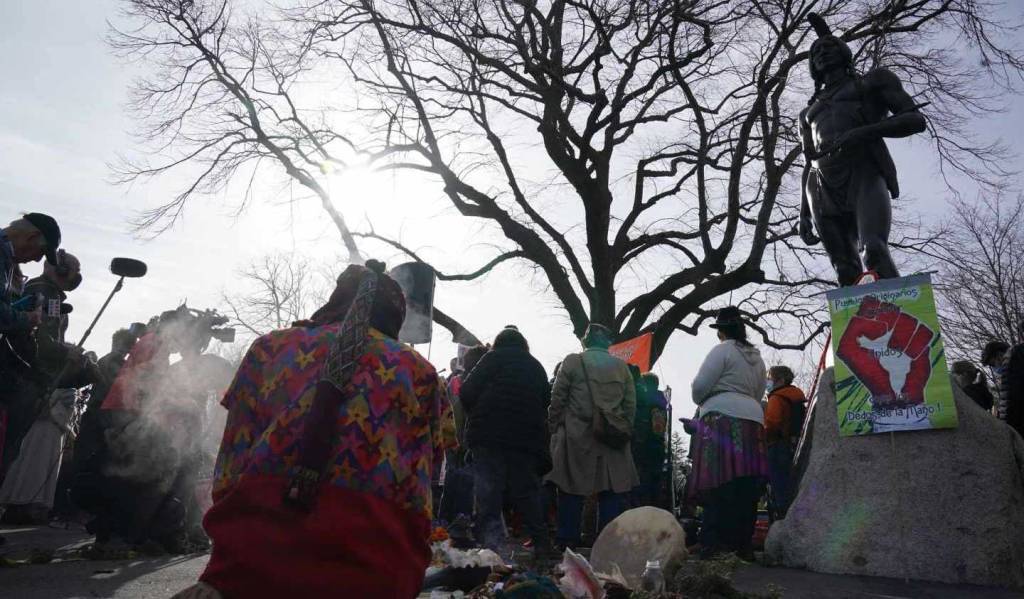
Lakota LawPeople engage in a National Day of Mourning ceremony in front of a statue of Chief Massasoit, leader of the Wampanoag tribe, in Plymouth, Mass. on Thanksgiving Day in 2021. (Bryan R. Smith / Getty Images)

Between Truthsgiving and our Wopila Gathering, on Friday the U.S. also celebrates Native American Heritage Day, at the conclusion of National Native American Heritage Month. I’m grateful that each November is designated as a time to celebrate the history, culture, and achievements of Turtle Island’s Indigenous nations. If you’re Native, I hope you’re able to take some extra time to commune with your relatives and acknowledge your ancestors this weekend. And if you’re non-Native, I hope you’ll make room to appreciate all we have given.

And then, everyone, please attend the Wopila Gathering on Giving Tuesday. This annual event provides an excellent opportunity for us to gather around an even larger table to share stories, priorities, music, and all we have to give to one another. It’s going to be a wonderful couple hours of togetherness, generosity, and joy, so I hope you’ll bookmark this page, RSVP, and Zoom in with us for the festivities!

Wopila tanka — thank you for hearing us, and I hope to see you on Tuesday.
Chase Iron Eyes
Director and Lead Counsel
Lakota People’s Law Project
Sacred Defense Fund

Lakota People’s Law Project

Lakota People’s Law Project
547 South 7th Street #149
Bismarck, ND 58504-5859

Wopila Gathering 2024 – December 3rd

Lakota Law

Today, I’m excited to announce that our fourth annual online Wopila Gathering is coming right up on Giving Tuesday, Dec. 3. It’s going to be a super incredible event this year — and you’re invited! Not only that, I hope you’ll extend the invitation to your friends for this special annual celebration of gratitude and Indigenous culture.

I’ll be hosting this year, and I urge you to come and spend some time online with me, Lakota Law leaders Darren Thompson and Chase and Tokata Iron Eyes, young leaders from the Native American Youth Organization (NAYO), and an incredible lineup of Indigenous performers and special guests. Please RSVP here, mark your calendar for Giving Tuesday, Dec. 3 from 4-6 p.m. PDT (7-9 p.m. EDT), then bookmark this page and return to it for the event in a couple weeks.

RSVP for Wopila Gathering

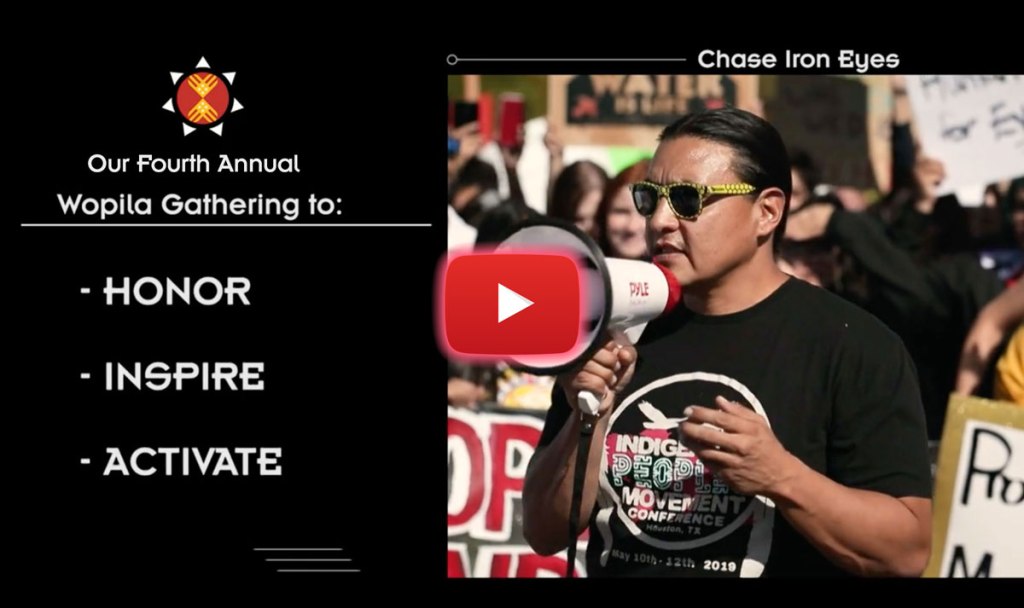
Watch: our short introductory video for more details on the big event — and RSVP to save the date!

I’m very much looking forward to seeing you at this yearly Giving Tuesday celebration, designed to share the spirit of wopila (deep gratitude), so we can honor, inspire, and activate as one in this movement for Indigenous and environmental justice. In addition to updates on our program priorities from Chase, Tokata, and NAYO, you’ll hear incredible music from talented Indigenous artists like Sage Bond and AntoineX and Miracle Spotted Bear of ALLSZN.

The Wopila Gathering is one of the highlights of our year at Lakota Law. Rather than simply ask for donations on Giving Tuesday like nonprofits across Turtle Island (though every donation is huge, and our allies at Nomadics Tipi Makers are generously matching the first $10,000 we receive this year), we want to use this day to give back to you and all our supporters. 

We love to feel the energy when thousands of our friends gather with us throughout the day to share space, stories, and culture. So I encourage you to be there, take it in, and use the opportunity to interact with us! Join the chat during the event, and we’ll post and read comments over the course of the livestream.

Again, please RSVP to let us know you’re coming, extend the invite to those you love by clicking the social share icons on our Wopila Page, then join the celebration on that same page on Dec. 3. I very much look forward to seeing you there! It promises to be a memorable and inspiring day of conversation, music, and celebration.

Wopila tanka — thank you for being a part of our circle!
Henry “Ozuya” Crow
Director of Community Empowerment & Cultural Health
The Lakota People’s Law Project
Sacred Defense Fund
An Apology is Not Enough

Lakota Law

In case you missed it, President Joe Biden traveled to the Gila River Indian Community in Arizona today, where he made a landmark formal apology on behalf of the U.S. government for the federal Indian boarding school era. “It’s a sin on our soul,” he said, before asking for a moment of silence “for what was lost and the generations who have lived with that trauma.”

In his speech, Biden earnestly described some of the atrocities perpetrated on generations of young children, separated from their families at these “schools.” He also used the occasion to list his administration’s accomplishments on behalf of Native People, including hiring Deb Haaland of the Pueblo of Laguna as the nation’s first Indigenous Cabinet secretary and protecting the Indian Child Welfare Act (ICWA) in the Supreme Court. 

As a Lakota Law supporter, you know those were team efforts, and I’ll always remain grateful to you for helping us participate in making them both happen. I am also thankful to the president for his long-overdue apology. But the truth is — as I said in a statement picked up widely by the press — it is not enough.

Watch: President Biden’s full speech here.

Let’s be clear: an apology is an acknowledgment of wrongdoing, but it is not any form of redress. An apology is just the beginning of a necessary truth-telling. It is a nice start, but it is not a true reckoning, nor is it a sufficient remedy for the long history of colonial violence. The president’s apology calls for a deeper examination. I ask him to work with those knowledge holders within Indigenous communities to tell the entire, historical truth and look at proper redress.

We need more real action on a path toward reconciliation. As you know, we have many ideas for what truly addressing the history of genocide in the U.S. should look like. From rescinding medals of honor given to those who massacred our people at Wounded Knee to codifying ICWA at the state level, there are many tangible steps that can be taken to help and honor Native families, children, and communities. 

Lakota Law

Let’s remember that the separation of Native children from their families did not end with boarding schools. Lakota Law came into being because our grandmothers sought help with the ongoing epidemic of South Dakota’s Department of Social Services (DSS) removing our children at alarming rates. While Native people make up around a tenth of the state’s population, Native children comprise about half of the children in foster care here. And a report we produced a few years back showed that more than 60 percent of children who aged out of DSS custody in South Dakota wound up dead, addicted, imprisoned, or houseless.

So yes, I’m grateful that Biden has acknowledged some historic wrongs and begun to prioritize Native representation and funding for our communities in the present day. I’m also clear-eyed that we have much more to do together moving forward, so let’s keep working! I thank you for your heart and your activism in helping us realize a better world for the generations to come.

Wopila tanka — my gratitude for your friendship in this journey.
Chase Iron Eyes
Director and Lead Counsel
Lakota People’s Law Project
Sacred Defense Fund
Indigenous Peoples’ Day 2024 Action

Lakota Law

Happy Indigenous Peoples’ Day! I hope you take time today to enjoy life and celebrate your Indigenous relatives. Perhaps you can also take a moment to take action. Because, unfortunately — despite 29 states (plus Washington, D.C.) recognizing the real history wrought by the arrival of Christopher Columbus to our shores 532 years ago, the federal government still recognizes today’s holiday as Columbus Day. 

We hope you’ll help us change that. The U.S. government should do right by the original peoples of this land. Please tell your state’s federal lawmakers to actively support the Indigenous Peoples’ Day Act, which would replace the Columbus Day federal holiday with Indigenous Peoples’ Day nationwide.


As a friend of Lakota Law, you’re fully aware that the mythology taught in schools about Columbus and the pilgrims routinely ignores the brutal details of colonization. His arrival on our shores began a chain of events that decimated Native peoples throughout the western hemisphere. In his journal, Columbus joyfully celebrated his ability to easily enslave Native peoples who had no idea people could be so evil. Obviously, this is not heroic behavior to be celebrated each year. It’s long past time to stop honoring Columbus and his legacy of genocide.

Replacing Columbus Day with Indigenous Peoples’ Day nationwide would be a symbolic but serious gesture. While not a solution to heal the generational trauma begun when Europeans invaded our homelands, it would, at least, be a recognition of our sacrifice. Native communities deserve to be seen, and non-Native communities should also be given the space to consider their impacts, both historically and in the present day. In this way, we can increase understanding, build compassion, and create a better world moving forward.

Wopila tanka — my deep gratitude for your solidarity!
Tokata Iron Eyes
Spokesperson and Organizer
Lakota People’s Law Project

P.S. Tell your senators and House rep: it’s long past time to stop celebrating Christopher Columbus and his legacy of pain. Instead, let’s acknowledge the original peoples of this land by replacing the federal holiday of Columbus Day with Indigenous People’s Day!

Take Action: Muwekma Recognition

Lakota Law

Over the past couple weeks, you may have seen stories or social media posts detailing the terrible treatment of the Muwekma Ohlone People by federal agents on the National Mall in Washington, D.C. It pains me just to write this, but government officials threatened to kill their horses and arrested tribal members at the tail end of the Muwekma’s cross-country “Trail of Truth” journey, in which tribal members sought government-to-government consultation with the U.S. Department of the Interior to restore their rightful federal recognition. 

I have more to say on that below, but first I ask you to take action now. Tell your reps: End the cycle of colonial violence and respect the sovereignty of the Muwekma Ohlone People. Congress must restore federal recognition to the original inhabitants of California’s San Francisco Bay Area by writing, sponsoring, and passing the “Restore Muwekma Bill.”

Lakota Law

The San Francisco Bay region has been the homeland of the Muwekma Ohlone People for more than 10,000 years, and congressional censuses acknowledged them throughout the early 20th century. And yet, today they’re landless and unrecognized by the federal government. This egregious oversight negatively impacts tribal members, who lose out on a myriad of important benefits when their sovereignty is ignored. The Muwekma Ohlone People have spent 40 years presenting valid evidence and struggling to reinstate their federal status, and the Department of Interior’s continued indifference amounts to a perpetuation of the cultural genocide of the Muwekma Ohlone.

With high hopes that an Interior Department now led by Deb Haaland of the Pueblo of Laguna would be more receptive to their message, the tribe, led by Chairwoman Charlene Nijmeh, set out on horseback from San Francisco in August on their Trail of Truth. Sadly, they — including women, children, and elders — were violently assaulted by the National Parks Police upon arrival in D.C. 

On Oct. 15 — the day after Indigenous Peoples’ Day — National Parks Police officers immediately moved to take the horses, which were provided by Lakota allies, specifically Percy White Plume (a direct descendant of Red Cloud) at the Horse Nation on the Pine Ridge Reservation. The police then arrested tribal members who tried to prevent the horses’ capture. Those actions were inconsistent with the law and far out of line, and these are some of the reasons why, in partnership with Muwekma, I plan to share more about various aspects of their story with you soon. In the meantime, please assist by taking action and telling your reps to restore federal recognition to the Muwekma Ohlone Tribe today.

Wopila tanka — thank you for supporting tribal sovereignty of the Muwekma Ohlone People!
Chase Iron Eyes
Director and Lead Counsel
Lakota People’s Law Project
Sacred Defense Fund

Terrorists? From the Same Government Participating in Genocide.

Lakota Law

Do you remember the hideous tactics used by law enforcement and private militarized security during the Dakota Access pipeline resistance? For instance, Lakota Law director Chase Iron Eyes was accused of domestic terrorism just for standing in a prayer circle to protect his homelands. Though this ridiculous charge was later dropped, it’s significant that such terminology was used in the first place. It’s a classic — and deeply harmful — racist trope to label non-white people as “terrorists” simply for exercising our First Amendment rights. 

While that dangerous rhetoric hasn’t gone away, I’m happy to say that, these days, tribes aren’t taking it lying down. A few weeks back, the Lac du Flambeau Band of Lake Superior Chippewa — my tribe — banished Wisconsin State Senator Mary Felzkowski from our lands after she equated tribal leadership to “terrorists.” She made the remark on Aug. 23 at a town hall meeting in Woodruff, Wisconsin, a bordertown of the reservation. This, of course, follows all nine of South Dakota’s Lakota nations banishing S.D. Gov. Kristi Noem earlier this year for her use of similarly abusive language.

Photo of the 37th Annual Bear River Pow Wow on the beautiful homelands of the Lac du Flambeau Band of Lake Superior Chippewa. From the tribe’s Facebook page.

The dispute in my homelands centers around residents of the town of Lac du Flambeau — situated on the reservation but home to many non-Natives — and their unauthorized use of roadways on tribal lands. Last year, the federal government sued the town on behalf of the tribe and asked for relief, asserting that non-Native residents had been trespassing on the tribe’s lands. The tribe set up barricades, later removed once the town agreed to pay fees to the tribe. 

Here’s a little more history on how we got here. When the Dawes Act was passed in 1887, lands opened to non-tribal members on many reservations. Now, in my home region, non-tribal members own land within every reservation but one. As a result, tribal governments govern tribal lands and members, while townships govern non-tribal lands and non-tribal members. In places like Lac du Flambeau — or the town of McLaughlin on the Standing Rock Reservation in South Dakota — the two entities often clash over competing priorities, and Natives and non-Natives must share space while at odds with each other.

By 1901 at Lac du Flambeau, 578 allotments had been distributed, and approximately 45,000 acres had passed into ownership by non-Natives. The problems associated with this reality can be hard to solve, but one thing I can be sure of is that it’s important to respect both the sovereignty and humanity of tribal peoples every step of the way. Felzkowski, who serves as co-chair for Wisconsin’s Special Committee on State-Tribal Relations, should know this.

Instead, in addition to spreading harmful stereotypes, her comments undermine the Lac du Flambeau Band’s sovereign right to govern itself, its lands, and its citizens. Like Gov. Noem, Sen. Felzkowski just found out what happens, even to powerful government actors, when you mess around with that. 

Wopila tanka — thank you for supporting sovereignty!
Darren Thompson
Director of Media Relations
Lakota People’s Law Project

Coalition Building

Lakota Law

You’ve heard from me a few times already this year about the importance of coalition building to achieve a new level of effectiveness — not just in our own work, but in the work my Indigenous relatives are undertaking at tribal nations across Turtle Island. To that end, today I share with you about a trip I took to spend a few days earlier this month with people I greatly respect at the Wind River Reservation in so-called Wyoming.

The seventh largest reservation in the U.S., the Wind River Nation encompasses more than 2 million acres of incredible wildlands, and it’s home to people from both Northern Arapaho and Eastern Shoshone tribes. I went to visit a few friends there, including Wes Martel, who you may remember from his keynote speech at the Great Plains Water Alliance’s Winter Water and Climate Conference, featured in our 20th Dakota Water Wars chapter. I also spent time with Jason Baldes, a central figure helping to return American Buffalo to Wind River and other tribal nations. I encourage you to watch “Homecoming,” a short documentary on PBS, about his wonderful work.

Watch: Buffalo return to Wind River in “Homecoming,” a PBS short documentary featuring the voice and good work of Jason Baldes.

To you, the inextricable link between Native people and buffalo is likely no mystery. Jason speaks to this eloquently in the documentary.“To restore that animal to our communities means that we can begin to heal,” he says. “From atrocities of the past, from loss of land, from loss of culture, loss of language. It’s foundational to who we are.”

That’s just one example of good Indigenous storytelling emanating from Wind River. While there, I also discovered the great music of Christian Wallowing Bull, a talented Northern Arapaho singer-songwriter featured in the new documentary film “Lone Wolf,” which premiered in California a few days ago. I then spoke with Dave Herring, the film’s director. I hope that you’ll watch their film and be as inspired by Christian’s story as I was. 

As you can see, we’re taking extra time this year to build connections with people, organizations, and tribal nations. In order to create a better society, it’s critical to advance not just our own priorities as Lakota People, but also those of all our relatives with their own traditional knowledge systems, art, and dreams. Between us, we’ve got much more in store to share with you. Stay tuned!

Wopila tanka — My continued thanks for supporting all Indigenous people, art, and culture.
Chase Iron Eyes
Director and Lead Counsel
The Lakota People’s Law Project

Let's Green CA!

Lakota People’s Law Project
547 South 7th Street #149
Bismarck, ND 58504-5859

Return of Land

Lakota Law

Greetings from Las Vegas, where I stopped to observe the mayhem of Super Bowl week. As my dad wrote to you a few days ago, we remain committed to changing the Kansas City Chiefs team name — and all racist characterizations of our people in the sports world. Also, I want to take a moment to say that because we are all human, and no matter how big our differences, I offer my sincere condolences to the Kansas City community in the wake of yet another instance of senseless gun violence. I pray for the day when we find better ways to listen to one another, discover common ground and understanding, and stop killing each other.

On a happier note, on my way to Vegas, I journeyed through some spectacular, sacred places. These included some of the Trail of the Ancients and traditional homelands of the Diné (Navajo) and Ute Peoples, including Monument Valley and Bears Ears National Monument — where something wonderful has occurred. I encourage you to watch my short video, recorded onsite, to hear about the recent gift of land back to Indigenous stewardship in Cottonwood Canyon.

Watch: I visited the sacred lands of the Ute and Diné Peoples to see Cottonwood Canyon and share with you about the importance of Landback efforts like the one in Cottonwood Canyon.

In many ways, the process undertaken with Cottonwood Canyon can serve as a model elsewhere across Turtle Island. A nonprofit organization bought available land and synched with a consortium of Native Peoples to preserve a beautiful place featuring rare views of spectacular rock formations and ancient dwelling sites. That’s something I dearly hope we can eventually replicate on a much larger scale with the Black Hills — but I’m also happy anytime we see the return of sacred lands to Indigenous care.

I’ll also say that the model isn’t perfect. Such transfers shouldn’t come with conditions. Isn’t the point of Native stewardship to respect our traditional knowledge systems regarding the land? So, while I appreciate the intent behind a condition of the transfer that will limit access to the site, I would also suggest that it shouldn’t be about eliminating human contact. Human beings should, in fact, have the opportunity to visit sacred places and relearn how to live in harmony with them, just as my relatives and ancestors have done for time immemorial. Even our allies can learn something here: please stop holding us to rules designed by colonizers.

In any case, a win is a win! Ultimately this gift will ensure that a special place displaying the ingenuity of our relatives’ ancestors and the vistas they loved will remain unspoiled for generations to come. And for that, I am truly grateful.

Wopila tanka — thank you for supporting landback efforts!
Tokata Iron Eyes
Spokesperson & Organizer
The Lakota People’s Law Project

Let's Green CA!

Lakota People’s Law Project
547 South 7th Street #149
Bismarck, ND 58504-5859

The Lakota People’s Law Project is part of the Romero Institute, a nonprofit 501(c)(3) law and policy center. All donations are tax-deductible.