Return Lands

Lakota Law

Over the past months, we’ve shared with you about our exciting partnership with the Muwekma Ohlone people of California’s Bay Area. We’ve helped the tribe create media and, together, we designed a call to action to assist the Muwekma — proud descendants of some of California’s original inhabitants — as they seek to restore their rightful status as a federally recognized tribe.

This week, we met with the Muwekma again to discuss and help amplify another of their important initiatives: namely, returning the Presidio to their caring hands. Giving this sacred and historic land back to its original stewards would be a huge win for Indigenous justice — and it’s a real possibility in this moment of change and opportunity. Please watch the new video from the Muwekma Ohlone Tribe, in which they lay out the reasons why it should happen.

Watch: The Muwekma Ohlone have the original right to the Presidio.

You may recall that, years ago, I helped to organize the #landback movement by calling to return the Black Hills to the Lakota. I was present at the protest action near Mount Rushmore when President Trump visited for American Independence Day during his first term. Today, we remain dedicated to the return of our own sacred lands — and we stand in strong solidarity with other Indigenous groups seeking the same.

Perhaps ironically, Trump’s return to office could present a new opportunity to achieve those goals. His administration’s efforts to gut the federal workforce, eliminate programs, and lessen the financial burden for the federal government could create openings for tribes to step into voids created around stewardship of federal lands. And while Lakota Law stands with needed federal workers who keep our society running smoothly, we also recognize Indigenous ownership and stewardship as the ultimate outcome for stolen, sacred lands.

As with many things these days, this is a rapidly evolving issue, and we’ll have more to say on it soon, including action opportunities and more messages directly from our friends at the Muwekma Ohlone Tribe. As always, I’m grateful for your solidarity with us and with Indigenous landback efforts across Turtle Island.

Wopila tanka — thank you for standing for the sacred.
Tokata Iron Eyes
Spokesperson & Organizer
Lakota People’s Law Project
Sacred Defense Fund

New Title: The Mahkato Reconciliation and Healing Ride

Lakota Law

From acknowledging the winter solstice to celebrating mainstream society’s holiday season, this time of year has always brought together gatherings of family and friends throughout Turtle Island.  And every December, reminders of our history add to the difficulties faced by many families, and tribes, as some of their people’s most tragic memories all occurred during this month — the assassination of Chief Sitting Bull, Wounded Knee Massacre, and the Dakota 38 Hanging.

The day after Christmas is more widely known as “Boxing Day,” especially outside of Indian Country, but in the last several years there has been growing momentum for mainstream society to acknowledge the day after Christmas as the day when 38 Dakota “Sioux” men were hanged in Mankato, Minnesota in 1862. The hanging, the largest mass execution in United States history, was carried out in front of an estimated 4,000 people in downtown Mankato and remains largely hidden from classrooms and public knowledge.

As the year ends, and millions gather to celebrate and acknowledge the holiday season, some Indigenous communities acknowledge its tragic past through memorial ceremonies aimed at teaching and healing while building community. 

The hangings were approved by former President Abraham Lincoln as a result of conflict between Dakota people and settlers in southwestern Minnesota. Dakota people were promised food and safety in exchange for ceding their lands, but they received neither, leading to attacks on white settlements in August 1862. The resulting widespread war in Minnesota lasted for five weeks, culminating in the hanging of 38 Dakota men in Mankato on Dec. 26, 1862.

Some say the Dakota War officially ended after the hanging, but the U.S. government’s oppression of the Dakota people, as well as other Indigenous groups, did not end with that atrocity. After the mass hanging, Dakota people were exiled and forcibly removed from Minnesota. Many sought refuge in Canada, South Dakota, Nebraska, and other communities willing to take them in. Memorializing such a painful history involves more than riding on horseback through blizzard-like conditions. While it remains a painful and tragic past, many have undertaken healing and positive efforts to repair relations with those in the places where history unfolded, hoping that such history will not repeat itself.

The movement to pay tribute to tragic times past is active healing in Indian Country. While memorials take time and tremendous effort, the initial memorial horse ride has caused great positive ripple. Today there are additional horse rides and a memorial run that begins at Ft. Snelling, the military fort where thousands of Dakota people were imprisoned during the Dakota War, and all convene at Reconciliation Park in Mankato, MN on Dec. 26. Many other Indigenous communities have begun to host memorial rides, runs, or walks, to pay their respects to their past, as well as to the land in hopes we continue to heal beyond times past.

Beginning in 2008, an annual memorial horse ride was organized to begin on the Lower Brule Reservation in central South Dakota and ride for 16 consecutive days, convening in Mankato, MN on Dec. 26. Their ride and ceremonial arrival to memorialize the Dakota 38 continues to this day — now under a new name — Mahkato Reconciliation and Healing Ride

Forever riding forward, while sometimes looking back, is magic we all have to embrace in this work. We’re grateful and gain strength as we join together to honor the pain and sacrifices of the past by celebrating and supporting these ongoing healing movements.

Miigwech — thank you, always, for remembering with us!
Darren Thompson
Director of Media Relations
Lakota People’s Law Project
Sacred Defense Fund

Your support makes jsutice possible - Donate Today

Lakota People’s Law Project
P.O. Box 27
Santa Fe, NM 87504

Good Thinking: Return it All

California land to be returned to Yurok Tribe

Rosie Clayburn is a descendant of the Yurok Tribe, which had its territory — called ‘O Rew in the Yurok language — ripped from them nearly two centuries ago.

“As the natural world became completely decimated, so did the Yurok people,” she said.

That decimation started when miners rushed in for gold, killing and displacing tens of thousands of Native Americans in California and ravaging the redwood trees for lumber.

1734393805389.png© Credit: CBSNews

“Everything was extracted that was marketable,” Clayburn said. “We’ve always had this really intricate relationship with the landscape. We’ve hunted, we’ve fished, we’ve gathered. And those are all management tools. Everything that we do has been in balance with the natural world.”

Now, generations later, 125 acres bordering Redwood National and State Parks will be handed back to the Yuroks.

The nonprofit Save the Redwoods League purchased the land in 2013 from an old timber mill, with the original goal of giving it to the National Park Service.

“As we continued conversations about the transfer of this land to the National Park Service, we began to realize that perhaps a better alternative would be to transfer the land back to the Yurok Tribe,” said Save the Redwoods League’s Paul Ringgold. “No one knows this land better. They’ve been stewarding this land since time and memorial”

Ringgold said that stewardship includes controlled burns to clear dead vegetation — a native practice once outlawed, but now recognized as essential in preventing catastrophic wildfires.

“Indigenous populations have been using fire as a management tool,” he said. “We’d like to see that kind of practice return.”

Redwoods serve as some of the largest stores of carbon on the planet. A single tree can capture up to 250 tons in its lifetime, the equivalent of removing nearly 200 cars from the road for an entire year. 

But between logging and fires, 95% of California’s redwoods have been destroyed. Over the past decade, the Yurok have been helping restore the land.

Another forgotten jewel of the ecosystem is salmon. The fish were once so plentiful, they were eaten with most meals. The Yurok word for salmon even translates to “that which we eat.” But the salmon population has dwindled to about one-quarter of what it was 20 years ago, according to a coalition of state and federal agencies.

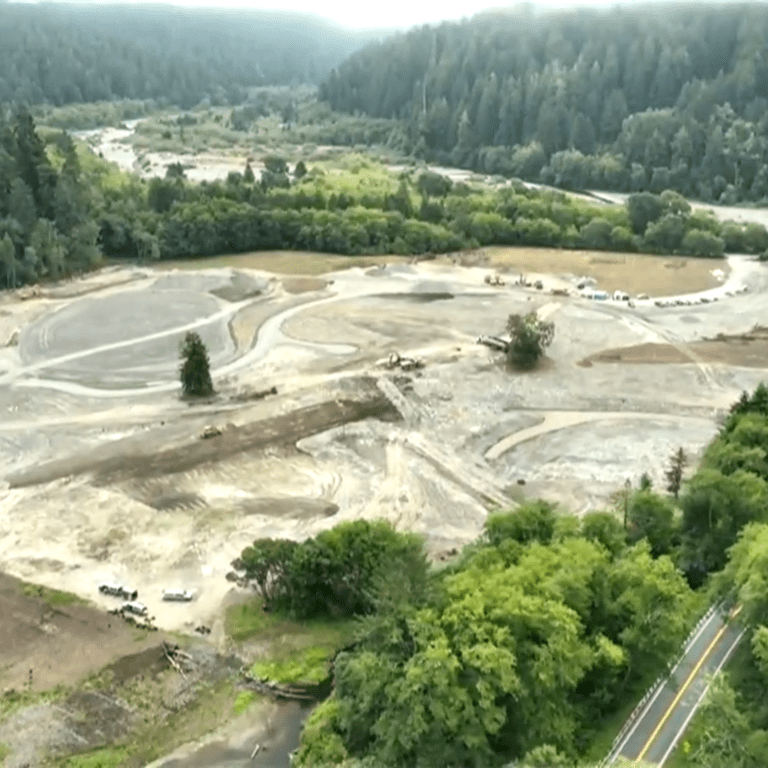
The tribe is working to bolster the fish’s population by building a stream channel, two connected ponds and about 20 acres of floodplain.

“You have salmon who provide for humans, but they also provide for other animals,” Clayburn said. “And then when they spawn and die, they put nutrients back in the ground. And so, everything just has this, this balance and this reciprocal way.”

That balance is returning. There’s been a rebound in the salmon population and the Yuroks also recently reintroduced the California condor — a scavenger that’s important to the ecosystem — back into the wild for the first time this century.

“It tells us that our land’s healing and that our people are gonna heal,” Clayburn said.

The Yuroks will take full control of ‘O Rew in 2026 and, in a first-of-its-kind partnership, receive help managing it from the Save the Redwoods League, California State Parks and The National Park Service.

“We understand some of the mistakes we made as a federal government, and it’s a chance to begin that healing with the native tribes all across the United States,” said National Park Service Director Chuck Sams.

For Sams, the first Native American to lead the agency, the partnership is personal. 

“We’ve been writing our histories separately. There’s been the native history and then the American history. This is a chance when we’re doing co-stewardship and co-management to write history together,” he said.

Of the 431 parks managed by the National Park Service, 109 of them now have formal co-stewardship agreements with indigenous tribes, with 43 more on the way.

In addition to restoration work, plans for ‘O Rew include the creation of new trails, the construction of a traditional Yurok village and a state-of-the-art visitor center. The visitor center will display Yurok artifacts and highlight the tribe’s history and culture, with the goal of educating new visitors on the land’s history and significance from the perspective of those who have lived on it the longest.

“I really hope ‘O Rew symbolizes a coming home of the Yurok people and reconnecting with our landscape,” said Clayburn.

Truthsgiving

Happy Truthsgiving to you and yours! If that term is new to you, I refer you here, to a “debate” I had with Sean Sherman, known as the Lakota Chef, last year at this time, published in The Nation Magazine. I put “debate” in quotes, because — truthfully — Sean and I agree on many things. For instance, we both talk about how traditional Thanksgiving mythology fails to recognize the steep price paid by our people after colonizers came to our shores, the land that was stolen from us, and the variety of indispensable foods contributed by Indigenous cultures now enjoyed around Thanksgiving tables.

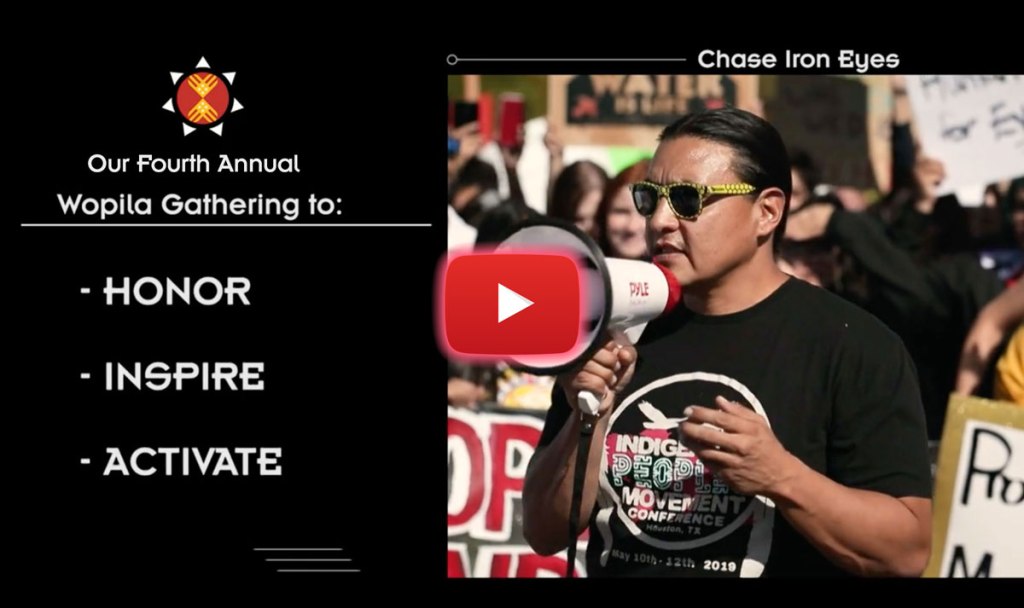
In my section, I expand on those thoughts by suggesting a rebrand of this deeply problematic holiday. Some in my community have called it “Thankstaking,” highlighting the many unwilling sacrifices Indigenous peoples have made over the centuries. Personally, I prefer Truthsgiving — which, while keeping with the traditional holiday spirit of sharing and gratitude, also calls for a necessary truthtelling component. And as a reminder to you: I invite you to stay in a space of gratitude and openness next week, when you’re invited to RSVP and join us online for our fourth annual Wopila Gathering, beginning at 4 p.m. PST on Giving Tuesday, Dec. 3.

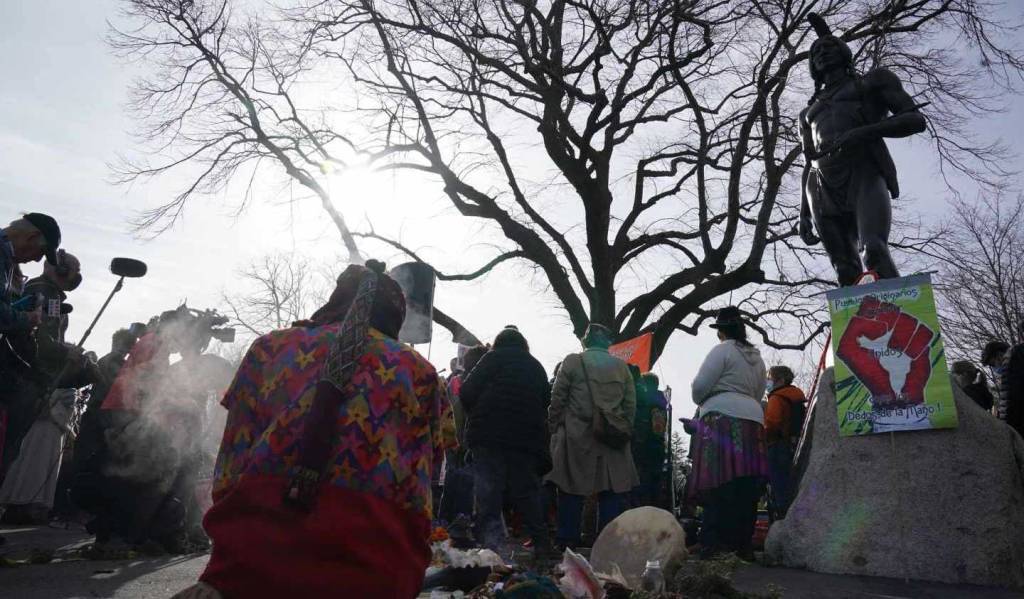
Lakota LawPeople engage in a National Day of Mourning ceremony in front of a statue of Chief Massasoit, leader of the Wampanoag tribe, in Plymouth, Mass. on Thanksgiving Day in 2021. (Bryan R. Smith / Getty Images)

Between Truthsgiving and our Wopila Gathering, on Friday the U.S. also celebrates Native American Heritage Day, at the conclusion of National Native American Heritage Month. I’m grateful that each November is designated as a time to celebrate the history, culture, and achievements of Turtle Island’s Indigenous nations. If you’re Native, I hope you’re able to take some extra time to commune with your relatives and acknowledge your ancestors this weekend. And if you’re non-Native, I hope you’ll make room to appreciate all we have given.

And then, everyone, please attend the Wopila Gathering on Giving Tuesday. This annual event provides an excellent opportunity for us to gather around an even larger table to share stories, priorities, music, and all we have to give to one another. It’s going to be a wonderful couple hours of togetherness, generosity, and joy, so I hope you’ll bookmark this page, RSVP, and Zoom in with us for the festivities!

Wopila tanka — thank you for hearing us, and I hope to see you on Tuesday.
Chase Iron Eyes
Director and Lead Counsel
Lakota People’s Law Project
Sacred Defense Fund

Lakota People’s Law Project

Lakota People’s Law Project
547 South 7th Street #149
Bismarck, ND 58504-5859

Wopila Gathering 2024 – December 3rd

Lakota Law

Today, I’m excited to announce that our fourth annual online Wopila Gathering is coming right up on Giving Tuesday, Dec. 3. It’s going to be a super incredible event this year — and you’re invited! Not only that, I hope you’ll extend the invitation to your friends for this special annual celebration of gratitude and Indigenous culture.

I’ll be hosting this year, and I urge you to come and spend some time online with me, Lakota Law leaders Darren Thompson and Chase and Tokata Iron Eyes, young leaders from the Native American Youth Organization (NAYO), and an incredible lineup of Indigenous performers and special guests. Please RSVP here, mark your calendar for Giving Tuesday, Dec. 3 from 4-6 p.m. PDT (7-9 p.m. EDT), then bookmark this page and return to it for the event in a couple weeks.

RSVP for Wopila Gathering

Watch: our short introductory video for more details on the big event — and RSVP to save the date!

I’m very much looking forward to seeing you at this yearly Giving Tuesday celebration, designed to share the spirit of wopila (deep gratitude), so we can honor, inspire, and activate as one in this movement for Indigenous and environmental justice. In addition to updates on our program priorities from Chase, Tokata, and NAYO, you’ll hear incredible music from talented Indigenous artists like Sage Bond and AntoineX and Miracle Spotted Bear of ALLSZN.

The Wopila Gathering is one of the highlights of our year at Lakota Law. Rather than simply ask for donations on Giving Tuesday like nonprofits across Turtle Island (though every donation is huge, and our allies at Nomadics Tipi Makers are generously matching the first $10,000 we receive this year), we want to use this day to give back to you and all our supporters. 

We love to feel the energy when thousands of our friends gather with us throughout the day to share space, stories, and culture. So I encourage you to be there, take it in, and use the opportunity to interact with us! Join the chat during the event, and we’ll post and read comments over the course of the livestream.

Again, please RSVP to let us know you’re coming, extend the invite to those you love by clicking the social share icons on our Wopila Page, then join the celebration on that same page on Dec. 3. I very much look forward to seeing you there! It promises to be a memorable and inspiring day of conversation, music, and celebration.

Wopila tanka — thank you for being a part of our circle!
Henry “Ozuya” Crow
Director of Community Empowerment & Cultural Health
The Lakota People’s Law Project
Sacred Defense Fund

An Apology is Not Enough

Lakota Law

In case you missed it, President Joe Biden traveled to the Gila River Indian Community in Arizona today, where he made a landmark formal apology on behalf of the U.S. government for the federal Indian boarding school era. “It’s a sin on our soul,” he said, before asking for a moment of silence “for what was lost and the generations who have lived with that trauma.”

In his speech, Biden earnestly described some of the atrocities perpetrated on generations of young children, separated from their families at these “schools.” He also used the occasion to list his administration’s accomplishments on behalf of Native People, including hiring Deb Haaland of the Pueblo of Laguna as the nation’s first Indigenous Cabinet secretary and protecting the Indian Child Welfare Act (ICWA) in the Supreme Court. 

As a Lakota Law supporter, you know those were team efforts, and I’ll always remain grateful to you for helping us participate in making them both happen. I am also thankful to the president for his long-overdue apology. But the truth is — as I said in a statement picked up widely by the press — it is not enough.

Watch: President Biden’s full speech here.

Let’s be clear: an apology is an acknowledgment of wrongdoing, but it is not any form of redress. An apology is just the beginning of a necessary truth-telling. It is a nice start, but it is not a true reckoning, nor is it a sufficient remedy for the long history of colonial violence. The president’s apology calls for a deeper examination. I ask him to work with those knowledge holders within Indigenous communities to tell the entire, historical truth and look at proper redress.

We need more real action on a path toward reconciliation. As you know, we have many ideas for what truly addressing the history of genocide in the U.S. should look like. From rescinding medals of honor given to those who massacred our people at Wounded Knee to codifying ICWA at the state level, there are many tangible steps that can be taken to help and honor Native families, children, and communities. 

Lakota Law

Let’s remember that the separation of Native children from their families did not end with boarding schools. Lakota Law came into being because our grandmothers sought help with the ongoing epidemic of South Dakota’s Department of Social Services (DSS) removing our children at alarming rates. While Native people make up around a tenth of the state’s population, Native children comprise about half of the children in foster care here. And a report we produced a few years back showed that more than 60 percent of children who aged out of DSS custody in South Dakota wound up dead, addicted, imprisoned, or houseless.

So yes, I’m grateful that Biden has acknowledged some historic wrongs and begun to prioritize Native representation and funding for our communities in the present day. I’m also clear-eyed that we have much more to do together moving forward, so let’s keep working! I thank you for your heart and your activism in helping us realize a better world for the generations to come.

Wopila tanka — my gratitude for your friendship in this journey.
Chase Iron Eyes
Director and Lead Counsel
Lakota People’s Law Project
Sacred Defense Fund
Indigenous Peoples’ Day 2024 Action

Lakota Law

Happy Indigenous Peoples’ Day! I hope you take time today to enjoy life and celebrate your Indigenous relatives. Perhaps you can also take a moment to take action. Because, unfortunately — despite 29 states (plus Washington, D.C.) recognizing the real history wrought by the arrival of Christopher Columbus to our shores 532 years ago, the federal government still recognizes today’s holiday as Columbus Day. 

We hope you’ll help us change that. The U.S. government should do right by the original peoples of this land. Please tell your state’s federal lawmakers to actively support the Indigenous Peoples’ Day Act, which would replace the Columbus Day federal holiday with Indigenous Peoples’ Day nationwide.


As a friend of Lakota Law, you’re fully aware that the mythology taught in schools about Columbus and the pilgrims routinely ignores the brutal details of colonization. His arrival on our shores began a chain of events that decimated Native peoples throughout the western hemisphere. In his journal, Columbus joyfully celebrated his ability to easily enslave Native peoples who had no idea people could be so evil. Obviously, this is not heroic behavior to be celebrated each year. It’s long past time to stop honoring Columbus and his legacy of genocide.

Replacing Columbus Day with Indigenous Peoples’ Day nationwide would be a symbolic but serious gesture. While not a solution to heal the generational trauma begun when Europeans invaded our homelands, it would, at least, be a recognition of our sacrifice. Native communities deserve to be seen, and non-Native communities should also be given the space to consider their impacts, both historically and in the present day. In this way, we can increase understanding, build compassion, and create a better world moving forward.

Wopila tanka — my deep gratitude for your solidarity!
Tokata Iron Eyes
Spokesperson and Organizer
Lakota People’s Law Project

P.S. Tell your senators and House rep: it’s long past time to stop celebrating Christopher Columbus and his legacy of pain. Instead, let’s acknowledge the original peoples of this land by replacing the federal holiday of Columbus Day with Indigenous People’s Day!

Take Action: Muwekma Recognition

Lakota Law

Over the past couple weeks, you may have seen stories or social media posts detailing the terrible treatment of the Muwekma Ohlone People by federal agents on the National Mall in Washington, D.C. It pains me just to write this, but government officials threatened to kill their horses and arrested tribal members at the tail end of the Muwekma’s cross-country “Trail of Truth” journey, in which tribal members sought government-to-government consultation with the U.S. Department of the Interior to restore their rightful federal recognition. 

I have more to say on that below, but first I ask you to take action now. Tell your reps: End the cycle of colonial violence and respect the sovereignty of the Muwekma Ohlone People. Congress must restore federal recognition to the original inhabitants of California’s San Francisco Bay Area by writing, sponsoring, and passing the “Restore Muwekma Bill.”

Lakota Law

The San Francisco Bay region has been the homeland of the Muwekma Ohlone People for more than 10,000 years, and congressional censuses acknowledged them throughout the early 20th century. And yet, today they’re landless and unrecognized by the federal government. This egregious oversight negatively impacts tribal members, who lose out on a myriad of important benefits when their sovereignty is ignored. The Muwekma Ohlone People have spent 40 years presenting valid evidence and struggling to reinstate their federal status, and the Department of Interior’s continued indifference amounts to a perpetuation of the cultural genocide of the Muwekma Ohlone.

With high hopes that an Interior Department now led by Deb Haaland of the Pueblo of Laguna would be more receptive to their message, the tribe, led by Chairwoman Charlene Nijmeh, set out on horseback from San Francisco in August on their Trail of Truth. Sadly, they — including women, children, and elders — were violently assaulted by the National Parks Police upon arrival in D.C. 

On Oct. 15 — the day after Indigenous Peoples’ Day — National Parks Police officers immediately moved to take the horses, which were provided by Lakota allies, specifically Percy White Plume (a direct descendant of Red Cloud) at the Horse Nation on the Pine Ridge Reservation. The police then arrested tribal members who tried to prevent the horses’ capture. Those actions were inconsistent with the law and far out of line, and these are some of the reasons why, in partnership with Muwekma, I plan to share more about various aspects of their story with you soon. In the meantime, please assist by taking action and telling your reps to restore federal recognition to the Muwekma Ohlone Tribe today.

Wopila tanka — thank you for supporting tribal sovereignty of the Muwekma Ohlone People!
Chase Iron Eyes
Director and Lead Counsel
Lakota People’s Law Project
Sacred Defense Fund
Terrorists? From the Same Government Participating in Genocide.

Lakota Law

Do you remember the hideous tactics used by law enforcement and private militarized security during the Dakota Access pipeline resistance? For instance, Lakota Law director Chase Iron Eyes was accused of domestic terrorism just for standing in a prayer circle to protect his homelands. Though this ridiculous charge was later dropped, it’s significant that such terminology was used in the first place. It’s a classic — and deeply harmful — racist trope to label non-white people as “terrorists” simply for exercising our First Amendment rights. 

While that dangerous rhetoric hasn’t gone away, I’m happy to say that, these days, tribes aren’t taking it lying down. A few weeks back, the Lac du Flambeau Band of Lake Superior Chippewa — my tribe — banished Wisconsin State Senator Mary Felzkowski from our lands after she equated tribal leadership to “terrorists.” She made the remark on Aug. 23 at a town hall meeting in Woodruff, Wisconsin, a bordertown of the reservation. This, of course, follows all nine of South Dakota’s Lakota nations banishing S.D. Gov. Kristi Noem earlier this year for her use of similarly abusive language.

Photo of the 37th Annual Bear River Pow Wow on the beautiful homelands of the Lac du Flambeau Band of Lake Superior Chippewa. From the tribe’s Facebook page.

The dispute in my homelands centers around residents of the town of Lac du Flambeau — situated on the reservation but home to many non-Natives — and their unauthorized use of roadways on tribal lands. Last year, the federal government sued the town on behalf of the tribe and asked for relief, asserting that non-Native residents had been trespassing on the tribe’s lands. The tribe set up barricades, later removed once the town agreed to pay fees to the tribe. 

Here’s a little more history on how we got here. When the Dawes Act was passed in 1887, lands opened to non-tribal members on many reservations. Now, in my home region, non-tribal members own land within every reservation but one. As a result, tribal governments govern tribal lands and members, while townships govern non-tribal lands and non-tribal members. In places like Lac du Flambeau — or the town of McLaughlin on the Standing Rock Reservation in South Dakota — the two entities often clash over competing priorities, and Natives and non-Natives must share space while at odds with each other.

By 1901 at Lac du Flambeau, 578 allotments had been distributed, and approximately 45,000 acres had passed into ownership by non-Natives. The problems associated with this reality can be hard to solve, but one thing I can be sure of is that it’s important to respect both the sovereignty and humanity of tribal peoples every step of the way. Felzkowski, who serves as co-chair for Wisconsin’s Special Committee on State-Tribal Relations, should know this.

Instead, in addition to spreading harmful stereotypes, her comments undermine the Lac du Flambeau Band’s sovereign right to govern itself, its lands, and its citizens. Like Gov. Noem, Sen. Felzkowski just found out what happens, even to powerful government actors, when you mess around with that. 

Wopila tanka — thank you for supporting sovereignty!
Darren Thompson
Director of Media Relations
Lakota People’s Law Project

Tribal Nations Maps – On Sale Now!

50% off ALL Tribal maps and flags ! Just use code 50off at checkout. Take 50% off our Deals section, here:

$8 & Up – MINIMUM PURCHASE OF $40 (tribalnationsmaps.com) 

Or, use the SAME code for our other products, here:

              www.tribalnationsmaps.com

I encourage you to purchase these accurate and beautiful maps. I had several in my classroom before I retired from teaching.

A story:

Outside my classroom, I had a very large wall used to display student work. My class was studying indigenous history and I had purchased a very large map showing all the tribal nations in the U.S. I hung the map on the wall along with recent artwork and reports my students had finished.

The next week was open house and many parents visited the school to view the classrooms. I noticed an elderly man sitting in a chair in front of the map. He appeared to be crying. I walked over and asked him if he was ok. He said that he was overcome with emotion to see this map with all of the tribes. He said he never thought anyone cared to do such research.

As a teacher, I went above and beyond the very limited curriculum. I made sure to add relevant materials, books, and maps to provide a more holistic and complete view of the world. My students did many independent research projects. These maps are very educational! Add them to your teaching materials and home.

When I retired I gave the maps to a student.

These are photos where you can see a few of the maps in the background.