The Fate of the Indian Child Welfare Act (ICWA)

Lakota Law

Yesterday morning, the Supreme Court heard oral arguments in Brackeen v. Haaland. Now, the justices will determine the fate of the Indian Child Welfare Act (ICWA). Depending on what they decide, Indigenous child welfare and sovereignty as we know it on Turtle Island could be seriously threatened.

The arguments from attorneys and questions from justices focused on two central legal questions, both involving ICWA’s preferences to place adoptive Native children with Native families. First, do ICWA’s placement preferences discriminate against non-Native people on the basis of race? Second, does ICWA fall within Congress’ plenary — or total — authority to legislate on Indian affairs to the exclusion of states? 

Click the pic to listen to the full Brackeen v. Haaland audio feed from the Supreme Court.

Let’s be clear. First, under law, tribes are considered sovereign political entities — not racial groups — and striking down ICWA would violate centuries of legal precedent and imperil other legislation that properly respects our sovereign status. And since the ratification of the Constitution, the federal government has been recognized as the sole arbiter of Indian affairs, to the exclusion of state authority.

During pointed questioning, Justice Neil Gorsuch (a conservative) noted that the Constitution does, in fact, give Congress plenary authority to legislate Native issues. The policy arguments brought forward by the legal team seeking to overturn ICWA  — including lawyers from Gibson Dunn, a law firm that represents the fossil fuel industry — “might be better addressed across the street” in the halls of Congress, Justice Gorsuch suggested.

I very much appreciate Gorsuch’s understanding and application of the law. But the truth is that if anyone should have complete authority over Native issues, it should be Native people. And while traditional congressional power to oversee Indian child welfare is a strong argument in defense of ICWA, it’s notable that a law made by the United States to protect our children is the exception, not the rule. It’s also worth mentioning that, even in 2022, no Native person could be found arguing or hearing the case. Instead, our people were literally outside the halls of power, demonstrating in the street.

Now, let’s talk a little history. For centuries, the U.S. government has enforced paternalistic and inhumane policies to separate Native children from their families. Through forced migration, the Indian boarding school era, and then their placement into non-Native foster care, our young ones have long been taken from their homes and homelands under the guise of assimilation, education, and Christianization. These policies, tantamount to genocide, have fractured lives and created generational trauma that plagues Indian Country to this day.

That’s exactly why, in 1978, after federal investigations found that public and private agencies had removed a third of all Native children from their homes and placed most of them in institutions or homes with no ties to American Indian tribes, Congress enacted ICWA. Lakota Law’s legal team remains proud to have drafted ICWA’s enforcement guidelines.

So now, we await the Court’s ruling. In addition to yesterday’s oral arguments, the justices have thousands of pages of legal documents— including our amicus brief — to consider. We remain hopeful that Chief Justice John Roberts will join Gorsuch and the Court’s liberal wing in preserving at least most of ICWA, despite his repeated questioning of ICWA’s “third preference.” It’s possible this portion of the law, which allows for a Native child who cannot be placed with either members of their extended family (the first preference) or members of the same tribe (the second preference) to be placed with members of another tribe, could be erased. 

The Court has many angles to consider, and the potential opinions and outcomes are legion. We don’t expect a decision until well into 2023 — most likely in June. In the meantime, please continue to spread the word and share our action asking President Biden to intervene. Hope is always worth having, but we mustn’t solely rely on this majority conservative Court. Let’s stay vigilant and use every means at our disposal to preserve our kinship structures, our culture, and our sovereignty.

Wopila tanka — thank you for your friendship in this important fight for our future!
Wašté Win Young
Legal Analyst
Lakota People’s Law Project

California Solidarity

Lakota Law

Han, Mitakuyepi. I’ll start by thanking every one of you who supported our Oceti Vote event this past weekend. Your friendship helped to create something very special — a successful Native voter outreach campaign and also a true celebration of our Lakota culture. Today we’re submitting the many voter registrations we gathered, and we’ll have a lot more to share with you once we’ve all had a chance to look back at everything.

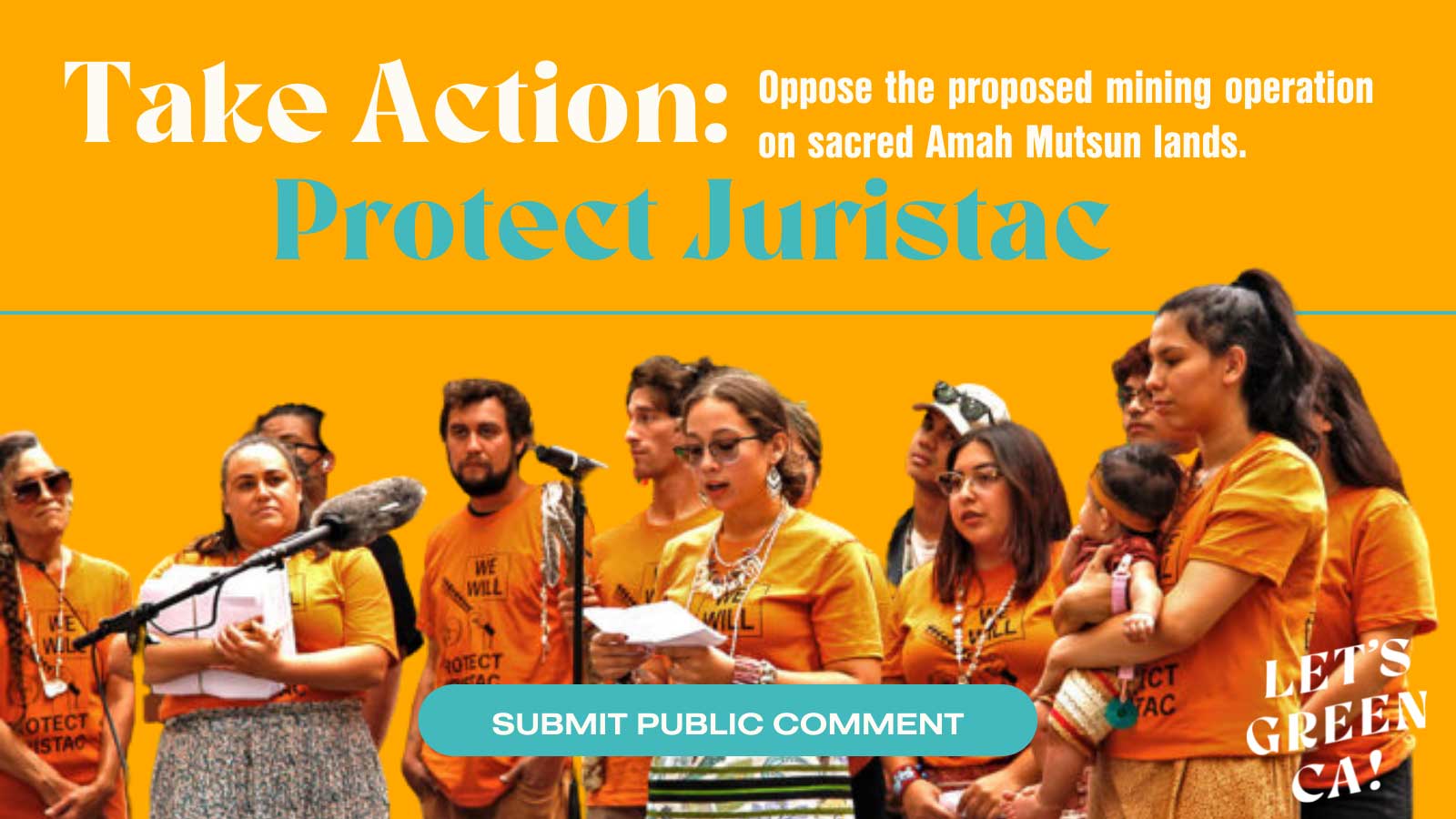
In the meantime, I’d like to draw your attention to something important from our sister org, Let’s Green CA! They’ve created a solidarity action to protect the Juristac — the ancestral lands of the Amah Mutsun Tribal Band, Indigenous People in what is now called Northern California. As Santa Clara County evaluates an environmental impact report on a proposed sand and gravel mining project, your input could help protect the sacred! So, because you live in California, today I ask you to stand with my relatives on the west coast of Turtle Island and tell the County: no mining at Juristac!

Lakota Law

The Lakota People’s Law Project and Let’s Green CA! (which also just got a climate equity bill signed into law in California) take both environmental and Indigenous justice extremely seriously. The two are inextricably intertwined, because far too often, Indigenous communities wind up on the frontlines battling extractive industry which demonstrates no regard for Unci Maka, our Grandmother Earth, nor for us as this land’s first inhabitants and stewards. 

The Amah Mutsun Band’s fight to protect the Juristac from being torn asunder by miners sounds a lot like our fight to stop gold, uranium, and lithium mining in our sacred He Sapa — the Black Hills. Our relatives in so-called Nevada have a similar fight on their hands with the lithium mining at Thacker Pass. And then there are all the oil pipelines — Dakota Access, Keystone XL, Line 3 — you have helped us resist. 

It’s critical that we continue to stand in solidarity with one another every step of the way, each time any project imperils Unci Maka and the future we wish to create for the next seven generations. By widening our circle, we increase our power. So, please do keep tabs on the good work of Let’s Green CA! and show your support by submitting a comment to protect the sacred at Juristac. Rest assured that together, we can and will continue to win justice — for Indigenous People and for our Grandmother Earth.

Wopila tanka — thank you for your friendship and solidarity!
DeCora Hawk
Field Organizer
The Lakota People’s Law Project

The War for Water

Lakota Law

Hello again, and I wish you well on the eve of Indigenous Peoples’ Day! Now seems an appropriate time to examine some history. Until now, our “Water Wars” video series has largely explored the present-day conflict around the Dakota Access pipeline (DAPL). Today, I invite you to watch our tenth chapter — co-produced again by Lakota Law, Standing Rock, and the Great Plains Water Alliance — in which we explore more of what led to this moment in time. This edition highlights the decades of sacrifice forced upon tribal nations as the U.S. government repeatedly flooded our homelands and uprooted us by building dams to block our great relative, the Mni Sose (Missouri River).

Watch me and the great Phyllis Young, Chase Iron Eyes, and others to talk about the long history of sacrifice demanded of Native nations to make way for dams along the Missouri River.

It all started with the passage of the Flood Control Act of 1944, which gave rise to the Pick-Sloan Missouri Basin Program. Pick-Sloan would go on to wreak havoc on tribal nations over the next several decades. The Oahe Dam at Standing Rock was one of seven installed to block the river. Its construction resulted in Lake Oahe, which now sits on the northern border of the Standing Rock reservation. Today, DAPL crosses directly beneath it, posing a direct threat to the water that sustains our people.

Damming the Mni Sose changed our way of life. Before then, my mom, Lakota Law Standing Rock organizer Phyllis Young, vividly recalls living in a paradise in the bottomlands near the river’s edge. But when the verdant area where my family had lived — filled with timberlands, plants, medicines, and wildlife, all gone now — disappeared under water, my mom and many others were forced to move into starker territory with none of the natural bounty they’d always known.

All this loss is real and remembered. But, in the end, it has galvanized our spirit. When, in 2016, DAPL came to our doorstep, we created a movement — which I’m grateful you share. So now, we must stick together for justice and honor the fighting spirit of those who preceded us. In this moment, we can and we will overcome, just as we have so many times before. 

Wopila tanka — my gratitude for your solidarity!
Wašté Win Young
Legal Analyst
The Lakota People’s Law Project

The Doctrine of Discovery Discussion

Lakota Law

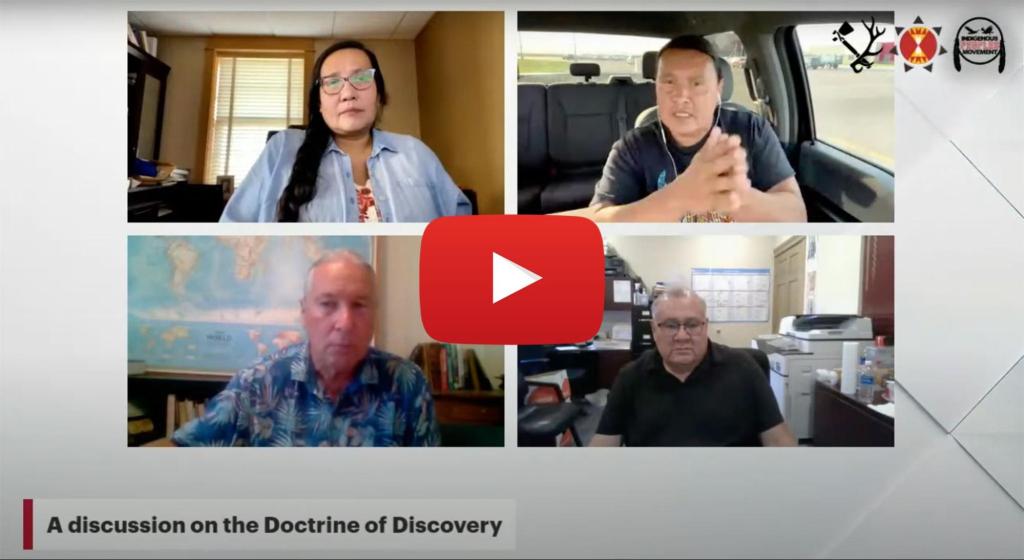
Lakota Law livestreams are back, y’all! Continuing in the tradition of “Cut to the Chase,” I’m organizing informative panels hosted by our Lakota leaders and featuring Indigenous guests from across Turtle Island and beyond. Co-produced by Indigenous Peoples Movement and Last Real Indians, “In Critical Times” streams will be available to view live or later on social media, and they take place every other Wednesday at 7 p.m. Eastern. This week, we had a trio of great guests join host Chase Iron Eyes for a deep dive on the Doctrine of Discovery. I encourage you to watch the whole discussion here!

A discussion on the Doctrine of Discovery

Click the pic to watch this informative discussion led by Lakota Law’s Chase Iron Eyes.

Our guest experts for this episode — Shawnee/Lenape scholar Steven Newcomb, Indigenous Peoples Movement co-founder Jen Martel, and Sicangu Lakota Treaty Council Executive Director Phil Two Eagle — really brought some fantastic perspective on the Doctrine, which forms the horrifyingly racist underpinning for the Christian colonial world’s justification for expanding into Indigenous territory.

The Doctrine, which stems from a papal bull written in the late 1400s, argued that Christian monarchies should be able to subdue non-Christian lands, at will, under divine right. The fact that this dangerous foolishness still influences public international law and Federal Indian Law should disturb every one of us. This 84-minute conversation is well worth the watch — all the way through. I think you’ll likely learn some new things and understand even more deeply why your friendship means so much to us.

Shonabish Chi — thank you for tuning in!
Earth Hadjo
Online Events Coordinator
The Lakota People’s Law Project

National Voter Registration Act Win!

Lakota Law

As we near this year’s midterm elections in November, I’m pleased to report that good things are happening that bode well for Native participation in our democracy. If you’ve been following us for a bit, you may recall that the Lakota People’s Law Project has been participating as a plaintiff in a landmark lawsuit against the State of South Dakota for its repeated noncompliance with the National Voter Registration Act (NVRA, also sometimes called the “motor voter” law). A while back, we let you know we were close to a settlement that would make access to voting much easier for residents — especially Native People — in South Dakota. Today, I’m happy to announce that we’ve won! The case is officially closed, and we achieved everything we set out to do. You can check out the article in Native News Online right here.

Click above to read the story in Native News Online.

As the news story above indicates, voters all across South Dakota (but especially Native People, who have been disproportionately affected by the state’s violations of federal law) will greatly benefit from the settlement. The Federal Court found that, among other violations, South Dakota failed to automatically update voter registration addresses of voters who change their driver’s license address; refused to provide voter registration services to individuals who lack an existing driver’s license number or Social Security number; failed to forward completed voter registration applications to county election officials in a timely way; didn’t properly train state employees or conduct internal oversight sufficient to ensure NVRA compliance; and failed to ensure that driver’s license “issue sites” — common in Indian Country and other rural areas in South Dakota — provide voter registration services.

The settlement ensures that, over the next three years, South Dakota will implement policies and practices to fully comply with the NVRA. Among the key elements are a provision that the state designate a statewide NVRA coordinator to oversee compliance with the law by all relevant state agencies. It also mandates that the state develop a comprehensive NVRA curriculum to provide annual training to county election officials, employees of driver’s license offices, and public assistance agency workers on their voter registration responsibilities. Importantly to South Dakota’s Native residents, the state must also amend its voter registration application form to allow voters without a postal address to provide a description of the physical location of their residence.

Thanks to this lawsuit, over the coming years, Native People in South Dakota should be given a fair shake at election time. That will be crucial in building the change we want to see. So now, it’s time to make sure my relatives exercise their right to vote. And on that note, I’m very excited to announce that Lakota Law’s 2022 Native vote campaign is just about ready to launch! Keep an eye on your email next week, because we have a big announcement coming your way. We think you’ll be as excited about it as we are. Please stay tuned!

Wopila tanka — thank you, always, for standing up for Indigenous rights.
Wašté Win Young
Legal Analyst
The Lakota People’s Law Project

Lakota People's Law Project

Lakota People’s Law Project

547 South 7th Street #149
Bismarck, ND 58504-5859

Wounded Knee National Historic Landmark

The Wounded Knee Memorial and cemetery, shown here in a 2018 file photo, marks the site where more than 250 Lakota men, women and children were massacred by U.S. soldiers in 1890 in South Dakota. The memorial land was already owned by the Oglala Sioux Tribe, but the tribal council voted Sept. 7, 2022, to join with the Cheyenne River Sioux to buy the remaining 40-acre parcel of the historic landmark from a non-Native owner. (Photo by Mary Annette Pember/Indian Country Today)

Mary Annette Pember
ICT

It was the last resolution of the day but it was a stunner.

The Oglala Sioux tribal council voted in an historic decision Sept. 7 to purchase 40 acres of Wounded Knee land from Jeanette Czywczynski for $500,000 – a move that now puts the entire Wounded Knee National Historic Landmark site under ownership of the Oglala Sioux.

Sold for far less than the $3.9 million price demanded by her now-deceased husband, James Czywczynski, the land now includes a covenant to preserve it as a sacred site and memorial without commercial development.

SUPPORT INDIGENOUS JOURNALISM. CONTRIBUTE TODAY.

The vote passed with 15 members voting yes, three voting no and one member not voting. Those opposing the resolution expressed concern over allowing the Cheyenne River Sioux tribe 49 percent ownership of the land.

“Our tribes have come together through war and times of need. It’s not just our relatives buried there (on Wounded Knee land),” said council member Julian Spotted Bear, who supported the purchase.

According to the resolution, the Oglala Sioux tribe will pay $255,000 and the Cheyenne River Sioux tribe will pay $245,000 for the site, and agree to petition the U.S. Department of the Interior to take the land into trust on behalf of both tribes. The title to the land will be held in the name of the Oglala Sioux tribe.

The Cheyenne River Sioux Tribe made the decision to participate in the purchase about a week ago, according to Chairman Harold Frazier.

“Many of those massacred at Wounded Knee were from the Minneconjou band on Cheyenne River,” Frazier said. 

“When I heard about it, I said, ‘We have to buy it; let’s buy it. That’s our ancestors’ resting place. We need to respect them,'” he said.

The agreement ends a decades-long dispute over land that is the site of the historic Wounded Knee massacre of 1890 in which hundreds of Lakota men, women and children were killed by U.S. soldiers of the 7th cavalry using machine guns in an attempt to suppress the Ghost Dance, a Lakota religious movement. Victims were buried in a mass grave in a nearby Catholic cemetery.

American Indian Movement co-founder Clyde Bellecourt, second from the right, joins in a solemn moment observed before the signing of a statement ending the bloody standoff between federal forces and the AIM members at Wounded Knee, South Dakota, on April 5, 1973. From left are: Russell Means, AIM leader; Kent Frizzell, U.S. assistant attorney general; Chief Tom Bad Cobb and AIM leaders Pedro Bisonette and Carter Camp. (AP Photo/Jim Mone)

American Indian Movement leaders join in a solemn moment in 1973 just before the signing of a statement ending the bloody standoff between federal forces and the AIM members at Wounded Knee, South Dakota. (AP File Photo/Jim Mone)

The property, which includes a portion of the Wounded Knee National Historic Landmark, has become a potent, painful reminder of brutal federal violence used to suppress Indigenous peoples.

Jeanette Czywczynski became sole owner of the property after her husband, James, died in 2019. James Czywczynski purchased the property in 1968.

The Czywczynski family operated a trading post and museum there until 1973, when American Indian Movement protesters occupied the site, destroying both the post and Czywczynski’s home.

The family moved away from the area and put the land up for sale, asking $3.9 million for the 40-acre parcel nearest the massacre site. The land, including an additional adjacent 40-acre plot, had been assessed at $14,000.

The issue of Wounded Knee ownership became a national symbol of a century of unscrupulous treatment of Native people by the U.S. government and non-Natives.

For a time, Czywczynski toyed with the idea of partnering with developers to build a motel and gas station near the site. He later offered the land to the Oglala Sioux tribe for sale but grew bitter and frustrated over negotiations.

Some tribal members wanted to develop the site for commercial purposes and some opposed such a plan, maintaining that it should be shielded from development and maintained as a sacred site.

In 2013, film star Johnny Depp announced a plan to buy the property and donate it to the Oglala Sioux tribe. Depp, who played the role of Tonto in a remake of the film, “The Lone Ranger,” was criticized for trying to capitalize on the film and for his misappropriation of Native culture. He was also criticized for making unsubstantiated claims of having Native ancestry. Depp did not follow through on the purchase.

In 2016, Lakota journalist Tim Giago, founder of Indian Country Today, announced plans to purchase the Wounded Knee land for $3.9 million and went to work fundraising the purchase price.

Giago, who grew up in the town of Wounded Knee, said he wanted to put the land into trust for the entire Sioux Nation. Giago’s plans, however, fell through. He died in July 2022 at age 88.

The Oglala Sioux tribe already owned the land containing the Wounded Knee cemetery and mass grave of the 1890 massacre victims. Red Cloud Indian School recently returned about one acre of land to the tribe where Sacred Heart Church once stood.

Leaders from  the Oglala Sioux tribe did not respond to ICT’s request for comment. ICT was unable to reach Jeannette Czywczynski.

New ICT logo

Our stories are worth telling. Our stories are worth sharing. Our stories are worth your support. Contribute $5 or $10 today to help ICT (formerly Indian Country Today) carry out its critical mission. Sign up for ICT’s free newsletter. 

Oglala SiouxLand DisputeHistoric LandmarkCheyenne River SiouxWounded KneeAmerican Indian Movement

Mary Annette Pember

By

Mary Annette Pember

Mary Annette Pember, a citizen of the Red Cliff Ojibwe tribe, is a national correspondent for ICT.

Let’s Green CA! Call to Action

Lakota Law

One in six children in California’s Central Valley have asthma. It’s a clear environmental injustice, one that our sister program, Let’s Green CA!, is working hard to correct. Now, they’re on the doorstep of a big win.

Earlier this year, Let’s Green CA! partnered with legendary activist Dolores Huerta and her foundation to reduce toxic air pollution and cut greenhouse gas emissions by increasing access to clean cars. And the great news is that their clean car equity bill, SB 1230, just passed the California State Assembly; it will soon head to Governor Newsom’s desk for his signature. Today, I invite you to take a look at Let’s Green CA’s new video, which examines the human impact of toxic air pollution in California’s Central Valley, then send a message to Gov. Newsom in support of SB 1230. Newsom’s signature is the last step on SB 1230’s journey to becoming law, so it’s time to rally together and get this done!

Click the image to watch LGCA’s new video (featuring the one and only Dolores Huerta) and take action for clean air.

Toxic air pollution is making children and families sick, and the climate crisis only exacerbates this injustice. The Let’s Green CA! team understands that climate action is one of the best ways we can protect frontline communities — and all communities. So I encourage you to send your message to the governor and stand in solidarity in this fight for environmental justice today.

Wopila — my thanks for your awareness and action.
DeCora Hawk
Field Organizer
The Lakota People’s Law Project

P.S. I’m proud of my colleagues at Let’s Green CA! Help push their bill across the finish line by urging Governor Newsom to sign SB 1230 into law today.

Your Voice Will Be Critical: NODAPL

Lakota Law

A couple weeks back, I was honored to join a delegation to Washington, D.C. led by Standing Rock Chairwoman Janet Alkire. We met with congressional reps and other decision makers to inspire action to stop the Dakota Access pipeline (DAPL). As the pipeline’s legally mandated Environmental Impact Statement (EIS) continues to stall despite the clear and present danger to Standing Rock and the Mni Sose — the Missouri River — this was mission critical. You can click here to watch our latest Water Wars video, produced in conjunction with Standing Rock, the Oceti Sakowin, and the Great Plains Water Alliance, which highlights our productive meeting with Rep. Rashida Tlaib (D-Mich.).

Watch: I joined Standing Rock Chairwoman Janet Alkire (right) for her delegation to Washington, D.C. We had several excellent conversations about DAPL, including one with Rep. Rashida Tlaib (left).

You may recall that, in 2021, members of the Squad — progressive millennial women leaders in the U.S. House of Representatives including Tlaib, AOC, Ayanna Pressley, Cori Bush, and Ilhan Omar — joined us and other Indigenous justice leaders in Minnesota to combat the Line 3 pipeline. And, of course, in 2017 AOC visited Standing Rock to take part in the #NoDAPL resistance, inspiring her run for Congress. These true leaders recognize the dangers of pipelines and care about what happens to us. Their support remains critical, but frankly it isn’t enough. We need other lawmakers and the executive branch to recognize DAPL’s danger and help us stop the oil before it spills and creates an emergency for our people.

As we pointed out during our meetings in D.C., the Army Corps of Engineers has repeatedly failed to provide Standing Rock with an adequate emergency response plan for DAPL. It has only shared a redacted version, which prevents us from planning on our own. This is particularly concerning now, because extremely low water levels in the Mni Sose have made accessing potential leak sites a logistical nightmare. We pray that something will be done before it’s too late.

In the meantime, please take a few minutes to watch our video and stay ready to take action. Eventually, the Corps will have to release its sham EIS. When it does, your voice will be critical. The public comment period will offer us an opportunity to stand strong together — again — for the water, for the people, and for our future.

Wopila tanka — thank you, as ever, for standing with Standing Rock and the Oceti Sakowin.
Chase Iron Eyes
Co-Director and Lead Counsel
The Lakota People’s Law Project

Should Rescind the Doctrine of Discovery: Vigilance Needed

The Newsletter
  It’s been quite a week here at Pine Ridge. Last Tuesday, our Tribal Council temporarily suspended Christian missionary work within the Oglala Nation’s boundaries after the distribution of an offensive brochure which labeled Tunkasila, our Creator, as a “demon idol.” 

This hideous brochure was handed out to Oglala youth at the Pine Ridge Nation. Once our Tribal Council was alerted, it took emergency action by passing an ordinance (since rescinded) banning all missionary work on our reservation. The ordinance was rescinded a few days later, mainly because folks had events — such as weddings and funerals — scheduled. Still, previous law requiring review and registration of religious entities will now be enforced with greater vigor, and my community is once again reckoning with the living history of colonization, particularly by western faith organizations.  As you probably know, our relationship as Native People to the Catholic Church is long and, for the most part, horrific. To this day, Federal Indian Law still cites the Doctrine of Discovery — which originated in the Catholic Church in the 1490s — as a justification for our subjugation. For five centuries, European powers “discovered” and colonized Indigenous lands using the legal argument that, because Christians didn’t yet inhabit them, those lands were fair game.   Of course, we all know what happened in the wake of this colonization: forced migrations, broken treaties, the Indian boarding school era, and the continued taking of our children by state agencies. And last week, while Pine Ridge was confronting yet another manifestation of the colonial mindset, Pope Francis took a trip to Canada to apologize for the Church’s role in the boarding school era — later even acknowledging it as genocide. I, for one, am happy to see progress; but I’ll be happier when he rescinds the Doctrine of Discovery. 
Pope Francis dons a ceremonial warbonnet during his apology tour in so-called Canada. Ugh. Photo from the AP. Obviously, we still have a long way to go and many truths to tell before we, as Native peoples, can heal from the generational trauma inflicted by centuries of colonization. It’s going to have to be one step at a time. In the meantime, I’m proud of my friends — the activists who brought their concerns to the attention of our Tribal Council at Pine Ridge. I actually helped to establish the Oglala Lakota chapter of the International Indigenous Youth Council, which spearheaded that organizing.   I’m hopeful that we can move forward with better understanding. Churches will now have to register with the Oglala Sioux Tribe, and existing religious establishments will have until Oct. 24 to clear their activities with the Tribal Council. It’s a start. Wopila tanka — thank you for your understanding and solidarity.
DeCora Hawk
Field OrganizerThe Lakota People’s Law Project Lakota People’s Law Project
547 South 7th Street #149
Bismarck, ND 58504-5859

Help Protect the Indian Child Welfare Act (ICWA)

Lakota Law

Earlier this week, I wrote to you about the exciting progress we’re making with my grandmothers’ group toward creating a tribally-run Child Welfare Department here at the Cheyenne River Nation. I also mentioned that our legal team was on the verge of completing the draft of an amicus brief for the Supreme Court that will help protect the Indian Child Welfare Act (ICWA), a federal law that keeps Native foster children in Native homes. Today, I’m happy to report that our draft brief has been completed and submitted for feedback to partner organizations who are part of the Tribal Supreme Court Project.

Protecting ICWA at the Supreme Court level goes hand-in-hand with my work to keep our children within kinship circles in my community.

Winning justice for our next generations and expanding tribal sovereignty will depend on a coordinated approach. Because ICWA’s fate will be determined by a dangerously conservative Supreme Court, our legal arguments must be well-measured and synced with our partners. Additionally, our work inside the courtroom must be paired with a continued focus on grassroots organizing in partnership with the Standing Rock and Cheyenne River Sioux Tribes to shore up tribally controlled foster care and adoption programs — especially in the event that ICWA gets struck down or modified later this year.

But the first line of defense is doing everything we can to preserve what we already have: ICWA is a good federal law that protects kids. The chair of our Advisory Board is former South Dakota Senator James Abourezk, who also happens to be ICWA’s primary creator. Now, Sen. Abourezk is co-authoring our amicus brief to the Supreme Court. We’re helping to communicate his detailed knowledge to the justices, and we believe his powerful testimony can help create key swing votes in our favor.

My deep appreciation to you for standing in our corner. Together, we can meet this pivotal moment. I’ve been active on the front lines of Native justice for five decades, and Lakota Law has worked to defend ICWA for more than 20 years. There’s nothing we haven’t seen, and there’s no fight we can’t win if we stay unified, work smart, and fight hard.

Wopila tanka — thank you for being a protector!
Madonna Thunder Hawk
Cheyenne River Organizer
The Lakota People’s Law Project