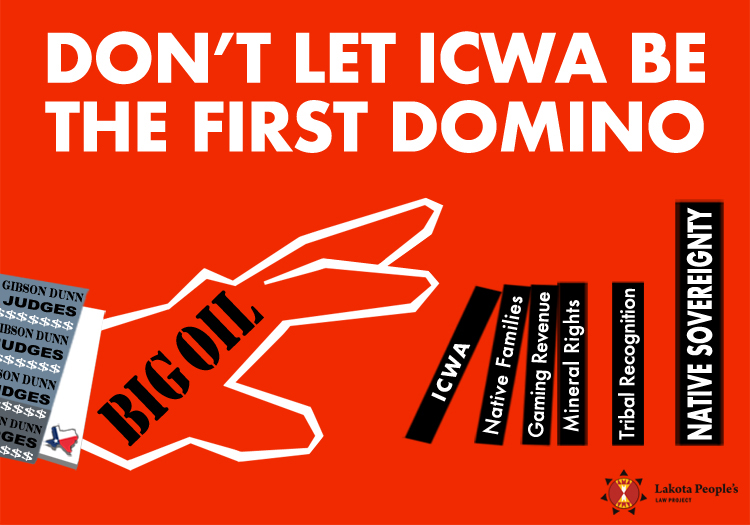
Have you heard of a court case called Brackeen v. Haaland? If you’ve followed our communications for any length of time, you likely recognize one of those names. Indeed, U.S. Secretary of the Interior Deb Haaland — the first Native Cabinet secretary in U.S. history — is already under legal attack. And it probably won’t surprise you that the powerful entities behind this threat include the State of Texas and lawyers representing Big Oil.
But it’s not just Secretary Haaland being targeted. The suit, which seeks to overturn the Indian Child Welfare Act, directly targets Native children and families. And because of the specific legal argument in play, it could also mean the end of tribal mineral rights, gaming revenues, Indian law as we know it, and ultimately our sovereignty as Indigenous nations. It’s not an overstatement to say our entire future could be at stake with a single decision — and that choice will now be made by a conservative-majority Supreme Court.
Please read our comprehensive blog on this case to learn more. From there, immediately take action by signing and widely sharing our petition to President Joe Biden and Department of Justice attorneys. Tell them it’s absolutely critical they protect Native children and safeguard Indigenous rights!
Right now — even as I drive from South Dakota to Minnesota in support of my Indigenous relatives fighting the Line 3 pipeline — the high court is deciding whether or not to hear this case. We will keep you updated every step of the way. This may well be the most important decision the Supreme Court has ever made in relation to Native justice. Please help us spread the word and stop this unconscionable attack on our Indigenous communities.
Wopila tanka — thank you for helping us stand up to racist colonial law. Madonna Thunder Hawk Cheyenne River Organizer The Lakota People’s Law Project
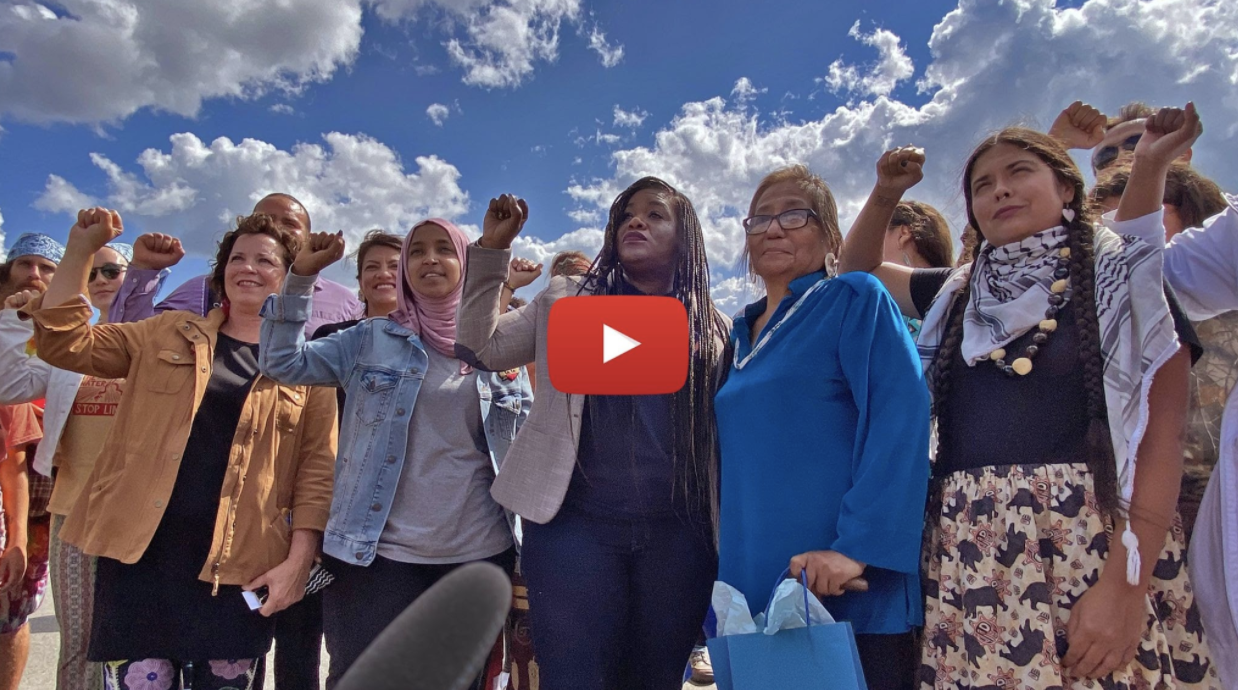
I have good news for you from the Line 3 front! This past weekend in Minnesota, I joined four members of “the Squad” — U.S. Reps. Ayanna Pressley, Rashida Tlaib, Cori Bush, and Ilhan Omar — to increase pressure on President Joe Biden to #StopLine3. As a Lakota elder and the former Standing Rock tribal liaison to the Oceti Sakowin camp during the NoDAPL struggle, I deeply understand the heartache my Anishinaabe relatives feel as this toxic pipeline invades their sacred lands and waterways — and I’m extremely grateful to these brave elected leaders for their solidarity.
Our Lakota team at the frontline included our co-director, Chase Iron Eyes, and the Squad was joined by Minn. State Sen. Mary Kunesh (a descendant of Standing Rock). As you know, the Indigenous women leading this fight — like Taysha Martineau of Camp Migizi, Tara Houska of Camp Giniw, and Winona Laduke of Honor the Earth — need all the support we can provide at the frontlines. It’s a meaningful step that the congresswomen, all of whom also signed onto a letter asking the president to intercede at Line 3, gave of their time and energy to visit resistance camps and amplify the struggle.
Notably, Alexandria Ocasio-Cortez (who decided to run for Congress while at Standing Rock in 2017, and whom I remember vividly as a friendly young woman in blue jeans) was also scheduled to come to the frontlines, but Hurricane Ida forced her to stay home in New York City. The horrific flooding in her borough further highlights humanity’s need to move climate justice to the very top of our priority list — right now, while we still can.
I’m happy to report that we were able to meet face to face with each of the congresswomen and get to know their staffers. We will remain in touch and ready to team up on key issues going forward. In about a week, my colleague and sister in service, Madonna Thunder Hawk, will lead more Lakota elders on a three-day trip to Line 3 to further support Taysha at Camp Migizi. We won’t stop doing whatever it takes to build key alliances and grow this movement to protect Unci Maka, our Grandmother Earth.
Wopila tanka — thank you for standing with our Anishinaabe relatives! Phyllis Young Standing Rock Organizer The Lakota People’s Law Project
Last week, we introduced you to Ruby Montoya, a schoolteacher and NoDAPL resistor being prosecuted as a terrorist by the U.S. government. She’s accused of putting four tiny holes into DAPL pipes before it was carrying oil — and for this, she’s facing the prospect of up to 20 years in federal prison. That’s far from acceptable, and it’s why we’re aiding her defense. Last week, Daphne Silverman, Ruby’s new attorney, submitted a motion to change Ruby’s prior guilty plea to not guilty based on crucial new discoveries. Read on for the details.
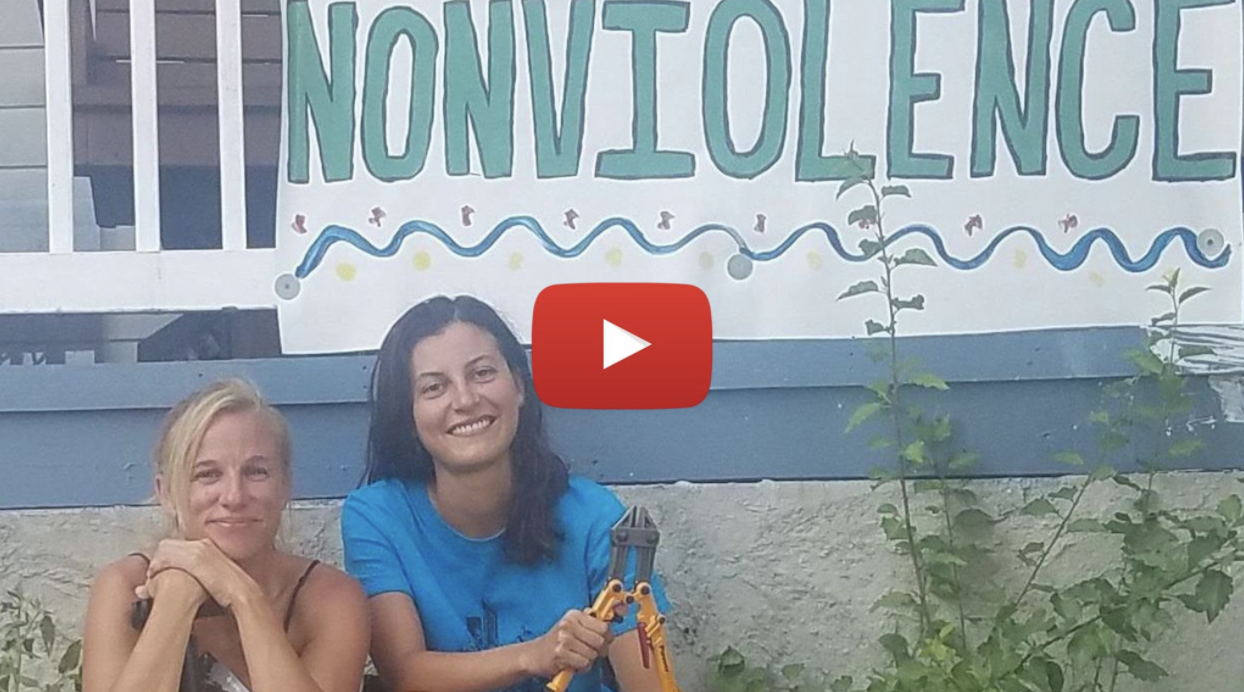
Ruby (right) and co-defendant Jessica Reznicek prior to their arrest. In our new video, Ruby and I talk about water protectors being labeled and prosecuted as terrorists.
After initial review of the case, our side has identified a number of major issues that should disqualify Ruby’s original plea. For one thing, the prosecutor and the pipeline company allege that millions of damage was done, but an expert hired by Daphne says it’s less than $50,000. In addition, some charges filed by the prosecutor require the pipeline to have been in use at the time it was allegedly damaged. It was not.
Those distinctions make a world of difference. Without damage over $100,000 to an operational pipe, these charges don’t qualify for federal court — and outside of federal court, there can be no terrorism enhancement. As I mention in our new video, this is eerily reminiscent of how I was treated during my own resistance to DAPL in 2016 and 2017. The government and law enforcement are demonstrating a pattern of deception designed to criminalize constitutionally protected protest, elevate charges, and label citizens who dare to care about the future of Planet Earth as terrorists. It’s infuriating.
If the court labels Ruby a terrorist, she’ll be punished like a career criminal — but Ruby has no criminal history at all. We expect a court decision on the plea change in the next couple months. Meanwhile, Daphne will be investigating, researching, and conducting additional review of the discovery. We hope that, with her expert legal assistance and support from folks like you, the justice system will ultimately treat Ruby with far more fairness than water protectors have come to expect. Stay tuned.
Wopila tanka — thank you for your solidarity with water protectors! Chase Iron Eyes Co-Director and Lead Counsel The Lakota People’s Law Project
Yesterday, led by our grandmothers, we took the Line 3 pipeline resistance directly to the Minnesota State Capitol in St. Paul. Emblematic of the deepening solidarity among tribal nations, a caravan of 20 Standing Rock citizens, assisted by the Lakota People’s Law Project, joined us for our “Treaties not Tar Sands” rally.
An impressive lineup of BIPOC speakers and Minnesota state officials, headlined by White Earth Nation’s Winona LaDuke, addressed more than 2,000 people who showed up to call out Enbridge’s toxic tar sands oil pipeline. Toward the end of the day, we at Camp Migizi took our turn at the microphone. Five Lakota People came onstage with us to acknowledge the importance of resisting pipelines together — and they should know, since they were all at Standing Rock in 2016 and ‘17 during the NoDAPL movement.
Among the more heartfelt and timely messages imparted by our Lakota relatives was a call for unity from elder Sonny Wonase. I invite you to watch highlights from both my talk and his.
Police presence was as strong as ever, including a fence meant to wall state officials off from our prayerful ceremony and pleas for justice. As you can probably guess, that didn’t deter water protectors. At the end of the rally, my fellow organizers read a statement of demands criticizing Governor Tim Walz’s support of the pipeline and militarized response. We also continued to call on President Joe Biden to intervene.
Until we’re heard and acknowledged, we will not be silent. We will not stop taking direct action to end this invasion of our sacred lands and protect our water and manoomin (wild rice). We are carrying forward the tradition of Indigenous activism begun by the American Indian Movement in the 1960s and renewed at Standing Rock five years ago. I express my gratitude to Standing Rock for standing with us now — and to you for holding space with us and Mother Earth. If we come together across our traditional boundaries, if we act with a unified voice and spirit, we can win this fight.
Miigwech — thank you for your support! Taysha Martinaeu Camp Migizi Via the Lakota People’s Law Project
At Standing Rock in 2016, water protectors were labeled as domestic terrorists. I created this short video to counter that claim. We are just the common people out here defending our rights and our lives. The government is supposed to work FOR US. The corporations are business entities that are supposed to be producing things FOR US.
Today, water protectors from Standing Rock are still being prosecuted, and — in the troubling cases of Ruby Montoya and Jessica Reznicek — they’re still being labeled as terrorists. Because we cannot allow this dangerous precedent to be used against more people who care for our Grandmother Earth, we’re going to help defend Ruby. Our struggle against the Dakota Access pipeline (DAPL) didn’t end at Standing Rock in 2017, and it won’t be over until every water protector in the crosshairs of the criminal justice system is liberated.
In 2017, Ruby and Jessica engaged in a direct action that damaged an empty section of DAPL’s pipe. Jessica was recently found guilty, given a “terrorism enhancement,” and sentenced to eight years in prison. Ruby’s fate now hangs in the balance as her trial approaches. With litigation support from Lakota Law and the National Lawyers Guild, Ruby is going to fight. Her next hearing is scheduled for Wednesday, Sept. 1.
As Ruby says in this new video produced by our team, humanity is going through a reckoning. In the future, no one will fondly remember the names of corporations that represented the status quo; instead, many people will only wish they had fought harder to protect life on this planet. Nobody who takes a stand to stop extractive destruction should ever be charged with a felony, much less be labeled a terrorist.
Ruby told me that Jessica has never even held a weapon in her hands, and at one point she was considering entering a monastery. And Ruby is a Waldorf School teacher, who vividly remembers kids in her classes crying and losing sleep because Australia and the Amazon were on fire. Ruby’s resistance, like my own back in 2017 that earned me a felony charge, has been motivated only by a desire to give the next generations a destiny they can believe in.
Nothing any of us did comes close to a level of governmental coercion necessary to justify a terrorism enhancement. It’s fallacious to suggest we have that type of power. If the government is being coerced by anyone, it’s the fossil fuel barons who buy politicians to protect their profits. Ruby was invited by an Indigenous community to protect water and help safeguard sacred lands. She showed up. Now, we will have her back, just like she had ours. Please stay tuned as we continue to fight to prevent a grave miscarriage of justice.
Wopila tanka — thank you for standing for justice! Chase iron Eyes Co-Director and Lead Counsel via the Lakota People’s Law Project
Sending you best wishes from the Line 3 frontline in Minnesota. I’m encouraged to report that nearly 30 high-profile national lawmakers have responded to grassroots pressure and sent a joint letter to President Biden. It urges the White House to ensure a full environmental assessment of the Line 3 tar sands pipeline, which is damaging sensitive wetlands in the midst of the ever-worsening climate emergency. We on the frontlines are grateful we’re being heard. Our team is doing all we can to protect our sacred homelands — and your support is essential.
Please give to lift up our #StopLine3 resistance. We need food, fuel, equipment, and supplies to remain effective. We now have just a matter of weeks to convince the Biden administration to end the desecration of our lands and waterways. We won’t go away — but this pipeline must. Help us stay in its path every single day.
Lakota Law reached out to lawmakers it has relationships with to sign onto the Biden letter, and the progress in D.C. is partly a result of all the direct action occurring here in Minnesota. Just today, we at Camp Migizi led a march on the Army Corps of Engineers building in Duluth, Minnesota. Lakota Law co-director and lead counsel Chase Iron Eyes and more than 300 water protectors joined us in delivering a strong message of resistance.
Today’s direct action exemplifies the growing partnership between my Anishinaabe People and the Lakota who have come to stand with us. As expected, the police reacted aggressively, even detaining one Indigenous woman so forcefully that we felt it necessary to shut down a nearby bridge in response.
Next, on Saturday, we’re helping organize and publicize a direct action in D.C. In tandem with allied groups and influencers, Camp Migizi and Lakota Law will deliver more than 127,000 #StopLine3 petitions to Biden, hold a sacred ceremony, and engage with our fellow activists at the National Museum of the American Indian.
I want you to know that, even as we — and so many in the world — grapple with one existential crisis after another, there is much reason for hope. We must stay active and vigilant!
Miigwech — thank you for your solidarity with our Indigenous nations. Taysha Martineau Via the Lakota People’s Law Project
As we enter the dog days of August, I think it’s fair to say that 2021 has become a year for recognition and reckoning. Of course, Native People grow up with a heightened understanding of the genocide on which the U.S. was founded. Today, I want to share a little more of that perspective with you.
As an ally integral to our movement for justice, your willingness to engage with hard truths is appreciated. You can help us spread the word and find a better way forward. Today, as part of this process, I ask you — if you can stomach it — to watch this special report about the Hiawatha Indian Insane Asylum from prominent South Dakota news organization KELO.
Hiawatha was a horrific place, located right here in South Dakota — something that should surprise nobody. Its reputation among Native People was so bad that the threat of being sent there was used as a deterrent for children who misbehaved at boarding schools. As some of the keepers of this story mention in their interviews with KELO, it housed people from many tribal nations, and once you went in, you were very unlikely to come out.
It’s hard to find an “insane asylum” with a good reputation. But of course, the conditions at the one that impounded Native folks were far worse than most. Most of those sent to Hiawatha were anything but “crazy.” As my colleague, Chase Iron Eyes, put it earlier today, many of these relatives were spiritually gifted. Others probably just had too much fighting spirit for their own good.
I know this is a heavy topic, and I thank you for reading. We are living in troubled times, and it’s only with your attention that we can avoid making the same mistakes again and leave a more equitable world to our future generations.
Wopila tanka — my gratitude for being on this difficult journey with us. You’re making things better! Madonna Thunder Hawk Cheyenne River Organizer The Lakota People’s Law Project
I have two pieces of wonderful news to share with you! As of yesterday, TC Energy at last canceled all remaining plans for the Keystone XL pipeline (KXL). The Zombie Pipeline is finally completely dead! At the same time, I was able to negotiate a deal with the South Dakota state’s attorney and avoid jail time for my KXL protest last year.
It was a good day not just for me, personally, but for all water protectors. This shows that — even as many states around the country continue to pass laws criminalizing protest — the people still have power. Our activism can make a real difference. As my fellow Cheyenne River protester, Oscar High Elk, said yesterday, “Respect our existence, or expect our resistance.”
Of course, as you know, our resistance still has much left to accomplish. I’m grateful that KXL’s immediate threats to our land and water are gone, along with the dangers its mancamps presented to Indigenous women and girls in Lakota Country. But Dakota Access still operates — without a legal permit — and Line 3 presents the same peril to the homelands of our Anishinaabe sisters and brothers in Minnesota.
Now, it’s time to #StopLine3 and continue our #NoDAPL fight. The cards are always stacked against us, but we have shown time and time again our resilience, the power of our movement, and our ability to triumph against the greatest odds.
Just this week, hundreds gathered at a pump station near the headwaters of the Mississippi River in Minnesota, led by my sisters in arms, for the largest Line 3 protest yet. Reports tell us that a Department of Homeland Security helicopter harassed them, kicking up dust and gravel in an attempt to deter my relatives. It didn’t work. More than 100 were arrested, and we aren’t done yet. Like Lakota Law’s team, I’m considering ways I can best support this movement going forward. Because — take it from me — we can win!
Wopila — I’m very grateful for your solidarity with our resistance. Jasilyn Charger via the Lakota People’s Law Project
The Keystone XL pipeline project is officially terminated, the sponsor company announced Wednesday.
Calgary-based TC Energy is pulling the plug on the project after Canadian officials failed to persuade President Joe Biden to reverse his cancellation of its permit on the day he took office.
The company said it would work with government agencies “to ensure a safe termination of and exit from” the partially built line, which was to transport crude from the oil sand fields of western Canada to Steele City, Nebraska.
“Through the process, we developed meaningful Indigenous equity opportunities and a first-of-its-kind, industry leading plan to operate the pipeline with net-zero emissions throughout its lifecycle,” said François Poirier, TC Energy’s president and chief executive officer in a statement.
The pipeline has been front and center of the fight against climate change, especially in Indigenous communities. Native people have been speaking out, organizing, and in opposition of the project for several years.
“OMG! It’s official,” Dallas Goldtooth, Mdewakanton Dakota and Diné, wrote on Twitter regarding Keystone XL’s termination. “We took on a multi-billion dollar corporation and we won!!”
Goldtooth is part of the Indigenous Environmental Network. The network said it has been organizing for more than 10 years against the pipeline.
“We are dancing in our hearts because of this victory!” wrote the network in a statement. “From Dene territories in Northern Alberta to Indigenous lands along the Gulf of Mexico, we stood hand-in-hand to protect the next seven generations of life, the water and our communities from this dirty tar sands pipeline. And that struggle is vindicated. This is not the end – but merely the beginning of further victories.”
The network noted that water protector Oscar High Elk still faces charges for standing against Keystone.
Construction on the 1,200-mile pipeline began last year when former President Donald Trump revived the long-delayed project after it had stalled under the Obama administration.
It would have moved up to 830,000 barrels of crude daily, connecting in Nebraska to other pipelines that feed oil refineries on the U.S. Gulf Coast.
Biden canceled it in January over long standing concerns that burning oil sands crude would make climate change worse.
In this Feb. 18, 2020, photo, a protester plays a drum and sings while joined by others opposing the Keystone XL Pipeline at the South Dakota Capitol. (AP Photo/Stephen Groves, File)
Canadian Prime Minister Justin Trudeau had objected to the move, although officials in Alberta, where the line originated, expressed disappointment in recent weeks that Trudeau didn’t push Biden harder to reinstate the pipeline’s permit.
Alberta invested more than $1 billion in the project last year, kick-starting construction that had stalled amid determined opposition to the line from environmentalists and Native American tribes along its route.
Alberta officials said Wednesday they reached an agreement with TC Energy, formerly known as TransCanada, to exit their partnership. The company and province plan to try to recoup the government’s investment, although neither offered any immediate details on how that would happen.
“We remain disappointed and frustrated with the circumstances surrounding the Keystone XL project, including the cancellation of the presidential permit for the pipeline’s border crossing,” Alberta Premier Jason Kenney said in a statement.
The province had hoped the pipeline would spur increased development in the oil sands and bring tens of billions of dollars in royalties over decades.
Attorneys general from 21 states had sued to overturn Biden’s cancellation of the pipeline, which would have created thousands of construction jobs. Republicans in Congress have made the cancellation a frequent talking point in their criticism of the administration, and even some moderate Senate Democrats including Montana’s Jon Tester and West Virginia’s Joe Manchin had urged Biden to reconsider.
Tester said in a statement Wednesday that he was disappointed in the project’s demise, but made no mention of Biden.
Wyoming Sen. John Barrasso, the top Republican on the Senate energy committee, was more direct: “President Biden killed the Keystone XL Pipeline and with it, thousands of good-paying American jobs.”
A White House spokesperson did not immediately respond to a request for comment on TC Energy’s announcement.
In case you missed it, a recent decision in the legal saga of the Dakota Access pipeline (DAPL) will keep the oil flowing while an Environmental Impact Statement (EIS) is done over the next nine months — and the courts have essentially stepped away from responsibility to shut operations down. Sadly, in his latest opinion, D.C. Judge James Boasberg has basically stated that his hands are tied by a higher court ruling.
Watch: Lakota Law chief counsel Danny Sheehan joined me to discuss the developments on Cut to the Chase.
As a reminder to you about what got us here, Boasberg (an Obama appointee) ruled last July to vacate federal permits for Dakota Access. He reasoned then that the Army Corps of Engineers failed to conduct a full EIS, as demanded in a lawsuit filed by the Standing Rock and Cheyenne River Sioux Tribes. Then, in August, an appeals court affirmed Boasberg’s decision to invalidate the permit, while simultaneously overturning his decision to empty the pipeline. DAPL has been operating unpermitted ever since — a completely unheard-of scenario, and a violation of the National Environmental Policy Act (NEPA).
Boasberg has since been essentially asking the Corps to make a political decision on whether it’s acceptable for this pipeline to operate without a valid permit on federal land. So far, the Corps (an executive branch agency now under president Biden’s leadership) has shown no desire to do the right thing. Rather than issuing an order to halt operations until proper environmental review is complete, Biden and the Corps are ducking responsibility.
Our legal analysis is that there’s still a potential path forward in the courts. At this stage, the tribes could go directly after the Army Corps under the Administrative Procedures Act. This could lead to a court-order forcing Biden and the Corps to make a decision on whether to continue allowing DAPL’s operation in violation of NEPA.
Lakota Law, its supporters, and a host of like-minded organizations and allies continue to ask Biden to step up and shut DAPL down. We’ll continue to closely examine all the legal and political angles, assessing potential leverage points to push the Corps. Stay tuned.
Wopila tanka — thank you, always, for standing with Standing Rock! Chase Iron Eyes Co-Director & Lead Counsel The Lakota People’s Law Project













 Water is Life