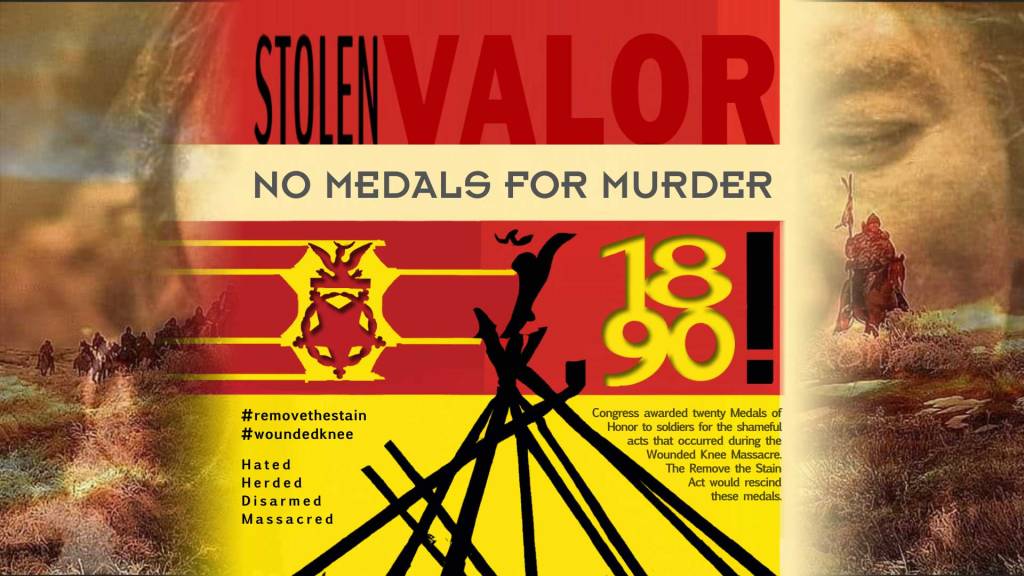
Chief Big Foot Memorial Ride

Lakota Law

A very Happy New Year from me and my family to you and yours! In December, I wrote to you and asked you to help spread the word about passing the Remove the Stain Act. By rescinding 20 Medals of Honor awarded to soldiers who murdered nearly 300 Lakota women, men, and children at the Wounded Knee Massacre in December of 1890, we can more deeply recognize our ancestors. In this way, we honor the sacrifices they made so that we can be here today.

In that same email, I referenced the annual Chief Big Foot Memorial Ride, in which many of my relatives take to horseback to retrace the path our ancestors traveled before that horrific day. Today, I encourage you to watch our new video, in which I talk more about the annual tradition of this ride, the history behind it, and its deep meaning to our people. 

My relatives honor our ancestors at the Chief Big Foot Memorial Ride.

Undertaking this journey and reminding ourselves of the reality of what our ancestors went through on that hard winter’s trail helps to ground and more fully connect us. It takes many days and resources to replicate on horseback the original journey from Standing Rock through my home nation of Cheyenne River to Wounded Knee Creek on the Pine Ridge Reservation. How hard it must have been for those families who did it on foot in 1890 — and directly on the heels of the murder of Sitting Bull. 

Eagle Hunter, my brother-in-law, put it eloquently and succinctly: “Wasigla.” This is something that you don’t forget. We Lakota are a visual people, and the modern-day visual of following the trail to Wounded Knee is powerfully symbolic for us. We who are Indigenous to this land engage in ceremonial memorials because it’s part of who we are. We don’t usually write it down, we just do what’s in our ancestral memory. But today, I write to share this memory with you.

Wopila tanka — thank you for riding with us in spirit!
Madonna Thunder Hawk
Cheyenne River Organizer
The Lakota People’s Law Project

Wounded Knee Massacre: Remove the Medals Call to Action

Lakota Law

On December 29, 1890, the 7th Cavalry of the United States committed an unconscionable act of genocide, killing nearly 300 Lakota women, children, and men at Cankpe’ Opi Wakpa, or Wounded Knee Creek. That number included 38 Hunkpapa and a larger number led by Lakota Chief Spotted Elk of the Mnicoujou band. Most of our people murdered that day were unarmed. Then, for taking part in the Wounded Knee Massacre, 20 U.S. soldiers were awarded the Medal of Honor.

Medals of Honor are meant to signify gallantry beyond the call of duty, clearly distinguishable from lesser forms of bravery. The soldiers at Wounded Knee did not live up to this standard. Rather, they slaughtered innocent Native families in cold blood, and it’s long past time to rescind their awards. Please take decisive action today. Tell your Senators and Congressperson to pass the Remove the Stain Act and rescind all Medals of Honor awarded for the Wounded Knee Massacre.

Click the pic and tell your reps to pass the Remove the Stain Act today.

Native People and the U.S. government both understand — to very different degrees — the gravity of what happened at Wounded Knee. In 1990, on the centennial of the massacre, both houses of the U.S. Congress passed a resolution expressing their “deep regret.” That gesture, of course, is far from adequate. In 2001, the National Congress of American Indians passed two resolutions demanding that the federal government rescind all Medals of Honor awarded for Wounded Knee. That same year, the Cheyenne River Nation, where I make my home, passed Tribal Council Resolution No. 132–01, asking for the same. Other organizations, such as Four Directions, have also taken up and amplified this call.

This is not ancient history in Lakota Country. The massacre’s memorial stands in stark relief against the plains and low hills of Pine Ridge — the location of Wounded Knee — every day. And each year in December, we honor our ancestors’ trek to Wounded Knee with a ride on horseback through the bitter cold, retracing the trail they left in their final moments on this earth. It’s our way of remembering and honoring the sacrifice they never should have had to make. Many people carry on this tradition and keep it alive, riding all the way from the homelands of Sitting Bull (Standing Rock) through Cheyenne River to the site of the massacre. Several organizations — such as my friends at the Horse Spirit Society — come together to provide horses, tack, feed, and other essentials for participants. 

Our people dedicate their limited resources for this cause, asking nothing in return but that we remember those who were lost. So today, as we approach the anniversary of the Wounded Knee Massacre, I ask you to learn more about how we keep our ancestors’ memories alive. And please, tell your senators and House rep to pass the Remove the Stain Act. While nothing we can do will bring them back, in this way we can properly honor our relatives.

Wopila tanka — thank you for taking action!
Madonna Thunder Hawk
Cheyenne River Organizer
The Lakota People’s Law Project

Note: I no longer participate in virtual worlds. I did create a virtual memorial and here is the link to an interview I had done about it. https://virtualoutworlding.blogspot.com/2018/02/2018-edu-massacre-at-wounded-knee.html

Dakota Water Wars

Lakota Law

Greetings from Lakota Country, where two blizzards just dumped several feet of snow and knocked out power for many of our people. Here’s hoping you’re staying warm wherever you are! Of course, no matter the weather, we keep doing all we can to look out for our relatives — including our ongoing fight to end the Dakota Access pipeline (DAPL).

Winning this battle is critical. Just last week, we received news of yet another pipeline disaster. One month after the Keystone pipeline increased the amount of oil it’s carrying, it ruptured and dumped 14,000 barrels — or nearly 600,000 gallons — of toxic tar sands crude in Kansas. So today, we bring you the eleventh chapter of our Dakota Water Wars video series, co-produced by the Lakota People’s Law Project, the Standing Rock Sioux Tribe, and the Great Plains Water Alliance. Give it a watch, and you’ll see how hard we fought to keep the Dakota Access pipeline (DAPL) from doubling its flow rate, and just how far the oil company went to downplay the potential consequences.

Watch: Standing Rock member Winona Gayton addresses the North Dakota Public Service Commission during a hearing on DAPL nearly doubling its capacity.

This latest Keystone spill — its third major leak in the past five years — is the second largest domestic pipeline incident ever recorded. It’s going to be nearly impossible to properly clean up, And, because Keystone is now carrying more oil, the problem is exacerbated. In our video (at the top of the blog, which also contains all the other Dakota Water Wars chapters), you’ll hear a lot about “worst case discharge.” That sounds bad because it is. The math says that when a pipeline inevitably leaks, it’s going to be worse the more oil it’s carrying. 

If DAPL spills where it crosses the Mni Sose — the Missouri River — just upstream from the Standing Rock Nation, it will threaten everything we hold dear: our drinking water, our pristine landscape, plants and animals, our way of life. That’s why we gathered by the thousands in 2016 and 2017 to prevent DAPL. And given the danger from increasing the oil flow, it should be easy to understand why we rallied again in 2019 to stop the doubling of its capacity to more than 1 million barrels per day. 

We cannot accept this illegal and dangerous pipeline (the Army Corps of Engineers still has yet to produce a valid Environmental Impact Statement for DAPL, as mandated by the courts). We won’t stop raising awareness about how it imperils both people and planet, and we’ll continue — with your help — to fight using every available method until the Black Snake is defeated once and for all.

Wopila tanka — my deep appreciation for your solidarity!
Chase Iron Eyes
Co-Director and Lead Counsel
The Lakota People’s Law Project

A Win for Civil Rights

Lakota Law

Are you ready for some good news? A few days back, on Dec. 9, the U.S. 9th Circuit Court of Appeals issued a big decision in favor of Native students who take pride in their communities. Its ruling ensures that Larissa Waln, member of Sisseton Wahpeton Tribe in South Dakota, can now pursue a civil rights suit against her former school district in Arizona.

In 2019, Larissa was forbidden to participate in her graduation ceremony for wearing a beaded graduation cap adorned with a sacred eagle feather and medicine wheel. Her school district had previously issued a rule prohibiting students from decorating or altering their commencement caps. But that very day, a different school in the same district permitted another graduating student to wear a commencement cap featuring a breast cancer awareness sticker. 

Larissa Waln with her deadly graduation cap.

In April of 2020, Waln and her family sued the school district in federal district court for violating their rights to freedom of religion and speech and denying her equal protection under various state and federal laws. Notably, the Waln v. Dysart School District lawsuit cited a 2019 report published by the Lakota People’s Law Project, which provided crucial context regarding the importance of regalia to Native peoples’ cultural expression.

Last week’s Circuit Court ruling overturns a 2021 dismissal by a district court, mandating that the lower court now hear Larissa’s case. When ruling in her favor, the 9th Circuit referenced Lakota Law’s report on the second page of its opinion, highlighting the report’s summary of the boarding school era and the longstanding U.S. assimilation policy of “kill the Indian, and save the man.” While one decision can never make up for the long and damaging history of Native erasure in America, we’re elated that Larissa will be able to pursue justice.

Through her lawsuit, Larissa is addressing Native self-determination from a different angle than the advocates defending the Indian Child Welfare Act in Brackeen v. Haaland, the case recently heard by the Supreme Court. Both cases are important. Thanks at least in part to her bravery and the activism of people standing in solidarity with Native students, Arizona changed its state law in 2021. The passage of AZ House Bill 2705 makes it illegal for state public and charter schools to prohibit Native students from wearing regalia at graduation ceremonies. So, today, I’m grateful to Larissa for taking a stand, to the 9th Circuit for making the right decision, and to you for standing by our side in the fight for justice.

Wopila tanka — thank you, as always, for your friendship.
Chase Iron Eyes
Co-Director and Lead Counsel
The Lakota People’s Law Project
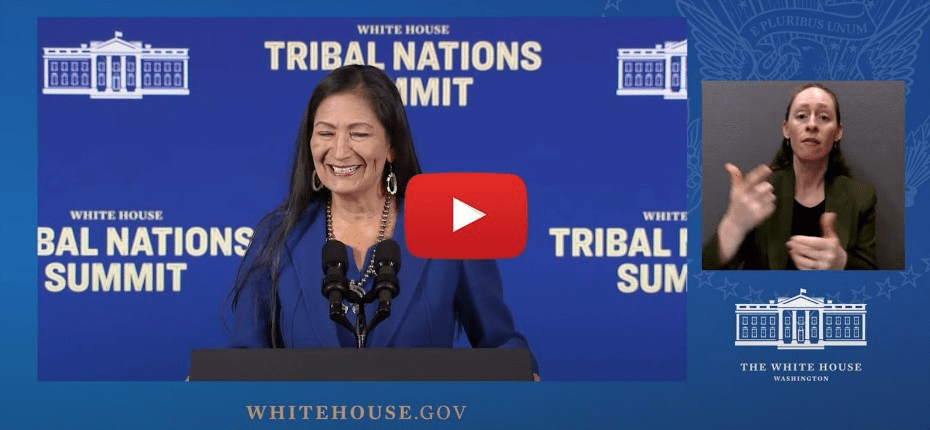
Tribal Nations Summit in D.C.

Lakota Law

It’s been a big couple days for Indian Country in Washington, D.C. For the first time in six years, tribal representatives from across Turtle Island gathered together with U.S. leaders for the White House Tribal Nations Summit. After a four-year hiatus during the Trump presidency, President Joe Biden revived the event last year, but that was held virtually because of the pandemic. This year, a delegation from the Standing Rock Sioux Tribe joined many other tribal citizens, making the trip to the nation’s capital to discuss the Biden administration’s promising agenda for Native America.

The administration made historic pledges of money and resources to tackle issues like infrastructure and climate. It also committed to protecting Spirit Mountain — a site sacred to several Native nations in and around so-called Nevada — and promised a new “respect for Indigenous knowledge and tribal consultations.”

Click the pic to watch: U.S. Secretary of the Interior Deb Haaland (Pueblo of Laguna) introduces President Biden at this year’s White House Tribal Nations Summit, and Biden gives his opening remarks.

In his opening remarks, Biden said monetary allocations to tribal nations will include a mandatory $9.1 billion for the Indian Health Service (IHS) and $135 million to help relocate 11 at-risk tribal communities. Specifically, the Department of the Interior, led by Secretary Deb Haaland of the Pueblo of Laguna, will provide $25 million each to three tribes on the frontlines of the climate crisis in Alaska and Washington State.

Of course, you know as I do that Indigenous populations — and other communities of color — suffer the effects of the climate emergency disproportionately. That’s not acceptable, whether it’s a majority-Black or Latinx neighborhood adjacent to a poisonous chemical plant, Standing Rock dealing with the existential threat of the Dakota Access pipeline, or the Quinault Indian Nation endangered by rising sea levels.

The money will help, as will enhanced agency cooperation and assistance. Still, to really solidify Native sovereignty, the government will need to make good on its promise to listen to tribal nations and gain consensus. While I would prefer to see the U.S. firmly adopt the standard of Free, Prior, and Informed Consent (FPIC) set forth in the United Nations Declaration on the Rights of Indigenous Peoples, I’m optimistic that we’re a step closer toward governmental recognition of the self-determination we deserve when it comes to our people and our homelands.

Wopila tanka — thank you for standing with us!
Chase Iron Eyes
Co-Director and Lead Counsel
The Lakota People’s Law Project
The Dream

Lakota Law
Lakota Law

On Aug. 26, 1963, the Reverend Dr. Martin Luther King, Jr. delivered his iconic “I Have a Dream” speech on the steps of the Lincoln Memorial in Washington, D.C. As you know, his powerful oratory laid out a vision of unification, calling for civil and economic rights and an end to racism. And yet, we still have a long way to go before his dream can become a reality.

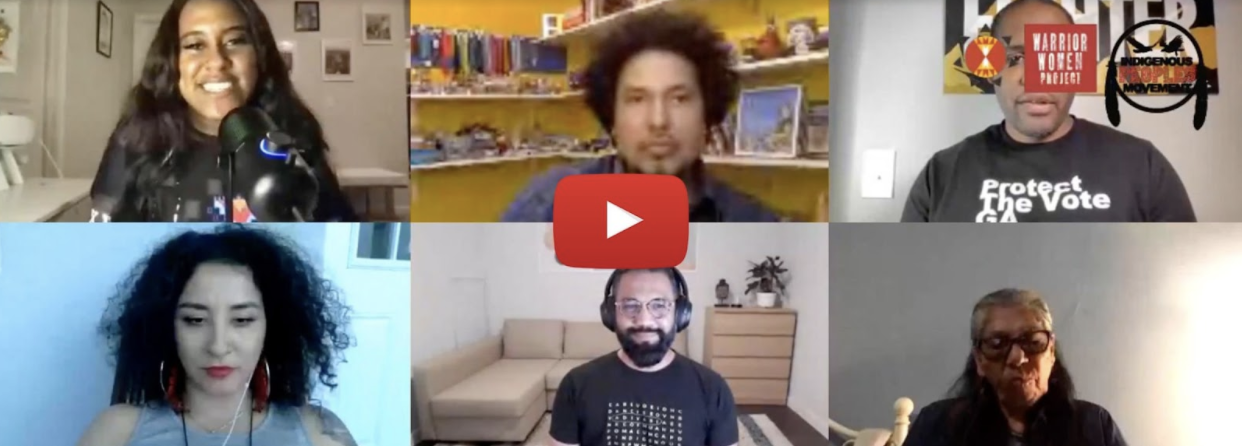
On Monday, as we celebrated Martin Luther King Day, the Lakota People’s Law Project joined the Indigenous Peoples Movement (IPM) and Warrior Women Project to host an online panel discussion titled “Are We Fulfilling the Dream?” You can find the entire roundtable on our social channels, and we’ve also cut together a shorter video with some highlights for you here.

Watch: IPM’s YoNasDa LoneWolf was joined by Madonna Thunder Hawk of Lakota Law and Warrior Women Project — and a diverse crew of BIPOC thinkers — to discuss racism and civil rights on MLK Day.

As a mixed-race Black and Yamassee woman, I’m proud to work not only for Lakota Law but also for my tribe as its Cultural and Government Liaison. I am also an IPM coalition member, and as such, I’m embedded every day in the movements for Indigenous sovereignty and Black liberation.

Sadly, many in this land are still working overtime to protect and propagate systemic exploitation. Just yesterday, the U.S. Senate met to debate a pair of voting rights bills — the Freedom to Vote Act and the John Lewis Voting Rights Advancement Act — which would implement voting protections especially helpful to People of Color. But conservative lawmakers are refusing to support these bills, leading to calls among liberals for filibuster reform so that a simple majority could pass them. Indeed, the filibuster is an antidemocratic institution; at a minimum it should be partially set aside to allow civil rights legislation, such as voting rights bills, to be passed by simple majority. 

At this critical moment, we can’t lose more ground in our battle for equity and justice. If we don’t stand for democracy now, we may never have the chance again. If you haven’t yet done so, you can use Lakota Law’s Action Center to write to your senators and tell them to safeguard the future of our democracy by reforming the filibuster and passing both voting rights bills! 

Please watch and share our discussion, and take action to create a more inclusive future. We can still fulfill the dream shared by MLK and John Lewis. We can let freedom ring from every mountainside. But we must act as one for the benefit of all.

Shonabish — thank you for standing for justice and equality!
Earth Hadjo
Social Media Coordinator
Lakota People’s Law Project

A Victory

Lakota Law

As many of us gather with family today — a “holiday” that people in our communities understand as a deeply problematic celebration of colonialism and genocide — I’ll choose to highlight a recent victory for Native America. You may recall that, a few months back, we asked you to help the Cherokee Nation seat a congressional delegate. Here’s the good news. About a week ago, after nearly two centuries of delay, Congress held its first ever hearing on the subject — and it went very well!

Watch the video and share this action: Chief Chuck Hoskin Jr. of the Cherokee Nation sat down with us to discuss the importance of seating Kimberly Teehee as the Cherokee Nation’s first congressional delegate.

To be clear, it isn’t a done deal. However, as NPR accurately reports, last week’s House Rules Committee hearing represents by far the biggest step the federal government has ever taken toward fulfilling a promise it made to the Cherokee way back in 1835’s Treaty of New Echota. And while we can’t celebrate prematurely, the U.S. government making progress toward doing what it said it would for any Native nation is historic and a reason for optimism.

So now what? Let’s keep the pressure on. Cherokee Nation Principal Chief Chuck Hoskin gave Lakota Law an informative interview about why it’s time to seat Kimberly Teehee as the Cherokee delegate to the House of Representatives, and that discussion is available to watch on our action page. If you have not already done any of the following, I urge you to make the time to watch the interview, send a message to your reps, and use the social media buttons on our action page (and perhaps dinner table conversation) to share this timely advocacy with your circle.

Given the tenor of the Rules Committee hearing and the outpouring of support by people like you, Chief Hoskin is confident the Cherokee can make history for Native representation in the halls of power as soon as this calendar year. Let’s help him make it happen!

Wopila tanka — thank you, and I wish you a good day of connection.
Chase Iron Eyes
Co-Director and Lead Counsel
The Lakota People’s Law Project

On this day in 2016…

I had arrived in Bismarck, North Dakota. Scroll back to the beginning of this blog and you can read about the history of events at Standing Rock. Some things have changed, many things have stayed the same. The things I witnessed there made me profoundly angry and sad. I saw militarized police practicing with their new gear how to do crowd control. I experienced racism and hatred from the local population in town. I witnessed how some people infiltrated the camp and tried to cause destruction from within the movement. They were largely unsuccessful because of the people´s spirit. This was a sacred space. I talked to the spirits one freezing night. It was those spirits that I called on for help last year while I was being held against my will in the COVID-19 ward in the hospital. Yes, after traveling to such a sacred place you experience the power of the spirits.

In 2017, I left the U.S. and moved to Costa Rica. The history is very different here. They do not have an army. I wish everyone a holiday season when they remember the spirits and their ancestors and fight to maintain their freedoms and way of life. A way of life that is non-destructive of the environment and other people. These are dangerous times.