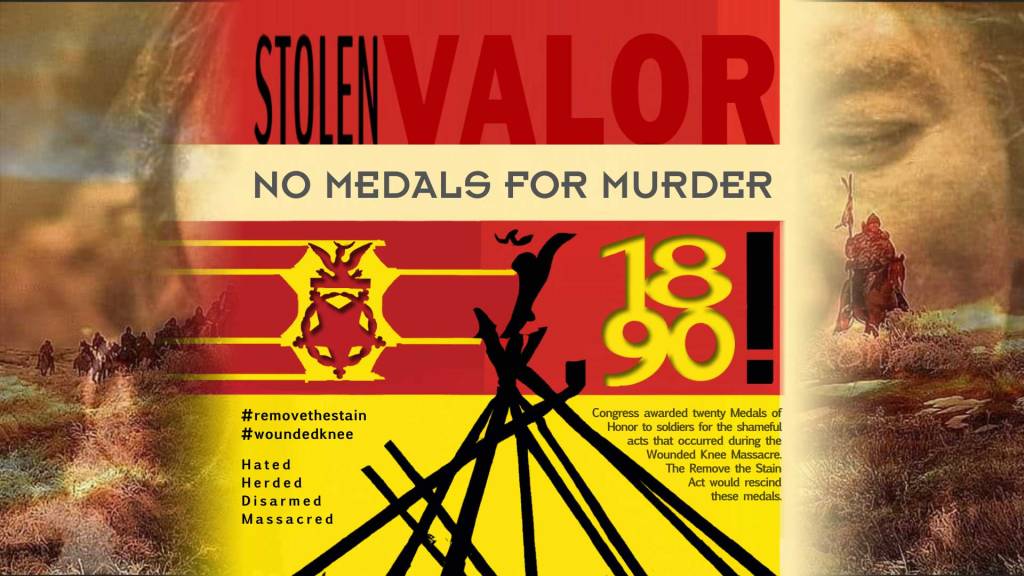
Wounded Knee Occupation

https://ictnews.org/news/wounded-knee-legacy-lives-on-50-years-later

On March 10, 1973, more than a week after American Indian Movement activists occupied the town of Wounded Knee, South Dakota, Oglala Sioux tribal members and AIM members march to to the cemetery where ancestors were buried following the 1890 massacre at the site. Third in line is Carter Camp, Ponca, one of the AIM leaders. (AP Photo/FILE)

Kalle Benallie
ICT

WOUNDED KNEE, South Dakota — Madonna Thunder Hawk remembers the firefights.

As a medic during the occupation of Wounded Knee in early 1973, Thunder Hawk was stationed each night in a frontline bunker in the combat zone between Native activists and government agents.

“I would crawl out there every night, and we’d just be out there in case anybody got hit,” said Thunder Hawk, Oohenumpa band of the Cheyenne River Sioux Tribe, one of four women assigned to the bunkers.

SUPPORT INDIGENOUS JOURNALISM. CONTRIBUTE TODAY.

Memories of the Wounded Knee occupation — one in a string of protests from 1969 to 1973 that pushed the American Indian Movement to the forefront of Native activism — still run deep within people like Thunder Hawk who were there.
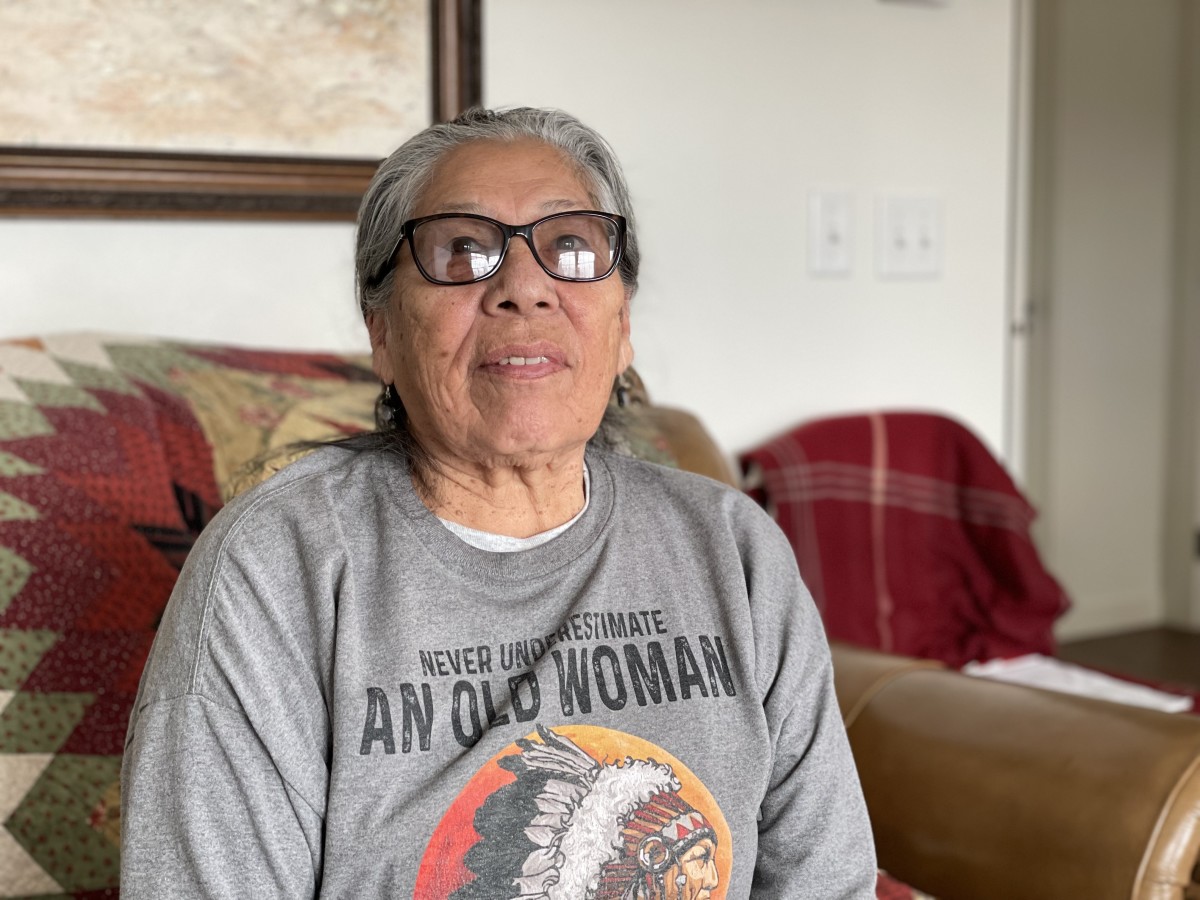
Madonna Thunder Hawk, 83, shown here in early February 2023, was one of the four women medics during the occupation of Wounded Knee, which started on Feb. 27, 1973 and ended May 8, 1973. She wears her “Never underestimate an old woman” shirt proudly. (Photo by Kalle Benallie/ICT)

Madonna Thunder Hawk, 83, shown here in early February 2023, was one of the four women medics during the occupation of Wounded Knee, which started on Feb. 27, 1973 and ended May 8, 1973. She wears her “Never underestimate an old woman” shirt proudly. (Photo by Kalle Benallie/ICT)

Thunder Hawk, now 83, is careful about what she says today about AIM and the occupation, but she can’t forget that tribal elders in 1973 had been raised by grandparents who still remembered the 1890 slaughter of hundreds of Lakota people at Wounded Knee by U.S. soldiers.

“That’s how close we are to our history,” she told ICT recently. “So anything that goes on, anything we do, even today with the land-back issue, all of that is just a continuation. It’s nothing new.”

Other feelings linger, too, over the tensions that emerged in Lakota communities after Wounded Knee and the virtual destruction of the small community. Many still don’t want to talk about it.

But the legacy of activism lives on among those who have followed in their footsteps, including the new generations of Native people who turned out at Standing Rock beginning in 2016 for the pipeline protests.

“For me, it’s important to acknowledge the generation before us — to acknowledge their risk,” said Nick Tilsen, founder of NDN Collective and a leader in the Standing Rock protests, whose parents were AIM activists.

“It’s important for us to honor them. It’s important for us to thank them.”

Read more:
My story: Behind the lines at Wounded Knee
Wounded Knee anniversary events
Wounded Knee land comes home at last

Akim D. Reinhardt, who wrote the book, “Ruling Pine Ridge: Oglala Lakota Politics from the IRA to Wounded Knee,” said the AIM protests had powerful social and cultural impacts.

“Collectively, they helped establish a sense of the permanence of Red Power in much the way that Black Power had for African-Americans, a permanent legacy,” said Reinhardt, a history professor at Towson University in Towson, Maryland.

“It was the cultural legacy that racism isn’t okay and people don’t need to be quiet and accept it anymore. That it’s okay to be proud of who you are.”

A series of events is planned in South Dakota to recognize the 50th anniversary of the occupation of Wounded Knee, starting on Friday, Feb. 24, in Rapid City, and building to a 50th anniversary pow wow on Sunday, Feb. 26, in Porcupine, South Dakota, and a Four Direction Walk and Ride on the actual anniversary, on Monday, Feb. 27.

The women of Wounded Knee will also be honored on Saturday, Feb. 25, in Porcupine, and another pow wow is set for Saturday in Rapid City. The documentary film, “From Wounded Knee to Standing Rock,” will be shown on Sunday, Feb. 26, in Kyle, South Dakota.

‘Thunderbolt’ of protest

The occupation began on the night of Feb. 27, 1973, when a group of warriors led by Oklahoma AIM leader Carter Camp, Ponca, moved into the small town of Wounded Knee. They took over the trading post and established a base of operations along with AIM leaders Russell Means, Oglala Lakota; Dennis Banks, Ojibwe; and Clyde Bellecourt, White Earth Nation.

Within days, hundreds of activists had joined them for what became a 71-day standoff with the U.S. government and other law enforcement.
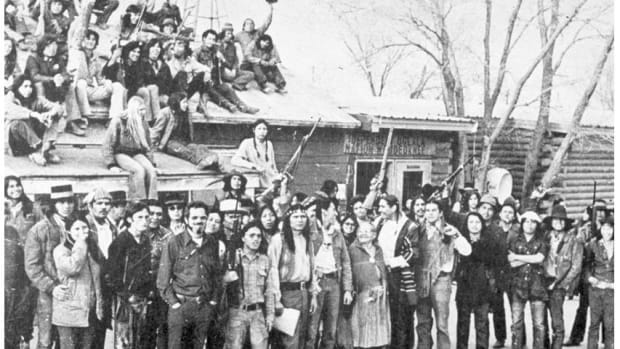
American Indian Movement members and other activists are shown during the occupation of Wounded Knee, South Dakota, which lasted 71 days - from Feb. 27 to May 8, 1973. The sign over the door reads in part, "Independent Oglala Nation." (Photo via Creative Commons)

American Indian Movement members and other activists are shown during the occupation of Wounded Knee, South Dakota, which lasted 71 days – from Feb. 27 to May 8, 1973. The sign over the door reads in part, “Independent Oglala Nation.” (Photo via Creative Commons)

It was the fourth protest in as many years for AIM. The organization formed in the late 1960s and drew international attention with the occupation of Alcatraz from 1969-1971. In 1972, the Trail of Broken Treaties brought a cross-country caravan of hundreds of Indigenous activists to Washington, D.C., where they occupied the Bureau of Indian Affairs headquarters for six days.

Then, on Feb. 6, 1973, AIM members and others gathered at the courthouse in Custer County, South Dakota, to protest the murder of Wesley Bad Heart Bull, Oglala Lakota, and the lenient sentences given to some perpetrators against Native Americans. When they were denied access into the courthouse, the protest turned violent, with the burning of the Chamber of Commerce Building and damage to other buildings and vehicles.

Three weeks later, AIM leaders took over Wounded Knee.

“It had been waiting to happen for generations,” said Kevin McKiernan, who covered the Wounded Knee occupation as a journalist in his late 20s and who later directed the 2019 documentary film, “From Wounded Knee to Standing Rock.”

“If you look at it as a storm, the storm had been building through abuse, land theft, genocide, religious intoleration, for generations and generations,” he said. “The storm built up, and built up and built up. The American Indian Movement was simply the thunderbolt.”

The takeover at Wounded Knee grew out of a dispute with Oglala Sioux tribal leader Richard Wilson but also put a spotlight on demands that the U.S. government uphold its treaty obligations to the Lakota people.

By March 8, the occupation leaders had declared the Wounded Knee territory to be the Independent Oglala Nation, granting citizenship papers to those who wanted them and demanding recognition as a sovereign nation.
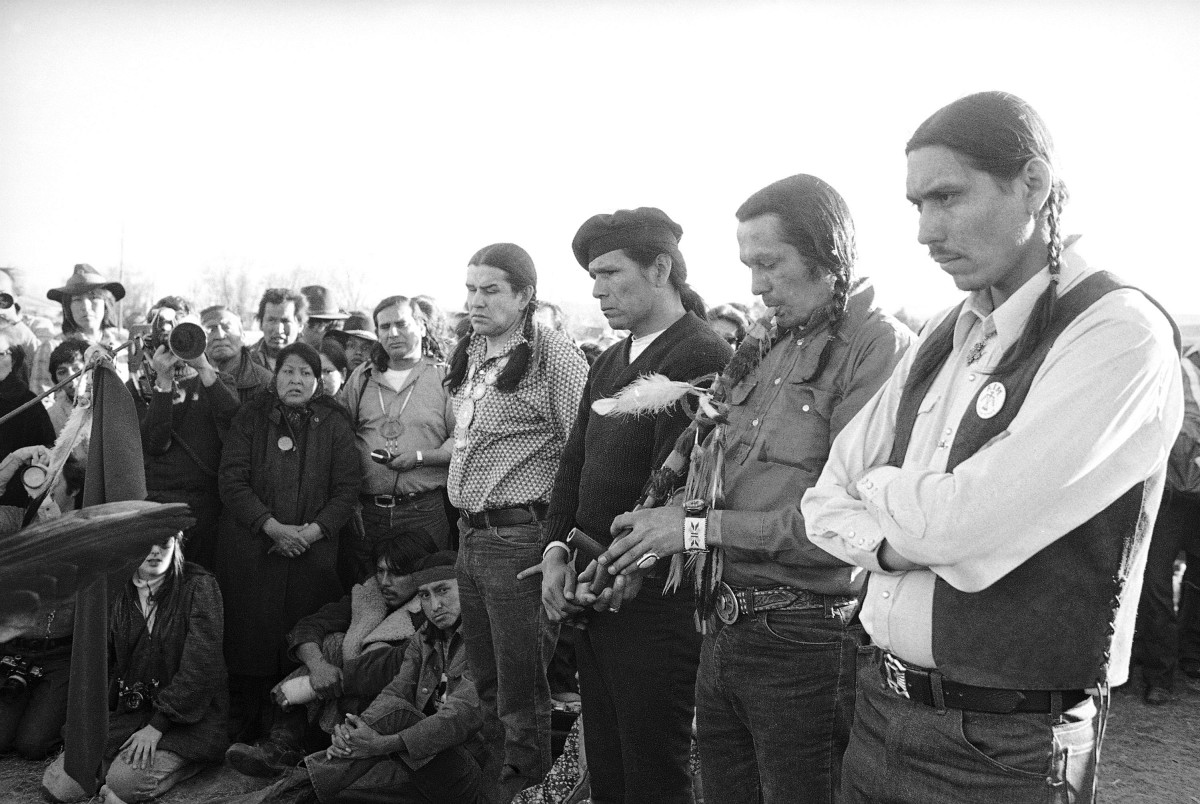
American Indian Movement leaders observe with a ceremonial peace pipe as the U.S. Department of Justice begins to remove government forces from around Wounded Knee, South Dakota,  with a ceremonial peace pipe smoking shown here on March 10, 1973. Shown are, starting with the fourth person from the right, AIM leaders Clyde Bellecourt, Dennis Banks, Russell Means and Carter Camp. (AP Photo/FILE)

American Indian Movement leaders observe with a ceremonial peace pipe as the U.S. Department of Justice begins to remove government forces from around Wounded Knee, South Dakota, with a ceremonial peace pipe smoking shown here on March 10, 1973. Shown are, starting with the fourth person from the right, AIM leaders Clyde Bellecourt, Dennis Banks, Russell Means and Carter Camp. (AP Photo/FILE)

The stand-off was often violent, and supplies became scarce within the occupied territory as the U.S. government worked to cut off support for those behind the lines. Discussions were ongoing throughout much of the occupation, with several government officials working with AIM leaders to try and resolve the issues.

The siege finally ended on May 8 with an agreement to disarm and to further discuss the treaty obligations. By then, at least three people had been killed and more than a dozen wounded, according to reports.

Two Native men died: Frank Clearwater, identified as Cherokee and Apache, who was shot on April 17, 1973, and died eight days later; and Lawrence “Buddy” LaMont, Oglala, who was shot and killed on April 26, 1973.

Another man, Black activist Ray Robinson, who had been working with the Oglala Sioux Civil Rights Organization, went missing during the siege.The FBI confirmed in 2014 that he had died at Wounded Knee, but his body was never recovered. A U.S. marshal was also shot and paralyzed, but died many years later.

Camp was later convicted of abducting and beating four postal inspectors during the occupation, and served three years in federal prison. Banks and Means were indicted on charges related to the events, but their cases were dismissed by a federal court for prosecutorial misconduct.

Today, the Wounded Knee National Historic Landmark identifies the site of the 1890 massacre, most of which is now under joint ownership of the Oglala Sioux and Cheyenne River Sioux.

The tribes agreed in 2022 to purchase 40 acres of land that included the area where most of the carnage took place in 1890, the ravine where victims fled, and the area where the trading post was located.

The purchase, from a descendant of the original owners of the trading post, included a covenant requiring the land to be preserved as a sacred site and memorial without commercial development.

And though internal tensions emerged in the AIM organization in the years after the Wounded Knee occupation, AIM continues to operate throughout the U.S. in tribal communities and urban areas.

In recent years, members participated in the Standing Rock protests and have persisted in pushing for the release from prison of former AIM leader Leonard Peltier, who was convicted of first-degree murder despite inconsistencies in the evidence in the deaths of two FBI agents during a shootout in 1975 on the Pine Ridge Indian Reservation.

A new generation

Tilsen, now president and chief executive of NDN Collective, an Indigenous-led organization centered around building Indigenous power, traces the roots of his activism to Wounded Knee.

His parents, JoAnn Tall and Mark Tilsen, met at Wounded Knee, and he praises the women of the movement who sustained the traditional matriarchal system during the occupation.

“I grew up in the American Indian Movement,” said Tilsen, a citizen of the Oglala Lakota Nation. “It wasn’t a question about what you were fighting for. You were raised up in it. In fact, if you didn’t fight, you weren’t going to live.”
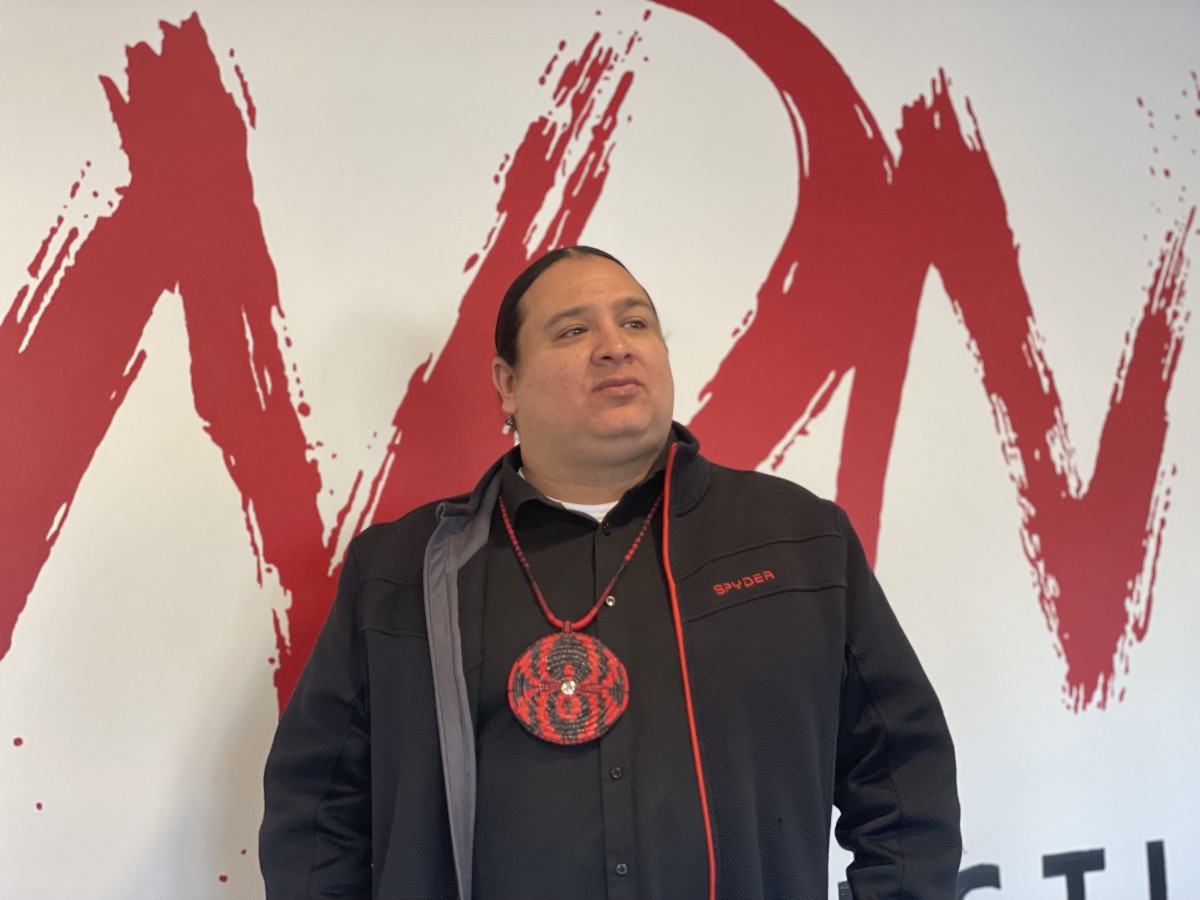
NDN Collective founder and CEO Nick Tilsen at the NDN Collective headquarters in Rapid City, South Dakota. (Photo by Kalle Benallie/ICT)

NDN Collective founder and CEO Nick Tilsen at the NDN Collective headquarters in Rapid City, South Dakota. (Photo by Kalle Benallie/ICT)

Tilsen credits AIM, and those who weren’t part of the movement, for most of the rights Indigenous people have today, including Indian gaming, tribal colleges, the Indian Self-Determination and Education Act and the American Indian Religious Freedom Act.

He said the movement showed the world that tribes were sovereign nations and their treaties were being violated. And when AIM and spiritual leaders such as Henry Crow Dog, Leonard Crow Dog and Matthew King joined the fight, it became intergenerational.

“It became a spiritual revolution,” he said. “It also became a fight that was about human rights. It became a fight that was about where Indigenous people aren’t just within the political system of America, but within the broader context of the system, of the world.”

Tilsen appreciates that his parents were willing to participate in an armed revolution to achieve one of their dreams of establishing KILI radio station, known as the “Voice of the Lakota Nation,” which began operating in 1983 as the first Indigenous-owned radio station in the United States.

They wanted to communicate and organize with the people as well as create transparency in tribal government, he said.

His own organization, NDN Collective, is based on what the American Indian Movement achieved, he said.

“It’s why NDN has the balanced approach that it does,” Tilsen said. “We defend, develop and decolonize.”

The Dakota Access Pipeline protest in 2016 came to be a defining moment for him and his brother. They had wondered, he said, what would be their Wounded Knee?

But though Standing Rock grew from the Wounded Knee occupation, it also had its differences, he said.

“What made it so powerful and what made it different was that you actually had grassroots organizers and revolutionaries and official tribal governments coming together, too,” Tilsen said. “I think that Standing Rock in particular actually reached way further than Wounded Knee because of how the issue was framed around ‘water is life.’”

AIM is the catalyst that started it all, however, he said. He wants the 50th anniversary of Wounded Knee to be a time to reflect on what still needs to be learned about the movement and to know more about the people who weren’t in the spotlight at the time.

“[It] created the pressure,” he said. “It held the mirror up to the United States government in a very powerful way.”

Alex Fire Thunder, deputy director of the Lakota Language Consortium, said the occupation of Wounded Knee and other activism helped revitalize Indigenous language and culture. His mother was too young to have participated in the occupation but he said she remembered visits from AIM members in the community.

“The whole point of AIM, the American Indian Movement, was to bring back a sense of pride in our culture,” Fire Thunder, Oglala Lakota, told ICT.

“A huge aspect of our culture and essence of our whole cultural identity is in the language,” he said. “A lot of language programs, educational programs, and the element of language in education itself and the whole status of the language, improved as a result of the awareness of the value of culture and the sense of pride that our people had.”

Fire Thunder, who now teaches the Lakota language, said he owes a debt of gratitude to AIM and the warriors at Wounded Knee.

“I show respect to anybody and everybody that stands up for our way of life, our culture, our language, our spiritual ways, our philosophies and worldviews,” he said. “ We’ve been oppressed, we’ve been silenced…

“We’ve been pushed aside and overlooked, I guess invisible to the mainstream American society,” he said. “And so, I like to pay respect and acknowledge anybody and everybody that stands up for our people in that way.”

Future generations

For Thunder Hawk, the issues became her lifelong work rather than momentary activism.

She joined AIM in 1968 and participated in the occupation at Alcatraz, the BIA headquarters, the Custer County Courthouse and Wounded Knee, as well as the Standing Rock pipeline protest in 2016.

She said work being done today by a new generation is a continuation of the work her ancestors did.

“That’s why we were successful in Indian Country, because we were a movement of families,” she said. “It wasn’t just an age group, a bunch of young people carrying on.”

She hopes her legacy will live on, that her great-great-grandchildren will see not just a photo of her but know what she sounded like and the person she seemed to be.
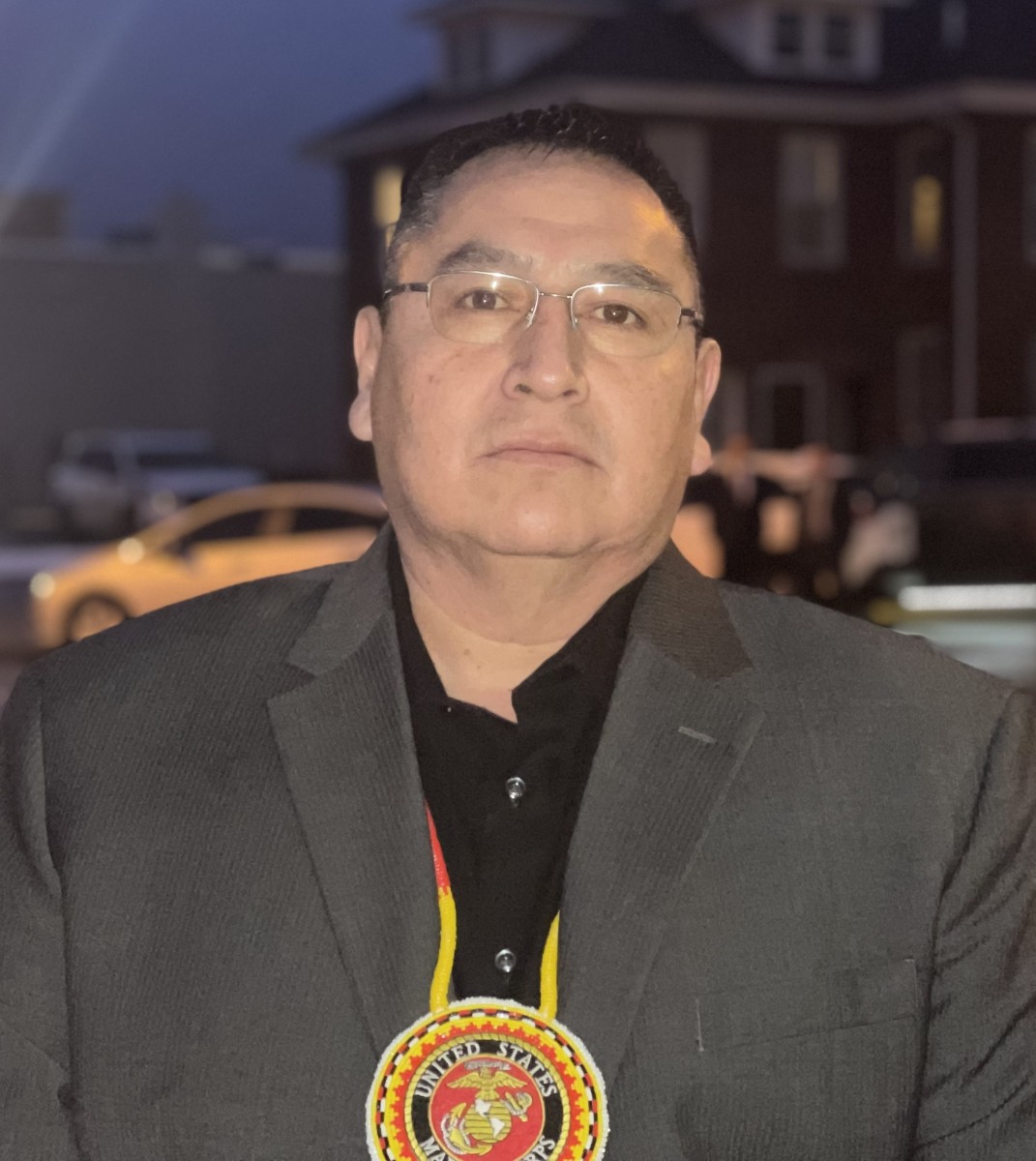
Frank Star Comes Out, shown here in February 2023, is president of the Oglala Sioux Tribe. (Photo by Kalle Benallie/ICT)

Frank Star Comes Out, shown here in February 2023, is president of the Oglala Sioux Tribe. (Photo by Kalle Benallie/ICT)

It’s something that she can’t have when she looks at a photo of her paternal great-grandparents.

“Hopefully that’s what my descendants will see, you know?” she said. “And with the technology nowadays, they can press a button, maybe, and it’ll come up.”

Frank Star Comes Out, the current president of the Oglala Sioux Tribe, also believes it’s time for the previous generation’s work to be recognized.

He will be at the 50th anniversary events and will speak at the Wounded Knee site. He is aware of the irony that he now leads a government created through the Indian Reorganization Act and opposed by AIM.

But he has family members who were strong supporters of AIM, including his mother and father. He said it’s important to fight for his people who survived genocide.

“That’s why I support AIM, not only on a family level,” he said. “I have a lot of pride in who I am as a Lakota … Times [have] changed. Now I’m using my leadership to help our people rise, to give them a voice. And I believe that’s important for Indian Country.”

Stewart Huntington contributed to this report.

New ICT logo

Our stories are worth telling. Our stories are worth sharing. Our stories are worth your support. Contribute $5 or $10 today to help ICT carry out its critical mission. Sign up for ICT’s free newsletter. 

Wounded Knee 1973American Indian MovementWounded Knee OccupationNative ActivistsAIMSouth Dakota

Kalle Benallie

By

Kalle Benallie

Kalle Benallie, Navajo, is a reporter-producer at ICT’s Phoenix bureau. Follow her on Twitter: @kallebenallie or email her at kalle@ictnews.org. Benallie was once the opening act for a Cirque Du Soleil show in Las Vegas. 

End Extraction: Thacker Pass

Lakota Law

A couple weeks ago, you heard from my daughter, Tokata, about some of our allyship work with our Nüümü and Newe (Paiute and Shoshone) relatives in California. At that time, she mentioned I was also on the ground in Nevada, visiting the Reno-Sparks Indian Colony (RSIC) to help develop media and outreach strategies for their frontline effort to protect the sacred PeeHee Mu’Huh (Thacker Pass) from an enormous, toxic lithium mining operation.

My trip to Thacker Pass last month was critical, and more are coming. Because mining in so-called Nevada is akin to what’s happening at Standing Rock — dangerous extraction threatening the health and safety of frontline Native communities without our consultation or consent — we must stand together, right now. That’s why, today, I’m asking for your help, in collaboration with our allies at Reno-Sparks. Please give what you can to support Lakota Law as we lend our expertise to build, sustain, and amplify a successful resistance movement at Thacker Pass. 

Give Your Gift Today! 

I sat down with Reno-Sparks Indian Colony Chairman Arland D. Melendez to talk about mining’s threats to his ancestral homelands.

As you know, we Lakota understand what it looks like on the frontlines of Big Extraction. Not only did we inspire the world with our resistance to the Dakota Access pipeline (DAPL) at Standing Rock, but now we also face the same dangers as RSIC to our water and sacred lands because of lithium and gold mining in the Black Hills. At every turn, corporate interests show zero regard for our wellbeing and feel no obligation to gain our permission when their projects will rip up sacred burial grounds and deplete or poison our water.

This is why it’s critical that we continue to travel to Nüümü and Newe homelands, help strategize with their leadership about resistance approaches, and help amplify their message through media support. On that note, we’ve just completed a separate video for use by RSIC’s Tribal Historic Preservation office. Our plan going forward is to keep listening to our valued relatives at every turn and keep producing content that can help them win justice.

Wopila tanka — my deepest gratitude for helping us lend needed support!
Chase Iron Eyes
Co-Director and Lead Counsel
The Lakota People’s Law Project

P.S. Lakota Law’s movement-building and legal savvy will be essential to the success of the Nüümü and Newe peoples’ effort to protect Thacker Pass. Please help fund our travel, media, and logistical expenses so we can assist our relatives at the highest level as they fight to safeguard their water, defend their sacred lands, and preserve their way of life.

Indian Child Welfare Act (ICWA)

Lakota Law

Anpetu Wašte. As the Supreme Court considers whether to gut the Indian Child Welfare Act (ICWA), two Native legislators in South Dakota are doing everything they can to preserve that critical law’s protections for our children at the state level. Predictably, though, it’s been a tough go. Just a week ago, the legislature failed to pass House Bills 1229 and 1168, both authored by Rep. Peri Pourier (from my home district of Oglala Lakota). 

SB 1229 would have provided a set of instructions for placing any child, once removed from their home, within their community. SB 1168 would have increased the requirements for the state’s Department of Social Services (DSS) to keep Native children with their families and tribes. Those losses are hard to swallow, but I am happy to say that — thanks to another powerful, Native woman, State Sen. Red Dawn Foster — hope remains.

We’re extremely grateful to Sen. Red Dawn Foster (left) and Rep. Peri Pourier for their excellent work in the state legislature on behalf of our Lakota children.

On Feb.15, South Dakota’s Senate Health and Human Services Committee will hold a hearing on SB 191, a bill championed by Sen. Foster which would establish a task force to address the welfare of Indian children in South Dakota. It would require the DSS to act in culturally responsive and socially supportive ways in cases of removal involving Native American children and make every effort to keep them with other relatives.

We’re rooting for a better outcome this time! We also remain hopeful that the High Court will uphold all or a significant part of ICWA, but can we rely on justices who have already rolled back our civil rights in astonishing ways over the past year? The smart move is to ensure ICWA’s mandates using all available methods, and that’s why these efforts by Sen. Foster and Rep. Pourier matter. They’re valiantly fighting an uphill — but essential — battle.

As you know, it’s important that we augment their work in the Capitol with on-the-ground organizing in our communities to provide Indigenous-led programming centered around healing and restoration of family services. It’s our obligation to be well informed on all the issues that affect our children, and we must lead from the grassroots on their behalf. Our young ones deserve to be supported by the Oyate (people) and enveloped in their cultural identity through kinship care. 

Please stay with us as we work to make that happen. With these rulings, it’s time to raise another battle cry for our children. We offer gratitude to Rep. Pourier and Sen. Foster, and we pledge to keep working hard, every day, with the same goal of a better future for the next generations.

Wopila tanka — thank you for standing with us!
DeCora Hawk
Field Organizer
The Lakota People’s Law Project

February Anniversaries: Calendar of Events

Lakota Law

As my colleague, Chase Iron Eyes, wrote to you earlier this week, February is a month of significant anniversaries here in Lakota Country. He told you about the 47th anniversary of the arrest of American Indian Movement (AIM) activist Leonard Peltier. Next comes a four-day celebration centered on the 50th anniversary of our AIM occupation of Wounded Knee in 1973 — an historic event that occurred a few years prior to Leonard’s unjust arrest. 

Here’s what happened: 50 years ago, the American Indian Movement was called to action by the communities of the Oglala Lakota territory on the Pine Ridge Reservation of South Dakota. That call resulted in a 71-day occupation of the town of Wounded Knee by AIM — and I was there, every step of the way. The resulting conflict with government agents, well chronicled in print and other media like the documentary “From Wounded Knee to Standing Rock,” is the stuff of legend. The occupation wasn’t without significant cost, but it also brought massive attention to our struggles as Native people.

Our gratitude to the Warrior Women Project, which is helping to organize and hosting a full calendar of events on their site.

From my perspective, it’s critical that we use part of the event to highlight the matriarchs who reached out to AIM in 1973. Fortunately, the Warrior Women Project has archival interviews of many of us, and we’ll take time during the four days to celebrate and honor the Wounded Knee veterans who are still here. The full event agenda also includes art and cultural celebrations, ceremonies, and a myriad of learning opportunities about the people and history of this movement.

We celebrate this moment in history with an eye toward our future. It’s important that we AIM elders take this opportunity to pass on our legacy to the younger generations. The standoff happened on the Pine Ridge Reservation, right down the road from where I live now at Cheyenne River. We must tell this story so it resonates with the communities and families on tribal nations in South Dakota today. As Chase mentioned, our Lakota Law staff is helping to organize numerous aspects of the event, including planned livestreams. We’ll let you know more about when and how to view those as we get a little closer, so please stay tuned! 

Wopila tanka — my gratitude, always, for your solidarity.
Madonna Thunder Hawk
Cheyenne River Organizer
The Lakota People’s Law Project

Return the Land

Lakota Law

As you may know, I’ve been involved in the landback movement for quite some time. Several years ago, I began helping lead the effort to return the Black Hills to the Lakota People. Protecting our water and returning our most sacred lands to Native stewardship — and defending them from degradation at the hands of mining and pipelines — is of paramount importance to me. I hope the same holds true for anyone who cares about the future of Unci Maka, our Grandmother Earth.

This movement extends far beyond the boundaries of Lakota Country. Recently, a friend of mine shared an important opportunity to return land to Native care in what we now call California. Because it’s critical that we act in solidarity with one another whenever possible, today I share this effort with you. I’ll describe things below, and I also hope you’ll visit the Owens Valley Indian Water Commission (OVIWC) website to learn more.

Click the pic to watch OVIWC’s video about Three Creeks.

Located just east of the Sierra Nevada mountain range in Central California, Payahuunadü — known in English as Owen’s Valley and translated as “land of the flowing water” — is part of the traditional homelands of the Nüümü (Paiute) and Newe (Shoshone) Native nations. They have now joined forces under OVIWC, a three-tribe consortium with an opportunity to acquire Three Creeks, a lush and beautiful five-acre property within Payahuunadü

The tribes intend to utilize this oasis as a haven for cultural resurgence involving food sovereignty initiatives, ceremonial healing, revitalization of kinship, and art and education to address traumas caused by displacement. Those goals also go hand in hand with a desire to preserve and protect this sacred space amid aggressive attempts by the Los Angeles Department of Water and Power (DWP) to control the area’s water. 

Over the past five years, 50 percent of Los Angeles’s water supply has come from Payahuunadü. The DWP has been taking and exporting its water since 1913 and owns 95 percent of the valley floor — while tribes share ownership of one third of one percent. This injustice must be addressed, and with an additional foothold in the area, the Nüümü and Newe Peoples will be better equipped to defend their homelands as a whole. 

My dad, Chase, is also on his way to Nüümü and Newe lands in present-day Nevada to meet this week with the Reno-Sparks Indian Colony and other Native leaders involved in the battle to protect PeeHee Mu’Huh (Thacker Pass) from lithium mining. You’ll hear more about that soon! Our family thanks you for joining us in showing solidarity with all Indigenous nations seeking to defend and return sacred lands.

Wopila tanka — thank you for your solidarity!
Tokata Iron Eyes
Organizer and Spokesperson
The Lakota People’s Law Project

Treaty Law

https://wordpress.com/post/clean-water-is-life.com/60 If you scroll back to the early posts of this blog, you will find some of the histories of Standing Rock that I researched. It is always important to study the past, to fully understand the present.

Lakota Law

Greetings, and I hope your year is off to a great start! We’ve got a good video for you to watch today. It’s the twelfth chapter of our Dakota Water Wars video series, produced, as always, by us in partnership with the Standing Rock Nation and Great Plains Water Alliance. In this episode, we detail some new threats to the Mni Sose — the Missouri River — and highlight the importance of respecting both our water and treaty rights.

Watch: Lakota Law Standing Rock Organizer Phyllis Young shares her studied perspective on treaty law and passion to protect our water rights and environment.

Here’s the bottom line: the 1868 Treaty of Fort Laramie granted the Lakota people stewardship of the Mni Sose. When the Dakota Access pipeline (DAPL) appeared in our homelands, it threatened both our sole source of fresh water and our way of life. Now, to make things worse, other entities have made plans to take water from the Missouri and pipe it to places far away, like Colorado, and nearby, like Rapid City and the Black Hills. 

That last part is particularly troublesome. Mining interests in the Black Hills will use even more water than a municipality, and those mines threaten to despoil an area filled with many of our most sacred sites. Plus, sending our water away for use by extractive industries is the exact opposite of what we should be doing in the midst of a climate emergency. Right now, we have to mitigate carbon emissions, halt the warming of our planet, and responsibly allocate our water. 

As you know, Indigenous cultures traditionally live in harmony with our surroundings, with care for all our relatives (not just the human ones). As we said during the heyday of our NoDAPL stand, and as we continue to say today: mni wiconi — water is life! When the 1868 treaty granted us the ability to protect the Mni Sose, the state of South Dakota didn’t even exist yet. So we won’t back down on this. We’re not going to let the state, or any other man-made entity, threaten or take our water without a fight.

Wopila tanka — thank you for standing with us!
Chase Iron Eyes
Co-Director and Lead Counsel
The Lakota People’s Law Project

Where is Justice in 2023?

With all of the talk about diversity, inclusion, and equity – I really don´t listen to the talk. I look at the actions. From where I am standing it does not appear that those words really mean anything in 2023 U.S.A. Those are just slogans, cliches: words to shout out to make one feel part of the pseudo-virtuous.

Now here is a 14-year-old girl in South Dakota who gets run over in a hit-and-run. Mark your calendar for February 17th. Demand justice. In the meantime, take time and examine the U.S. justice system. You will not like what you will find.

Lakota Law

Han, Mitakuyepi. Today I write to you with some sad news — but it’s something we absolutely need to talk about. On October 14, 2022 in Rapid City, South Dakota, Nevaeh Rose Brave Heart, a fourteen-year-old Lakota youth, was tragically killed in a hit-and-run incident. Jordan Hare, a 27-year-old white man, has now been arrested in connection with the crime. 

According to the Pennington County State’s Attorney’s Office, Hare fled the scene, leaving Nevaeh to die in the street of her injuries before medical help could arrive. He then allegedly washed his vehicle and painted his rims to hide the evidence. Now, he faces a maximum penalty of two years and/or a $4,000 fine for felony hit and run resulting in injury or death, and he’s free on $10,000 bail as the case proceeds.  

Click the pic to watch: In October, Nevaeh Brave Heart’s community gathered for a candlelight vigil and to call for justice.

If those penalties don’t sound commensurate with the crime to you, you’re not alone. Nevaeh Brave Heart’s death, which occurred just as her life was beginning, is emblematic of the kind of tragedy we see far too often in the Deep North, as we sometimes call it here. Too often, our health, wellbeing, and existence are not valued, protected, or respected. That has a cumulative effect on our Native communities and families. Meanwhile, someone like Jordan Hare is able to walk free on a measly $10,000 bail? If Nevaeh wasn’t Native, might Hare be in a lot more trouble — such as an additional manslaughter charge, a higher bail amount, or both?

There have been far too many instances of blatant racism — taking many forms — in and around Rapid City for us to ignore the lack of justice for Nevaeh. You may recall that, just last year, a hotel in town instituted a policy prohibiting Native guests, prompting us to ask you to write to the Department of Justice and demand an investigation. The pattern is so bad that, among the BIPOC community here, Rapid City has earned itself the name “Racist City.”

So, what’s next? Hare is scheduled to appear in court for a status hearing on Friday, Feb. 17 at 3 p.m. I’m happy to say that because of public interest in the case — our community wants justice for Nevaeh! — the judge has moved this hearing to a larger courtroom. I’ll be there, and I’ll keep you informed. We must watch closely and be ready to act if Hare — who has pled not guilty — isn’t held accountable. In the meantime, please join me in honoring Nevaeh’s memory by saying her name and praying for her family. 

Wopila tanka — thank you for your friendship with our community.
DeCora Hawk
Field Organizer
The Lakota People’s Law Project

Chief Big Foot Memorial Ride

Lakota Law

A very Happy New Year from me and my family to you and yours! In December, I wrote to you and asked you to help spread the word about passing the Remove the Stain Act. By rescinding 20 Medals of Honor awarded to soldiers who murdered nearly 300 Lakota women, men, and children at the Wounded Knee Massacre in December of 1890, we can more deeply recognize our ancestors. In this way, we honor the sacrifices they made so that we can be here today.

In that same email, I referenced the annual Chief Big Foot Memorial Ride, in which many of my relatives take to horseback to retrace the path our ancestors traveled before that horrific day. Today, I encourage you to watch our new video, in which I talk more about the annual tradition of this ride, the history behind it, and its deep meaning to our people. 

My relatives honor our ancestors at the Chief Big Foot Memorial Ride.

Undertaking this journey and reminding ourselves of the reality of what our ancestors went through on that hard winter’s trail helps to ground and more fully connect us. It takes many days and resources to replicate on horseback the original journey from Standing Rock through my home nation of Cheyenne River to Wounded Knee Creek on the Pine Ridge Reservation. How hard it must have been for those families who did it on foot in 1890 — and directly on the heels of the murder of Sitting Bull. 

Eagle Hunter, my brother-in-law, put it eloquently and succinctly: “Wasigla.” This is something that you don’t forget. We Lakota are a visual people, and the modern-day visual of following the trail to Wounded Knee is powerfully symbolic for us. We who are Indigenous to this land engage in ceremonial memorials because it’s part of who we are. We don’t usually write it down, we just do what’s in our ancestral memory. But today, I write to share this memory with you.

Wopila tanka — thank you for riding with us in spirit!
Madonna Thunder Hawk
Cheyenne River Organizer
The Lakota People’s Law Project

Wounded Knee Massacre: Remove the Medals Call to Action

Lakota Law

On December 29, 1890, the 7th Cavalry of the United States committed an unconscionable act of genocide, killing nearly 300 Lakota women, children, and men at Cankpe’ Opi Wakpa, or Wounded Knee Creek. That number included 38 Hunkpapa and a larger number led by Lakota Chief Spotted Elk of the Mnicoujou band. Most of our people murdered that day were unarmed. Then, for taking part in the Wounded Knee Massacre, 20 U.S. soldiers were awarded the Medal of Honor.

Medals of Honor are meant to signify gallantry beyond the call of duty, clearly distinguishable from lesser forms of bravery. The soldiers at Wounded Knee did not live up to this standard. Rather, they slaughtered innocent Native families in cold blood, and it’s long past time to rescind their awards. Please take decisive action today. Tell your Senators and Congressperson to pass the Remove the Stain Act and rescind all Medals of Honor awarded for the Wounded Knee Massacre.

Click the pic and tell your reps to pass the Remove the Stain Act today.

Native People and the U.S. government both understand — to very different degrees — the gravity of what happened at Wounded Knee. In 1990, on the centennial of the massacre, both houses of the U.S. Congress passed a resolution expressing their “deep regret.” That gesture, of course, is far from adequate. In 2001, the National Congress of American Indians passed two resolutions demanding that the federal government rescind all Medals of Honor awarded for Wounded Knee. That same year, the Cheyenne River Nation, where I make my home, passed Tribal Council Resolution No. 132–01, asking for the same. Other organizations, such as Four Directions, have also taken up and amplified this call.

This is not ancient history in Lakota Country. The massacre’s memorial stands in stark relief against the plains and low hills of Pine Ridge — the location of Wounded Knee — every day. And each year in December, we honor our ancestors’ trek to Wounded Knee with a ride on horseback through the bitter cold, retracing the trail they left in their final moments on this earth. It’s our way of remembering and honoring the sacrifice they never should have had to make. Many people carry on this tradition and keep it alive, riding all the way from the homelands of Sitting Bull (Standing Rock) through Cheyenne River to the site of the massacre. Several organizations — such as my friends at the Horse Spirit Society — come together to provide horses, tack, feed, and other essentials for participants. 

Our people dedicate their limited resources for this cause, asking nothing in return but that we remember those who were lost. So today, as we approach the anniversary of the Wounded Knee Massacre, I ask you to learn more about how we keep our ancestors’ memories alive. And please, tell your senators and House rep to pass the Remove the Stain Act. While nothing we can do will bring them back, in this way we can properly honor our relatives.

Wopila tanka — thank you for taking action!
Madonna Thunder Hawk
Cheyenne River Organizer
The Lakota People’s Law Project

Note: I no longer participate in virtual worlds. I did create a virtual memorial and here is the link to an interview I had done about it. https://virtualoutworlding.blogspot.com/2018/02/2018-edu-massacre-at-wounded-knee.html

Dakota Water Wars

Lakota Law

Greetings from Lakota Country, where two blizzards just dumped several feet of snow and knocked out power for many of our people. Here’s hoping you’re staying warm wherever you are! Of course, no matter the weather, we keep doing all we can to look out for our relatives — including our ongoing fight to end the Dakota Access pipeline (DAPL).

Winning this battle is critical. Just last week, we received news of yet another pipeline disaster. One month after the Keystone pipeline increased the amount of oil it’s carrying, it ruptured and dumped 14,000 barrels — or nearly 600,000 gallons — of toxic tar sands crude in Kansas. So today, we bring you the eleventh chapter of our Dakota Water Wars video series, co-produced by the Lakota People’s Law Project, the Standing Rock Sioux Tribe, and the Great Plains Water Alliance. Give it a watch, and you’ll see how hard we fought to keep the Dakota Access pipeline (DAPL) from doubling its flow rate, and just how far the oil company went to downplay the potential consequences.

Watch: Standing Rock member Winona Gayton addresses the North Dakota Public Service Commission during a hearing on DAPL nearly doubling its capacity.

This latest Keystone spill — its third major leak in the past five years — is the second largest domestic pipeline incident ever recorded. It’s going to be nearly impossible to properly clean up, And, because Keystone is now carrying more oil, the problem is exacerbated. In our video (at the top of the blog, which also contains all the other Dakota Water Wars chapters), you’ll hear a lot about “worst case discharge.” That sounds bad because it is. The math says that when a pipeline inevitably leaks, it’s going to be worse the more oil it’s carrying. 

If DAPL spills where it crosses the Mni Sose — the Missouri River — just upstream from the Standing Rock Nation, it will threaten everything we hold dear: our drinking water, our pristine landscape, plants and animals, our way of life. That’s why we gathered by the thousands in 2016 and 2017 to prevent DAPL. And given the danger from increasing the oil flow, it should be easy to understand why we rallied again in 2019 to stop the doubling of its capacity to more than 1 million barrels per day. 

We cannot accept this illegal and dangerous pipeline (the Army Corps of Engineers still has yet to produce a valid Environmental Impact Statement for DAPL, as mandated by the courts). We won’t stop raising awareness about how it imperils both people and planet, and we’ll continue — with your help — to fight using every available method until the Black Snake is defeated once and for all.

Wopila tanka — my deep appreciation for your solidarity!
Chase Iron Eyes
Co-Director and Lead Counsel
The Lakota People’s Law Project