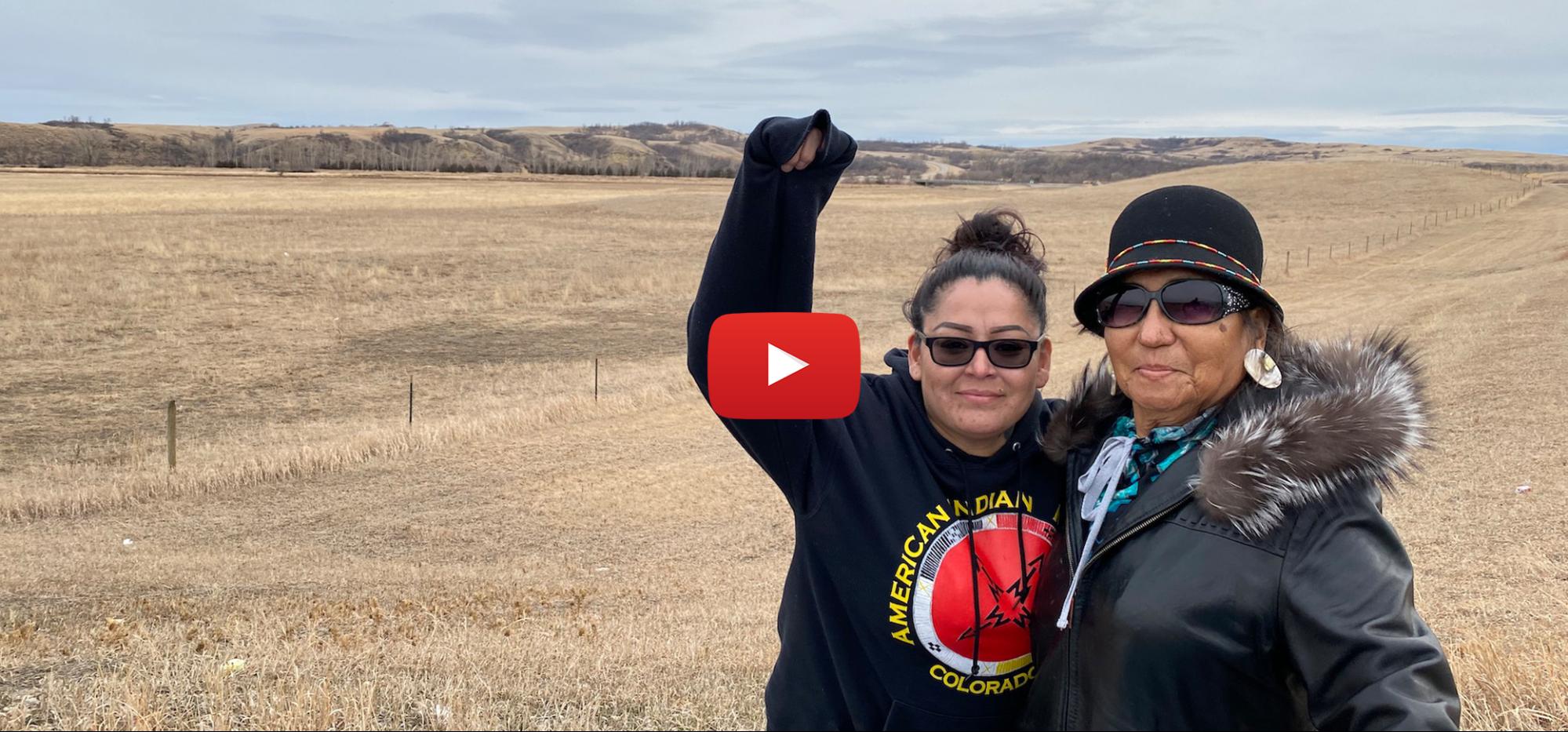
My name is Red Fawn Janis. I was born on the Oglala Nation and raised in Denver by my mother — a pipe carrier — and my grandmother. It was a spiritual home. But in 2016, everything changed. After losing both of these powerful women, my guiding lights, I went to Standing Rock to protest the Dakota Access pipeline (DAPL). As you may know, I was subsequently arrested and imprisoned for four and a half years. But today, I am finally home again. And despite the hardships, I would do it all over again.
Because there’s nothing more important than standing up for Unci Maka, our Grandmother Earth. She produces food, shelter, and life. And, at Standing Rock, she produced healing for so many of us. So I ask you today to stand with her, with me, with all our ancestors and relatives. If you have not yet done so, please tell President Biden: end DAPL now. I ask you, humbly, to help stop this pipeline and restore my homelands.
Watch my new video: I give one of my first interviews since my release from prison. I’m headed home!
Going to Standing Rock was a life-changing journey for me and for so many other people. Something deep within us called us there. I remember sitting with Standing Rock members and hippie kids and Black people — so many young ones — all of us together, in the first days, before construction began. We had no idea what was about to happen.
I showed up with about $300 and a couple changes of clothes, planning to be there for a few weeks at most. But I wound up staying, and even If I took a short trip home, I felt called back immediately. We formed not just a movement, but a real community. But, of course, not everyone can be trusted.
I will share more details with you soon, but what you should know for now is that I met a man who seemed genuine, who helped the elders, who was within a trusted circle. So I couldn’t believe what was happening when it turned out a gun had been planted on me. I’d been set up by the feds. And, after a confrontation with police, I was taken as a political prisoner.
Fortunately, I understand that things happen the way the Creator wants them to. This pivotal time in my life has led to growth and healing, and it’s positioned me to share my perspective with you. For that, I’m grateful. I really believe that I’ve been given my life back. It was the betrayal that blessed me.
Now, I look forward to telling my story in full and finding ways we can work together to protect our Grandmother, her waters, her creatures — all of our sacred relatives. Much will depend upon listening to our elders and supporting our youth. So many of those who came to Standing Rock have found new avenues in life, but others continue to struggle. I ask that you stand with them. Let’s start by defeating DAPL, but let us not stop there. There’s so much we can accomplish by praying together, by listening to one another, by taking united action. In this way, we will properly respect both those who came before us and the generations to come.
Wopila tanka — thank you, always, for standing in solidarity with me and all water protectors! Red Fawn Janis In partnership with the Lakota People’s Law Project
Charges against Nick Tilsen, Oglala Lakota, President and CEO of NDN Collective, and all other treaty defenders arrested at a Black Hills protest on July 3 will be dropped, announced NDN Collective, an Indigenous-led advocacy organization.
The initial charges came after Tilsen and more than 200 treaty defenders protested former President Donald Trump’s visit to the Black Hills last summer, as he traveled to speak at Mount Rushmore for an Independence Day celebration.
The Lakota have long attempted to have the Black Hill region returned to tribal authority, as specified under the Fort Laramie Treaty of 1868.
The treaty defenders gathered on a highway leading to the monument, using cars and vans to block the road for nearly three hours. In response, law enforcement officers and members of the South Dakota Air and Army National Guard were called in, leading to a skirmish between protestors and law enforcement.
Twenty-one treaty defenders ended up being arrested and charged with misdemeanors, with Tilsen receiving a combination of misdemeanors and felonies — a sentence that could have resulted in up to 17 years in prison. He told the Associated Press that he will participate in a prison diversion program in exchange for all but one charge against him being dropped. The final charge will be dropped once he completes the program.
In the aftermath, thousands of supporters came to the group’s defense through petitions, social media campaigns, and national media coverage of the cases. In December, the United Nations weighed in with a statement in support of the treaty defenders.
“This victory and the dropped charges are a direct result of the Movement showing up and standing up for all the Land Defenders who took a stand in the Ȟesápa (Black Hills) on July 3,” Tilsen said in a statement. “Tens of thousands organized, called, donated to our legal and bail fund and signed the petitions to drop these charges, and we acknowledge their invaluable support.”
Nick Tilsen, Oglala Lakota and CEO of NDN Collective, talks with park rangers on July 3, 2020. (Screenshot)
“I have so much gratitude for the thousands of supporters who prayed, donated, called, emailed, signed petitions and reached out over the past nine months. This is a wake up call for our communities,” said Krystal Two Bulls, Oglala Lakota and Northern Cheyenne, director of the LANDBACK Campaign at NDN Collective. “We will continue to organize forward and fight for all our targeted and incarcerated Relatives!”https://platform.twitter.com/embed/Tweet.html?dnt=false&embedId=twitter-widget-0&frame=false&hideCard=false&hideThread=false&id=1374138541639401474&lang=en&origin=https%3A%2F%2Findiancountrytoday.com%2Fnews%2Fcharges-against-treaty-defenders-dropped&theme=light&widgetsVersion=e1ffbdb%3A1614796141937&width=550px
Nataani Means, Oglala Lakota, Navajo, and Omaha, will join Tilsen and Two Bills in a discussion about the news on NDN Collective’s livestream show “NDN Live” on Tuesday at 6 p.m. MST.
“This is a day of victory for our Movement and our People,” said Tilsen. “We will utilize it to catalyze our cause forward.”
The Pennington County State’s Attorney’s office did not immediately respond to a request by The Associated Press to confirm the charges were dropped.
The Associated Press contributed to this story.
Meghan Fate Sullivan, Koyukon Athabascan, is a writer for Indian Country Today. She grew up in Alaska, and is currently reporting on her home state from Anchorage.
NCAI Events and Resources in Preparation for Upcoming Federal-Tribal Consultations on Consultation Policy
In response to President Biden’s “Memorandum on Tribal Consultation and Strengthening Nation-to-Nation Relationships,” the National Congress of American Indians (NCAI) is announcing several events and resources to support Tribal Nations in their efforts to shape federal tribal consultation policies to reflect a true government-to-government relationship. Events and resources include (scroll down for details): Webinar: “Federal Consultation Policies: Working towards Consent,” Wednesday, March 3, 2021 from 12:00 – 1:30 p.m. EST. Register here> Tribal Leader Caucus hosted by NCAI in preparation for the Department of the Interior’s (DOI) upcoming tribal consultation sessions. Thursday, March 4, 2021 from 12:00 – 1:30 p.m. EST. Register here> Tribal Leader Caucuses hosted by the Intertribal Agriculture Council (IAC), the Indigenous Food and Agriculture Initiative (IFAI), and NCAI in preparation for the Department of Agriculture’s (USDA) tribal consultation sessions. Tuesday, March 9, 2021 and Thursday, March 11, 2021 from 11:30 a.m. – 2:00 p.m. EST. Listing of Upcoming Federal Consultations. Please continue reading to learn more about each of these events and resources.
WEBINAR ANNOUNCEMENTFederal Consultation Policies: Working towards Consent March 3, 2021, 12-1:30 p.m. EST NCAI will hold a webinar on Wednesday, March 3, 2021 from 12-1:30 p.m. EST to discuss President Biden’s recent “Memorandum on Tribal Consultation and Strengthening Nation-to-Nation Relationships” and its implications for federal consultation policy with Tribal Nations. Register here > Panelists will include: Michael Connor, Partner, WilmerHale, and previously served as Deputy Secretary of the Interior under President Barack Obama from 2014-2017 Colette Routel, Professor of Law, Co-Director, Native American Law & Sovereignty Institute, Mitchell Hamline School of Law Fawn Sharp, President, National Congress of American Indians, and President, Quinault Indian Nation Kim Teehee, Director of Government Relations, Cherokee Nation, and previously served as the Senior Policy Advisor for Native American Affairs for President Barack Obama from 2009 to 2012 This webinar will provide an overview of federal consultation policies for tribal consultation, explore ideas regarding the future of the government-to-government relationship between the U.S. and Tribal Nations, and share resources for how Tribal Nations can prepare for the upcoming series of consultations being convened by federal agencies that will focus on how to improve current consultation practices. NCAI Contact:Ryan Seelau, Senior Researcher, Partnership for Tribal Governance, rseelau@ncai.org
Tribal Leader Caucus to prepare for DOI Consultation March 4, 2021, 12-1:30 p.m. EST NCAI will host a tribal leader caucus on Thursday, March 4, 2021 from 12-1:30 p.m. EST to give tribal leaders an opportunity to talk with one another and prepare for a series of Department of the Interior (DOI) consultations that will be taking place March 8-12. Information about the DOI consultations is available here. Registration for NCAI’s Tribal Leader Caucus is available here. The majority of the time during this event is designed to give tribal leaders and others space to discuss the issues they see concerning tribal consultation, and to discuss strategies on how to improve government-to-government consultations moving forward. NCAI Contact:Ryan Seelau, Senior Researcher, Partnership for Tribal Governance, rseelau@ncai.org
Federal Government Dates and Deadlinesfor Upcoming Consultations On January 26, 2021 President Biden signed a memorandum titled “Memorandum on Tribal Consultation and Strengthening Nation-to-Nation Relationships” declaring, “It is a priority of my Administration to make respect for Tribal sovereignty and self-governance, commitment to fulfilling Federal trust and treaty responsibilities to Tribal Nations, and regular, meaningful, and robust consultation with Tribal Nations cornerstones of Federal Indian policy.” The Presidential Memorandum goes on to convey its commitment to fulfilling the consultation requirements of Executive Order 13175, a directive originally issued by President Clinton on November 6, 2000. President Biden’s Memorandum also directs “each agency” to submit “a detailed plan of actions the agency will take to implement the policies and directives of Executive Order 13175.” These plans “shall be developed after consultation by the agency with Tribal Nations and Tribal officials”. All plans are to be submitted to the Director of the Office of Management and Budget (OMB) by April 26, 2021. In March, several federal agencies are holding tribal consultation sessions and/or have deadlines related to their tribal consultation plans, including: March 8, 2021: DOI consultation focusing on Great Plains, Midwest, and Rocky Mountain Regions. March 8: 2021: Department of Defense (DOD) deadline for all written comments regarding tribal consultation. March 9, 2021: USDA consultationon their tribal consultation plan. March 10, 2021: DOI consultation focusing on Eastern, Eastern Oklahoma, and Southern Plains Regions. March 10, 2021: DOI Consultation focusing on Navajo, Southwest, and Western Regions. March 11, 2021: USDA consultation on their tribal consultation plan. March 12, 2021: DOI consultation focusing on Alaska, Northwest, and Pacific Regions. March 19, 2021: DOI deadline for all written comments regarding tribal consultation. March 24, 2021: Department of Transportation (DOT) consultation on their tribal consultation plan. March 26, 2021: DOT deadline for all written comments regarding tribal consultation. For more detailed information about these dates and deadlines, visit NCAI’s Consultation Support Center. NCAI Contact:Ryan Seelau, Senior Researcher, Partnership for Tribal Governance, rseelau@ncai.org
Many across the country are battling the aftermath of a Feb. 13 winter storm as nearly 3.4 million customers around the U.S. are still without electricity or heat. The demand for power overwhelmed power grids unprepared for climate change.
Temperatures hovered in the single digits as snow and ice storms hit parts of Texas where winter temperatures seldom fall below 40 degrees.
The latest storm front was expected to bring more hardship to Texas, Arkansas and the Lower Mississippi Valley before moving to the Northeast on Thursday, according to the Associated Press.
“Most people here have electric stoves so there’s no way to heat or cook food; they heat their homes with electric heat, so there’s no heat,” said Ashley Fairbanks, White Earth Nation.
Originally from Minnesota, Fairbanks lives in San Antonio, where winter temperatures usually hover around 70-80 degrees. On Wednesday morning the temperature was around 28 degrees, she said.
“It got down to 6 degrees during the storm; the week before it was like 80 degrees,” she said
“The ice on roads finally melted today so we left the house in search of food. It really is like the end times out here.”
Customer lines at fast food establishments snaked around city blocks and half of San Antonio’s restaurants were closed; grocery stores have run out of essential food and many are closed, Fairbanks said.
“There’s really no letup to some of the misery people are feeling across that area,” said Bob Oravec, lead forecaster with the National Weather Service, referring to Texas.
At least 30 people have died in the extreme weather this week, some while struggling to find warmth inside their homes. In the Houston area, one family succumbed to carbon monoxide from car exhaust in their garage. Another perished as they used a fireplace to keep warm.
City of Richardson worker Kaleb Love breaks ice on a frozen fountain Tuesday, Feb. 16, 2021, in Richardson, Texas. Temperatures dropped into the single digits as snow shut down air travel and grocery stores. (AP Photo/LM Otero)
Record low temperatures were reported in city after city. Scientists say the polar vortex, a weather pattern that usually keeps to the Arctic, is increasingly spilling into lower latitudes and sticking around longer, and global warming caused by humans is partly responsible.
Utilities from Minnesota to Texas and Mississippi have implemented rolling blackouts to ease the burden on power grids straining to meet extreme demand for heat and electricity. In Mexico, rolling blackouts Tuesday covered more than one-third of the country after the storms in Texas cut the supply of imported natural gas.
Tribes in Texas are working together and handling the challenges well, according to tribal leaders from the Alabama-Coushatta Tribe of Texas, the Tigua Ysleta Del sur Pueblo and the Lipan Apache Tribe contacted by Indian Country Today.
“Native people are extremely resilient. We’re all kind of tired of the cold weather, but we’re hunkered down and staying warm; at first it was beautiful but now we’re kind of done,” said Christi Sullivan, director of media and communications for the Alabama-Coushatta Tribe of Texas.
About 600 of the 1,375 tribal citizens live on reservation land about 90 minutes north of Houston.
“We urged people to prepare for the weather before it hit; one of our main concerns is our elders. We are calling and checking in on everyone making sure they’re okay,” said Sullivan.
Fortunately, only a portion of the reservation has been hit by the rolling electricity blackouts.
“So far, everyone is safe,” Sullivan said.
The worst U.S. power outages by far have been in Texas, where officials requested 60 generators from the Federal Emergency Management Agency and planned to prioritize hospitals and nursing homes.
The state opened 35 shelters to more than 1,000 occupants, the agency said.
Texas’ power grid manager, the Electric Reliability Council of Texas, said electricity had been restored to 600,000 homes and businesses by Tuesday night. Many, however, remain without power.
The weather also caused major disruptions to water systems in the Texas cities of Houston, Fort Worth, Galveston, Corpus Christi and in Memphis, Tennessee, and Shreveport, Louisiana, where city fire trucks delivered water to several hospitals and bottled water was being brought in for patients and staff, KSLA News reported. In Houston, residents were told to boil their water — if they had power to do so — because of a major drop in water pressure linked to the weather.
In Abilene, Texas, firefighters were hampered by low water pressure as they tried to extinguish a house fire this week, the Abilene Reporter News reported.
“They had to watch that house burn,” City Manager Robert Hanna said Tuesday at a news conference.
“Last night we were lying in bed without power and we could hear emergency sirens going all night long,” Fairbanks said.
The Texas power blackouts could be a glimpse of the future as climate change intensifies winter extremes that overwhelm utility infrastructures unable to handle unseasonable demands, according to the New York Times.
“Hey, we’re not built for this,” said Robert Soto, vice chair of the Texas state recognized Lipan Apache Tribe of Texas.
The tribe’s headquarters is based in McAllen, just north of Reynosa, Mexico, and near the Gulf of Mexico.
“Homes here aren’t built to handle the cold; for us a cold front is around 60 degrees. With this storm it’s been in the single digits and the 20s,” he said.
Thankfully everyone is safe, according to Soto.
The greatest needs for the tribe now are food and water. “We’re delivering food and water when and where we can; we don’t have a lot of funds but we’re doing the best we can,” Soto said.
Temperatures are expected to rise to the 70s by the weekend.
“We’ll be enjoying life and happy again; in the meantime please keep us in your prayers.”
Mary Annette Pember, a citizen of the Red Cliff Ojibwe tribe, is a national correspondent for Indian Country Today.
50 abandoned uranium mines + a mess = $220M from EPA
Klee Benally of the Navajo Nation at a 2016 protest outside the Environmental Protection Agency in Washington, demanding cleanup of abandoned uranium mines. Even though mining stopped decades ago – and was banned by the tribe in 2005 – the fight to clean up the toxic sites has lingered. (File photo by Danika Worthington/Cronkite News)
Cronkite News
The U.S. Environmental Protection Agency announced three contract awards for the clean-up of more than 50 abandoned uranium mine sites on the Navajo Nation
Haleigh Kochanski Cronkite News
WASHINGTON – The Environmental Protection Agency said Thursday it will award contracts worth up to $220 million to three companies for the cleanup of some of the hundreds of abandoned uranium mines on the Navajo Nation.
Work could start later this year following the completion of assessments for mining sites coordinated between the EPA and the Navajo Nation’s environmental agency, the federal agency said.
This week’s announcement is just the latest in years of efforts to clean up the mines, the toxic legacy of Cold War mining in the region. More than 30 million tons of uranium ore were mined in the region, according to the EPA, which said more than 500 mines were ultimately abandoned.
“From World War II until the end of the Cold War, millions of tons of uranium were mined on Navajo lands, exposing mine workers and their families to deadly radiation,” said Rep. Tom O’Halleran, D-Arizona, whose district includes the Arizona portion of the Navajo Nation.
“As a result, high rates of cancer, birth defects, and contaminated water sources remain a reality for residents of the Navajo Nation even now,” O’Halleran said in a statement on the contracts.
Navajo Nation President Jonathan Nez released a statement following the announcement.
“The Navajo people have endured decades of radiation exposure and contamination caused by uranium mining and production that has taken the lives of many former miners and downwinders and continues to impact the health of our children,” Nez said. “We appreciate the U.S. EPA’s efforts to create incentives and opportunities for Navajo Nation residents by working with the contracted companies to develop training programs for our people and businesses to promote professional growth related to abandoned mine clean-ups.”
The tribe said the cleanup sites are in New Mexico’s Grants Mining District and in 10 chapters located on the Navajo Nation, which was the primary focus of uranium extraction and production activities for several decades beginning in the 1950’s.
The Navajo Area Abandoned Mine Remedial Construction and Services Contracts were awarded to contractors that are classified as small businesses, two of which are owned by Native Americans, the EPA said. Contracts were awarded to the Red Rock Remediation Joint Venture, Environmental Quality Management Inc. and Arrowhead Contracting Inc.
Terms of the contracts require the companies to develop training programs “for Navajo individuals and businesses to promote professional growth” in areas related to the cleanup work. The companies have also partnered with local businesses on the project, the EPA said.
A 2016 Environmental Protection Agency map showing some of the hundreds of abandoned mines in and around the Navajo Nation. Tribal and federal officials have been working for years on cleanup plans for the mines. (Map courtesy the EPA)
The agency said it worked closely with Navajo Nation to develop contracts that would incentivize the creation of employment opportunities for Navajo residents in order to build local economic and institutional capacity.
The majority of funding for the contracts comes from a nearly $1 billion settlement made in 2015 with Kerr McGee Corp. for the cleanup of more than 50 mines in Nevada and on the Navajo Nation that the company and its successor, tronox, were responsible for.
From the late 1940s through the 1960s, Kerr-McGee mined more than 7 million tons of ore on or near the Navajo Nation, leaving behind uranium mine sites that included contaminated waste rock piles. Exposure to uranium in soil, dust, air, and groundwater, as well as through rock piles and structural materials used for building can pose risks to human health, according to the EPA.
Mining stopped for the most part decades ago, and the Navajo Nation banned uranium mining on its lands in 2005. But the cleanup effort has lingered. The EPA launched five-year programs in 2007 and 2014 to study the issue and identify the biggest risks, and the agency last year added abandoned Navajo uranium mines to its list of Superfund sites “targeted for immediate, intense action.”
Representatives of Indigenous environmental groups did not respond to requests for comment and an official with the Grand Canyon chapter of the Sierra Club said she was not familiar enough with the contracts to comment – but did express concerns that there is no federal standard for what mine cleanup entails.
A regional EPA official said that the “contract awards mark a significant step in this ongoing work.”
“EPA continues to work with the Navajo Nation EPA and local communities to address the legacy of abandoned uranium mines,” said Deborah Jordan, acting regional administrator for the EPA’s Pacific Southwest office, in Thursday’s statement.
O’Halleran welcomed the announcement.
“I am glad to see my oversight efforts have pushed the EPA to make these critical investments,” he said in a statement Friday.
Criticism of Alaska article stirs broader discussion
*****Let´s go broader than this article.****
Manipulation 101
Why would native people want to be put first in line for an injection of something that is #1 experimental, #2 not fully safety tested, #3 has actually been responsible for reported serious adverse reactions and even some deaths, #4 does not stop infection. Because of the history of discrimination and racism, we are persuaded to think that NOW, during this pandemic, the powers that be are actually giving a care to indigenous people. We need to step back a moment and really look at what is being done and how things are spun into a narrative that puts people of color at the head of the line to being harmed.
I will add that one way to motivate people to do something is to play out the scenario that there is a scarcity – also to create the feeling that one group is getting something that others are not. So, you begin to see that this issue of indigenous getting better treatment actually is only a narrative that plays to the pharmaceutical companies´ agenda to persuade people who are reluctant to get the vaccine to race to get the vaccine.
A nurse administers the Pfizer-BioNTech COVID-19 vaccine at Guy’s Hospital in London, Tuesday, Dec. 8, 2020. U.K. health authorities rolled out the first doses of a widely tested and independently reviewed COVID-19 vaccine Tuesday, starting a global immunization program that is expected to gain momentum as more serums win approval. (AP Photo/Frank Augstein, Pool)
Joaqlin Estus
Vera Starbard: ‘Any time Native people are perceived to be ‘doing better’ than the dominant group in Alaska, there will absolutely, without fail be a backlash from individuals or large groups about how it’s not fair’
Alaska Public Media reporter Nathaniel Herz has done numerous stories on the fight against COVID-19 in Alaska in the past year.
His stories described historical pandemics that decimated Alaska Native populations, and the disproportionately high toll that COVID is taking on Indigenous peoples. He has reported on the tribal health system’s success in vaccinating tribal members despite logistical challenges.
Then last weekend Herz wrote and aired a story headlined: “Eligibility differences between state and tribal health systems frustrate some Alaskans waiting for vaccines.” The story said the Anchorage-based Southcentral Foundation was vaccinating people who work with Alaska Natives and for Native organizations. The story featured critics who saying the Native nonprofit should instead be giving shots to more vulnerable groups no matter what their relationship with Natives.
Nathaniel Herz, reporter. (Photo courtesy of Alaska Public Media)
The reaction after the story was aired and then posted on Alaska Public Media’s web page was immediate and on social media dozens of angry responses were posted on Twitter and Facebook. In the sometimes hyperbolic and profanity-laden style of social media, people saw the story as horrible, divisive, super-biased, whiney, colonialist, and reckless.
If Southcentral should be sharing its allotment beyond its clientele, will the same demand be made to the Department of Defense to share its allotment beyond the military, asked one commenter. “Or is the criticism reserved only for the most marginalized in our community?”
The story “feeds into ill will against Natives in an already super racist state,” and non-Natives will use the views expressed in the story as a “justification to their racism” that “feeds into their own victimhood,” read other Tweets.
Vera Starbard, Tlingit and Dena’Ina Athabascan, an author and playwright, wrote in her Writing Raven blog that she was surprised to see what she called, “an absolute hit job piece of poor journalism published with a disgraceful slant toward how the system is failing the Anchorage community,” given the tribal health system’s success in getting people vaccinated.
“Except it’s not surprising. Any time Native people are perceived to be ‘doing better’ than the dominant group in Alaska, there will absolutely, without fail be a backlash from individuals or large groups about how it’s not fair,” Starbard said.
“Never mind that instead of highlighting the state’s failed responsibility to the Pacific Islander community’s risk, and ask why it was not reaching this community more, this media organization chose to place the blame on an organization that is already serving those outside of its founding responsibility – and seeking to do more,” Starbard said.
Efficiency of distribution
The Alaska Public Media story questioned how Southcentral was distributing vaccines.
“Anchorage’s main tribal health provider is vaccinating employees of its affiliated for-profit company and nonprofit organizations, and their household members, without regard to their race, age or vulnerability,” Herz reported. “That’s frustrating some of the teachers, people with underlying conditions and others enduring an excruciating wait for shots from state government.”
“Southcentral Foundation’s vaccination framework has the effect of skipping over groups that face higher risk levels,” the story read, such as grocery store workers, the elderly and South Pacific Islanders, who are disproportionately affected by COVID.
One reason that Southcentral even had such a choice was its efficiency in distributing vaccines.
The number of doses provided to tribal health organizations is based on the same formula the Centers for Disease Control and Prevention uses to determine allotments to federal, state, and local governments. CDC considered 15 factors, including preparedness; critical populations; capacity for handling and managing the vaccine; and the number of providers to administer vaccinations.
While federal, state and tribal health systems are all limited by the number of doses allotted to them, the foundation has been able to get categories of people vaccinated more quickly than the state.
It’s had teams calling tribal members to come in for their shots, which it’s dispensing at the rate of 800 per day. By Feb. 1, it had administered more than 10,000 doses.
The foundation’s first priorities were health care workers and Native elders followed by the American Indian and Alaska Native “customer-owners” it serves. Next it vaccinated other employees and customers’ household members. Then it opened appointments to people who work for or with Native people.
Southcentral Foundation had no comment on the Alaska Public Media story.
Like this story? Support our work with a $5 or $10 contribution today. Contribute to the nonprofit Indian Country Today.
Alaska Public Media’s side of the story
Anchorage-based Alaska Public Media combines news stories of its own with those of reporters at public radio stations across Alaska, many of them located in rural communities that are as much as 75 percent Alaska Native. The resulting news shows regularly have Alaska Native issues in the forefront, and has for decades.
Alaska Public Media News Director Lori Townsend, said, “in the 18 years I’ve worked for the [Alaska public radio] network, I can think of no other time that we were accused of racist coverage by the Alaska Native community.”
Herz said the story was meant to prompt a conversation about the foundation’s distribution but erred in its presentation.
“…the story was framed in a way that was inflammatory and hurtful — and particularly to a lot of Native people but to plenty of white and non-Native people [too] — that didn’t allow anyone to engage with its content and with the question that we were trying to raise. It just caused hurt and pain and confusion about why we would do something like this,” Herz said.
Speaking for himself and the two editors who worked with him from concept to completion of the story, Herz said, “we thought we were being sensitive … we didn’t appreciate how sensitive and delicate the conversations around tribal healthcare are, and just sort of how much work and labor and explicating and justifying Indigenous people have to do around their healthcare whenever the subject comes up.
“This was absolutely… a personal and professional and human failure on my part. And I take full responsibility for that,” Herz said.
He said he and the editors “who considered ourselves to be sensitive and connected to the Alaska Native community and compassionate and aware of the sensitivity of these topics… had no sense of how the piece would hurt Alaska Native people, and how it would fail to connect with Alaska Native readers.” Herz said he and his institution are reflecting on the matter and are committed to making sure it doesn’t happen again.
Herz said, “the intensity of the reaction and just all of the different ways that people shared their feelings, I’ve never experienced anything like this in my entire life and it really hurt. But I am really hoping that this whole thing can be in the service of more responsible and complete and sensitive media coverage of Alaska Native people and really important personal lessons for me” and the institution where he works.
Townsend said a careful approach, talking through who should be in a story, and taking the time for careful editing is “so incredibly important. And having more diversity in our newsroom is crucial.” Herz said Alaska Public Media had already been taking steps to increase staff diversity.
Joaqlin Estus, Tlingit, is a national correspondent for Indian Country Today, and a long-time Alaska journalist.
Indian Country Today is a nonprofit news organization. Will you support our work? All of our content is free. There are no subscriptions or costs. And we have hired more Native journalists in the past year than any news organization ─ and with your help we will continue to grow and create career paths for our people. Support Indian Country Today for as little as $10.
Victory! Several reputable news outlets have announced that president-elect Joe Biden plans to cancel the Keystone XL pipeline (KXL) on his first day in office. From all of us here at the Cheyenne River Nation to you, wopila tanka! Thank you so much for staying with us and keeping the pressure on Washington, D.C. to do right by Lakota Country. We only achieve huge wins like this by speaking out together.
Please watch this new film by our friends at the Standing Rock Sioux Tribe and Earthjustice, written and directed by Josué Rivas. Our pipeline fight won’t end until we win justice for Standing Rock, too.
Rescinding KXL’s permit is a promising early signal that the new administration is listening to our concerns and will take issues of climate and Indigenous justice seriously. We have to insist that it not stop there. It’s also high time to shut down the Dakota Access pipeline (DAPL) once and for all.
Nearly 13,000 of you have already signed onto our petition telling the Biden-Harris administration to end KXL and DAPL. Once the KXL decision is official, we’ll adjust the petition to thank our new leadership in D.C. for its action while remaining insistent that DAPL come next. We stand in solidarity with our relatives at Standing Rock and allied organizations like Earthjustice, which represents Standing Rock in its legal battle to stop DAPL. The two co-produced this powerful new video and asked us to share it. Please take a moment to watch.
In this hour, victory is undeniably sweet. I think it’s safe to say we needed some good news! But, as the actions of many over the past days and years have demonstrated, we must not let down our guard. Our mission to end the devastation wrought by pipelines on our Grandmother Earth — and on our Lakota families — won’t be finished until we dig DAPL out of our sacred lands. We will stay ever vigilant, and I thank you for supporting us every step of the way.
Wopila tanka — our enduring gratitude for helping us fight and win!
Madonna Thunder Hawk Cheyenne River Organizer The Lakota People’s Law Project
Environmental activist Winona LaDuke (C) and water protectors stand in front of the construction site for the Line 3 oil pipeline near Palisade, Minnesota, on January 9, 2021. (Photo: Kerem Yucel/AFP via Getty Images)
Water protectors were arrested Thursday after halting construction at a Minnesota worksite for Enbridge’s Line 3 project by locking themselves together inside a pipe segment.
“I refuse to be complicit in settler colonialist practices, and feel that I have to put my body on the line to protect Indigenous communities’ sovereignty and all of our futures.” —Abby Hornberger, water protector
“After moving to Minnesota to attend college and study environmental science, I was excited to be in a place where people valued protecting the Earth and finding a viable future. What I found, however, was a state that had formed ‘ambitious’ climate goals yet endorsed one of the dirtiest fossil fuels, tar sands oil,” water protector Abby Hornberger said in a statement. “I realized that Indigenous ways of knowing and practicing harmony with the environment are continuously ignored.”
KFGOreports that Cass County Sheriff Tom Burch said two protesters who were taken into custody on Thursday now face charges of trespassing and obstructing.
Hornberger explained that “the Line 3 pipeline far outweighs all clean energy initiatives and progress being made in renewable energies. Line 3 will destroy Minnesota’s essential clean water resources for future generations and will ultimately drive us into climate doom. Education and spreading awareness is no longer enough to create meaningful change for me.”
FOR IMMEDIATE RELEASE: Water Protectors Lock Down Inside Line 3 Pipeline to #StopLine3
(Backus, MN) Thursday morning, water protectors locked to each other inside a Line 3 pipe segment, halting construction at an Enbridge worksite as dozens more held space. pic.twitter.com/flQuiFniV4
Indigenous and environmental activists have long opposed the Canadian company’s efforts to replace an aging oil pipeline with a larger one running from Alberta, through North Dakota and Minnesota, to Wisconsin—noting Enbridge’s track record on spills and that cultural maps indicate “numerous sacred and significant sites lie in the path of the Line 3 project.”
Minnesota Gov. Tim Walz has come under fire from Indigenous and climate leaders in recent months as the state has approved key permits that Enbridge needs to complete the new Line 3, especially given the Democratic governor said publicly in February of 2019 that projects like this one “don’t just need a building permit to go forward, they also need a social permit.”
As some water protectors on Thursday protested inside a pipe segment a few miles from a man camp in Backus, “dozens more held space,” according to the Giniw Collective. The group also pointed out that “Enbridge is working 24 hours per day at several worksites, as a pending injunction to halt work while tribally led lawsuits are heard has yet to be decided.”
Water protector Andrew Lee said that he participated in the action againt Line 3 on Thursday “to protect the treaties that my ancestors failed to uphold.”
“I’ve learned over the course of this year that Tim Walz isn’t going to protect us, the government of Minnesota isn’t going to protect us, and the federal government isn’t going to protect us,” Lee continued. “I believe it is my duty, as a colonizer and as a person with the privilege, to do so, to put my body on the line to stop the Enbridge Corporation from building this pipeline.”
Thursday’s action came after eight people were arrested on Saturday, when scores of water protectors and Anishinaabe jingle dress dancers gathered at the Mississippi River, then walked onto a Line 3 worksite. According to a statement from organizers:
After praying and sharing a healing jingle dance, water protectors went to Haypoint, Minnesota, where Enbridge is actively boring under Highway 169 on its way to the Willow and Mississippi Rivers.
Construction stopped as water protectors held space and documented irregularities in the pipe being put into the ground. Nearly 30 police squad cars from multiple counties and the Department of Natural Resources were onsite.
The statement, which confirmed the eight arrests, also said that “one arresting officer in a Cass County uniform without a badge refused to put on a face mask and grinned at the crowd as he held a zip-tied water protector. Enbridge’s worksites and man camps have quickly become hotspots for Covid-19 in Aitkin County.”
While critics of Line 3 and similar projects have long raised health and safety concerns—including about the well-documented connection between man camps and the epidemic of Missing and Murdered Indigenous Women—the pandemic, which has hit Indigenous communities hard, has further fueled opposition.
Activists are calling on President-elect Joe Biden to stand up for those “on the frontlines of fossil fuel racism and the climate crisis” by stopping Line 3. On Thursday, more than 75 Indigenous women leaders wrote to the next president, urging him to block Line 3 and two other projects that “pose grave threats to Indigenous rights, cultural survival, sacred water and land, the global climate, and the public health crises within our communities, which have been greatly exacerbated by Covid-19.”
As Houska, Couchiching First Nation Anishinaabe and a signatory to the letter, put it: “The Biden administration can uphold their climate justice claims by acting to stop Line 3, stop Keystone XL, and stop Dakota Access Pipeline, now.” Our work is licensed under a Creative Commons Attribution-Share Alike 3.0 License. Feel free to republish and share widely.
Over 75 Indigenous Women Urge Biden to Stop Climate-Wrecking Pipelines and Respect Treaty Rights
“Joe Biden, we are asking you to stand on the right side of history and humanity by putting an immediate end to the deadly pipelines destroying our Earth, our communities, and all life.” byJessica Corbett, staff writer 12 Comments
“We have shown we are willing to risk our liberty and freedom and put our bodies on the line to blockade and stop construction of these dirty oil and gas projects, to ensure we have a clean future for our children,” said Kanahus Manuel of the Tiny House Warriors. (Photo: Tiny House Warriors/Facebook)
In a joint letter Thursday, more than 75 Indigenous women called on President-elect Joe Biden to immediately demonstrate his “commitment to fulfilling the U.S. treaty obligations and ending the reign of fossil fuel extraction in our tribal territories.”
The women leaders focus on the Line 3, Keystone XL (KXL), and Dakota Access (DAPL) pipeline projects. Long opposed by local tribes, environmentalists, and landowners, “these three pipelines pose grave threats to Indigenous rights, cultural survival, sacred water and land, the global climate, and the public health crises within our communities, which have been greatly exacerbated by Covid-19,” says the letter (pdf).
Casey Camp-Horinek of the Ponca Nation and the Women’s Earth and Climate Action Network (WECAN) is among the dozens of women who signed on to the letter. The message to the next president, who will be sworn in next week, comes just a day after the historic second impeachment of President Donald Trump for inciting a siege of the U.S. Capitol while Congress was certifying Biden’s electoral victory.
“After witnessing the violent attempted insurrection on January 6th, 2021, and seeing ‘white privilege’ on full display,” Camp-Horinek said of how the pro-Trump mob was treated by law enforcement, “I am acutely reminded of the drastic contrast of response that Indigenous peoples experienced at Standing Rock where we were attacked by dogs, maced, shot at with rubber bullets, strip searched, put in dog kennels when arrested, and our bodies marked with numbers for peacefully protecting our water and lands.”
75+ Indigenous women from Tribes & Nations across the country are demanding @JoeBiden take executive actions to halt the #KXL#DAPL#Line3 pipeline projects, all of which pose threats to Indigenous Rights, local environments, & our global climate. https://t.co/wLafvb4FHmpic.twitter.com/jQPOCh5h3D
The letter notes the record-breaking heat, wildfires, and hurricanes of the past year; that the Biden administration must take seriously the climate emergency, including by exceeding the goals of the Paris agreement; and Indigenous knowledge and scientific warnings that keeping fossil fuels in the ground is a necessity.
“Massive pipeline projects such as Keystone XL, Line 3, and DAPL,” the letter declares, “are not in alignment with the natural laws or with meeting these commitments.”
Tara Houska, Couchiching First Nation Anishinaabe and founder of Giniw Collective, is on the frontlines of the fight against Line 3. “One of Trump’s first actions in office was reauthorizing oil pipelines through Native lands,” she said. “The Biden administration can uphold their climate justice claims by acting to stop Line 3, stop Keystone XL, and stop Dakota Access Pipeline, now.”
The three pipelines would not only “emit catastrophic amounts of carbon dioxide annually,” worsening both the health of surrounding communities and the climate crisis, but also specifically endanger Indigenous women and girls.
“Already, our communities are dealing with the epidemic of Missing and Murdered Indigenous Women (MMIW) and our families are impacted without the support of federal or state agencies,” the letter explains. “We still have daughters, aunties, mothers, cousins, and two-spirit relatives who have never been found and whose perpetrators have never been brought to justice. There is clear evidence that the epidemic of MMIW is directly linked to fossil fuel production.”
The letter points to studies and reporting that have shown the so-called “man camps” of temporary laborers drawn to a particular area to work on fossil fuel projects “lead to increased rates of sexual violence and sexual trafficking of Indigenous women and girls, as well as an influx of drug trafficking.”
“These pipelines are the outward manifestation of the rape of not only Mother Earth, but the very real rape of our people.” —Joye Braun, Cheyenne River Sioux Tribe and IEN
The raging coronavirus pandemic raises additional health and safety concerns. “Indigenous Peoples across the U.S. are experiencing the devastating impact of the virus’s spread due to colonial policies and practices that have led to historically underfunded healthcare programs and significant health disparities,” the letter says. “Moving forward with pipeline construction of Line 3 or KXL will only exacerbate the issues Indigenous communities already endure.”
“These pipelines are the outward manifestation of the rape of not only Mother Earth, but the very real rape of our people,” said Joye Braun of the Cheyenne River Sioux Tribe and the Indigenous Environmental Network (IEN). “From our bodies to the land and water we all need to survive, they must be stopped to prove this new president, indeed the new administration and electors, are serious about real climate change.”
All three pipelines “are also in clear violation of our treaty rights and all are moving forward without the Free, Prior, and Informed Consent (FPIC) of Indigenous tribes and nations,” the letter notes, referring to a right defined by a United Nations resolution allowing Indigenous Peoples to weigh in on actions impacting their communities.
Indigenous women “are the first to be impacted and have voiced a collective no consent for these pipelines to invade our tribal lands,” said Kanahus Manuel of the Secwepemc and Ktunaxa Nations, Secwepemc Women Warriors, and Tiny House Warriors. “We have shown we are willing to risk our liberty and freedom and put our bodies on the line to blockade and stop construction of these dirty oil and gas projects, to ensure we have a clean future for our children.”
The letter informs Biden that there are five actions he can take to uphold Indigenous sovereignty, align his administration with the goals of the Paris agreement and exceed its agenda, and keep fossil fuels in the ground:
Fulfill your promise and rescind all permits for Keystone XL pipeline.
Order a review of the Section 404 and 408 permits for the Line 3 pipeline.
Shut down all DAPL operations and order the Army Corps of Engineers to complete a thorough Environment Impact Statement for DAPL.
Issue a presidential memoranda to halt construction and operations of the Keystone XL, Line 3, and DAPL fossil fuel pipeline projects, including the construction of temporary housing for workers, also known as “man camps.”
Take executive action requiring federal agencies to engage in a process of Free, Prior, and Informed Consent of American Indian and Alaska Native Indigenous Nations, as laid out by the U.N. Declaration on the Rights of Indigenous Peoples.
“We have been conquered, colonized, killed, dehumanized, and yet we continue forward,” said signatory Christina Valdivia-Alcalá, who is Mexican Indigenous/Chicana, founder and director of Tonantzin Society, and a city councilwoman in Topeka, Kansas. “President Biden, help make right the injustice set upon our Indigenous Peoples.”
As Ashley (McCray) Engle of the Absentee Shawnee Tribe of Oklahoma/Oglala Lakota Nation put it: “Joe Biden, we are asking you to stand on the right side of history and humanity by putting an immediate end to the deadly pipelines destroying our Earth, our communities, and all life.”
“We are asking you to honor the treaties, tribal sovereignty, and our shared commitment to being good future ancestors,” said Engle, also an IEN Green New Deal organizer and Stop the Plains All American Pipeline founder. “We are counting on you to be the climate president we all need. Future generations are depending on each of us to do what’s right. The time is now to do your part.”
This post has been updated with comment from Tara Houska, Couchiching First Nation Anishinaabe and founder of Giniw Collective. Our work is licensed under a Creative Commons Attribution-Share Alike 3.0 License. Feel free to republish and share widely.
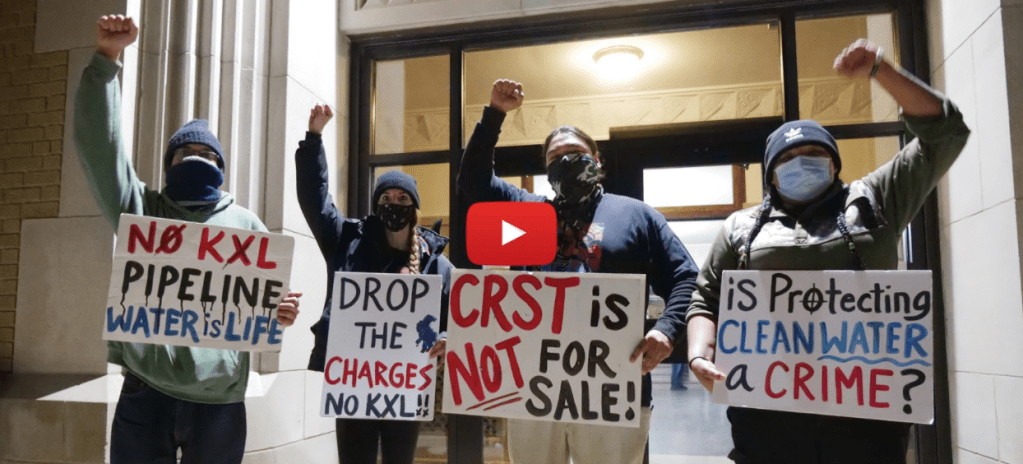
I hope you’re staying safe as we begin this new year. It’s been a wild election season, culminating with Tuesday’s Senate races in Georgia and Wednesday’s insurrection at the Capitol. Sadly, it’s inevitable that many of Trump’s (mostly white) followers will get away with their seditious actions in D.C. — meanwhile, a pair of young, Native activists here at the Cheyenne River Nation face charges after nonviolently protesting the Keystone XL pipeline.
Also on Wednesday, police arrested Cheyenne River tribal member Oscar High Elk (30 years old) and charged him on 12 counts, including felony aggravated assault, though he committed no acts of violence. Now, he faces a maximum of 23 years in prison. How wrong it would be should either one of these young water protectors serve time for standing against a Canadian pipeline which would provide little economic value to Americans and threaten Unci Maka.
This glaring disparity in our country between how law enforcement treats us Natives and other people of color as opposed to whites underlines the urgency of our struggle. We must take every opportunity to secure justice for Black and brown communities as the Trump era comes to an ignominious end. If you have not already done so, please sign our petition to the Biden transition team telling the president-elect: It’s time to end KXL and DAPL once and for all. We hope you’ll stay with us — and with our young activists — in the fight for environmental justice.
You can also share our call to action via social media by clicking the buttons below:
Wopila tanka — thank you for supporting our struggle! Mni wiconi.
Madonna Thunder Hawk Cheyenne River Organizer The Lakota People’s Law Project






 Water is Life