An Apology is Not Enough

Lakota Law

In case you missed it, President Joe Biden traveled to the Gila River Indian Community in Arizona today, where he made a landmark formal apology on behalf of the U.S. government for the federal Indian boarding school era. “It’s a sin on our soul,” he said, before asking for a moment of silence “for what was lost and the generations who have lived with that trauma.”

In his speech, Biden earnestly described some of the atrocities perpetrated on generations of young children, separated from their families at these “schools.” He also used the occasion to list his administration’s accomplishments on behalf of Native People, including hiring Deb Haaland of the Pueblo of Laguna as the nation’s first Indigenous Cabinet secretary and protecting the Indian Child Welfare Act (ICWA) in the Supreme Court. 

As a Lakota Law supporter, you know those were team efforts, and I’ll always remain grateful to you for helping us participate in making them both happen. I am also thankful to the president for his long-overdue apology. But the truth is — as I said in a statement picked up widely by the press — it is not enough.

Watch: President Biden’s full speech here.

Let’s be clear: an apology is an acknowledgment of wrongdoing, but it is not any form of redress. An apology is just the beginning of a necessary truth-telling. It is a nice start, but it is not a true reckoning, nor is it a sufficient remedy for the long history of colonial violence. The president’s apology calls for a deeper examination. I ask him to work with those knowledge holders within Indigenous communities to tell the entire, historical truth and look at proper redress.

We need more real action on a path toward reconciliation. As you know, we have many ideas for what truly addressing the history of genocide in the U.S. should look like. From rescinding medals of honor given to those who massacred our people at Wounded Knee to codifying ICWA at the state level, there are many tangible steps that can be taken to help and honor Native families, children, and communities. 

Lakota Law

Let’s remember that the separation of Native children from their families did not end with boarding schools. Lakota Law came into being because our grandmothers sought help with the ongoing epidemic of South Dakota’s Department of Social Services (DSS) removing our children at alarming rates. While Native people make up around a tenth of the state’s population, Native children comprise about half of the children in foster care here. And a report we produced a few years back showed that more than 60 percent of children who aged out of DSS custody in South Dakota wound up dead, addicted, imprisoned, or houseless.

So yes, I’m grateful that Biden has acknowledged some historic wrongs and begun to prioritize Native representation and funding for our communities in the present day. I’m also clear-eyed that we have much more to do together moving forward, so let’s keep working! I thank you for your heart and your activism in helping us realize a better world for the generations to come.

Wopila tanka — my gratitude for your friendship in this journey.
Chase Iron Eyes
Director and Lead Counsel
Lakota People’s Law Project
Sacred Defense Fund

Indigenous Peoples’ Day 2024 Action

Lakota Law

Happy Indigenous Peoples’ Day! I hope you take time today to enjoy life and celebrate your Indigenous relatives. Perhaps you can also take a moment to take action. Because, unfortunately — despite 29 states (plus Washington, D.C.) recognizing the real history wrought by the arrival of Christopher Columbus to our shores 532 years ago, the federal government still recognizes today’s holiday as Columbus Day. 

We hope you’ll help us change that. The U.S. government should do right by the original peoples of this land. Please tell your state’s federal lawmakers to actively support the Indigenous Peoples’ Day Act, which would replace the Columbus Day federal holiday with Indigenous Peoples’ Day nationwide.


As a friend of Lakota Law, you’re fully aware that the mythology taught in schools about Columbus and the pilgrims routinely ignores the brutal details of colonization. His arrival on our shores began a chain of events that decimated Native peoples throughout the western hemisphere. In his journal, Columbus joyfully celebrated his ability to easily enslave Native peoples who had no idea people could be so evil. Obviously, this is not heroic behavior to be celebrated each year. It’s long past time to stop honoring Columbus and his legacy of genocide.

Replacing Columbus Day with Indigenous Peoples’ Day nationwide would be a symbolic but serious gesture. While not a solution to heal the generational trauma begun when Europeans invaded our homelands, it would, at least, be a recognition of our sacrifice. Native communities deserve to be seen, and non-Native communities should also be given the space to consider their impacts, both historically and in the present day. In this way, we can increase understanding, build compassion, and create a better world moving forward.

Wopila tanka — my deep gratitude for your solidarity!
Tokata Iron Eyes
Spokesperson and Organizer
Lakota People’s Law Project

P.S. Tell your senators and House rep: it’s long past time to stop celebrating Christopher Columbus and his legacy of pain. Instead, let’s acknowledge the original peoples of this land by replacing the federal holiday of Columbus Day with Indigenous People’s Day!

Take Action: Muwekma Recognition

Lakota Law

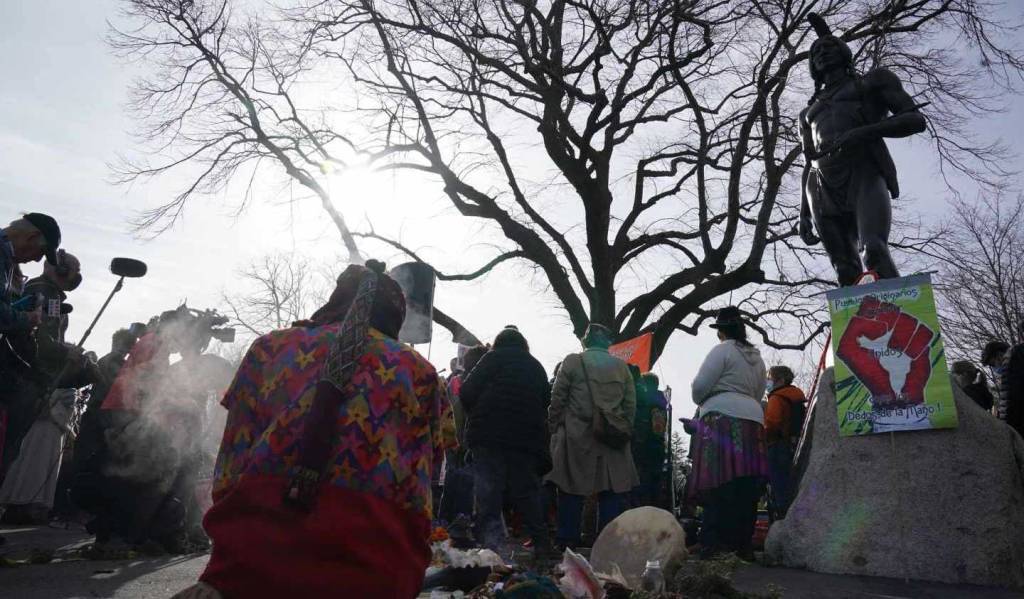
Over the past couple weeks, you may have seen stories or social media posts detailing the terrible treatment of the Muwekma Ohlone People by federal agents on the National Mall in Washington, D.C. It pains me just to write this, but government officials threatened to kill their horses and arrested tribal members at the tail end of the Muwekma’s cross-country “Trail of Truth” journey, in which tribal members sought government-to-government consultation with the U.S. Department of the Interior to restore their rightful federal recognition. 

I have more to say on that below, but first I ask you to take action now. Tell your reps: End the cycle of colonial violence and respect the sovereignty of the Muwekma Ohlone People. Congress must restore federal recognition to the original inhabitants of California’s San Francisco Bay Area by writing, sponsoring, and passing the “Restore Muwekma Bill.”

Lakota Law

The San Francisco Bay region has been the homeland of the Muwekma Ohlone People for more than 10,000 years, and congressional censuses acknowledged them throughout the early 20th century. And yet, today they’re landless and unrecognized by the federal government. This egregious oversight negatively impacts tribal members, who lose out on a myriad of important benefits when their sovereignty is ignored. The Muwekma Ohlone People have spent 40 years presenting valid evidence and struggling to reinstate their federal status, and the Department of Interior’s continued indifference amounts to a perpetuation of the cultural genocide of the Muwekma Ohlone.

With high hopes that an Interior Department now led by Deb Haaland of the Pueblo of Laguna would be more receptive to their message, the tribe, led by Chairwoman Charlene Nijmeh, set out on horseback from San Francisco in August on their Trail of Truth. Sadly, they — including women, children, and elders — were violently assaulted by the National Parks Police upon arrival in D.C. 

On Oct. 15 — the day after Indigenous Peoples’ Day — National Parks Police officers immediately moved to take the horses, which were provided by Lakota allies, specifically Percy White Plume (a direct descendant of Red Cloud) at the Horse Nation on the Pine Ridge Reservation. The police then arrested tribal members who tried to prevent the horses’ capture. Those actions were inconsistent with the law and far out of line, and these are some of the reasons why, in partnership with Muwekma, I plan to share more about various aspects of their story with you soon. In the meantime, please assist by taking action and telling your reps to restore federal recognition to the Muwekma Ohlone Tribe today.

Wopila tanka — thank you for supporting tribal sovereignty of the Muwekma Ohlone People!
Chase Iron Eyes
Director and Lead Counsel
Lakota People’s Law Project
Sacred Defense Fund

Terrorists? From the Same Government Participating in Genocide.

Lakota Law

Do you remember the hideous tactics used by law enforcement and private militarized security during the Dakota Access pipeline resistance? For instance, Lakota Law director Chase Iron Eyes was accused of domestic terrorism just for standing in a prayer circle to protect his homelands. Though this ridiculous charge was later dropped, it’s significant that such terminology was used in the first place. It’s a classic — and deeply harmful — racist trope to label non-white people as “terrorists” simply for exercising our First Amendment rights. 

While that dangerous rhetoric hasn’t gone away, I’m happy to say that, these days, tribes aren’t taking it lying down. A few weeks back, the Lac du Flambeau Band of Lake Superior Chippewa — my tribe — banished Wisconsin State Senator Mary Felzkowski from our lands after she equated tribal leadership to “terrorists.” She made the remark on Aug. 23 at a town hall meeting in Woodruff, Wisconsin, a bordertown of the reservation. This, of course, follows all nine of South Dakota’s Lakota nations banishing S.D. Gov. Kristi Noem earlier this year for her use of similarly abusive language.

Photo of the 37th Annual Bear River Pow Wow on the beautiful homelands of the Lac du Flambeau Band of Lake Superior Chippewa. From the tribe’s Facebook page.

The dispute in my homelands centers around residents of the town of Lac du Flambeau — situated on the reservation but home to many non-Natives — and their unauthorized use of roadways on tribal lands. Last year, the federal government sued the town on behalf of the tribe and asked for relief, asserting that non-Native residents had been trespassing on the tribe’s lands. The tribe set up barricades, later removed once the town agreed to pay fees to the tribe. 

Here’s a little more history on how we got here. When the Dawes Act was passed in 1887, lands opened to non-tribal members on many reservations. Now, in my home region, non-tribal members own land within every reservation but one. As a result, tribal governments govern tribal lands and members, while townships govern non-tribal lands and non-tribal members. In places like Lac du Flambeau — or the town of McLaughlin on the Standing Rock Reservation in South Dakota — the two entities often clash over competing priorities, and Natives and non-Natives must share space while at odds with each other.

By 1901 at Lac du Flambeau, 578 allotments had been distributed, and approximately 45,000 acres had passed into ownership by non-Natives. The problems associated with this reality can be hard to solve, but one thing I can be sure of is that it’s important to respect both the sovereignty and humanity of tribal peoples every step of the way. Felzkowski, who serves as co-chair for Wisconsin’s Special Committee on State-Tribal Relations, should know this.

Instead, in addition to spreading harmful stereotypes, her comments undermine the Lac du Flambeau Band’s sovereign right to govern itself, its lands, and its citizens. Like Gov. Noem, Sen. Felzkowski just found out what happens, even to powerful government actors, when you mess around with that. 

Wopila tanka — thank you for supporting sovereignty!
Darren Thompson
Director of Media Relations
Lakota People’s Law Project

Sugarcane: A New Documentary

Lakota Law

This weekend, I had the opportunity to experience an incredible work of art. Because you’re with us in the ongoing effort to find healing for our people, I feel it’s important to share it with you, too. “Sugarcane” — an award-winning new documentary feature about the generational trauma Indigenous families and communities face as a result of the residential and boarding school era — is currently touring Indian Country and in limited theatrical release across Turtle Island. Acquired for distribution by National Geographic, it will soon stream on Disney+ and Hulu. Today, I urge you to watch the trailer, then make plans to see the full movie as soon as it’s available to you!

 Watch the trailer: The film explores director Julian Brave NoiseCat’s fraught relationship with his father (pictured), who was born at a Canadian residential school.

By now, you’re no doubt all-too familiar with the horrors wrought at Indian residential and boarding schools — and the generational trauma that, as a result, affects virtually every person who grows up Indigenous in North America. Indeed, if you are Indigenous and didn’t go through it yourself, you 100% have relatives who experienced the forced assimilation, dehumanization, and cultural genocide of these institutions firsthand. If you’re non-Indigenous, you’ve probably read about it in more detail previously from us, in the news, or both.

Sugarcane,” co-directed by Julian Brave NoiseCat (a member of the Canim Lake Band Tsq’escen and descendant of the Lil’Wat Nation of Mount Currie) and Emily Kassie, takes on this dynamic in a personal way. Its uncompromising lens includes NoiseCat’s exploration of his relationship with his father, who was born at a Canadian residential school. If the implications of that are not immediately obvious, I caution you to prepare yourself for some heavy material.

The New York Times called “Sugarcane” a “must-see film about a difficult subject.” I couldn’t agree more. Nonetheless, this is not a movie that overtly seeks to polemicize. It brings you in, sharing with the viewer an investigation, a personal quest, a struggle to understand and forgive what can be forgiven and expose what cannot.

I want to acknowledge in this space my real respect for NoiseCat, who in addition to directing this film and sharing his deeply personal story, is a decorated journalist. He also led the call — which Lakota Law, and by extension, supporters like you — joined to position Deb Haaland as the U.S.’s first Indigenous Cabinet secretary. That’s a strong example of what we can accomplish together when we watch and follow with action.

So I hope you will watch what NoiseCat, Kassie, and their team have created with “Sugarcane.” It’s beautiful. It’s tough. It’s important.  

Wopila tanka — thank you for supporting Indigenous creators!
Tokata Iron Eyes
Spokesperson & Organizer
Lakota People’s Law Project

Federal Indian Boarding School Report

Lakota Law

This week, the Federal Indian Boarding School Initiative released the second volume of its investigative report. Its conservative estimate that at least 973 children died in federally operated Indian boarding schools sadly confirms what we in Native communities have known for decades. The legacy of these prison camps for children is generational trauma that may never fully heal. I know this is a difficult subject, but I invite you to read a recent article from USA Today, in which I offer more thoughts on this dark chapter of our shared history.

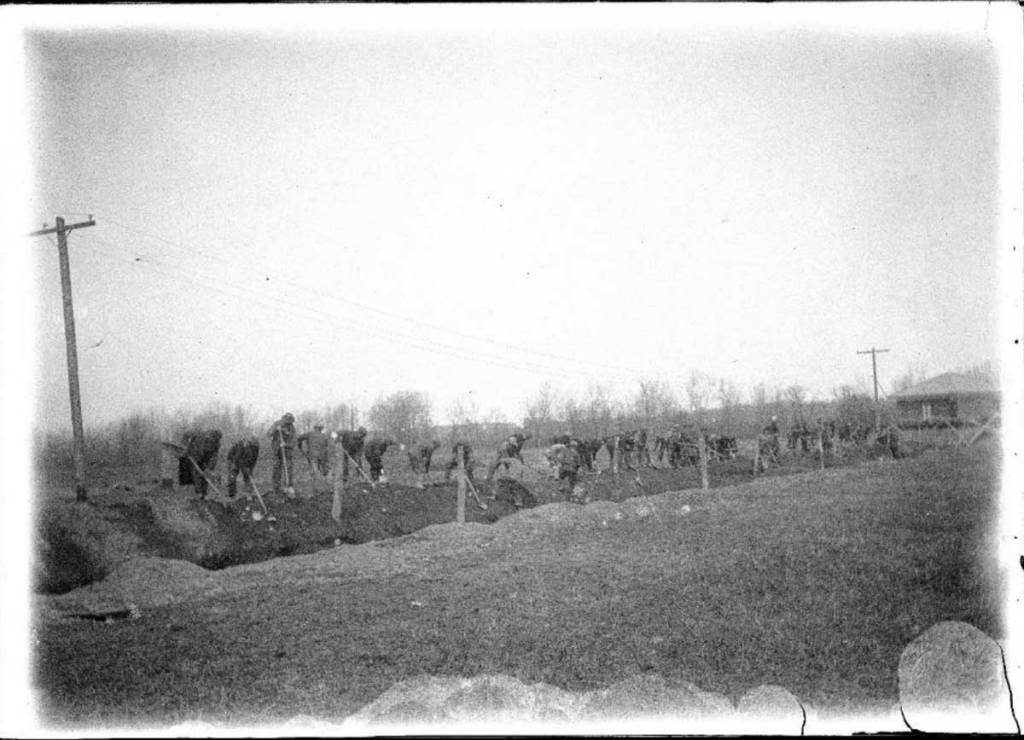
Students working outside [Photograph]. (ca. 1900-1930). Thomas Indian School glass plate negatives, Box 5; National Museum of the American Indian, Smithsonian Institution (Catalog Number N49089). From the Federal Indian Boarding School Initiative Investigative Report, Vol. II.

As a Lakota Law supporter, you’re likely well aware that Indian boarding and residential schools were noxious and dangerous places, designed to strip Native and First Nations children of their Indigenous identities, force them to work long hours, and assimilate them as good Christian subjects. (The report unfortunately does not include full statistics from the roughly 50 percent of domestic boarding schools formerly operated by religious institutions.) 

Many of the young ones fortunate enough to make it home after their incarceration bore permanent scars — mental and/or physical — which often later manifested in a variety of ways, not least a common difficulty raising the next generations in traditional and loving homes. Anyone who grew up Indigenous on Turtle Island can tell you stories of the danger, abuse, and dehumanization either they or family members experienced in these “schools.” 

That’s why, in 2021, on the heels of the revelation that 215 unmarked children’s graves had been discovered at the former Kamloops Indian Residential school located on Tk’emlúps te Secwépemc land in so-called British Columbia, Lakota Law advocated for a reckoning in the U.S. Secretary of the Interior Deb Haaland (a member of the Pueblo of Laguna and the nation’s first Native Cabinet secretary) quickly lept into action, launching the Federal Indian Boarding School Initiative to investigate, make public its findings, and provide recommendations for next steps.

Now the world knows what really happened. As I told USA Today, truth and reconciliation are not beyond our reach — and I’m grateful to see the United States begin to assist in providing paths to recovery. While we can’t go back in time and save the children who endured the terrors of the boarding school experience, we can move forward in a good way. Your solidarity, empathy, and generosity of spirit are always welcomed and valued as we forge ahead.

Wopila tanka — my gratitude for your support of our children.
Chase Iron Eyes
Director and Lead Counsel
Lakota People’s Law Project
Sacred Defense Fund

The Legacy of Crazy Horse

Lakota Law

Today, I write to you to share a little piece of joy. Summer is an important time of year in Lakota Country. Right now, many from the Oceti Sakowin and beyond — including my father, Chase — are reconnecting in a deeply meaningful way with their spiritual identities at the annual Sun Dance ceremony. 

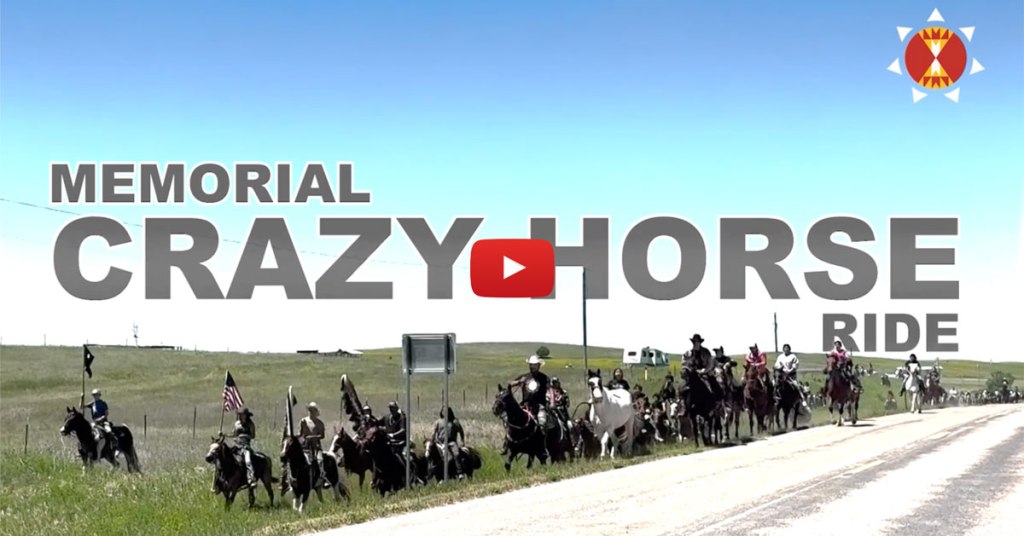
And about a month ago, I also felt the power of reconnection with our ancestors, homelands, and tradition of horseback riding at this year’s Memorial Crazy Horse Ride. I invite you to watch our new video, which features footage from the days-long event, background on its meaning, and an interview with Oglala Lakota organizer Kylie Richards Red Willow, a junior political science major and pre-law student at the University of Colorado.


 Watch: I interviewed organizer Kylie Red Willow about this year’s Memorial Crazy Horse Ride.

By now, you’re most likely aware of Crazy Horse and his enduring legacy. We recently wrote to you about the battles of the Rosebud and Greasy Grass (Little Big Horn), both of which were won in part thanks to this legendary Ogala Lakota war leader. The annual ride pays tribute to him, the role he played in those and many more confrontations with the U.S. Army, and also our other warriors, many of whom honorably served in the U.S. military over the decades.

Native People, of course, have a complicated and bloody history with the U.S. government, but that hasn’t stopped us from answering the call to serve in large numbers to protect this land, particularly when faced with existential threats like Hitler’s fascism during World War II. You may recall that, at that time, 29 Navajo code talkers in the Marine Corps provided a key to victory in the Pacific.

Today, of course, we still face fascist threats — some right here in our own homelands. Whether it’s the architects of Project 2025 seeking to reinstall Donald Trump as their presidential puppet, or S.D. Gov. Kristi Noem, who recently, offensively invoked the Sun Dance to falsely connect Native communities with Mexican drug cartels, we still have plenty of terrible people to fight.

As you know, we’ll take on those battles, and we won’t stop in the pursuit of justice and equality. When we pray to and ride for our ancestors, who fought so hard so we could be here today, we’re always reminded they expect nothing less.

Wopila tanka — my gratitude, always, for your friendship!
Tokata Iron Eyes
Spokesperson & Organizer
Lakota People’s Law Project

Parole Denied

Lakota Law

With a heavy heart, I report to you that, once again, American Indian Movement (AIM) activist Leonard Peltier has been denied his freedom. On July 2 — despite the best efforts of a large coalition and so many who lobbied the U.S. Parole Commission to do the right thing by Leonard, behind bars since 1977 and our longest-standing political prisoner — it decided against his release.

That said, options remain — so we must keep the pressure on! We continue to ask the president to grant Leonard clemency and let this legendary justice defender live out his remaining years at home. As we have mentioned to you before, Leonard has serious health issues which the prison cannot properly handle. Time is running out. That’s why we hope you’ll send your message to the president and share this action today.

It’s long past time for the president to free Leonard Peltier. Please send your message and share this action. 

Understand that Leonard’s case is a classic miscarriage of justice. Leonard, a citizen of the Turtle Mountain Band of Chippewa in North Dakota and a Dakota, was a key member of AIM — which pushed back hard in the 1970s against violence in our communities perpetrated under the auspices of federal law enforcement. Thus, the government went after him hard and, despite a host of problems with his trial, he’s now serving two life sentences as a scapegoat.

Problems with his conviction include a lack of eyewitnesses, recanted testimony from other witnesses, and withheld ballistics evidence. The prosecuting attorney is now on record saying Leonard should be freed — and a host of other justice advocates, including Amnesty International and the Dalai Lama, agree.

Leonard’s freedom is an issue of Indigenous sovereignty, as embodied by a single man. A good human being has now spent nearly 50 years behind bars, essentially because he’s Native and once made for a convenient example. Enough is enough! Please send your message to President Biden. Ask him to do the right thing, show empathy to a misunderstood elder with a good heart, and grant clemency to Leonard Peltier.

Wopila tanka — thank you for showing your love and respect.
Chase Iron Eyes
Director and Lead Counsel
The Lakota People’s Law Project

Let's Green CA!

Lakota People’s Law Project
547 South 7th Street #149
Bismarck, ND 58504-5859