“A lot of people from American society don’t understand our connection, our intergenerational connection, and how deep it runs within us to the land and the Earth,” Logan said.
Logan described a thanksgiving speech, or Ganö:nyök, that the Seneca recite to recognize the natural world around them.
“We start at the Earth and we go all the way up to the sky, to the creator, and it covers everything from the water, the plants, food, medicine, trees, birds, animals, everything in the natural environment,” Logan said. “If any one of those things goes away, eventually we will perish.”
Creating sustainable energy does not mitigate the problem. I used to get into these tremendous arguments with my father about progress. To summarize my stance: I used to take the bus because I did not have a car. I suffered through strange men groping me, people smoking, waiting in the rain for late busses, limiting my shopping because I could not carry a lot of stuff. It was sometimes unbearable. I was able to buy a car and at first, it was incredible. I had freedom! I had safety! It was convenient and I could go shopping in many places and load everything in the trunk!
But then one rainy day I drove by a crowded bus stop and realized all I had done was trade some problems for other problems. I now had a vehicle in which I had a traffic accident: someone ran into me and the car had to be repaired. I could get parking tickets so I always had to hunt around for parking space, and in some places, I had to pay for parking. I had insurance to pay, and I had to spend my Sundays washing the car. I had maintenance and car repairs. Instead of a monthly bus pass, I now had a car loan to pay off. I had a driver’s license to renew at the DMV. I had a yearly car registration to renew. I had to have a car inspection to get the registration renewed. I worried about someone trying to steal the car, so I bought an expensive car alarm system. Instead of being able to dose off when riding in the bus, I had to stay alert at all times when driving the car. I now got stuck in traffic jams on the freeway and ended up taking a longer time to get home from work than if I had taken the bus! When I added it up, I actually had more problems than when I rode the bus.
Energy is not created or destroyed – it just changes form.
I think this law applies to everything we do. There is no such thing as progress. We just change out one set of actions for another, one set of problems for another. We are not getting anywhere from where we started. We are making things worse.
We used to know how to make the things we needed, but now we are dependent on people and systems for everything.
We used to be able to drink water from the rivers and fish/hunt for our food. Now we use self-checkout at stores that sell us contaminated and processed unnutritious food.
We used to work in our fields growing the food from sun up to sundown. Now we sit in cars in traffic for hours to get to work and then back home so we can afford a gym membership to try and stay fit.
We used to sit on our front porches on hot summer evenings because we had no air conditioning and would talk to our neighbors to get the daily gossip. Now we are isolated in air-conditioned homes with security systems behind locked doors.
So, back to the article I cited. Little has changed in relation to the land and indigenous people. They have a pristine forest with old-growth trees. How are they able to still live there and the land has not been destroyed? – that is the big question.
We are clearly missing some knowledge. We come along and want to build a potentially polluting ¨Green¨ plant right next to their land because, you know, progress.
We live an unsustainable, nonregenerative lifestyle. That is why their forest is beautiful and all the other land is polluted, exploited, and dead.
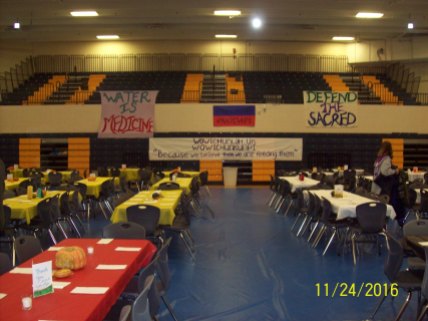
Thursday, November 24th, 2016 I thought at night very hard about why I was there in Oceti Sakowin Camp. The area is filled with spirits. They are in the wind as it blows over the hills. One can feel that many things have happened here. So, the question was, are you ready to die for this cause? Because if you are not serious about it, you should not be here at all. I thought about how I was a guest, an ally to help others. They have always been here fighting to live. I cried this night knowing that if I was called to do an action, I would willingly go with a prayer and make the stand full of peace as many others have done before. There are some things worth dying for and water is surely one of them. In acknowledging this, I understood fully what everyone here is going through. I knew that I was there for the right reason. I had seen people crying, I had seen some people walking alone looking very sad. But overall, peace and hopefulness in the power of prayer hovers about over the whole camp. No matter where anyone is from, no matter what style or condition of clothes, no matter the language, everyone is united and I could feel the power in that and everyone comforted and helped each other. This is the front line of a very serious battle. A battle between peace and violence, between right and wrong, between the oppressor and the oppressed, between common citizens and corporate power. Every thought, every word uttered, every action must radiate the peace and love we have for each other and to the people watching us on the hills overlooking the camp. There is no profanity at camp, no hateful words. One might be asked to leave if they are overheard saying negative things about others or swearing. There are children all playing about the camp and no one wants to upset them. I heard about people being led out of camp for breaking the rules. Anyone thinking this is a Woodstock or some sort of hippy camp-out is very mistaken. The camps are sacred places for prayer, these lands are filled with spirits and people must respect those spirits.
Morning. I got up before dawn, it was overcast, frosty, and cold, and I went to the California Kitchen to help with breakfast. I helped clean the tent floor, it was getting muddy with the wet frosty footprints. I helped organize the service tables. There were already many people working in the kitchen getting the Thanksgiving food prepared. The California Kitchen is actually three tents, one central large cabin tent and two smaller circular tents at each end connected by swinging doors. The Central tent has all of the food on shelves, the food prep tables, and the wash basins with water. The rear tent has the stoves and ovens hooked to generators. The front tent has four tables and a few chairs for people to sit and eat. Someone had decorated this space with Christmas decorations and lights. There are service tables against two sides and here are where you can find condiments, utensils, plates, and cups. They had a lot of paper donations but were trying to be mindful of waste and use metal utensils and real plates. Everyone is encouraged to bring their own mug, plate, and eating utensils.
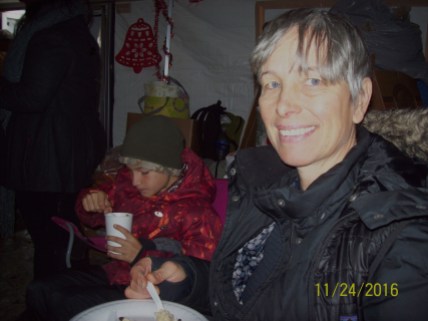
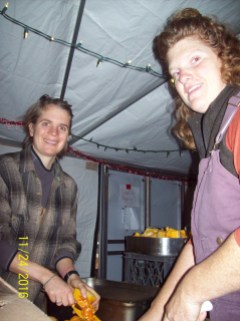
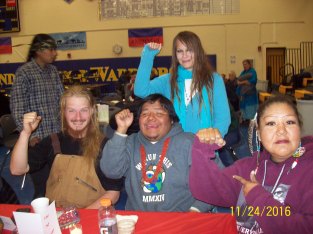
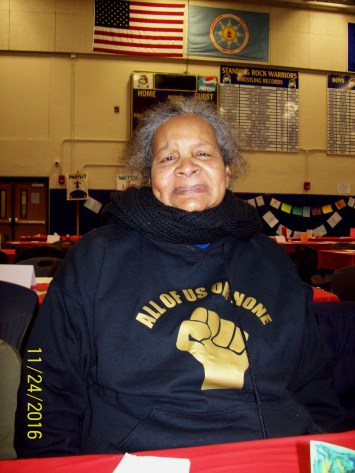
After breakfast was served, I sat and talked to people I met until about 12:00 noon. I met a filmmaker doing a documentary, a retired sailboat lady, Travis from a children’s school, a man from Bishop, California, a Washington State hippy dude who lived in a commune, a woman from New Zealand who was there with a group to perform a Haka, Nan, her husband, and two sons (pictured with one named Salmon). I also met two friends cutting the apples for apple pie and vegetables for Thanksgiving dinner (pictured). It was these conversations that later sprouted an idea.
There was someone who announced that there would be a raid on the camp. However, one of the security asked where this news came from. That a person should evaluate everything and not spread rumors that could disturb the peace. There are instigators and those people are quickly exposed when everyone is calm and connected and knows where to get the accurate information. Besides, no one cared what this rumor stated. No one was going to leave.
I sat in my car to get warm and to write some notes. I fell asleep as I was writing. It was here that I formed an idea. These people are not protestors and rioters, they are mothers, fathers, brothers, sisters, aunties, uncles, grandmothers, cousins, nurses, medics, lawyers, teachers, farmers, vets, retired people, rich, poor, educated, wise, homeless, they are everyone. I met in this one day people from over 10 different countries. I met people from all over California – yes even a few from Sacramento. One must humanize who is here.
I AM………. WATER IS LIFE
I took a walk to the sacred fire around 2:00 p.m.. This fire must not be photographed. You must approach it with peace in your heart. You must respect this fire as a spirit.I brought a gift of tobacco for an elder and a gift of the Water is Life stickers. I thanked him for allowing me to be an ally. There were some singing performances happening and then I heard of buses that were going to Ft. Yates to a high school for Thanksgiving dinner. I knew the California Kitchen was going to be very busy and crowded, so I got on a bus. I met a woman from Oakland and a school teacher and his aunt. As we were going to the high school, the driver had the radio on and was listening to a football game. An announcement interrupted the game coverage, it stated “Important! There are rioters and protestors in town. If you observe any suspicious activity or see any suspicious people, immediately call the Morton County Sheriff’s Department.” Wow, I thought, I wonder who the announcement was talking about because I had not met any!
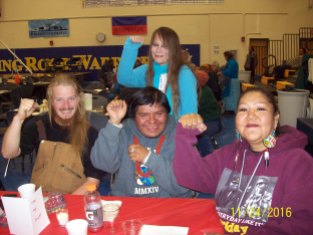
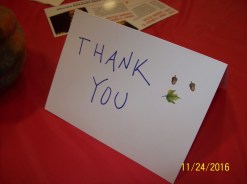
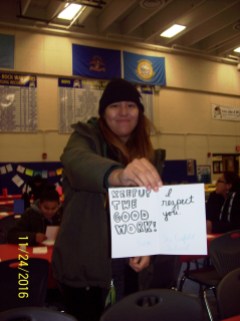
Thanksgiving Dinner. This dinner was provided by Jane Fonda. It was very beautiful and there was a great deal of delicious food. The servers were all volunteers and youngsters from the school. There were cards of thanks from children all around the world that were hung on the wall and placed on all of the tables. Archambault’s uncle prayed and spoke at length about the connection with the land and water. How we need to reconnect and teach the young people. He also told a story about Sitting Bull. How he always said he fought to defend the women and children. He never fought just because he wanted to fight from hate. He always fought to defend. We also heard a beautiful canoe song from the Pacific Northwest. There were many thanks to the celebrities who helped the camp and helped with the dinner.
Dinner: squash, mashed potatoes, carrots, stuffing, turkey, rice, bread, fry bread, tortilla, pumpkin pie. You are supposed to leave a little bit on your plate for the spirits.
Reckless development proposals such as mines, mega-dams, and oil pipelines have a way of coming back from the dead. The controversial Keystone XL pipeline is a recent and classic example: a zombie project that just wouldn’t die. Now, in North Dakota, environmental groups and Native American tribes are seizing on a rare opportunity to shut down a fossil fuel project that’s already up and running—the fiercely fought Dakota Access Pipeline.
Earlier this month, tribal members and environmentalists gathered in Bismarck, North Dakota, to give public testimony on the draft environmental impact statement for a critical section of the Dakota Access Pipeline. Before the hearing, activists who had traveled by bus from the Twin Cities rallied on the sidewalk with members of the Cheyenne River and Standing Rock Sioux Tribes, which for years have led opposition to the oil pipeline.
Format of public comment meetings for Dakota Access oil pipeline upsets opponents
Updated 11:28 AM CST, November 2, 2023
BISMARCK, N.D. (AP) — Opponents of the Dakota Access oil pipeline are taking issue with the format of private oral testimony in meetings for public comment on a draft environmental review of the controversial pipeline.
The U.S. Army Corps of Engineers is in the midst of two public comment meetings in Bismarck, North Dakota, the first held Wednesday, the second set for Thursday. People wishing to give testimony may do so orally in a curtained area with a stenographer, or do so in writing at tables.
The Standing Rock Sioux Tribe has long opposed the pipeline due to the risk of an oil spill contaminating the tribe’s drinking water supply. The four-state pipeline crosses under the Missouri River just upstream of the tribe’s reservation.
The long-awaited draft environmental review, released in September, outlines five options for the pipeline’s fate. Those include denying the easement for the controversial crossing and removing or abandoning a 7,500-foot (2,286-meter) segment, or granting the easement with no changes or with additional safety measures. A fifth option is to reroute the pipeline north of Bismarck, which would require new state, local and federal permits.
Future of controversial Dakota Access pipeline’s river crossing remains unclear
September 8, 20233:14 PM ET By The Associated Press
BISMARCK, N.D. — Federal officials on Friday released a draft environmental review of the Dakota Access oil pipeline, but said they’re waiting for more input before deciding the future of the line’s controversial river crossing in North Dakota.
The draft was released over three years after a federal judge ordered the environmental review and revoked the permit for the Missouri River crossing, upstream of the Standing Rock Sioux Tribe’s reservation. The tribe is concerned a pipeline oil spill could contaminate its water supply.
Today, as the Standing Rock Nation continues to battle the Dakota Access pipeline (DAPL), I invite you to take a look back at the origins of this movement. Perhaps you remember those fateful days in 2016 and 2017, when DAPL’s construction first threatened our sacred lands, we formed our prayer camps, and we sent our message to the world: “Mni wiconi, water is life!”
Though the fully operational pipeline now crosses under the Missouri River, our battle is far from over. Tens of thousands of environmental justice heroes like you have already aided Standing Rock by flooding the U.S. Army Corps of Engineers with public comments contesting DAPL’s problematic draft Environmental Impact Statement. The Corps will also host two DAPL public hearings on Nov. 1 and 2, at the Radisson Hotel in Bismarck, N.D. from 6-9 p.m. CST. We’ll be there, and so will water protectors from around Turtle Island. We encourage you to watch the video streams on our social channels or attend and lend your voice if you can!
Watch: Standing Rock’s NoDAPL leaders, including Lakota Law’s Phyllis Young, take you back to the origins of the movement.
As you’ll hear in the latest chapter of our Dakota Water Wars video series, we have always understood our mission as water and land defenders. We stand not only for ourselves but for our neighbors, ancestors, and future generations. Produced by the Lakota People’s Law Project in partnership with the Great Plains Tribal Water Alliance and Standing Rock Nation, this video shares powerful remembrances and insights from many of my relatives who organized the camps and kickstarted this resistance.
As we near the Nov. 13 cut-off for submission of public comments, please continue to stand with Standing Rock. As our powerful women, energetic youth, and knowledgeable elders have shown us since they first organized our movement, we have enormous power together when we unite for justice. We’re grateful for every ounce of support, and we pray the federal government will ultimately listen and do the right thing.
Wopila tanka — thank you for your solidarity and action. Chase Iron Eyes Co-Director and Lead Counsel The Lakota People’s Law Project
Lakota People’s Law Project 547 South 7th Street #149 Bismarck, ND 58504-5859
The Lakota People’s Law Project is part of the Romero Institute, a nonprofit 501(c)(3) law and policy center. All donations are tax-deductible.
Over this last weekend, as news channels and social media were inundated with tragic reports out of Gaza, Australia’s electorate voted down a key referendum of vital concern to Indigenous Peoples the world over. The referendum would have created a national advisory board to counsel parliament on Indigenous issues, but 60 percent of the Australian electorate rejected what could have been an important advancement for Indigenous representation at the highest levels of government.
The board was proposed to include Indigenous representatives from Australia’s six states and two territories. Each would have been voted in by local Indigenous community member-electors. A majority of Indigenous voters polled supported the proposal, and although the board would have “non-binding advice” on issues affecting Indigenous Australians, many saw it as a step in the right direction toward reconciliation.
Australian Prime Minister Anthony Albanese and Minister for Indigenous Australians Linda Burney deliver a statement on the outcome of the Voice Referendum at Parliament House in Canberra, Australia October 14, 2023. AAP Image/Lukas Coch via REUTERS
The referendum, supported by the Prime Minister and Indigenous leaders, nevertheless faced opposition from both sides. Some Indigenous Australians and allies saw its goals as insufficient. Grassroots Indigenous sovereignty activists have said they want more significant reconciliation efforts, such as a formal treaty. On the conservative side of the fence, many Australians’ no votes seem to indicate they care little about following a path of truth, justice, and healing in regards to the nation’s Indigenous citizens, who comprise nearly 4 percent of the country’s population of 26 million.
Let me be clear with you: Aboriginal Peoples of Australia and Indigenous Peoples of the Americas share a collective experience of genocide and exploitation at the hands of settler-colonial interests. We both have resisted, gradually carving out a space to practice our cultures and exercise sovereignty. On Turtle Island, we at least have had the benefit of treaties (though, as you probably know, the U.S. government has never been known for honoring them). British settlers never even gave lip service to the Aboriginal Peoples of Australia, which is one reason any advancement in their status (the Australian Constitution fails to even recognize their existence) would have been welcome.
Indigenous Australians weren’t even allowed to vote until 1962, and the Australian state’s genocidal policies have repeatedly targeted them. Throughout the 1800s, they faced an onslaught of settler violence and dispossession of their homelands — a period parallel to the “manifest destiny” era here on Turtle Island. Continuing through the 1900s, Christian and white supremacist institutions such as boarding schools, missions, reservations, and corrupt child welfare systems abused Aboriginal children and families. I urge you to read more about the “Stolen Generations,” Indigenous children removed from their homes by the Australian government and other institutions in an attempt to eliminate the nation’s Indigenous population.
I may hail from the Standing Rock Sioux Tribe, but I have spent my life advocating for the rights and humanity of Indigenous Peoples on the international stage. While one failed referendum might seem insignificant when placed along the Australian state’s lengthy timeline of violence and dispossession of Indigenous Peoples, it is nevertheless a crucial marker of a settler-colonial society’s inability to take accountability and respectfully listen to Indigenous voices. I stand with my Indigenous relatives on the Australian continent, and I call on you to join me. Let’s show solidarity with all Indigenous people in their various struggles against settler-colonialism and genocide.
Wopila tanka — my gratitude to you. Phyllis Young Standing Rock Organizer The Lakota People’s Law Project
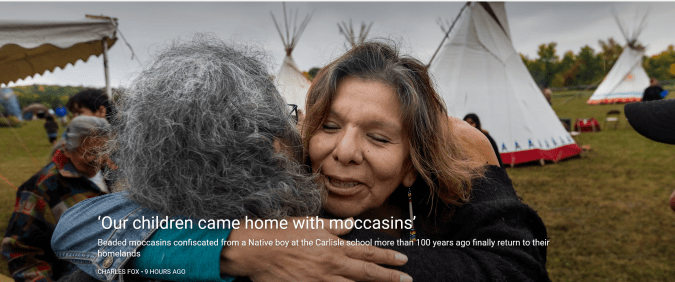
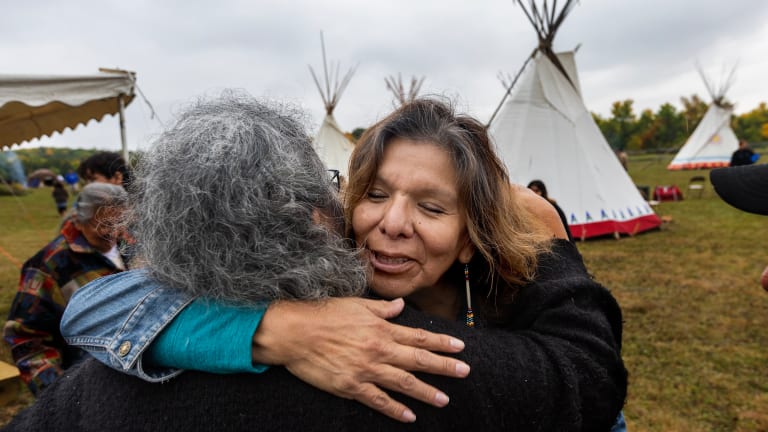
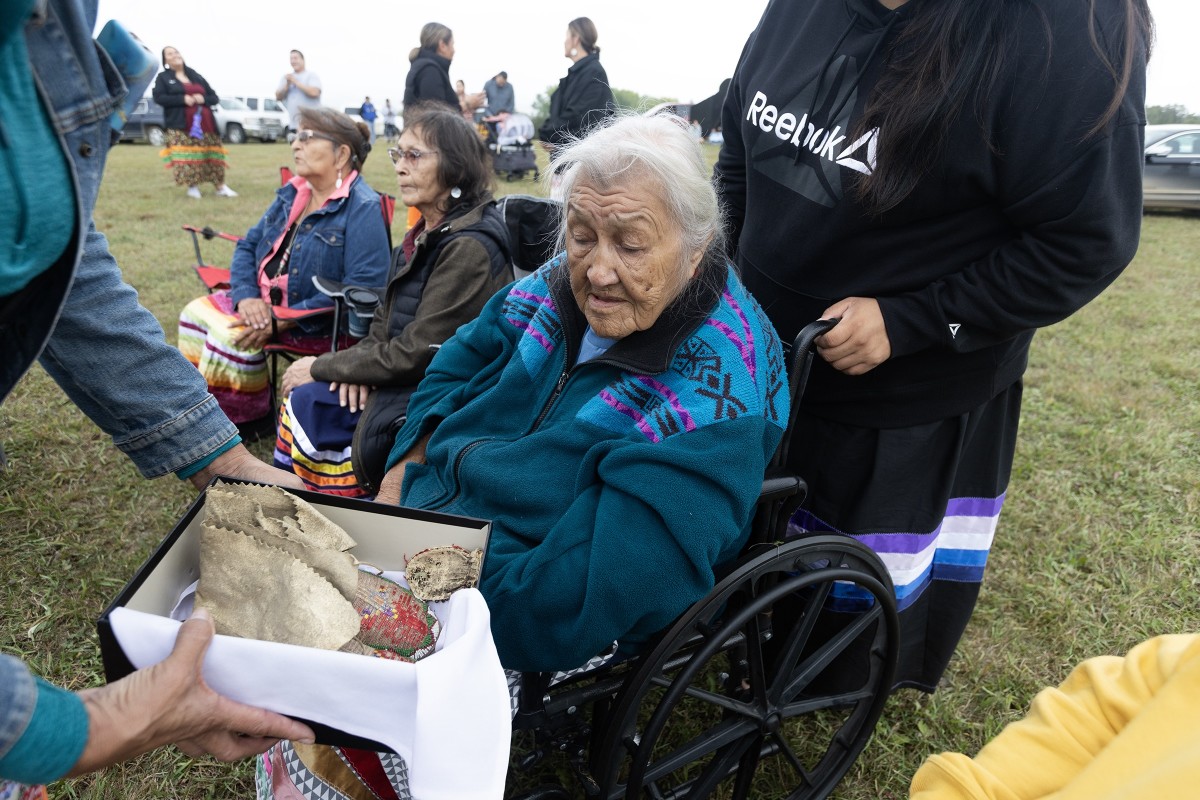
Kelley Bova, right, receives a hug after speaking to a group of elders at the Lake Traverse Reservation in South Dakota on Sept. 23, 2023. Bova, Sisseton Wahpeton Oyate, brought home a pair of moccasins that had been confiscated from a Native boy at the Carlisle Indian Industrial School in Pennsylvania more than 100 years ago. They were repatriated to the tribe along with the remains of two students who died there in the late 1800s. (Photo by Charles Fox for ICT)
WARNING: This story contains disturbing details about residential and boarding schools. If you are feeling triggered, here is a resource list for trauma responses from the National Native American Boarding School Healing Coalition in the U.S. In Canada, the National Indian Residential School Crisis Hotline can be reached at 1-866-925-4419.
LAKE TRAVERSE RESERVATION, S.D. — The moccasins sat for decades in the corner of a glass-enclosed bookcase in Pennsylvania, nestled on a shelf with a Davy Crockett trading card and Canadian Mountie knick-knack.
They had long been separated from the unknown Native boy who had worn them into the notorious Carlisle Indian Industrial School more than 100 years ago, where they were taken from him along with his Native connections to family, language and traditions.
By the time they returned quietly home to Sisseton Wahpeton Oyate lands in late September, however, their anonymity had made them universal, a reminder of the forced assimilation that had formed the mission of the Pennsylvania school.
“It’s all about those moccasins,” said Tamara St. John, a Sisseton Wahpeton Oyate historian and South Dakota state representative. “They are the symbol of everything that happened there.”
Their journey home – accompanying the remains of two Sisseton and Spirit Lake boys repatriated to their tribes and families – brought not only another step toward reconciliation and healing for those involved but also inner peace and a sense of purpose to others along the way.
Moccasin tracks
The skilled craftsmanship of the moccasins’ quill and beadwork apparently caught the attention of seamstress Susan Zeamer, who worked at the Carlisle school from 1895 to 1908.
At some point, she took them home for herself. Whether she slipped the moccasins into her pockets or was given permission to keep them is lost to history.
The moccasins were then passed down through generations until a great-nephew by marriage, John Baker, 72, now of Buckingham Township, Pennsylvania, became their owner in 2011.
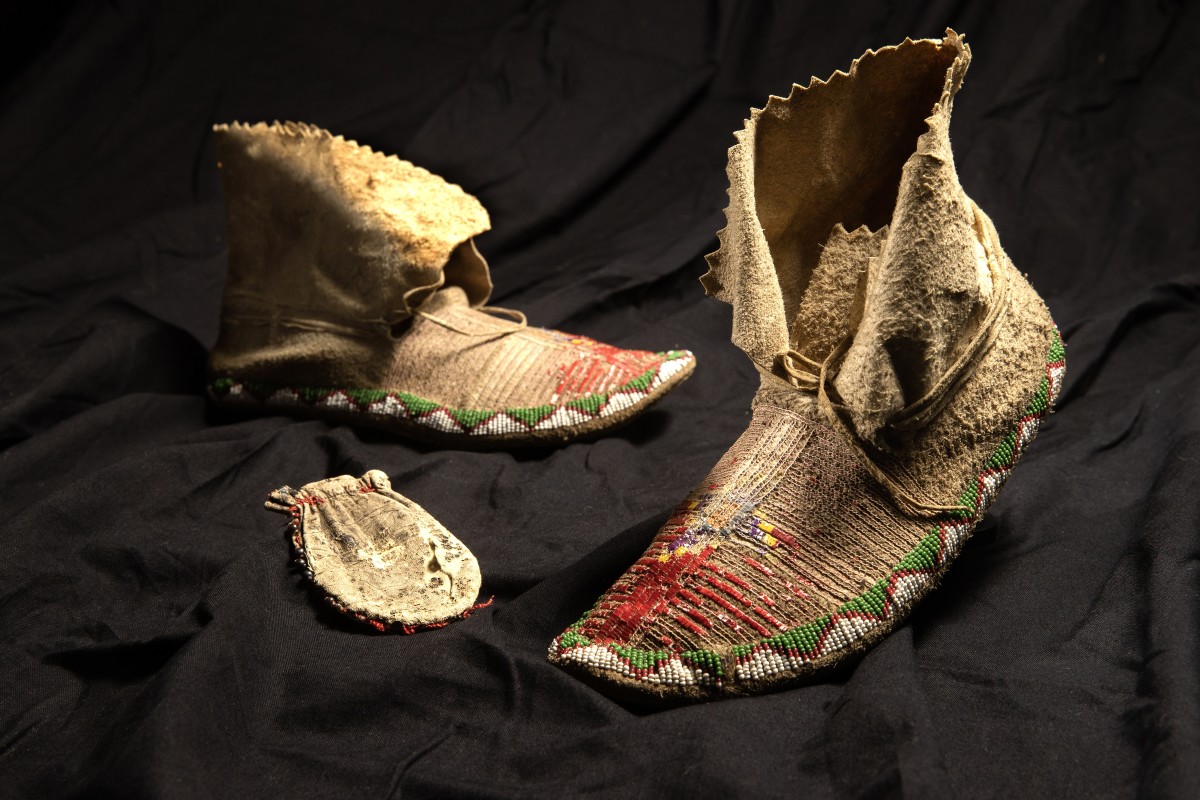
A pair of moccasins and a medicine pouch that were confiscated from a student at the Carlisle Indian Industrial School more than 100 years ago were repatriated to the Sisseton Wahpeton Oyate on Sept. 23, 2023. They had been in the possession of a Pennsylvania family for more than a century before Kelley Bova, a tribal citizen, was asked to return them to the tribe. (Photo by Charles Fox for ICT)
Baker remembers being fascinated by the moccasins in the bookcase in his parent’s home as a boy in the 1950s, when Westerns were popular on television and movie screens. He visualized a young Indigenous boy wearing them on adventures.
Over the past decade, however, despite the sentimental attachment, Baker became uneasy with possessing them. Like many who grew up in the Carlisle area, Baker’s knowledge of the Carlisle school was limited, but being the owner of the moccasins had enlightened him to the reality of the harsh history of the school and the treatment of Indigenous children. He felt a new responsibility. He understood the moccasins were not his to keep, but his quest to find their home of origin was filled with frustrations.
Museums and tribes did not always reply to his queries, but his research convinced him the moccasins were Plains Indian in style.
He finally reached out to Arla Patch, in Bucks County, Pennsylvania, a founding member of the Coalition of Natives and Allies advocacy, group which has led a fight against Native mascots. He showed her the moccasins on a Zoom call and told her of his desire to see them returned.
“I was getting pretty frustrated,” Baker said. “What’s going to happen to these? … They’re more than just an artifact, they’re actually part of a lineage that still is alive and well.”
Patch introduced him to her close friend, Kelley Bova, a fellow member of the Coalition of Natives and Allies, who is Dakota.
Bova, too, had been removed from her culture and traditions. Born in Sisseton, South Dakota, she was adopted as a 3-month-old infant by a White family and grew up far from her Native relatives.
Independent research with tribal historians and museum experts confirmed the moccasins were Plains Indian in style, though a specific tribe could not be pinpointed. Officials with the Blackfeet, Dakota, and Rosebud Sioux tribes all felt they were characteristic of their style.
Kelley Bova (not shown) shows the moccasins to Helena Little Ghost at the Lake Traverse Reservation in South Dakota on Sept. 23, 2023. The moccasins were confiscated from a student at the Carlisle Indian Industrial School more than 100 years ago. They remained in the possession of a Pennsylvania family for more than a century before being repatriated back to the Sisseton Wahpeton Oyate. (Photo by Charles Fox for ICT)
Bova believed her own tribe, the Sisseton Wahpeton Oyate, should take the moccasins, and tribal officials agreed. Bova was tapped as the proper person to deliver them to their symbolic home.
“I find it mystical that Kelley and my path would cross, and that John’s and my path would cross,” Patch recalled. “It’s just so amazing. You couldn’t write a script like this.”
Baker presented the moccasins to Bova in November 2022, at Peace Valley Park in Bucks County. He said he felt both a void and a peace to no longer have them in his home in the antique bookcase that he inherited along with the moccasins.
“It was really strange to not have the moccasins in the bookcase anymore,” he said recently. “They’ve been there my whole life. I kind of lost this imaginary friend. But I can’t tell you how much peace that brought me. There was a real sense of well-being about it. Something definitely was settled.”
A different era
While Baker felt the absence, Bova quickly formed a close bond with the worn, leather shoes. They had been on similar journeys, more than a half-century apart, and Bova felt it was time to take them home.
“I would actually talk to them, tell them that they were safe now,” Bova said, as she waited to take the moccasins to Sisseton. “I have prayed with them, and I treat them like a child. I take care of them and plan to be able to bring them home.”
Finding your way home is something Bova knows about.
Her journey began as Rose Anne Owen, a Dakota infant taken from her family at birth and moved to Rosebud to await adoption. At age 3 months, she was placed into the hands of Salvatore and André Petrilli, a suburban Philadelphia dentist and his wife. The Glenside couple, of Italian and Irish descent, had struggled to have their own biological children and had arranged for the adoption through Catholic Charities.
Rose made her 1,900-mile journey to Glenside, Pennsylvania, and was renamed Kelley Elizabeth Petrilli. A new birth certificate was created to reflect that she was the child of two Caucasian parents. Her American Indian heritage was wiped away on paper. A Montgomery County Orphans Court clerk, ironically with the last name of Custer, gave the final stamp of approval to the adoption.
She had become a child of the Native adoption era, a decades-long forced assimilation of Native children established under the Indian Adoption Project, which started in 1958 and evolved to include 50 private and public placement agencies across the United States and Canada.
By then, boarding schools had proven to be expensive and unsuccessful. Adoption was the new attempt at assimilation, but the expenses would be the responsibility of the adopting parents and not that of the government. Raised in a White home, without the communal support of other students, adoption was viewed as a more successful tool for assimilation.
In the next 20 years, until the Indian Child Welfare Act ended the adoption project, almost 13,000 Native children were adopted. Native children are still four times more likely to be removed from their families and placed in foster care than non-Native children.
Love without identity
Unlike many other adoptees, Bova did not suffer a childhood of abuse. The Petrillis provided a loving, middle-class home and private schools, while never hiding her Native heritage.
Eventually, they would have five biological children on their own, but Bova always knew she was different, a Native island in an ocean of White suburbia.
“You’re an Indian, you’re an Indian,” one of her cousins would taunt.
“No, I’m not,” she would scream back, a denial that still embarrasses her and causes her pain today.
“When I was younger, I wanted to be White; I still feel guilty about that,” Bova told The Philadelphia Inquirer in 2021. “I just wanted to fit in and be like my sisters. … I did not like being tall and brown and different.”
For Bova, that feeling of isolation led to what she calls her “dark years” after high school.
“Deep down, when you are adopted, you have a wound inside yourself,” she said. “If your parents gave you up, how lovable can you be?”
Sandy White Hawk, a Sicangu Lakota from Rosebud, knows the feeling. She was adopted at 18 months, and grew up to found the First Nations Repatriations Institute. She currently works at the Indian Child Welfare Act Law Center in Minneapolis.
“Even in loving families, Native adoptees live without a sense of who they are,” White Hawk told the Inquirer. “Love doesn’t provide identity.”
Bova, now 60, did not find her way back to her biological mother, Lillian Owen, and siblings, or her Dakota tribe, the Sisseton Wahpeton Oyate, until she was 50. Like students who attended Native boarding schools, she found herself split between two worlds and not fitting completely in either.
“When any child was taken, they were also not able to continue their journey of being Native American. We were robbed of our identity,” said Bova, who is now an enrolled member of the tribe. “I think that’s the hardest part for me to sometimes wrap around, that you’re robbed of that. And people don’t understand that, but I’m … grateful that I found my family and I try to learn as much as I can.”
Patch said the journey continues.
“Kelley does not have her Whiteness, and she does not have her Nativeness,” Patch said of her friend. “The healing power of Kelley’s story is that she is now getting to be Dakota. She’s getting to connect with that Dakota heritage.”
Rose’s story
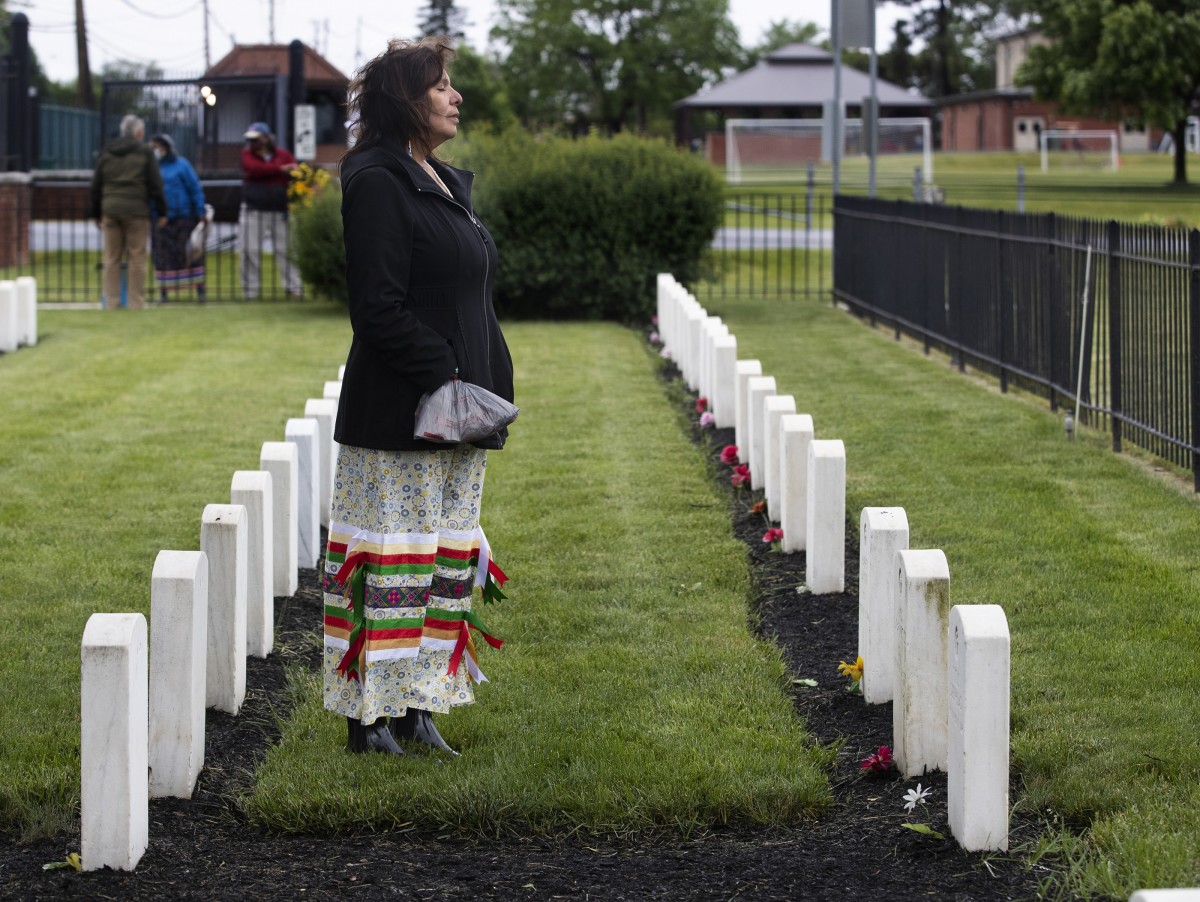
On Memorial Day weekend in 2021, Kelley made her first visit to the former grounds of the Carlisle Indian Industrial School, drawn by a group of Native women and others from the Circle Legacy group who clean and decorate the graves each year.
She stood in the Indian Cemetery on a raw, rainy day with the white gravestones laid out in front of her in perfect rows, like desks in a classroom.
Kelley Bova, of Pennsylvania, pays her first visit to the Indian Cemetery on May 29, 2021, at the site where the Carlisle Indian Industrial School operated from 1879-1918. Bova was taken from her family as an infant and adopted out at three months old to a White Pennsylvania family. She later reconnected with her birth family and is now a member of the Sisseton Wahpeton Oyate. (Photo by Charles Fox, courtesy of The Philadelphia Inquirer)
They marked the remains of the students who had died while attending the school but had not been returned home to their families. Most were victims of diseases such as tuberculosis.
Her eyes became transfixed on one particular grave. The gravestone simply read “Rose, Sioux.” It was the name she had been given by her biological parents.
“Just seeing that grave with her name, my name on it,” Kelley later said, “it just made me cry.”
It was the grave of Rose Long Face, also known as Little Hawk, Rosebud Sioux, who was among the initial group of 84 students to arrive at the school on Oct. 6, 1879. She died 18 months later on April 29, 1881.
Their journeys had been separated by 84 years but were nonetheless similar. Both had made the journey from Rosebud to a Pennsylvania town, to have their Native identities removed and be renamed in the process. Both had been separated from their families and the land that should have been their home by a government assimilation program.
Bova moved a few rows over and found the graves of two other Dakota students, Amos LaFromboise and Edward Upright. She knelt, placing tobacco bundles on their graves, speaking softly to let them know they were not forgotten and one day they would be home again.
Rose Long Face made it home first, however. In the summer of 2021, she was among nine Rosebud students repatriated from the cemetery to their homeland in South Dakota. She had been away 140 years.
Amos and Edward
Amos and Edward began their journeys home in September 2023, when they were disinterred from the Carlisle cemetery in a private ceremony that included tribal members, ancestors and others.
Their homecoming provided a chance to return the moccasins, as well, to Sisseton.
Amos and Edward were among six Sisseton Wahpeton Oyate/Spirit Lake students, four boys and two girls, who arrived at the Carlisle school on Nov. 6, 1879, along with seven students from other tribes. They arrived exactly one month after the first group of students had walked through the gates.
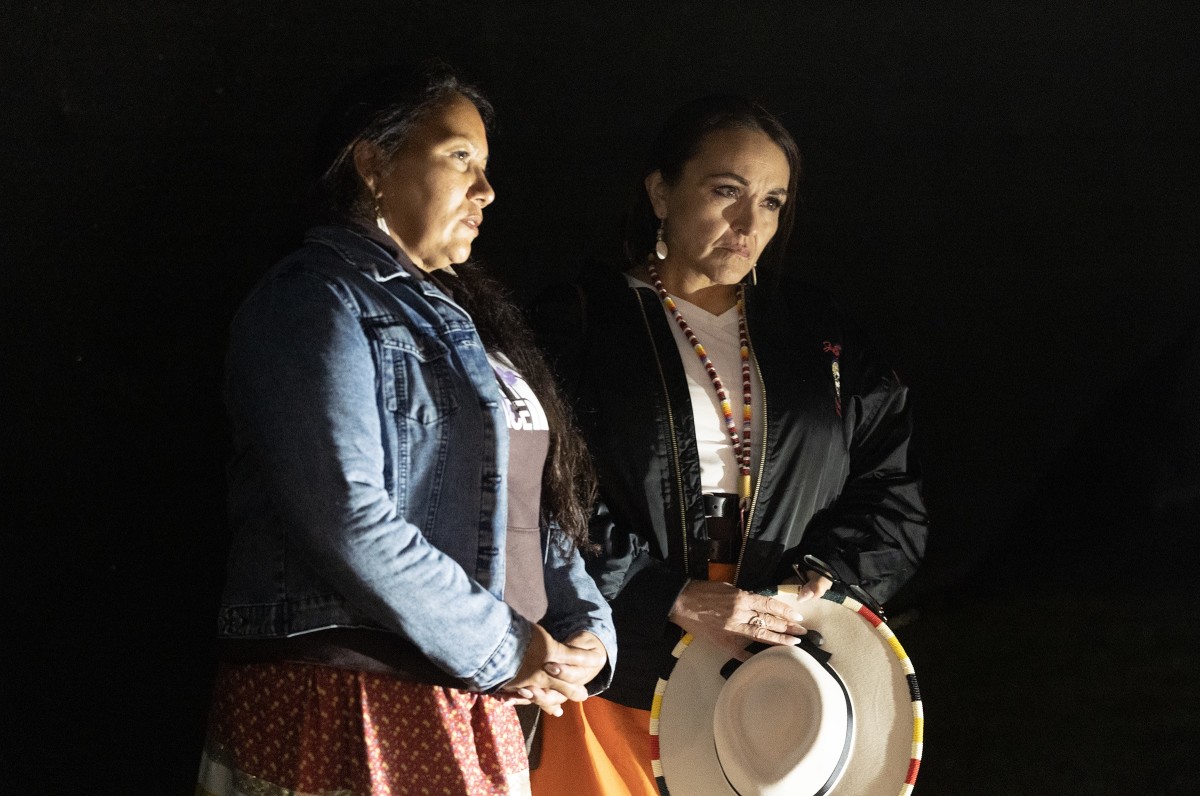
Chairperson Lonna Street, left, Spirit Lake Tribe, and Tamara St. John, Sisseton Wahpeton Oyate historian and a South Dakota state representative, stand in the Indian Cemetery at the former site of the Carlisle Indian Industrial School late in the evening of Sept. 17, 2023. Work in the cemetery disinterring the graves of Amos LaFromboise and Edward Upright had gone on for approximately 11 hours on a rainy day. (Photo by Charles Fox for ICT)
In 20 days, Amos was dead — the first student to die at the school. There is no record of the case of death, though a newspaper report at the time suggested he was sick when he arrived at the school.
Edward, son of Chief Waanatan II, was 12 when he arrived at the school, a year younger than Amos. He died on May 5, 1881, of pneumonia as he was recovering from measles.
Amos and Edward were among four students disinterred from Carlisle in September as part of the U.S. Army’s disinterment project at the Carlisle Barracks. The others, Beau Neal, Northern Arapaho, and Launey Shorty, Blackfeet, were also returned to their tribes and families.
Amos and Edward were taken by a caravan of nine passenger vans and vehicles that left Carlisle on the afternoon of Sept. 19 for the 22-hour drive to Sisseton.
Along the way, the caravan stopped in Ohio to pick up two more remains being returned by Oberlin College. Two additional remains, believed to be about 500 years old, were already waiting for burial in South Dakota after being returned by a North Dakota coroner’s office.
Amos and Edward arrived on Sept. 20 at the site of the former Sisseton Agency, where they had last said goodbye to their parents. This time, however, they were greeted by about 100 people gathered in celebration.
They were then taken to the Sisseton Wahpeton Oyate repatriation grounds to complete the traditional four days of mourning before a private ceremony and burial at the repatriation cemetery. The other four remains were also buried at the repatriation cemetery.
Bova made the same journey with the moccasins tucked inside a shoebox, boarding the caravan at Carlisle for the trip to Sisseton.
For her, the trip was an opportunity to take part in an historic moment for the Sisseton Wahpeton Oyate and Spirit Lake people, but also an opportunity to continue her healing process. She had visited Sisseton more than 10 times in the past 10 years for Sundances, powwows, and family events.
“It’s like there’s this vessel and this wound and every time [I go to Sisseton] it gets filled a little more, then a little more and a little more,” Bova said afterward. “That’s why it helped doing this. Because that was able to fill [the void] even more. Fill that wound up and heal it.”
During the final three days of mourning at Sisseton, with ceremonies at sunrise and sunset, gatherings with food, and conversations with elders, Bova experienced events she had missed for 50 years. This was especially true of her time spent with the Buffalo Heart women.
“Those Buffalo Heart women allowed me to help with the remains,” she said. “That was such a gift to me.”
‘These are my people’
On Saturday, Sept. 23, the day of burial for Amos and Edward, about 100 people of all ages stood on the hillside overlooking the open graves.
The remains were taken down from a wooden scaffold and eventually bundled in buffalo robes along with a star quilt, moccasins, and other traditional items brought by relatives. They were then placed in their graves with the love and respect that should have been afforded them as the sons of chiefs.
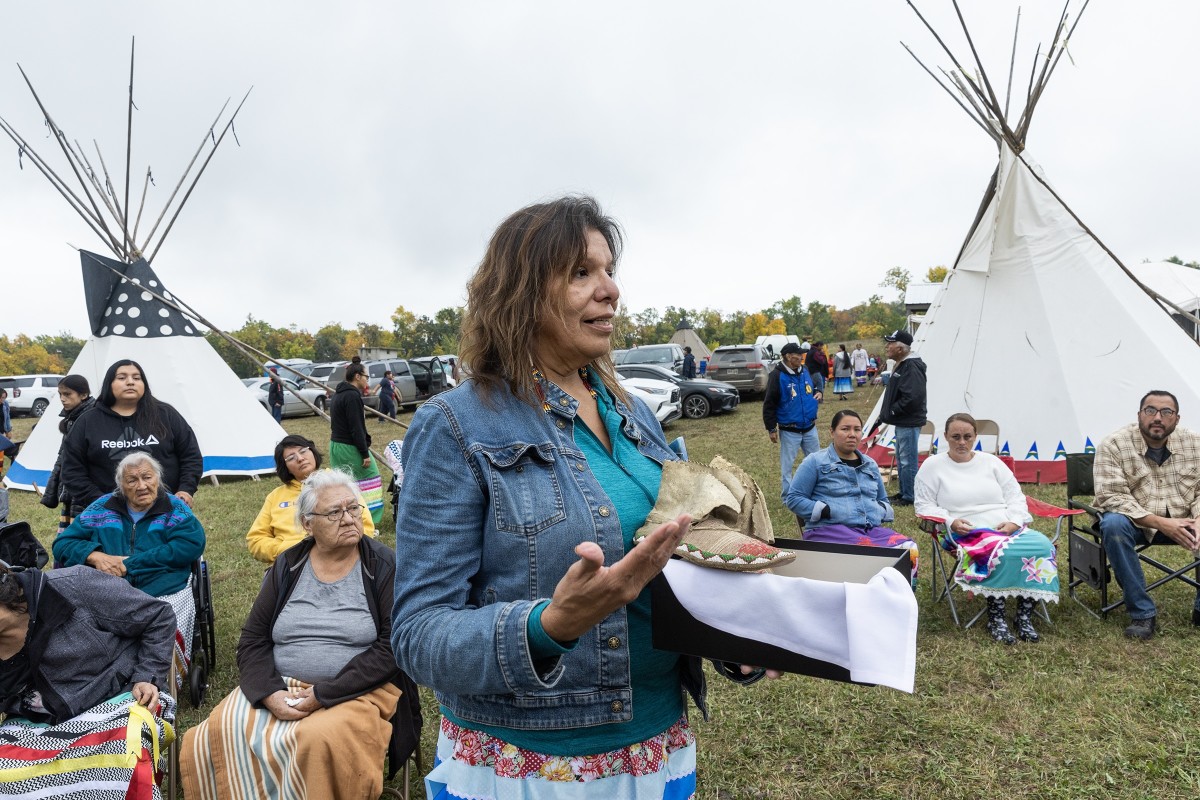
Kelley Bova, Sisseton Wahpeton Oyate, speaks to a gathering at the Lake Traverse Reservation in South Dakota on Sept. 23, 2023, after bringing home a pair of moccasins confiscated from an unknown Native boy at the Carlisle Indian Industrial School more than 100 years ago. They had been in the possession of Pennsylvania family for more than a century. (Photo by Charles Fox for ICT)
“Whenever I am in the teepees, by the fire, and hearing the men drumming and singing, it takes me back to another time,” Bova said. “It’s something that makes me feel so special. …That’s my DNA; that’s my heritage. Not knowing it for 50 years and finally seeing things like that, it has a healing power inside of me that helps a lot. Seeing all of this, I come to the realization that these are my people. This is who I am… The biggest thing I have learned is to let go of how I was raised as opposed to who I really am.”
Then it was Bova’s turn to address the group. She spoke to a gathered group of elders at the front of the crowd where they could see the moccasins she held in her hands.
She told the story of the moccasins and their pathway to her, and then presented them to tribal chairpersons J. Garret Renville of the Sisseton Wahpeton Oyate and Lonna Street of Spirit Lake, as well as historian St. John.
“It’s a privilege to be able to do this,” she told ICT. “And it’s a very spiritual thing. Because I feel like it’s my journey home, and now I can help these moccasins go home. I know they’re just a thing. But to me, there are symbols of every child that was taken, whether it was through adoption or through the residential schools. I think it’s just so important that these go home.”
Upon hearing the news of the moccasins’ return to the Dakota people, Baker responded from his Pennsylvania home that he felt “ relief, peace, and closure” and “a sense of gratification that comes with complete accomplishment.” The endeavor had taken over a century but was finally achieved.
St. John has big plans for the moccasins.
“I could build a museum around the moccasins to forever tell the stories of so many — past, present, and future,” she said. “I want them to be representative of our children and their journey home. I want them to represent how the federal assimilation tactics of places like Carlisle did not win.”
The moccasins can tell that story, she said.
“Our boys will be here and laid to rest on the homelands and protected ever on, but those moccasins will sit in their place in our collections with their story,” St. John said.
“To ‘keep one’s moccasins’ is said to mean that a Native person did not give up their traditional way,” she said. “Our children came home with moccasins.”
Our stories are worth telling. Our stories are worth sharing. Our stories are worth your support. Contribute $5 or $10 today to help ICT carry out its critical mission. Sign up for ICT’s free newsletter.
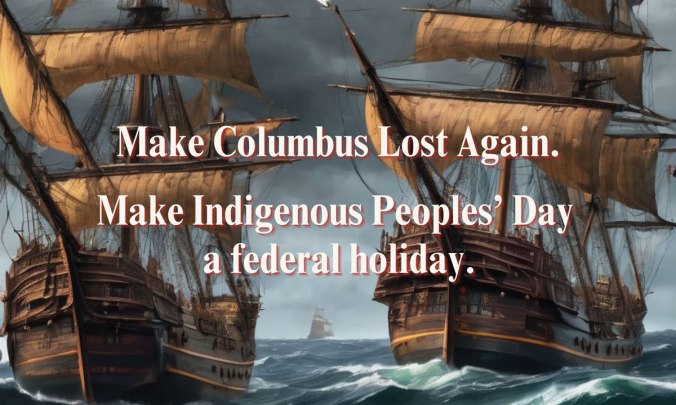
This Monday, Oct. 9, we’ll be observing Indigenous Peoples’ Day. But in too many places around the country, others will still be celebrating Columbus Day. It’s 2023 — 531 years since Christopher Columbus landed on our shores and started a chain of events leading to the decimation of Native peoples throughout this hemisphere — and we must do better. It’s time to stop honoring Columbus and his legacy of genocide.
29 states (plus Washington, D.C.) have stopped observing Columbus Day, and many communities now celebrate Indigenous Peoples’ Day either concurrently or as a replacement. That’s a start, but it’s not enough. The U.S. government should do right by the original peoples of this land. Please tell your state’s federal lawmakers to actively support the Indigenous Peoples’ Day Act, which would replace the Columbus Day federal holiday with Indigenous Peoples’ Day nationwide.
By now, you’re likely aware of the difference between the mythology taught in schools about Columbus and the pilgrims and the bloody reality of real history. Upon arrival in the “New World,” Columbus promptly wrote in his journal about the apparent ease of subjugating and enslaving the Native peoples. This is not heroic behavior, fit to be celebrated by all on an annual basis.
Replacing Columbus Day with Indigenous Peoples’ Day nationwide would be a symbolic but serious gesture, helping to offset some of the generational pain and trauma begun when Europeans invaded our homelands. Native communities deserve to be seen, and non-Native communities should also be given the space to consider their impacts, both historically and in the present day. In this way, we can increase understanding, build compassion, and perhaps even start to heal together.
Wopila tanka — my deep gratitude for your solidarity! Tokata Iron Eyes Spokesperson and Organizer The Lakota People’s Law Project
On September 26, a good thing happened. In coordination with the United Nations Human Rights Committee (UNHRC) and Civil Society Task Force, I spoke before the United Nations International Covenant on Civil and Political Rights (ICCPR) working group on Indigenous Rights and Self-Determination. I’m grateful for this rare opportunity to declare our sovereignty and present our case as Indigenous Peoples on a global stage. Today, I’m excited to share with you my thoughts, and I invite you towatch my short video presentation right here.
The ICCPR is a major international treaty that commits signatory nations to protecting individuals’ civil and political rights. In speaking on behalf of Native treaty rights and sovereignty, I quoted the wisdom of Chief Frank Fools Crow, advocating for land back and a renewed international commitment to justice for Indigenous Peoples.
Lakota Law was originally invited by the American Civil Liberties Union of South Dakota, North Dakota, and Wyoming (special thanks to the ACLU’s Stephanie Amiotte) to sign on to a report presented to the UNHRC regarding threats posed to the Black Hills by mining. That report quotes my thoughts regarding innumerable sacred sites contained within the Black Hills, including Pe’ Sla, a cherished 2,022-acre mountain prairie home to buffalo that features pristine springs and ponds. I also discuss the deceitful history of the U.S. in its dealings with the Oceti Sakowin and the vital need to protect our sacred lands from extractive industry.
In addition to the ACLU and Lakota Law, the report, titled “Desecration and Exploitation of the Black Hills, South Dakota Indigenous Sacred Site,” has signatories from our friends and allies at the Black Hills Clean Water Alliance and Great Plains Tribal Chairmen’s Association. At the ICCPR working group briefing, other worldwide Indigenous sovereignty leaders — including chiefs, NGO directors, and legal operatives — joined me in providing important testimony.
The international human rights community must attend to the interests of Indigenous Peoples, particularly in the context of climate justice. In both my written and verbal statements, I emphasized the United States’ illegal seizure and ongoing occupation of the Black Hills. Our history — from the original occupation of our shores, through the Black Hills Gold Rush, to the present day — clearly demonstrates that colonizers will always prioritize taking lands and resources over respect for Indigenous knowledge and sovereignty. That’s why true and holistic justice requires the return of sacred lands to Indigenous hands.
Wopila tanka — thank you for recognizing our sovereignty! Chase Iron Eyes Co-Director and Lead Counsel The Lakota People’s Law Project
As we close in on the submittal deadline for public comments on Nov. 13, please send yours to the Army Corps of Engineers demanding the shut-down of the Dakota Access pipeline (DAPL) and a new Environmental Impact Statement. I also encourage you to use the buttons below (or on our action page) to inspire your fellow activists in your networks to join the movement. It’s going to take all our voices to stop this dangerous, illegal pipeline.
To more fully understand exactly the real and present threat DAPL poses to the sacred waters of the Mni Sose (Missouri River), watch the latest chapter in our Dakota Water Wars video series. Produced by the Lakota People’s Law Project in partnership with the Standing Rock Nation and Great Plains Tribal Water Alliance, this video features important testimony from meetings with the U.S. Army Corps of Engineers about its mismanagement of the river and the consequences for Lakota people.
Watch: Standing Rock has had enough of the Army Corps’ mismanagement of the sacred Mni Sose.
As you likely know, this could be a critical moment in history. It’s possibly our best chance to protect the water, health, and safety of Standing Rock’s people from DAPL — and we’re already making ourselves heard. So far, with the help of Standing Rock and activists like you, we’ve generated more than 55,000 comments to the Corps. Our press campaign also inspired an Associated Press story, subsequently picked up by major news outlets including PBS, FOX, and ABC.
That’s a good start, but we can’t let up until the deadline is behind us. We must keep building momentum and pressure over the coming few weeks to sway the government to act in the best interest of the tribe. It’s our job as friends of the Lakota people to fight with everything we’ve got for clean water, unspoiled land, and a liveable future. Please continue to stand with Standing Rock.
Wopila tanka — thank you, always, for your activism and attention. Chase Iron Eyes Co-Director and Lead Counsel The Lakota People’s Law Project
Over the past year and a half, Lakota Law has worked in support of the Paiute and Shoshone peoples near Peehee Mu’huh (Thacker Pass) in so-called Nevada. In those sacred homelands of our relatives, a lithium mine planned to become Turtle Island’s largest poses a grave threat to Unci Maka (Grandmother Earth) and the Indigenous communities who need clean water, air, and soils to live safely in balance with their natural surroundings.
I hope you agree that our society must transition to clean energy, and quickly. Our future generations depend on it. I hope you also agree that, as we make that transition, we must always center environmental justice. As with oil pipelines, lithium mines shouldn’t endanger frontline Black and Brown communities — or their land and water sources. As Thacker Pass water protector and Ox Sam Camp grandmother Justina Paradise shares in our latest short video, the relationship between Mother Earth and the water that flows through her rivers is akin to the blood in our veins.
Watch: Grandmother Justina Paradise discusses the importance of water to our Mother Earth in our new short video.
When the mine is built — and a hasty approval process that failed to seek permission from all the affected Native frontline communities means that, sadly, that will likely soon come to pass — it will destroy local ecosystems. Lithium Americas plans to extract more than 1.7 billion gallons of water annually from an aquifer in the Quinn River Valley. Uranium, antimony, sulfuric acid, and other dangerous substances will likely contaminate the groundwater. The cumulative effects of that would be disastrous for not just the nearby human beings, but for rare and protected species like the critically endangered spring snail (which only lives in the Thacker Pass area), the greater sage-grouse, and the Lahontan cutthroat trout.
The rush to build this mine is yet another indication that the federal government’s stated commitment to tribal consultation (a problematic term) is hollow, at best. It also means that dangerous man camps, temporary housing for extraction workers which often lead to an uptick in the epidemic of Missing and Murdered Indigenous Relatives, are on the horizon.
During his visit last week to Peehee Mu’huh, the Fort McDermitt Reservation, and Reno-Sparks Indian Colony, my colleague, Lakota Law attorney Dov Korff-Korn, heard loud and clear that local Native communities consider the project to be a dishonest slap in the face carried out by an alliance of government and extractive industry. No matter how uphill the battle, we must ensure that Indigenous peoples’ safety and wellbeing are prioritized and that Native communities retain access to the sacred places their families have visited since time immemorial.
There’s much more we plan to do and say about that — and what it all means for tribal health and safety and the ongoing relationship between the federal government and tribal nations. Please stay tuned.
Wopila tanka — thank you for standing for environmental justice! Chase Iron Eyes Co-Director and Lead Counsel The Lakota People’s Law Project

















 Water is Life