Happy Truthsgiving to you and yours! If that term is new to you, I refer you here, to a “debate” I had with Sean Sherman, known as the Lakota Chef, last year at this time, published in The Nation Magazine. I put “debate” in quotes, because — truthfully — Sean and I agree on many things. For instance, we both talk about how traditional Thanksgiving mythology fails to recognize the steep price paid by our people after colonizers came to our shores, the land that was stolen from us, and the variety of indispensable foods contributed by Indigenous cultures now enjoyed around Thanksgiving tables.
In my section, I expand on those thoughts by suggesting a rebrand of this deeply problematic holiday. Some in my community have called it “Thankstaking,” highlighting the many unwilling sacrifices Indigenous peoples have made over the centuries. Personally, I prefer Truthsgiving — which, while keeping with the traditional holiday spirit of sharing and gratitude, also calls for a necessary truthtelling component. And as a reminder to you: I invite you to stay in a space of gratitude and openness next week, when you’re invited to RSVP and join us online for our fourth annual Wopila Gathering, beginning at 4 p.m. PST on Giving Tuesday, Dec. 3.
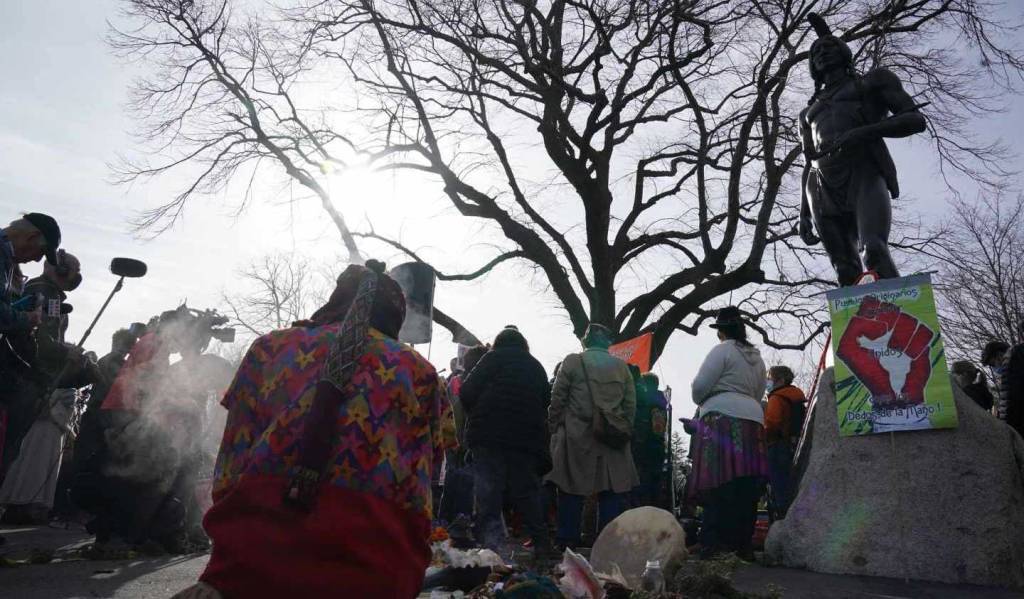
Lakota LawPeople engage in a National Day of Mourning ceremony in front of a statue of Chief Massasoit, leader of the Wampanoag tribe, in Plymouth, Mass. on Thanksgiving Day in 2021. (Bryan R. Smith / Getty Images)
Between Truthsgiving and our Wopila Gathering, on Friday the U.S. also celebrates Native American Heritage Day, at the conclusion of National Native American Heritage Month. I’m grateful that each November is designated as a time to celebrate the history, culture, and achievements of Turtle Island’s Indigenous nations. If you’re Native, I hope you’re able to take some extra time to commune with your relatives and acknowledge your ancestors this weekend. And if you’re non-Native, I hope you’ll make room to appreciate all we have given.
And then, everyone, please attend the Wopila Gathering on Giving Tuesday. This annual event provides an excellent opportunity for us to gather around an even larger table to share stories, priorities, music, and all we have to give to one another. It’s going to be a wonderful couple hours of togetherness, generosity, and joy, so I hope you’ll bookmark this page, RSVP, and Zoom in with us for the festivities!
Wopila tanka — thank you for hearing us, and I hope to see you on Tuesday. Chase Iron Eyes Director and Lead Counsel Lakota People’s Law Project Sacred Defense Fund

Lakota People’s Law Project
Lakota People’s Law Project 547 South 7th Street #149 Bismarck, ND 58504-5859
This is a very informative video that puts our current situation into a historical perspective. Watch the video, research the information, and make plans to prepare to change what is happening.
This weekend, I had the opportunity to experience an incredible work of art. Because you’re with us in the ongoing effort to find healing for our people, I feel it’s important to share it with you, too. “Sugarcane” — an award-winning new documentary feature about the generational trauma Indigenous families and communities face as a result of the residential and boarding school era — is currently touring Indian Country and in limited theatrical release across Turtle Island. Acquired for distribution by National Geographic, it will soon stream on Disney+ and Hulu. Today, I urge you to watch the trailer, then make plans to see the full movie as soon as it’s available to you!
Watch the trailer: The film explores director Julian Brave NoiseCat’s fraught relationship with his father (pictured), who was born at a Canadian residential school.
By now, you’re no doubt all-too familiar with the horrors wrought at Indian residential and boarding schools — and the generational trauma that, as a result, affects virtually every person who grows up Indigenous in North America. Indeed, if you are Indigenous and didn’t go through it yourself, you 100% have relatives who experienced the forced assimilation, dehumanization, and cultural genocide of these institutions firsthand. If you’re non-Indigenous, you’ve probably read about it in more detail previously from us, in the news, or both.
“Sugarcane,” co-directed by Julian Brave NoiseCat (a member of the Canim Lake Band Tsq’escen and descendant of the Lil’Wat Nation of Mount Currie) and Emily Kassie, takes on this dynamic in a personal way. Its uncompromising lens includes NoiseCat’s exploration of his relationship with his father, who was born at a Canadian residential school. If the implications of that are not immediately obvious, I caution you to prepare yourself for some heavy material.
The New York Times called “Sugarcane” a “must-see film about a difficult subject.” I couldn’t agree more. Nonetheless, this is not a movie that overtly seeks to polemicize. It brings you in, sharing with the viewer an investigation, a personal quest, a struggle to understand and forgive what can be forgiven and expose what cannot.
I want to acknowledge in this space my real respect for NoiseCat, who in addition to directing this film and sharing his deeply personal story, is a decorated journalist. He also led the call — which Lakota Law, and by extension, supporters like you — joined to position Deb Haaland as the U.S.’s first Indigenous Cabinet secretary. That’s a strong example of what we can accomplish together when we watch and follow with action.
So I hope you will watch what NoiseCat, Kassie, and their team have created with “Sugarcane.” It’s beautiful. It’s tough. It’s important.
Wopila tanka — thank you for supporting Indigenous creators! Tokata Iron Eyes Spokesperson & Organizer Lakota People’s Law Project
Today, I write to you to share a little piece of joy. Summer is an important time of year in Lakota Country. Right now, many from the Oceti Sakowin and beyond — including my father, Chase — are reconnecting in a deeply meaningful way with their spiritual identities at the annual Sun Dance ceremony.
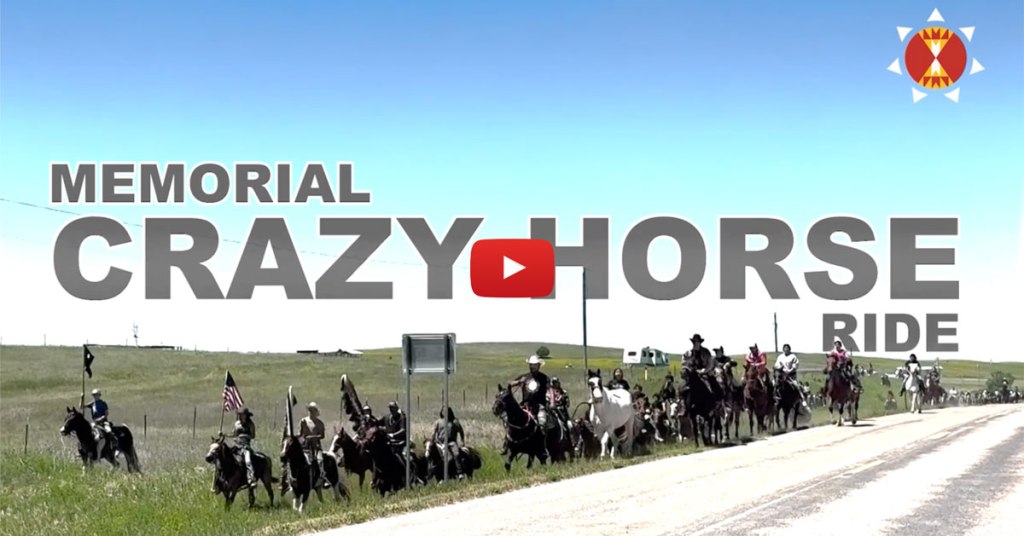
And about a month ago, I also felt the power of reconnection with our ancestors, homelands, and tradition of horseback riding at this year’s Memorial Crazy Horse Ride. I invite you to watch our new video, which features footage from the days-long event, background on its meaning, and an interview with Oglala Lakota organizer Kylie Richards Red Willow, a junior political science major and pre-law student at the University of Colorado.
Watch: I interviewed organizer Kylie Red Willow about this year’s Memorial Crazy Horse Ride.
By now, you’re most likely aware of Crazy Horse and his enduring legacy. We recently wrote to you about the battles of the Rosebud and Greasy Grass (Little Big Horn), both of which were won in part thanks to this legendary Ogala Lakota war leader. The annual ride pays tribute to him, the role he played in those and many more confrontations with the U.S. Army, and also our other warriors, many of whom honorably served in the U.S. military over the decades.
Native People, of course, have a complicated and bloody history with the U.S. government, but that hasn’t stopped us from answering the call to serve in large numbers to protect this land, particularly when faced with existential threats like Hitler’s fascism during World War II. You may recall that, at that time, 29 Navajo code talkers in the Marine Corps provided a key to victory in the Pacific.
Today, of course, we still face fascist threats — some right here in our own homelands. Whether it’s the architects of Project 2025 seeking to reinstall Donald Trump as their presidential puppet, or S.D. Gov. Kristi Noem, who recently, offensively invoked the Sun Dance to falsely connect Native communities with Mexican drug cartels, we still have plenty of terrible people to fight.
As you know, we’ll take on those battles, and we won’t stop in the pursuit of justice and equality. When we pray to and ride for our ancestors, who fought so hard so we could be here today, we’re always reminded they expect nothing less.
Wopila tanka — my gratitude, always, for your friendship! Tokata Iron Eyes Spokesperson & Organizer Lakota People’s Law Project
It has been a century since the imposition of American citizenship on Indigenous Nations marked a systemic threat to Tribal Nationhood and people. Since the signing of the Indian Citizenship Act on June 2, 1924, we’ve resisted the many waves of attempted erasure of Tribal sovereignty – legal and otherwise – designed to assimilate Indigenous identities into American citizenship.
Native Nations are not merely American citizens. The rights, privileges, and immunities granted by the U.S. Constitution are not the ultimate aspiration for Native people. Our treaties with the United States were made to uphold our status as sovereign nations, not subjects. Native people’s voluntary defense of the U.S. and its allies in World War I was used as a pretext to impose American citizenship, undermining Tribal sovereignty.
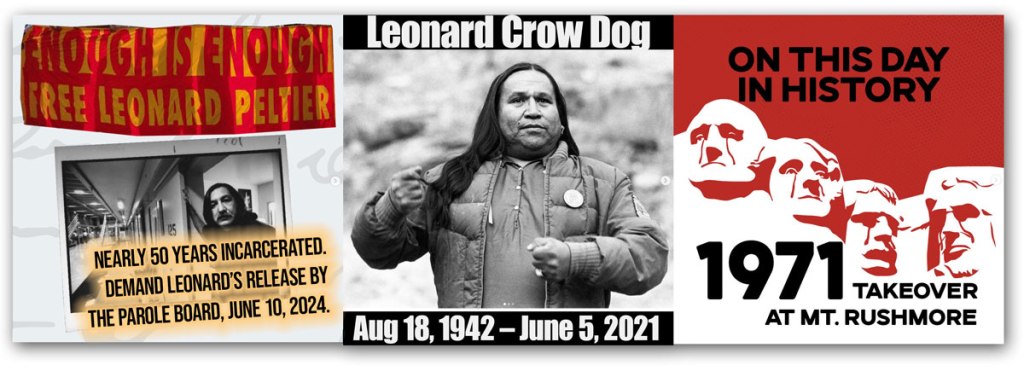
This week, we mark three of the many important anniversaries in our history: As Leonard Peltier nears 50 years in prison we demand his release by the June 10th parole board meeting. And we remember Leonard Crow Dog’s passing June 5, 2021, and the American Indian Movement (AIM) Mount Rushmore Action of June 6, 1971.
While it is good to pursue the rights that America considers inalienable, America will be lost unless it learns from the spiritual foundations of Native Nations and respects our sovereignty. We stand with all those who are willing to stand with Native Nations to defend our collective birthrights in these sacred lands and waters from the poison of corporations and government profiteering.
Free Leonard Peltier: No discussion of the American Indian Movement (AIM) can proceed without advocating for the release of Leonard Peltier, who has been illegally held captive as a political prisoner of the U.S.A. for nearly 50 years. Peltier is a victim of a corrupt FBI and anti-Indigenous Federal policies that caused numerous deaths and conflicts in the 1970s. Why have they not been held to account for this grave injustice? Why has no U.S. President or parole board, in 50 years, freed this man? Who are we if we live in a state of fear and terror of oppressive violent oligarchs?
Join us in calling for Leonard’s release by the Parole Board that meets on June 10th. It is imperative for restoring faith in justice and upholding human rights. Leonard deserves to spend his remaining years embraced by his community.
Remember Leonard Crow Dog: We honor the legacy of Chief of Chiefs Leonard Crow Dog, who passed on June 5, 2021. As a primary spiritual leader of the AIM, Crow Dog’s influence ensured the survival and pride of our traditional ways. His efforts helped establish a world of allies (Oceti Sakowin) and fortified the Native American Church. Crow Dog’s spiritual strength offers hope for humanity’s future against colonial violence.
Commemorating AIM’s Mount Rushmore Action: On June 6, 1971, AIM leaders, including Russell Means and Madonna Thunder Hawk, responded to Oglala Sioux elders’ call to assert Indigenous sovereignty over the sacred Black Hills. Guided by Leonard Crow Dog, they conducted a ceremony and climbed Mount Rushmore to reclaim their rights. Despite National Guard intervention and arrests, the charges were dismissed, culminating this powerful act of resistance and treaty defense.
In Solidarity, we express profound gratitude to all who stand with Indigenous sovereignty. Upholding Native sovereignty is essential to defending our collective rights to clean water, air, and a healthy climate. This is the Native way.
Wopila tanka — Thank you for your unwavering support. Chase Iron Eyes Director and Lead Counsel The Lakota People’s Law Project
We’re Less than a Week Away from the 2024 Mid Year Convention & Marketplace
The National Congress of American Indians 2024 Mid Year Convention & Marketplace is less than a week away, and we are thrilled to welcome you to Cherokee, North Carolina! If you haven’t registered yet, there’s still time to join us for this impactful event at Harrah’s Cherokee Hotel & Casino Resort.At this year’s convention, attendees will have the opportunity to engage in key discussions and strategy sessions between Tribal Nations, Native organizations, federal agencies, and the Administration that will shape the future of Indian Country. Additionally, attendees will hear from an exceptional lineup of speakers sharing their insights and experiences on critical topics facing Tribal Nations. Key speakers will feature: Tom Vilsack, Secretary, U.S. Department of AgricultureLynn Malerba, Treasurer, U.S. Department of the Treasury Bryan Newland, Assistant Secretary for Indian Affairs, U.S. Department of the InteriorElizabeth Carr, Tribal Advisor to the Director, Office of Management and BudgetRoselyn Tso, Director, Indian Health Service, U.S. Department of Health and Human ServicesHeidi Frechette, Deputy Assistant Secretary for Native American Programs, U.S. Department of Housing and Urban Development Dr. Sallie Ann Keller, Chief Scientist & Associate Director of Research and Methodology Directorate, U.S. Census BureauRose Petoskey, Senior Advisor and Tribal Affairs Director, White House Office of Intergovernmental AffairsMorgan Rodman, Senior Policy Advisor for Native Affairs, White House Domestic Policy Council
Last Call to Register for the 2024 Mid Year Convention Golf Tournament
Join NCAI for the second annual Mid Year Convention Golf Tournament Fundraiser! Hosted at the Sequoyah National Golf Club, this exciting event will feature a 4-Person Team Scramble format with trophies and prizes up for grabs. Fuel up with breakfast, tee off with a shotgun start, and enjoy a boxed lunch before diving into a BBQ dinner. The course boasts 6,600 yards of championship play, offering immaculate greens, expansive practice areas, and a full-service golf shop overlooking the Great Smoky Mountains. Don’t miss out on an unforgettable day, and register now for an opportunity to connect at the Sequoyah National Golf Club.When: Sunday, June 2, 2024Where: Sequoyah National Golf ClubFormat: 4-Person Scramble
Empowering Native Youth: View the Full Youth Agenda
The 2024 Mid Year Convention & Marketplace Youth Agenda is designed to empower Native youth with opportunities to connect, learn, and grow with like-minded leaders from across Indian Country. Through our curated agenda, Native Youth will engage in discussions, workshops, and activities focused on pivotal policy areas such as education, wellness, environmental stewardship, data sovereignty, civic participation, cultural knowledge, climate action, and much more. The Native Youth Agenda is intended for young adults ages 15-24.
A pro-Palestinian demonstration encampment is seen at the Columbia University, Friday, April 26, 2024, in New York. (AP, Yuki Iwamura)
A wave of highly charged student protests sweeping college campuses around the nation this week include Indigenous students protesting Israel’s killing of Palestinians.
Kianna Pete, Diné and a Columbia University graduate student from New Mexico, said she and other Native American peers stand in solidarity with Palestinians.
She has taken part in a protest encampment at Columbia – which ignited the fast-spreading student movement – in New York City since last week when 100 students were arrested. Student protesters’ ranks have swollen nationally with reportedly mostly peaceful protests.
Kianna Pete (Courtesy photo)
“All of those things that we’ve experienced as Indigenous peoples here on Turtle Island, the same thing is happening in Palestine and has been happening in Palestine for the past 75 years,” Pete said. “But through this movement, I’ve begun to learn a lot more about it and to offer support.”
Pete, who’s studying politics and education, sees parallels between American colonization and what she considers to be inhumane acts of war by Israel against everyday Palestinians.
“Similar to settler-colonial projects we’ve experienced here in the United States as Indigenous peoples – that being the justification of land grabs and that is done through stealing Indigenous land and displacing them, (we are) being super highly surveillanced,” Pete said.
She said police are using drones to monitor the student encampment.
A student pro-Palestine encampment at Columbia University in New York City is shown here. (Photo courtesy of Kianna Pete)
Like students across the country, Columbia’s student protesters are demanding that their administration stop doing business with companies linked to Israel and are also calling on the U.S. government to stop providing military aid to Israel.
“I’ve been in a stage of solidarity with our pro-Palestinian movement here on campus,” Pete said. “And that encompasses a huge plethora of different organizations, different people inside and outside of the community … supporting the Columbia University’s divestment from Israeli apartheid.”
According to Gaza health officials, at least 34,000 Palestinians have been killed in the ongoing war between Palestine and Israel since the Hamas resistance group retaliated against Israel on Oct. 7, 2023, and killed about 1,200 people and took more than 200 hostages. As of Nov. 2023, Israel help nearly 7,000 Palestinians, many of them children, according to the Israeli human rights organization HaMoked.
The United Nations reports that two million Gazans are trying to survive near-famine conditions. At least two-thirds of the 34,000 killed reportedly are women and children.
Columbia alumni have donated money to and provided on-the-ground necessities like food, water and shelter to student protesters.
Indigenous people see many similarities between the U.S. government’s seizure of Native lands and murder of of Native people and Israel’s treatment of Palestinians, said Nick Tilsen, Lakota and president of the NDN Collective, a Rapid City, S.D.-based nonprofit.
NDN Collective has been documenting the student protesters’ efforts and supporting them.
Nick Tilsen, NDN Collective president (Photo by Arlo Iron Cloud courtesy of NDN Collective)
“We have been in deep solidarity with the Palestinian Liberation over the past few years,” said Tilsen. “One of the real important reasons why we as an organization supports … the movement for cease-fire and for Palestinian liberation is specifically because if you look at the amount of resources that the United States of America, which is a settler-colonial government, is sending over to Israel, it’s in the billions. Before October 7, it was annually about $3.4 billion a year.”
The NDN Collective is dedicated to building Indigenous power, he said. It invests in the self-determination of Indigenous people across Turtle Island, as well as in Canada, Mexico, American Samoa, Guam and Puerto Rico. They focus on grant-making, loans, community development, advocacy, policy development and public relations support. https://www.youtube-nocookie.com/embed/3tZkdbfvVqI
Although not directly involved in the current University of Minnesota student protests, NDN Collective sent staff to document the protests. But Tilsen said while his organization supports the protesters, it’s not NDN Collective’s role to lead the student movement.
“And so the work that they have done to extract our resources from our lands and to impose violence and settler-colonialism on a whole other people in Gaza is not something that we stand for,” he said. “We’re part of the ant-militarization movement. We do not believe that military violence is the solution.
“And we do not believe that U.S. imperialism is the solution.”
In the face of what protesters describe as overly aggressive police response to the peaceful protests, students have persevered – even as end-of-semester final exams and spring graduations loom. At the University of Southern California, main-stage graduation ceremonies were canceled after authorities cited safety concerns due to protests.
Misinformation in the mainstream media has led many to believe the protests are not peaceful, Pete said.
“There’s a lot of rhetoric saying that these are not peaceful, or that these protests are funded by terrorists,” she added. “A lot of these different stories aren’t capturing what exactly is happening in these different encampments.”
She suggested the public pay attention to independent news sources to get the real stories of what’s happening in Gaza.
“So (we’re) making sure we’re getting verified information that is from people on the front lines, that is from independent journalists who have been at these encampments from the very beginning, listening to students, organizations, newspapers and outlets who have been covering this since October, when many of the protests started.”
Pete remains adamant that Indigenous people stand up for the vulnerable people of Gaza.
“We are protesting for the right to life, the right for Palestinian people to live and to exist,” she said. “Right now, there are no more universities left in Gaza. We have an extreme privilege to be able to protest and to use our voice for those who don’t have them right now.”
Columbia University students protest the war in Gaza. (Photo courtesy of Kianna Pete)
By now, you’ve no doubt become familiar with ongoing legal battles over the Dakota Access pipeline (DAPL). You may recall that I, myself, was targeted and faced years in prison. Fortunately, all serious charges against me were dropped as I prepared to present a comprehensive necessity defense outlining why I had no choice but to resist the pipeline and its threat to my homelands, our people, and Unci Maka, our Grandmother Earth. You might remember the Standing Rock Nation’s lawsuits to prevent the pipeline, and you also recently heard from me about my testimony in the trial between North Dakota and the federal government regarding who will split the costs of over-policing our peaceful protest camps.
Did you know that Energy Transfer, which operates the pipeline, has also targeted nonprofit organizations in the courts of law? Specifically — and preposterously — the oil company has gone after Greenpeace USA with a pair of lawsuits. Energy Transfer’s tactic is, unfortunately, increasingly popular. Extractive industry corporations seeking to suppress opposition to their exploitative projects file what’s known as a Strategic Lawsuits Against Public Participation (SLAPP). To give you another example, the lithium mine company operating at Thacker Pass is using SLAPP in an attempt to silence tribal activists, elders, and allies resisting the company’s destruction of Unci Maka and sacred sites on Paiute and Shoshone homelands.
A sign from a NoDAPL resistance camp perfectly sums up one reason why lawsuits against Greenpeace and other nonprofits are way off the mark. They discredit the Indigenous agency involved in frontline resistance movements.
Frankly, the latest lawsuit against Greenpeace is of a different magnitude — both in terms of the exorbitant amount of damages Energy Transfer is seeking and the specifics of the case. Greenpeace (and other entities resisting DAPL, including Standing Rock and other tribal nations) have evidence of clear legal violations committed by Energy Transfer in its rush to complete DAPL. Aware of the gravity of those violations and wanting to cast doubt on their veracity and rewrite the narrative, Energy Transfer has attacked Greenpeace with false allegations of defamation.
As Greenpeace has highlighted in this piece — which I strongly encourage you to read — none of the nine statements Energy Transfer claims as defamatory were originally made by Greenpeace. Rather, they were circulated publicly (and endorsed widely). I commend Greenpeace for hearing the call to join Native nations on the frontline of this fight and for accurately summarizing the problems with Energy Transfer’s SLAPP effort. Honestly, from our perspective, if you’re being sued for defamation by a major extractive industry corporation, you’re probably doing something right!
Of course, Native water protectors and land defenders are all too familiar with the oil company’s modus operandi. Our ancestors witnessed similar tactics when Indian agents exerted control over their lives in the wake of the Dawes Allotment Act. More recently, my parents, aunties, and uncles remember well the FBI’s attempt to infiltrate and destroy the American Indian Movement in the 1970s. Native Peoples understand deeply that a commitment to truth telling and justice invites backlash from wealthy and powerful interests — government, corporate, or both.
It’s extra important for us to have our allies’ backs now, as all of this is occurring against a stark backdrop: not only has DAPL already leaked many times, but it continues to operate without a valid Environmental Impact Study or easement to cross under the Missouri River upstream of Standing Rock. Furthermore, in 2022, Energy Transfer was convicted of criminal charges in connection to its disastrous operation of pipelines in Pennsylvania and Ohio. In other words, it’s essentially a criminal corporation committed to shifting blame onto activists fighting for environmental justice and tribal sovereignty. That’s why we’ll keep battling and shining the light of truth. We hope that despite all spurious and costly legal attacks, Greenpeace will, too. We are all in this fight together.
Wopila tanka — thank you for protecting water and advancing environmental justice! Chase Iron Eyes Director and Lead Counsel The Lakota People’s Law Project
In 2015, Pope Francis published Laudato Si’, his encyclical acknowledging the climate crisis and extolling his flock to consciously act in accordance with Unci Maka, our Grandmother Earth. Then, in 2022, he visited Canada and apologized for the genocide of First Nations peoples in residential schools at the hands of the Catholic Church. Finally, in 2023, the pope denounced the Doctrine of Discovery, 15th century papal bulls responsible for underpinning centuries of colonization of Indigenous lands under European banners in the name of the Christian God.
The pope’s apparent desires to make recompense for the Church’s historic role in the genocide of Indigenous People and have his flock live with more respect for the Earth go hand in hand. As you well know, we have always known how to live in harmony with our natural surroundings, with a deep understanding of our own relationship to all living things. My ancestors fought the colonizers, and with respect for their sacrifice, I have stood up to Big Oil and all who disrupt the natural balance or threaten our communities. I also take the stance that we must build alliances — even unlikely ones — to create the future we want for our next generations.
Therefore it makes perfect sense for us to take the lead in encouraging the pope to work with Native nations to return sacred lands to Indigenous stewardship — and also with state governments who have benefitted through the centuries from their affiliation with the Church. Let me be clear about those benefits: it is no overstatement to say that the Doctrine of Discovery underpins both Federal Indian Law and property law here in the United States. Virtually every aspect of the legal system we encounter as Native People has been set up to keep us down — from day one into the foreseeable future.
But we won’t be kept down. Let us be united, creative, and diligent in seeking remedies that can benefit not just Indigenous communities, but everyone who shares space with us in this world.
Wopila tanka — thank you for your care and advocacy! Chase Iron Eyes Director and Lead Counsel The Lakota People’s Law Project
CINCINNATI, Ohio — They came to protect the water.
Nearly 200 people traveled from Michigan to Cincinnati on Thursday, March 21, to support the state of Michigan’s efforts to stay out of federal court with its legal case calling for a partial shutdown of Enbridge Line 5.
Several citizens and leaders of Michigan tribes were among those who joined the rally at Fountain Square, a major public space in downtown Cincinnati near the U.S. Court of Appeals for the Sixth Circuit.
The crowd waved banners and signs calling for the shutdown of the Line 5 pipeline, with some calling for “people and planet over profits.”
Inside the courthouse, Michigan officials asked the federal appeals court to allow the lawsuit filed by the state attorney general’s office to remain in state court – a move supported by a coalition led by the Bay Mills Indian Community of more than 60 tribes from the Great Lakes region and beyond.
“I’m from the Bear Clan. My job is to protect the forest and make sure our water is safe,” Andrea Pierce told the crowd Thursday. Pierce, of the Little Traverse Bay Bands of Odawa Indians, is part of the Michigan Environmental Justice Coalition.
Nicole Keyawbiber and Joe VanAlstine of the Little Traverse Bay Band of Odawa Indians in Michigan join a rally in Cincinnati, Ohio, on March 21, 2024, supporting Michigan Attorney General Dana Nessel’s efforts to keep her office’s lawsuit seeking shutdown of Enbridge line 5 in Michigan state court. (Photo by Mary Annette Pember/ICT)
Michigan Attorney General Dana Nessel, who filed the legal action to shut down the pipeline, addressed the crowd during the rally at Fountain Square on why she wants to keep the issue in state court.
“This is a Michigan case brought under Michigan law by Michigan’s chief law enforcement officer on behalf of the people of Michigan on behalf of our Great Lakes and it belongs in a Michigan court,” she told the cheering crowd.
The Bad River Band of Lake Superior Chippewa in Wisconsin, which is litigating to keep Line 5 off of reservation lands, also signed onto the brief. All 12 of Michigan’s federally recognized tribes passed resolutions calling to decommission Line 5.
‘Public nuisance’
Line 5, constructed in 1953, runs 645 miles from Superior, Wisconsin, east through Michigan’s Upper Peninsula and under the Straits of Mackinac before it terminates in Sarnia, Ontario, Canada.
In the original 2019 lawsuit filed in Michigan circuit court, Nessel sought a shutdown of four miles of Line 5 pipeline that ran under the Straits of Mackinac. The lawsuit contends that the pipeline is a public nuisance and that allowing Enbridge to continue operating it is a violation of the public trust doctrine and the Michigan Environmental Protection Act.
The Straits of Mackinac link Lake Michigan and Lake Huron, and constitute one of the most ecologically sensitive areas in the world, according to Oil and Water Don’t Mix, an advocacy organization based in Michigan.
Michigan Attorney General Dana Nessel tells a crowd of supporters in Cincinnati, Ohio, on March 21, 2024, that her case seeking shutdown of Enbridge Line 5 belongs in Michigan state court rather than federal court. (Photo by Mary Annette Pember/ICT)
Nessel won a restraining order from a state judge in June 2020, but Enbridge successfully moved the case into federal court in December 2021.
Nessel asked U.S. Circuit Judge Janet Neff to shift the case back into state court, but Neff refused, prompting Nessel to appeal to the Sixth Circuit appeals court.
Enbridge filed a separate federal lawsuit in 2020 arguing the state’s attempt to shut down the pipeline interferes with federal regulation of pipeline safety, and could interfere with interstate and international trading of petroleum, driving up oil prices. That case is still pending in Neff’s court.
Enbridge has insisted the section of pipeline that runs beneath the Mackinac Straits is in good condition and could operate indefinitely. Enbridge has proposed encasing the pipes in a protective tunnel.
Assistant Attorney General Daniel Bock told the three-judge panel of the court in Cincinnati Thursday that the challenge to Enbridge’s Line 5 deals with the public trust doctrine, a legal concept in which natural resources belong to the public. He said that concept is rooted in state law.
Water protector Nicole Keyawbiber wears a “Water not War” button on her hat at a rally on March 21, 2024, in Cincinnati, Ohio, supporting efforts to keep a Michigan state lawsuit seeking shutdown of Enbridge Line 5 out of federal court. (Photo by Mary Annette Pember/ICT)
Bock went on to assert that Enbridge, the Canadian company that owns the pipeline, missed its deadline to shift the case from state to federal court.
Enbridge attorney Alice Loughran countered that the case should remain in federal court because it affects international trade. She said the company didn’t have to comply with the standard 30-day deadline for requesting removal to federal court because it lacked enough information to formulate the request.
In an email sent to ICT, Enbridge spokesperson Ryan Duffy accused Nessel of forum-shopping in an effort to secure a favorable outcome.
“We are confident that ultimately the Sixth Circuit Court will agree with the lower court’s decisions from August 2022 and November 2021 that this dispute—which has generated a US foreign policy controversy—properly belongs in federal court,” Duffy wrote.
Protests continue
The protesters outside the courthouse were among thousands in recent years to protest the pipeline in Michigan, Wisconsin, Minnesota and even in Canada.
“Near and far, Anishinaabe people have united to protect the Great Lakes,” said Whitney Gravelle, president of the Bay Mills Indian Community, in a statement released Thursday to Earthjustice, a nonprofit environmental law organization.
“We stand behind Attorney General Nessel because we know that shutting down Line 5 is the only way to protect everyone who depends on the land, water, and natural resources within the Great Lakes,” Gravelle said, “including Anishinaabe people exercising our treaty rights.”
This article contains material from The Associated Press.