My greetings to you from the Standing Rock Nation. Today, I invite you to experience something wonderful: Next week, Big Sky Documentary Film Festival is hosting the online world premiere of “OYATE” — a brand new feature documentary film produced by Films with a Purpose and Irrelevant Media, in association with the Lakota People’s Law Project. Big Sky has graciously also made the movie available for viewing online at the same time, and you can purchase your ticket to watch today.
Look, it’s me and Phyllis Young in “OYATE!” Please click here to watch the trailer for this heartfelt and skillfully done documentary, and purchase your tickets for the premiere on the same page.
We wanted to make sure you have the opportunity to watch this special premiere with us! Please note that the film will be available through Big Sky for a limited time. I urge you to purchase your ticket right now, then mark your calendar to remind yourself the streaming window opens on Feb. 25 at 9 a.m. PST. After that, you’ll have about three days to start watching and another 24 hours to finish.
Now that you’ve got all those important details, let me tell you a little more about our involvement and what you’ll see. In the wake of the protests at Standing Rock in 2016 and ‘17, our Lakota Law team worked closely with producers Brandon Jackson, Emil Benjamin, Sandra Evers-Manly, and Jennifer Martel of the Cheyenne River and Standing Rock Sioux tribes, to tell this powerful story of resistance. You’ll spend time with Phyllis Young, me and my daughter Tokata, U.S. Secretary of the Interior Deb Haaland of the Laguna Pueblo People, and many more powerful Native voices.
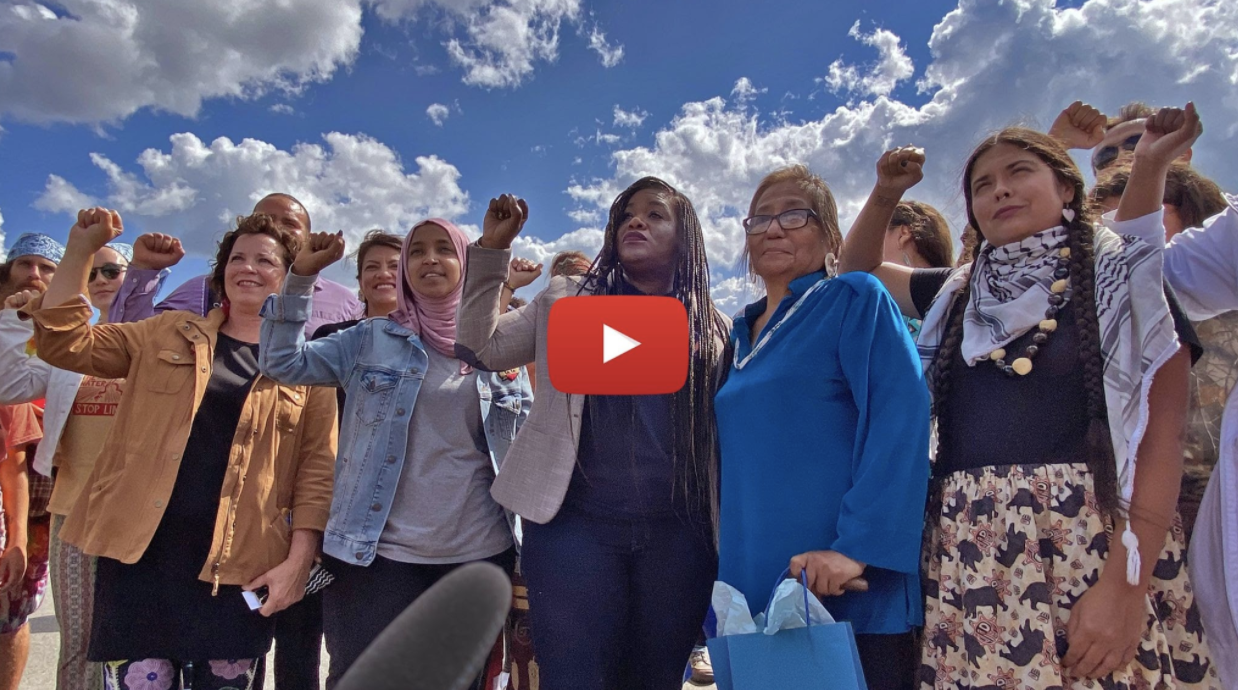
Here’s a promotional still of Secretary Haaland and other sisters in the fight for Indigenous justice. This film is really beautifully shot.
As you know, our #NoDAPL struggle at Standing Rock became an inflection point for human rights and environmental justice, a rallying cry for Indigenous people everywhere to take a stand against centuries of land theft, imposed poverty, and cultural erasure. “OYATE” successfully communicates our thoughts, as Indigenous activists, organizers, and politicians, on that complicated history.
Lakota Law aided the filmmakers by providing exclusive interviews, archival footage, and perspective. The directors did a fantastic job of using a blend of storytelling tools to weave all elements harmoniously and to fully immerse you in our worldviews. The end result is a thing of beauty, ambitious in scope and, at the same time, personal and intimate. I think you’ll very much enjoy watching, and I hope you’ll find it illuminating. You may gain new understanding of our struggles for sovereignty and justice — and you’ll even meet some rez dogs! So, please watch the trailer, and then join us for this exciting premiere. I can’t wait to hear your feedback.
Wopila tanka — thank you, and happy watching. Chase Iron Eyes Co-Director & Lead Counsel The Lakota People’s Law Project
Last weekend some 400 Karankawa Kadla and their supporters organized protests across Texas to call attention to the expansion plans for an Enbridge oil terminal. It’s already the largest crude export terminal in North America potentially transporting as much as 1.5 million barrels of oil per day.
“The Enbridge terminal expansion is planned to be constructed in the ancestral settlement and land of the Karankawa Kadla, where thousands of sacred Karankawa artifacts remain and ceremony and prayer have continued for the past 2,000 years,” said a news release from the Indigenous Environmental Network. “If the expansion of the Enbridge terminal on Karankawa land continues, the Karankawa Kadla will lose direct access to their land and ancestral artifacts in addition to the pollution of sacred natural waters.”
The release also included a simple line asking for “accountability from Enbridge and Bank of America, one of the major funders of the expansion, for developing on Indigeneous land without consent and the environmental destruction of the Gulf Coast.”
That word “accountability” shifts the protest to another kind of action, one based on ESG standards; a metric that includes Environment, Social and Governance as well as the planning for net-zero carbon emissions by 2050.
Both Bank of America and Enbridge say they have ESG plans and are on track to reach net-zero carbon emissions by 2050.
At a conference last year, Al Monaco, Enbridge’s president and chief executive officer, called ESG and sustainability the key to an energy transition. “Essentially, this is society’s dual challenge,” he said. “One the one hand, it’s clear that population growth, urbanization and a growing middle class will drive energy demand higher. On the other hand . . . energy supplies need to be developed sustainably, and aligned with climate goals.”
This dual challenge, he said, will lead to “responsible” growth over the next three decades including achieving net-zero greenhouse gas emissions, reducing emissions from operations by 35 percent in eight years and increasing the diversity of its workforce in the next couple of years. That’s a lot of ambition. Enbridge says that existing infrastructure, such as pipelines, is a part of that plan.
So why expand an oil terminal now? How does it move the company forward on its promises of sustainability? And what about Bank of America?
“The net-zero equation remains unsolved: greenhouse gas emissions continue unabated and are not counterbalanced by removals, nor is the world prepared to complete the net-zero transition,” the report warns. “Indeed, even if all net-zero commitments and national climate pledges were fulfilled, research suggests that warming would not be held to 1.5°C above pre industrial levels, increasing the odds of initiating the most catastrophic impacts of climate change, including the risk of biotic feedback loops.”
McKinsey said getting to net zero requires significant changes. Significant is an understatement because the numbers are huge. McKinsey estimates that an investment need of $9.2 trillion per year on average, an annual increase of as much as $3.5 trillion from today. To put this increase in comparative terms, the $3.5 trillion is approximately equivalent, in 2020, to half of global corporate profits, one-quarter of total tax revenue, and 7 percent of household spending. An additional $1 trillion of today’s annual spend would, moreover, need to be reallocated from high-emissions to low-emissions assets.”
Hence the urgency of reducing existing energy investments that do not meet climate change goals.
And there is a difference of opinion here. Some companies, even those claiming an ESG or net-zero plan, say that reductions are necessary but will come down the road.
“Some pathways to net-zero emissions assume that the decline in emissions begins immediately and progresses gradually to 2050, with appropriate measures in place to manage disruptions and limit costs. Others assume that reduction of emissions begins later and progresses more quickly to achieve the same amount of cumulative emissions,” McKinsey reports. “The latter could involve significant and abrupt changes in policy, high carbon prices, and sudden changes to investment practices—along with greater socioeconomic effects and a larger-scale response. Making job transitions would be more challenging, and there could be greater risk of stranded assets.”
The energy companies that are betting on “later” for dramatic emission reductions could be putting at risk significant assets, stranded assets. Enbridge, for example, spent $3 billion on its acquisition of the Moda Midstream Terminal, nearly $10 billion on the line 3 project, and millions more on smaller projects, including a seaport near Houston.
What about Bank of America?
A report last year by the Rainforest Action Network said that “until the banks prove otherwise, the ‘net’ in ‘net zero’ leaves room for emissions targets that fall short of what the science demands, based on copious offsetting or absurd assumptions about future carbon-capture schemes, as well as the rights violations and fraud that often come hand in hand with offsetting and carbon markets.”
That reported Bank of America’s at number four for the “dirty dozen” banks that finance fossil fuel development.
“These ‘Dirty Dozen’ banks have very different policies regarding restriction and phase-out of coal, oil, and gas, but none are sufficient. Among the world’s largest banks, strong coal policies are rare, and even the strongest oil and gas policies are sorely lacking,” the Rainforest Action Network said.
Bank of America says it’s goal is “to rebalance our portfolios away from more carbon emission intensive fossil fuel extraction, power generation, transportation and other consumption … toward low-carbon business models.”
The bank says it’s committed to “industry-leading disclosures” on its environmental progress, including a metric called “emission intensity.” That metric is different from overall carbon emission reduction because it’s based on a connection with the larger economy. So if the economy grows, so can total emissions.
Of course all of this economic and investment framework misses another leverage point, consent from Indigenous communities.
The company outlines its Indigenous People’s Policy that includes a commitment “to pursuing sustainable relationships with Indigenous Nations and groups in proximity to where Enbridge conducts business.”
Yet there has been no communication with Indigenous groups in Texas.
The Indigenous Peoples of the Coastal Bend, the Karankawa Kadla Tribe of the Texas Gulf Coast, and Ingleside on the Bay Coastal Watch Association filed a lawsuit in August against the U.S. Army Corps of Engineers for its approval of permits for the Texas project.
“Members of the Indigenous Peoples and of the Karankawa Kadla tribe travel regularly to Ingleside on the Bay in San Patricio County, Texas to enjoy the natural beauty of the land and the ocean, to observe wildlife in the area, and to find spiritual joy and fulfillment through their connections to the land, water, wildlife, and their ancestors who lived in the area,” according to the lawsuit. “This undeveloped space between the Moda facility and Ingleside on the Bay is the only remaining undeveloped area in this part of the Bay. This undeveloped space represents the last remaining vestige of the landscape and ecosystems that once occupied the area.”
The dredging of the bay “will destroy the McGloin’s Bluff site and the surrounding area. The increase in ship traffic and the associated increase in noise, industrial activity, and pollution will destroy their ability to pray and find spiritual joy and fulfillment in observing their ancestral lands and waters.”
This leads to even more questions about ESG, and especially its connection to Indigenous communities. Enbridge and other companies’ Indigenous Peoples Policies support the United Nations Declaration on the Rights of Indigenous People. Yet that protocol explicitly calls for Free, Prior and Informed Consent on projects.
This is why many critics dismiss ESG as “greenwashing,” giving companies cover to continue business as usual. On the other hand, companies see the growing value of being favored as ESG-compliant. Last year more than $120 billion flowed from investors into sustainable projects (more than double from 2020) and a regulatory structure is being added. The U.S. Securities and Exchange Commission is nearing completion of guidelines for companies to disclose climate-related risks.
There are three climate tests ahead: Transparent. Sustainable. And accountable.
Mark Trahant, Shoshone-Bannock, is editor-at-large for Indian Country Today. On Twitter: @TrahantReports Trahant is based in Phoenix. The Indigenous Economics Project is funded with a major grant from the Bay and Paul Foundations.
Indian Country Today is a nonprofit news organization. Will you support our work? All of our content is free. There are no subscriptions or costs. And we have hired more Native journalists in the past year than any news organization ─ and with your help we will continue to grow and create career paths for our people. Support Indian Country Today for as little as $10.
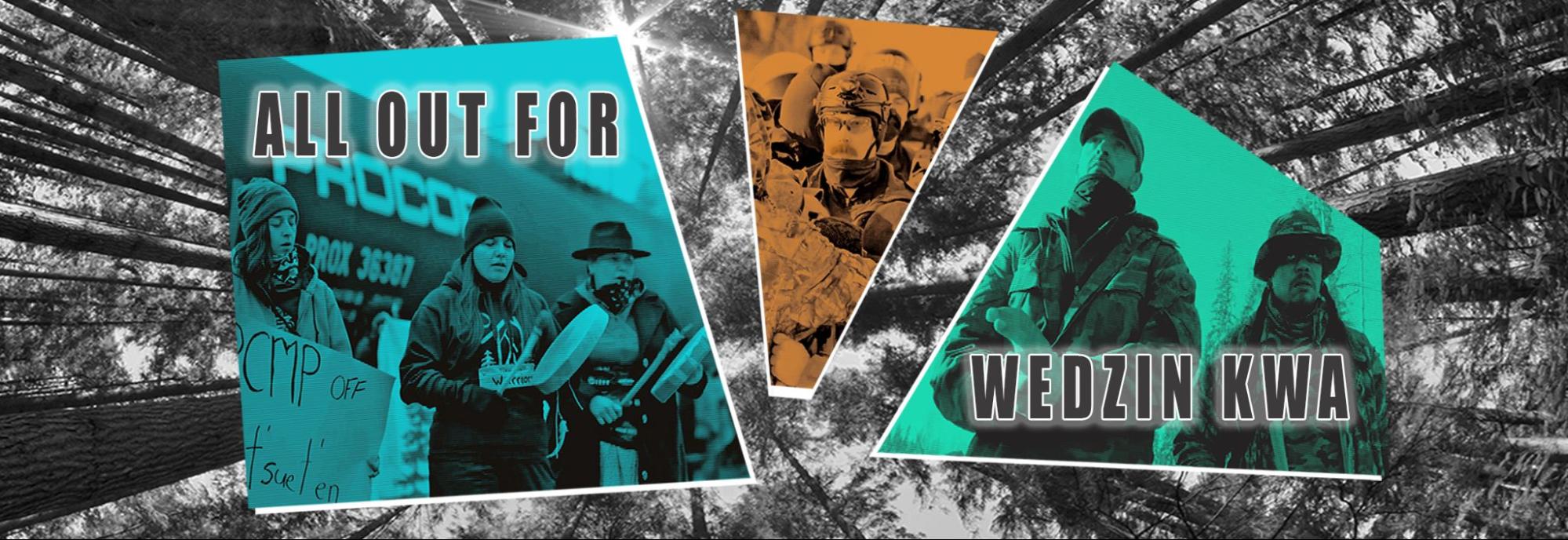
Toward the end of last year, I told you about Gidimt’en Checkpoint — which has rapidly become something akin to a Canadian Standing Rock. Right now, the Wet’suwet’en People are standing strong to protect their yintah, or homelands, and the planet we all share from the Coastal GasLink pipeline. But, just as happened with our own movement against the Dakota Access pipeline in 2016-’17, the fossil fuel industry — backed by big banks, the colonial government, and militarized law enforcement — is ignoring their sovereign rights and violently attempting to stamp out Indigenous-led resistance.
After setting up their Gidimt’en Checkpoint blockade, the Wet’suwet’en People have been subject to violent raids by the Royal Canadian Mounted Police, including the use of sniper rifles and police dogs. 30 people have been arrested, including two elders. In one incident, a chainsaw and axes were used to break into homes and arrest movement leaders, journalists, and legal observers. One CBC TV journalist was jailed for three days, and the home he was removed from was subsequently burned to the ground.
I’ve also authored a blog detailing some of the history of the Wet’suwet’en struggle for justice. Notably, this pipeline crosses unceded lands under the care of Wet’suwet’en hereditary chiefs for time immemorial. Their free and prior and informed consent should be the first requirement before any project threatening their sacred headwaters, Wedzin Kwa, can move forward. Their consent has not been given, and their title to the land has been upheld by Canada’s Supreme Court.
The violence against Wet’suwet’en land protectors must end and their yintah protected. It’s long past time to stop treating Indigenous People protecting their homelands and Unci Maka — our Grandmother Earth — like terrorists and start listening to our calls for environmental justice.
Wopila tanka — thank you for standing strong with the Wet’suwet’en! Chase Iron Eyes Co-Director and Lead Counsel The Lakota People’s Law Project
ANISHINAABE LANDS — Line 3 is dead. Long live Line 93.
Enbridge’s controversial Line 3 construction project is complete.
“The Line 3 replacement project/Line 93 came into service on Friday, October 1, as expected through N(orth) Dakota and Minnesota,” Juli Kellner, communications specialist for Enbridge, said in an email to Indian Country Today.
And with that, Line 3 will be deactivated, according to Kellner.
After nearly 8 years of Indigenous and citizen opposition that saw numerous protests and arrests in Minnesota and Wisconsin, and a string of state, federal and tribal court filings, it appears that the corporate giant has won.
Not so, say Indigenous and non-Native water protectors.
As clean-up begins and more construction accidents come to light, water protectors are claiming victory on a number of fronts.
Members of Indigenous advocacy organizations such as Honor the Earth and the Indigenous Environmental Network as well as tribal grassroots pipeline opponents say that the fight against Line 3 helped focus the world’s attention on what they describe as an untenable corporate push to build fossil fuel infrastructure projects at the expense of the environment.
“Line 3 is a crime against the environment and Indigenous rights, waters and lands and it marks the end of the tar sands era — but not the resistance to it,” said Winona LaDuke, executive director of Honor the Earth.
LaDuke, a citizen of the White Earth Ojibwe Nation, praised the actions of water protectors opposing the pipeline.
“Your brave efforts have reshaped the world’s views on the climate crisis that we are in,” she said.
Signs near the Firelight water protector camp along country Highway 2 near Bagley, Minnesota, on Oct. 4, 2021. (Photo by Mary Annette Pember/Indian Country Today)
On Oct. 11, Indigenous Peoples’ Day, activists kicked off a week of protests calling out President Joe Biden for failing to stop Line 3, and for failing to meet his promises on addressing climate change and protecting Indigenous treaty rights and lands. On Oct. 14, dozens of Indigenous leaders held a sit-in at the Interior Department in Washington, D.C., in an effort to stop extractive fossil fuel industry projects such as Line 3.
The Indigenous Environmental Network issued a statement questioning Enbridge’s rosy outlook on the project.
“Although Enbridge is pushing the message that Line 3 is a done deal and that they followed all the rules and regulations, we can see even at this late date the continuing harm to our lands and waters,” the statement said. “There have been spills, frac-outs and pierced aquifers even to this day.”
Enbridge’s decision to change the name of Line 3 to Line 93 further confirms what water protectors knew all along, said Taysha Martineau, founder of Camp Migizi, a camp for water protectors opposing Line 3.
“We stated from the beginning that this was an entirely new pipeline project,” said Martineau, a citizen of the Fond du Lac Band of Ojibwe.
Negative fallout
Although Enbridge has repeatedly framed the pipeline construction as a safety-based replacement project for the 32-inch Line 3, Line 93 is 34 inches wide, allowing it to carry tar sands oil that Line 3 could not.
Leaders of the White Earth and Red Lake Bands of Ojibwe and Line 3 opponents insist that the negative fallout from pipeline construction continues.
Frank Bibeau, attorney for and citizen of the White Earth Band of Ojibwe, said the pipeline construction exacerbated already low water levels and endangered the health of manoomin or wild rice.
In a unique rights of nature lawsuit filed in White Earth tribal court, tribal citizens accuse the Minnesota Department of Natural Resources of failing to protect the state’s fresh water by allowing Enbridge to pump up to five million gallons of additional water from construction trenches. That case is ongoing.
In January, Enbridge construction crews accidentally pierced an artesian aquifer near Clearbrook, Minnesota, causing the aquifer to lose about 24 million gallons of groundwater. The Department of Natural Resources learned about the accident in June when independent monitors reported seeing water pooling in ditches, according to a report issued by the agency.
“Enbridge began work at the Clearbrook Terminal site in early 2021 but did not follow the construction plans it provided to the DNR,” according to the report.
Enbridge erected a protective boom, shown here on Oct. 4, 2021, around a frac-out of drilling fluid along the Mississippi River near Solway, Minnesota. (Photo by Mary Annette Pember/Indian Country Today)
In September, the agency ordered Enbridge to pay $3.32 million in penalties, including $300,000 to pay for loss of groundwater as well as create a restoration plan to stop the groundwater flow within 30 days. The agency is also investigating two additional sites of artesian aquifer breaches by the company, but did not disclose the locations.
The Department of Natural Resources has referred the breaches to the Clearwater County attorney where the company could face criminal charges.
On Oct. 17, the agency reported that Enbridge failed to meet a deadline to clean up the ruptured aquifer near Clearbrook and announced that Enbridge must pay compensation for the additional time it takes to stop the flow of groundwater.
Kellner said the company is working with state and local officials.
“Enbridge is fully cooperating with the Minnesota DNR in correcting uncontrolled groundwater flows at Clearbrook and is working with the DNR as two other locations are being evaluated,” she wrote.
Enbridge tanks sit at the company’s terminal in Superior, Wisconsin, on Oct. 8, 2021, the destination of petroleum products flowing through the newly completed Line 93. (Photo by Mary Annette Pember/Indian Country Today)
LaDuke called the company’s failure to meet the deadline alarming.
“If Enbridge can’t meet basic safety requirements, they should not be allowed to operate a pipeline,” she said. “It doesn’t bode well for the future.”
In August, the Minnesota Public Pollution Control Agency reported that Enbridge created 28 spills of drilling mud during the summer. The agency confirmed the spills in response to a letter from Minnesota Democratic Farm Labor Party lawmakers demanding an accurate account of the spills.
“Our friends have reported frac-outs further down from the headwaters of the Mississippi,” Bibeau said.
“We are looking into doing a thermal imaging flight over the pipeline to see where all the damage is because we don’t think the DNR or the Public Pollution Control Agency is actually investigating these locations,” he said.
Earlier this month, Ron Turney of the Indigenous Environmental Network and members of Honor the Earth took Indian Country Today via canoe to an Enbridge frac-out location near the headwaters of the Mississippi River.
Turney, a citizen of the White Earth Band of Ojibwe, has been using a drone camera to monitor the pipeline. The location, near Solway, Minnesota, is not accessible on foot or visible from the road. A large boom surrounded the area where opaque white material appeared to rest on top of the water.
Igniting a movement
On Oct. 2, Honor the Earth sponsored a celebration on Madeline Island in Wisconsin of traditional Ojibwe subsistence food and activities as a means to celebrate water protector victories fighting Line 3.
The event coincided with Treaty Day, a commemoration of the signing of the Treaty of 1854 at the town of LaPointe on Madeline Island. In this treaty, the Ojibwe established reservations in their traditional homelands and retained rights to hunt, fish and gather.
Water protector celebration
Water protectors gathered at Madeline Island in Wisconsin in October 2021.
Madeline Island or Mooningwanekaaning, “home of the yellow-breasted flicker,” is considered a sacred place by Ojibwe and the birthplace of the tribe’s traditional religion.
About 150 people gathered to share traditional activities such as butchering sturgeon, parching wild rice, feasting, dancing, singing and playing lacrosse.
“We used to survive on this island,” said Paul DeMain, a citizen of the Ojibwe and Oneida tribes and an Honor the Earth board member who was among those at the celebration. “To me, it’s a productive fortress, a place of healing.”
DeMain said water protectors were bound to lose in the massively unequal fight with a global corporate giant such as Enbridge. Among the victories, however, was that the fight focused the world’s attention on the impact of ongoing reliance on fossil fuel on climate change and the preservation of the Earth.
“We came here to celebrate our victories over the fossil fuel industry, our survival and to heal our trauma of watching our people get arrested, harassed, beaten and hurt,” DeMain said.
“We came here to show we could feast in camaraderie with the rich, poor, Indigenous and non-Indigenous and work on forging a path ahead.”
This article contains material from The Associated Press.
Today — Indigenous Peoples Day (IPD) — marks the highlight of the Indigenous year. I hope you will join us as we gather to celebrate, heal, and re-Indigenize. This long weekend represents a reprieve from trauma, sadness, and grief as we travel with good hearts to see close family and distant relatives, celebrate together, and share our cultures.
As you likely know, many places do not yet celebrate with us. They’re still celebrating Columbus Day, perpetuating the myth that Christopher Columbus discovered so-called America. Columbus arrived on October 12, 1492 on Taino homelands. This first voyage was a reconnaissance mission wherein he later established La Navidad in present-day Haiti — America’s first colony. The following fall, he returned with an invasion force of 17 ships and 1,500 soldiers. He found La Navidad destroyed by Taino People, who had retaliated against rapes and murders carried out by the Spaniards.
European weapons (like cannons and muskets), armor, horses, and dogs soon overwhelmed the Indigenous warriors, who were armed only with clubs and spears. Celebrating Columbus, therefore, condones genocide and colonization. Many think of these issues as only existing in the past. But these systems, set in motion hundreds of years ago by Columbus and other conquistadors, continue. All Taino homelands, from Puerto Rico to the Bahamas, remain colonized today — many by the United States.
To combat the Columbus-as-hero narrative, we’re working to replace Columbus Day with IPD everywhere. Our hope is that more people like you will come together with us, as Indigenous People focus throughout the long weekend on empowerment through solidarity and sharing pathways to action.
Watch Tara Houska’s Ted Talk. As our skilled Anishinaabe relative points out, many of these struggles are deeply rooted in trauma. But today is about sharing successes within our sustained resistance to colonization. We see ourselves in the faces of our relatives while they reflect on Indigenous sovereignty, land and water rights, education, economic development, language preservation and promotion, and religious freedom.
Our celebrations feature Indigenous poets, musicians, artists, singers, leaders, and performers from across Turtle Island, who offer their gifts. Everyone who attends an event can actively participate in round dancing and be uplifted by traditional prayers. The overwhelming feelings of celebration and open-heartedness are palpable. This is the chance for settlers and non-Natives to catch us in our most generous mindset. As we come together across nations to actively decolonize and re-Indigenize our communities and share our gifts, I hope you will join a celebration in your area.
Wado — thank you for your ongoing solidarity with our Indigenous nations. Sarah Rose Harper Social Media Coordinator The Lakota People’s Law Project
A controversial pipeline project in northern Minnesota is complete and oil is scheduled to start flowing this week.
Enbridge’s Line 3 pipeline project will carry oil as soon as Friday despite months-long protests against it. The Canadian-based company’s president and CEO, Al Monaco, said in a statement that the pipeline “will soon deliver the low-cost and reliable energy that people depend on every day.”
The project was completed despite stiff opposition from tribes, environmentalists and others who argued that the 1,097-mile pipeline — including the 337-mile segment across Minnesota — would violate treaty rights, worsen climate change and risk spills in waters where Native Americans harvest wild rice.
It will carry oil from Alberta’s tar sands, a heavier crude that consumes more energy and generates more carbon dioxide in the refining process than lighter oil.
In a statement, Camp Migizi promised to remain an open camp and to disrupt and stop pipeline work. More than 900 people have been arrested or ticketed at protests along the route since construction began in December.
“We ask that you remember us, as we will still be here, fighting to protect all that is sacred, even if they build line 3,” read the statement.. “Our community that we have built here will still remain, and we ask that you remember that just like all of the Indigenous communities we have come from we are still here, learning, fighting, and healing.”
The main remaining tasks are cleanup and restoration along the route, said Leo Golden, an Enbridge vice president in charge of the project. Some parts have already been restored with crops and native grasses growing on them, he said. But construction mats still need to be removed from wetlands and other cleanup work will continue through next summer.
Golden said officials do not expect to get the final sign-offs from landowners along the route until next summer.
Enbridge said the project was necessary to replace a deteriorating pipeline built in the 1960s, which could carry only half its original volume of oil, and to ensure the reliable delivery of crude to U.S. refineries. Enbridge expects to start running the pipeline at its full capacity of 760,000 barrels per day in mid-October.
Line 3 starts in Alberta, Canada, and clips a corner of North Dakota before crossing Minnesota en route to Enbridge’s terminal in Superior, Wisconsin. The Canadian, North Dakota and Wisconsin segments were finished earlier and the Canadian and Wisconsin legs are already in service.
Water protectors tour an Enbridge Line 3 construction site near Park Rapids, Minnesota, on June 6, 2021. (Photo by Mary Annette Pember/Indian Country Today)
The process of filling the line starts in North Dakota on Friday, Golden said. Enbridge puts the cost at $5.3 billion Canadian dollars for the Canadian section and $4 billion U.S. dollars for the work in the U.S.
Opponents have challenged the pipeline’s permits in court to no avail so far. They’ve also unsuccessfully sought to persuade Biden, who canceled a key permit for the Keystone XL pipeline soon after taking office, to intervene.
A challenge is still pending in federal court to a permit granted by the U.S. Army Corps of Engineers, but that case didn’t block construction. Opponents can still ask the state Supreme Court to review a clean water certification granted by the Minnesota Pollution Control Agency.
Also, a novel “rights of nature” lawsuit is pending in the White Earth Ojibwe tribal court. It names Manoomin, or wild rice, as one of the plaintiffs. The Minnesota Department of Natural Resources has asked a federal appeals court to block the case.
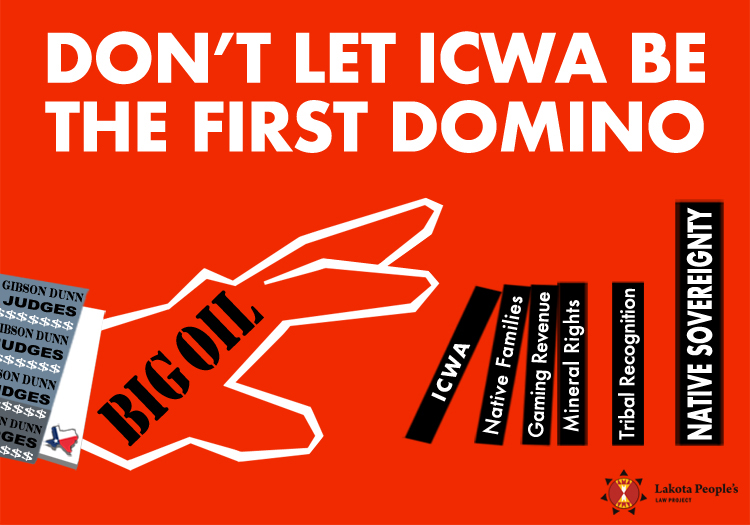
Have you heard of a court case called Brackeen v. Haaland? If you’ve followed our communications for any length of time, you likely recognize one of those names. Indeed, U.S. Secretary of the Interior Deb Haaland — the first Native Cabinet secretary in U.S. history — is already under legal attack. And it probably won’t surprise you that the powerful entities behind this threat include the State of Texas and lawyers representing Big Oil.
But it’s not just Secretary Haaland being targeted. The suit, which seeks to overturn the Indian Child Welfare Act, directly targets Native children and families. And because of the specific legal argument in play, it could also mean the end of tribal mineral rights, gaming revenues, Indian law as we know it, and ultimately our sovereignty as Indigenous nations. It’s not an overstatement to say our entire future could be at stake with a single decision — and that choice will now be made by a conservative-majority Supreme Court.
Please read our comprehensive blog on this case to learn more. From there, immediately take action by signing and widely sharing our petition to President Joe Biden and Department of Justice attorneys. Tell them it’s absolutely critical they protect Native children and safeguard Indigenous rights!
Right now — even as I drive from South Dakota to Minnesota in support of my Indigenous relatives fighting the Line 3 pipeline — the high court is deciding whether or not to hear this case. We will keep you updated every step of the way. This may well be the most important decision the Supreme Court has ever made in relation to Native justice. Please help us spread the word and stop this unconscionable attack on our Indigenous communities.
Wopila tanka — thank you for helping us stand up to racist colonial law. Madonna Thunder Hawk Cheyenne River Organizer The Lakota People’s Law Project
I have good news for you from the Line 3 front! This past weekend in Minnesota, I joined four members of “the Squad” — U.S. Reps. Ayanna Pressley, Rashida Tlaib, Cori Bush, and Ilhan Omar — to increase pressure on President Joe Biden to #StopLine3. As a Lakota elder and the former Standing Rock tribal liaison to the Oceti Sakowin camp during the NoDAPL struggle, I deeply understand the heartache my Anishinaabe relatives feel as this toxic pipeline invades their sacred lands and waterways — and I’m extremely grateful to these brave elected leaders for their solidarity.
Our Lakota team at the frontline included our co-director, Chase Iron Eyes, and the Squad was joined by Minn. State Sen. Mary Kunesh (a descendant of Standing Rock). As you know, the Indigenous women leading this fight — like Taysha Martineau of Camp Migizi, Tara Houska of Camp Giniw, and Winona Laduke of Honor the Earth — need all the support we can provide at the frontlines. It’s a meaningful step that the congresswomen, all of whom also signed onto a letter asking the president to intercede at Line 3, gave of their time and energy to visit resistance camps and amplify the struggle.
Notably, Alexandria Ocasio-Cortez (who decided to run for Congress while at Standing Rock in 2017, and whom I remember vividly as a friendly young woman in blue jeans) was also scheduled to come to the frontlines, but Hurricane Ida forced her to stay home in New York City. The horrific flooding in her borough further highlights humanity’s need to move climate justice to the very top of our priority list — right now, while we still can.
I’m happy to report that we were able to meet face to face with each of the congresswomen and get to know their staffers. We will remain in touch and ready to team up on key issues going forward. In about a week, my colleague and sister in service, Madonna Thunder Hawk, will lead more Lakota elders on a three-day trip to Line 3 to further support Taysha at Camp Migizi. We won’t stop doing whatever it takes to build key alliances and grow this movement to protect Unci Maka, our Grandmother Earth.
Wopila tanka — thank you for standing with our Anishinaabe relatives! Phyllis Young Standing Rock Organizer The Lakota People’s Law Project
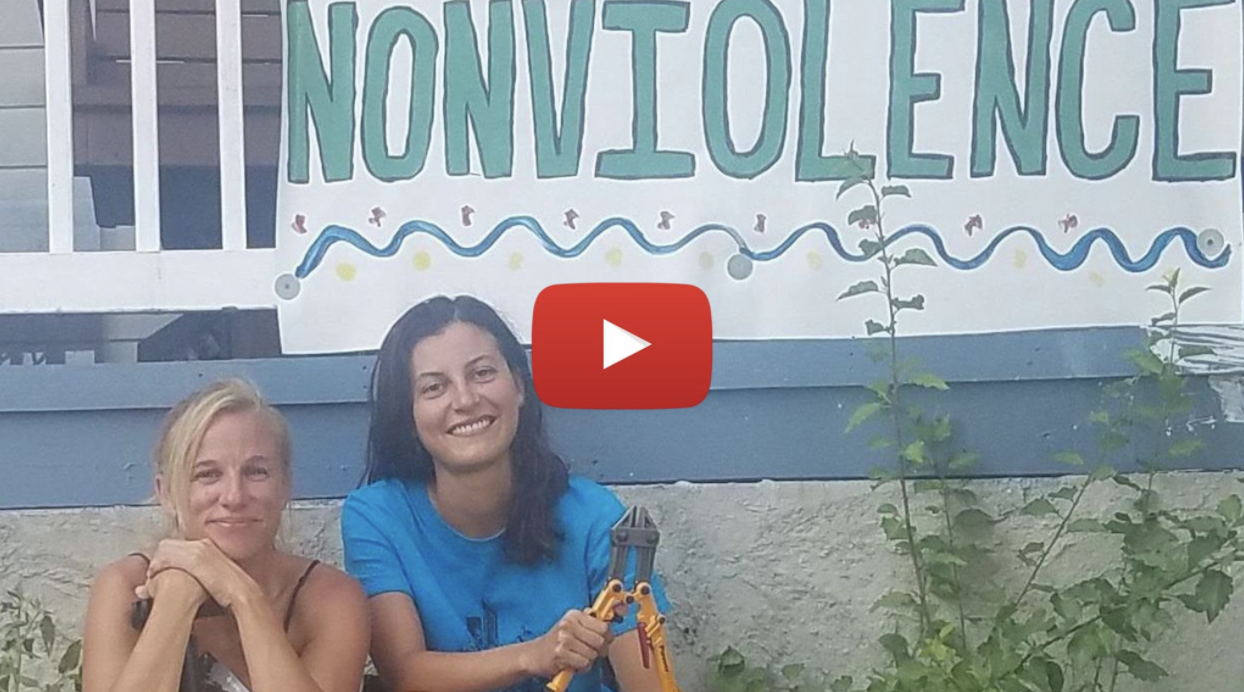
Last week, we introduced you to Ruby Montoya, a schoolteacher and NoDAPL resistor being prosecuted as a terrorist by the U.S. government. She’s accused of putting four tiny holes into DAPL pipes before it was carrying oil — and for this, she’s facing the prospect of up to 20 years in federal prison. That’s far from acceptable, and it’s why we’re aiding her defense. Last week, Daphne Silverman, Ruby’s new attorney, submitted a motion to change Ruby’s prior guilty plea to not guilty based on crucial new discoveries. Read on for the details.
Ruby (right) and co-defendant Jessica Reznicek prior to their arrest. In our new video, Ruby and I talk about water protectors being labeled and prosecuted as terrorists.
After initial review of the case, our side has identified a number of major issues that should disqualify Ruby’s original plea. For one thing, the prosecutor and the pipeline company allege that millions of damage was done, but an expert hired by Daphne says it’s less than $50,000. In addition, some charges filed by the prosecutor require the pipeline to have been in use at the time it was allegedly damaged. It was not.
Those distinctions make a world of difference. Without damage over $100,000 to an operational pipe, these charges don’t qualify for federal court — and outside of federal court, there can be no terrorism enhancement. As I mention in our new video, this is eerily reminiscent of how I was treated during my own resistance to DAPL in 2016 and 2017. The government and law enforcement are demonstrating a pattern of deception designed to criminalize constitutionally protected protest, elevate charges, and label citizens who dare to care about the future of Planet Earth as terrorists. It’s infuriating.
If the court labels Ruby a terrorist, she’ll be punished like a career criminal — but Ruby has no criminal history at all. We expect a court decision on the plea change in the next couple months. Meanwhile, Daphne will be investigating, researching, and conducting additional review of the discovery. We hope that, with her expert legal assistance and support from folks like you, the justice system will ultimately treat Ruby with far more fairness than water protectors have come to expect. Stay tuned.
Wopila tanka — thank you for your solidarity with water protectors! Chase Iron Eyes Co-Director and Lead Counsel The Lakota People’s Law Project
Yesterday, led by our grandmothers, we took the Line 3 pipeline resistance directly to the Minnesota State Capitol in St. Paul. Emblematic of the deepening solidarity among tribal nations, a caravan of 20 Standing Rock citizens, assisted by the Lakota People’s Law Project, joined us for our “Treaties not Tar Sands” rally.
An impressive lineup of BIPOC speakers and Minnesota state officials, headlined by White Earth Nation’s Winona LaDuke, addressed more than 2,000 people who showed up to call out Enbridge’s toxic tar sands oil pipeline. Toward the end of the day, we at Camp Migizi took our turn at the microphone. Five Lakota People came onstage with us to acknowledge the importance of resisting pipelines together — and they should know, since they were all at Standing Rock in 2016 and ‘17 during the NoDAPL movement.
Among the more heartfelt and timely messages imparted by our Lakota relatives was a call for unity from elder Sonny Wonase. I invite you to watch highlights from both my talk and his.
Police presence was as strong as ever, including a fence meant to wall state officials off from our prayerful ceremony and pleas for justice. As you can probably guess, that didn’t deter water protectors. At the end of the rally, my fellow organizers read a statement of demands criticizing Governor Tim Walz’s support of the pipeline and militarized response. We also continued to call on President Joe Biden to intervene.
Until we’re heard and acknowledged, we will not be silent. We will not stop taking direct action to end this invasion of our sacred lands and protect our water and manoomin (wild rice). We are carrying forward the tradition of Indigenous activism begun by the American Indian Movement in the 1960s and renewed at Standing Rock five years ago. I express my gratitude to Standing Rock for standing with us now — and to you for holding space with us and Mother Earth. If we come together across our traditional boundaries, if we act with a unified voice and spirit, we can win this fight.
Miigwech — thank you for your support! Taysha Martinaeu Camp Migizi Via the Lakota People’s Law Project
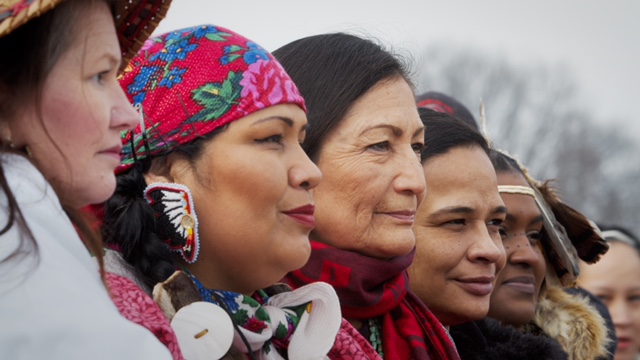 Here’s a promotional still of Secretary Haaland and other sisters in the fight for Indigenous justice. This film is really beautifully shot.








 Water is Life