Wopila: December 2, Tuesday

Lakota Law

It’s almost time for one of our most exciting events of the year! If you’ve been with us for some time, you may be familiar with our Wopila Gathering — an online celebration we hold every Giving Tuesday to share the spirit of wopila and Indigenous knowledge and culture with the world. This year’s fifth annual gathering is scheduled for 5 p.m. MST (4 PST/7 EST) on Tuesday, Dec. 2. We hope you can be with us, because the program is absolutely stacked with goodness.

This year’s theme is The Spiritual Resistance: Sustaining Sovereignty and Culture in Troubled Times. In addition to organizing, legal, and program updates from Lakota Law’s team, we’re bringing in Native musical artists and knowledge keepers from all four directions across Indian country. We’re particularly excited you’ll be able to hear from tribal leaders — including Chuck Hoskin, Principal Chief of the Cherokee Nation — and enjoy music from Nataanii Means, Rain from Heaven, Nanibaah, destroykasmin, and our own Tokata Iron Eyes. Please mark your calendars, RSVP here, and then join us on Dec. 2 at give.lakotalaw.org for the event!

Lakota Law

Our theme and participants this year are consciously chosen to address the current moment. Across Turtle Island and around the world, Indigenous communities face tremendous challenges — legal battles, climate threats, political upheaval, and ongoing attacks on our rights and our ways of life. But through ceremony, through culture, through art and music and the unbroken lines of our traditional teachings, we remain strong. 

Our spiritual resistance is more than survival — it is the active, daily practice of sovereignty. It is the protection of our homelands and our relatives. It is the renewal of our languages and our kinship systems. It is the courage to keep standing in full humanity, even when the world tries to silence us. We engage in the practice of wopila — of giving our heartfelt gratitude — for all those who participate in this resistance, and we invite all our relations and allies to stand with us on Dec. 2 as we build a future worthy of our ancestors.

This is our biggest fundraiser of the year — and we make sure the experience is reciprocal. You’ll hear incredible and uplifting music and presentations that highlight not just our own concerns and voices as Lakota People, but also those of our relatives from as far away as Hawaii and Alaska. It’s going to be an enlightening and amazing day, so please feel free to share this invitation with anyone and everyone interested in sharing in the music and conversation, learning more about our cultures, and helping to forward tribal sovereignty and win Indigenous justice. 

Wopila tanka — thank you, always, for being a valued friend to us.
Chase Iron Eyes
Executive Director
Lakota People’s Law Project
Sacred Defense Fund

P.S. Please RSVP and join us for our fifth annual Wopila Gathering — a joyful day of music, culture, and conversation — on Giving Tuesday, Dec. 2. With your participation and that of so many of our talented and generous friends, we believe this will be our best event yet!

The Black Hills: Garden of Heroes?

Lakota Law

Happy Juneteenth to all! Speaking of American racism, the domestic news cycle this past week largely focused on protests by millions nationwide against the attacks on migrant communities by U.S. Immigration and Customs Enforcement (as well as President Donald Trump’s costly, sparsely attended military parade). Those are important issues, and we hope you stand with us in the ongoing fights for equity and justice — and against fascistic policies and displays.

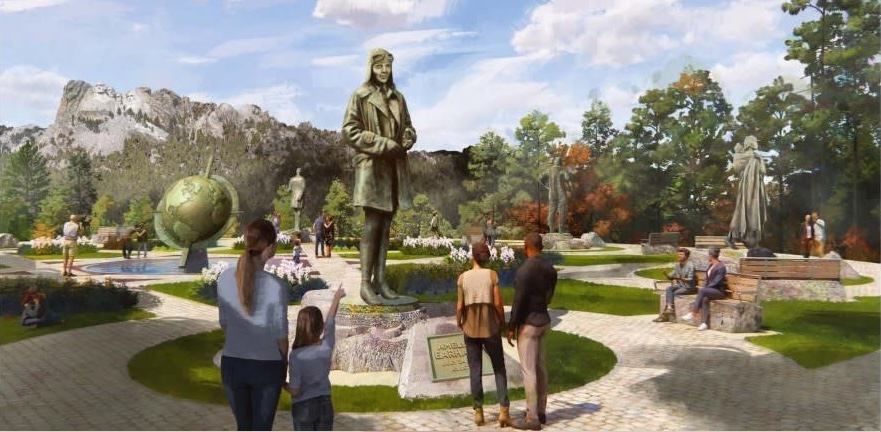
Meanwhile, it’s also important not to overlook the myriad implications of the administration’s proposed legislative agenda, including for Native communities. Those include massive budget cuts to eliminate funding for key programs and services, and now — as I report to you on our sister site, the Last Real Indians (LRI) Native News Desk — South Dakota elected officials want to put Trump’s proposed “Garden of Heroes” on Lakota homelands in the Black Hills, without consent from Native People. 

Read on LRI: Do Native People want Trump’s Garden of Heroes in our homelands? Did anyone think to ask us?

In the story, you’ll get the gist of the proposal, and you’ll notice a vast difference in approaches toward it from South Dakota’s (white) elected officials and from Indigenous leaders. Because the Lakota have never ceded the sacred He Sapa (Black Hills) to the U.S., and because the area was stolen in violation of treaty law, one might think the elected officials would make it a priority to get thoughts — permission, even — from the land’s original inhabitants. Unfortunately, they continue to operate from a place of entitlement.

As you’re likely aware, the U.S. Supreme Court ruled 45 years ago in favor of the tribes, but the Lakota have never accepted the (now more than $1 billion in) settlement money. The Black Hills are not, and never have been, for sale. As Lakota Law and Sacred Defense Fund executive director Chase Iron Eyes mentions in our story, if the federal government wants to place its garden on Lakota lands, it should return them first.

On a positive note, the garden is slated to include Indigenous representation. That, at least, is something. But, on this monumental day commemorating the end of U.S. slavery, let’s be clear that respecting the perspectives and agency of marginalized groups must also be part of the process. Now more than ever, we must keep fighting — not just for recognition, but for an inclusive and healthy path forward for all who call this place their home.

Miigwech — thank you for fighting for equity and justice!
Darren Thompson
Director of Media Relations, Lakota People’s Law Project
Editor-In-Chief, LRI Native News Desk

Return Lands

Lakota Law

Over the past months, we’ve shared with you about our exciting partnership with the Muwekma Ohlone people of California’s Bay Area. We’ve helped the tribe create media and, together, we designed a call to action to assist the Muwekma — proud descendants of some of California’s original inhabitants — as they seek to restore their rightful status as a federally recognized tribe.

This week, we met with the Muwekma again to discuss and help amplify another of their important initiatives: namely, returning the Presidio to their caring hands. Giving this sacred and historic land back to its original stewards would be a huge win for Indigenous justice — and it’s a real possibility in this moment of change and opportunity. Please watch the new video from the Muwekma Ohlone Tribe, in which they lay out the reasons why it should happen.

Watch: The Muwekma Ohlone have the original right to the Presidio.

You may recall that, years ago, I helped to organize the #landback movement by calling to return the Black Hills to the Lakota. I was present at the protest action near Mount Rushmore when President Trump visited for American Independence Day during his first term. Today, we remain dedicated to the return of our own sacred lands — and we stand in strong solidarity with other Indigenous groups seeking the same.

Perhaps ironically, Trump’s return to office could present a new opportunity to achieve those goals. His administration’s efforts to gut the federal workforce, eliminate programs, and lessen the financial burden for the federal government could create openings for tribes to step into voids created around stewardship of federal lands. And while Lakota Law stands with needed federal workers who keep our society running smoothly, we also recognize Indigenous ownership and stewardship as the ultimate outcome for stolen, sacred lands.

As with many things these days, this is a rapidly evolving issue, and we’ll have more to say on it soon, including action opportunities and more messages directly from our friends at the Muwekma Ohlone Tribe. As always, I’m grateful for your solidarity with us and with Indigenous landback efforts across Turtle Island.

Wopila tanka — thank you for standing for the sacred.
Tokata Iron Eyes
Spokesperson & Organizer
Lakota People’s Law Project
Sacred Defense Fund

New Title: The Mahkato Reconciliation and Healing Ride

Lakota Law

From acknowledging the winter solstice to celebrating mainstream society’s holiday season, this time of year has always brought together gatherings of family and friends throughout Turtle Island.  And every December, reminders of our history add to the difficulties faced by many families, and tribes, as some of their people’s most tragic memories all occurred during this month — the assassination of Chief Sitting Bull, Wounded Knee Massacre, and the Dakota 38 Hanging.

The day after Christmas is more widely known as “Boxing Day,” especially outside of Indian Country, but in the last several years there has been growing momentum for mainstream society to acknowledge the day after Christmas as the day when 38 Dakota “Sioux” men were hanged in Mankato, Minnesota in 1862. The hanging, the largest mass execution in United States history, was carried out in front of an estimated 4,000 people in downtown Mankato and remains largely hidden from classrooms and public knowledge.

As the year ends, and millions gather to celebrate and acknowledge the holiday season, some Indigenous communities acknowledge its tragic past through memorial ceremonies aimed at teaching and healing while building community. 

The hangings were approved by former President Abraham Lincoln as a result of conflict between Dakota people and settlers in southwestern Minnesota. Dakota people were promised food and safety in exchange for ceding their lands, but they received neither, leading to attacks on white settlements in August 1862. The resulting widespread war in Minnesota lasted for five weeks, culminating in the hanging of 38 Dakota men in Mankato on Dec. 26, 1862.

Some say the Dakota War officially ended after the hanging, but the U.S. government’s oppression of the Dakota people, as well as other Indigenous groups, did not end with that atrocity. After the mass hanging, Dakota people were exiled and forcibly removed from Minnesota. Many sought refuge in Canada, South Dakota, Nebraska, and other communities willing to take them in. Memorializing such a painful history involves more than riding on horseback through blizzard-like conditions. While it remains a painful and tragic past, many have undertaken healing and positive efforts to repair relations with those in the places where history unfolded, hoping that such history will not repeat itself.

The movement to pay tribute to tragic times past is active healing in Indian Country. While memorials take time and tremendous effort, the initial memorial horse ride has caused great positive ripple. Today there are additional horse rides and a memorial run that begins at Ft. Snelling, the military fort where thousands of Dakota people were imprisoned during the Dakota War, and all convene at Reconciliation Park in Mankato, MN on Dec. 26. Many other Indigenous communities have begun to host memorial rides, runs, or walks, to pay their respects to their past, as well as to the land in hopes we continue to heal beyond times past.

Beginning in 2008, an annual memorial horse ride was organized to begin on the Lower Brule Reservation in central South Dakota and ride for 16 consecutive days, convening in Mankato, MN on Dec. 26. Their ride and ceremonial arrival to memorialize the Dakota 38 continues to this day — now under a new name — Mahkato Reconciliation and Healing Ride

Forever riding forward, while sometimes looking back, is magic we all have to embrace in this work. We’re grateful and gain strength as we join together to honor the pain and sacrifices of the past by celebrating and supporting these ongoing healing movements.

Miigwech — thank you, always, for remembering with us!
Darren Thompson
Director of Media Relations
Lakota People’s Law Project
Sacred Defense Fund

Your support makes jsutice possible - Donate Today

Lakota People’s Law Project
P.O. Box 27
Santa Fe, NM 87504

Action: Deadline Approaching for a Journalism Fellowship December 9th

December 4, 2024
Deadline: Montana Free Press/ICT fellowship Applications are being accepted through Dec. 9, 2024, for a full-time, paid fellowship position with ICT and the Montana Free Press to cover Indigenous issues in the upcoming 2025 Montana legislative session.  The internship will be based in Helena, Montana, and will run from January through May 2025. A salary and housing allowance will be provided. The Montana Free Press, Montana’s premier independent nonprofit news organization, in partnership with ICT (formerly Indian Country Today), has an immediate opening for an Indigenous Montana Legislative Fellowship in our Helena, Montana, newsroom. The paid fellowship is open to undergraduate or graduate college students and early career journalists who want to develop statehouse and political reporting skills in service of impactful community coverage. Knowledge of Indigenous communities, issues and policies will be considered a plus. The fellowship is an opportunity to deepen and broaden reporting skills while learning from and collaborating with experienced statehouse journalists and news industry professionals.

FIND DETAILS HERE [Eliza Wiley/Montana Free Press] Read the work of JoVonne Wagner, the 2023 fellow, from her time in Helena!

Email Dianna Hunt at dianna@ictnews.org for any questions. SUPPORT INDIGENOUS JOURNALISM Donate now To sponsor ICT, please contact Heather Donovan at (315) 447-6145 or hdonovan@ictnews.org