In case you missed it, a recent decision in the legal saga of the Dakota Access pipeline (DAPL) will keep the oil flowing while an Environmental Impact Statement (EIS) is done over the next nine months — and the courts have essentially stepped away from responsibility to shut operations down. Sadly, in his latest opinion, D.C. Judge James Boasberg has basically stated that his hands are tied by a higher court ruling.
Watch: Lakota Law chief counsel Danny Sheehan joined me to discuss the developments on Cut to the Chase.
As a reminder to you about what got us here, Boasberg (an Obama appointee) ruled last July to vacate federal permits for Dakota Access. He reasoned then that the Army Corps of Engineers failed to conduct a full EIS, as demanded in a lawsuit filed by the Standing Rock and Cheyenne River Sioux Tribes. Then, in August, an appeals court affirmed Boasberg’s decision to invalidate the permit, while simultaneously overturning his decision to empty the pipeline. DAPL has been operating unpermitted ever since — a completely unheard-of scenario, and a violation of the National Environmental Policy Act (NEPA).
Boasberg has since been essentially asking the Corps to make a political decision on whether it’s acceptable for this pipeline to operate without a valid permit on federal land. So far, the Corps (an executive branch agency now under president Biden’s leadership) has shown no desire to do the right thing. Rather than issuing an order to halt operations until proper environmental review is complete, Biden and the Corps are ducking responsibility.
Our legal analysis is that there’s still a potential path forward in the courts. At this stage, the tribes could go directly after the Army Corps under the Administrative Procedures Act. This could lead to a court-order forcing Biden and the Corps to make a decision on whether to continue allowing DAPL’s operation in violation of NEPA.
Lakota Law, its supporters, and a host of like-minded organizations and allies continue to ask Biden to step up and shut DAPL down. We’ll continue to closely examine all the legal and political angles, assessing potential leverage points to push the Corps. Stay tuned.
Wopila tanka — thank you, always, for standing with Standing Rock! Chase Iron Eyes Co-Director & Lead Counsel The Lakota People’s Law Project
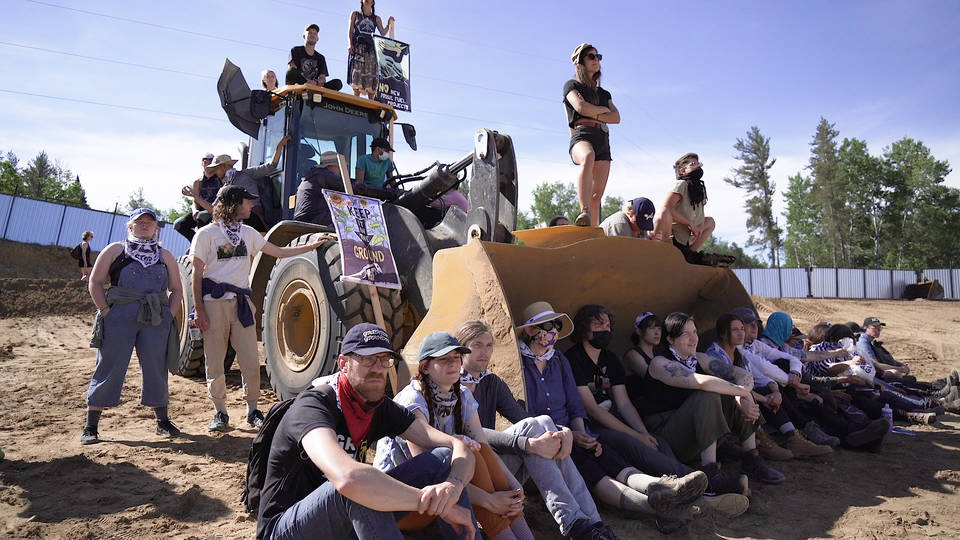
In northern Minnesota, over 100 water protectors were arrested Monday in the largest act of civil disobedience to date aimed at halting the Enbridge Line 3 pipeline. If completed, Line 3 would carry more than 750,000 barrels of Canadian tar sands oil a day through Indigenous land and fragile ecosystems, endangering lakes, rivers and wild rice beds. The day of action began when over 1,000 water protectors blockaded a pipeline pump station north of the town of Park Rapids. Many of the activists locked themselves together or to heavy machinery, including bulldozers and diggers.
Kerry Labrador: “I’m a mother of three children. I trooped out here from Boston. I’m a Mi’kmaq woman. And I’m here because they need backup. They need voices. There’s strength in numbers. You know? All these kids out here — I’m going to say it over and over and over again: All the kids out here deserve the future that we, as parents, promised our kids. And if this is how I have to fulfill that promise, then this is how I’m going to fulfill that promise, and not just for my kids, but for every kid sitting out here in this world.”
Protesters are calling on President Biden to shut down the pipeline.
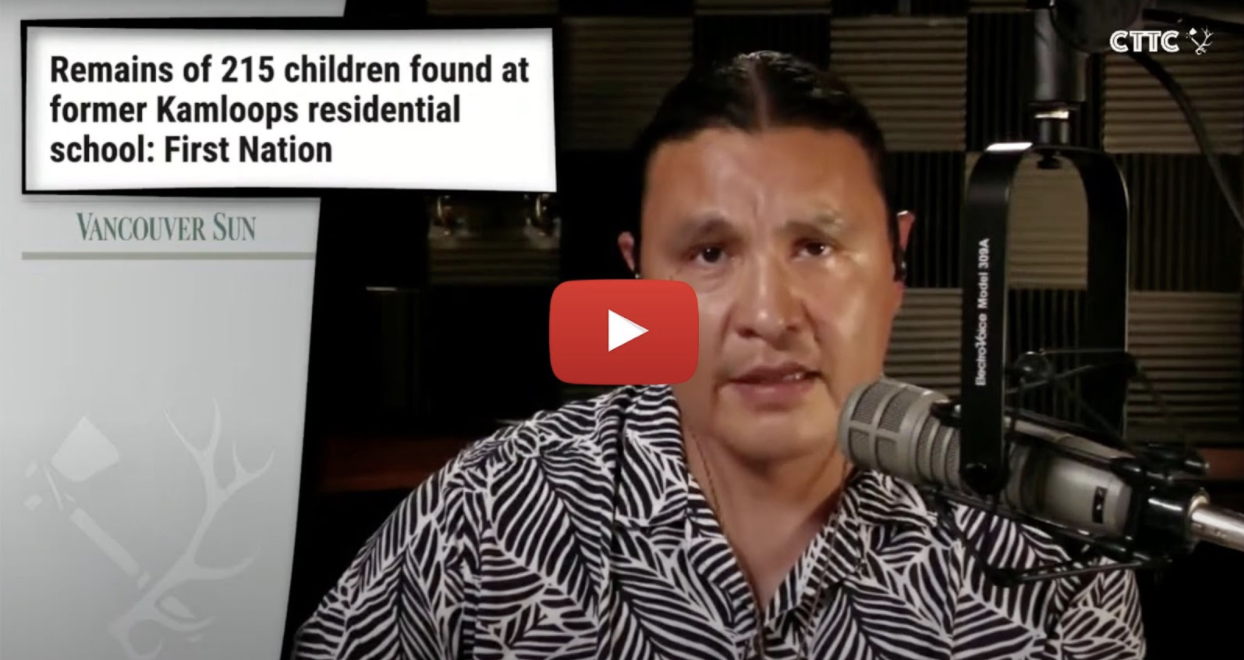
With a heavy heart but with clear eyes, I write to you today as Lakota Law’s newest team member. Global Indigenous communities are mourning over the recent discovery of a mass grave containing the human remains of 215 children at the Kamloops Indian Residential school in Canada. This discovery is not the first and will not be the last. Residential and boarding schools occupy a long and bloody, but recent, chapter in the story of Turtle Island’s colonization. The last school didn’t close until 1978.
Watch, then take action: Chase provides real talk about the tragedy of 215.
Since our inception, the Lakota Peoples’ Law Project has focused on protecting the health and safety of Lakota children. In partnership with the tribes and Native communities in the Dakotas, we have years of experience fighting to keep Native kids in Native care and for the proper implementation of the Indian Child Welfare Act. Most recently, your support has helped us establish a Native-run foster home on the Standing Rock Nation, as another means of dismantling this practice of forced assimilation.
We did not stumble upon this undertaking. Our work grew from the same sense of urgency — shown to us by Lakota grandmothers as their grandkids were being stolen by the state — that you are now experiencing as you read about the children found in a mass grave at The Indian Residential School at Kamloops. This “breaking news” is an all-too-familiar reality for Indigenous children and families. Generations of Native communities have suffered from the deadly and traumatizing boarding school experience.
We should not be surprised that countries founded on the ideals of the Doctrine of Discovery — an ideology that supports the dehumanization of those living on the land and their dispossession, murder, and forced assimilation — would have so much to answer for.
I have written an article to attempt to explain this history and its present-day implications for allies. This is not an easy read. It was not an easy write. I wrote it to eliminate the need for any other Native person within our network to suffer by having to explain this senselessness.
Wado — thank you for reckoning with the harsh realities we Indigneous People continue to endure. Sarah Rose Social Media Coordinator The Lakota People’s Law Project
Criticism of Alaska article stirs broader discussion
*****Let´s go broader than this article.****
Manipulation 101
Why would native people want to be put first in line for an injection of something that is #1 experimental, #2 not fully safety tested, #3 has actually been responsible for reported serious adverse reactions and even some deaths, #4 does not stop infection. Because of the history of discrimination and racism, we are persuaded to think that NOW, during this pandemic, the powers that be are actually giving a care to indigenous people. We need to step back a moment and really look at what is being done and how things are spun into a narrative that puts people of color at the head of the line to being harmed.
I will add that one way to motivate people to do something is to play out the scenario that there is a scarcity – also to create the feeling that one group is getting something that others are not. So, you begin to see that this issue of indigenous getting better treatment actually is only a narrative that plays to the pharmaceutical companies´ agenda to persuade people who are reluctant to get the vaccine to race to get the vaccine.
A nurse administers the Pfizer-BioNTech COVID-19 vaccine at Guy’s Hospital in London, Tuesday, Dec. 8, 2020. U.K. health authorities rolled out the first doses of a widely tested and independently reviewed COVID-19 vaccine Tuesday, starting a global immunization program that is expected to gain momentum as more serums win approval. (AP Photo/Frank Augstein, Pool)
Joaqlin Estus
Vera Starbard: ‘Any time Native people are perceived to be ‘doing better’ than the dominant group in Alaska, there will absolutely, without fail be a backlash from individuals or large groups about how it’s not fair’
Alaska Public Media reporter Nathaniel Herz has done numerous stories on the fight against COVID-19 in Alaska in the past year.
His stories described historical pandemics that decimated Alaska Native populations, and the disproportionately high toll that COVID is taking on Indigenous peoples. He has reported on the tribal health system’s success in vaccinating tribal members despite logistical challenges.
Then last weekend Herz wrote and aired a story headlined: “Eligibility differences between state and tribal health systems frustrate some Alaskans waiting for vaccines.” The story said the Anchorage-based Southcentral Foundation was vaccinating people who work with Alaska Natives and for Native organizations. The story featured critics who saying the Native nonprofit should instead be giving shots to more vulnerable groups no matter what their relationship with Natives.
Nathaniel Herz, reporter. (Photo courtesy of Alaska Public Media)
The reaction after the story was aired and then posted on Alaska Public Media’s web page was immediate and on social media dozens of angry responses were posted on Twitter and Facebook. In the sometimes hyperbolic and profanity-laden style of social media, people saw the story as horrible, divisive, super-biased, whiney, colonialist, and reckless.
If Southcentral should be sharing its allotment beyond its clientele, will the same demand be made to the Department of Defense to share its allotment beyond the military, asked one commenter. “Or is the criticism reserved only for the most marginalized in our community?”
The story “feeds into ill will against Natives in an already super racist state,” and non-Natives will use the views expressed in the story as a “justification to their racism” that “feeds into their own victimhood,” read other Tweets.
Vera Starbard, Tlingit and Dena’Ina Athabascan, an author and playwright, wrote in her Writing Raven blog that she was surprised to see what she called, “an absolute hit job piece of poor journalism published with a disgraceful slant toward how the system is failing the Anchorage community,” given the tribal health system’s success in getting people vaccinated.
“Except it’s not surprising. Any time Native people are perceived to be ‘doing better’ than the dominant group in Alaska, there will absolutely, without fail be a backlash from individuals or large groups about how it’s not fair,” Starbard said.
“Never mind that instead of highlighting the state’s failed responsibility to the Pacific Islander community’s risk, and ask why it was not reaching this community more, this media organization chose to place the blame on an organization that is already serving those outside of its founding responsibility – and seeking to do more,” Starbard said.
Efficiency of distribution
The Alaska Public Media story questioned how Southcentral was distributing vaccines.
“Anchorage’s main tribal health provider is vaccinating employees of its affiliated for-profit company and nonprofit organizations, and their household members, without regard to their race, age or vulnerability,” Herz reported. “That’s frustrating some of the teachers, people with underlying conditions and others enduring an excruciating wait for shots from state government.”
“Southcentral Foundation’s vaccination framework has the effect of skipping over groups that face higher risk levels,” the story read, such as grocery store workers, the elderly and South Pacific Islanders, who are disproportionately affected by COVID.
One reason that Southcentral even had such a choice was its efficiency in distributing vaccines.
The number of doses provided to tribal health organizations is based on the same formula the Centers for Disease Control and Prevention uses to determine allotments to federal, state, and local governments. CDC considered 15 factors, including preparedness; critical populations; capacity for handling and managing the vaccine; and the number of providers to administer vaccinations.
While federal, state and tribal health systems are all limited by the number of doses allotted to them, the foundation has been able to get categories of people vaccinated more quickly than the state.
It’s had teams calling tribal members to come in for their shots, which it’s dispensing at the rate of 800 per day. By Feb. 1, it had administered more than 10,000 doses.
The foundation’s first priorities were health care workers and Native elders followed by the American Indian and Alaska Native “customer-owners” it serves. Next it vaccinated other employees and customers’ household members. Then it opened appointments to people who work for or with Native people.
Southcentral Foundation had no comment on the Alaska Public Media story.
Like this story? Support our work with a $5 or $10 contribution today. Contribute to the nonprofit Indian Country Today.
Alaska Public Media’s side of the story
Anchorage-based Alaska Public Media combines news stories of its own with those of reporters at public radio stations across Alaska, many of them located in rural communities that are as much as 75 percent Alaska Native. The resulting news shows regularly have Alaska Native issues in the forefront, and has for decades.
Alaska Public Media News Director Lori Townsend, said, “in the 18 years I’ve worked for the [Alaska public radio] network, I can think of no other time that we were accused of racist coverage by the Alaska Native community.”
Herz said the story was meant to prompt a conversation about the foundation’s distribution but erred in its presentation.
“…the story was framed in a way that was inflammatory and hurtful — and particularly to a lot of Native people but to plenty of white and non-Native people [too] — that didn’t allow anyone to engage with its content and with the question that we were trying to raise. It just caused hurt and pain and confusion about why we would do something like this,” Herz said.
Speaking for himself and the two editors who worked with him from concept to completion of the story, Herz said, “we thought we were being sensitive … we didn’t appreciate how sensitive and delicate the conversations around tribal healthcare are, and just sort of how much work and labor and explicating and justifying Indigenous people have to do around their healthcare whenever the subject comes up.
“This was absolutely… a personal and professional and human failure on my part. And I take full responsibility for that,” Herz said.
He said he and the editors “who considered ourselves to be sensitive and connected to the Alaska Native community and compassionate and aware of the sensitivity of these topics… had no sense of how the piece would hurt Alaska Native people, and how it would fail to connect with Alaska Native readers.” Herz said he and his institution are reflecting on the matter and are committed to making sure it doesn’t happen again.
Herz said, “the intensity of the reaction and just all of the different ways that people shared their feelings, I’ve never experienced anything like this in my entire life and it really hurt. But I am really hoping that this whole thing can be in the service of more responsible and complete and sensitive media coverage of Alaska Native people and really important personal lessons for me” and the institution where he works.
Townsend said a careful approach, talking through who should be in a story, and taking the time for careful editing is “so incredibly important. And having more diversity in our newsroom is crucial.” Herz said Alaska Public Media had already been taking steps to increase staff diversity.
Joaqlin Estus, Tlingit, is a national correspondent for Indian Country Today, and a long-time Alaska journalist.
Indian Country Today is a nonprofit news organization. Will you support our work? All of our content is free. There are no subscriptions or costs. And we have hired more Native journalists in the past year than any news organization ─ and with your help we will continue to grow and create career paths for our people. Support Indian Country Today for as little as $10.
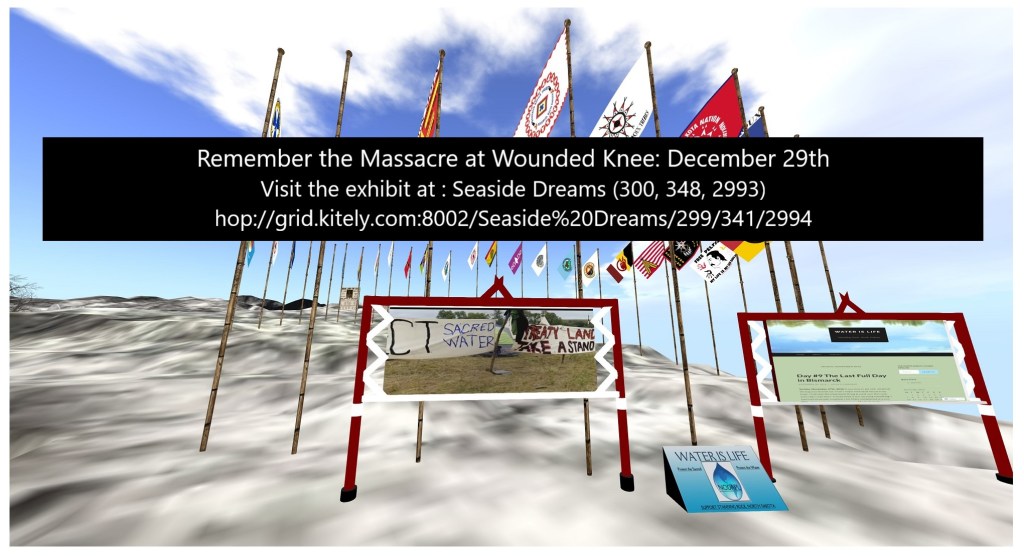
I would like to share that tomorrow Dec. 29th is the anniversary of the Wounded Knee Massacre, please visit the memorial at Kitely: grid.kitely.com:8002:Seaside Dreams
When you enter the world at the dock you will now find a teleporter to Wounded Knee, South Dakota. This is a memorial of the massacre that occurred December 29th, 1890 and the information that I gather connects with the current news about the struggles of the First Nation. From Uranium mining poisoning the water on Navajo land to the leaking oil pipelines in Standing Rock to climate change literally melting the permafrost in Alaska. What we are witnessing are human rights violations and environmental racism. We cannot change what we do not know, so the memorial will bring this knowledge to the virtual world.
This year has called on us to respond with unprecedented creativity to unprecedented challenges. We’ve had to use the platforms we have to think big, make bold statements, and create rapid change. That’s why I was so heartened last week to see players in the National Basketball Association (NBA) take their position and influence seriously. After a police officer shot yet another black man — Jacob Blake — seven times in the back, players refused to take the court for their playoff games. Then they met, formed a plan, and got buy-in from team owners and the league to use NBA arenas as polling places and voting centers in November.
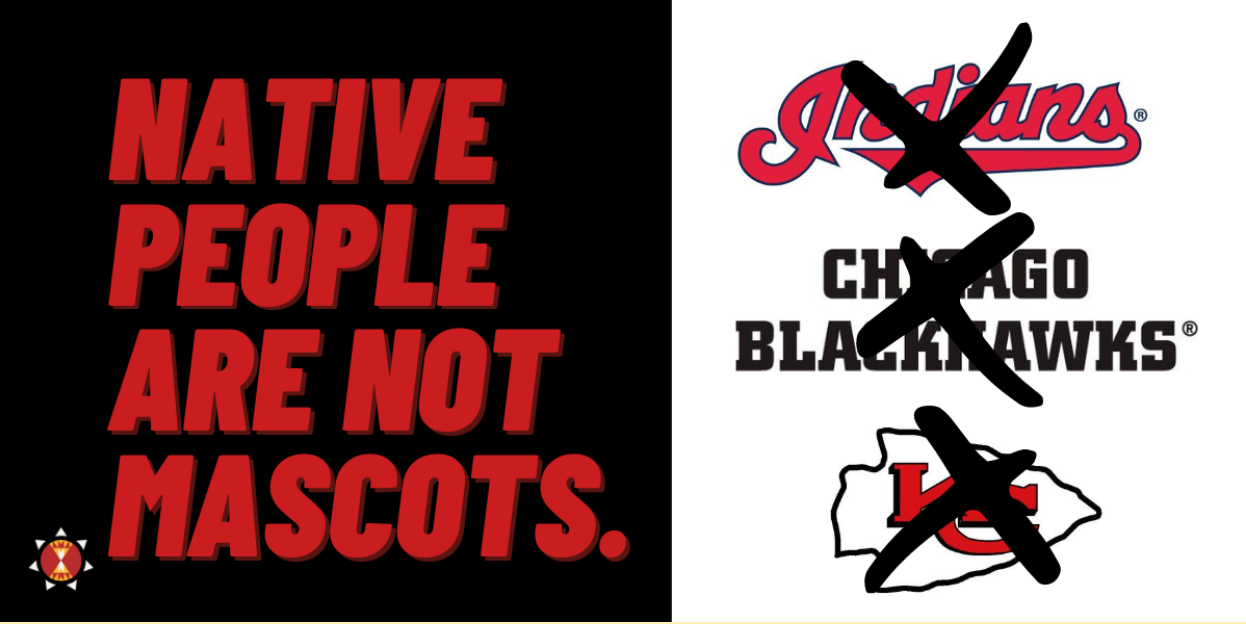
Unfortunately, no other American pro sports league approaches the NBA’s level of social justice awareness. Just weeks ago, after years of pressure, Washington, D.C.’s pro football team finally announced it would change its name from the most offensive in all of sports. But sports mascots and branding appropriated from Native culture are still all too common. This includes the Superbowl champion Kansas City Chiefs and baseball’s Atlanta Braves. Please sign and share our petition to change offensive sports mascots and branding, and watch my video about why it’s so important.
So many people watch and participate in sports, on every level from little league to the pros. Offensive team names, mascots, and logos impact all of us from a young age. Minor league baseball teams and college programs — like the Florida State Seminoles, whose fans often display the offensive “tomahawk chop” in stadiums — are guilty, just like the pros. A long time ago, I did all I could to help change my own alma mater’s nickname from the North Dakota State Fighting Sioux to the Fighting Hawks. Now I can be proud of my school.
These symbols rely upon stereotypes which demean Native culture and have real, negative effects on Indigenous children. Their continued existence perpetuates bullying and alienation.
Personal Note: I taught for 27 years in elementary education. Overcrowded classrooms, badly ventilated classrooms, and shared water fountains were the norm. No officials cared for the staff and students before, and I do not see how they will be able to address these problems now when the economy is in freefall. If I was not already retired I would be leaving the profession due to this pandemic. Certain politicians were put in high-level positions where they could undermine public education. Well, it occurs to me that I have witnessed the end of public education. It also seems to be following a trend: public postal service, public polling stations, public gatherings…it is almost as if we – the public – are under attack. A virus is being used as a weapon to disrupt and undermine everything we hold valuable.
There is no talk about what you can do to improve your immune system.
There is no talk about how masks (which, if covered with a deadly virus, should be handled as a biohazard) are to be discarded. Instead, people are throwing them in the regular trash or on the street. Masks are becoming a source of pollution – like we needed another one.
There is no talk about how to take care of the growing amount of homeless as we swelter in the summer heat and head towards fall and winter.
There is no talk about how people will pay for a vaccine – a vaccine that requires two shots so far and will be given to the so-called ¨most neediest groups¨first: remember, it is an experimental vaccine and the pharmaceuticals companies have full immunity if something goes wrong. >The indigenous, the black, the elderly, the poor communities will be first. Something does not sound right to me about this. Since when do the powers-that-be care about what happens to ¨the most neediest groups¨? If they cared they would be discussing establishing Medicare for all – after all – the few who had employee healthcare now are without a job and have joined the large groups of people with no health coverage.
Every educator without a classroom, set up virtual classrooms online. Do not go back unless the proper cleaning and adjustments are made to classrooms. It is a bad idea for educators and a bad idea for students – it has always been that way and now a virus pandemic just shines the light on the bad situation. IMHO
Bureau of Indian Education: Open schools or else
(Photo: S. Hermann & F. Richter, Pixabay)
Mary Annette Pember
School opening during pandemic is a confusing, deadly challenge for reservation residents
The Bureau of Indian Education’s plans to reopen its schools for in-person instruction is irresponsible, according to many Native parents and tribal leaders across Indian Country.
Tara Sweeney, assistant secretary of Indian Affairs, sent a letter to tribal leaders this month indicating that Bureau of Indian Education-operated schools will open Sept. 16 with in-person instruction. Sweeney wrote: “To the maximum extent possible, BIE (operated) schools will operate brick and mortar schools.”
According to its website, the Bureau of Indian Education oversees a total of 187 schools. Of those, 132 are tribally controlled, operating under the direction of individual tribes. Fifty-five are operated by the bureau. Although bureau leaders maintain they actively include input from tribal consultation and stakeholder meetings and surveys in crafting policies for both tribally controlled and bureau-operated schools, many tribal leaders disagree.
“These ‘Dear tribal leader’ letters sent out by the BIE don’t acknowledge the authority of tribal nations and our elected officials,” says Daniel Tso, Navajo Nation council delegate and chairman of Navajo Nation Health, Education and Human Services Committee.
Sweeney wrote: “The guidance in this letter specifically pertains to bureau-operated schools. However, BIE recommends tribally controlled schools take the recommendation included as guidance to inform their general operations and to prepare each learning environment for the 2020-2021 school year.”
Nearly half of the Navajo Nation’s 65 Bureau of Indian Education schools are operated directly by the bureau. Only about a third of all bureau-funded schools are operated by the agency. Most are tribally controlled schools.
During a meeting Wednesday, committee members created a resolution recommending all reservation schools provide virtual or online learning options.
“I realize that Mr. Dearman has to toe the line according to the orders of the Trump administration, but the BIE people in Washington, D.C., don’t know the lay of the land out here,” Tso says.
Tony Dearman of the Cherokee Nation of Oklahoma is the director of the Bureau of Indian Education. In an email response to Indian Country Today, he referred questions about school openings to the Bureau of Indian Affairs office of public affairs.
Neither that office nor the Bureau of Indian Education responded to emails seeking comment.
President Donald Trump is pushing for public schools to open with in-person instruction.
Parents on the Navajo reservation are overwhelmingly opposed to sending their children back to in-person school instruction, according to Tso
“Our dear children need to be protected; On a per-capita basis, we are still experiencing high rates of COVID-19 infections and deaths (on the Navajo reservation),” Tso says.
The Navajo Nation, which spans parts of Arizona, Utah and New Mexico, has been one of the worst hotspots during the pandemic.
The reservation continues to operate under a declared state of emergency and has enacted numerous weekend lockdowns to curb travel on and off the reservation. Navajo Nation government offices remain closed, offering minimal services.
Overall, according to the Centers for Disease Control, Native Americans have the highest hospitalization rates for COVID-19 of any ethnicity.
KTUU of Anchorage reports that one in 1,600 Indigenous people are impacted by COVID-19, compared with about one in 3,200 for non-Natives. Native people also have higher rates of chronic conditions such as diabetes and high blood pressure, making them especially vulnerable to the disease.
Many Native people depend on the Indian Health Service, a chronically underfunded federal agency, for their health care needs.
“Our IHS clinics couldn’t handle an outbreak on the reservation. COVID-19 could potentially wipe out half of our nation here on Pine Ridge,” says Dayna Brave Eagle, tribal education agency director for the Oglala Sioux Tribe in South Dakota.
The Oglala Sioux Tribe is still operating under a tribal shelter at home ordinance enacted in March prohibiting gatherings of more than 10 people and closing its borders to nonresidents and nonessential travel except for state highway entrances for pass-through vehicles.
“I don’t know of anybody who wants to send their kid to in-person school,” says Davidica Littlespottedhorse, who lives on the Pine Ridge Reservation.
Five of the Bureau of Indian Education schools on the reservation are tribally controlled; only one, Pine Ridge School, is a bureau-operated school.
According to tribal council member Valentina Merdanian, the Oglala Sioux Tribe has ordered all reservation schools, including private, public and Bureau of Indian Education tribally controlled and bureau-controlled schools to offer remote instruction to students. Despite the bureau’s insistence that its directly operated schools offer in-person instruction, Pine Ridge School will offer only remote classes, according to Brave Eagle.
“The Oglala Sioux Tribe remains strong in looking after the health and welfare of our people; there are too many unanswered questions surrounding the pandemic for us to risk the health of our children,” Merdanian says.
Several Native leaders expressed concern that the Bureau of Indian Education may force its other bureau-controlled schools to offer in-person instruction regardless of individual tribes’ wishes.
“Yes, it’s totally possible that since the bureau-operated schools are federal, they will offer in-person instruction (regardless of tribal law),” says Carl Slater, Navajo Nation council delegate and a member of the Health, Education and Human Services Committee.
According to both Oglala Sioux and Navajo Nation leaders, communication from the Bureau of Indian Education has always been a problem.
As reported by Rebecca Klein and Neal Morton for the Hechinger Report, the bureau was slow to offer advice and close its schools in March, at the beginning of the pandemic.
According to Tso, the bureau’s Rocky Ridge boarding school on the Navajo reservation didn’t receive the agency-wide March notification to close for several days.
“Somehow they never got the message and remained open for several days. One of their staff died from COVID-19,” says Tso.
Although more students have received devices such as mobile phones, tablets and computers, limited internet access continues to be a problem.
“Many of our families live on a fixed income and can’t afford internet access fees,” says Brave Eagle.
Both the Navajo Nation and the Oglala Sioux Tribe are using their CAREs Act funds to expand internet access to families, but leaders worry funding is inadequate.
Members of the Senate Committee on Indian Affairs expressed concerns and asked for details regarding BIE’s distribution of CAREs Act funding to tribes during an oversight hearing in July.
“Several of our parents support using jump drives that can be exchanged weekly with the schools, but the BIE schools have not been receptive to these kinds of suggestions,” says Tso.
But schooling during a pandemic is a challenge for all schools serving reservation youth. According to the National Congress of American Indians, only about 8 percent of Native students attend Bureau of Indian Education schools; the remainder attend tribal, public or private schools both on and off the reservation.
“We’ve heard of some students transferring to schools off the reservation in order to access athletic programs,” says Merdanian.
The Oglala Sioux Tribe has been operating under a shelter at home ordinance since March 2020. (Photo by Mary Annette Pember)
South Dakota Gov. Kristi Noem is pushing for schools to remain open and is discouraging the use of masks. Guidelines from the Centers for Disease Control support in-person learning with social distancing, masks and cleaning protocols.
Brave Eagle finds the overall lack of clear, coordinated policies among schools disheartening.
She notes that the recent Bureau of Indian Education letter announcing the Pine Ridge School start date of Sept. 16, which is significantly later than some others, added to the confusion.
“All the schools are starting at different times,” she says.
“The BIE should be ashamed of themselves,” Brave Eagle says. “The federal government has failed us for the past 100 years, but now it’s time for tribes to stand up. We are the ones who know what we need.”
Mary Annette Pember, a citizen of the Red Cliff Ojibwe tribe, is a national correspondent for Indian Country Today.
Indian Country Today is a nonprofit news organization. Will you support our work? All of our content is free. There are no subscriptions or costs. And we have hired more Native journalists in the past year than any news organization ─ and with your help we will continue to grow and create career paths for our people. Support Indian Country Today for as little as $10.
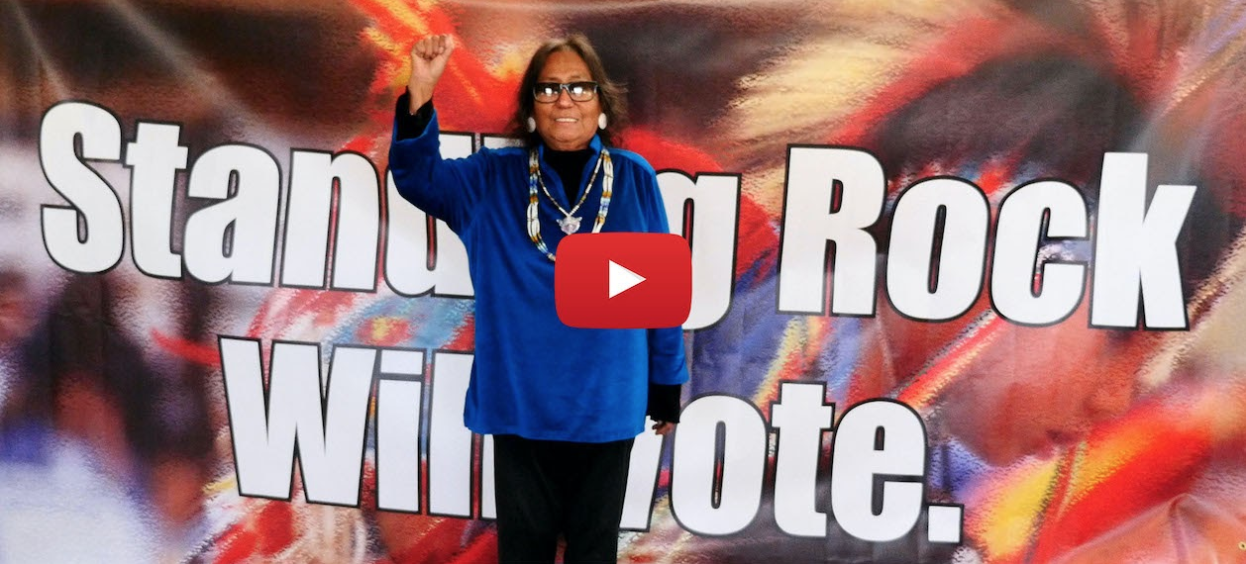
Voting rights are under attack across America. President Trump’s threat to withhold funding from the U.S. Postal Service is just the latest attempt to limit our power by blocking free and fair elections. Of course, to Native people like me, this is nothing new. That’s why, two weeks ago, the Standing Rock Sioux Tribe voted unanimously to team up with the Lakota People’s Law Project, Sen. Tom Udall (D-N.M.), and U.S. House Assistant Speaker Ben Ray Luján (D-N.M.) to make sure Congress passes the Native American Voting Rights Act (NAVRA) as soon as possible.
We Standing Rocked the Vote in 2018, and now, with your help, we’ll pass NAVRA and ensure fair elections are held throughout all of Indian Country.
You likely recall that, in 2018, North Dakota passed a voter ID law specifically aimed at disenfranchising Native citizens without street addresses. I remain grateful that you leapt into action at that time, helping us Standing Rock the Vote. Together, we put 100 tribal volunteers on the street, printed 800 new IDs, and doubled turnout over the prior midterm.
But other Indigenous communities around the U.S. aren’t so fortunate. Many face significant hurdles, such as remote or difficult-to-reach polling locations, language barriers, and no vote-by-mail option. NAVRA will address these concerns and more.
I also want you to know that we’re just getting started. We intend to engage the members of the Great Plains Tribal Chairmen’s Association — the leaders of 16 tribes throughout North and South Dakota and Nebraska. We’ll also organize with tribal nations around the country to gain bipartisan support, and we’ll train a group of ambassadors from Standing Rock to phonebank and turn out the national Native vote, come election time. The tribe has also requested a congressional hearing.
Voter suppression within communities of color must end, right now. We have the opportunity to make a tremendous difference — not just for folks on reservations, but for the future of our nation. Please join us in what could be the most important action we’ve ever undertaken together.
Wopila tanka — my thanks for standing with Native voters!
Phyllis Young
Standing Rock Organizer
The Lakota People’s Law Project
How many? It’s a question that journalists often ask. How many people across Indian Country have been infected with COVID-19? And, sadly, how many have died?
Jourdan Bennett-Begaye did not like the answers she was getting. The Indian Health Service’s data collection is limited. Some tribes release information. Others don’t.
So Bennett-Begaye set out to create her own which turned into Indian Country Today’s COVID-19 Tracker with an interactive map and a way to anonymously submit cases to track. It’s not perfect. But it’s a start and even today is the only national database that collects mortality data on Natives and COVID-19. The research published has already been cited in academic studies and several universities have asked to contribute and make the information even more useful.
This is the kind of independent journalism that you can help support. Can we count on you to make a one-time contribution today? Or how about a monthly recurring donation? Your dollars support the reporting that goes into journalism you won’t find anywhere else.
Thank you for your support,
Mark Trahant, Shoshone-Bannock
Editor, Indian Country Today
Twitter: @TrahantReports
Division of Water Resources cites doubts about MVP Mainline project, says construction in NC could cause “unnecessary water quality impacts.”
This is a developing story and will be updated.
Another natural gas pipeline in North Carolina has been derailed, at least temporarily, as the North Carolina Department of Environmental Quality has denied a water quality permit for the MVP Southgate project that would route through Rockingham and Alamance counties.
In a letter released this afternoon, Division of Water Resources Director Danny Smith wrote, “Due to uncertainty surrounding the completion of the MVP Mainline project,” it has determined that “work on the Southgate extension could lead to unnecessary water quality impacts and disturbance of the environment in North Carolina.”
Owned by Pittsburgh-based EQM Midstream Partners, MVP Southgate is an extension of the main MVP natural gas pipeline, which starts at a fracked gas operation in northern West Virginia and ends in Chatham, Va.
MVP Southgate would run from Chatham, Va., and enter North Carolina near Eden, in Rockingham County. From there, it would route nearly 50 miles southeast, cutting through Alamance County and ending in Graham. Construction costs are roughly $470 million.
In total, the southern portion would cross 207 streams, three ponds and temporarily affect 17,726 linear feet of streams, 6,538 square feet of open waters, and 14 acres of wetlands; another 0.02 of an acre of wetlands would be permanently damaged. Nearly 14 acres of riparian buffers would also be affected. MVP Southgate would cross the Dan River, home to endangered and threatened species, and Stony Creek Reservoir, the main drinking water supply for the City of Burlington.
The division also denied a Jordan Lake Riparian Buffer Authorization. Such an authorization would be required because the route is within the sensitive Jordan Lake watershed, which includes the Haw River.
MVP Southgate is an extension of the controversial main Mountain Valley Pipeline project, which runs for 303 miles from a fracked gas operation in northern West Virginia to southern Virginia. The mainline has racked up hundreds of environmental violations and prompted state and federal regulators to issue dozens of stop-work orders. Construction on the main line is currently halted, per a FERC stop-work order. That project’s costs have ballooned to $6.2 billion.
“Division staff have determined the Southgate project’s sole utility and purpose is tied to and wholly relies on the completion of the entire Mainline project,” today’s letter reads. “The uncertainty of the MVP Mainline Project’s completion presents a critical risk to the achievability of the fundamental purpose of MVP Southgate,” it continued.
Most of the environmental harm would occur during construction, the division wrote, adding that it “finds it is inappropriate to unnecessarily risk impacting high-quality waters and drinking water supplies of North Carolinians.”
Examples of this harm can be seen in the wake of construction of the now-defunct Atlantic Coast Pipeline, which destroyed miles of private farmland and forests in several North Carolina counties, Policy Watch reported on July 30. It’s yet unclear how those environmental harms will be remedied.
An EQT spokesperson could not be reached this afternoon for comment about the decision and whether the company would appeal.
Crystal Cavalier, a citizen of the Occaneechi Band of the Saponi Nation, is an indigenous activist. MVP Southgate would run through indigenous family lands, she said. There were also questions of whether Indian burial mounds were located near waterways; several were found along the route of the main line.
“This is huge,” Cavalier said. “I’m so excited that North Carolina is taking a stand for indigenous people. Because once you dig up this land, you can’t renew it.”
Haw Riverkeeper Emily Sutton has co-organized opposition to the MVP Southgate project for more than two years. “We’re so thrilled to hear that DEQ has made the right decision to deny this unnecessary pipeline,” Sutton told Policy Watch. “This pipeline would have destroyed streams and critical habitat throughout the Haw River watershed. This is a win for all of North Carolinians and a step forward in our state’s commitment to limiting our dependence on fossil fuels.”
This is the second time DEQ has denied what’s known as a “401 permit” under the terms of the Clean Water Act. Last year the agency rejected the project application because, after repeatedly asking for information for more than six months, DEQ had not received from MVP Southgate a full accounting of stream crossings and other impacts on waterways. Without the additional information, DEQ couldn’t evaluate the application before a federal deadline,
In previous comments to federal regulators, DEQ doubted the necessity of the project. The western and central Piedmont already has access to existing natural gas pipelines; Dominion Energy would be MVP Southgate’s primary customer.
DEQ’s decision counters those issued by the Federal Energy Regulatory Commission. FERC approved the project in February and issued it a Certificate of Public Convenience and Necessity in June. However, even FERC, which rarely reins in natural gas projects, issued the certificate on the condition that the main Mountain Valley Project obtain all necessary permits.
In a separate statement, DEQ Secretary Michael Regan said, “Today’s decision to deny the MVP Southgate certification protects North Carolina’s water quality, our natural resources and our communities. DEQ has questioned the need for the MVP Southgate project since our initial comments to FERC. This has always been an unnecessary project that poses unnecessary risks to our environment and given the uncertain future of the MVP Mainline, North Carolinians should not be exposed to the risk of another incomplete pipeline project.
“North Carolina’s clean energy future is not dependent on adding more natural gas infrastructure,” Regan continued. “Projects like this slow down the state’s goal to reduce greenhouse gases under North Carolina’s Clean Energy Plan and our efforts to address climate change under Executive Order 80. We should invest in clean, renewable energy sources and the economic benefits of energy innovation.”
This recent setback for MVP Southgate, coupled with the cancellation of the Atlantic Coast Pipeline last month, have occurred despite actions by the Trump administration to roll back environmental regulations to ease the way for natural gas projects.
On June 1, President Trump signed an executive order to fast-track energy projects like natural gas pipelines, undoing key components of longstanding environmental law. States can no longer consider any factors except water quality in acting on a 401 permit. For example, if DEQ found that the MVP Southgate project would draw down aquifers or reservoirs serving as a drinking water supply — such as Stony Creek Reservoir — that’s a water quantity issue, and could not be considered.
Nor can states cite climate change as a reason to deny a 401 permit.
Natural gas pipelines leak methane, a greenhouse gas and major driver of climate change. The EPA is expected to issue a new rule on methane later this week that weakens environmental protections. Although the exact text of the rule has not been publicly released, The New York Times reported that the EPA will eliminate federal requirements that oil and gas companies must install technology to detect and fix methane leaks from wells, pipelines and storage sites.
Despite the Trump administration’s deregulation, in some cases, court rulings have foiled the EPA. On April 15, the federal District Court for Montana vacated the U.S. Army Corps of Engineers’ nationwide permit; although that permit related to the Keystone XL pipeline, the court’s decision had implications for pipeline projects throughout the U.S., including the ACP and the MVP mainline and Southgate pipelines.
In cancelling the ACP, Dominion Energy and Duke Energy cited the court ruling as one reason it was no longer economically or logistically feasible to continue the project.











 Water is Life