The future is now, and it’s looking brighter by the day. Recently, a youth group from the Oglala Lakota Nation — all members of the Lakota Tech High School Student Council — attended a meeting of the Great Plains Tribal Water Alliance (GPTWA) to learn and talk about their inspiring efforts to uplift their community. I was honored and encouraged to witness that powerful interaction, the culminating event in a series of activities the students undertook early this year as leaders of their school and future leaders of the Oceti Sakowin (Sioux Nation). You can watch our new video to see them in action!
Watch: future leaders of the Lakota Nation detail their vision. Opening musical track provided by Hundred in the Hand (featuring Tokata Iron Eyes).
My son, Zaniyan Iron Eyes, was joined by fellow student leaders Derrick Merrival, Antoine Running Bear, Wazilya Fuller, Marcel Swallow, Keldon Weston, and advisor Marlin Kingi to address Doug Crow Ghost, Reno Red Cloud, Syed Huq, and Mary J. Gourneau of the GPTWA. The students’ words are eloquent, so again, I urge you to see for yourself what they had to say.
Highlights include recaps of the students’ various community projects, their plans for their own futures, Marcel’s frank and poignant reference to the hurdles faced by young people on the reservation, and his gratitude for the mentoring provided by GPTWA. In turn, the leaders of the alliance, whose membership is composed of people from seven Sioux tribes, conveyed their concerns for all waters in the Oceti Sakowin, from the Big Horn Mountains to east of the Missouri River. I can confidently report that the students took to heart the necessity to protect Unci Maka (our Grandmother Earth).
Many of these same young leaders from Lakota Tech also presented to Lakota Law members at our Membership Event in February. That was such a special interaction, and I’m grateful to every member who listened in. On that note, I’m elated to report that our March membership drive was a huge success! 100 of you signed up, helping us shatter our goal of 60 new members, and I can’t wait to introduce members to other inspiring people from our community at subsequent events. In the meantime, please stay tuned right here, because I’ll have updates to share with you soon about further plans to engage with and support our youth leaders.
Wopila tanka — thank you for supporting us, and my enduring gratitude to you for lifting up our next generations! Chase Iron Eyes Director and Lead Counsel The Lakota People’s Law Project
I was finally able to put together the book about my climate alteration exhibit in Second Life for Burning Man 2, back in October 2019. The years between 2019 and now have been totally chaotic, so much has happened. The topic is still appropriate and the points I made are still valid, even more so.
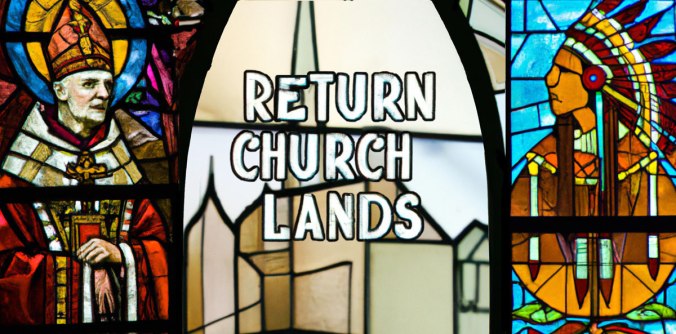
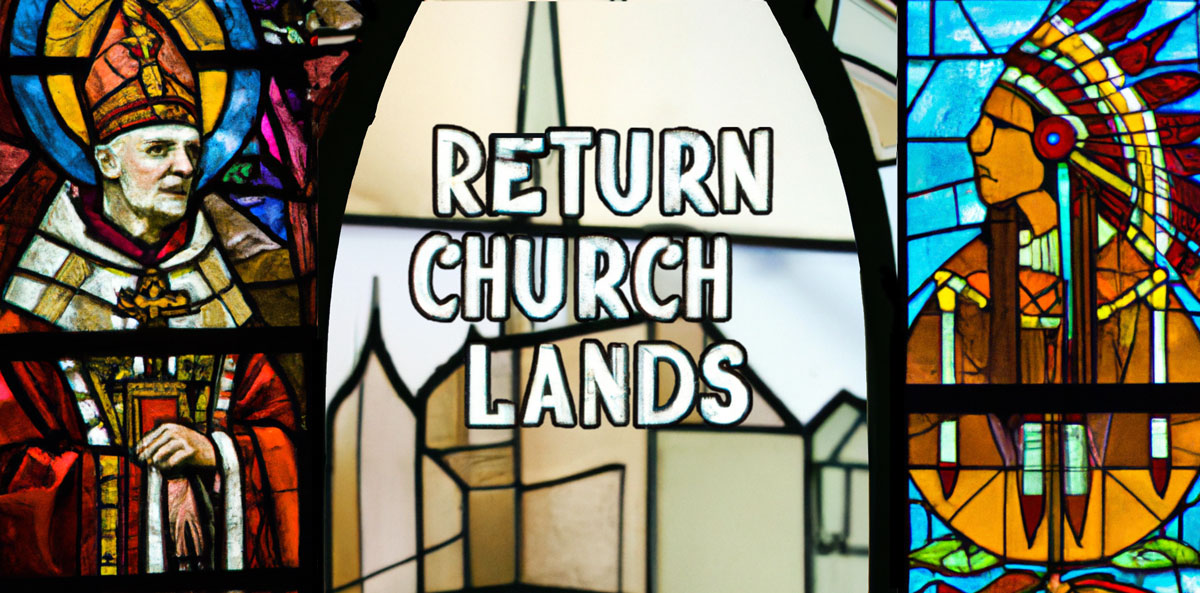
In 2015, Pope Francis published Laudato Si’, his encyclical acknowledging the climate crisis and extolling his flock to consciously act in accordance with Unci Maka, our Grandmother Earth. Then, in 2022, he visited Canada and apologized for the genocide of First Nations peoples in residential schools at the hands of the Catholic Church. Finally, in 2023, the pope denounced the Doctrine of Discovery, 15th century papal bulls responsible for underpinning centuries of colonization of Indigenous lands under European banners in the name of the Christian God.
The pope’s apparent desires to make recompense for the Church’s historic role in the genocide of Indigenous People and have his flock live with more respect for the Earth go hand in hand. As you well know, we have always known how to live in harmony with our natural surroundings, with a deep understanding of our own relationship to all living things. My ancestors fought the colonizers, and with respect for their sacrifice, I have stood up to Big Oil and all who disrupt the natural balance or threaten our communities. I also take the stance that we must build alliances — even unlikely ones — to create the future we want for our next generations.
Therefore it makes perfect sense for us to take the lead in encouraging the pope to work with Native nations to return sacred lands to Indigenous stewardship — and also with state governments who have benefitted through the centuries from their affiliation with the Church. Let me be clear about those benefits: it is no overstatement to say that the Doctrine of Discovery underpins both Federal Indian Law and property law here in the United States. Virtually every aspect of the legal system we encounter as Native People has been set up to keep us down — from day one into the foreseeable future.
But we won’t be kept down. Let us be united, creative, and diligent in seeking remedies that can benefit not just Indigenous communities, but everyone who shares space with us in this world.
Wopila tanka — thank you for your care and advocacy! Chase Iron Eyes Director and Lead Counsel The Lakota People’s Law Project
As you know, very few things matter to me — and to this organization and to the planet we all hope our future generations can continue to inhabit — as much as a just transition to clean energy. That’s why we support communities fighting on the frontlines against harmful extractive projects, like the Standing Rock Nation and the Reno-Sparks Indian Colony as they resist the Dakota Access pipeline (DAPL) and Thacker Pass lithium mine, respectively. It’s also why we continue to ally with Native-led groups promoting climate solutions which encompass Indigenous knowledge and respect tribal sovereignty.
To that end, this week I traveled to the Muscogee Nation near Tulsa, OK, to attend the second annual Tribal Energy Equity Summit. I was honored to speak at this important gathering, hosted by the Alliance for Tribal Clean Energy. It brought leaders from tribes and organizations across Turtle Island together with representatives from the federal government to share our viewpoints and advance equitable clean energy solutions. As part of my attendance, I sat down with Chéri Smith, the alliance’s president and CEO, to talk about the importance of Indigenous agency in creating a clean energy future for tribes. Please watch our short video, meet Chéri, and learn more about her organization’s mission.
Watch: I sat down with Chéri Smith, President and CEO of the Alliance for Tribal Clean Energy, to talk about the importance of Indigenous agency in creating a clean energy future for tribes.
It’s been — if you’ll pardon the pun — an energizing week! The summit afforded me a great opportunity to network with like-minded people and organizations, meet new friends, and reconnect with old ones. I was especially happy to share space with Dennis “Bumpy” Pu‘uhonua Kanahele, head of the Nation of Hawai’i, which maintains its status as a sovereign government under international law, independent of the United States.
As our presence at the same summit that also hosted a pair of representatives from the White House indicates, this was a diverse gathering which welcomed a multitude of perspectives on how we can solve tribal energy issues in a just way and begin to remediate the climate crisis. As you know — and as exemplified by DAPL’s violation of our treaty lands, which hold so much potential for renewable energy development — those two issues are inextricably linked. I’m excited to see where we’ll go from here!
Speaking of DAPL: many of you have reached out to us after reading about my participation in the ongoing trial to determine whether the federal government should reimburse the State of North Dakota for exorbitant costs it alleges it incurred by over-policing our peaceful NoDAPL movement in 2016 and 2017. This article and this one can provide you a bit more of my perspective. I’ll also plan to report back to you with further thoughts once we hear of a judgment.
Wopila tanka — as always, thank you for supporting environmental justice! Chase Iron Eyes Director and Lead Counsel The Lakota People’s Law Project
CINCINNATI, Ohio — They came to protect the water.
Nearly 200 people traveled from Michigan to Cincinnati on Thursday, March 21, to support the state of Michigan’s efforts to stay out of federal court with its legal case calling for a partial shutdown of Enbridge Line 5.
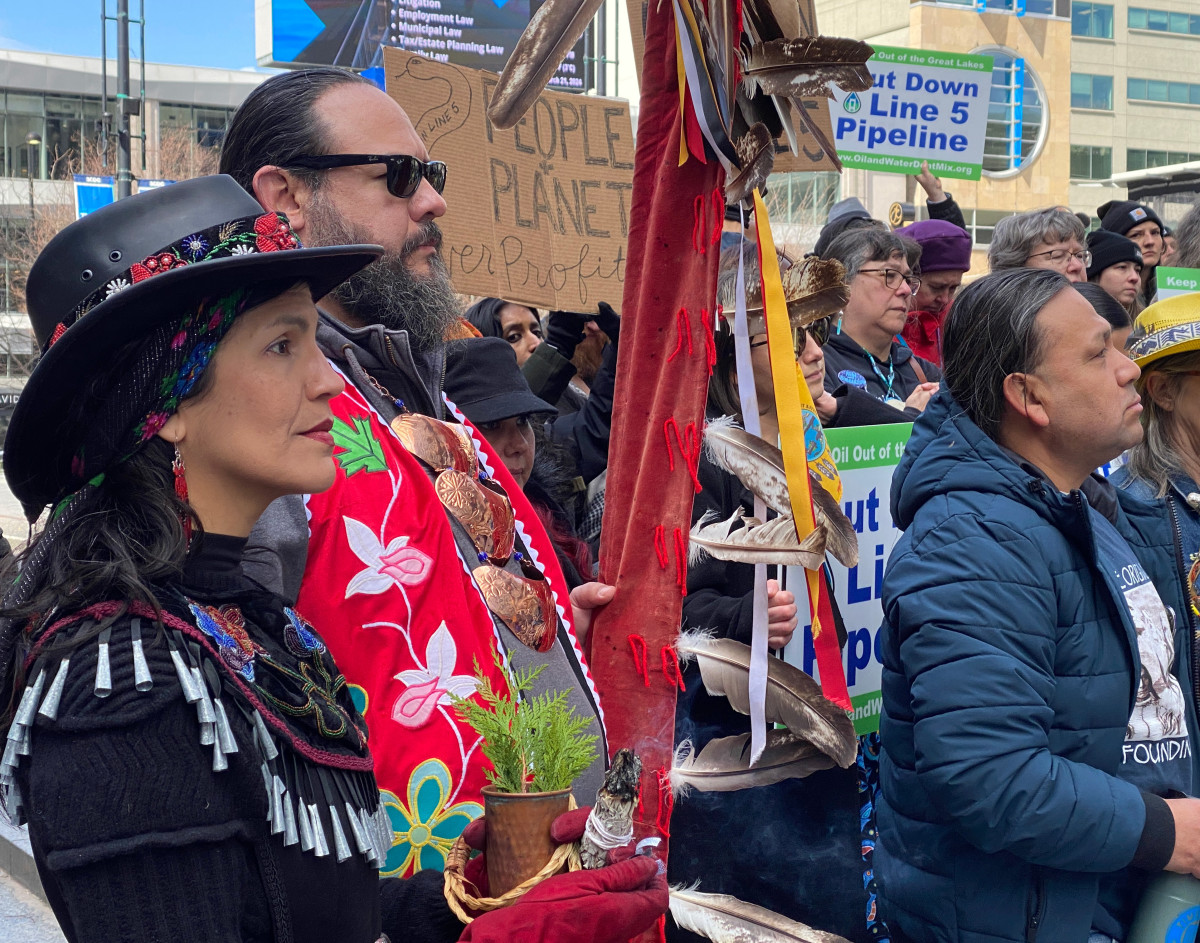
Several citizens and leaders of Michigan tribes were among those who joined the rally at Fountain Square, a major public space in downtown Cincinnati near the U.S. Court of Appeals for the Sixth Circuit.
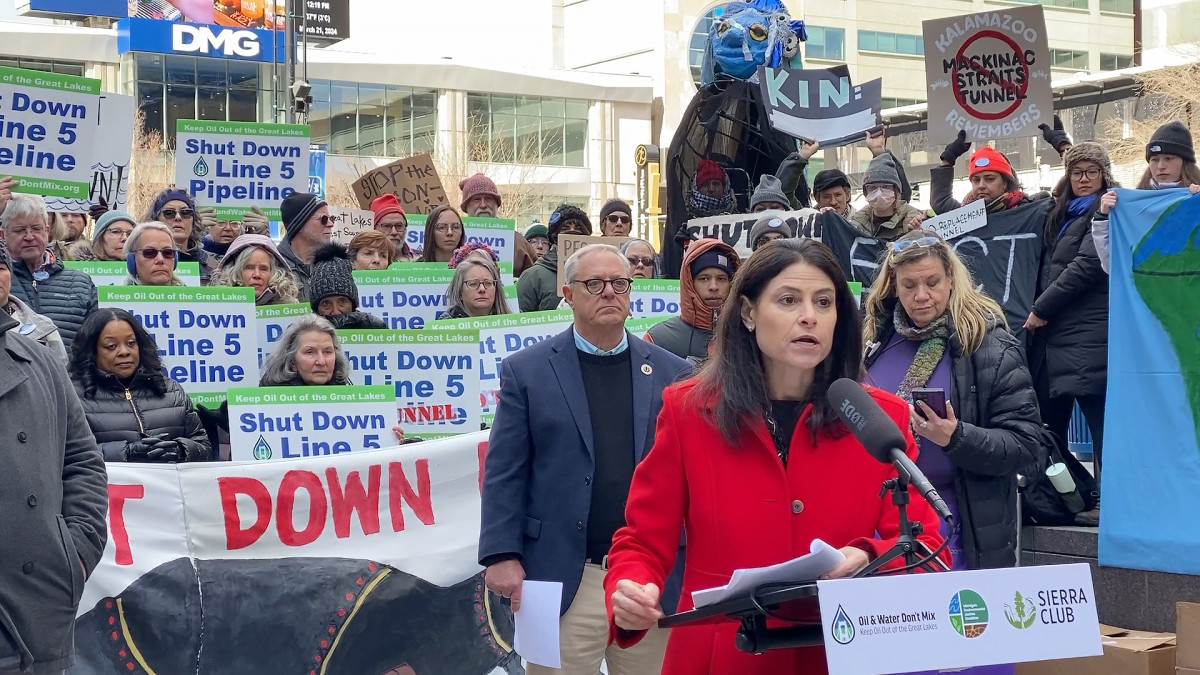
The crowd waved banners and signs calling for the shutdown of the Line 5 pipeline, with some calling for “people and planet over profits.”
Inside the courthouse, Michigan officials asked the federal appeals court to allow the lawsuit filed by the state attorney general’s office to remain in state court – a move supported by a coalition led by the Bay Mills Indian Community of more than 60 tribes from the Great Lakes region and beyond.
“I’m from the Bear Clan. My job is to protect the forest and make sure our water is safe,” Andrea Pierce told the crowd Thursday. Pierce, of the Little Traverse Bay Bands of Odawa Indians, is part of the Michigan Environmental Justice Coalition.
Nicole Keyawbiber and Joe VanAlstine of the Little Traverse Bay Band of Odawa Indians in Michigan join a rally in Cincinnati, Ohio, on March 21, 2024, supporting Michigan Attorney General Dana Nessel’s efforts to keep her office’s lawsuit seeking shutdown of Enbridge line 5 in Michigan state court. (Photo by Mary Annette Pember/ICT)
Michigan Attorney General Dana Nessel, who filed the legal action to shut down the pipeline, addressed the crowd during the rally at Fountain Square on why she wants to keep the issue in state court.
“This is a Michigan case brought under Michigan law by Michigan’s chief law enforcement officer on behalf of the people of Michigan on behalf of our Great Lakes and it belongs in a Michigan court,” she told the cheering crowd.
The Bad River Band of Lake Superior Chippewa in Wisconsin, which is litigating to keep Line 5 off of reservation lands, also signed onto the brief. All 12 of Michigan’s federally recognized tribes passed resolutions calling to decommission Line 5.
‘Public nuisance’
Line 5, constructed in 1953, runs 645 miles from Superior, Wisconsin, east through Michigan’s Upper Peninsula and under the Straits of Mackinac before it terminates in Sarnia, Ontario, Canada.
In the original 2019 lawsuit filed in Michigan circuit court, Nessel sought a shutdown of four miles of Line 5 pipeline that ran under the Straits of Mackinac. The lawsuit contends that the pipeline is a public nuisance and that allowing Enbridge to continue operating it is a violation of the public trust doctrine and the Michigan Environmental Protection Act.
The Straits of Mackinac link Lake Michigan and Lake Huron, and constitute one of the most ecologically sensitive areas in the world, according to Oil and Water Don’t Mix, an advocacy organization based in Michigan.
Michigan Attorney General Dana Nessel tells a crowd of supporters in Cincinnati, Ohio, on March 21, 2024, that her case seeking shutdown of Enbridge Line 5 belongs in Michigan state court rather than federal court. (Photo by Mary Annette Pember/ICT)
Nessel won a restraining order from a state judge in June 2020, but Enbridge successfully moved the case into federal court in December 2021.
Nessel asked U.S. Circuit Judge Janet Neff to shift the case back into state court, but Neff refused, prompting Nessel to appeal to the Sixth Circuit appeals court.
Enbridge filed a separate federal lawsuit in 2020 arguing the state’s attempt to shut down the pipeline interferes with federal regulation of pipeline safety, and could interfere with interstate and international trading of petroleum, driving up oil prices. That case is still pending in Neff’s court.
Enbridge has insisted the section of pipeline that runs beneath the Mackinac Straits is in good condition and could operate indefinitely. Enbridge has proposed encasing the pipes in a protective tunnel.
Assistant Attorney General Daniel Bock told the three-judge panel of the court in Cincinnati Thursday that the challenge to Enbridge’s Line 5 deals with the public trust doctrine, a legal concept in which natural resources belong to the public. He said that concept is rooted in state law.
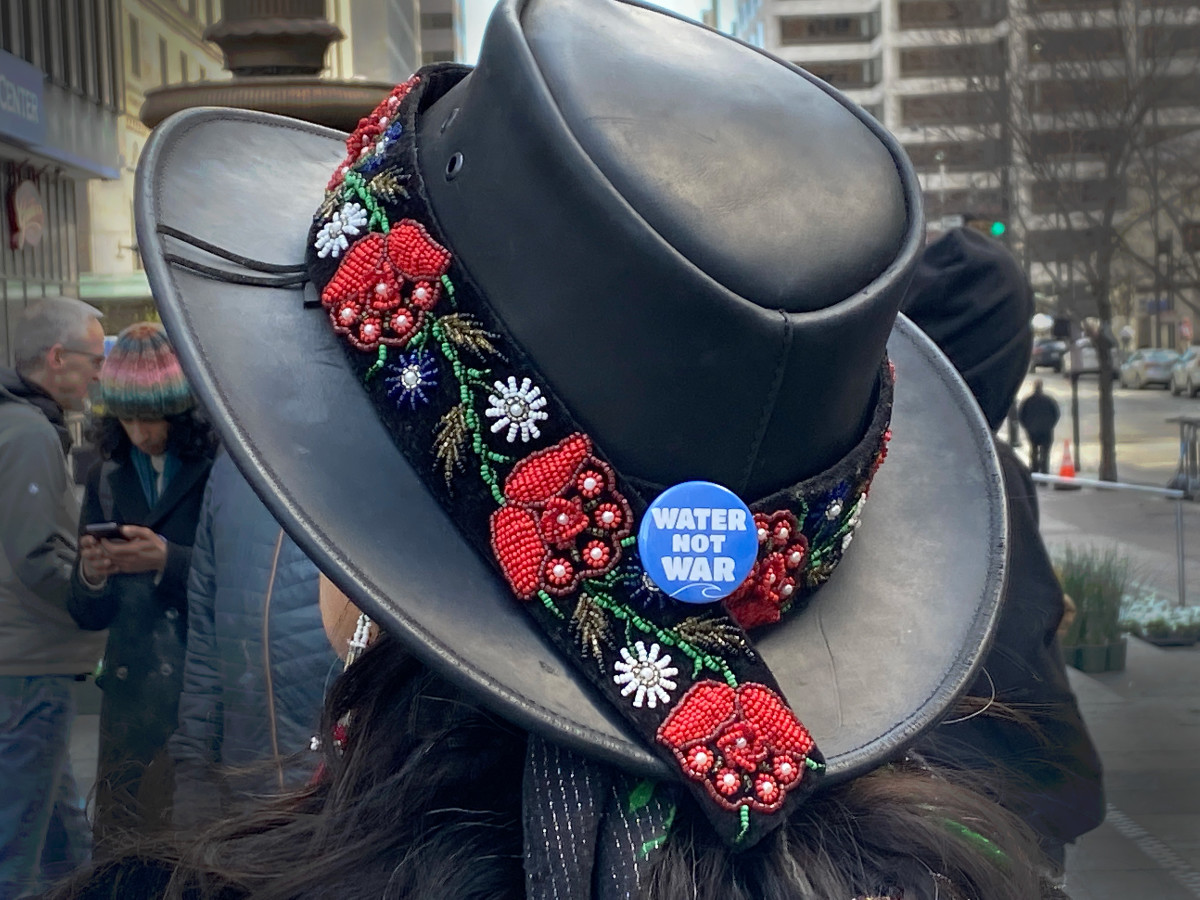
Water protector Nicole Keyawbiber wears a “Water not War” button on her hat at a rally on March 21, 2024, in Cincinnati, Ohio, supporting efforts to keep a Michigan state lawsuit seeking shutdown of Enbridge Line 5 out of federal court. (Photo by Mary Annette Pember/ICT)
Bock went on to assert that Enbridge, the Canadian company that owns the pipeline, missed its deadline to shift the case from state to federal court.
Enbridge attorney Alice Loughran countered that the case should remain in federal court because it affects international trade. She said the company didn’t have to comply with the standard 30-day deadline for requesting removal to federal court because it lacked enough information to formulate the request.
In an email sent to ICT, Enbridge spokesperson Ryan Duffy accused Nessel of forum-shopping in an effort to secure a favorable outcome.
“We are confident that ultimately the Sixth Circuit Court will agree with the lower court’s decisions from August 2022 and November 2021 that this dispute—which has generated a US foreign policy controversy—properly belongs in federal court,” Duffy wrote.
Protests continue
The protesters outside the courthouse were among thousands in recent years to protest the pipeline in Michigan, Wisconsin, Minnesota and even in Canada.
“Near and far, Anishinaabe people have united to protect the Great Lakes,” said Whitney Gravelle, president of the Bay Mills Indian Community, in a statement released Thursday to Earthjustice, a nonprofit environmental law organization.
“We stand behind Attorney General Nessel because we know that shutting down Line 5 is the only way to protect everyone who depends on the land, water, and natural resources within the Great Lakes,” Gravelle said, “including Anishinaabe people exercising our treaty rights.”
This article contains material from The Associated Press.
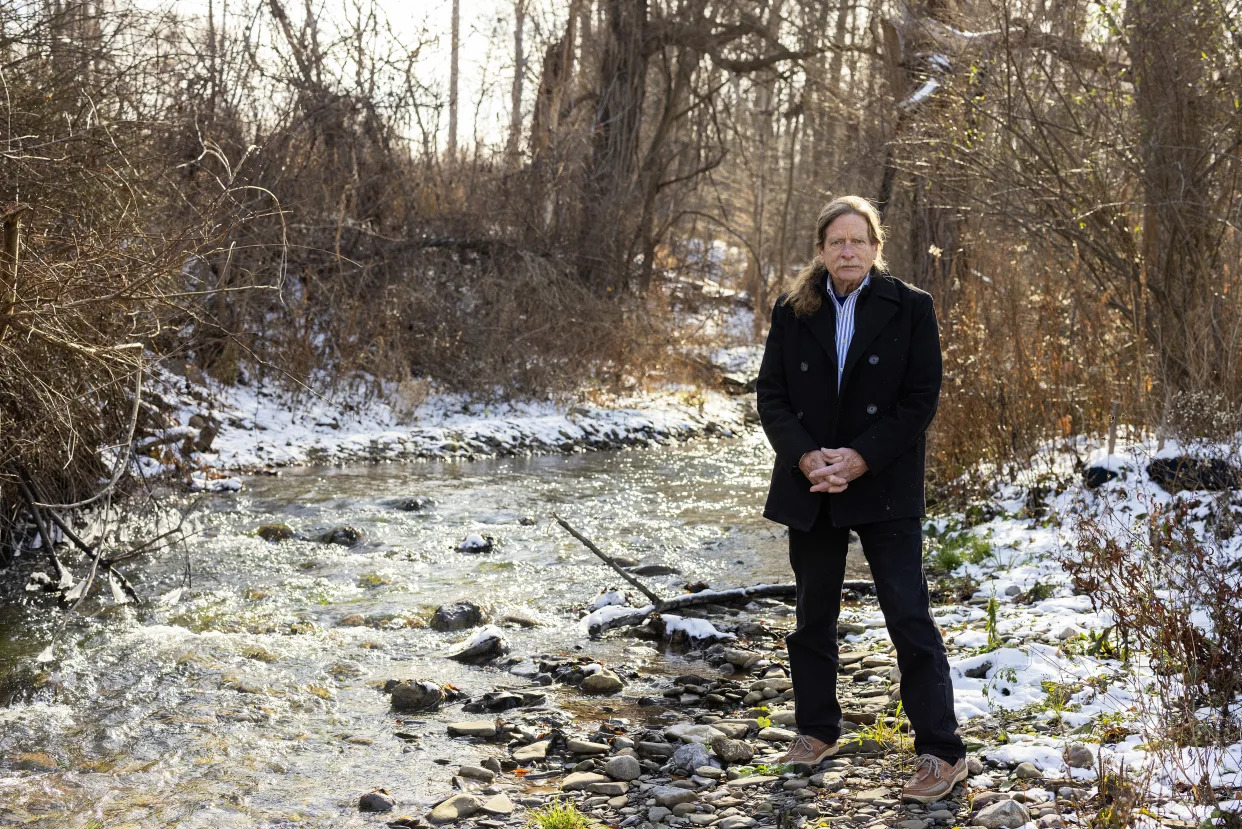
Joe Heath, a lawyer for the Onondaga Nation, at Onondaga Creek, south of Syracuse, N.Y., Nov. 30, 2023. (Lauren Petracca/The New York Times)
ONONDAGA NATION TERRITORY, N.Y. — Four or five years ago, Sidney Hill’s young son came to him with a question that Hill didn’t know how to answer.
The boy had learned that day about the millions of acres of land that his people, the Onondaga, had once called home, and the way that their homeland had been taken parcel by parcel by the state of New York, until all that was left was 11 square miles south of Syracuse.
“We lost all this land,” Hill recalled his son saying. “How can that be?”
In many ways, Hill was the best person to answer that question. As Tadodaho, the spiritual leader of the Onondaga Nation, he was responsible for protecting its legacy and guiding it into the future. He was one of a handful of elders who have worked for decades on a legal and diplomatic strategy to fight back against the historic wrongs his son now sought to understand.
Even so, it caught him off balance.
The younger generation needed to know, he said. “But it doesn’t make much sense to them.”
Hill tried to reassure his son that all that injustice was in the past.
But he knew how hard it was to accept past wrongs, particularly when their consequences so informed the present. It was why he had spent so long pushing — first Onondaga elders, then the U.S. justice system and, finally, an international human rights commission — for a correction to that history.
The Onondaga claim that the United States violated a 1794 treaty, signed by George Washington, that guaranteed 2.5 million acres in central New York to them. The case, filed in 2014, is the second brought by an American Indian nation against the United States in an international human rights body; a finding is expected as soon as this year.
Even if the Onondaga are successful, the result will mostly be symbolic. The entity, the Inter-American Commission on Human Rights, has no power to enforce a finding or settlement, and the United States has said that it does not consider the commission’s recommendations to be binding.
“We could win against them, but that doesn’t mean that they have to abide by whatever,” Hill said in an interview.
The 2.5 million acres have long since been transformed by highways and utility lines, shopping malls, universities, airports and roller rinks.
The territory encompasses the cities of Binghamton and Syracuse, as well as more than 30 state forests, dozens of lakes and countless streams and tributaries. It is also home to 24 Superfund sites, the environmental detritus of the powerhouse economy that helped central New York thrive during the beginning and middle half of the 20th century.
Most notorious of these is Lake Onondaga, which once held the dubious title of America’s most polluted lake.
Industrial waste has left its mark on Onondaga territory, leaving the nation unable to fish from its streams and rivers. The history of environmental degradation is part of what motivates the Onondaga, who consider it their sacred responsibility to protect their land.
One of their chief objectives in filing the petition is a seat at the table on environmental decisions across the original territory. The other is an acknowledgment that New York, even if only in principle, owes them 2.5 million acres.
Across the nation, government officials have grappled with the notion of reparations to address historical injustices. In 2022, officials in Evanston, Illinois, began distributing $25,000 to Black descendants of enslaved people as reparations for housing discrimination.
In New York, people who were once imprisoned for marijuana crimes received preference for licenses to sell cannabis; Gov. Kathy Hochul last year also created a statewide task force to examine whether reparations can be made to address the legacy of racial injustice.
Some Native nations have been willing to drop land claims in exchange for licenses to operate casinos. But the Onondaga say they are not interested in cash. Nor are they interested in licenses to sell cannabis or operate a casino — which they consider socially irresponsible and a threat to their tribal sovereignty.
There’s really just one thing that Hill says would be an acceptable form of payment: land.
The Onondaga insist they are not looking to displace anyone. Instead they hope the state might turn over a tract of unspoiled land for the nation to hunt, fish, preserve or develop as it sees fit. One such repatriation effort is underway: the return of 1,000 acres as a part of a federal settlement with Honeywell International for the contamination of Onondaga Lake.
The United States has not contested the Onondaga’s account of how the nation lost its land. Indeed, the lawyers representing the United States in the Onondaga case have centered their argument on legal precedence, noting that courts at every level — including the U.S. Supreme Court — rejected the Onondaga’s claims as too old and most remedies too disruptive to the region’s current inhabitants.
To the Onondaga, the logic required to square these contentions seems unfair. Why should the United States be allowed to steal their land and face no obligation to give some back?
Joe Heath, a lawyer representing the Onondaga, said the refusal to acknowledge the past stands in the way of healing the future.
“If we don’t admit that those things have happened, how do we move forward together?” he said. But Heath understood that such an admission would have serious legal and practical implications.
“The problem is that all of the land in New York, in the United States, is stolen Indian land,” he said. “What does that mean in terms of U.S. property law?”
‘All of Our Country and for a Very Trifle’
There was a time when the United States worked with the Haudenosaunee, the confederacy that includes the Onondaga, Cayuga, Oneida, Tuscarora, Mohawk and Seneca nations, as the fledgling government sought to defuse conflicts in the aftermath of the Revolutionary War.
The federal government entered into three treaties that affirmed the confederacy’s sovereignty and ownership over much of the northern part of New York state. Critically, those treaties guaranteed that no one but the federal government would have the authority to deal with the Haudenosaunee.
But as early as 1788, New York state had started to chip away at the Haudenosaunee land and sovereignty. Over the next 34 years, the state would come to control nearly all of the Onondaga land — as well as most of that owned by the other Haudenosaunee nations — because of a series of transactions that the Onondaga say were illegal.
“The [New] York people have got almost all of our Country and for a very trifle,” Onondaga chiefs told federal officials in 1794, according to the papers of U.S. Indian Commissioner Timothy Pickering.
For the next two centuries, the Onondaga continued to fruitlessly press their case in numerous face-to-face meetings with presidents, members of Congress and governors of New York.
Legal options were limited: In New York, for example, Native people were not considered to have standing to sue on their own behalf until 1987.
When Indian nations did make it into the courtroom, many claims were dismissed.
The Onondaga’s decision to go to court was decades in the making, with the first discussions beginning more than 40 years ago. For the next 20 years, the council debated in the long house — a long, low structure made of whole logs used for ceremonial events and Haudenosaunee gatherings.
Hill is one of 14 chiefs on that council, each of whom represents a different clan. In the Onondaga tradition, these chiefs are male, but they are appointed by the clan mothers.
The chiefs did not initially embrace the idea of a lawsuit, seeing it as another venue for broken promises.
“Our elders were always afraid of going into courts,” Hill said. Many were concerned that losing in court could lead them to lose what little land they had left.
“We finally said: We have to do something,” Hill said.
In 2005, the Onondaga filed a version of their current claim in U.S. District Court in the Northern District of New York, naming as defendants the state of New York, its governor, Onondaga County, the city of Syracuse and a handful of the companies responsible for the environmental degradation over the past centuries. A similar case filed by the Oneida Nation was, at the time, pending before the Supreme Court.
But just 18 days after the Onondaga filed their petition, the Supreme Court rejected the Oneidas’ case. The decision referenced an colonial-era legal theory known as the Doctrine of Discovery, which holds, in part, that Indigenous property claims were nullified by the “discovery” of that land by Christians.
The “long lapse of time” and “the attendant dramatic changes in the character” precluded the Oneida nation from the “disruptive remedy” it sought, Justice Ruth Bader Ginsburg wrote in the majority decision.
The ruling appeared to doom the chances of any Native nation seeking recompense through the courts. The history seemed settled.
‘Disruptive to Who?’
Of the more than 1,600 words in the Supreme Court’s ruling, one stood out to Hill: “disruptive.”
“When I heard that, I said, ‘Well, OK, disruptive to who?’” he recalled. “It’s already been disruptive to us, as Indigenous people.”
Some might have left it at that: an admission that Native people could never be made whole for the profound wrongs perpetrated on them.
Instead, lawyers for the Onondaga used the rejection as the premise for a new argument. They contended that the U.S. court system’s refusal to find in their favor proved that they could not find justice in the United States.
The petition filed before the international commission amounts to the most direct challenge of the United States’ treatment of Indigenous people to date in terms of human rights — and the first to apply the lens of colonialism.
“What the Onondaga litigation is doing right now is to force a political dialogue with the colonial occupier,” said Andrew Reid, a lawyer representing the Onondaga, adding that a favorable finding could prompt a political conversation about the United States’ treatment of native people on the world stage.
Representatives for the State Department declined to be interviewed and did not respond to requests for comment. But in legal documents, the United States contended that the Onondaga’s central claims have been rejected in prior cases; that they have had “abundant opportunity” for their case to be heard; and that they are merely unhappy with the outcome. It also contended that the commission has no jurisdiction, given that the bulk of the nation’s losses took place two centuries before it was established.
“The judicial process functioned as it should have in this matter,” the United States wrote in legal papers.
The commission’s decision could come at any time, but Hill is trying not to focus on it.
Most days he is glad to have tried.
“We aren’t sure how it’s going to go,” he says. “But at least it won’t be hanging there for the next generation.”
51 years ago last week, my relatives powerfully announced themselves on the world stage. In response to the ongoing subjugation of our people, more than 200 Oglala Lakota and American Indian Movement (AIM) activists occupied the town of Wounded Knee, right down the road from me, here on the Pine Ridge Indian Reservation. You probably know some of what happened next. The armed standoff with federal government agents lasted more than two months, garnering regular coverage on the nightly news and waking people across the planet to our struggle in a new way.
Today, I encourage you to become more familiar with what this occupation meant at the time and explore its lasting legacy. Please read my article on Last Real Indians from a few years back and watch this video from my daughter, Lakota Law spokesperson and organizer Tokata Iron Eyes, who was on the ground (and horseback) for the anniversary last week.
More than 50 years after the fact, I still have questions — some similar to those my relatives must have asked at the time they rose up in 1973. How could the U.S. government expect traditional people to live under the conditions colonialism forced upon us? How could such treatment escape the accountability of the law, and how could we be expected to forgive it? And, now, as we continue to fight for basic things like clean water and meaningful input — and as we continue, too often, to question one another — what will be the legacy of AIM, and of our resistance decades later against the Dakota Access pipeline?
Those are hard questions to answer, but I do know one thing. Without a doubt, the United States is responsible for all of it. This is how colonization works. An occupying force gains by instigating, arming, funding, and providing legal cover for murder. It gains by dividing and conquering. It gains land, minerals, and wealth. Our continued subjugation and our infighting are good for the colony.
About two years after the occupation ended, on the very day that FBI agents Ronald Williams and Jack Coler were killed on the Jumping Bull compound (for which AIM activist Leonard Peltier was later falsely convicted), the Oglala Sioux Tribe signed over a huge chunk of land containing mineral deposits to the United States. Consider that colonizers often use diversionary tactics and counterinsurgency measures to lower the cost of extracting whatever minerals the corporations want — and to eliminate opposition.
In the 1970s, that opposition was coming domestically from hippies, Black nationalists, the Brown Berets, the Student Nonviolent Coordinating Committee, the Weathermen, AIM, the National Indian Youth Council, and so forth. America was still openly racist, people were dying, and BIPOC (Black/Indigenous/People of Color) had no choice but to take public stands to shed light and call attention to the conditions we faced, regularly enforced by a government that either didn’t care or wanted us gone.
Thus, in our lexicon, we say that AIM liberated Wounded Knee. We celebrate Feb. 27 as “Liberation Day.” To this day, we remember the liberators with pride — and we remember that we are always susceptible to manipulation by outside forces. That’s exactly why we rose up once again at Standing Rock in 2016. And while it’s troubling that we continue to have to make such stands, I also see reason for hope.
More and more Americans are beginning to understand that most of their elected leaders have little interest in defending our country from extractive and/or war-profiteering corporations. Many Americans find themselves on our side now; they see corporate encroachment invading every aspect of their lives. I’m grateful that you recognize we must celebrate liberation, celebrate a patriotism which defends sacred lands and waters — and, by extension, ourselves, our birthrights, and our constitutional rights.
Wopila tanka — thank you for supporting Indigenous sovereignty! Chase Iron Eyes Director and Lead Counsel
You’ve heard from me a few times already this year about the importance of coalition building to achieve a new level of effectiveness — not just in our own work, but in the work my Indigenous relatives are undertaking at tribal nations across Turtle Island. To that end, today I share with you about a trip I took to spend a few days earlier this month with people I greatly respect at the Wind River Reservation in so-called Wyoming.
The seventh largest reservation in the U.S., the Wind River Nation encompasses more than 2 million acres of incredible wildlands, and it’s home to people from both Northern Arapaho and Eastern Shoshone tribes. I went to visit a few friends there, including Wes Martel, who you may remember from his keynote speech at the Great Plains Water Alliance’s Winter Water and Climate Conference, featured in our 20th Dakota Water Wars chapter. I also spent time with Jason Baldes, a central figure helping to return American Buffalo to Wind River and other tribal nations. I encourage you to watch “Homecoming,” a short documentary on PBS, about his wonderful work.
Watch: Buffalo return to Wind River in “Homecoming,” a PBS short documentary featuring the voice and good work of Jason Baldes.
To you, the inextricable link between Native people and buffalo is likely no mystery. Jason speaks to this eloquently in the documentary.“To restore that animal to our communities means that we can begin to heal,” he says. “From atrocities of the past, from loss of land, from loss of culture, loss of language. It’s foundational to who we are.”
That’s just one example of good Indigenous storytelling emanating from Wind River. While there, I also discovered the great music of Christian Wallowing Bull, a talented Northern Arapaho singer-songwriter featured in the new documentary film “Lone Wolf,” which premiered in California a few days ago. I then spoke with Dave Herring, the film’s director. I hope that you’ll watch their film and be as inspired by Christian’s story as I was.
As you can see, we’re taking extra time this year to build connections with people, organizations, and tribal nations. In order to create a better society, it’s critical to advance not just our own priorities as Lakota People, but also those of all our relatives with their own traditional knowledge systems, art, and dreams. Between us, we’ve got much more in store to share with you. Stay tuned!
Wopila tanka — My continued thanks for supporting all Indigenous people, art, and culture. Chase Iron Eyes Director and Lead Counsel The Lakota People’s Law Project
Lakota People’s Law Project 547 South 7th Street #149 Bismarck, ND 58504-5859
Greetings from Las Vegas, where I stopped to observe the mayhem of Super Bowl week. As my dad wrote to you a few days ago, we remain committed to changing the Kansas City Chiefs team name — and all racist characterizations of our people in the sports world. Also, I want to take a moment to say that because we are all human, and no matter how big our differences, I offer my sincere condolences to the Kansas City community in the wake of yet another instance of senseless gun violence. I pray for the day when we find better ways to listen to one another, discover common ground and understanding, and stop killing each other.
On a happier note, on my way to Vegas, I journeyed through some spectacular, sacred places. These included some of the Trail of the Ancients and traditional homelands of the Diné (Navajo) and Ute Peoples, including Monument Valley and Bears Ears National Monument — where something wonderful has occurred. I encourage you to watch my short video, recorded onsite, to hear about the recent gift of land back to Indigenous stewardship in Cottonwood Canyon.
Watch: I visited the sacred lands of the Ute and Diné Peoples to see Cottonwood Canyon and share with you about the importance of Landback efforts like the one in Cottonwood Canyon.
In many ways, the process undertaken with Cottonwood Canyon can serve as a model elsewhere across Turtle Island. A nonprofit organization bought available land and synched with a consortium of Native Peoples to preserve a beautiful place featuring rare views of spectacular rock formations and ancient dwelling sites. That’s something I dearly hope we can eventually replicate on a much larger scale with the Black Hills — but I’m also happy anytime we see the return of sacred lands to Indigenous care.
I’ll also say that the model isn’t perfect. Such transfers shouldn’t come with conditions. Isn’t the point of Native stewardship to respect our traditional knowledge systems regarding the land? So, while I appreciate the intent behind a condition of the transfer that will limit access to the site, I would also suggest that it shouldn’t be about eliminating human contact. Human beings should, in fact, have the opportunity to visit sacred places and relearn how to live in harmony with them, just as my relatives and ancestors have done for time immemorial. Even our allies can learn something here: please stop holding us to rules designed by colonizers.
In any case, a win is a win! Ultimately this gift will ensure that a special place displaying the ingenuity of our relatives’ ancestors and the vistas they loved will remain unspoiled for generations to come. And for that, I am truly grateful.
Wopila tanka — thank you for supporting landback efforts! Tokata Iron Eyes Spokesperson & Organizer The Lakota People’s Law Project
Lakota People’s Law Project 547 South 7th Street #149 Bismarck, ND 58504-5859
The Lakota People’s Law Project is part of the Romero Institute, a nonprofit 501(c)(3) law and policy center. All donations are tax-deductible.
PORTLAND, Ore., Jan. 25 – As light from the morning sun began to fill the city of Portland, a group of over 100 community members gathered together on the steps of the Lovejoy Fountain Park in downtown Portland. Traditional Palestinian Keffiyehs, now a symbol for Palestinian freedom, shielded the faces of some attendees and kept them warm in the dreary weather.
The smell of sage wafted through the air leading community members to the Indigenous-led sunrise ceremony in solidarity with Palestine, as Lummi Nation citizen, Nic Niggemeyer, shared a hand drum song with the crowd.
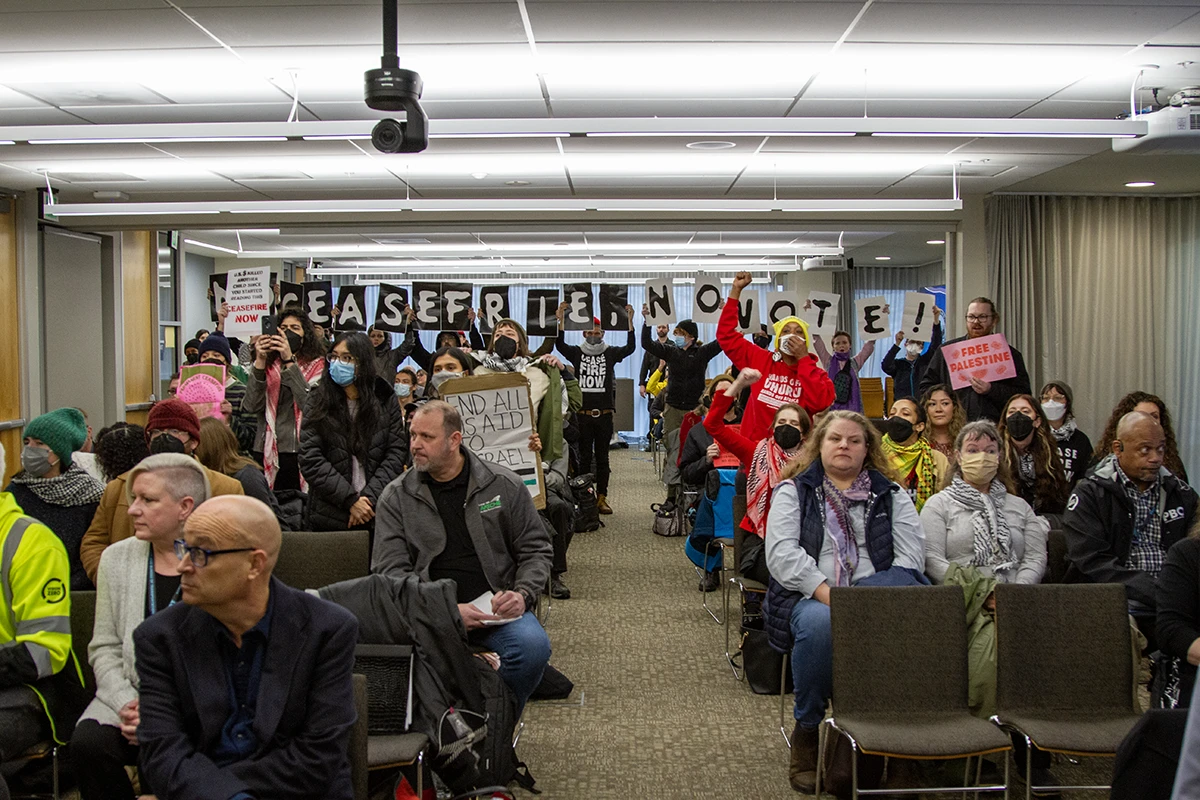
As the clock ticked closer to 9:30 am, attendees lined up inside a City of Portland Building for the Jan. 24 Portland City Council meeting. Dozens streamed into the meeting room. Four people who signed up ahead of time, delivered remarks to city commissioners and asked them to pass a resolution calling for an immediate and permanent ceasefire in Gaza. Mayor Ted Wheeler was not in attendance, as he had a “conflict for the early part of the meeting,” according to commissioner Mingus Mapps, who presided over the meeting.
Each speaker stood in front of the council members and used their three minutes to speak about the injustices they believe are happening in Palestine and the complacency of the U.S. government and the city of Portland in the genocide of Palestinians. Members in the crowd stood up holding signs reading, “No ceasefire, no votes,” and, “Free Palestine.”
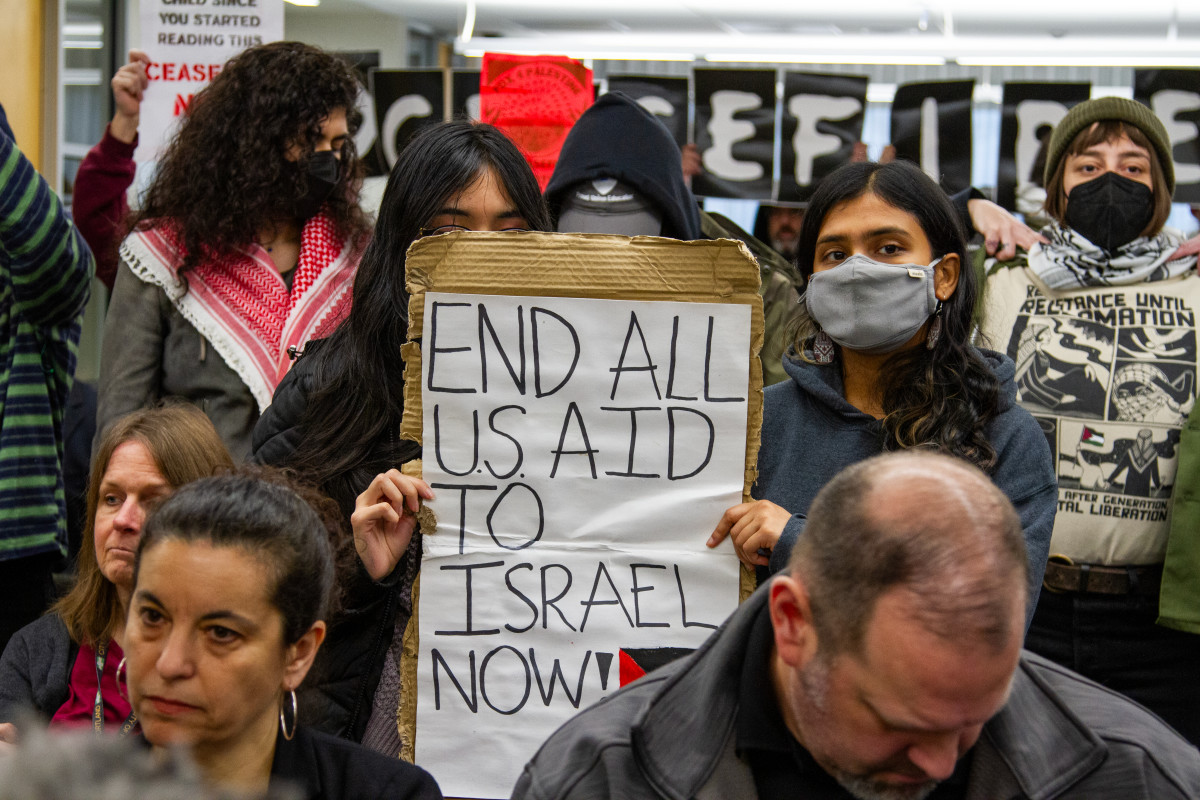
One attendee at the Jan. 24 Portland city council meeting held a sign that reads, “U.S. [money] killed another child since you started reading this. Ceasefire now.” (Photo by Jarrette Werk Underscore News/Report for America)
“I am here to emphasize that this global issue has deep, local repercussions and requires you to take action,” said Alexandria Saleem, a Palestinian American woman who spoke to the council. She shared that 19 members of her family have been killed in Palestine by Israeli airstrikes. “I am testifying today to urge you to support an immediate and permanent ceasefire and the entry of urgent humanitarian aid into Gaza.”
After the first four speakers, Portland commissioners moved on with little acknowledgement of the demands for a ceasefire. Attendees quickly erupted into chants of, “What about Palestine?,” “Acknowledge us,” “Blood on your hands,” and, “How many more children?” Dozens more spilled out of the room, down the hall and in the main entrance of the building holding signs and demanding a ceasefire.
The protest caused the commissioners to take a recess. None responded to the demands of their constituents.
Two individuals hold up a piece of cardboard with signs on the front and back. One reads, “End all U.S. aid to Israel now.” (Photo by Jarrette Werk Underscore News/Report for America)
‘Their struggle is our struggle’
Protests like these have been consistent across the globe following the Israeli besiege and bombardment of the Gaza strip after a Palestinian resistance group called, Hamas, attacked Israeli civilians on Oct. 7. From organizing marches, to using social media to spread information, to paddling in traditional Nisqually canoes to block docked military ships, Indigenous organizers from across Turtle Island have been actively speaking up and speaking out against what they all agree is a genocide currently taking place in Gaza.
“I want to be loud,” said Colleta Macy, a Warm Springs artist and activist. “I want to be radical. I want to shut it down.”
During the first week of December, Macy, a citizen of the Confederated Tribes of Warm Springs, says she organized the first march in Warm Springs history to show support and solidarity for another country. Around 40 community members joined in as they marched to the Deschutes River to sing songs and offer prayers for Palestine.
One week later, she organized another protest in the neighboring town of Madras. On the last day of 2023, she joined hundreds of protestors while wearing her jingle dress, dancing and offering prayers for Palestine while they shut down the Morrison Bridge in downtown Portland. Last week, Macy and her daughter were invited to attend the “March in DC for Palestine,” where thousands gathered at the country’s capital to demand an end to the Israeli military action in Gaza.
On Jan. 24, Macy and members of her family joined the sunrise ceremony, offering a hand drum song, before the crowd marched to attend the Portland City Council meeting, calling for a ceasefire. Macy says as an Indigenous woman she has a responsibility to stand in solidarity with her Palestinian relatives.
Colleta Macy, citizen of the Confederated Tribes of Warm Springs, is an artist and activist who uses her platform to educate her community about what she calls an ongoing genocide of Palestinian people in Gaza. “Their struggle is our struggle,” Macy said. “It’s just history repeating itself. We can’t have what happened to us happen to them.” (Photo by Jarrette Werk Underscore News/Report for America)
Indigenous nations of Turtle Island have been dealing with colonization for over five centuries, and because of this Macy says all Indigenous people need to be standing in solidarity and demanding an end to the genocide that is being publicized for the world to see.
“Seeing that same resilience, that same strength as our people – it’s powerful,” Macy said, in reference to the resistance of Palestinian people. “It reminds me of our warriors, back centuries ago, who would dance in prayer before they would go out and face the cavalry.”
Over a century of Palestinian resistance
Most people think the conflict started on Oct. 7, but in reality the Palestinian story is more than 100 years old. The fight for Palestinian sovereignty came to a head with the passage of the Balfour Declaration of 1917 in which the United Kingdom expressed sympathy with the Zionist movement and support of Palestine becoming a “national home for the Jewish people.”
What follows has been over a hundred years of occupation, oppression and struggle for Palestinian sovereignty. Millions of Palestinians have been displaced and now live as refugees all over the world because of the violence of the occupation.
On May 15 every year, Palestinians around the world remember “Al Nakba,” which translates to “the catastrophe.” This is a reference to the Israeli ethnic cleansing of Palestinian people from 531 villages encompassing 78 percent of Palestine for settler occupation. This catastrophe is especially marked with memory of the many massacres by Zionist militias and attempted destruction of Palestinian society in 1948 when the State of Israel came into being.
Attendees were overtaken with emotions as one speaker, an expecting mother, shared statistics about infant and other deaths at the hands of the Israeli military. (Photo by Jarrette Werk Underscore News/Report for America)
Today, one of the few areas Palestinians have been relocated to is the Gaza strip, a portion of land roughly the size of the city of Las Vegas that is fenced in to control the movement of people and goods coming in and out of Gaza. Two-thirds of Palestinians before Oct. 7 were living in poverty.
“In reality, the Palestinian question…started in 1897, by the establishment of the Zionist movement,” said Michel Shehadeh, Palestinian writer and activist.
The goal of the Zionist movement claimed to be to secure a Jewish national home after the First World War — which they claim is Jersulem. However, in establishing Israel, the movement has displaced millions of Indigenous Palestinian people, who have lived in that region for millennia. Zionism has since come under scrutiny as a political ideology and settler colonial movement that has established an apartheid state.
The Reagan administration attempted to use the Immigration and Nationality Act of 1952 out of fear of a “communist infiltration” to deport Shehadeh. After a 20 year long legal battle that would bring their case to every level of federal court, including the U.S. Supreme Court, a federal appeals court decision declared the act unconstitutional in 2007 and they were allowed to stay in the U.S.. The group became known as the L.A. Eight.
Three years after the 2007 decision, Shehadeh and the other seven were allowed to apply for citizenship. Shehadeh went on to get married and started a family, raising two sons, in central Oregon. Today, he is retired but continues to speak out about the ongoing genocide in his homelands.
“Eighty percent of Gaza is destroyed,” said Shehadeh. “No schools, no hospitals, no infrastructure, no electricity, no water.”
Nearly 200 Palestinians are killed each day, according to Reuters. The death toll from Israeli air strikes has risen to 25,900. At least 11,500 of them were children and 7,300 were women. Thousands more are still unaccounted for, suspected to be under the rubble. Because of the Israeli blockade of humanitarian aid into Gaza, more than half a million people are also facing catastrophic hunger conditions in Gaza. According to the United Nations, no one is safe from starvation. The Israeli civilian death toll since Oct. 7 remains at 1,139.
“Basically, what they’re trying to do is ethnically cleanse Gaza,” Shehadeh said.
Scroll to Continue
Read More
‘We fight for whoever’s land that we are currently on’
Shehadeh also pointed to the long history of allyship between the Indigenous people of Turtle Island and Palestinian people. For him, this is rooted in both living through and resisting genocide and colonization.
“What they’re trying to do is exactly what happened to the Native Americans,” Shehadeh said. “They took the land and want to put the Palestinians in reservations and with time, ethnically cleanse the Palestinians.”
Shedadeh also sees parallels in the biased erasure and stereotyping of the Indigenous people of Turtle Island, and those Indigenous to Palestine in the media and popular films.
Shehadeh remembers watching Western movies growing up. In those movies, Indigenous people were vilified, creating an image of the “evil,” “savage” Native American person, free of any sense of humanity, as if to try and justify genocide. He says this intentional imagery is similar to the picture painted of Palestinians, particularly by mainstream media today equating all Palestinians with terrorism.
“They are vilifying the Palestinian people and dehumanizing them, so it becomes easier for the American public and the west in general, to accept killing [our] people,” Shehadeh said.
A small red pick up truck flew both a Palestinian flag and a Land Back flag with a sign on the back that reads, “No more colonial genocide.” (Photo by Jarrette Werk Underscore News/Report for America)
For both him and Krystal Two Bulls, executive director of Honor the Earth, this genocide is hauntingly similar to the one that colonial settlers brought upon Indigenous people across Turtle Island starting in 1492.
The same U.S. government that killed millions of Indigenous people to create what is now the United States for European settlers to occupy is providing money, weapons and diplomatic support to Israel to do the same to Palestinians. Shehadeh says that the U.S. government is enabling Israel in the genocide of Palestinian people.
Because of the similar history, Shehadeh and Two Bulls, Oglala Lakota and Northern Cheyenne, encourage Indigenous and Palestinian people to stand together in solidarity.
Indigenous Nations and organizations issue calls for a ceasefire
That solidarity can be seen all across Native country, in national Indigenous organizations and Native Nations. Showing solidarity has meant an urgency to release public calls for support of Palestinians and a ceasefire in Gaza. For many, this also means calling out the United States government for the role it plays in what they believe is a genocide.
“Settler colonialism is at the root of the violence in Gaza,” the statement said.
“A ceasefire, an end to the U.S. funding Israel’s military, and true Palestinian land rights and liberation are the path to peace.”
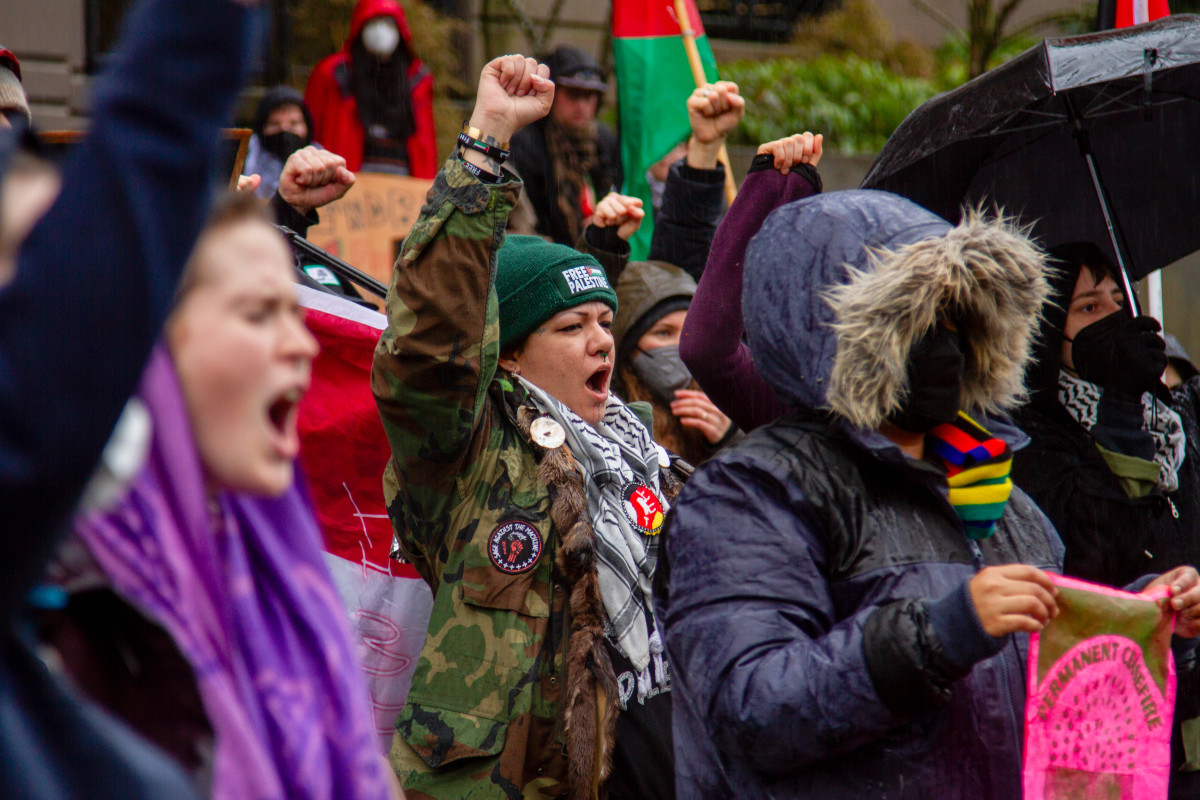
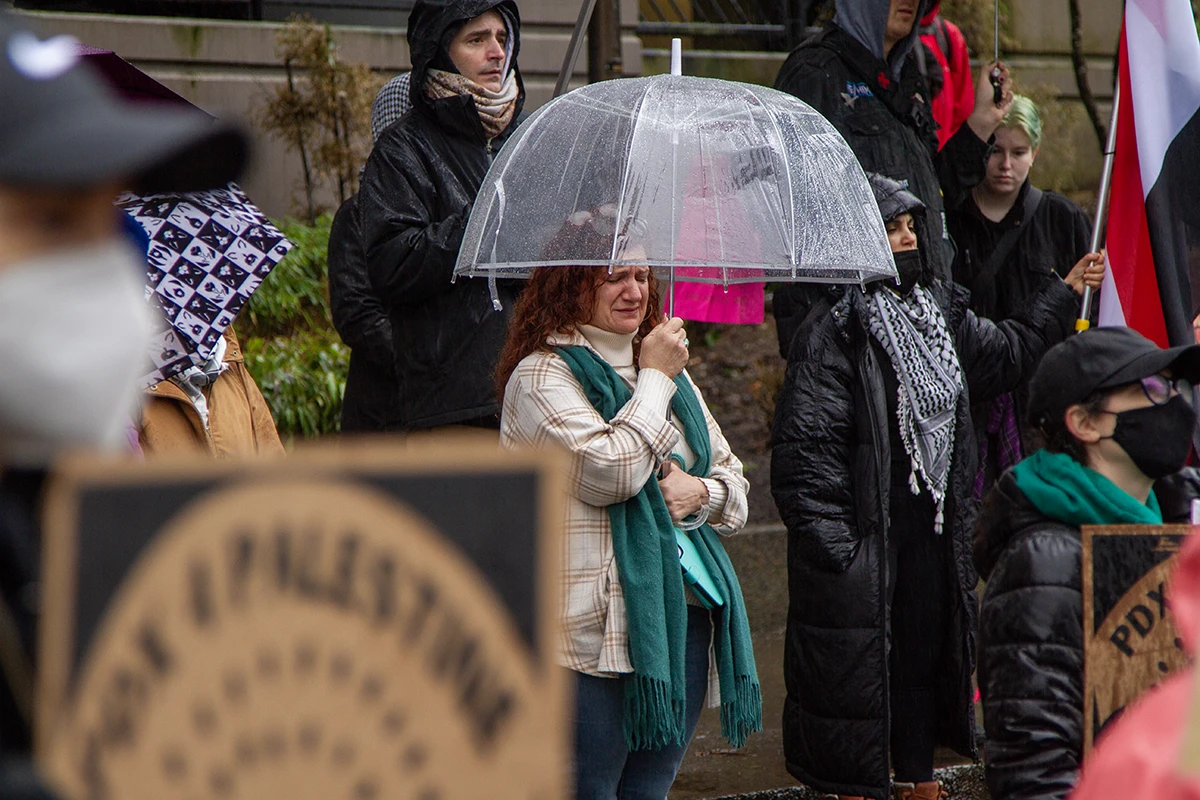
Over 100 community members from Portland and neighboring cities gathered at Lovejoy Fountain Park in downtown Portland for an Indigenous-led sunrise ceremony in solidarity with Palestine. (Photo by Jarrette Werk Underscore News/Report for America)
NDN Collective, an Indigenous-led organization dedicated to decolonization, made four specific demands. First, a call for an immediate ceasefire in Gaza. Second, to allow lifesaving food, fuel and water into Gaza to support Palestinian people. Third, the deployment of refugee and recovery support. And finally, an end to U.S. aid to Israel in the form of money for weapons and military efforts. Over 100 days later, none of those demands have been met and NDN Collective continues to advocate for Palestinian people.
Across Turtle Island, a few Native Nations have also issued public statements calling for a ceasefire. On Nov. 9, Yurok Tribal Council issued one such statement.
“We have endured mass violence, displacement and attempted genocide,” the statement said. “The trauma caused by these devastating events continues to reverberate through our community. For these reasons, we are calling for a swift and equitable end to the conflict.”
A few days later, the Winnemem Wintu Tribe in California issued a similar statement. The statement, released on Nov. 12, positions the nation as standing against the Israeli occupation and invasion of Palestine. The statement points to similar genocidal tactics used by the U.S. government against the Winnemem Wintu Tribe.
Last month, the Oceti Sakowin Treaty Council passed a resolution. The treaty council represents all 49 tribes within the Oceti Sakowin, according to a press release about the resolution.
“In 1830, Congress passed the Indian Removal Act as a means of claiming and expanding U.S. territory by violently removing Native Peoples from our homelands to territories not our own,” the resolution says. “This act was designed to cut relationships Native Peoples had with the land by removing us, keeping us in prisoner of war camps, destroying our homes, our medicines, our crops, our livestock, and killing any who resisted. On the other side of the world, our Palestinian Relatives in Gaza are resisting similar violence and conditions, albeit under a different timeline of settler colonization…the Oceti Sakowin Treaty Council stands in full solidarity with our Palestinian relatives and full liberation of their homeland.”
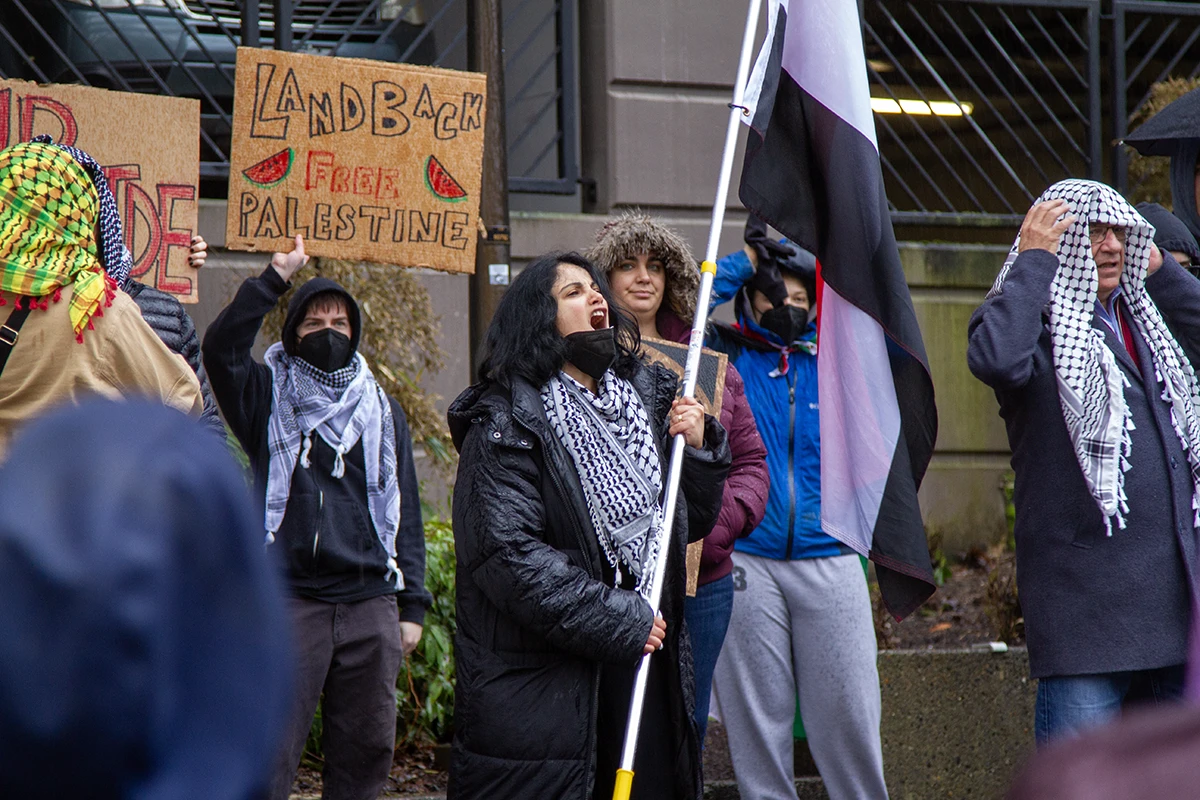
Attendees had posters, banners and tapestries all referencing Palestine and the demand for a ceasefire. Two individuals hold a black flag that reads, “No ceasefire, No votes.” (Photo by Jarrette Werk Underscore News/Report for America)
In the Southwest, President Buu Nygren of the Navajo Nation promised to issue a call for a ceasefire in Gaza in coming weeks, according to an article in the Navajo Times in December. No such call has been released to the public since.
Two Bulls said she hopes other Native Nations call for a ceasefire and for the U.S. government to withdraw military aid from Israel.
“[The U.S. government] always tells us that there’s no funding, and yet we can write checks to Israel to kill other people and do exactly what they did to us,” said Two Bulls. “So it’s actually really foolish of us to think that this doesn’t impact us and that it’s not our fight.”
Calling on Portland city council
As Indigenous people call for Native Nations to issue a ceasefire, there is a movement by community members in Portland demanding the Portland city council do the same. Attendees at the Jan. 24 city council meeting called for Portland to join over 40 other cities across the United States who have passed resolutions in support of a ceasefire.
Nearly five dozen community members attended the Portland city council meeting, on Jan 24. Four different individuals addressed the council, claiming the council is complacent in what they believe is an ongoing genocide in Palestine. They demanded the commissioners pass a resolution for an immediate and permanent ceasefire in Gaza. (Photo by Jarrette Werk Underscore News/Report for America)
Though city council members didn’t respond to the demands of attendees during that meeting, organizers were not deterred. The crowd marched back to the steps of Lovejoy Fountain Park, taking to the streets despite the heavy downpour of rain, speakers continued to talk about the importance of this fight and standing in solidarity with Palestine.
“We call Palestine the tip of the spear because once they are liberated, all Indigenous people will be liberated,” Macy said to the crowd gathered at Lovejoy Fountain Park. “All oppressed people will be liberated. We are all Palestine. We are all Gaza.”
















![One attendee at the Jan. 24 Portland city council meeting held a sign that reads, “U.S. [money] killed another child since you started reading this. Ceasefire now.” (Photo by Jarrette Werk Underscore News/Report for America)](https://ictnews.org/.image/t_share/MjAzODg2OTM0NDc5NjExMzg3/_mg_9813.jpg)




 Water is Life