Oyate watch party at Noon Pacific Time on January 20th
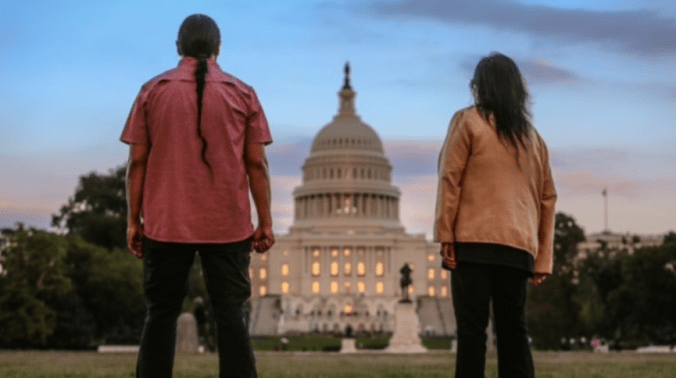
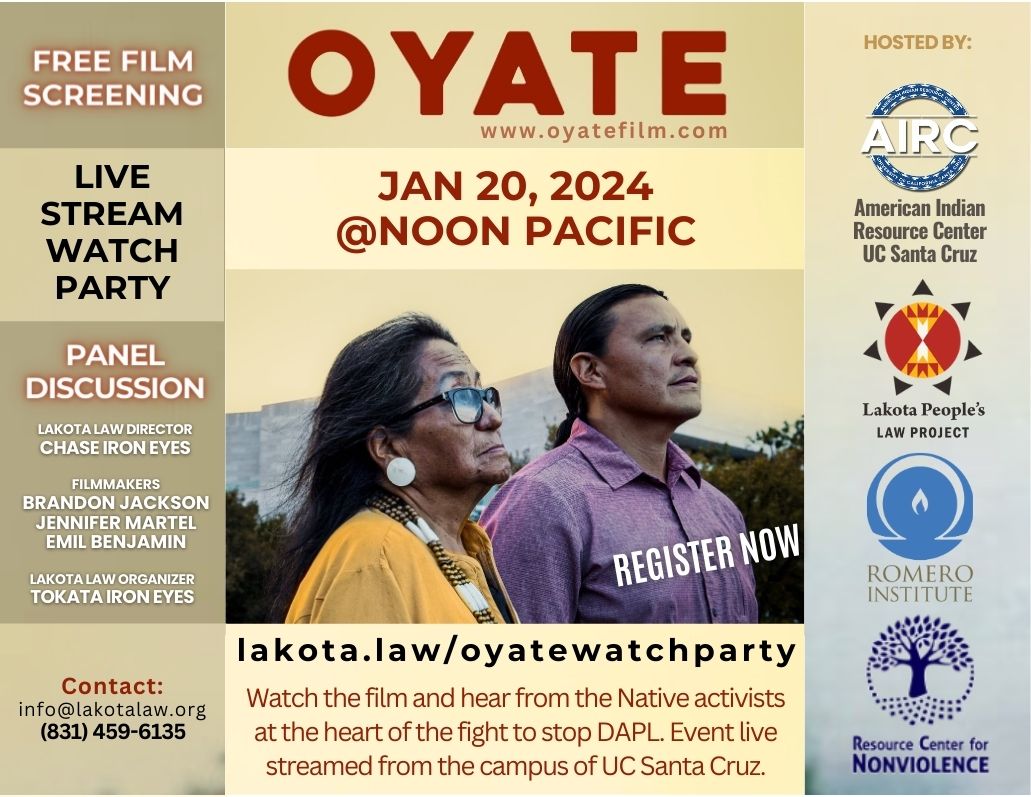
I’m looking forward to a new year working together for Native sovereignty and justice with you. It’s appropriate that our first 2024 event is gathering to watch a crucial film contextualizing the movement to stop the Dakota Access pipeline. You may have heard that we’ve joined with local Santa Cruz groups and the filmmakers of “Oyate” to host our in-person screening at UC Santa Cruz on Jan. 20 at noon PST, which will also be streamed online in real time!
To quickly update you, my daughter Tokata and I will present at the event, joined by the film’s producer/director and the two other producers. Please note that the event’s venue has been moved to the Merrill Center on the UC Santa Cruz campus, and we’ll stream all the festivities from there.
We’ll send you reminders with the link for your party to join our livestream. Look out for those the day before and on the morning of this very special event, Jan. 20!
“Oyate” elevates the voices of Indigenous activists, organizers, and politicians, offering our perspectives on our complicated history and present-day circumstances and illuminating the interconnectivity among the issues facing Indigenous People today. It features excellent music, tells some of our personal stories, and delves deeply into our movement for Native and environmental justice.
In the ongoing spirit of wopila — a meaningful acknowledgment of our gratitude and a desire to share the best of ourselves with you — we offer this opportunity to come together, watch, learn, and move forward with purpose. We thank UCSC, the American Indian Resource Center, and the Resource Center for Nonviolence for making this event possible, and we hope you’ll join us on Jan. 20!
Wopila tanka — thank you for your support and attention! Chase Iron Eyes Director and Lead Counsel The Lakota People’s Law Project
I did not even imagine that my trip to Standing Rock, North Dakota from Sacramento, California with a banner signed by members of the elementary school would end up on the front of the guard shack at the main entrance to the camp.
It is a story.
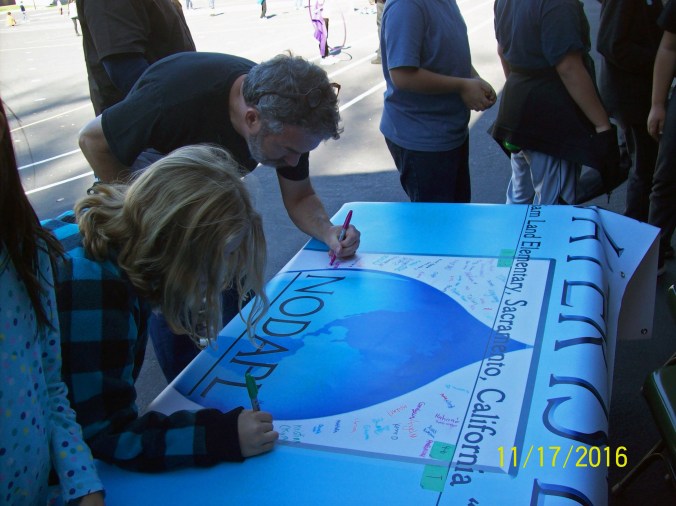
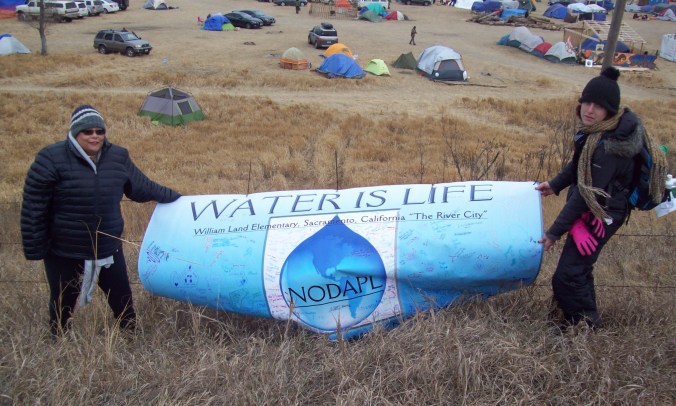
After watching the news of attacks on peaceful protestors and reading about the oil pipeline being rapidly approved, I felt that I must act. I designed a banner, had it printed, and scheduled a signing party at the elementary school where I taught. Everyone at William Land Elementary placed their signatures on the banner during the event on November 17, 2016.
When I arrived in Bismark, I had one mission. I needed to deliver the banner to the tribe.
I was in contact with a woman on Facebook who said she had a friend who was on her way to Standing Rock. This friend, her name was Katie, was going to meet me at the hotel but was delayed. I met her instead at the main gate in Standing Rock. I witnessed the live feed of a major action against the water protectors the night before.
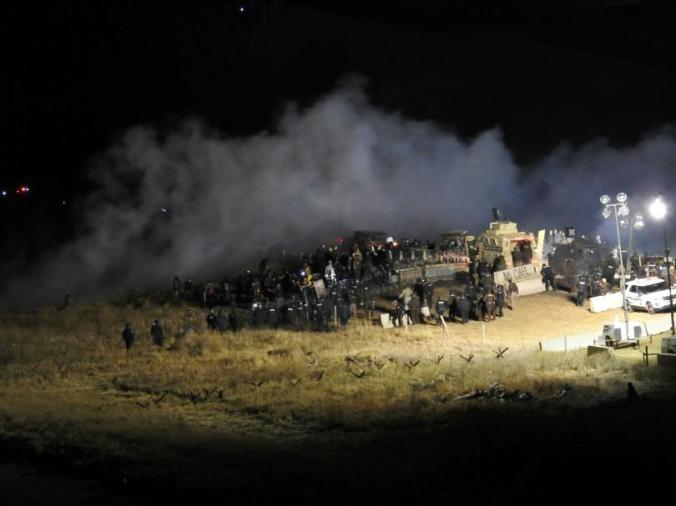
Katie (not her name) had a friend (Billy) come with us to pick up supplies from the Walmart in Bismarck. I found the guy to be very untrustworthy – he shoplifted a hat in Walmart. He did not seem to have the spirit of a person participating in prayer vigils or protest of an oil pipeline. I found Katie to also be very suspect. I thought they might be agents of some sort. I found out on our drive into town that they had already been in Standing Rock and had been involved in the action the night before. They were still coughing from the tear gas.
We delivered the supplies to the various tents at camp: medical, food, and school.
On the third day at Standing Rock, I was able to formally present the banner to the tribal chief. I had purchased tobacco in Bismarck to give as a gift first. Then I handed the chief the banner and asked him to accept it from all the signatories in Sacramento. He accepted it and told me that I had permission to hang it at the front gate. There were hundreds of banners from around the world and around the country in the camp. Each had to get permission from the tribal council to be hung. I was very lucky to get to hang ours on the front gate near the main entrance. In the video it is fleetingly visible, the third banner to the left of the large EnbridgeLies banner.
Unknown water protector, Katie, and Billy with the banner.Me and Katie with the banner.
I felt I was supposed to be there. None of the staff of my school had even heard about what was happening at Standing Rock. The mainstream media was not covering what was happening. Here I was, able to deliver a signed banner all the way from California to Bismarck, North Dakota!
I found out from Katie that Billy was kicked out of camp for not complying with camp rules.
On the day I left Standing Rock, I heard that people were told to evacuate the camp. I worried about the banner and I called and asked Katie to take it down and send it to the tribal offices on the reservation. She told me that she found two guys who would deliver it because she was on her way out of the camp also.
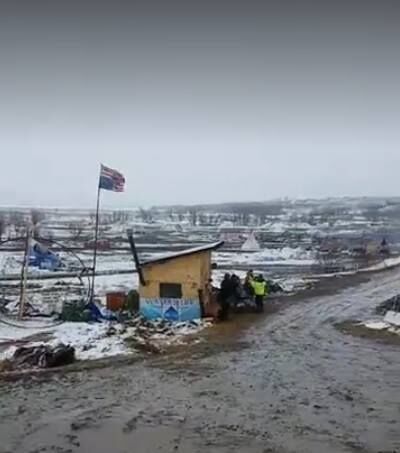
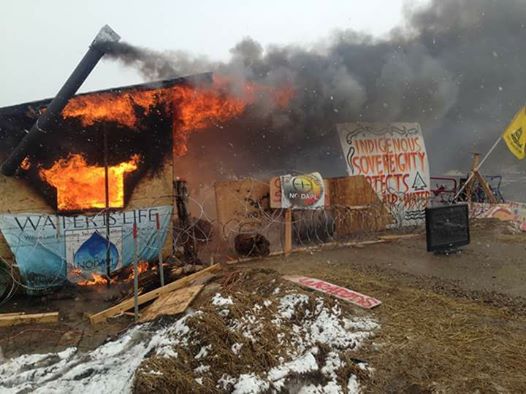
Katie sent me this photo. But instead of delivering the banner to the reservation, they hung it in front of the guard shack! I can only speculate that they put it there temporarily and that it would be taken to the reservation later. I did not know of the ritual burning of everything in the camp as it was evacuated. I left on the 28th.
So, by the time I got back to Sacramento, imagine my shock to see images of our school banner being burned up!
William Land Elementary School in Sacramento, California is forever part of history.
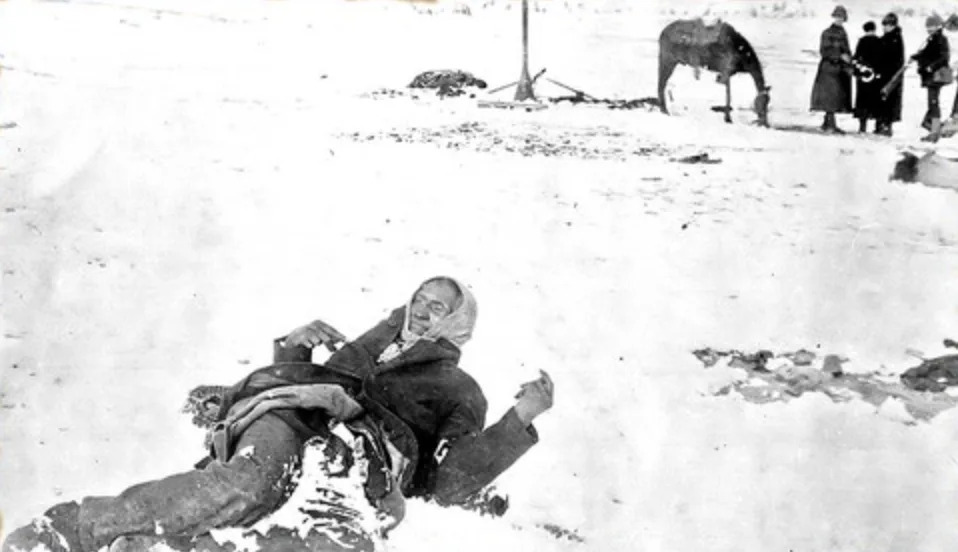
An iconic photo of Big Foot left frozen from the 1890 massacre at Wounded Knee of a dead and frozen Big Foot. (Photo/Public Domain)
Opinion. Today marks the 133rd anniversary of the Massacre of Wounded Knee during the wintry week between Christmas and New Years back in 1890.
Nine days before the massacre that left hundreds of Sioux men, women, and children dead, an obscure weekly newspaper in South Dakota ran an editorial about the death of the Hunkpapa Lakota leader Sitting Bull. In the opinion piece, L. Frank Baum, publisher of the Saturday Pioneer, wrote:
“The Whites, by law of conquest, by justice of civilization, are masters of the American continent, and the best safety of the frontier settlements will be secured by the total annihilation of the few remaining Indians. Why not annihilation? Their glory has fled.”
Early in the morning on Dec. 29, 1890, across the state of South Dakota at Wounded Knee Creek, the Sioux, who were captured the previous afternoon by members of the US 7th Cavalry Regiment, were surrendering their weapons. A shot was fired. The Calvary proceeded to shoot unarmed and innocent Sioux elders, women, and children. While an accurate account will never be known, it is believed between 250 and 300 Sioux were massacred that day.
Snowfall was heavy that December week. The Sioux ancestors killed that day were left on the frigid wintery plains of the reservation before a burial party came to bury them in one mass grave.
After the mass killing of Natives, Baum picked up his poisonous pen again and wrote another editorial for his Saturday Pioneer newspaper. This time, he wrote:
“The Pioneer has before declared that our only safety depends upon the total extirmination [sic] of the Indians. Having wronged them for centuries we had better, in order to protect our civilization, follow it up by one more wrong and wipe these untamed and untamable creatures from the face of the earth. In this lies future safety for our settlers and the soldiers who are under incompetent commands. Otherwise, we may expect future years to be as full of trouble with the redskins as those have been in the past.”
Ten years later, Braum wrote a children’s book called The Wonderful Wizard of Oz. Yes, that one. It was eventually made into one of the most famous movies of all time. When I was a youth, my siblings and I would make popcorn and sit and watch the movie when it was broadcast yearly. As an adult, I discovered Baum’s hatred and poisonous racism towards Native Americans. Suffice it to say, I stopped watching the film.
Now, I realize Braum did not single-handedly cause the genocide of Native Americans. But, he contributed to it with his editorials and his calls for the extermination of Native people. His family later apologized for Baum’s racist editorials.
This is why history matters. If you know your history, you know your place in this world.
In recent weeks, the Republican presidential front-runner, former president Donald Trump, has stated in his stump speech that immigrants entering the U.S. illegally are “poisoning the blood of our country.” There has been pushback that Trump borrowed the line from Adolf Hitler’s rhetoric in his autobiographical manifesto Mein Kampf, which set the principles behind Nazi Germany’s genocide of more than six million Jews.
Trump denies reading the book. I don’t doubt his claim because he is known for not being a reader. But I’m guessing that some of his speech writers and political advisers may have — and they certainly play a role in the words that come out of candidate Trump’s mouth.
I suspect most Americans don’t subscribe to the belief that immigrants are poisoning the blood of our country.
I also believe that most Americans would agree that racism has been a true poison in our country throughout the last two centuries, though it’s not something we’ve been able to eradicate.
That’s why it’s important we remember the Massacre of Wounded Knee, as well as the rhetoric and words used to justify it. Because it’s a potent reminder of what racism has led to in this country: the death of innocent Native people whose ancestors lived on this land since time immemorial.
Thayék gde nwéndëmen – We are all related.
About the Author: “Levi \”Calm Before the Storm\” Rickert (Prairie Band Potawatomi Nation) is the founder, publisher and editor of Native News Online. Rickert was awarded Best Column 2021 Native Media Award for the print\/online category by the Native American Journalists Association. He serves on the advisory board of the Multicultural Media Correspondents Association. He can be reached at levi@nativenewsonline.net.”
Contact: levi@nativenewsonline.net
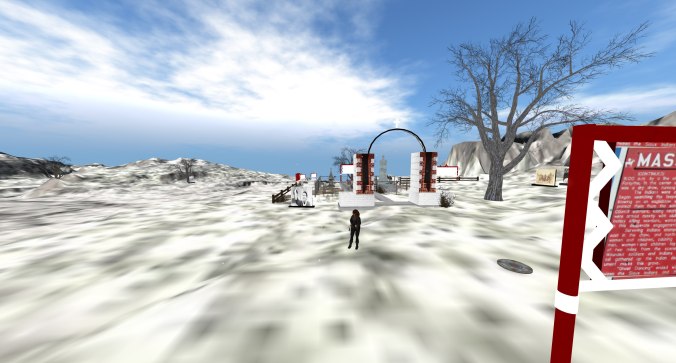
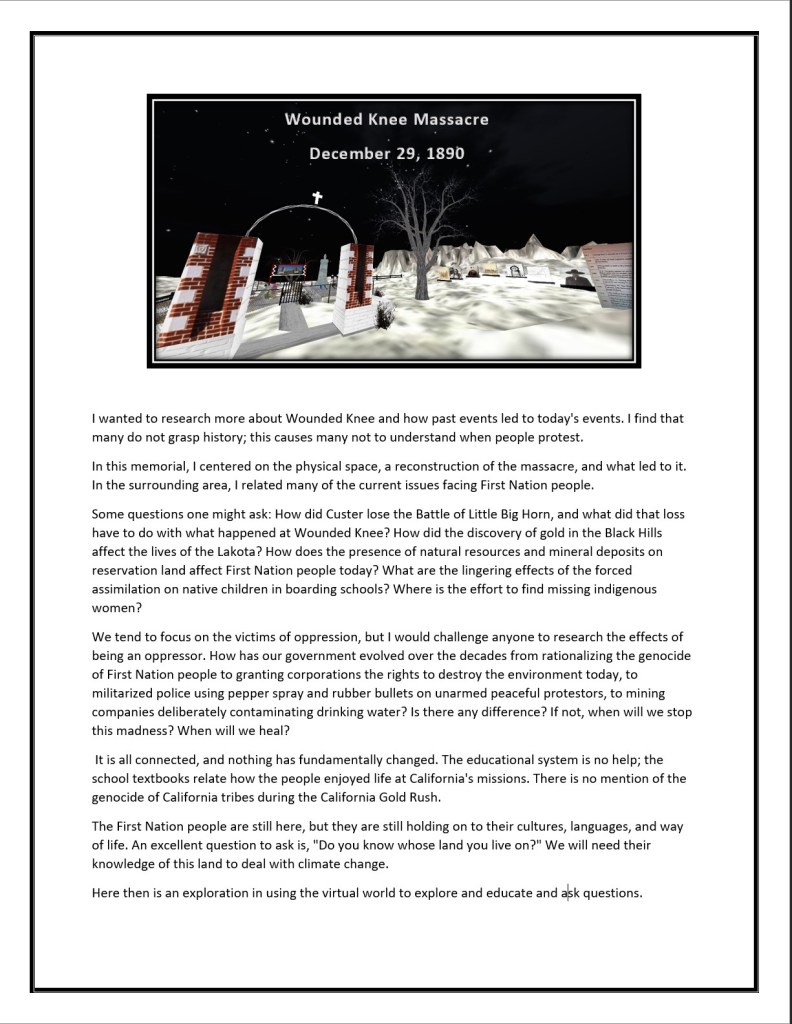
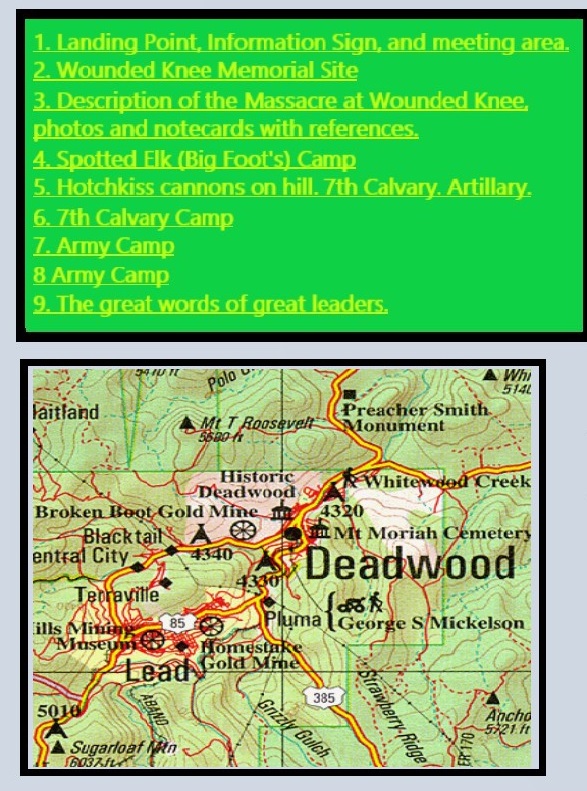
Wounded Knee Massacre December 29, 1890
by Renee Michel 2020 Second Life Virtual Wounded Knee Memorial
I wanted to research more about Wounded Knee and how past events led to today’s events. I find that many do not grasp history; this causes many not to understand when people protest.
In this memorial, I centered on the physical space, a reconstruction of the massacre, and what led to it. In the surrounding area, I related many of the current issues facing First Nation people.
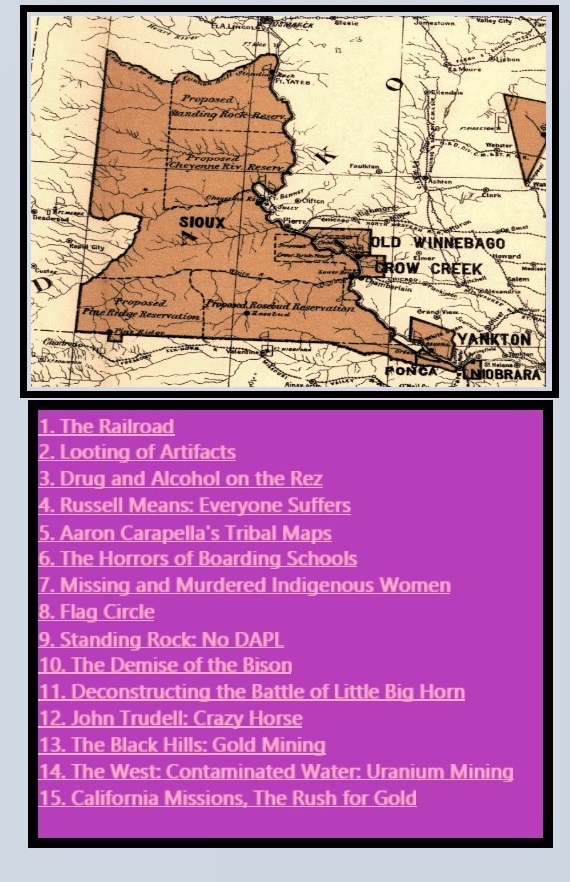
Some questions one might ask: How did Custer lose the Battle of Little Big Horn, and what did that loss have to do with what happened at Wounded Knee? How did the discovery of gold in the Black Hills affect the lives of the Lakota? How does the presence of natural resources and mineral deposits on reservation land affect First Nation people today? What are the lingering effects of the forced assimilation on native children in boarding schools? Where is the effort to find missing indigenous women?
We tend to focus on the victims of oppression, but I would challenge anyone to research the effects of being an oppressor. How has our government evolved over the decades from rationalizing the genocide of First Nation people to granting corporations the rights to destroy the environment today, to militarized police using pepper spray and rubber bullets on unarmed peaceful protestors, to mining companies deliberately contaminating drinking water? Is there any difference? If not, when will we stop this madness? When will we heal?
It is all connected, and nothing has fundamentally changed. The educational system is no help; the school textbooks relate how the people enjoyed life at California’s missions. There is no mention of the genocide of California tribes during the California Gold Rush.
The First Nation people are still here, but they are still holding on to their cultures, languages, and way of life. An excellent question to ask is, “Do you know whose land you live on?” We will need their knowledge of this land to deal with climate change.
I encourage you to purchase these accurate and beautiful maps. I had several in my classroom before I retired from teaching.
A story:
Outside my classroom, I had a very large wall used to display student work. My class was studying indigenous history and I had purchased a very large map showing all the tribal nations in the U.S. I hung the map on the wall along with recent artwork and reports my students had finished.
The next week was open house and many parents visited the school to view the classrooms. I noticed an elderly man sitting in a chair in front of the map. He appeared to be crying. I walked over and asked him if he was ok. He said that he was overcome with emotion to see this map with all of the tribes. He said he never thought anyone cared to do such research.
As a teacher, I went above and beyond the very limited curriculum. I made sure to add relevant materials, books, and maps to provide a more holistic and complete view of the world. My students did many independent research projects. These maps are very educational! Add them to your teaching materials and home.
When I retired I gave the maps to a student.
These are photos where you can see a few of the maps in the background.
“A lot of people from American society don’t understand our connection, our intergenerational connection, and how deep it runs within us to the land and the Earth,” Logan said.
Logan described a thanksgiving speech, or Ganö:nyök, that the Seneca recite to recognize the natural world around them.
“We start at the Earth and we go all the way up to the sky, to the creator, and it covers everything from the water, the plants, food, medicine, trees, birds, animals, everything in the natural environment,” Logan said. “If any one of those things goes away, eventually we will perish.”
Creating sustainable energy does not mitigate the problem. I used to get into these tremendous arguments with my father about progress. To summarize my stance: I used to take the bus because I did not have a car. I suffered through strange men groping me, people smoking, waiting in the rain for late busses, limiting my shopping because I could not carry a lot of stuff. It was sometimes unbearable. I was able to buy a car and at first, it was incredible. I had freedom! I had safety! It was convenient and I could go shopping in many places and load everything in the trunk!
But then one rainy day I drove by a crowded bus stop and realized all I had done was trade some problems for other problems. I now had a vehicle in which I had a traffic accident: someone ran into me and the car had to be repaired. I could get parking tickets so I always had to hunt around for parking space, and in some places, I had to pay for parking. I had insurance to pay, and I had to spend my Sundays washing the car. I had maintenance and car repairs. Instead of a monthly bus pass, I now had a car loan to pay off. I had a driver’s license to renew at the DMV. I had a yearly car registration to renew. I had to have a car inspection to get the registration renewed. I worried about someone trying to steal the car, so I bought an expensive car alarm system. Instead of being able to dose off when riding in the bus, I had to stay alert at all times when driving the car. I now got stuck in traffic jams on the freeway and ended up taking a longer time to get home from work than if I had taken the bus! When I added it up, I actually had more problems than when I rode the bus.
Energy is not created or destroyed – it just changes form.
I think this law applies to everything we do. There is no such thing as progress. We just change out one set of actions for another, one set of problems for another. We are not getting anywhere from where we started. We are making things worse.
We used to know how to make the things we needed, but now we are dependent on people and systems for everything.
We used to be able to drink water from the rivers and fish/hunt for our food. Now we use self-checkout at stores that sell us contaminated and processed unnutritious food.
We used to work in our fields growing the food from sun up to sundown. Now we sit in cars in traffic for hours to get to work and then back home so we can afford a gym membership to try and stay fit.
We used to sit on our front porches on hot summer evenings because we had no air conditioning and would talk to our neighbors to get the daily gossip. Now we are isolated in air-conditioned homes with security systems behind locked doors.
So, back to the article I cited. Little has changed in relation to the land and indigenous people. They have a pristine forest with old-growth trees. How are they able to still live there and the land has not been destroyed? – that is the big question.
We are clearly missing some knowledge. We come along and want to build a potentially polluting ¨Green¨ plant right next to their land because, you know, progress.
We live an unsustainable, nonregenerative lifestyle. That is why their forest is beautiful and all the other land is polluted, exploited, and dead.
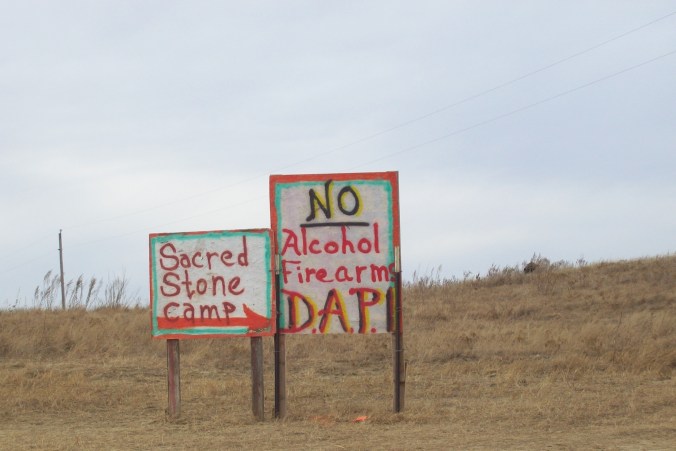
Thursday, November 24th, 2016 I thought at night very hard about why I was there in Oceti Sakowin Camp. The area is filled with spirits. They are in the wind as it blows over the hills. One can feel that many things have happened here. So, the question was, are you ready to die for this cause? Because if you are not serious about it, you should not be here at all. I thought about how I was a guest, an ally to help others. They have always been here fighting to live. I cried this night knowing that if I was called to do an action, I would willingly go with a prayer and make the stand full of peace as many others have done before. There are some things worth dying for and water is surely one of them. In acknowledging this, I understood fully what everyone here is going through. I knew that I was there for the right reason. I had seen people crying, I had seen some people walking alone looking very sad. But overall, peace and hopefulness in the power of prayer hovers about over the whole camp. No matter where anyone is from, no matter what style or condition of clothes, no matter the language, everyone is united and I could feel the power in that and everyone comforted and helped each other. This is the front line of a very serious battle. A battle between peace and violence, between right and wrong, between the oppressor and the oppressed, between common citizens and corporate power. Every thought, every word uttered, every action must radiate the peace and love we have for each other and to the people watching us on the hills overlooking the camp. There is no profanity at camp, no hateful words. One might be asked to leave if they are overheard saying negative things about others or swearing. There are children all playing about the camp and no one wants to upset them. I heard about people being led out of camp for breaking the rules. Anyone thinking this is a Woodstock or some sort of hippy camp-out is very mistaken. The camps are sacred places for prayer, these lands are filled with spirits and people must respect those spirits.
Morning. I got up before dawn, it was overcast, frosty, and cold, and I went to the California Kitchen to help with breakfast. I helped clean the tent floor, it was getting muddy with the wet frosty footprints. I helped organize the service tables. There were already many people working in the kitchen getting the Thanksgiving food prepared. The California Kitchen is actually three tents, one central large cabin tent and two smaller circular tents at each end connected by swinging doors. The Central tent has all of the food on shelves, the food prep tables, and the wash basins with water. The rear tent has the stoves and ovens hooked to generators. The front tent has four tables and a few chairs for people to sit and eat. Someone had decorated this space with Christmas decorations and lights. There are service tables against two sides and here are where you can find condiments, utensils, plates, and cups. They had a lot of paper donations but were trying to be mindful of waste and use metal utensils and real plates. Everyone is encouraged to bring their own mug, plate, and eating utensils.
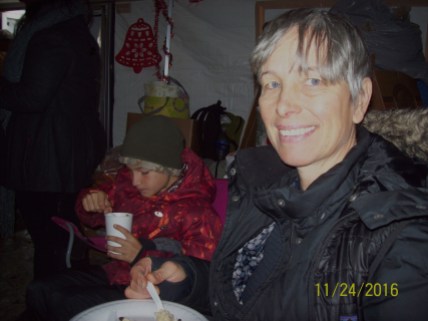
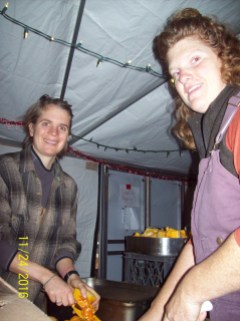
After breakfast was served, I sat and talked to people I met until about 12:00 noon. I met a filmmaker doing a documentary, a retired sailboat lady, Travis from a children’s school, a man from Bishop, California, a Washington State hippy dude who lived in a commune, a woman from New Zealand who was there with a group to perform a Haka, Nan, her husband, and two sons (pictured with one named Salmon). I also met two friends cutting the apples for apple pie and vegetables for Thanksgiving dinner (pictured). It was these conversations that later sprouted an idea.
There was someone who announced that there would be a raid on the camp. However, one of the security asked where this news came from. That a person should evaluate everything and not spread rumors that could disturb the peace. There are instigators and those people are quickly exposed when everyone is calm and connected and knows where to get the accurate information. Besides, no one cared what this rumor stated. No one was going to leave.
I sat in my car to get warm and to write some notes. I fell asleep as I was writing. It was here that I formed an idea. These people are not protestors and rioters, they are mothers, fathers, brothers, sisters, aunties, uncles, grandmothers, cousins, nurses, medics, lawyers, teachers, farmers, vets, retired people, rich, poor, educated, wise, homeless, they are everyone. I met in this one day people from over 10 different countries. I met people from all over California – yes even a few from Sacramento. One must humanize who is here.
I AM………. WATER IS LIFE
I took a walk to the sacred fire around 2:00 p.m.. This fire must not be photographed. You must approach it with peace in your heart. You must respect this fire as a spirit.I brought a gift of tobacco for an elder and a gift of the Water is Life stickers. I thanked him for allowing me to be an ally. There were some singing performances happening and then I heard of buses that were going to Ft. Yates to a high school for Thanksgiving dinner. I knew the California Kitchen was going to be very busy and crowded, so I got on a bus. I met a woman from Oakland and a school teacher and his aunt. As we were going to the high school, the driver had the radio on and was listening to a football game. An announcement interrupted the game coverage, it stated “Important! There are rioters and protestors in town. If you observe any suspicious activity or see any suspicious people, immediately call the Morton County Sheriff’s Department.” Wow, I thought, I wonder who the announcement was talking about because I had not met any!
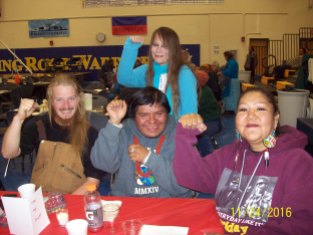
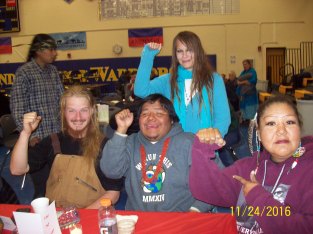
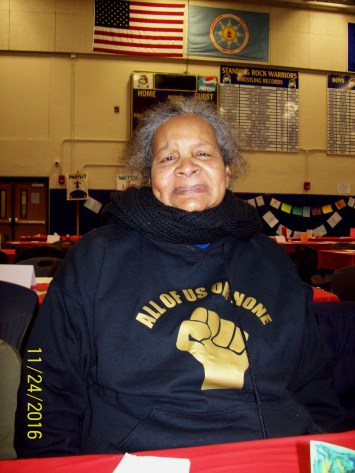
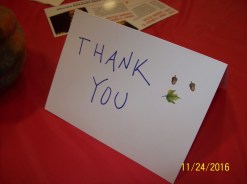
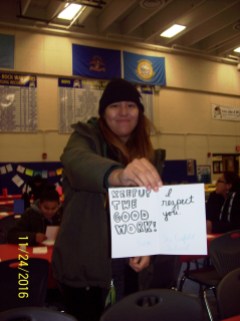
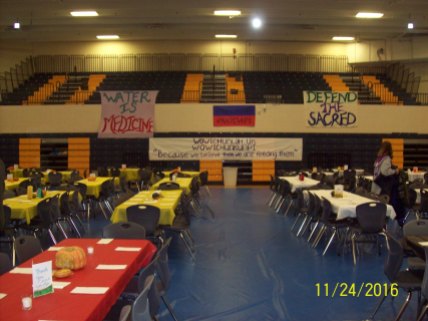
Thanksgiving Dinner. This dinner was provided by Jane Fonda. It was very beautiful and there was a great deal of delicious food. The servers were all volunteers and youngsters from the school. There were cards of thanks from children all around the world that were hung on the wall and placed on all of the tables. Archambault’s uncle prayed and spoke at length about the connection with the land and water. How we need to reconnect and teach the young people. He also told a story about Sitting Bull. How he always said he fought to defend the women and children. He never fought just because he wanted to fight from hate. He always fought to defend. We also heard a beautiful canoe song from the Pacific Northwest. There were many thanks to the celebrities who helped the camp and helped with the dinner.
Dinner: squash, mashed potatoes, carrots, stuffing, turkey, rice, bread, fry bread, tortilla, pumpkin pie. You are supposed to leave a little bit on your plate for the spirits.
It’s that time of year again. Thanksgiving is upon us. I encourage you to read a piece I wrote for The Nation magazine and watch my segment on CNN arguing that we should scrap this holiday and replace it with “Truthsgiving.” (Note that the CNN segment starts after the ads about four minutes and ten seconds in.) This is not, perhaps, an entirely novel idea. We’ve tried it before — a popular rebranding of Thanksgiving as “Thankstaking,” communicating that there should be no pride in genocide. But this year I am committing to the concept of Truthsgiving, which I feel better embodies the right spirit of generous sharing and listening.
Watch: I appeared on CNN to discuss changing the Thanksgiving holiday to Truthsgiving.
Here’s some truth: gathered around our tables, we still eat turkey, corn, beans, squash, cranberries, and mashed potatoes. All these are Indigenous foods. In fact, 60 percent of all the food consumed by the human species has been created by Indigenous nations. Please understand that (despite the headline in The Nation), I am not trying to cancel Thanksgiving — for we give thanks every day!
Our celebrations, however, should also honor real history. We must tell the truth. The truth is a fire that burns all lies in its way. It is no secret that colonial project countries (e.g. the USA, Canada, Australia, and New Zealand) have hidden important truths from us. It’s no surprise settlers like governor Kristi Noem fight so hard to hide historical facts from students taught in South Dakota schools. How fragile the American settler identity is that it cannot abide teaching the truth. But until the truth is shared, there can be no justice. And if there is no justice, then peace is beyond our reach.
We have to tell the hard truths, painful as they may sometimes be. We must recognize that genocide is not a “dark chapter in our nation’s history,” but that it’s still imposed on tribal nations in the present. The first Americans are still denied real nationhood. In all ways “legal,” political, and economic, Indigenous nations across Turtle Island and around the globe remain captive to outdated institutional systems carrying out the centuries old Doctrine of Christian “Discovery.”
Let us, then, meet each other where we stand today. We don’t have to turn back the clock, but we must be truthful with each other in the here and now. It’s our mandate — as Native and allied activists — to reinvigorate the quest for truth. We have to show up and reorganize the very symbols of our culture and our shared identity. Like Columbus Day, Thanksgiving is one of these symbols, one of those rituals, a place where worldviews collide. That’s not a bad thing. Let us use these collisions to move forward, knowing in our hearts that we are all in a conscious evolution together.
Wopila tanka — my gratitude for your investment in truth! Chase Iron Eyes Director and Lead Counsel The Lakota People’s Law Project
P.S. Our desire to share both the giving of thanks and the telling of truth is one reason we initiated our live-streamed Wopila (Gratitude) Gathering every year around Truthsgiving. Please RSVP now to join us online on Giving Tuesday, Nov. 28, and spread the word about this annual event to honor, inspire, and activate. The citizens of the Lakota Nation conduct wopila ceremonies to give back as a practice of gratitude, and this is our way of bringing you into the circle.
Lakota People’s Law Project 547 South 7th Street #149 Bismarck, ND 58504-5859
The Lakota People’s Law Project is part of the Romero Institute, a nonprofit 501(c)(3) law and policy center. All donations are tax-deductible.
Reckless development proposals such as mines, mega-dams, and oil pipelines have a way of coming back from the dead. The controversial Keystone XL pipeline is a recent and classic example: a zombie project that just wouldn’t die. Now, in North Dakota, environmental groups and Native American tribes are seizing on a rare opportunity to shut down a fossil fuel project that’s already up and running—the fiercely fought Dakota Access Pipeline.
Earlier this month, tribal members and environmentalists gathered in Bismarck, North Dakota, to give public testimony on the draft environmental impact statement for a critical section of the Dakota Access Pipeline. Before the hearing, activists who had traveled by bus from the Twin Cities rallied on the sidewalk with members of the Cheyenne River and Standing Rock Sioux Tribes, which for years have led opposition to the oil pipeline.
Format of public comment meetings for Dakota Access oil pipeline upsets opponents
Updated 11:28 AM CST, November 2, 2023
BISMARCK, N.D. (AP) — Opponents of the Dakota Access oil pipeline are taking issue with the format of private oral testimony in meetings for public comment on a draft environmental review of the controversial pipeline.
The U.S. Army Corps of Engineers is in the midst of two public comment meetings in Bismarck, North Dakota, the first held Wednesday, the second set for Thursday. People wishing to give testimony may do so orally in a curtained area with a stenographer, or do so in writing at tables.
The Standing Rock Sioux Tribe has long opposed the pipeline due to the risk of an oil spill contaminating the tribe’s drinking water supply. The four-state pipeline crosses under the Missouri River just upstream of the tribe’s reservation.
The long-awaited draft environmental review, released in September, outlines five options for the pipeline’s fate. Those include denying the easement for the controversial crossing and removing or abandoning a 7,500-foot (2,286-meter) segment, or granting the easement with no changes or with additional safety measures. A fifth option is to reroute the pipeline north of Bismarck, which would require new state, local and federal permits.
Future of controversial Dakota Access pipeline’s river crossing remains unclear
September 8, 20233:14 PM ET By The Associated Press
BISMARCK, N.D. — Federal officials on Friday released a draft environmental review of the Dakota Access oil pipeline, but said they’re waiting for more input before deciding the future of the line’s controversial river crossing in North Dakota.
The draft was released over three years after a federal judge ordered the environmental review and revoked the permit for the Missouri River crossing, upstream of the Standing Rock Sioux Tribe’s reservation. The tribe is concerned a pipeline oil spill could contaminate its water supply.
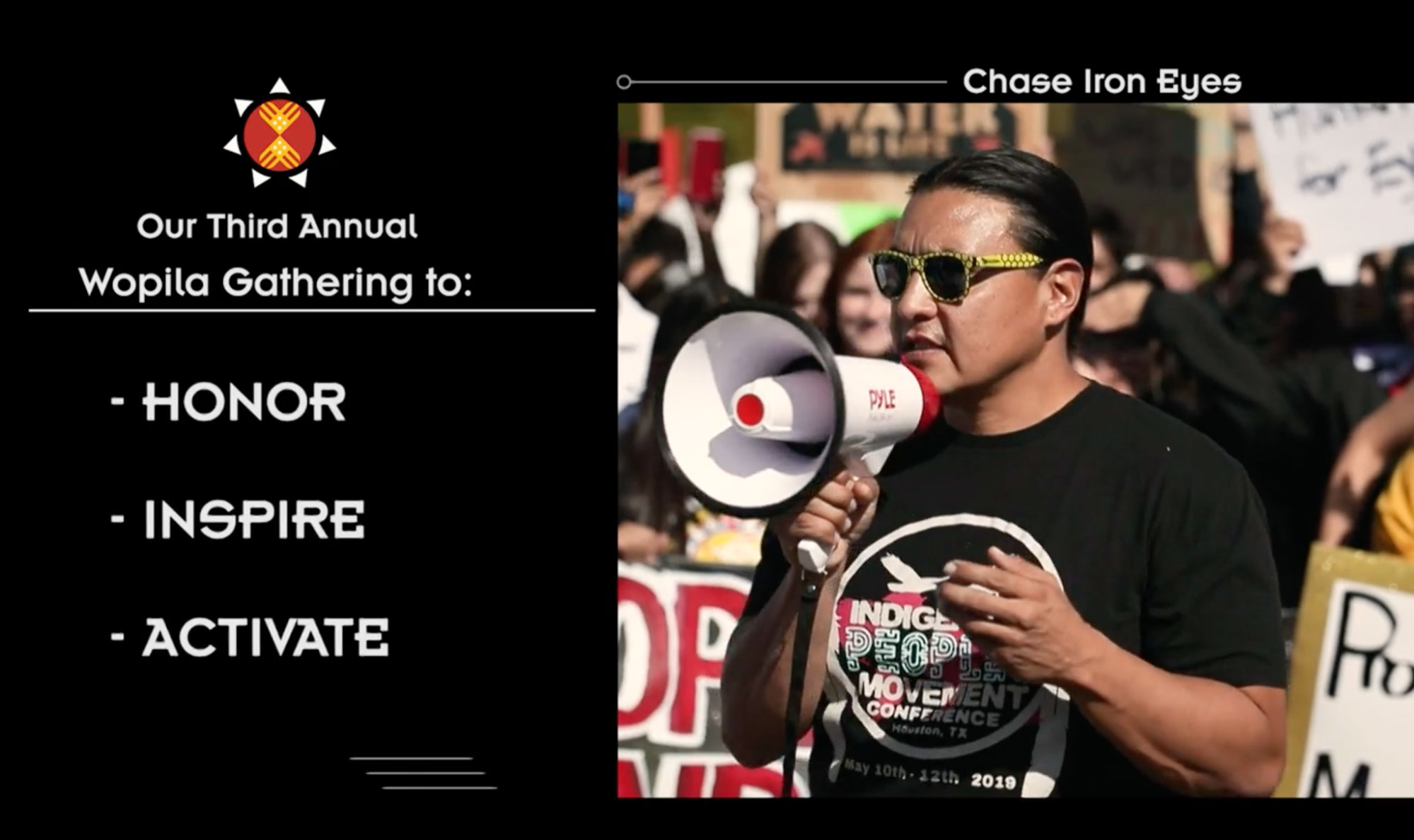
I’m excited to announce that our third annual Wopila Gathering is almost here — and you’re invited! Please come spend time with me, other Lakota Law leaders, and special guests at the live-streamed event on Giving Tuesday, Nov. 28 from 3-6 p.m. PDT (6-9 p.m. EDT).
I’m very much looking forward to hosting you for this annual online celebration. In addition to entertainment and insights from artists and influencers, I will be joined by three powerful activists — Tokata Iron Eyes, Lily Joy Winder from People, Not Mascots, and Lakota Law Standing Rock organizer Phyllis Young — for candid conversations on topics important to Indian Country. This year’s topics are Resistance, Representation, and Resurgence.
Watch our promo video for more details on the big event — and RSVP to save the date!
The Wopila Gathering is one of the highlights of my work with Lakota Law. I get energized when thousands of supporters like you gather with us throughout the day to honor, inspire, and activate around curated content and conversations that build the movement for Native justice. And I encourage you to interact! You can join the chat during the event, and we’ll post and read comments over the course of the livestream.
I hope to see you there! RSVP to let us know you’re coming, and please extend this invite to those you love by clicking the social share icons — to Facebook, Twitter, and email — on our Wopila Page. Let’s continue to grow the circle of support and come together to make a difference for Indigenous justice! Stay tuned for more info soon.
Wopila tanka — thank you, always, for your friendship! Chase Iron Eyes Director and Lead Counsel The Lakota People’s Law Project
Lakota People’s Law Project 547 South 7th Street #149 Bismarck, ND 58504-5859
National Congress of American Indians Unveils New Visual Identity, Marking a Historic Milestone in 80-Year LegacyWASHINGTON, D.C. | To mark the start of Native American Heritage Month, the National Congress of American Indians (NCAI), the oldest, largest, and most representative American Indian and Alaska Native organization serving Tribal Nations, is proud to announce the unveiling of its new visual identity. This transformative moment in NCAI’s 80-year history is the result of years of collaborative efforts led by tribal leaders and feedback from across Indian Country.
As NCAI approaches its 80th anniversary, this landmark rebrand signifies a bold step toward the future while honoring its rich legacy of tribal policy advocacy. The timely launch during Native American Heritage Month underscores the organization’s long-standing commitment to safeguarding traditional laws, cultures, and ways of life, while championing a more representative and empowered future. https://ncai.us6.list-manage.com/track/click?u=9a05d466a08334b9dbb97078e&id=b0ebf5cfc2&e=67d5b89d29
“Today is a pivotal moment in NCAI’s history,” said NCAI President Fawn Sharp. “It represents more than just a change in our visual identity—it is a profound commitment to unity, solidarity, and a brighter future for Tribal Nations. This rebrand is a symbol of our collective strength as Native peoples, and we invite all of Indian Country to join us on this exciting journey.”
Central to NCAI’s rebrand is a captivating new logo—a symbol of hope, unity, and the enduring spirit of Tribal Nations. The logo features key elements such as 12 feathers representing the 12 NCAI regions, a forward-looking eagle symbolizing progress and advocacy, and soaring wings embodying the spirit of hope for the next seven generations. The organization is also making waves in the digital landscape with a brand new website and recent launch of ‘The Sentinel’ podcast and blog, reinforcing its dedication to amplifying the voice of Indian Country.
“Within this rebrand, we have completely transformed NCAI’s digital presence, ensuring that our resources are more accessible than ever,” said NCAI Executive Director Larry Wright, Jr. “This new website not only showcases our fresh identity but also serves as a hub to explore NCAI’s 80-year legacy, discover key resources, and stay updated on issues that matter most to Tribal Nations. It is a true reflection of who we are, and it’s designed to be a valuable asset for all who rely on us.”
To celebrate Native American Heritage Month, experience the next chapter of NCAI’s journey at the upcoming NCAI 80th Annual Convention & Marketplace. Follow us on social media at @ncai1944 and use the official hashtag #NCAIRebrand to join the conversation.
###
About the National Congress of American Indians: Founded in 1944, the National Congress of American Indians (NCAI) is the oldest, largest, and most representative American Indian and Alaska Native organization in the United States. NCAI advocates on behalf of tribal governments and communities, promoting strong tribal-federal government-to-government policies. NCAI promotes an understanding among the general public regarding American Indian and Alaska Native governments, people, and rights. For more information, visit www.ncai.org.
























 Water is Life