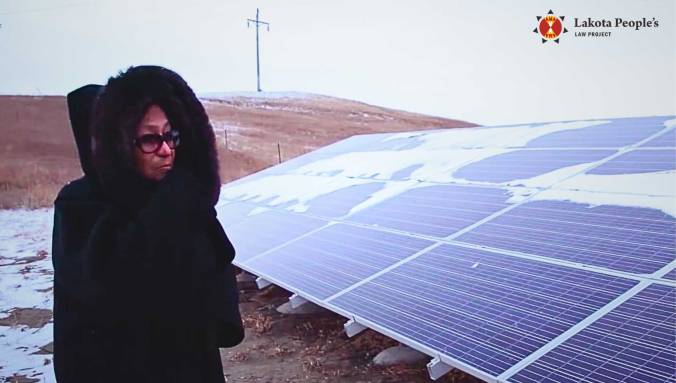
Since 2017, Lakota Law’s team has worked with leadership at the Standing Rock Nation to help bring clean energy to my homelands. We’ve now assessed solar potential on a dozen tribal government buildings, and for the past few months we’ve worked overtime to help my tribe prepare to apply for historic sums of grant money. President Biden’s Inflation Reduction Act has earmarked as much as $100 million for individual low income communities — including tribal nations — to transition to low-carbon technologies.
I’ve been working for years to increase solar and wind production on the Standing Rock Nation. High energy costs from our utility can leave our people without power during the Dakotas’ harsh winters. That’s not acceptable.
As part of the Inflation Reduction Act, a $7 billion solar grant called “Solar for All” will make up to five $25-100 million grants available to different tribes or tribal consortia. The Lakota People’s Law Project aims to ensure that Standing Rock and several other South Dakota tribes can make their best case to collect and use a portion of these funds to install solar panels that will help the people pay less and stay safe.
That last part is important. In yet another example of injustice toward Native communities, tribal members at Standing Rock pay 33 percent more for electricity than people living just an hour away in Bismarck, North Dakota. That’s money most can’t afford to pay, which can result in life-endangering power shut-offs during winter months when midwestern temperatures can dip well below zero.
By collecting and storing energy from the abundant sun above the plains, tribal governments and communities can save — and even earn by sending power back to the grid. And by building out a cohesive clean energy system, Standing Rock and other South Dakota tribes can demonstrate a sustainable model for other tribal nations and communities to follow. I consider this to be one of the most important things I’ve ever worked on, and I deeply value your continued solidarity as we pursue this plan.
Wopila tanka — my gratitude for all of your care and support, Phyllis Young Standing Rock Organizer The Lakota People’s Law Project
My name is Dov Korff-Korn and I’m the new staff attorney at Lakota Law. I write to you to both introduce myself and to provide some important context regarding the fires in Lāhainā, Maui. For the last two years I’ve worked closely with this organization as a volunteer law clerk, supporting a variety of projects. I recently joined full-time after graduating from law school and passing the bar exam. It has been a true privilege to be a part of this organization, and I’m excited for all that we can continue accomplishing together on behalf of Indigenous sovereignty and environmental justice.
One of the most formative experiences I’ve had in 10 years of work around Indigenous sovereignty was my time spent last year as a visiting student at the University of Hawaiʻi. The week we visited Maui to work with a team on water access for Native Hawaiian farmers and local residents, there was a large wildfire raging in the valley up in the hills behind Lāhainā. In my new blog post I share with you my reflections on that experience in light of the recent disastrous fires.
This image is from the time I spent in Lāhainā before the catastrophic fire. There was already a fire burning there at the time. Little did we realize what a foreshadowing it was.
The short story is this: the news will tell you that the fires were caused by high winds, a downed power line, and/or climate change. These factors may have contributed to the tragedy. However, the underlying truth is that more than a century of systematic exploitation by wealthy colonizing interests, armed with the greenlight from federal, state, and military agencies, set the stage for this devastation. As I delve into the dynamics of dispossession in my blog post, decades of water diversions drained Maui of its water, evaporating ecosystems and suppressing sovereignty.
The Indigenous Peoples of Turtle Island are familiar with this marriage between wealthy interests and government. As was the case with the intentional slaughter of the Tatanka (buffalo) to drive the people of the Great Plains onto reservations against their will, greedy entities strike at the heart of Indigenous Peoples and their sovereignty by debilitating once-abundant natural ecosystems. The situation in Maui is no different. As Lāhainā starts out on a path of rebuilding, it is critical that we support our Kānaka Maoli relatives by ensuring that their voices are heard and their sovereignty is respected. Only that way can justice begin to be restored to Islands held sacred by so many.
In Solidarity, Dov Korff-Korn Staff Attorney, Lakota Law
Lakota People’s Law Project 547 South 7th Street #149 Bismarck, ND 58504-5859
The Lakota People’s Law Project is part of the Romero Institute, a nonprofit 501(c)(3) law and policy center. All donations are tax-deductible.
Here are also the links to the information in the Lakota Law Project article. I think it is important to look at all questionable disasters as if viewing a crime scene; what is the context? what interests are in play? Calling it a conspiracy puts up a wall against asking questions. I now view the words conspiracy theorist as a sign that some truth is about to be discovered.
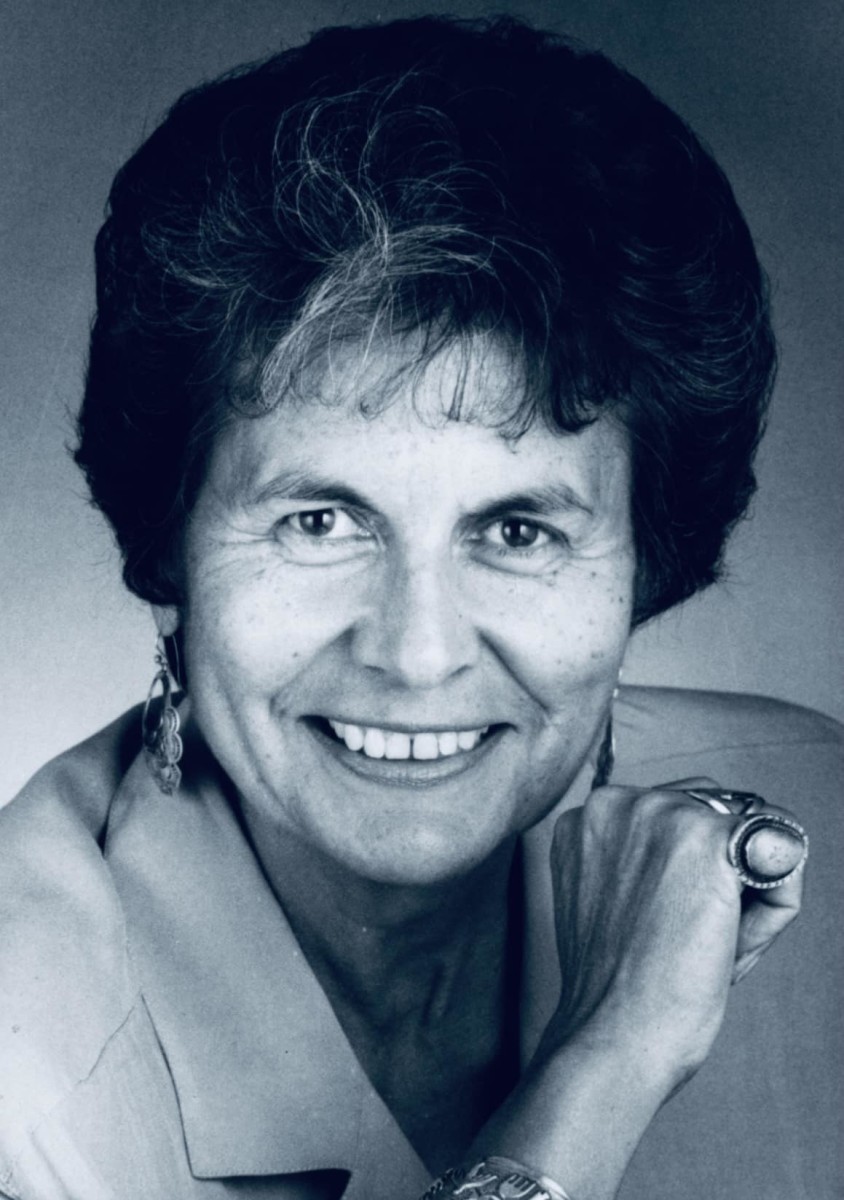
Ada Deer, a “force of nature” and a legendary figure whose life and accomplishments are woven into the social and political fabric of Indian Country, died Tuesday night.
Deer, 88, was the first Native American woman to run for statewide office and only the second to run for Congress. She was the first woman to serve as Assistant Secretary for Indian Affairs at the Interior Department. She was also the first woman chair of her tribe, the Menominee Indian Tribe of Wisconsin.
On Wednesday, the tribe issued a statement.
“It is with great sadness that we announce the passing of Ada Deer, a prominent leader of the Menominee Indian Tribe of Wisconsin,” the tribe wrote. “Ada was a true inspiration to many and her legacy will continue to live on through her contributions to the Menominee community and her tireless work in advocating for Native American rights.”
Deer was an instrumental figure in the 1973 restoration of her tribe following its termination 15 years earlier. She later served as the first chair of the Menominee Restoration Committee.
“Ada’s contributions to the Menominee community and her dedication to improving the lives of Native Americans will never be forgotten,” the Menominee Tribe said Wednesday. “As we mourn her loss, let us also celebrate her remarkable life and the profound impact she had on all of us.”
During termination, the Menominee Tribe became a county instead of a reservation.
Deer once told ICT: “This is the story of Indian land ownership throughout the history of this country. It was lost after certain pieces of legislation have passed to allot Indian land to private Indian owners who have little real estate know-how.”
In order to fight for restoration of the tribal government, Deer dropped out of law school.
“I moved to Washington, D.C., in 1972 to lobby … I talked to everyone I could,” Deer said. “I held meetings with reporters. I held meetings with legislative aides. I went around to receptions. I smiled. I shook hands. I prepared bumper stickers and fact sheets and made it look like there were thousands of Indians, screaming about termination. That’s part of what it takes to get a bill through the Congress.”
Gwen Carr, a longtime friend of Deer’s and executive director of the Carlisle Indian School Project, said the Menominee restoration was a milestone in the efforts of tribes to regain federal recognition following the Termination Era of 1950s and 1960s.
“For a Native person to get their tribe out of termination is a prodigious effort,” said Carr, a citizen of the Cayuga Nation. “Nobody had ever done that before.”
Deer had a way of convincing people to do what she wanted, not by arguing with them, but simply by talking to them until they agreed with her, Carr said.
“She was a force of nature who was as gentle as a breeze,” she said.
Born in Keshena, Wisconsin, Deer spent her childhood in a log cabin on the Menominee reservation without running water or electricity, attended Shawano High School and studied at the University of Wisconsin-Madison and later at Columbia University.
In 1978 and 1982, Deer ran for Wisconsin secretary of state, and then for Congress in 1992. Many remember her campaign slogan “Run Like a Deer.”
She was appointed by President Bill Clinton in 1993 as the Assistant Secretary for Indian Affairs at the Interior Department, a position that included overseeing the Bureau of Indian Affairs. In that capacity, she signed off on federal recognition of hundreds of Alaskan tribes that, for decades, had been fighting for sovereignty. Many saw the Alaska Native Claims Settlement Act as a termination bill. So Deer’s act fits a restoration of tribal government in that state.
She led the American Indian and Indigenous Studies Program at the University Wisconsin-Madison, chaired the board of the Native American Rights Fund and co-founded the Indian Community School in Milwaukee.
Carr said more than once she accompanied Deer to events where people would line up to meet her friend, but that recognition never inflated Deer’s ego. Instead, she had a profound gentleness and innocence about her, though she was nobody’s fool, Carr said.
She said Deer never married or had children, instead devoting her life to advancing the rights of Native people.
“A big page in Indian Country has turned,” she said.
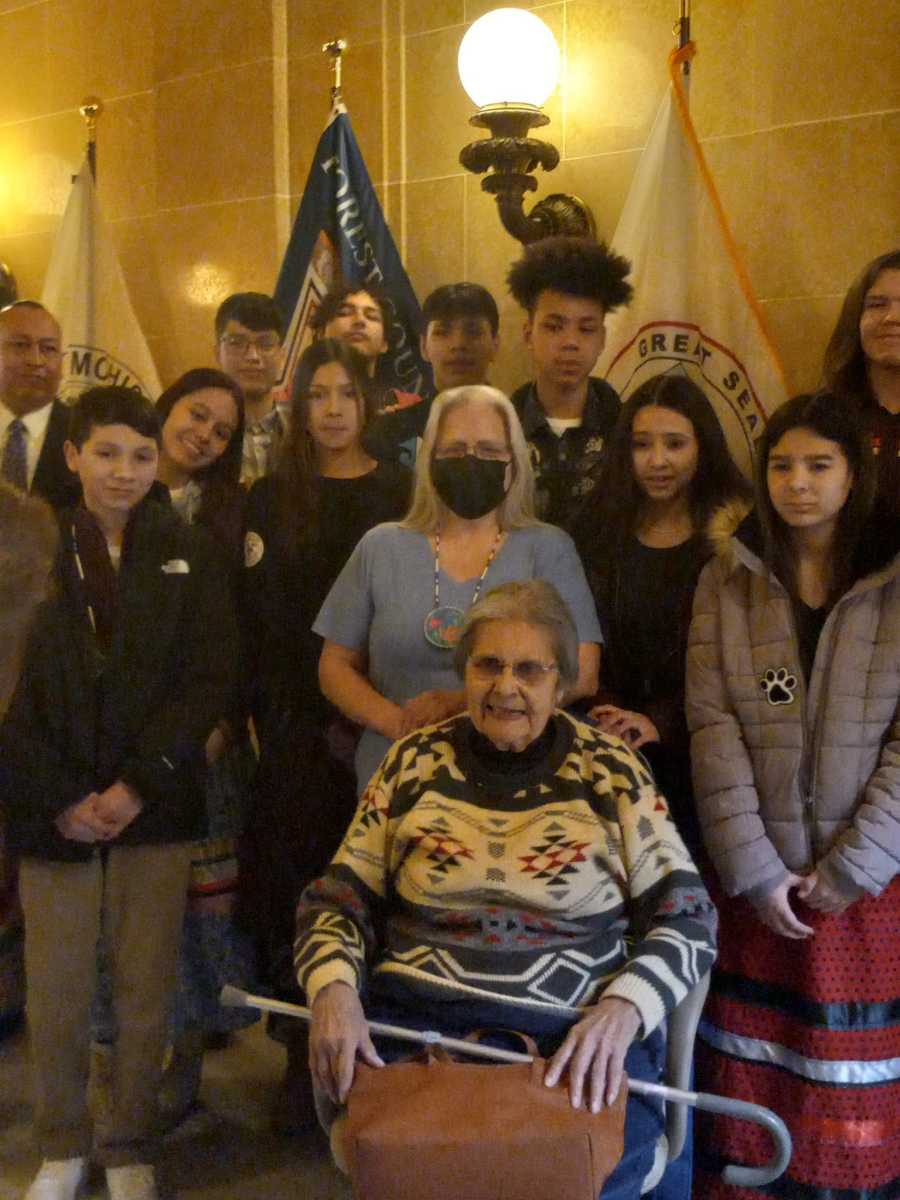
Ada Deer (sitting), Menominee Indian Tribe of Wisconsin. Deer died Tuesday, Aug. 15, 2023. She was 88. (Courtesy of Menominee Indian Tribe of Wisconsin)
On Aug. 7, Deer celebrated her 88th birthday, leaving hospice care to attend a celebration that drew Wisconsin state and Menominee tribal leaders, including Wisconsin Gov. Tony Evers, U.S. Sen. Tammy Baldwin and Menominee Chairwoman Gena Kakkak. All paid tribute to Deer’s legacy and influence in their lives.
The same day, Gov. Evers proclaimed Aug. 7, 2023, to be “Ada Deer Day.”
“It is my honor to proclaim today as ‘Ada Deer Day’ throughout Wisconsin to recognize her groundbreaking work as a champion for Tribal rights and Indigenous communities, an advocate for social justice, and a foundational changemaker in our state,” Evers wrote on social media.
Deer also spoke at the celebration.
Writing on social media recently, Ben Wikler, Deer’s godson and chair of the Wisconsin Democratic Party, summarized her final speech.
“She urged everyone, all of us — you reading this right now — to dedicate ourselves to advancing justice in this world.”
Our stories are worth telling. Our stories are worth sharing. Our stories are worth your support. Contribute $5 or $10 today to help ICT carry out its critical mission. Sign up for ICT’s free newsletter.
Today, I share with you a piece of good news on the mining and Native justice fronts! In case you missed it, earlier this week, President Biden and U.S. Secretary of the Interior Deb Haaland of the Pueblo of Laguna traveled to Arizona to announce a new national monument designed to protect Native homelands in the Southwest. Afterward, Secretary Haaland appeared on PBS News Hour to discuss the monument’s significance and its impact for Indigenous people. I encourage you to watch that segment here.
U.S. Secretary of the Interior Deb Haaland sat down with PBS News Hour to discuss the new national monument protecting Native homelands in the Southwestern United States.
We have rightly been critical of this administration and its failure to do more to stop mining in the Black Hills and at Peehee Mu-huh (Thacker Pass) in Nevada. Even as it has taken the most aggressive steps toward climate remediation that we’ve seen from the White House, the Biden administration is still falling short of its own climate goals. It’s just not enough. And, critically, Biden and Haaland must engage and adhere to the wishes of Indigenous communities on the frontlines of extractive industry — such as Standing Rock Nation with the Dakota Access pipeline and our Paiute and Shoshone relatives battling Lithium Americas at Thacker Pass.
Nonetheless, this near million-acre set-aside is a significant step in the right direction. We’re grateful that Baaj Nwaavjo I’tah Kukveni — Ancestral Footprints of the Grand Canyon National Monument in Arizona — will prevent new mining leases in this sacred and beautiful place.
According the administration’s fact sheet, the monument will protect “thousands of cultural and sacred sites that are precious to Tribal Nations in the Southwest – including the Havasupai Tribe, Hopi Tribe, Hualapai Tribe, Kaibab Band of Paiute Indians, Las Vegas Paiute Tribe, Moapa Band of Paiutes, Paiute Indian Tribe of Utah, Navajo Nation, San Juan Southern Paiute Tribe, Yavapai-Apache Nation, Pueblo of Zuni, and the Colorado River Indian Tribes.”
Still, it’s up to all of us to hold the administration’s feet to the fire. Props to PBS anchor Amna Nawaz for pressing Secretary Haaland for an explanation of why many voters still feel a lack of satisfaction in the administration’s handling of the climate crisis. This national monument is significant and cause for gratitude and celebration — but it can’t stop there. Going forward, Biden and Haaland must be better and do more to support Native and environmental justice issues.
Wopila tanka — We deeply appreciate your care for Native homelands. Chase Iron Eyes Co-Director and Lead Counsel The Lakota People’s Law Project
Today, I share with you our new blog and video delving into the long, disturbing history of mining on Indigenous lands on Turtle Island. As we’ve written to you previously, the sacred lands of our Paiute and Shoshone relatives at Peehee Mu’huh (or Thacker Pass) in Nevada are under imminent threat from a massive new lithium mine. They did not give their consent for this project, and now it could despoil sacred ceremonial grounds, historic massacre sites, and sensitive habitat home to several protected species.
In our new, short video — which you can find near the top of my blog — Paiute elder Dean Barlese discusses the importance of protecting our shared world.
Thacker Pass isn’t the only mining project currently endangering Native homelands. The Yaqui people are struggling to effectively resist another massive lithium mine in Sonora, Mexico, and according to the Associated Press, our southern neighboring nation has become the world’s deadliest location for environmental activists. And in our sacred Black Hills right here in the Dakotas, lithium is joining gold, uranium, and other precious elements on the list of mining interests we’ve been confronted by for 150 years.
I encourage you to read my blog to learn more, and watch the accompanying video to get additional perspective from Dean Barlese, a respected Paiute elder. Our thoughts today are also with all those on Maui in the Kingdom of Hawaii. We are praying for the safety of all living things in that beautiful place as they confront deadly fires powered by fast winds fueled by yet another hurricane.
This is, of course, all related. Storm frequency and intensity rise in conjunction with the out-of-balance relationship we have with Unci Maka, our Grandmother Earth. Our society’s failure to listen to Indigenous knowledge and plan ahead accordingly exacerbates the climate crisis and puts the future in peril for my generation and those to come. The youth say it. The elders are saying it. It’s time to make big changes before it’s too late. That’s why your advocacy with our cause is so important. It’s up to us — working together — to change the game.
Wopila tanka — thank you, always, for your care and attention. Tokata Iron Eyes Spokesperson The Lakota People’s Law Project
For the past six months, our co-director, law clerk, videographer, and organizers have all been in and out of Nevada, joining others in the effort to force the federal government to respect Indigenous sovereignty. By now, you’re probably well aware of the cause: Thacker Pass, or Peehee mu’huh, the site of the largest lithium deposit in the United States, anticipated to produce 25 percent of global lithium in the near term.
Today, I ask that you give to support our stand in solidarity with the Paiute and Shoshone peoples of Nevada in their fight to keep Big Green Extraction honest. We stand at a crossroads. As we press forward to replace fossil fuels with renewable energy, we must answer a question: will we show respect for Indigenous nations by honoring their right to self-determination and land possession, or will we allow the same tactics deployed by the fossil fuel industry for generations to sully our transition to green technology? Let’s make Elon Musk and other green entrepreneurs respect Indigenous sovereignty.
This beautiful area, home to multiple protected species and sacred to our Paiute and Shoshone relatives, is under threat from a massive lithium mining operation.
At Thacker Pass, the Ox Sam resistance camp has been active in recent months, and arrests and temporary restraining orders have been issued against our staff and other allies. Founding grandmother Josephine Sam has been forced to watch as her relative, Ox Sam founder Dorece Sam, faces a civil lawsuit. I’m the former official liaison for the Standing Rock Sioux Tribe to the resistance camps at Standing Rock in 2016 and ‘17. As such, I know something about what it takes to push back against the Destroyers of Unci Maka, our Grandmother Earth. One of the first principles of environmental justice is to show up when needed, and to not back down.
Peehee mu’huh (which means “Rotten Moon” in the Paiute language) got its name from a pair of massacres, including one in 1865 of at least 31 men, women, and children by U.S. soldiers. It’s now the place where the soul of the Green Revolution will be measured. In the coming weeks, we plan to publish a series of short videos telling the story of the resistance at Thacker Pass in the words of those on the ground. Please stay tuned.
We expect this struggle to be bruising, but it must be fought. In the current era of runaway climate change and rampant loss of biodiversity, playing defense is never enough. If we’re not on offense, we’re losing — and in this case, the cost could well be a healthy future for the people and other living things that call Peehee mu’huh home. Please join us in this struggle!
Wopila tanka — thank you for your friendship and solidarity. Phyllis Young Standing Rock Organizer The Lakota People’s Law Project
Today, I share with you some great news and a big wopila! A couple weeks back, we asked for your support in helping us to transfer the title of Standing Rock’s teen center to our nonprofit allies and the people of the Standing Rock Nation. Today, I am proud and happy to announce that, with your assistance, this has been accomplished! Thank you so much for your friendship, which has helped make our long-term goal of providing a safe and productive space for teens and young adults on Standing Rock a reality.
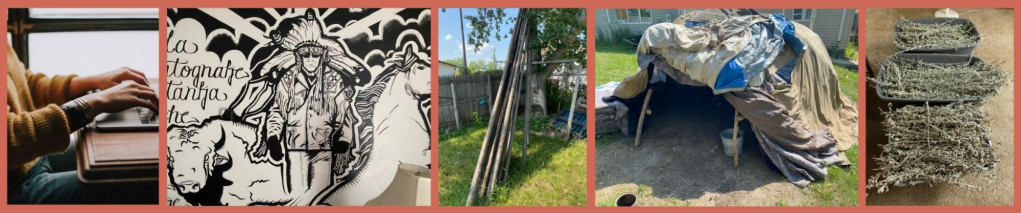
The Iyuha Icu Youth Services Center is now open every weekday afternoon and evening, offering a space for simple leisure and a mix of spiritual and cultural learning activities. We take pride in having purchased the building and formed the right partnerships — most critically with our friend, Hoksila White Mountain — to incubate the idea from concept to completion.
Among other amenities and activities, the youth center features art depicting the core Lakota values (second from left above). Also pictured are the property’s tipi poles, sweat lodge, and sage harvested at Standing Rock.
You may remember learning of Hoksila in past Lakota Law newsletters. We helped raise consciousness around his unjustly contested candidacy for mayor, and we helped him push through obstacles to serving on the City Council in McLaughlin, South Dakota (Standing Rock’s Bear Soldier District). He’s been a driving force behind the youth center from the very beginning.
I’m delighted to say that, today, this invaluable resource for Standing Rock’s youth stands as a concrete example of what we can achieve when we work together for a common cause, across organizational lines. We’re grateful to Hoksila for his cooperation and for sharing his vision.
The cultural focus and activities the youth center empowers go beyond its walls. Recently, Hoksila took 29 youths and chaperones on a trip to visit cultural heritage sites in Oregon and Northern California. That’s rare, world-expanding exposure for a group of vulnerable young people.
In a world filled with inequity, and in a place where young people could use a lot more opportunity, your friendship with Lakota Law makes a real difference. Today, please know how much that means to me and to our youth on the Standing Rock Nation. Aho.
Wopila tanka — our deep thanks for creating access and improving lives. Chase Iron Eyes Co-Director and Lead Counsel The Lakota People’s Law Project
After a protracted series of delays, we continue to await the long-promised draft Environmental Impact Statement (DEIS) for the Dakota Access pipeline (DAPL). In today’s Water Wars video — produced as always by us in partnership with the Standing Rock Nation and Great Plains Tribal Water Alliance — we take you inside a May meeting between tribal leaders and the U.S. Army Corps of Engineers. You’ll see our frustration: none of Standing Rock’s serious concerns about DAPL have yet been addressed, and both the tribe and public must soon be given the ability to review and provide input on the environmental impacts of the dangerous and illegal pipeline.
Watch The Army Corps doesn’t have any answers for us. It’s time for them to face the music!
You probably know the history. Late in 2016, President Obama heard the call of thousands and halted construction on DAPL, citing the requirement of the National Environmental Policy Act that a full environmental assessment be done. But Trump greenlit the project in violation of federal law as soon as he took office. Now DAPL crosses the Missouri River and our treaty lands with no effective plan, as far as we’ve seen, for handling a spill.
And we know the current DEIS process is a sham. Environmental Resources Management (ERM), the company tapped by the Army Corps of Engineers to prepare the study, is a member of the American Petroleum Institute. And that body filed a legal brief in support of DAPL in Standing Rock’s lawsuit against the Army Corps. That’s an obvious conflict of interest.
The Army Corps has routinely ignored Standing Rock’s many critical concerns, and that’s why we’re counting on you when the public comment period finally opens. That could be any week now. No matter what, please stay ready to demand that the Army Corps procure a new EIS prepared by an impartial party — and shut this pipeline down.
Wopila tanka — thank you, as ever, for standing with Standing Rock. Chase Iron Eyes Co-Director and Lead Counsel The Lakota People’s Law Project
A few months back, I wrote to you about the digital release of “Oyate” on iTunes. This award-winning documentary (rated 100% fresh on Rotten Tomatoes!) about our Dakota Access pipeline (DAPL) resistance and movement for Native justice was produced by Films with a Purpose in association with the Lakota People’s Law Project. Now, we continue to assist with word-of-mouth distribution — we hope to get as many eyes as possible on this special movie — and we’re setting up a screening in partnership with the American Indian Resource Center at the University of California, Santa Cruz.
That screening will happen this winter at Santa Cruz’s historic Del Mar Theater, and we’ll keep you informed once the date is firmed up. Meanwhile, we’re hoping you’ll participate by hosting a local screening and then joining afterward for a question and answer session to be broadcast live online. I plan to be there for that, as will the filmmakers and other subjects including my Lakota Law colleague, Standing Rock organizer Phyllis Young. To set up a screening with your friends at your home, we encourage you to take the first step: purchase or rent the movie on iTunes and give it a watch.
Phyllis and I stare down the White House in a still from “Oyate.”
And if you represent a theater or educational group such as a university, you’re also encouraged to participate — either that night or independently at another time. To inquire about setting up a public or educational screening event, please contact the filmmakers directly using the handy “screening inquiries” form on their homepage.
I’ll finish by noting that this film remains interesting and timely. Its narrative incorporates unexpected elements, and it tells the story of Indigenous resistance from some very personal perspectives — making it both intimate and ambitious in scope. And it’s of this moment because we expect the public review period for DAPL’s draft Environmental Impact Statement any week now. The days of our resistance camps may be in the rearview, but soon we can stand with Standing Rock once again to shut the pipeline down.
Wopila tanka — thank you for supporting Native media and resistance! Chase Iron Eyes Co-Director and Lead Counsel The Lakota People’s Law Project
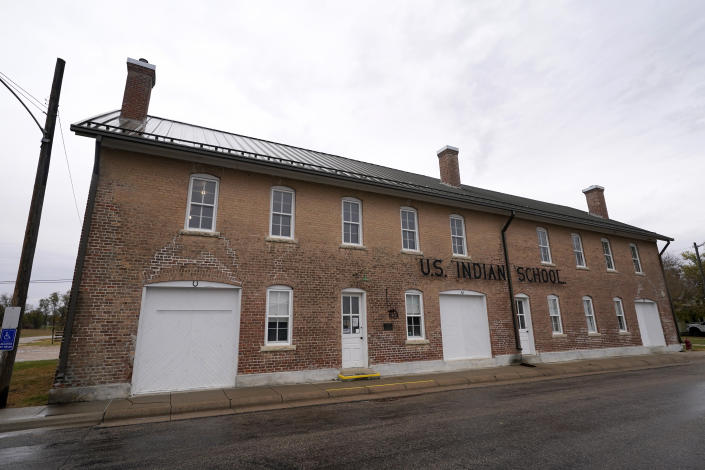
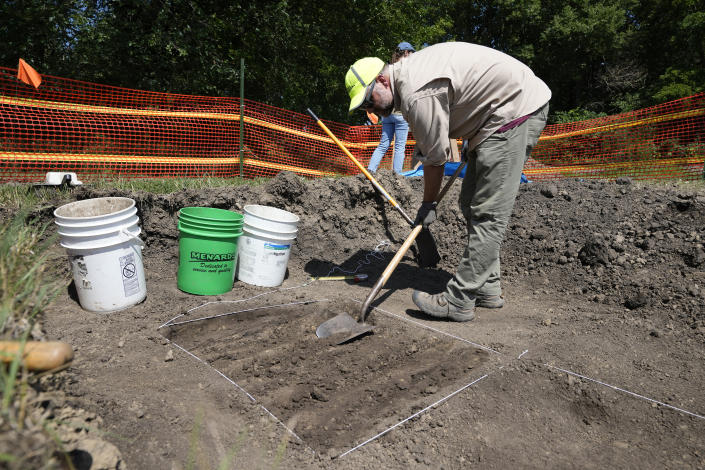
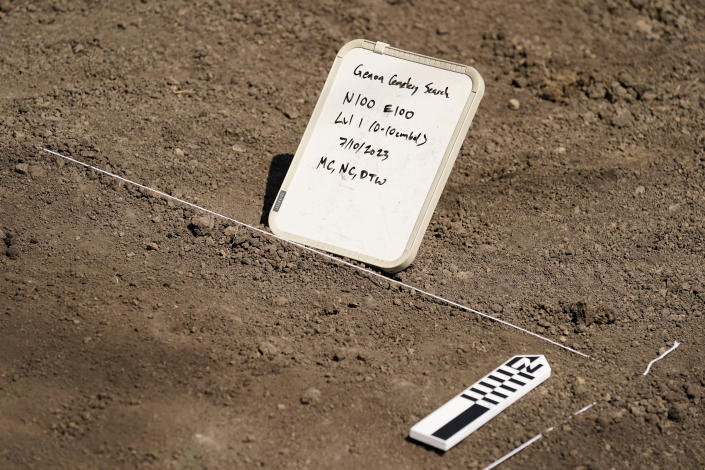
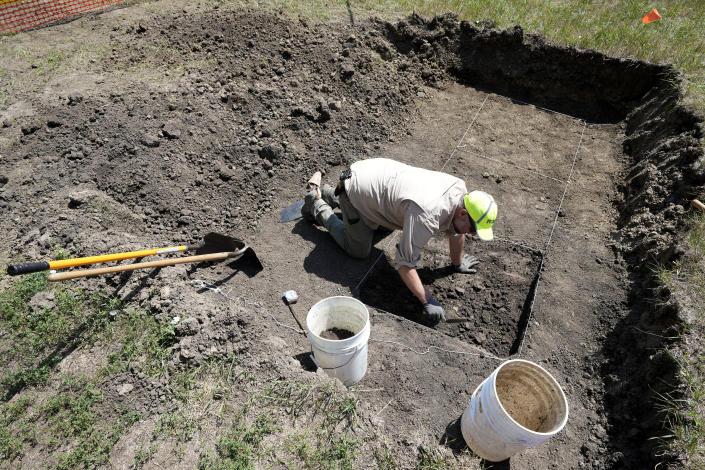
GENOA, Neb. (AP) — In a remote patch of a long-closed Native American boarding school, near a canal and some railroad tracks, Nebraska’s state archeologist and two teammates filled buckets with dirt and sifted through it as if they were searching for gold.
They’re trying to find the bodies of children who died at the school and have been lost for decades, a mystery that archeologists aim to unravel as they dig in a central Nebraska field that was part of the sprawling campus a century ago.
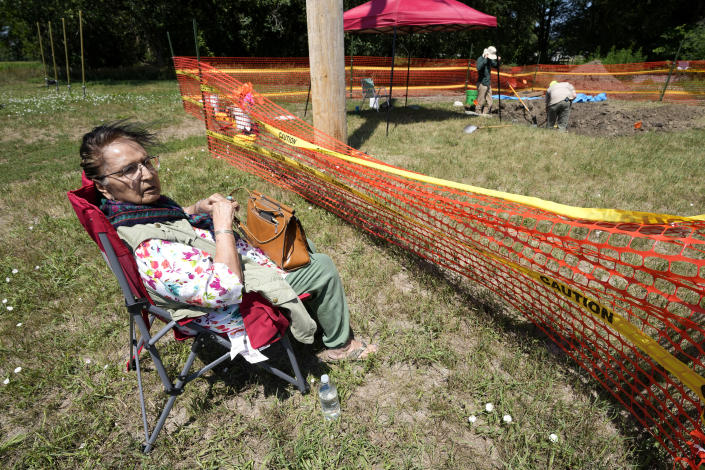
People toting shovels, trowels and even smaller tools are searching the unmarked site where ground-penetrating radar suggested a possible location for the cemetery of the Genoa Indian Industrial School.
Genoa was part of a national system of more than 400 Native American boarding schools that attempted to assimilate Indigenous people into white culture by separating children from their families and cutting them off from their heritage. And the discovery of more than 200 children’s remains buried at the site of what was once Canada’s largest Indigenous residential school has magnified interest in the troubling legacy both in Canada and the U.S. since 2021.
“For all those families with students who died here in Genoa and weren’t returned home — and that information being lost for over 90 years now — it creates this perpetual cycle of trauma,” Dave Williams, the state archeologist, said Monday.
Williams added, “Finding the location of the cemetery, and the burials contained within, will be a small step towards bringing some peace and comfort” to tribes after a long period of uncertainty where children were sent to boarding schools and never came home.
The school, about 90 miles (145 kilometers) west of Omaha, opened in 1884 and at its height was home to nearly 600 students from more than 40 tribes across the country. It closed in 1931 and most buildings were long ago demolished.
For decades, residents of the tiny community of Genoa, with help from Native Americans, researchers and state officials, have sought the location of a forgotten cemetery where the bodies of students are believed to be buried.
Judi Gaiashkibos, the executive director of the Nebraska Commission on Indian Affairs, whose mother attended the school in the late 1920s, has been involved in the cemetery effort for years and planned to travel to Genoa on Monday. She said it’s difficult to spend time in the community where many Native Americans suffered, but the vital search can help with healing and bringing the children’s voices to the surface.
“It’s an honor to go on behalf of my ancestors and those who lost their lives there and I feel entrusted with a huge responsibility,” Gaiashkibos said.
Newspaper clippings, records and a student’s letter indicate at least 86 students died at the school, usually due to diseases such as tuberculosis and typhoid, but at least one death was blamed on an accidental shooting.
Researchers identified 49 of the children killed but have not been able to find names for 37 students. The bodies of some of those children were returned to their homes but others are believed to have been buried on the school grounds at a location long ago forgotten.
As part of an effort to find the cemetery, last summer dogs trained to detect the faint odor of decaying remains searched the area and signaled they had found a burial site in a narrow piece of land bordered by a farm field, railroad tracks and a canal.
A team using ground-penetrating radar last November also showed an area that was consistent with graves, but there will be no guarantees until researchers can dig into the ground, said Williams, the archeologist.
The process is expected to take several days.
“We’re going to take the soil down and first see if what’s showing up in the ground-penetrating radar are in fact grave-like features,” Williams said. “And once we get that figured out, taking the feature down and determining if there are any human remains still contained within that area.”
If the dig reveals human remains, the State Archeology Office will continue to work with the Nebraska Commission on Indian Affairs in deciding what’s next. They could rebury the remains in the field and create a memorial or exhume and return the bodies to tribes, Williams said.
DNA could indicate the region of the country each child was from but narrowing that to individual tribes would be challenging, Williams said.
The federal government is taking a closer examination of the boarding school system. The U.S. Interior Department, led by Secretary Deb Haaland, a member of Laguna Pueblo in New Mexico and the first Native American Cabinet secretary, released an initial report in 2022 and is working on a second report with additional details.
___
Ahmed reported from Minneapolis. Scott McFetridge contributed from Des Moines, Iowa.
___
This story has been corrected throughout to note that researchers determined more than 80 children died at the school, not that there are more than 80 bodies buried there.



















 Water is Life