As we’ve been reporting to you for some time, Big Oil’s most powerful attorneys are attacking the Indian Child Welfare Act (ICWA) at the Supreme Court level. The legal effort is being led by Gibson Dunn, a firm notorious for helping fossil fuel goliaths evade environmental protections. With the Brackeen v. Haaland lawsuit, Gibson Dunn is attempting to eliminate tribes’ rights to keep Native kids in Native care. As you know, Lakota Law is fighting back against this frightening attack on Indigenous sovereignty.
We’re preparing an amicus curiae brief — more details on that below — for the Supreme Court’s consideration during its next session. We also recently had a strategy meeting in New York City with attorney Steven Donziger, another of Gibson Dunn’s targets. On behalf of Indigenous People in the Amazon, Donziger won a landmark judgment against Chevron for dumping billions of gallons of toxic waste into the rainforest. Gibson Dunn then used every dirty trick in the book to turn the tables on him, and now he’s been under house arrest for years. We’ll work to connect Steven to resources that can help him find solutions to his legal problems.
In South America and North America alike, as Indigenous people, we’ve seen a blatant disregard for our lives played out for hundreds of years. That’s why we’re doing everything we can to ensure ICWA is protected, right now. We know this law inside and out. Former South Dakota Senator James Abourezk, who chairs Lakota Law’s Board of Advisors, was the principal author of ICWA, and a decade ago we were contacted by the Justice Department to propose implementation guidelines.
Our amicus brief will make three arguments designed to counter flawed positions taken by Gibson Dunn and the rest of the opposition’s legal team. First, our lawyers will explain that granting tribes the sovereign right to determine what happens to their children is not reverse racism. Second, we will say there is no violation of the U.S. Constitution or the Tenth Amendment when states are required to enforce federal law. And finally, federal, executive branch agencies — in this case, the Bureau of Indian Affairs — must be able to publish and enforce rules and regulations under their purview.
ICWA is a well-intentioned, well-written law with enforcement guidelines we know to be solid. Since going into effect more than 40 years ago, it has helped countless children remain with family, live healthy lives, and maintain a deep understanding of who they are and where they’re from. We can’t go back to the days of government-mandated mass cultural erasure. We must continue to stand together for the Earth and our future generations against the fossil fuel industry and its high-powered attorneys, whatever the costs. It’s up to all of us, and your friendship and care mean we can keep fighting for justice, every day.
Wopila tanka — thank you for supporting our legal work! Chase Iron Eyes Co-Director and Lead Counsel The Lakota People’s Law Project
Beginning soon, when Indigenous people go missing in Washington, social media, radio airwaves and highways will be blanketed with their information to hopefully lead to them being found — the first state in the U.S. where that will be guaranteed.
That’s because Gov. Jay Inslee on March 31 signed House Bill 1725, creating the nation’s first statewide alert system for missing Indigenous people during a ceremony on the Tulalip Reservation in front of tribal leaders and community members, state officials and lawmakers. The bill was proposed by Washington Attorney General Bob Ferguson and sponsored by Rep. Debra Lekanoff, Tlingit and Aleut.
When operational, the system — similar to the state’s “silver alert” for missing vulnerable adults — will help identify and locate missing Indigenous people, who, especially women, go missing at disproportionately high rates and face higher rates of violence and murder compared to other ethnic groups in the U.S.
Advocates like Lekanoff say the measure is just one step in addressing the complex crisis, but it’s another signal to “Native Americans who have said no one is doing anything to stop the crisis of our missing and murdered Indigenous people” that policymakers are acknowledging the problem and working to address it.
“There’s no one solution to help us in our Native American community address the crisis that’s happened to our women and our people,” Lekanoff, a Democrat and the only tribal citizen in the state Legislature, said in a March 30 interview before the signing ceremony. “This is one of many tools in the toolbox.”
When activated, the first-of-its-kind alert will broadcast information about missing Indigenous people on electronic highway signs, through radio messages and across social media. An activation will also include the state alerting local and regional media through press releases. The bill is also meant to lead to better communication and coordination among law enforcement departments and other agencies in investigating cases, Lekanoff said.
The state Legislature unanimously approved the legislation earlier in March, reflecting a trend of Washington, other states, tribal governments and organizations, and the federal government increasingly working to address the crisis of missing and murdered Indigenous people.
Washington Gov. Jay Inslee signed a bill that creates a first-in-the-nation statewide alert system for missing Indigenous people on March 31, 2022.
In Washington, those efforts include a Missing and Murdered Indigenous Women and People Task Force created by the state Legislature last year to come up with recommendations of how to address the crisis in the state. The group began meeting late last year.
The 23-member group includes tribal nation leaders and community members, tribal advocacy organization representatives, state lawmakers, law enforcement officials and others. The task force is meant to build on the previous work of tribal nations and advocates in identifying the problem and potential solutions in Washington — where, according to the Urban Indian Health Institute (UIHI), Indigenous women are more than four times more likely to go missing than white women — and elsewhere.
In Washington, the problem is among the worst in the country. According to a 2018 report from UIHI, the group found that more than 5,700 Indigenous women or girls were reported as missing or murdered in 2016. The organization, which is a division of the Seattle Indian Health Board, also examined more than 500 cases from 71 U.S. cities, finding that Washington had the second most cases as a state, with Seattle having the most among the cities studied. Tacoma had the seventh most cases.
During the ceremony, Ferguson, the state attorney general, said the legislation was one of the first accomplishments the task force could point to and said other states could look to Washington’s alert system as a model to tackle the problem.
He also pledged that the alert system wouldn’t be the last reform “to ensure that we bring everybody back home” and that cases involving missing Indigenous people should include “accountability and justice.”
The Washington State Patrol will be responsible for operating the system, but Lekanoff said the missing and murdered Indigenous person task force, as well as broadcasters and the state Office of the Attorney General, will work together to develop and implement the plan. She said she hoped the system would be designed and implemented soon.
“Missing and murdered Indigenous women and peoples is not just an Indian issue; it’s not just an Indian responsibility,” Lekanoff said during the March 31 ceremony, adding that the bill “brings together all of our governing bodies to collaborate, to take care (of) those who have been taken, those who have been lost and those yet to come.”
The ceremony also included Gov. Inslee signing several other bills affecting tribal nations and Indigenous people, like one strengthening tribal consultation guidelines in spending money for climate protection actions and another allowing Indigenous people serving sentences in tribal jails to be transferred to a state prison, where inmates have better access to rehabilitative programs, services and training.
In legislative hearings earlier this year before the bill was passed, and during the signing ceremony, supporters said the cases of missing Indigenous people often don’t receive the same level of attention or urgency as cases involving people of other groups. That means the burden of raising awareness about a missing person frequently falls on family members and friends.
Tulalip Tribes Chairwoman Teri Gobin said at the signing event that the lack of awareness contributed to perpetuating a feeling among Indigenous people that they “didn’t matter.”
“We’re finally getting to that place where we’re righting some of those wrongs,” she said.
This story is co-published by Underscore.news and Indian Country Today, a news partnership that covers Indigenous communities in the Pacific Northwest. Funding is provided in part by Meyer Memorial Trust.
Underscore is a nonprofit collaborative reporting team in Portland focused on investigative reporting and Indian Country coverage. We are supported by foundations, corporate sponsors and donor contributions. Follow Underscore on Facebook and Twitter.
In 2016 and ‘17, when tens of thousands of people showed up at Standing Rock to protest the Dakota Access pipeline, our rallying cry was “mni wiconi” — water is life. Many of us hail from river tribes, and this saying isn’t just some trite slogan for us; it is our reality as Lakota People. We’re all connected by our ties as human beings, just as water systems are connected above and underground. That’s why, in February — in the same spirit as NoDAPL — representatives from many Great Plains tribes gathered together to bring one voice to the halls of power in South Dakota in support of SB 181.
This legislation, proposed by Lakota State Senator Red Dawn Foster, would require our Department of Agriculture and Natural Resources to assemble a task force to study the adoption of a comprehensive and sustainable watershed ecosystems management approach. Please watch our new video, a co-production by Lakota Law and Uniting Resilience, the nonprofit I run with my partner, Felipa De Leon. It depicts highlights from our presentations and the real impression we made on the senators.
Watch: Lakota Law’s Chase Iron Eyes joined a host of Lakota leaders in addressing the SD State Senate about the importance of SB 181.
The day was a victory, though the legislation didn’t pass this go-round. The senators listened closely and showed real appreciation for our dedication to achieving environmental justice through legislative channels. Tamar Stands And Looks Back made a presentation in Lakota; Chief John Spotted Tail impressed with his words and ceremonial headdress; Lakota Law’s Madonna Thunder Hawk and Chase Iron Eyes made key points that shook the room; and we also heard from the new Standing Rock Sioux Tribe Chairwoman, Janet Alkire, and many others. In the end, senators from both parties spoke in favor of Red Dawn’s legislation and encouraged us to come back with the bill next session.
That’s exactly what we’ll do. We’re ready to show the power of tribal unity until the bill passes. This legislation is important, because the groundwater and aquifers that connect Lakota Country must be protected. As a study I did in cooperation with Lakota Law shows, the long history of uranium mining throughout South Dakota means our people often rely on toxic water. That’s not acceptable, and we will change it. I invite you to stay connected with us. Only by working and showing up together can we make the right impressions, overcome historical barriers, and improve the health and safety of our communities.
Wopila tanka — thank you for helping us protect our homelands and water! Monique “Muffie” Mousseau Via the Lakota People’s Law Project
Lakota People’s Law Project 547 South 7th Street #149 Bismarck, ND 58504-5859
The Lakota People’s Law Project is part of the Romero Institute, a nonprofit 501(c)(3) law and policy center. All donations are tax-deductible.
NDN Collective released a damning climate justice report Tuesday on the controversial Dakota Access Pipeline, the same day as World Water Day.
In a detailed analysis, the Climate Justice Campaign calls on the Biden administration to drain and shut down the pipeline, which the roughly 200-page report argues would protect the nation’s longest river, the Missouri River, and its basin. The report is drawn from court documents, treaties, government documents, news stories, congressional hearings and more.
Engineering and construction flaws of DAPL that threaten tribal sovereignty; and
Six continuous years of failed U.S. Army Corps of Engineers processes.
“The vision of this report is to hold accountable these agencies to their own regulations, to their own laws, to their own climate agendas, but also to support our communities in understanding the regulatory processes and the laws so that we can push against them, or hold these agency accountable to their own laws,” said NDN Collective’s Climate Justice Campaign Director Jade Begay, Diné. Begay also sits on the White House Environmental Justice Advisory Council.
Begay noted how the Standing Rock Sioux Tribe opted out as a cooperating agency in the environmental review process. This happened after the tribe was repeatedly denied access to information, which the report details.
The tribal nation didn’t immediately respond to Indian Country Today’s attempts for a comment.
NDN Collective Climate Justice Organizer Kailea Frederick, Tahltan and Kaska, said draining and shutting down the pipeline would send a clear message to its operator, Energy Transfer, and other companies like it: It’s not okay to violate treaties or environmental protection laws. People, water and the land must be respected, Frederick said.
“The current routing of the Dakota Access Pipeline is a blatant suppression of treaty rights and free, prior and informed consent,” Frederick said.
A recent U.N. report states climate change is already “causing widespread disruption in nature and affecting the lives of billions of people around the world” and calls for urgent action to adapt to climate change and to make deep cuts in greenhouse gas emissions.
“It is actually a conversation on life and death,” Frederick said. “The other voices in the room that continue to try to dominate the conversation are trying to give an illusion that we have more options and more time than we do. And the reality of climate change is that we actually have very few options and we have very limited time to get it right.”
There’s been years of community resistance against the Dakota Access pipeline and recently the Standing Rock Sioux Tribe claimed a legal victory in the case.
Indigenous water protectors and allies blocked the pipeline for months starting in 2016 and were met with violence.
The Standing Rock Sioux Tribe sued Energy Transfer over National Environmental Policy Act violations. A district court judge ruled a new Environmental Impact Statement would be required by the company. The Supreme Court denied Energy Transfer’s bid to thwart environmental oversight.
The new environmental impact statement is due in September and a public comment period will open up after that.
NDN Collective will issue a call to action at that time and help the public navigate the public comment requirements because comments must meet strict guidelines that specifically deal with the underwater pipeline crossing on Lake Oahe.
But the possibility of shutting down the pipeline entirely is left up to the executive branch and the Biden administration has so far refused to do so.
Begay questions if the policies and proposals in the Build Back Better Plan and the Green New Deal will be enough to help with a needed paradigm shift.
“The paradigm shift of not consuming as much, staying home more, being more localized, valuing getting around and living our lives without fossil fuels – and plastics,” Begay said.
Frederick said “we don’t have a choice at this moment in time other than to think about how we’re going to live our lives differently and how we’re going to descale.”
NDN Collective releases Dakota Access Pipeline report on World Water Day. The organization worked on the report for over a year. It offers the most thorough, and critical, analysis of the DAPL project yet. (Courtesy of NDN Collective)
“Indigenous peoples need to see the government acting in good faith and so one action towards that is taking action around DAPL and reducing the flow and eventually abandoning the pipeline. That’s our demand,” Begay said.
The NDN Collective report took more than a year to develop in “consultation with an array of skilled and respected industry Indigenous and non-Indigenous specialists who also possess intimate knowledge of the DAPL.”
“It feels like a very big responsibility to get it right, on many different levels,” Frederick said.
The environmental impact statement requires the public’s participation to determine its contents but the report found that didn’t happen with the DAPL project.
“Previously, through the EIS process, there was a time that they would sit down with tribes and strategize together and this process was called scoping. And with the DAPL process, this did not happen,” Frederick said.
The report is critical of how the Army Corps of Engineers has carried out “flawed” processes.
“The way that the entirety of the DAPL process has gone even just now that this pipeline is operating illegally without the right permitting, it really sets the precedent for the other future types of projects,” Frederick said. “If this specific issue around DAPL is not corrected and if this pipeline is not drained and shut down, that it lets other agencies know or companies know that it’s okay to operate in this way with our people on our lands. And the truth is that it’s not okay. And that it is a true violation of treaties.”
The report states the Army Corps lacks “transparency by continuing to withhold critical technical information requested repeatedly by the Tribes while hiding under the guise of “national security”.
One of the major concerns listed in the report is an “independent third-party.” A contractor that is meant to be neutral in the environmental review process has blatant financial ties to the oil and gas industry through membership in the American Petroleum Institute, according to the report.
The report calls for transparency and diligent assessments on the impact of the DAPL project.
Five key elements are:
1. Challenge the legitimacy of the DAPL on Indian land – Treaty Rights 2. Approval of DAPL continues as modern-day dispossession of Indigenous people 3. Army Corps and the Trump era NEPA 4. Major DAPL routing, engineering, spill risk, and safety issues 5. Failure to adequately address environmental justice
“We feel really grateful that our campaign has been able to steward this report coming out into the world,” Frederick said.
She’s looking forward to seeing how tribes and other organizations utilize the material compiled in the report.
In January, a fellow LGBTQ2S person who had taken a trip to California contacted me and my partner, Felipa. On her way back to the Dakotas, she’d stopped at Winnemucca in Nevada, where she realized the battle over the lithium mine at Thacker Pass was making life extremely hard for Native populations. She asked us, “Can you and Felipa help these tribes? Everything is in despair.”
If you’ve been receiving Lakota Law newsletters for some time, you know that Felipa and I take our responsibilities as Native Two-Spirit and environmental advocates seriously. When our friend asked us to help at Thacker Pass, we knew we had to take action. We contacted Lakota Law and other friends and planned a roadtrip to deepen our understanding and see what we could do to bring attention to the plight of the Winnemucca and other relatives on Paiute and Shoshone homelands in Nevada.
Above: a protest camp set up to protect Thacker Pass. Please watch our interview with our new friend, Daranda, who told us about the Native-led resistance to safeguard this beautiful place, then take action to protect Thacker Pass!
Like so many other Native communities on the frontlines of environmental racism, our relatives near Thacker Pass have been ignored and railroaded in the name of Big Extraction. Because the area is home to the largest lithium deposit in the U.S., mining companies are coming for it fast. And despite resistance led by local tribes, the government has given the go-ahead to rip this beautiful place apart.
In February, the Winnemucca Colony joined a lawsuit against federal agencies — including the Bureau of Land Management, which manages the land. Of course, at no point did these agencies properly consult Native communities before moving ahead with the mine, which will almost certainly contaminate groundwater essential for the survival of both the region’s people and its diversity of animal life.
As a key component of batteries that power solar arrays and electric vehicles, lithium may be essential to the transition to a clean energy economy. Still, we must make that transition responsibly — with input from all affected populations. A recent study found that, just like fossil fuel extraction, mining lithium and other metals has an outsized negative impact on Native communities. It should come as no surprise that in the U.S., 97% of nickel, 89% of copper, 79% percent of lithium and 68% of cobalt mines are located within just 35 miles of Indian reservations.
The situation at Winnemucca is particularly scary. Many of its people were afraid to talk to us, or they didn’t want their names revealed. One elder woman told us, “We cannot go on like this.” The Bureau of Indian Affairs (BIA) is leveling their territory, ejecting more than 500 people, and making room for a mancamp to house construction workers. We all know where that will lead: to a new frontier for the epidemic of Missing and Murdered Native Women and People.
It’s also bad in surrounding communities. At the Fort McDermitt tribal nation — whose people are closely related to Winnemucca’s — they have the second highest violent crime rate out of all 576 tribes in the U.S. The BIA is in charge of law enforcement, but the people are suffering at the hands of a constant stream of new, rookie officers. Community elders are subject to routine violence, and most people carry loaded weapons. Many Fort McDermitt youth have been killed by BIA cops. From what I saw, I believe it’s possible that neither Winnemucca nor Fort McDermitt will even exist as communities a year from now.
There is so much more to report from our trip, but for the moment, I believe it’s most important that you know what’s happening at Thacker Pass. Standing Rock’s NoDAPL resistance may have been an inflection point that brought many of us together — but it was not unique. We still have a ton of work to do to hold the government and extractive industry accountable for their many sins against our communities all across Turtle Island. Please start by helping to protect Thacker Pass today!
Wopila tanka — thank you for your friendship. We’re all in this together! Monique “Muffie” Mousseau Via the Lakota People’s Law Project
Lakota People’s Law Project 547 South 7th Street #149 Bismarck, ND 58504-5859
When you heard from me last week, Standing Rock was about to host tribal representatives and the Assistant Secretary of the Army Civil Works (Michael Connor) for a meeting about the Dakota Access pipeline (DAPL). Today, I’m happy to report that things went about as well as could be expected. I attended the meeting in my capacity as an advisor to Standing Rock Chairwoman Janet Alkire, and I can report that Connor paid close attention as leaders from nine nations of the Oceti Sakowin expressed a unity of purpose in our fight to end DAPL once and for all.
Yankton Sioux Tribal Councilman Kip Spotted Eagle addresses the Army, flanked (left to right) by Spirit Lake Chairman Doug Yankton, Cheyenne River Chairman Harold Frazier, and Standing Rock Chairwoman Janet Alkire.
As you know, this toxic pipeline, which crosses the Mni Sose — the Missouri River — on Standing Rock’s doorstep, is an existential threat to our homelands and our water. I almost went to prison for peacefully protesting against it in 2017. As Connor sits atop the Army Corps of Engineers — tasked by the courts with creating DAPL’s Environmental Impact Statement — this meeting was critical. Connor listened for many hours, eventually postponing a subsequent meeting with North Dakota Governor Doug Burgum so all our people could speak.
The fact that Chairwoman Alkire was joined by representatives from the Oglala, Cheyenne River, Flandreau, Rosebud, Crow Creek, Yankton, Lower Brule, and Spirit Lake Sioux Nations was an important show of tribal solidarity. And while getting federal officials to take action on our behalf will be an uphill climb at a time when gas prices are rising on account of the Ukraine invasion, this was an important step.
Left: Standing Rock Chairwoman Janet Alkire with Michael Connor. Center: The color guard presents the flags. Right: Cheyenne River Chairman Harold Frazier, Connor, and Spirit Lake Chairman Doug Yankton.
Renewable energy is now cheaper than fossil fuel throughout the nation, so regardless of what’s happening to oil markets, there is no excuse for failing to go green immediately. And tribal communities should never be forced to bear the risk of noxious infrastructure.
This resistance united us in 2016, and it’s still uniting us today. Now we are being heard by the U.S. Army instead of being shot with water cannons and rubber bullets by TigerSwan, a contracted private army. The fight goes on in a new way — but we still have a long way to go before we can say the Black Snake is defeated. So please stay with us. We’re in this together, and your spirit is always valued in this struggle.
Wopila tanka — thank you for your solidarity! Chase Iron Eyes Co-Director and Lead Counsel The Lakota People’s Law Project
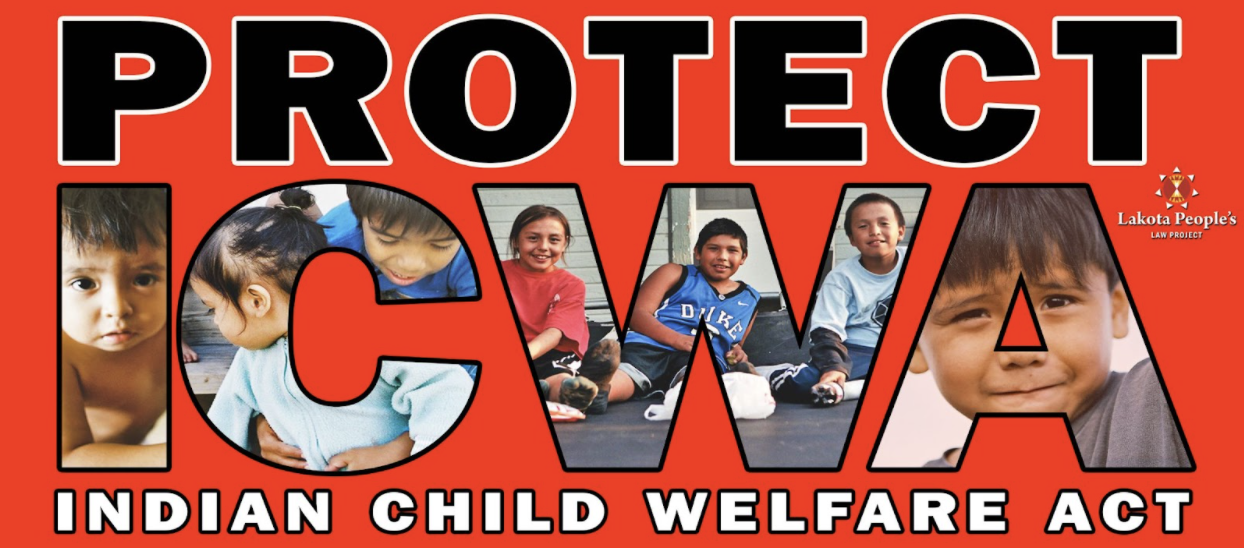
The moment has come to rally together for our children. The United States Supreme Court has announced that, this autumn, it will hear the case of Brackeen v. Haaland — which could redefine the constitutionality of the Indian Child Welfare Act (ICWA) and threaten tribal sovereignty. Because legal arguments will soon be due, we’re already in high gear. Our attorneys are now preparing an amicus brief for the justices, and it’s up to all of us to raise awareness about the importance of protecting this law and keeping Native kids in Native care. I ask you today, with all my heart, please stand with us in this fight.
The Supreme Court could strike down the Indian Child Welfare Act this year, which could also jeopardize Native sovereignty as we know it. We must not 👏 let 👏 that 👏 happen! 👏
Protecting our youth and keeping them in Native care — or kinship care, as we call it — is a huge deal for all of us in Indian Country, especially with the ongoing discovery of mass graves at boarding schools. In fact, safeguarding our children is what motivated me to co-found the Lakota People’s Law Project.
Over the years, with help from friends like you and conscientious reporters like Laura Sullivan at NPR (who won a Peabody Award for her coverage of South Dakota’s foster care crisis), we have made massive inroads. Today, Lakota Law has a Native-run kinship care home at Standing Rock, and I’m helping to oversee the creation of similar facilities and lobby for a tribally-run Child Welfare Department here at the Cheyenne River Nation.
Importantly, too, this Supreme Court case isn’t just about our young ones. As we detailed in our blog a few months back (if you haven’t yet, please read that!), it’s also potentially an attack on tribal mineral rights and, ultimately, our sovereignty. It’s no coincidence that the white family who initiated the case in Texas after adopting Native children is backed, pro bono, by Big Oil lawyers — including a hideous firm called Gibson-Dunn — who normally have no interest in these matters.
If ICWA falls, it could become the first domino in a series of Native rights rollbacks. The colonists want our children because our youth are our future. The chair of our board of advisors, Senator James Abourezk, was the principal author of ICWA back in the late 1970s, and our president and chief counsel, Danny Sheehan, consulted with the Department of Justice to draft the enforcement guidelines that are the subject of this Supreme Court case.
That’s why we’ll work night and day to stop this legal attack. In the coming weeks, we’ll help the Supreme Court justices understand the legal arguments behind this critical law. We’ll also continue to ensure the case gets maximum media coverage. This must be a full team effort. So, stay with us over the year to come, and please do everything you can to help us amplify this issue.
Wopila tanka — thank you for helping us protect our children and our culture. Madonna Thunder Hawk Cheyenne River Organizer The Lakota People’s Law Project
P.S. With ICWA headed to the Supreme Court, it’s an all-hands-on-deck moment. Please donate today to ensure our skilled legal and media teams can protect Native children, kinship care, and sovereignty. The forces of modern colonialism, capitalism, and racism are aligned against us. Let’s unite, stand strong, and show them what we’re made of.
Lakota People’s Law Project 547 South 7th Street #149 Bismarck, ND 58504-5859
I hope you’re safe and remaining hopeful despite the horrific world events taking place. The Russian invasion of Ukraine highlights once again how important it is for people everywhere to remain sovereign and free of tyranny. My heart goes out to all who are now suffering through another needless, bloody war.
Perhaps it will lend you some comfort to know that there is good news this week from Standing Rock. This Wednesday, tribal leaders from across the Great Sioux Nation will have an opportunity to sit down with the U.S. Army Civil Works and relay our concerns about the Dakota Access pipeline (DAPL). After years of our #NoDAPL resistance falling on deaf ears — as highlighted by Standing Rock Chairwoman Janet Alkire in our new video, co-produced with the tribe — the Army finally reached out to Standing Rock. This is a potential turning point, though we are keeping our expectations modest.
Watch: In our new video, Standing Rock Sioux Tribe Chairwoman Janet Alkire discusses the importance of tribal input and gaining our consent for projects like DAPL.
We originally expected the Army Corps of Engineers to release its DAPL Environmental Impact Statement (EIS) earlier this month. But that’s now on hold, pending our coming conversation about this dangerous pipeline. This opportunity to have the appropriate government officials really listen to our concerns is long overdue.
Of course, given the long history of broken promises by the U.S. government to Native People, I take everything with a grain of salt and won’t celebrate prematurely. We must continue to stand ready to protest the EIS, should it eventually be released in any form that doesn’t fully address our concerns.
Right now, I’m happy to say we have some additional leverage. The meeting with Civil Works will happen against the backdrop of a huge win for Standing Rock in the Supreme Court this past week. Justices shut down DAPL’s attempt to make an end-run around the environmental oversight process.
Solidarity remains paramount if we are to achieve our goal of ending DAPL once and for all. As people from many nations gathered for our original NoDAPL stand in 2016 and ‘17, Wednesday’s meeting will bring together leaders from throughout the Oceti Sakowin — our Great Sioux Nation. We will, of course, report on the results of that conversation to you. So, please continue to stay with us. We must remain vigilant, united, and ready to act.
Wopila tanka — my deep gratitude to you for your friendship! Chase Iron Eyes Co-Director and Lead Counsel The Lakota People’s Law Project
Lakota People’s Law Project 547 South 7th Street #149 Bismarck, ND 58504-5859
The Lakota People’s Law Project is part of the Romero Institute, a nonprofit 501(c)(3) law and policy center. All donations are tax-deductible.
FILE – In this Nov. 5, 2020, file photo the Supreme Court is seen in Washington. (AP Photo/J. Scott Applewhite, File)
The U.S. Supreme Court agreed to hear Texas v. Haaland, a case seeking to overturn the Indian Child Welfare Act.
The high court said Monday morning it would take the case reviewing the 1978 federal law. Many call the Indian Child Welfare Act a gold standard for child welfare policy.
A federal appeals court in April upheld the law and Congress’ authority to enact it. But the judges also found some of the law’s provisions unconstitutional, including preferences for placing Native American children with Native adoptive families and in Native foster homes.
“The far-reaching consequences of this case will be felt for generations,” stated the National Indian Child Welfare Association in a statement. “In a coordinated, well-financed, direct attack, Texas and other opponents aim to simultaneously exploit Native children and undermine tribal rights.”
ICWA has long been championed by tribal leaders to preserve Native families and cultures involving Native children, and it places reporting and other requirements on states.
“In keeping (Native children) connected to their extended family and cultural identity, the positive outcomes are far-reaching and include higher self-esteem and academic achievement. Further, they recognize that collaboration between sovereign Tribal Nations and state child welfare systems is effective and just governance,” the national organization stated.
The case will be argued during the court’s new term that begins in October.
Texas, Louisiana, Indiana and seven individuals had sued over provisions in the law, and a federal district court initially sided with the group and struck down much of the law. But in 2019, a three-judge federal appeals court panel voted 2-1 to reverse the district court and uphold the law. The full court then agreed to hear the case and struck some provisions.
The Biden administration asked the Supreme Court to review the case, arguing that the provisions should not have been struck.
Before the Indian Child Welfare Act was passed, between 25 percent and 35 percent of Native American children were being taken from their homes and placed with adoptive families, in foster care or in institutions. Most were placed with white families or in boarding schools in attempts to assimilate them.








 Water is Life