|
|||||||||||
|
Author: aztec8888


A Pipeline Denied
Mountain Valley Pipeline Water Permit Denied
https://popularresistance.org/mountain-valley-pipeline-water-permit-denied/
Division of Water Resources cites doubts about MVP Mainline project, says construction in NC could cause “unnecessary water quality impacts.”
This is a developing story and will be updated.
Another natural gas pipeline in North Carolina has been derailed, at least temporarily, as the North Carolina Department of Environmental Quality has denied a water quality permit for the MVP Southgate project that would route through Rockingham and Alamance counties.
In a letter released this afternoon, Division of Water Resources Director Danny Smith wrote, “Due to uncertainty surrounding the completion of the MVP Mainline project,” it has determined that “work on the Southgate extension could lead to unnecessary water quality impacts and disturbance of the environment in North Carolina.”
Owned by Pittsburgh-based EQM Midstream Partners, MVP Southgate is an extension of the main MVP natural gas pipeline, which starts at a fracked gas operation in northern West Virginia and ends in Chatham, Va.
MVP Southgate would run from Chatham, Va., and enter North Carolina near Eden, in Rockingham County. From there, it would route nearly 50 miles southeast, cutting through Alamance County and ending in Graham. Construction costs are roughly $470 million.
In total, the southern portion would cross 207 streams, three ponds and temporarily affect 17,726 linear feet of streams, 6,538 square feet of open waters, and 14 acres of wetlands; another 0.02 of an acre of wetlands would be permanently damaged. Nearly 14 acres of riparian buffers would also be affected. MVP Southgate would cross the Dan River, home to endangered and threatened species, and Stony Creek Reservoir, the main drinking water supply for the City of Burlington.
The division also denied a Jordan Lake Riparian Buffer Authorization. Such an authorization would be required because the route is within the sensitive Jordan Lake watershed, which includes the Haw River.
MVP Southgate is an extension of the controversial main Mountain Valley Pipeline project, which runs for 303 miles from a fracked gas operation in northern West Virginia to southern Virginia. The mainline has racked up hundreds of environmental violations and prompted state and federal regulators to issue dozens of stop-work orders. Construction on the main line is currently halted, per a FERC stop-work order. That project’s costs have ballooned to $6.2 billion.
“Division staff have determined the Southgate project’s sole utility and purpose is tied to and wholly relies on the completion of the entire Mainline project,” today’s letter reads. “The uncertainty of the MVP Mainline Project’s completion presents a critical risk to the achievability of the fundamental purpose of MVP Southgate,” it continued.
Most of the environmental harm would occur during construction, the division wrote, adding that it “finds it is inappropriate to unnecessarily risk impacting high-quality waters and drinking water supplies of North Carolinians.”
Examples of this harm can be seen in the wake of construction of the now-defunct Atlantic Coast Pipeline, which destroyed miles of private farmland and forests in several North Carolina counties, Policy Watch reported on July 30. It’s yet unclear how those environmental harms will be remedied.
An EQT spokesperson could not be reached this afternoon for comment about the decision and whether the company would appeal.
Crystal Cavalier, a citizen of the Occaneechi Band of the Saponi Nation, is an indigenous activist. MVP Southgate would run through indigenous family lands, she said. There were also questions of whether Indian burial mounds were located near waterways; several were found along the route of the main line.
“This is huge,” Cavalier said. “I’m so excited that North Carolina is taking a stand for indigenous people. Because once you dig up this land, you can’t renew it.”
Haw Riverkeeper Emily Sutton has co-organized opposition to the MVP Southgate project for more than two years. “We’re so thrilled to hear that DEQ has made the right decision to deny this unnecessary pipeline,” Sutton told Policy Watch. “This pipeline would have destroyed streams and critical habitat throughout the Haw River watershed. This is a win for all of North Carolinians and a step forward in our state’s commitment to limiting our dependence on fossil fuels.”
This is the second time DEQ has denied what’s known as a “401 permit” under the terms of the Clean Water Act. Last year the agency rejected the project application because, after repeatedly asking for information for more than six months, DEQ had not received from MVP Southgate a full accounting of stream crossings and other impacts on waterways. Without the additional information, DEQ couldn’t evaluate the application before a federal deadline,
In previous comments to federal regulators, DEQ doubted the necessity of the project. The western and central Piedmont already has access to existing natural gas pipelines; Dominion Energy would be MVP Southgate’s primary customer.
In addition to hundreds of public comments opposing the project, 40 state lawmakers also petitioned DEQ to disapprove it.
DEQ’s decision counters those issued by the Federal Energy Regulatory Commission. FERC approved the project in February and issued it a Certificate of Public Convenience and Necessity in June. However, even FERC, which rarely reins in natural gas projects, issued the certificate on the condition that the main Mountain Valley Project obtain all necessary permits.
In a separate statement, DEQ Secretary Michael Regan said, “Today’s decision to deny the MVP Southgate certification protects North Carolina’s water quality, our natural resources and our communities. DEQ has questioned the need for the MVP Southgate project since our initial comments to FERC. This has always been an unnecessary project that poses unnecessary risks to our environment and given the uncertain future of the MVP Mainline, North Carolinians should not be exposed to the risk of another incomplete pipeline project.
“North Carolina’s clean energy future is not dependent on adding more natural gas infrastructure,” Regan continued. “Projects like this slow down the state’s goal to reduce greenhouse gases under North Carolina’s Clean Energy Plan and our efforts to address climate change under Executive Order 80. We should invest in clean, renewable energy sources and the economic benefits of energy innovation.”
This recent setback for MVP Southgate, coupled with the cancellation of the Atlantic Coast Pipeline last month, have occurred despite actions by the Trump administration to roll back environmental regulations to ease the way for natural gas projects.
On June 1, President Trump signed an executive order to fast-track energy projects like natural gas pipelines, undoing key components of longstanding environmental law. States can no longer consider any factors except water quality in acting on a 401 permit. For example, if DEQ found that the MVP Southgate project would draw down aquifers or reservoirs serving as a drinking water supply — such as Stony Creek Reservoir — that’s a water quantity issue, and could not be considered.
Nor can states cite climate change as a reason to deny a 401 permit.
Natural gas pipelines leak methane, a greenhouse gas and major driver of climate change. The EPA is expected to issue a new rule on methane later this week that weakens environmental protections. Although the exact text of the rule has not been publicly released, The New York Times reported that the EPA will eliminate federal requirements that oil and gas companies must install technology to detect and fix methane leaks from wells, pipelines and storage sites.
Despite the Trump administration’s deregulation, in some cases, court rulings have foiled the EPA. On April 15, the federal District Court for Montana vacated the U.S. Army Corps of Engineers’ nationwide permit; although that permit related to the Keystone XL pipeline, the court’s decision had implications for pipeline projects throughout the U.S., including the ACP and the MVP mainline and Southgate pipelines.
In cancelling the ACP, Dominion Energy and Duke Energy cited the court ruling as one reason it was no longer economically or logistically feasible to continue the project.
Native American Voting Rights Act

I write to you from Standing Rock with encouraging news: despite losing a tough mayoral campaign in McLaughlin, South Dakota, I’ve been promised appointment to the city council. Given the profound hardships it took to get here, I’m pleased with this outcome.
Three months ago, my uncle Robert White Mountain shared my story with you — I was unjustly removed from the ballot as a mayoral candidate by McLaughlin’s majority white city council. Robert’s message triggered an article in our local paper, The Teton Times, which put City Hall on alert: the Lakota People’s Law Project — and supporters like you — would not tolerate violation of my right to run for elected office. The pressure worked, and I gained a last minute chance to re-enter the race.
In Lakota Law’s new video, I talk about our mayoral race in McLaughlin and my plans, as a future City Council member, to provide for our youth.
While I couldn’t win with just days to campaign, an appointment to the council will still let me accomplish many good things for this town. Thank you for being part of the watchdog community who supported my right to run. More and more, we Indigenous people are seeking elected office throughout the United States, and we are casting more votes, too. But the trend of keeping us off ballots — or of not counting our ballots at all — remains a huge problem.
That’s why, just last week, the Lakota People’s Law Project forged a compact with the Standing Rock Sioux Tribe to support a nationwide campaign encouraging Congress to pass the Native American Voting Rights Act. Very soon, Lakota Law will give you an opportunity — via its about-to-be-launched Action Center — to make your voice heard on this critical topic.
As I prepare to join the city council here in McLaughlin, I plan to collaborate with the Lakota People’s Law Project to start a youth center where, as director, I will ensure that the children of our tribal nation have access to culturally enriching experiences, like sweat lodge, ceremony, and prayer songs. Because of the imposed poverty here at Standing Rock, far too many of our youth fall into substance use, gang activity, or suicide. As someone with a degree in social work, I intend to help solve this crisis.
Thank you for supporting our work here on tribal nations in the Dakotas. Please stay with us. We have much to accomplish together to protect Native voting rights and assist our youth.
Wopila tanka — my enduring gratitude for your care and attention!
Hoksila White Mountain
Via the Lakota People’s Law Project
Water Project
Someone out there in the great E-universe, how can I match up this company and their technology with the Navajo nation that so desperately needs a green source of clean water? https://air2watersolutions.com/about-us/
Today contacted the company.
Tomorrow begin a GoFundMe page.
Wednesday begin calling around for assistance to make something happen.
Water
Cronkite News
Luce Foundation: Southwest Stories Fellowship
PHOENIX – By now, you’ve probably heard it more times than you can count: One of the simplest ways to reduce the risk of COVID-19 infection is to wash your hands.
But for the nearly one in three Navajo Nation households without indoor plumbing, that’s easier said than done.
“People (here) call it a luxury to be able to have running water,” said Yolanda Tso, a Navajo Nation member and community advocate. “I don’t really believe that should be considered a luxury in this day and age, especially in this country.”
Tso founded WATERED – Water Acquisition Team for Every Resident & Every Diné – to help fill gaps in water access on the reservation, which this summer eclipsed New York in per-capita coronavirus infection rates, according to CNN. She started raising funds to purchase hand-washing stations for families in need in April and began deliveries in June.

Tso said she knows her small-scale, donation-dependent operation can’t fix the broader infrastructure problems on Navajo land. In 2018, the Indian Health Service told Congress the tribe had more than $450 million in unfunded water needs.
But she hopes it can help even the playing field for a population infectious disease specialists say has a higher-than-average risk of contracting COVID-19.
“At this moment, it’s going to help people be able to accomplish those goals of protecting themselves,” Tso said.
Impact of federal relief funding unclear
As of Aug. 4, the Navajo Health Department had reported 9,156 confirmed cases of COVID-19 in a population of about 175,000 – more infections per 100,000 residents than any state in the country, according to data from Johns Hopkins University.
The reservation also had a death toll higher than that of 16 U.S. states, with 463 residents lost to the disease by that date.
Navajo officials have proposed spending about $300 million of the $714 million they’ve received in federal CARES Act funding on water infrastructure to help slow the spread of COVID-19, according to a release from Navajo Nation President Jonathan Nez’s office.
But restrictions require officials to spend CARES Act funds by the end of the calendar year, and Navajo officials say it likely would take at least two years to get a substantial water infrastructure project off the ground.
Even if the federal government grants the spending extension Navajo leaders have requested, the extra time would not address the immediate needs of families without running water.
That’s where Tso and other Navajo volunteers come in.
WATERED’s team has delivered hand-washing stations to more than 110 households on the 27,000-square-mile reservation as a stopgap measure, Tso said.

The stations include reusable 5-gallon jugs and 5-gallon buckets for catching used water, and WATERED provides liquid hand soap, toilet paper, paper towels and disinfectant.
The group relies on donations to cover supply and travel costs, Tso said, and some local companies have made in-kind contributions to increase WATERED’s efficiency and reach. The Glendale moving company State 48, for instance, provided a delivery truck to transport of the stations.
These families “don’t have the ability to get a main source of stopping the spread of COVID as easily as most other communities,” State 48 owner Amanda Lindsey said.
Pandemic prompts ‘important’ access conversation
Annie Lascoe of DigDeep, a nonprofit that works to address water needs on the reservation and elsewhere, described water access as a “deeply entrenched racial justice issue.”
White households are 19 times as likely as Native households to have running water, according to a 2019 report from DigDeep and the Water Alliance that argued rural and tribal community members “understand the historical barriers to access better than outsiders.”
“When we’re looking at Indigenous peoples’ rights, Indigenous communities around the world are the ones that are preserving all of our natural resources,” Lascoe said, citing the Navajo philosophy of “tó éí ííná” – “water is life.”
Yet Native populations are “the No. 1 communities that are also deeply impacted by entrenched systems that have robbed them of access to those resources,” she said.
Indeed, the U.S. government has repeatedly left tribal officials out of key water-policy negotiations, despite the 1908 Winters Doctrine promising federally reserved water rights to Indigenous communities.
Navajo leaders in recent years have pursued water settlements at the state level in Arizona, Utah and New Mexico, but the Navajo Department of Water Resources continues to point to a “lack of adequate domestic and municipal water” as one of the nation’s biggest challenges.
Tso said she would “would never choose a pandemic to have these conversations,” but “it’s so important for people to understand that even though we live in 2020 and we think of America as this superpower, we still have people who are living in conditions that are subpar.”
“We have to be able to lift each other up,” she said. “That’s the only way we’re going to make it out of this together.”

This story is made possible through a partnership between the Walter Cronkite School of Journalism and the Center for the Study of Religion and Conflict at Arizona State University, with the support of the Henry Luce Foundation.
DAPL News

In case you haven’t yet heard, yesterday an appellate court dropped a big decision in the Standing Rock Sioux Tribe’s lawsuit to stop the Dakota Access pipeline (DAPL). Unfortunately, the court’s ruling did not support immediately shutting down oil flow as we hoped. However, the court also failed to reverse the lower court’s decision to vacate DAPL’s permit to pass under Lake Oahe, Standing Rock’s primary source of drinking water. DAPL’s continued operation is now officially as illegal as it is dangerous.
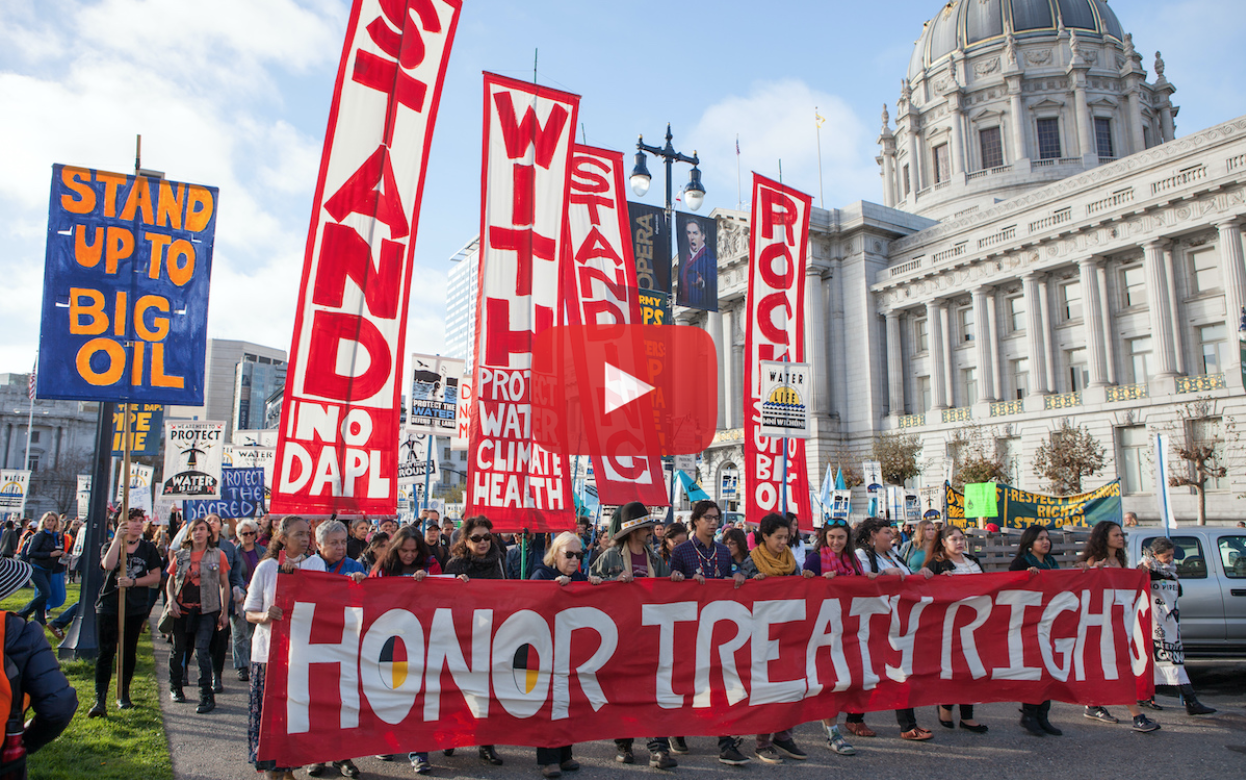
Press play to watch my video breakdown of the court’s decision.
You likely recall that, a month ago, D.C. Circuit Court Judge James Boasberg set a 30-day deadline for Energy Transfer to stop pumping oil through DAPL. Yesterday’s appellate court decision is complex, but it essentially delays that deadline while the U.S. Army Corps of Engineers decides whether to stop the oil given the absence of a permit. The Corps can demand Energy Transfer comply with the National Environmental Policy Act, shut down the oil, and perform a full Environmental Impact Study.
If that doesn’t happen, we’ll see more arguments before Judge Boasberg. Bottom line, this fight now looks likely to stretch into 2021, when a new administration could revoke DAPL’s permits for good. I urge you to watch my video breakdown, stay tuned for more updates, and keep a positive outlook.
The struggle continues, but hope is on the horizon. We remain optimistic, and we must keep fighting with all our collective strength. We won’t stop until this pipeline is emptied and dug out of our sacred ground. I look forward to the day we can gather together at Standing Rock again — this time to celebrate the end of DAPL, once and for all.
Wopila tanka — my eternal appreciation for standing with Standing Rock!
Chase Iron Eyes
Lead Counsel
The Lakota People’s Law Project
Important Census 2020 Information
|
|
|
|


|
“sovereignty hobbyists¨? Racist Comment
Oklahoma attorney general dismisses legislation critics as ‘sovereignty hobbyists’

Mary Annette Pember
Mary Annette Pember
Indian Country Today
The Supreme Court’s McGirt v. Oklahoma ruling affirmed tribal sovereignty, but the state’s attorney general, Republican Mike Hunter, is disputing its importance in negotiating jurisdictional responsibility with tribes and the state.
Hunter described some of those concerned about the impact of proposed federal legislation related to the case as “sovereignty hobbyists,” during an interview with reporter Scott Mitchell on News 9 in Tulsa.
According to Hunter, hobbyists are worried about “theoretical” problems and have misplaced criticism of the proposed legislation.
“They’ve accused us of eroding the Violence Against Women Act (VAWA); we’ve actually increased the ability to utilize VAWA in protecting women by using concurrent state and tribal jurisdiction rather than limiting it to tribal jurisdiction,” Hunt said.
Under the proposed legislation, announced in an “agreement in principle,” the state would have criminal jurisdiction over non-Native and overlapping jurisdiction over most Native offenders.
Five Oklahoma tribes — Cherokee, Chickasaw, Muscogee (Creek), Seminole and Choctaw — initially signed on to the agreement. Later, however, after many tribal citizens complained that it undermined sovereignty, the Muscogee (Creek) and Seminole tribes announced they were not in agreement with the proposal.
Muskogee (Creek) Nation Principal Chief David Hill said previously that although he believes in collaboration between federal, state and tribal governments, “that collaboration doesn’t require congressional legislation.”
Seminole Nation Chief Greg Chilcoat agreed and complained that since his tribe was not involved with discussions regarding the agreement, it would not consent to join.
Rosemary McCombs Maxey of the Muscogee (Creek) Nation described Hunter’s words as paternalistic.
“He is trivializing sovereignty. When I hear someone talking like that, I’m reminded of my childhood when the White men got to do all the talking,” she said.
Maxey, 75, lives on her grandmother’s allotted lands on the Muscogee (Creek) reservation. A native Mvscokee language speaker, Maxey has taught the language at the college level. Now retired, she holds Mvskokee language immersion events at her farm.
“Why would Congress be the arbiter of any agreement between the tribe and state? Our sovereignty is intact. We have the ability to negotiate directly with the state,” she said.
Jay Fife of the Muscogee (Creek) Nation agreed. “Hunter’s comments represent how Oklahoma views Indigenous peoples and our fight. Defending sovereignty is not something we do for fun; this is our life,” he said.
Fife, 20, is a rising sophomore at Yale University majoring in American Studies and Linguistics.
Chief David Hill wrote in an editorial Wednesday in Tulsaworld.com that Hunter’s agreement in principle would reverse the Supreme Court decision and disestablish the Muscogee (Creek) reservation.

Hill also issued a statement Wednesday announcing an executive order creating the Mvskoke Reservation Protection Commission.
According to the statement, the commission will be made up of Muscogee (Creek) citizens and will conduct an in-depth analysis of major subject areas that will include, but are not limited to: law enforcement and public safety, Indian child welfare and social services, government-to-government relationships and policy, judicial affairs, legal and regulatory matters, business and commerce, and violence against Native women and murdered and missing Indigenous women.
The commission will also collaborate with federal, state, tribal, county and municipal authorities to create mutual understanding and cooperation across jurisdictions.
The commission is expected to continue its work for one year and will issue an initial report in six months.
Critics of Oklahoma’s agreement in principle speculate that state Republican leaders forwarded the agreement as a means to protect powerful oil and gas businesses in the state.
Ostensibly the McGirt decision affects criminal jurisdiction, but its impact on businesses including oil and gas development is unclear.
In his dissenting opinion Chief Justice Roberts wrote in the McGirt decision, “The decision today creates significant uncertainty for the state’s continuing authority over any area that touches Indian affairs, ranging from zoning and taxation to family and environmental law.”

Mary Annette Pember, a citizen of the Red Cliff Ojibwe tribe, is a national correspondent for Indian Country Today.
Comments (3)
No. 1-3
Warmother
They are hobbiests. They will blame the tribal jurisdiction problems for high rates of murder and sexual assault on reservations, yet rejoice to importing those problems into Oklahoma. Natives in Oklahoma deserve the same protection and justice as non-Natives. The tribes need to serve their members within their scope, not subject their members to a degraded and incapable tribal criminal and civil justice system that plagues reservations all across America. It isn’t about our “lives” it is about POWER and MONEY. And they know it.
synnove1
It was good that the court ruled in favor of the tribe’s rights and then we hear that it should be in talks again. Like you say you want to first deal with the state not the Congress. It is right to have a protocol. In the news right now it is argued when violence starts in a rightful protest first the local authorities handle it then if needed they have help from the state before the federal authorities are asked to help. this I’m sure is what you want to handle it and if you need help it will be there.
macblackwolf
Treaties, Supreme Court decision government promises are useless to all native tribes. Not worth the words spoken.

Why ‘Come and Get Your Love’ now? After 46 years ‘the time has come’
‘We wanted to showcase the culture, not just the band, so the story became a spiritual traveler who leaves home to explore a new world’
Sandra Hale Schulman
by
babamunga

SpaceX capsule and NASA crew make first splashdown in 45 years
UPDATED: Two NASA astronauts returned safely to Earth on Sunday. The last time NASA astronauts returned from space to water was on July 24, 1975
The Associated Press

Navajo Nation reports 35 more COVID-19 cases, 1 death
The new figures bring the total number of people infected to 9,103 and the known death toll to 461 as of Sunday night
The Associated Press

Indian Country headlines for Monday
News we’re talking about, including the Iroquois Nationals, the first-ever Virtual Indian Market, the Mashpee Wampanoag land case and a North Dakota tribe’s mineral rights battle
Indian Country Today

California governor asks Warren Buffett to back dam removal
‘The river is sick, and the Klamath Basin tribes are suffering’
The Associated Press

Mineral rights on hold amid North Dakota tribes’ lawsuit
At stake is more than $100 million in unpaid royalties and future payments certain to come from oil drilling beneath the Missouri River
The Associated Press

Navajo Nation reports 13 new virus cases, 4 deaths
Updated: The tribal council late Friday approved a massive spending bill to respond to the pandemic that includes money for water projects, power lines, broadband and laid-off casino workers
The Associated Press

US appeals ruling in Mashpee Wampanoag land case
The appeal was filed Friday in the U.S. District Court for the District on Columbia
The Associated Press


