When I was teaching in Sacramento, I took my class to the convention for a field trip. We saw many beautiful items for sale in the marketplace, we got to witness a ceremonial dance. An elder told my class a story. Above all, my students were able to see all the many tribal representatives from all over the state.
Don’t Miss Your Chance to Register for the NCAI 79th Annual Convention & Marketplace!This October, join NCAI in Sacramento, California, for the 79th Annual Convention & Marketplace! Those who attend will have the opportunity to work together to protect and advance tribal sovereignty. Tribal leaders, NCAI members, Native youth, and partners from across Indian Country will gather in person to discuss critical issues, develop strategy, and embark upon a new era of Nation-to-Nation engagement. Additionally, attendees and the general public will be able to browse the NCAI Marketplace, which features a variety of booths ranging from artists, to federal job recruiters, and much more!
Reserve Your Hotel Room for the NCAI 79th Annual Convention & MarketplaceNCAI still has plenty of availability at the Sheraton Grande and Hyatt Regency, both located across the street from the SAFE Credit Union Convention Center. Both hotel rooms are $199 per night, plus tax. To book your sleeping room in NCAI’s discounted hotel block, please contact Carole Holyan at cholyan@zion-e.com or 520-609-5511.
Exhibitor Registration Closes SoonThe NCAI Marketplace offers exhibitors a premiere opportunity to interact with tribal leaders, national Native organizations, and other key figures from across Indian Country. Exhibitor registration ends Friday, October 14, 2022. Become an ExhibitorAttend a Pre-Conference WorkshopThis free workshop will provide a walk-through on how individuals and organizations can prepare a Get-Out-the-Vote plan of action for their communities. Participants will engage in discussion about election protection, how to become a poll worker, and much more.Register Now
Become a Member of NCAIAs a membership-driven organization, NCAI strives to represent the many nations, villages, communities, and individuals that make up Indian Country.Join usSponsorship Opportunities AvailableFor more information on sponsorship opportunities to showcase your brand, please contact Keely Purscell, Manager of External Partnerships.Learn More
Thank you to our Sponsors!
Copyright (C) 2022 National Congress of American Indians. All rights reserved. You are receiving this email because you opted in via our website.
Our mailing address is: National Congress of American Indians1516 P St NWWashington, D.C.20005-1910Add us to your address book
Hello again, and I wish you well on the eve of Indigenous Peoples’ Day! Now seems an appropriate time to examine some history. Until now, our “Water Wars” video series has largely explored the present-day conflict around the Dakota Access pipeline (DAPL). Today, I invite you to watch our tenth chapter — co-produced again by Lakota Law, Standing Rock, and the Great Plains Water Alliance — in which we explore more of what led to this moment in time. This edition highlights the decades of sacrifice forced upon tribal nations as the U.S. government repeatedly flooded our homelands and uprooted us by building dams to block our great relative, the Mni Sose (Missouri River).
Watch me and the great Phyllis Young, Chase Iron Eyes, and others to talk about the long history of sacrifice demanded of Native nations to make way for dams along the Missouri River.
It all started with the passage of the Flood Control Act of 1944, which gave rise to the Pick-Sloan Missouri Basin Program. Pick-Sloan would go on to wreak havoc on tribal nations over the next several decades. The Oahe Dam at Standing Rock was one of seven installed to block the river. Its construction resulted in Lake Oahe, which now sits on the northern border of the Standing Rock reservation. Today, DAPL crosses directly beneath it, posing a direct threat to the water that sustains our people.
Damming the Mni Sose changed our way of life. Before then, my mom, Lakota Law Standing Rock organizer Phyllis Young, vividly recalls living in a paradise in the bottomlands near the river’s edge. But when the verdant area where my family had lived — filled with timberlands, plants, medicines, and wildlife, all gone now — disappeared under water, my mom and many others were forced to move into starker territory with none of the natural bounty they’d always known.
All this loss is real and remembered. But, in the end, it has galvanized our spirit. When, in 2016, DAPL came to our doorstep, we created a movement — which I’m grateful you share. So now, we must stick together for justice and honor the fighting spirit of those who preceded us. In this moment, we can and we will overcome, just as we have so many times before.
Wopila tanka — my gratitude for your solidarity! Wašté Win Young Legal Analyst The Lakota People’s Law Project
AP FILE Leonard Peltier at the U.S. Penitentiary at Leavenworth, Kan. Peltier, Turtle Mountain Band of Chippewa, is how at a prison in Florida and is requesting clemency from President Joe Biden. (Joe Ledford/The Kansas City Star via AP, File)
Leonard Peltier’s name has become a story that reflects other stories. One narrative describes Peltier as America’s longest political prisoner, serving more than 46 years in a federal maximum security prison. In that telling, Peltier has become a humanitarian and a 78-year-old Turtle Mountain elder who has been incarcerated for far too long.
There is a long list of people, tribes and organizations that have called for Peltier’s freedom. The former prosecutor in the case. Members of Congress. Amnesty International USA. Pope John Francis. The Dalai Lama. The National Congress of American Indians. Dozens of tribal nations, including Peltier’s own tribe, the Turtle Mountain Band of Chippewa Indians. And, as of this month, the Democratic National Committee.
That’s one version. A contrary account casts Peltier as the lead character for the crimes committed by the American Indian Movement during the Wounded Knee era, including internal community violence, and he is described as a remorseless murderer.
That last story is still promoted by the Federal Bureau of Investigation on its website. But Peltier is not in prison for murder. The government could not justify a murder case, so it switched gears and today Leonard Peltier is Inmate #89637-132 serving at the United States Penitentiary, Coleman, in central Florida, on charges of “aiding and abetting” the murder of federal officers, plus a seven-year sentence for an escape attempt.
Indeed Peltier has already served a longer sentence than most principals in murder convictions. There is no way to look at the evidence and come away with any conclusion other than Peltier is being punished for crimes that could not be proven beyond a reasonable doubt in a court of law.
Kevin Sharp is a Nashville attorney, and former U.S. District Court judge, who is representing Peltier pro bono with a petition to President Joe Biden calling for clemency. That petition questions the role of the United States government saying “the FBI redoubled their efforts to secure a conviction,” including dropping other charges, so that the “weight of the Federal Government could be directed against Leonard Peltier.”
One of the problems is that even if guilty, Peltier has overserved.
“He’s overserved any sentence he should have,” Sharp said. “You got your pound of flesh. If that’s what you wanted, you got a guy who was there and you, he’s now 78 years old, and he’s got 46 years behind bars. What else do you want? Except for him to die. And we stopped talking about him that way, but that’s the worst thing that can happen because now you don’t start, stop talking about him. Now you’ve got this guy that you allowed to die in prison. It gets louder, not softer.”
Over the years the government first said Peltier shot the agents. Then later the prosecution switched the story to “we don’t know who killed the agents, but we know Leonard was there,” Sharp said.
“Okay. Congratulations. There were 40 other people there with weapons. There were lots of other people there that day. There were 150 agents there. One of them killed Joe Stuntz, a 21-year-old Native boy. We don’t know who killed him. We know it was one of the agents that they never went to figure it out. So those are the facts that we know. And if that case was tried today, there is no way it stands.”
Sharp said the Peltier’s trial would not stand scrutiny today.
“There aren’t even two sides,” he said. “We know that the witnesses were intimidated. We know that witnesses were threatened. We know that affidavits knowingly false affidavits were submitted to the courts. We know that when the trial took place and the prosecutor said, we only have this one piece of evidence, this shell casing, this ties Leonard to, to this shooting. We know now that they knew that wasn’t true. And we only learned years later after his conviction, that there had been a ballistics test that showed it wasn’t his weapon.”
In the White House petition Sharp argues that Peltier “remains a casualty of this country’s cruel and lawless war against American Indians his continued incarceration, moreover, is a constant reminder to Native communities that they are disposable in the eyes of the U.S. government and unworthy of the most basic protections afforded by our Constitution.”
It’s the failure of basic constitutional protections that power Sharp’s message: He left the federal bench because of what he saw as structural issues in the criminal justice system.
“I was forced because of mandatory minimums to sentence a young man to two life sentences,” Sharp recalled. “It was very frustrating to me because in order to become a federal judge, you’re vetted and investigated by the FBI, vetted and investigated by the White House, the Department of Justice, the Senate Judiciary committee, and they have their own investigators all for one reason … and that’s to satisfy themselves that you have the intellect and the temperament and the judgment to rule on these most important items in our country and that is dealing with somebody’s liberty.”
Sharp sent Chris Young to prison. And that crossed a line for him. So after six years as a federal judge, Sharp shifted gears and set out to defend justice. “That led me to the Trump Oval Office and working with Kim Kardashian to help free this young man. His name was Chris Young … and Chris is free today. We actually were able to secure clemency.”
AP FILE: Leonard Peltier in 1999 at the U.S. Penitentiary at Leavenworth, Kan. (AP Photo/The Kansas City Star, Joe Ledford)
It was in that context that Sharp became interested in Leonard Peltier.
He received a package from Connie Nelson, the former wife of Willie Nelson. “And I sat down with this package and it was the trial transcripts from Leonard’s trial,” he said. “It was newspaper articles, court opinions, photographs, and I just started going through it and I am sucked in.”
Sharp saw holes in the government’s story.
“It was easy for me to see what happened, the misconduct by the prosecutors, by the investigators, the rulings by the court that would never stand today because the standard of review is different. All of that was easy for me,” he said. “What then has sucked me in for years since I first opened that package is the ‘why?’”
Why are there so many constitutional violations? What was going on? What led to this point?
“It was the context. That’s what sucked me into this and has aggravated me, has, you know, made me angry, made me sad, made me confused. ‘What are we doing? And why are we here? And that’s why Leonard Peltier is so important.’ This isn’t about people with guns on Pine Ridge, you know, South Dakota on June 26th, 1975. That’s part of it. But the real story is the why. And as, as one of the courts said in one of the court opinions, the United States government needs to take responsibility for what happened there that day.”
Sharp said there is no way that Peltier’s trial would meet today’s minimum standards of justice.
In 1986 the 8th U.S. Court of Appeals found that the government had failed to disclose evidence favorable to Peltier. This is what’s known as a “Brady violation” and it’s enough to require a new trial. But in Peltier’s case the rule was ignored. The district court “held that the October 2, 1975, teletype, evaluated in the context of the entire record, would not have affected the outcome of the trial and that, therefore, Peltier was not entitled to relief.”
Or consider the story of a self-proclaimed racist juror. Three women in Fargo slipped a note to the trial judge, Paul Benson, that said they were friends with the juror and she told them that she was really prejudiced against Indians. The judge asks her about the statement. “Yep, I said it. But I told you when you were asking me questions that I would set any prejudice I had. I’d be fair.” The judge says, “Thank you very much.” And the trial continued on and Juror Number 10 voted “guilty.”
That fact alone would be enough to reverse a trial.
“If that happened today, he gets a new trial,” Sharp said. “So it’s those things that drive me crazy. When I talk about, look, I, I believe in the Constitution, those are all constitutional violations. We get a new trial.”
The government’s prosecutors changed their theory in 1985 – after Peltier’s conviction. As the prosecutor Lynn Crooks told the appeals court, “we can’t prove who shot those agents.” Thus, Peltier was not actually convicted of murder instead he’s been in prison since 1977 on “adiding and abetting” the murder of federal officers.
Another former prosecutor in the case, James Reynolds, has called for clemency. In a letter to the president, Reynolds wrote that with the benefit of hindsight “I have realized that the prosecution and continued incarceration of Mr. Peltier was and is unjust. We were not able to prove that Mr. Peltier personally committed any offense on the Pine Ridge Reservation.”
One other story told about Peltier is not directly related to his aiding and abetting conviction – and that’s the tie to the Anna Mae Aquash murder investigation. The American Indian Movement at first blamed the FBI for Anna Mae Aquash’s murder in February of 1976. But later information surfaced that she was murdered by AIM because she was suspected of being an informer. Aquash’s family said Peltier was involved and was aware of her killer. Two former AIM members, Arlo Looking Cloud and John Graham, were convicted of killing Aquash.
Sharp points out that Peltier has never been charged in connection with Aquash.
In a statement this week, Thalia Carroll-Cachimuel, executive director of the International Leonard Peltier Defense Committee, said “there has been an extraordinary volume of misinformation spread regarding Leonard Peltier. Leonard Peltier’s conviction and perverse length of his incarceration are emblematic of the racist mistreatment of American Indians by law enforcement that existed throughout Indian Country for decades. If there is evidence that has never before been produced, then we encourage its unveiling if the true motive is justice. If the motive is simply to support Mr. Peltier’s unjust imprisonment, the bar must be set much higher.”
Peltier’s petition for clemency will be up to President Biden. Just this month a resolution enacted by the Democratic National Committee said the party’s platform already says the president should use clemency “to secure the release of those serving unduly long sentences.”
And, in Peltier’s case, “given the overwhelming support for clemency, the constitutional due process issues underlying Mr. Peltier’s prosecution, his status as an elderly inmate, and that he is an American Indian, who suffer from greater rates of health disparities and severe underlying health conditions, Mr. Peltier is a good candidate to be granted mercy and leniency; and … it is highly appropriate that consideration of clemency for Mr. Peltier be prioritized and expedited, so that Mr. Peltier can return to his family and live his final years among his people.”
Peltier’s petition says the time for clemency is now because his health is fading. “Leonard suffers from a variety of ailments, including kidney disease, Type 2 diabetes, high blood pressure, a heart condition, bone spurs in his feet, a degenerative joint disease, constant shortness of breath and dizziness, and painful injuries to his jaw. A stroke in 1986 left Leonard virtually blind in one eye,” the clemency petition says. “Prison doctors advised Leonard that the condition required surgery, but the maximum-security prison where he is incarcerated does not have the capacity to treat the condition. Leonard’s physical condition is dire, and he cannot physically defend himself in prison, let alone threaten anyone with harm.”
North Dakota state Rep. Ruth Buffalo, Mandan Hidatsa Arikara, brought the resolution forward at the September DNC meeting. She said it started with a coordinated message from a variety of state legislators and the North Dakota Democratic–Nonpartisan League Party. That was followed by a similar call from the Native American caucus of Native American state legislators. All that built toward the DNC resolution.
Buffalo represents Fargo in the legislature, the city where Peltier’s trial originally took place. She said has heard from constituents “regardless of party affiliation” supporting clemency because of the constitutional violations.
“One thing that has kept us going is so many of us unfortunately have relatives and loved ones who are currently in the criminal justice system or who have thankfully made it out of serving time behind bars,” she said. And so Peltier’s long prison time is “something an issue that definitely hits home for many of us.”
She said Peltier should come home.
“I know there’s so many people who have been praying since the seventies for Leonard’s release,” Buffalo said. “And so we know that there’s many grandmas and elder women at Turtle Mountain who pray for Leonard on a daily basis.”
This whole case is a reflection of injustice, she said, and it must be resolved in order to heal communities. She said: “Leonard’s release is one sure way to make sure that we are on a path towards healing.”
Mark Trahant, Shoshone-Bannock, is ICT’s editor-at-large. On Twitter: @TrahantReports Trahant is based in Phoenix. The Indigenous Economics Project is funded with a major grant from the Bay and Paul Foundations.
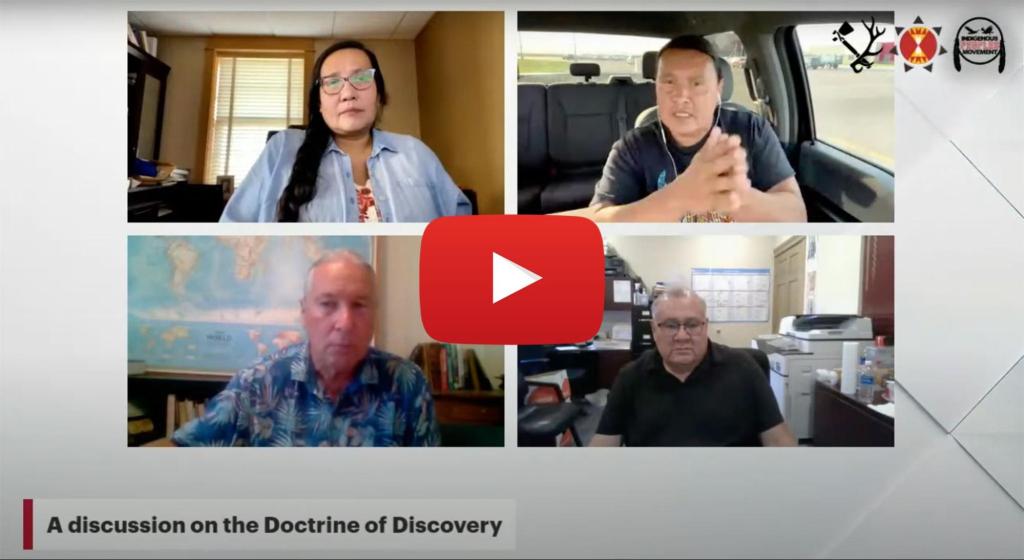
Lakota Law livestreams are back, y’all! Continuing in the tradition of “Cut to the Chase,” I’m organizing informative panels hosted by our Lakota leaders and featuring Indigenous guests from across Turtle Island and beyond. Co-produced by Indigenous Peoples Movement and Last Real Indians, “In Critical Times” streams will be available to view live or later on social media, and they take place every other Wednesday at 7 p.m. Eastern. This week, we had a trio of great guests join host Chase Iron Eyes for a deep dive on the Doctrine of Discovery. I encourage you to watch the whole discussion here!
A discussion on the Doctrine of Discovery
Click the pic to watch this informative discussion led by Lakota Law’s Chase Iron Eyes.
Our guest experts for this episode — Shawnee/Lenape scholar Steven Newcomb, Indigenous Peoples Movement co-founder Jen Martel, and Sicangu Lakota Treaty Council Executive Director Phil Two Eagle — really brought some fantastic perspective on the Doctrine, which forms the horrifyingly racist underpinning for the Christian colonial world’s justification for expanding into Indigenous territory.
The Doctrine, which stems from a papal bull written in the late 1400s, argued that Christian monarchies should be able to subdue non-Christian lands, at will, under divine right. The fact that this dangerous foolishness still influences public international law and Federal Indian Law should disturb every one of us. This 84-minute conversation is well worth the watch — all the way through. I think you’ll likely learn some new things and understand even more deeply why your friendship means so much to us.
Shonabish Chi — thank you for tuning in! Earth Hadjo Online Events Coordinator The Lakota People’s Law Project
As we near this year’s midterm elections in November, I’m pleased to report that good things are happening that bode well for Native participation in our democracy. If you’ve been following us for a bit, you may recall that the Lakota People’s Law Project has been participating as a plaintiff in a landmark lawsuit against the State of South Dakota for its repeated noncompliance with the National Voter Registration Act (NVRA, also sometimes called the “motor voter” law). A while back, we let you know we were close to a settlement that would make access to voting much easier for residents — especially Native People — in South Dakota. Today, I’m happy to announce that we’ve won! The case is officially closed, and we achieved everything we set out to do. You can check out the article in Native News Online right here.
Click above to read the story in Native News Online.
As the news story above indicates, voters all across South Dakota (but especially Native People, who have been disproportionately affected by the state’s violations of federal law) will greatly benefit from the settlement. The Federal Court found that, among other violations, South Dakota failed to automatically update voter registration addresses of voters who change their driver’s license address; refused to provide voter registration services to individuals who lack an existing driver’s license number or Social Security number; failed to forward completed voter registration applications to county election officials in a timely way; didn’t properly train state employees or conduct internal oversight sufficient to ensure NVRA compliance; and failed to ensure that driver’s license “issue sites” — common in Indian Country and other rural areas in South Dakota — provide voter registration services.
The settlement ensures that, over the next three years, South Dakota will implement policies and practices to fully comply with the NVRA. Among the key elements are a provision that the state designate a statewide NVRA coordinator to oversee compliance with the law by all relevant state agencies. It also mandates that the state develop a comprehensive NVRA curriculum to provide annual training to county election officials, employees of driver’s license offices, and public assistance agency workers on their voter registration responsibilities. Importantly to South Dakota’s Native residents, the state must also amend its voter registration application form to allow voters without a postal address to provide a description of the physical location of their residence.
Thanks to this lawsuit, over the coming years, Native People in South Dakota should be given a fair shake at election time. That will be crucial in building the change we want to see. So now, it’s time to make sure my relatives exercise their right to vote. And on that note, I’m very excited to announce that Lakota Law’s 2022 Native vote campaign is just about ready to launch! Keep an eye on your email next week, because we have a big announcement coming your way. We think you’ll be as excited about it as we are. Please stay tuned!
Wopila tanka — thank you, always, for standing up for Indigenous rights. Wašté Win Young Legal Analyst The Lakota People’s Law Project
Lakota People’s Law Project 547 South 7th Street #149 Bismarck, ND 58504-5859
The Wounded Knee Memorial and cemetery, shown here in a 2018 file photo, marks the site where more than 250 Lakota men, women and children were massacred by U.S. soldiers in 1890 in South Dakota. The memorial land was already owned by the Oglala Sioux Tribe, but the tribal council voted Sept. 7, 2022, to join with the Cheyenne River Sioux to buy the remaining 40-acre parcel of the historic landmark from a non-Native owner. (Photo by Mary Annette Pember/Indian Country Today)
It was the last resolution of the day but it was a stunner.
The Oglala Sioux tribal council voted in an historic decision Sept. 7 to purchase 40 acres of Wounded Knee land from Jeanette Czywczynski for $500,000 – a move that now puts the entire Wounded Knee National Historic Landmark site under ownership of the Oglala Sioux.
Sold for far less than the $3.9 million price demanded by her now-deceased husband, James Czywczynski, the land now includes a covenant to preserve it as a sacred site and memorial without commercial development.
The vote passed with 15 members voting yes, three voting no and one member not voting. Those opposing the resolution expressed concern over allowing the Cheyenne River Sioux tribe 49 percent ownership of the land.
“Our tribes have come together through war and times of need. It’s not just our relatives buried there (on Wounded Knee land),” said council member Julian Spotted Bear, who supported the purchase.
According to the resolution, the Oglala Sioux tribe will pay $255,000 and the Cheyenne River Sioux tribe will pay $245,000 for the site, and agree to petition the U.S. Department of the Interior to take the land into trust on behalf of both tribes. The title to the land will be held in the name of the Oglala Sioux tribe.
The Cheyenne River Sioux Tribe made the decision to participate in the purchase about a week ago, according to Chairman Harold Frazier.
“Many of those massacred at Wounded Knee were from the Minneconjou band on Cheyenne River,” Frazier said.
“When I heard about it, I said, ‘We have to buy it; let’s buy it. That’s our ancestors’ resting place. We need to respect them,'” he said.
The agreement ends a decades-long dispute over land that is the site of the historic Wounded Knee massacre of 1890 in which hundreds of Lakota men, women and children were killed by U.S. soldiers of the 7th cavalry using machine guns in an attempt to suppress the Ghost Dance, a Lakota religious movement. Victims were buried in a mass grave in a nearby Catholic cemetery.
American Indian Movement leaders join in a solemn moment in 1973 just before the signing of a statement ending the bloody standoff between federal forces and the AIM members at Wounded Knee, South Dakota. (AP File Photo/Jim Mone)
The property, which includes a portion of the Wounded Knee National Historic Landmark, has become a potent, painful reminder of brutal federal violence used to suppress Indigenous peoples.
Jeanette Czywczynski became sole owner of the property after her husband, James, died in 2019. James Czywczynski purchased the property in 1968.
The Czywczynski family operated a trading post and museum there until 1973, when American Indian Movement protesters occupied the site, destroying both the post and Czywczynski’s home.
The family moved away from the area and put the land up for sale, asking $3.9 million for the 40-acre parcel nearest the massacre site. The land, including an additional adjacent 40-acre plot, had been assessed at $14,000.
The issue of Wounded Knee ownership became a national symbol of a century of unscrupulous treatment of Native people by the U.S. government and non-Natives.
For a time, Czywczynski toyed with the idea of partnering with developers to build a motel and gas station near the site. He later offered the land to the Oglala Sioux tribe for sale but grew bitter and frustrated over negotiations.
Some tribal members wanted to develop the site for commercial purposes and some opposed such a plan, maintaining that it should be shielded from development and maintained as a sacred site.
In 2013, film star Johnny Depp announced a plan to buy the property and donate it to the Oglala Sioux tribe. Depp, who played the role of Tonto in a remake of the film, “The Lone Ranger,” was criticized for trying to capitalize on the film and for his misappropriation of Native culture. He was also criticized for making unsubstantiated claims of having Native ancestry. Depp did not follow through on the purchase.
In 2016, Lakota journalist Tim Giago, founder of Indian Country Today, announced plans to purchase the Wounded Knee land for $3.9 million and went to work fundraising the purchase price.
Giago, who grew up in the town of Wounded Knee, said he wanted to put the land into trust for the entire Sioux Nation. Giago’s plans, however, fell through. He died in July 2022 at age 88.
The Oglala Sioux tribe already owned the land containing the Wounded Knee cemetery and mass grave of the 1890 massacre victims. Red Cloud Indian School recently returned about one acre of land to the tribe where Sacred Heart Church once stood.
Leaders from the Oglala Sioux tribe did not respond to ICT’s request for comment. ICT was unable to reach Jeannette Czywczynski.
Our stories are worth telling. Our stories are worth sharing. Our stories are worth your support. Contribute $5 or $10 today to help ICT (formerly Indian Country Today) carry out its critical mission. Sign up for ICT’s free newsletter.
As we all find ways to escape the summer heat, I want you to look at the picture below. That’s Jenny Gulch at Pactola Lake, one of the most beautiful spots in the sacred He Sapa — known to settlers as the Black Hills of South Dakota. The people of the Oceti Sakowin were this land’s original stewards and protectors. But, because the federal government won’t adhere to the treaties it made with us, these pristine headwaters of the Rapid Creek watershed are now controlled by the National Forest Service. And instead of protecting this sensitive ecosystem, that agency is accepting mining applications and permitting dangerous, toxic drilling.
Fortunately, the Oglala Nation and others who care about our homelands are pushing back. So, today, I ask you to sign onto my tribe’s call and send a message to the Forest Service demanding they stop the Jenny Gulch Gold Exploration Drilling Project.
Jenny Gulch is one of South Dakota’s natural gems. This beautiful spot at the Rapid Creek headwaters in the sacred He Sapa should never be defaced and polluted by miners.
Fortunately, the Forest Service doesn’t just get to rubber stamp their approval on this one. The public comment period is open for another few weeks, and we need to make all the noise we can. We’re not alone in this fight. As I wrote to you a couple months back, just like the Oglala Nation, the good people of the Black Hills Clean Water Alliance are working overtime to raise awareness. Even the City Council for Rapid City voted to pass a resolution in opposition to the Forest Service’s finding of no significant environmental impact at Jenny Gulch.
No significant impact? The history of mining and exploration in the Black Hills tells a very different story. Mining here over the past seven decades created the need for four separate toxic Superfund sites — polluted locations which require a long-term response to clean up contamination from hazardous materials including arsenic, mercury, and cyanide. About $100 million of public money has already been spent to try and fix just one of those sites, with no end in sight.
So I hope you’ll get to know more about mining in the Black Hills, join the Oglala Nation’s call (and ours), and share all this information with your family and friends. It’s going to take pushback from all quarters to stop the new gold rush in the sacred He Sapa, but it’s worth every second of our time to do so. Because I think you’ll agree: We have to protect Unci Maka, our Grandmother Earth, and some things are worth more than gold.
Wopila tanka — thank you for protecting our homelands! DeCora Hawk Field Organizer The Lakota People’s Law Project
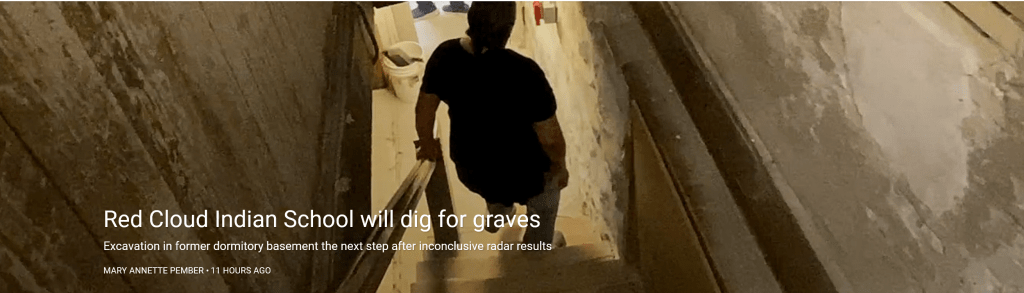
Stairs lead down to the basement of Drexel Hall on the campus of Red Cloud Indian School on the Pine Ridge reservation in South Dakota, where officials are set to begin excavation in October 2022 to search for unmarked graves. A search with ground-penetrating radar in the basement was inconclusive as to whether graves might be there. (Photo by Mary Annette Pember/ICT)
WARNING: This story contains disturbing details about residential and boarding schools. If you are feeling triggered, here is a resource list for trauma responses from the National Native American Boarding School Healing Coalition in the U.S. In Canada, the National Indian Residential School Crisis Hotline can be reached at 1-866-925-4419.
Leaders at the Red Cloud Indian School on the Pine Ridge Reservation have announced they will dig up a portion of the basement in a former school dormitory in search of unmarked graves.
The announcement came after a search with ground-penetrating radar in May was inconclusive about whether remains might be under what is now a concrete slab in a corner of the large basement.
A report on the testing said the ground-penetrating radar failed to show a definitive presence of graves, but that a final determination could only be determined through excavation.
The excavation is part of what the school calls its own search for truth and reconciliation as the U.S. and Canada continue to search for unmarked graves at former Indian residential or boarding schools.
“We are committed to the process of being transparent,” said Maka Black Elk, executive director for Truth and Healing at Red Cloud Indian School. Black Elk is a citizen of the Oglala Lakota tribe.
“We will investigate places that have been identified by eyewitness testimony (of the presence of graves),” Black Elk said.
Drexel Hall, a former dormitory on the Red Cloud Indian School campus on the Pine Ridge reservation, is more than 100 years old. School leaders will begin excavation of a corner of the basement in October 2022 to search for unmarked graves after ground-penetrating radar was inconclusive. (Photo by Mary Annette Pember/ICT)
In May, Marsha Small, Northern Cheyenne, and technicians from Ohio Valley Archaeology Inc. used ground-penetrating radar to conduct an analysis of the front lawn of the school as well as an area in the basement of Drexel Hall, a former student dorm.
According to the radar report, there were no indications of graves in the area of the school’s lawn.
‘Horrific truths’
Rumors of unmarked graves and missing students have circulated in the Pine Ridge community for years but have seldom included eyewitness testimony, until now.
A former worker at the school came forward recently to report he had seen what looked like small graves in the basement in the 1990s – with small crosses marking each one.
“These stories are rooted in horrific truths of the broader boarding school past,” Black Elk said.
Red Cloud Indian School was originally opened as Holy Rosary Mission in 1888 by Jesuits, a Catholic order of priests. The name was changed to Red Cloud in 1969. In 1980, the school ceased offering boarding and now functions as a day school serving about 600 students.
Red Cloud now operates as a nonprofit organization describing itself as “a Lakota Jesuit Catholic Institution administered by the Jesuits and Lakota people.”
Unlike discoveries of unmarked graves at Canada’s Indian residential schools, however, where hundreds of bodies have been discovered at several former school sites, the allegations of graves in the basement of Drexel Hall raise more sinister concerns.
Drexel Hall was built more than 100 years ago, serving first as a student dorm and later as a convent for nuns who worked at the school. Today, the building houses offices for school staff and the Heritage Center, an art gallery and gift shop.
Marsha Small and technicians from Ohio Valley Archaeology Inc. use ground penetrating radar to scan the basement of Drexel Hall on the Red Cloud Indian School campus in May 2022. Officials decided to dig up the concrete and excavate the area after radar findings were inconclusive about whether unmarked graves may be underneath. (Photo by Mary Annette Pember/ICT)
“Red Cloud wasn’t a boarding school in the 1990s when the graves were first discovered, so we will be involving law enforcement in addition to members of the community when we excavate the area,” Black Elk said.
“This is a hard conversation for our community to have,” he said. “If our GPR work helps open the door to those conversations, then hopefully that leads people to healing.”
‘Mitigating damage’
Not everyone in the Pine Ridge community is confident in the school’s show of transparency.
Dusty Lee Nelson, of the Oglala Lakota tribe, describes the school’s truth and healing efforts as a charade, saying that letting the Catholic Church and Red Cloud lead its own investigations into wrongdoing is the opposite of transparency.
“It’s all about mitigating damage control,” she said.
She said most efforts have been focused on a small group of Lakota Catholics.
On Aug. 16, for example, Jesuit Father General Arturo Sosa visited the school, but his presence was not widely publicized in the community.
Sosa, whose office is in Rome, is the leader of the Society of Jesus, the largest religious order of priests and brothers in the Catholic Church. Red Cloud was founded by Jesuit priests, as was St. Francis Indian School on the Rosebud Reservation. St. Francis has been tribally controlled since 1979.
“On behalf of the Society of Jesus, I apologize for the ways in which St. Francis and Holy Rosary Missions and boarding schools were for decades complicit in the U.S. government’s reprehensible assimilation policies, trying to eradicate your culture,” he said. “I ask for your forgiveness for that and for any other abuses that your ancestors may have suffered.”
In response to ICT’s inquiry about why the broader community was not notified of Sosa’s visit, Black Elk said, “I think the feeling was to keep his visit intimate. So we informed our community and parents. But didn’t do anything big with press.”
A video of Sosa speaking at Red Cloud was posted on the school’s website shortly after ICT inquired about the visit.
Sosa promised to take demands from leadership of both the Oglala Lakota and Rosebud Sioux tribes for the Catholic church to rescind the Doctrine of Discovery to Pope Francis. The letter, signed by Kevin Killer, president of the Oglala Sioux Tribe, was posted on the tribe’s Facebook page.
Demands have escalated in recent months to rescind the doctrine, a foundational document guiding Catholic and Christian occupation of the Americas. The doctrine is composed of bulls or orders handed down in the 1400s by Catholic popes authorizing agents of European monarchs to dominate Indigenous lands and people by any means necessary. The doctrine helped shape the entirety of the White settler relationship with Indigenous peoples in the Americas and is the genesis of U.S. federal Indian law.
But the issue is dividing the community. Since speaking out publicly about Red Cloud’s truth and healing efforts, Nelson said she has become a target for community members who disagree with her.
“I’m tired of being the one to say things,” she said. “God bless the [Indigenous Youth Council]. They are organizing and approaching these issues. Activism has been demonized here.”
Looking ahead
School leaders said in a statement posted to the school website that the next round of work in the Drexel Hall basement is set for this fall.
“We will be working again with Marsha Small and OVAI to follow their recommendations,” the statement said.
“The removal of concrete and excavation will take place in October 2022 where law enforcement, spiritual advisors and the community member who brought forward the testimony will be present.”
Our stories are worth telling. Our stories are worth sharing. Our stories are worth your support. Contribute $5 or $10 today to help ICT (formerly Indian Country Today) carry out its critical mission. Sign up for ICT’s free newsletter.
A couple weeks back, I was honored to join a delegation to Washington, D.C. led by Standing Rock Chairwoman Janet Alkire. We met with congressional reps and other decision makers to inspire action to stop the Dakota Access pipeline (DAPL). As the pipeline’s legally mandated Environmental Impact Statement (EIS) continues to stall despite the clear and present danger to Standing Rock and the Mni Sose — the Missouri River — this was mission critical. You can click here to watch our latest Water Wars video, produced in conjunction with Standing Rock, the Oceti Sakowin, and the Great Plains Water Alliance, which highlights our productive meeting with Rep. Rashida Tlaib (D-Mich.).
Watch: I joined Standing Rock Chairwoman Janet Alkire (right) for her delegation to Washington, D.C. We had several excellent conversations about DAPL, including one with Rep. Rashida Tlaib (left).
You may recall that, in 2021, members of the Squad — progressive millennial women leaders in the U.S. House of Representatives including Tlaib, AOC, Ayanna Pressley, Cori Bush, and Ilhan Omar — joined us and other Indigenous justice leaders in Minnesota to combat the Line 3 pipeline. And, of course, in 2017 AOC visited Standing Rock to take part in the #NoDAPL resistance, inspiring her run for Congress. These true leaders recognize the dangers of pipelines and care about what happens to us. Their support remains critical, but frankly it isn’t enough. We need other lawmakers and the executive branch to recognize DAPL’s danger and help us stop the oil before it spills and creates an emergency for our people.
As we pointed out during our meetings in D.C., the Army Corps of Engineers has repeatedly failed to provide Standing Rock with an adequate emergency response plan for DAPL. It has only shared a redacted version, which prevents us from planning on our own. This is particularly concerning now, because extremely low water levels in the Mni Sose have made accessing potential leak sites a logistical nightmare. We pray that something will be done before it’s too late.
In the meantime, please take a few minutes to watch our video and stay ready to take action. Eventually, the Corps will have to release its sham EIS. When it does, your voice will be critical. The public comment period will offer us an opportunity to stand strong together — again — for the water, for the people, and for our future.
Wopila tanka — thank you, as ever, for standing with Standing Rock and the Oceti Sakowin. Chase Iron Eyes Co-Director and Lead Counsel The Lakota People’s Law Project
This hideous brochure was handed out to Oglala youth at the Pine Ridge Nation. Once our Tribal Council was alerted, it took emergency action by passing an ordinance (since rescinded) banning all missionary work on our reservation. The ordinance was rescinded a few days later, mainly because folks had events — such as weddings and funerals — scheduled. Still, previous law requiring review and registration of religious entities will now be enforced with greater vigor, and my community is once again reckoning with the living history of colonization, particularly by western faith organizations. As you probably know, our relationship as Native People to the Catholic Church is long and, for the most part, horrific. To this day, Federal Indian Law still cites the Doctrine of Discovery — which originated in the Catholic Church in the 1490s — as a justification for our subjugation. For five centuries, European powers “discovered” and colonized Indigenous lands using the legal argument that, because Christians didn’t yet inhabit them, those lands were fair game. Of course, we all know what happened in the wake of this colonization: forced migrations, broken treaties, the Indian boarding school era, and the continued taking of our children by state agencies. And last week, while Pine Ridge was confronting yet another manifestation of the colonial mindset, Pope Francis took a trip to Canada to apologize for the Church’s role in the boarding school era — later even acknowledging it as genocide. I, for one, am happy to see progress; but I’ll be happier when he rescinds the Doctrine of Discovery.
Pope Francis dons a ceremonial warbonnet during his apology tour in so-called Canada. Ugh. Photo from the AP. Obviously, we still have a long way to go and many truths to tell before we, as Native peoples, can heal from the generational trauma inflicted by centuries of colonization. It’s going to have to be one step at a time. In the meantime, I’m proud of my friends — the activists who brought their concerns to the attention of our Tribal Council at Pine Ridge. I actually helped to establish the Oglala Lakota chapter of the International Indigenous Youth Council, which spearheaded that organizing. I’m hopeful that we can move forward with better understanding. Churches will now have to register with the Oglala Sioux Tribe, and existing religious establishments will have until Oct. 24 to clear their activities with the Tribal Council. It’s a start. Wopila tanka — thank you for your understanding and solidarity. DeCora Hawk Field OrganizerThe Lakota People’s Law Project Lakota People’s Law Project 547 South 7th Street #149 Bismarck, ND 58504-5859


 Exhibitor Registration Closes SoonThe NCAI Marketplace offers exhibitors a premiere opportunity to interact with tribal leaders, national Native organizations, and other key figures from across Indian Country. Exhibitor registration ends Friday, October 14, 2022. Become an Exhibitor
 Attend a Pre-Conference WorkshopThis free workshop will provide a walk-through on how individuals and organizations can prepare a Get-Out-the-Vote plan of action for their communities. Participants will engage in discussion about election protection, how to become a poll worker, and much more.Register Now
 Become a Member of NCAIAs a membership-driven organization, NCAI strives to represent the many nations, villages, communities, and individuals that make up Indian Country.Join us
 Sponsorship Opportunities AvailableFor more information on sponsorship opportunities to showcase your brand, please contact Keely Purscell, Manager of External Partnerships.Learn More
 Copyright (C) 2022 National Congress of American Indians. All rights reserved.









 Pope Francis dons a ceremonial warbonnet during his apology tour in so-called Canada. Ugh. Photo from the AP. Obviously, we still have a long way to go and many truths to tell before we, as Native peoples, can heal from the generational trauma inflicted by centuries of colonization. It’s going to have to be one step at a time. In the meantime, I’m proud of my friends — the activists who brought their concerns to the attention of our Tribal Council at Pine Ridge. I actually helped to establish the
  Water is Life