As we near this year’s midterm elections in November, I’m pleased to report that good things are happening that bode well for Native participation in our democracy. If you’ve been following us for a bit, you may recall that the Lakota People’s Law Project has been participating as a plaintiff in a landmark lawsuit against the State of South Dakota for its repeated noncompliance with the National Voter Registration Act (NVRA, also sometimes called the “motor voter” law). A while back, we let you know we were close to a settlement that would make access to voting much easier for residents — especially Native People — in South Dakota. Today, I’m happy to announce that we’ve won! The case is officially closed, and we achieved everything we set out to do. You can check out the article in Native News Online right here.
Click above to read the story in Native News Online.
As the news story above indicates, voters all across South Dakota (but especially Native People, who have been disproportionately affected by the state’s violations of federal law) will greatly benefit from the settlement. The Federal Court found that, among other violations, South Dakota failed to automatically update voter registration addresses of voters who change their driver’s license address; refused to provide voter registration services to individuals who lack an existing driver’s license number or Social Security number; failed to forward completed voter registration applications to county election officials in a timely way; didn’t properly train state employees or conduct internal oversight sufficient to ensure NVRA compliance; and failed to ensure that driver’s license “issue sites” — common in Indian Country and other rural areas in South Dakota — provide voter registration services.
The settlement ensures that, over the next three years, South Dakota will implement policies and practices to fully comply with the NVRA. Among the key elements are a provision that the state designate a statewide NVRA coordinator to oversee compliance with the law by all relevant state agencies. It also mandates that the state develop a comprehensive NVRA curriculum to provide annual training to county election officials, employees of driver’s license offices, and public assistance agency workers on their voter registration responsibilities. Importantly to South Dakota’s Native residents, the state must also amend its voter registration application form to allow voters without a postal address to provide a description of the physical location of their residence.
Thanks to this lawsuit, over the coming years, Native People in South Dakota should be given a fair shake at election time. That will be crucial in building the change we want to see. So now, it’s time to make sure my relatives exercise their right to vote. And on that note, I’m very excited to announce that Lakota Law’s 2022 Native vote campaign is just about ready to launch! Keep an eye on your email next week, because we have a big announcement coming your way. We think you’ll be as excited about it as we are. Please stay tuned!
Wopila tanka — thank you, always, for standing up for Indigenous rights. Wašté Win Young Legal Analyst The Lakota People’s Law Project
Lakota People’s Law Project 547 South 7th Street #149 Bismarck, ND 58504-5859
The Wounded Knee Memorial and cemetery, shown here in a 2018 file photo, marks the site where more than 250 Lakota men, women and children were massacred by U.S. soldiers in 1890 in South Dakota. The memorial land was already owned by the Oglala Sioux Tribe, but the tribal council voted Sept. 7, 2022, to join with the Cheyenne River Sioux to buy the remaining 40-acre parcel of the historic landmark from a non-Native owner. (Photo by Mary Annette Pember/Indian Country Today)
It was the last resolution of the day but it was a stunner.
The Oglala Sioux tribal council voted in an historic decision Sept. 7 to purchase 40 acres of Wounded Knee land from Jeanette Czywczynski for $500,000 – a move that now puts the entire Wounded Knee National Historic Landmark site under ownership of the Oglala Sioux.
Sold for far less than the $3.9 million price demanded by her now-deceased husband, James Czywczynski, the land now includes a covenant to preserve it as a sacred site and memorial without commercial development.
The vote passed with 15 members voting yes, three voting no and one member not voting. Those opposing the resolution expressed concern over allowing the Cheyenne River Sioux tribe 49 percent ownership of the land.
“Our tribes have come together through war and times of need. It’s not just our relatives buried there (on Wounded Knee land),” said council member Julian Spotted Bear, who supported the purchase.
According to the resolution, the Oglala Sioux tribe will pay $255,000 and the Cheyenne River Sioux tribe will pay $245,000 for the site, and agree to petition the U.S. Department of the Interior to take the land into trust on behalf of both tribes. The title to the land will be held in the name of the Oglala Sioux tribe.
The Cheyenne River Sioux Tribe made the decision to participate in the purchase about a week ago, according to Chairman Harold Frazier.
“Many of those massacred at Wounded Knee were from the Minneconjou band on Cheyenne River,” Frazier said.
“When I heard about it, I said, ‘We have to buy it; let’s buy it. That’s our ancestors’ resting place. We need to respect them,'” he said.
The agreement ends a decades-long dispute over land that is the site of the historic Wounded Knee massacre of 1890 in which hundreds of Lakota men, women and children were killed by U.S. soldiers of the 7th cavalry using machine guns in an attempt to suppress the Ghost Dance, a Lakota religious movement. Victims were buried in a mass grave in a nearby Catholic cemetery.
American Indian Movement leaders join in a solemn moment in 1973 just before the signing of a statement ending the bloody standoff between federal forces and the AIM members at Wounded Knee, South Dakota. (AP File Photo/Jim Mone)
The property, which includes a portion of the Wounded Knee National Historic Landmark, has become a potent, painful reminder of brutal federal violence used to suppress Indigenous peoples.
Jeanette Czywczynski became sole owner of the property after her husband, James, died in 2019. James Czywczynski purchased the property in 1968.
The Czywczynski family operated a trading post and museum there until 1973, when American Indian Movement protesters occupied the site, destroying both the post and Czywczynski’s home.
The family moved away from the area and put the land up for sale, asking $3.9 million for the 40-acre parcel nearest the massacre site. The land, including an additional adjacent 40-acre plot, had been assessed at $14,000.
The issue of Wounded Knee ownership became a national symbol of a century of unscrupulous treatment of Native people by the U.S. government and non-Natives.
For a time, Czywczynski toyed with the idea of partnering with developers to build a motel and gas station near the site. He later offered the land to the Oglala Sioux tribe for sale but grew bitter and frustrated over negotiations.
Some tribal members wanted to develop the site for commercial purposes and some opposed such a plan, maintaining that it should be shielded from development and maintained as a sacred site.
In 2013, film star Johnny Depp announced a plan to buy the property and donate it to the Oglala Sioux tribe. Depp, who played the role of Tonto in a remake of the film, “The Lone Ranger,” was criticized for trying to capitalize on the film and for his misappropriation of Native culture. He was also criticized for making unsubstantiated claims of having Native ancestry. Depp did not follow through on the purchase.
In 2016, Lakota journalist Tim Giago, founder of Indian Country Today, announced plans to purchase the Wounded Knee land for $3.9 million and went to work fundraising the purchase price.
Giago, who grew up in the town of Wounded Knee, said he wanted to put the land into trust for the entire Sioux Nation. Giago’s plans, however, fell through. He died in July 2022 at age 88.
The Oglala Sioux tribe already owned the land containing the Wounded Knee cemetery and mass grave of the 1890 massacre victims. Red Cloud Indian School recently returned about one acre of land to the tribe where Sacred Heart Church once stood.
Leaders from the Oglala Sioux tribe did not respond to ICT’s request for comment. ICT was unable to reach Jeannette Czywczynski.
Our stories are worth telling. Our stories are worth sharing. Our stories are worth your support. Contribute $5 or $10 today to help ICT (formerly Indian Country Today) carry out its critical mission. Sign up for ICT’s free newsletter.
As we all find ways to escape the summer heat, I want you to look at the picture below. That’s Jenny Gulch at Pactola Lake, one of the most beautiful spots in the sacred He Sapa — known to settlers as the Black Hills of South Dakota. The people of the Oceti Sakowin were this land’s original stewards and protectors. But, because the federal government won’t adhere to the treaties it made with us, these pristine headwaters of the Rapid Creek watershed are now controlled by the National Forest Service. And instead of protecting this sensitive ecosystem, that agency is accepting mining applications and permitting dangerous, toxic drilling.
Fortunately, the Oglala Nation and others who care about our homelands are pushing back. So, today, I ask you to sign onto my tribe’s call and send a message to the Forest Service demanding they stop the Jenny Gulch Gold Exploration Drilling Project.
Jenny Gulch is one of South Dakota’s natural gems. This beautiful spot at the Rapid Creek headwaters in the sacred He Sapa should never be defaced and polluted by miners.
Fortunately, the Forest Service doesn’t just get to rubber stamp their approval on this one. The public comment period is open for another few weeks, and we need to make all the noise we can. We’re not alone in this fight. As I wrote to you a couple months back, just like the Oglala Nation, the good people of the Black Hills Clean Water Alliance are working overtime to raise awareness. Even the City Council for Rapid City voted to pass a resolution in opposition to the Forest Service’s finding of no significant environmental impact at Jenny Gulch.
No significant impact? The history of mining and exploration in the Black Hills tells a very different story. Mining here over the past seven decades created the need for four separate toxic Superfund sites — polluted locations which require a long-term response to clean up contamination from hazardous materials including arsenic, mercury, and cyanide. About $100 million of public money has already been spent to try and fix just one of those sites, with no end in sight.
So I hope you’ll get to know more about mining in the Black Hills, join the Oglala Nation’s call (and ours), and share all this information with your family and friends. It’s going to take pushback from all quarters to stop the new gold rush in the sacred He Sapa, but it’s worth every second of our time to do so. Because I think you’ll agree: We have to protect Unci Maka, our Grandmother Earth, and some things are worth more than gold.
Wopila tanka — thank you for protecting our homelands! DeCora Hawk Field Organizer The Lakota People’s Law Project
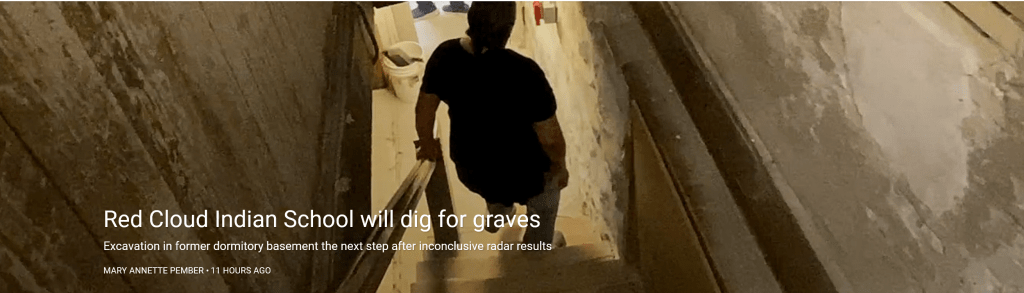
Stairs lead down to the basement of Drexel Hall on the campus of Red Cloud Indian School on the Pine Ridge reservation in South Dakota, where officials are set to begin excavation in October 2022 to search for unmarked graves. A search with ground-penetrating radar in the basement was inconclusive as to whether graves might be there. (Photo by Mary Annette Pember/ICT)
WARNING: This story contains disturbing details about residential and boarding schools. If you are feeling triggered, here is a resource list for trauma responses from the National Native American Boarding School Healing Coalition in the U.S. In Canada, the National Indian Residential School Crisis Hotline can be reached at 1-866-925-4419.
Leaders at the Red Cloud Indian School on the Pine Ridge Reservation have announced they will dig up a portion of the basement in a former school dormitory in search of unmarked graves.
The announcement came after a search with ground-penetrating radar in May was inconclusive about whether remains might be under what is now a concrete slab in a corner of the large basement.
A report on the testing said the ground-penetrating radar failed to show a definitive presence of graves, but that a final determination could only be determined through excavation.
The excavation is part of what the school calls its own search for truth and reconciliation as the U.S. and Canada continue to search for unmarked graves at former Indian residential or boarding schools.
“We are committed to the process of being transparent,” said Maka Black Elk, executive director for Truth and Healing at Red Cloud Indian School. Black Elk is a citizen of the Oglala Lakota tribe.
“We will investigate places that have been identified by eyewitness testimony (of the presence of graves),” Black Elk said.
Drexel Hall, a former dormitory on the Red Cloud Indian School campus on the Pine Ridge reservation, is more than 100 years old. School leaders will begin excavation of a corner of the basement in October 2022 to search for unmarked graves after ground-penetrating radar was inconclusive. (Photo by Mary Annette Pember/ICT)
In May, Marsha Small, Northern Cheyenne, and technicians from Ohio Valley Archaeology Inc. used ground-penetrating radar to conduct an analysis of the front lawn of the school as well as an area in the basement of Drexel Hall, a former student dorm.
According to the radar report, there were no indications of graves in the area of the school’s lawn.
‘Horrific truths’
Rumors of unmarked graves and missing students have circulated in the Pine Ridge community for years but have seldom included eyewitness testimony, until now.
A former worker at the school came forward recently to report he had seen what looked like small graves in the basement in the 1990s – with small crosses marking each one.
“These stories are rooted in horrific truths of the broader boarding school past,” Black Elk said.
Red Cloud Indian School was originally opened as Holy Rosary Mission in 1888 by Jesuits, a Catholic order of priests. The name was changed to Red Cloud in 1969. In 1980, the school ceased offering boarding and now functions as a day school serving about 600 students.
Red Cloud now operates as a nonprofit organization describing itself as “a Lakota Jesuit Catholic Institution administered by the Jesuits and Lakota people.”
Unlike discoveries of unmarked graves at Canada’s Indian residential schools, however, where hundreds of bodies have been discovered at several former school sites, the allegations of graves in the basement of Drexel Hall raise more sinister concerns.
Drexel Hall was built more than 100 years ago, serving first as a student dorm and later as a convent for nuns who worked at the school. Today, the building houses offices for school staff and the Heritage Center, an art gallery and gift shop.
Marsha Small and technicians from Ohio Valley Archaeology Inc. use ground penetrating radar to scan the basement of Drexel Hall on the Red Cloud Indian School campus in May 2022. Officials decided to dig up the concrete and excavate the area after radar findings were inconclusive about whether unmarked graves may be underneath. (Photo by Mary Annette Pember/ICT)
“Red Cloud wasn’t a boarding school in the 1990s when the graves were first discovered, so we will be involving law enforcement in addition to members of the community when we excavate the area,” Black Elk said.
“This is a hard conversation for our community to have,” he said. “If our GPR work helps open the door to those conversations, then hopefully that leads people to healing.”
‘Mitigating damage’
Not everyone in the Pine Ridge community is confident in the school’s show of transparency.
Dusty Lee Nelson, of the Oglala Lakota tribe, describes the school’s truth and healing efforts as a charade, saying that letting the Catholic Church and Red Cloud lead its own investigations into wrongdoing is the opposite of transparency.
“It’s all about mitigating damage control,” she said.
She said most efforts have been focused on a small group of Lakota Catholics.
On Aug. 16, for example, Jesuit Father General Arturo Sosa visited the school, but his presence was not widely publicized in the community.
Sosa, whose office is in Rome, is the leader of the Society of Jesus, the largest religious order of priests and brothers in the Catholic Church. Red Cloud was founded by Jesuit priests, as was St. Francis Indian School on the Rosebud Reservation. St. Francis has been tribally controlled since 1979.
“On behalf of the Society of Jesus, I apologize for the ways in which St. Francis and Holy Rosary Missions and boarding schools were for decades complicit in the U.S. government’s reprehensible assimilation policies, trying to eradicate your culture,” he said. “I ask for your forgiveness for that and for any other abuses that your ancestors may have suffered.”
In response to ICT’s inquiry about why the broader community was not notified of Sosa’s visit, Black Elk said, “I think the feeling was to keep his visit intimate. So we informed our community and parents. But didn’t do anything big with press.”
A video of Sosa speaking at Red Cloud was posted on the school’s website shortly after ICT inquired about the visit.
Sosa promised to take demands from leadership of both the Oglala Lakota and Rosebud Sioux tribes for the Catholic church to rescind the Doctrine of Discovery to Pope Francis. The letter, signed by Kevin Killer, president of the Oglala Sioux Tribe, was posted on the tribe’s Facebook page.
Demands have escalated in recent months to rescind the doctrine, a foundational document guiding Catholic and Christian occupation of the Americas. The doctrine is composed of bulls or orders handed down in the 1400s by Catholic popes authorizing agents of European monarchs to dominate Indigenous lands and people by any means necessary. The doctrine helped shape the entirety of the White settler relationship with Indigenous peoples in the Americas and is the genesis of U.S. federal Indian law.
But the issue is dividing the community. Since speaking out publicly about Red Cloud’s truth and healing efforts, Nelson said she has become a target for community members who disagree with her.
“I’m tired of being the one to say things,” she said. “God bless the [Indigenous Youth Council]. They are organizing and approaching these issues. Activism has been demonized here.”
Looking ahead
School leaders said in a statement posted to the school website that the next round of work in the Drexel Hall basement is set for this fall.
“We will be working again with Marsha Small and OVAI to follow their recommendations,” the statement said.
“The removal of concrete and excavation will take place in October 2022 where law enforcement, spiritual advisors and the community member who brought forward the testimony will be present.”
Our stories are worth telling. Our stories are worth sharing. Our stories are worth your support. Contribute $5 or $10 today to help ICT (formerly Indian Country Today) carry out its critical mission. Sign up for ICT’s free newsletter.
A couple weeks back, I was honored to join a delegation to Washington, D.C. led by Standing Rock Chairwoman Janet Alkire. We met with congressional reps and other decision makers to inspire action to stop the Dakota Access pipeline (DAPL). As the pipeline’s legally mandated Environmental Impact Statement (EIS) continues to stall despite the clear and present danger to Standing Rock and the Mni Sose — the Missouri River — this was mission critical. You can click here to watch our latest Water Wars video, produced in conjunction with Standing Rock, the Oceti Sakowin, and the Great Plains Water Alliance, which highlights our productive meeting with Rep. Rashida Tlaib (D-Mich.).
Watch: I joined Standing Rock Chairwoman Janet Alkire (right) for her delegation to Washington, D.C. We had several excellent conversations about DAPL, including one with Rep. Rashida Tlaib (left).
You may recall that, in 2021, members of the Squad — progressive millennial women leaders in the U.S. House of Representatives including Tlaib, AOC, Ayanna Pressley, Cori Bush, and Ilhan Omar — joined us and other Indigenous justice leaders in Minnesota to combat the Line 3 pipeline. And, of course, in 2017 AOC visited Standing Rock to take part in the #NoDAPL resistance, inspiring her run for Congress. These true leaders recognize the dangers of pipelines and care about what happens to us. Their support remains critical, but frankly it isn’t enough. We need other lawmakers and the executive branch to recognize DAPL’s danger and help us stop the oil before it spills and creates an emergency for our people.
As we pointed out during our meetings in D.C., the Army Corps of Engineers has repeatedly failed to provide Standing Rock with an adequate emergency response plan for DAPL. It has only shared a redacted version, which prevents us from planning on our own. This is particularly concerning now, because extremely low water levels in the Mni Sose have made accessing potential leak sites a logistical nightmare. We pray that something will be done before it’s too late.
In the meantime, please take a few minutes to watch our video and stay ready to take action. Eventually, the Corps will have to release its sham EIS. When it does, your voice will be critical. The public comment period will offer us an opportunity to stand strong together — again — for the water, for the people, and for our future.
Wopila tanka — thank you, as ever, for standing with Standing Rock and the Oceti Sakowin. Chase Iron Eyes Co-Director and Lead Counsel The Lakota People’s Law Project
This hideous brochure was handed out to Oglala youth at the Pine Ridge Nation. Once our Tribal Council was alerted, it took emergency action by passing an ordinance (since rescinded) banning all missionary work on our reservation. The ordinance was rescinded a few days later, mainly because folks had events — such as weddings and funerals — scheduled. Still, previous law requiring review and registration of religious entities will now be enforced with greater vigor, and my community is once again reckoning with the living history of colonization, particularly by western faith organizations. As you probably know, our relationship as Native People to the Catholic Church is long and, for the most part, horrific. To this day, Federal Indian Law still cites the Doctrine of Discovery — which originated in the Catholic Church in the 1490s — as a justification for our subjugation. For five centuries, European powers “discovered” and colonized Indigenous lands using the legal argument that, because Christians didn’t yet inhabit them, those lands were fair game. Of course, we all know what happened in the wake of this colonization: forced migrations, broken treaties, the Indian boarding school era, and the continued taking of our children by state agencies. And last week, while Pine Ridge was confronting yet another manifestation of the colonial mindset, Pope Francis took a trip to Canada to apologize for the Church’s role in the boarding school era — later even acknowledging it as genocide. I, for one, am happy to see progress; but I’ll be happier when he rescinds the Doctrine of Discovery.
Pope Francis dons a ceremonial warbonnet during his apology tour in so-called Canada. Ugh. Photo from the AP. Obviously, we still have a long way to go and many truths to tell before we, as Native peoples, can heal from the generational trauma inflicted by centuries of colonization. It’s going to have to be one step at a time. In the meantime, I’m proud of my friends — the activists who brought their concerns to the attention of our Tribal Council at Pine Ridge. I actually helped to establish the Oglala Lakota chapter of the International Indigenous Youth Council, which spearheaded that organizing. I’m hopeful that we can move forward with better understanding. Churches will now have to register with the Oglala Sioux Tribe, and existing religious establishments will have until Oct. 24 to clear their activities with the Tribal Council. It’s a start. Wopila tanka — thank you for your understanding and solidarity. DeCora Hawk Field OrganizerThe Lakota People’s Law Project Lakota People’s Law Project 547 South 7th Street #149 Bismarck, ND 58504-5859
Si Pih Koh, Cree, who sang an emotional protest to Pope Francis with tears streaming down her face in Maskwacis, Alberta, Canada on July 25, 2022, was at peace by the time she followed the Pope to Lac Ste. Anne on Tuesday, July 26, 2022. (Photo by Miles Morrisseau/ICT)
LAC STE. ANNE, Alberta, Canada — She is glowing as she stands near the shores of Lac Ste. Anne, wearing the same white buckskin dress and beaded headband that captivated the world.
But this time Si Pih Ko didn’t break into song in Cree as she did Monday in Maskwacis, with tears streaming down her face — a symbol of protest at Pope Francis’ first public appearance on what he calls a “penitence pilgrimage” across Canada.
Instead, on Tuesday, she stood beaming as the sun sparkled on her beadwork and her smiles at the sacred waters of Lac Ste. Anne. It was as though the weight of the world had been lifted from her shoulders.
“I’m on my healing journey,” she told ICT.
Her emotional rendition of “Our Village,” in Cree, which was mistaken for the Canadian National Anthem, “O Canada,” drew an explosion of comments on Facebook and other social media.
“Indigenous rising, listen to this call!” one woman posted on Facebook.
“Give ‘em hell, lady,” another posted.
The song is yet another example of cultural elements stolen from Indigenous peoples and corrupted by colonizers, she said.
“They use that,” she told ICT. “They tried to translate that song and use it for their anthem. It doesn’t belong to them.”
On a mission
Si Pih Ko, who is Cree, traveled to Alberta from the remote mining town of Thompson, Manitoba, to come face to face with the Pope and deliver a message to him and to the world.
She delivered the song in such a powerful way that it will likely be interpreted for years to come.
She told ICT she came for her brother, who died in police custody in unknown circumstances.
“Holding my brother’s jacket with me, he would have been right beside me too, yesterday and today,” she said Tuesday. “Still to this day, there’s no answers. And I’m here actually to heal for that.”
On a six-day swing through Canada, the Pope made his first public appearance Monday in Maskwacis, delivering an historic apology for the Catholic Church’s role in Canada’s ugly residential school system that forced Indigenous children into boarding schools where they were isolated from their families, culture and language.
Their hair was cut and they were beaten if they spoke their Native language. Many suffered physical and sexual abuse, or died at the school, never to be returned to their families.
Canada’s Truth and Reconciliation Commission called the system “cultural genocide” in its 2015 report on the residential school system. The issue drew international attention in May 2021 with the announcement that 215 remains of children had been found in unmarked graves at the former site of the Kamloops Indian Residential School in British Columbia.
On Monday, Si Pih Ko stepped into the international spotlight in Maskwacis — singing in a language that would have been forbidden in residential schools — after the Pope issued his apology and received a ceremonial headdress.
She walked directly to the front of the stage, with the Pope seated just a few feet away, and began to sing a song that sounded very much like “O Canada.” But it wasn’t.
“It’s “Our Village,’” she told ICT Tuesday, then proceeded to break down the song word-for-word, translating carefully from Cree to English.
Our land.
Our village.
For the love of your children.
You have made the people of the North proud.
Capturing the pain
The images and sounds of Si Pih Ko singing with so much emotion captured the pain and anger that many Indigenous peoples felt about the Pope’s visit.
For some, the visit and apology represented an opportunity for healing and reconciliation, a message the Pope has continued to voice at additional appearances. For others, watching the head of the Catholic Church receive a traditional headdress from chiefs was unacceptable.
“I seen them chiefs behind him and not behind me,” Si Pih Ko told ICT. “That’s pure evil you’re standing behind and you won’t stand by me.”
She said she wanted to send a message to the chiefs as well as the Pope.
“I said, ‘I know who I am. You need to be reminded who you are and not bow down. We’re looking for a place to heal, not to kneel,” she said.
She also delivered a final message of taking back power.
“In order for us to heal you need to remove what you brought here,” she said. “That law. Because it doesn’t belong on these territories – our law does.”
A message in song
Si Pih Ko was at peace on Tuesday at Lac Ste. Anne, where hundreds gathered to hear the Pope speak of healing at the Feast of Saint Anne.
As the words of the Pope echoed across the lands and the sacred water — his words also spoken in a language that few in the audience could understand — Si Pih Ko stood far from the gathering crowd and smiled.
People around the world, she realized, were beginning to understand what she had said.
As many of you know, the Lakota People’s Law Project is a proud ally of Standing Rock. We provide media, fundraising, organizing, and lobbying support to the tribal chairwoman’s team, especially on environmental causes like the Dakota Access Pipeline (DAPL). In this capacity, we’re traveling next week to Washington D.C. to support Chairwoman Janet Alkire as she meets with key decision-makers about the ongoing injustice of DAPL.
More on that soon — but for now, we’d like to share our new video with you, made in collaboration with Chairwoman Alkire’s team, the Oceti Ŝakowiŋ, and the Great Plains Tribal Water Alliance. It brings tribal leaders together from all over South Dakota to speak about the necessity to protect Unci Maka (Grandmother Earth) from Big Extraction’s misdeeds, like Dakota Access.
Watch: Janet Alkire and Oceti Ŝakowiŋ camp leaders reflect on the importance of the #NoDAPL movement to protecting Unci Maka (Grandmother Earth).
The stakes of our environmental movement remain as high as ever for all humans, plants, and animals. The year 2022 is on track to be one of the hottest on record. To make a difference we must act locally while thinking globally. Local for me means the Dakotas, where Standing Rock’s water supply (and that of 17 million others) is still in jeopardy from an illegal oil pipeline without a permit.
Why is it operating without a permit? Because the company hired by the federal government to do the environmental impact statement (EIS) was among those who joined a lawsuit against Standing Rock early in the NoDAPL movement. Of course, Standing Rock’s leaders won’t accept this, so there is a standoff at the moment with the feds. The Army Corps of Engineers has now postponed the release of their flawed EIS until next year, and that gives the tribe more time to fight back and demand that a decent company conduct a new assessment.
As you’re aware, Big Oil has a stranglehold on American politics. Wind power is the cheapest energy source available today — there’s enough wind in just the Dakotas and Texas to power the entire United States. But instead of shifting aggressively to clean technologies, this nation is allowing the fossil fuel industry to bully us into greater investments in our own destruction. Indigenous voices must remain strong to counteract forces of greed and narrow self-interest that plague our nation and world at this time. We will continue doing what we can, with your support!
Wopila tanka — thank you for your ongoing determined support Chase Iron Eyes Co-Director and Lead Counsel The Lakota People’s Law Project
This week, the Supreme Court issued an odious trifecta of decisions limiting three precious things: a woman’s right to choose, the Environmental Protection Agency’s ability to combat the climate crisis, and tribal sovereignty in Oklahoma. I’m here to tell you, we must battle back. Here on the frontlines of environmental racism, we know exactly how far the colonizers will go to preserve their own power and profit. Breaking or changing laws is nothing new, and neither is marginalizing Native tribes. But we can and we must restore justice.
That’s the subject of the fifth chapter in our “Dakota Water Wars” series, Ignoring Tribes and Ignoring Laws, co-produced by us in conjunction with Standing Rock, the Oceti Sakowin, and the Great Plains Water Alliance. Please give it a watch.
Watch: Cheyenne River Sioux Tribe Chairman Harold Frazier joins other leaders from the Oceti Sakowin to talk about how DAPL ignores both tribes and laws.
Over the past five centuries, since European settlers first invaded the shores of Turtle Island, our Indigenous voices have routinely been silenced. Treaties have always been broken. Despite promise after promise, we’ve been further marginalized, year by year. State and federal governments alike seemingly couldn’t care less about the dire consequences for our People when projects like the Dakota Access pipeline (DAPL) are railroaded through our homelands. And conservative politicians, like South Dakota Governor Kristi Noem, are especially eager to reduce our influence and make us invisible.
Whenever we’re the ones most affected, industry and government seem to have no qualms ignoring their own laws, too — as has happened with DAPL. During Standing Rock’s lawsuit to stop the pipeline, the presiding judge had to tell the Department of Justice it was flouting the National Environmental Policy Act with its argument that tribal input doesn’t matter.
The fact is, we do matter, and your solidarity with us ensures that our voices increasingly become part of the conversation. As Lakota Law Standing Rock organizer Phyllis Young says in the video, it’s up to us to make sure government agencies take a new approach that prioritizes “mutual respect, mutual participation, and mutual benefit.” Please continue to stand with Standing Rock and the Lakota People’s Law Project. As our rights and protections are rolled back, it’s more important than ever that we unite and fight — hard.
Wopila tanka — thank you, always, for your friendship and solidarity. Chase Iron Eyes Co-Director and Lead Counsel The Lakota People’s Law Project
The United States Supreme Court has limited the scope of its historic McGirt decision.
In a 5-4 vote, the high court ruled in Oklahoma v. Castro-Huerta that the state of Oklahoma has concurrent jurisdiction and the ability to prosecute non-Natives when the victim is Native and the crime is committed on tribal land.
“From start to finish, the dissent employs extraordinary rhetoric in articulating its deeply held policy views about what Indian law should be,” Justice Brett Kavanaugh’s opinion reads.
Justice Kavanaugh wrote the majority opinion and was joined by Chief Justice John Roberts and Justices Clarence Thomas, Samuel Alito and Amy Coney Barrett in the majority. Justice Kavanaugh wrote that the views of the justices in the dissent were contrary to previous Supreme Court precedents and other laws.
“The dissent goes so far as to draft a proposed statute for Congress. But this Court’s proper role under Article III of the Constitution is to declare what the law is, not what we think the law should be,” Justice Kavanaugh wrote.
Justice Neil Gorsuch wrote the dissenting opinion and was joined by Justices Stephen Breyer, Sonia Sotomayor and Elena Kagan.
Gorsuch, the author of the historic McGirt decision, wrote that tribes were promised to be free from interference by state authorities.
“Where this Court once stood firm, today it wilts,” Gorsuch wrote. “Where our predecessors refused to participate in one State’s unlawful power grab at the expense of the Cherokee, today’s Court accedes to another’s.”
ICT is a nonprofit news organization. Will you support our work? All of our content is free. There are no subscriptions or costs. And we have hired more Native journalists in the past year than any news organization ─ and with your help we will continue to grow and create career paths for our people. Support ICT for as little as $10. Sign up for ICT’s free newsletter.
Kolby KickingWoman, Blackfeet/A’aniih is a reporter/producer for Indian Country Today. He is from the great state of Montana and currently reports for the Washington Bureau. For hot sports takes and too many Lakers tweets, follow him on Twitter – @KDKW_406. Email – kkickingwoman@indiancountrytoday.com










 Pope Francis dons a ceremonial warbonnet during his apology tour in so-called Canada. Ugh. Photo from the AP. Obviously, we still have a long way to go and many truths to tell before we, as Native peoples, can heal from the generational trauma inflicted by centuries of colonization. It’s going to have to be one step at a time. In the meantime, I’m proud of my friends — the activists who brought their concerns to the attention of our Tribal Council at Pine Ridge. I actually helped to establish the