As a violent mob backing President Donald Trump stormed the U.S. Capitol on Wednesday with what appeared to be relative ease, many in Indian Country took to social media to point out drastic differences of past treatment by law enforcement of water protectors and other peaceful protestors.
In a chaotic scene in Washington, D.C., that lasted for hours, dozens of Trump supporters rushed the famous building, causing lawmakers to scramble for safety and the building to be locked down.
Trump supporters try to break through a police barrier Wednesday at the Capitol in Washington. (AP Photo/Julio Cortez)
Videos posted on social media show a violent mob, many wearing Trump gear, knocking down police barriers and damaging building property. The mob even reached the Senate floor and posed for photos, while one video showed police taking a selfie photo with members of the mob.
One person was shot and killed at the Capitol, The Associated Press reported, citing sources familiar with the situation. Police eventually used tear gas and percussion grenades to clear people from the grounds ahead of a curfew in Washington.
The district’s police chief said at least 13 people were arrested, and five firearms had been recovered during the pro-Trump protests. Rep. Markwayne Mullin, Cherokee, of Oklahoma, told ABC News that he was inside and spoke with some of the Trump supporters. A photo posted on social media shows Mullin behind civilian-dressed law enforcement with guns drawn and aimed at the door. “It’s fortunate that a lot more civilians didn’t get shot because (Capitol) police showed a great restraint by not doing so. A great restraint.”
Rep. Tom Cole, Chickasaw, of Oklahoma, said he was outraged by the “lawless protests,” and it’s not the “American way.”
“While Americans have the right to passionately voice their views & peacefully dissent in protest, I strongly condemn the perpetrators of this destructive & violent activity,” Cole said in a tweet.
Critics, including Black, Indigenous and people of color, say at least some of the scene was a stark contrast to what water protectors and treaty defenders have faced over the years, specifically at Standing Rock in 2016, where law enforcement repeatedly used tear gas, water cannons and rubber bullets.
In this Dec. 4, 2016, photo, protesters march at Oceti Sakowin camp, where people gathered to protest the Dakota Access oil pipeline in Cannon Ball, N.D. (AP Photo/David Goldman, File)
More than 760 arrests were made in southern North Dakota during the height of protests in 2016 and 2017. At times, thousands of pipeline opponents gathered in the region to protest the $3.8 billion project to move North Dakota oil to Illinois, but the effort didn’t stop the project.
NDN Collective CEO and President Nick Tilsen, who was arrested during a rally against Trump’s visit to the Black Hills in July, didn’t hold back on Twitter.
“If these were Black, Brown and Indigenous people they would of killed us already; read between the lines people,” Tilsen, Oglala Lakota, said in a tweet.
Everett Baxter, Omaha Tribe of Nebraska chairman, said Natives speaking their mind get arrested, while the Trump supporters in Washington, D.C., “will probably get pardons.”
Baxter also questioned Nebraska state leaders in their involvement at Standing Rock.
“The Nebraska State Patrol sent officers to aid North Dakota’s law enforcement against the water protectors during (the) Standing Rock standoff,” Baxter posted on Facebook. “Will Nebraska do the same to aid the law enforcement of the Washington D.C. riots? Not likely.”
On Twitter, writer, actor and producer Azie Mira Dungey, Pamunkey, called out law enforcement’s response at the Capitol.
“Police literally worked harder to make sure a private company could build an oil pipeline on Native land, and to stop black people from walking through their own neighborhood asking politely not to be murdered, than to stop a few hundred white men from taking over the US Capitol,” Dungey said in a tweet.
Nick Estes, Lower Brule Sioux Tribe, is a college professor and host of “The Red Nation” podcast. He responded to South Dakota Gov. Kristi Noem’s tweet criticizing the violence. Her post included the comment, “We are all entitled to peacefully protest.”
“What? You pushed laws to criminalize protest in SD and pushed conspiracy theories about stolen election,” Estes said.
Comedian Lucas Brown Eyes, Oglala Lakota, tweeted photos of water protectors being attacked by law enforcement at Standing Rock.
“As we watch Trumpers storm the capital with guns. Just a reminder, this is what America did to Native protesting for clean water,” Brown Eyes said.
2020 was a very difficult year personally and world-wide. There was some very excellent progress as we kept up the effort to end fracking and oil pipelines. Let 2021 be an even better year. Even in the face of great adversity, we will keep fighting for peace, health, and WATER.
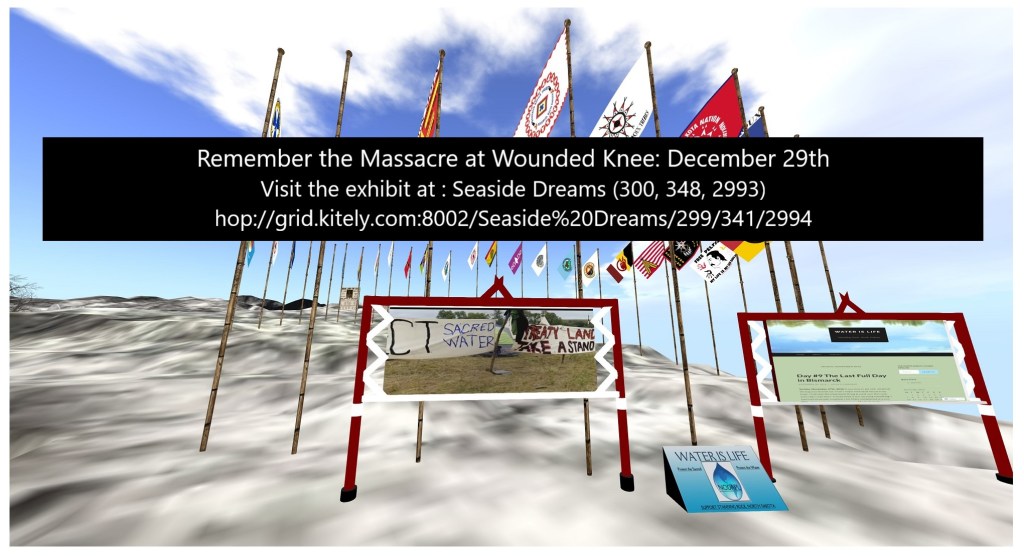
I would like to share that tomorrow Dec. 29th is the anniversary of the Wounded Knee Massacre, please visit the memorial at Kitely: grid.kitely.com:8002:Seaside Dreams
When you enter the world at the dock you will now find a teleporter to Wounded Knee, South Dakota. This is a memorial of the massacre that occurred December 29th, 1890 and the information that I gather connects with the current news about the struggles of the First Nation. From Uranium mining poisoning the water on Navajo land to the leaking oil pipelines in Standing Rock to climate change literally melting the permafrost in Alaska. What we are witnessing are human rights violations and environmental racism. We cannot change what we do not know, so the memorial will bring this knowledge to the virtual world.
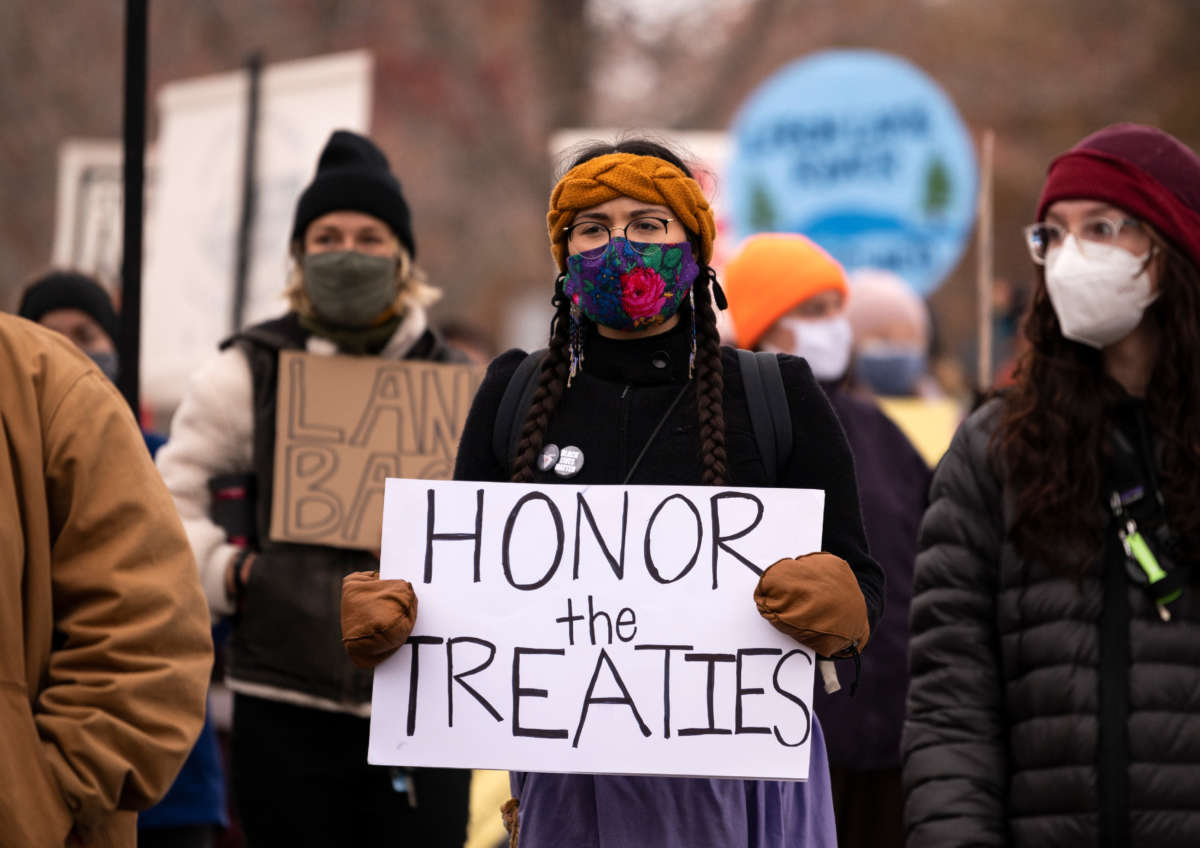
People protest against the Enbridge Energy Line 3 pipeline project outside the governor’s mansion on November 14, 2020, in St. Paul, Minnesota.Stephen Maturen / Getty Images
Mike Ludwig talks to Whitney Gravelle, an attorney for the Bay Mills Indian Community, about the fight against Enbridge’s Line 5 pipeline.
TRANSCRIPT
Climate Front Lines
To Protect Great Lakes, Michigan Tribes Oppose Enbridge Line 5 Pipelines
Note: This a rush transcript and has been lightly edited for clarity. Copy may not be in its final form.
Mike Ludwig: Welcome to Climate Front Lines, the podcast exploring the people and places on the front lines of the climate crisis. My name is Mike Ludwig. I’m a reporter for Truthout.org. President-elect Joe Biden announced this week that former environmental protection agency administrator Gina McCarthy will serve as his top climate advisor.
The actions from environmentalists have been mixed to say the least on one hand McCarthy was the EPA administrator during the Obama administration. When regulators attempted to put caps on the energy sector’s greenhouse gas emissions for the first time, of course, the Trump administration crushed all these efforts and then some, and on the other hand, McCarthy was EPA administrator during the Obama administration.
When the word fracking became a household term for years, fracking opponents accused the EPA under Obama and McCarthy of suppressing research. Showing that fracking for oil and gas is a threat to drinking water. Still fracking caused an explosion of fossil fuel production across the U.S., and Canada was pushing to export more oil and gas at the same time.
All of these fossil fuels needed places to go in ways to get there and suddenly fights against new oil and gas pipelines erupted across the nation. The Keystone XL pipeline, for example, became a political hot potato under president Obama as tribal governments and environmental activists launched fierce campaigns against the project.
During the last days of the Obama administration. Law enforcement moved to crush the uprising at standing rock where the standing rock, Sioux tribe and other indigenous led activists resisted the Dakota access pipeline for months and drew international attention to the legacy of colonialism in the Americas.
Activists continue to take direct action to stop oil and gas pipelines under President Trump, who made it clear that the fossil fuel industry had a friend in the White House. Those days are coming to an end, the campaigns to prevent the industry from establishing new infrastructure and locking in decades of fossil fuel production will continue under president Biden.
Like other struggles on the front lines of climate change, many of these campaigns are led by indigenous activists. One such campaign can be found in Northern Michigan where the Canadian firm Enbridge wants to extend the life of line five to underwater oil and gas pipelines that have operated for decades in the straits of Mackinac, the narrow body of water between Michigan’s lower and upper peninsula. In 2018, a ship’s anchor struck line five causing damage and alarming the public lion five runs under what it’s essentially headwaters for much of the great lakes and oil spill in this region could spell disaster for ecosystems and fresh water supplies. Enbridge wants to build a quote unquote tunnel over line five so the pipelines can continue operating for years to come. But the company is facing opposition from a coalition of tribal governments, along with Michigan’s democratic governor Gretchen Whitmer. To learn more, I spoke with Whitney Gravelle, an attorney for the Bay Mills Indian community, a Northern Michigan tribe that has fished the waters flowing above Line 5 for generations.
Whitney Gravelle: So Bay Mills Indian community is a federally recognized Indian tribe located in the upper peninsula of Michigan. So we’re in the Northern most part of the state. Um, and as I mentioned earlier, uh, closer to Canada than the rest of the state, but we have been here since time immemorial.
So this is where the Aboriginal people of the Bay Mills Indian community, Ojibwe Anishinaabe, have always resided and lived and been a part of the environment and culture here within the state of Michigan.
ML: Can you give us a little bit of background on the Enbridge line five? Um, how much construction has been completed, maybe where you all are at, in the permitting process?
WG: Yeah. So Enbridge line five, the dual pipelines that run beneath the straits of Mackinac have actually been in existence since 1953. That is when Enbridge first saw an easement from the state of Michigan and actually placed the pipelines into the water. Since then in early 2018, there was actually an anchor strike that struck the pipelines in caused some severe damage.
And that was the first time that the tribes or the public in the state of Michigan were actually made aware of the pipelines. So they had been around, you know, for almost 60 years and all of a sudden, everyone was made aware of what was actually going on beneath the water. Uh, Which was really surprising, not only to the tribe, but to the public.
And then it started raising all of these concerns of why did we have an oil and natural gas pipeline running through the straits of Mackinac, running through the Great Lakes, which is the largest freshwater body in the world. And a critical part of not only the environment of the state of Michigan, but also our economy up here.
ML: Right, and I was watching the video you sent me, that fishing is a big part of the economy where, where you live or for your community.
WG: Yes, that is correct. So Bay mills is actually a signatory of the 1836 treaty of Washington. And in that treaty, there were five different tribes. Females included that seeded 14 million acres to the United States government for the creation of the state of Michigan.
If we had not signed that treaty back in 1836, uh, the state of Michigan would not have. Um, become part of the union, essentially during that time, what we did when we signed the treaty of Washington, however, is we reserved rights on reservation and offers a ration to fish hunt and gather throughout the seed and territory, which is essentially that 14 million acres, that 14 million acres also includes the waters of the great lakes.
And in reserving the. The right to fish in the great lakes, what our ancestors were doing was actually preserving a way of life for our people. That is something that we have always done commercially as well as subsistently in order to provide and feed our community.
ML: And you mentioned earlier, other pipelines, have you drawn inspiration or, uh, maybe some tactical knowledge just from seeing other indigenous led fights against pipelines in the U S.
WG: Absolutely. Um, you know, the most. The largest example that comes to mind was the No DAPL that took place in the Dakotas against that pipeline. That was the first time that the, the indigenous community had come together and rallied around one another in order to stop a pipeline. And there were a lot of atrocities that occurred in the no dapple protest, but they ultimately succeeded.
Now that pipeline is still in litigation. Uh, over there in the Dakotas, they’re still figuring out what those issues, but the strength that those indigenous communities found amongst each other. We also had citizens from the mills Indian community that went out to the Dakotas to support them. We had donations coming from our own tribal community.
It made us realize that if we could draw upon the same strength that we might be able to then get line five, the dual pipelines out of the straits of Mackinac.
ML: And they’re there. Enbridge is trying to extend these lines, right? That is what you’re fighting right now.
WG: Yeah. So originally this has actually been a really rapid and moving process here in the state of Michigan, but originally in 2018, when those anchor strikes had occurred, that. As I mentioned brought awareness to the general public and the state of Michigan of the dangers of these pipelines. Uh, what Enbridge started doing then was coming up with other alternatives in a way to keep the pipeline going underneath the streets of Mackinaw and what the mills Indian community is actively fighting right now is a proposed tunnel project.
So essentially Enbridge wants to build a tunnel beneath the straits of Mackinac that would then house these dual pipelines, still keeping them. You know, underneath the water, underneath the soil, but endangering our Great Lakes.
ML: Right. And as, um, and as a community, I imagine there, isn’t just the sense of you. You want to preserve and protect the water for fishing and, uh, for the area that you live, but you’re also fighting to protect the entire great lakes system, really that, that flows from that area. And also the climate.
WG: Absolutely. You know, you hear the term often that tribal communities are often the first stewards of the environment, the first stewards of the land, and that is an obligation and a duty that our communities and the different indigenous populations take very seriously.
We actually have a teaching amongst our people. It’s called the seven generations teaching. But what it asks you to do is to look seven generations into the future for every action that you take. So whether it be a pipeline or driving a car, you know, or constructing something or polluting or recycling, you are supposed to examine that decision that you do and determine how.
Are the actions that I am taking today, having an impact on my children’s children and their children, seven generations into the future. And that teaching is so ingrained into our society. That what it really. Has us do and requires of us is to reflect upon the impacts that we are doing towards the future, which is a direct correlation to climate change, you know, to global warming, uh, to being a steward for the environment.
What are we doing today that will provide the most sustainable future for our children?
ML: And where are we with the fight? I know that. Enbridge filed a lawsuit recently. I think it was against governor. Whitmer correct for, um, attempting to block the pipeline. And then there’s also some permits that are in the air.
WG: Yeah. So most recently, just a few weeks ago, Governor Whitmer actually revoked the easement for the dual pipelines in the streets and Makena first, the governor and the attorney general filed litigation on the easements. In state court, state of Michigan court, and then Enbridge responded by filing an action in federal court, essentially stating that the governor has no right to revoke the easement and that federal regulations over pipelines actually preempt any state law that may apply in terms of easement or regulation of water and lands.
Uh, dual and running along that there’s actually a litigation taking place before the Michigan public service commission, which females is directly involved in. And the Michigan public service commission is the governing body that will decide whether or not Enbridge can move the duel. Pipelines in the streets of Mackinaw into the tunnel.
Also running adjacent to that is there are two permits that are going before Eagle, which is a state regulatory agency in Michigan and also the United States army Corps of engineers to actually build and construct the tunnel. So first and bridge must receive permission from the Michigan public service commission to place the pipelines into the tunnel. And then they also need two permits approved by both the army Corps and Eagle in order to build the tunnel.
ML: And so, and those permits are, um, the decisions on those are going to be made next month I read. Is that correct? So you’re kind of like, this is a crucial time for your campaign.
WG: Yes, um, Eagle the environment, great lakes and energy division actually extended the deadline until January, 2021.
And then the army Corps is also evaluating that permit. Their process is a little bit longer, but they typically run very parallel to one another. So once we just see a decision from the Eagle state side, we will also see a decision come from the army Corps as well.
ML: One thing we’ve seen internationally. In the past few years is climate negotiators of the United nations and other intergovernmental organizations that are working on climate have come to recognize the leadership that indigenous people have in, in the movement for climate justice. And also in the effort to just preserve the planet, um, that indigenous knowledge, not just the United States, but across the world can be a guiding. For us in determining how to preserve land, to manage forests, to create carbon sinks, um, to do these things that can help us mitigate at least some of the impacts of climate change. Do you feel like when you’re, when you’re opposing this pipeline, that that does have climate implications, that you are part of a bigger movement and international recognition of, the, I guess, indigenous knowledge about land and about the areas that need to be preserved.
WG: Not at this moment in time. And I think that it is because our focus is so narrowed and lasered-in on the issues that we’re confronting here on the ground, in the state of Michigan. Um, but definitely the inspiration that we have seen from other indigenous communities, not only within the United States, but around the globe.
Have lent us strength in the, in the battles that we are engaging here on the front lines, we learn from their mistakes. We learn from their achievements. We learn from them as communities and how they engage their state or federal regulatory agencies. And we try to apply that here because I think as a people and looking at the teachings from indigenous communities, we’re all aligned that we’re here.
Uh, again, you know, reflecting upon that seven generation principle to continue to provide for our communities who have bet on this land since the beginning of time.
ML: Thanks for listening to Climate Front Lines. If you’ve enjoyed this podcast, give us a like, and a share. You can also sign up for our free daily email newsletter@truthout.org. Stay safe out there, friends.
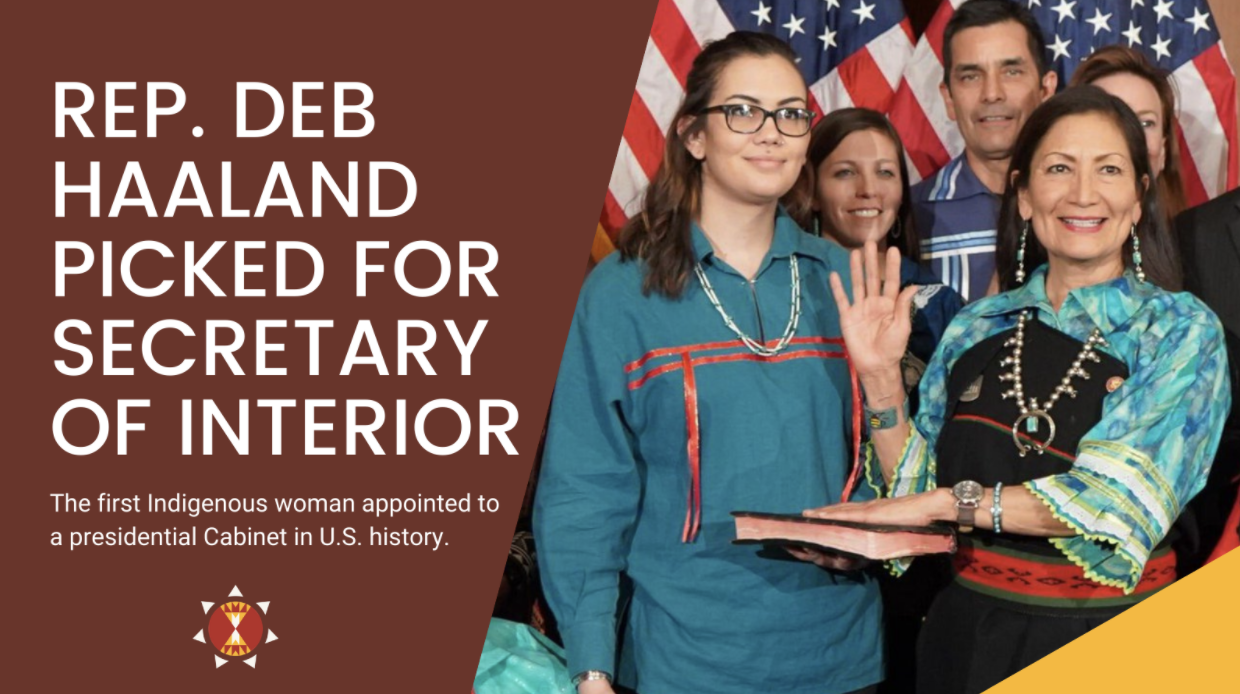
We have incredible news! Today, for the first time in U.S. history, a Native American person was nominated to fill a Cabinet position when Joe Biden tapped Rep. Deb Haaland (D-NM) to serve as his Secretary of the Interior. We all share in this victory for Indigenous rights, and I can’t thank Lakota Law supporters like you enough for lending your voices. Nearly 9,500 of you signed our petition to Biden’s transition team in support of Congresswoman Haaland! Today, they made the right call.
Once she’s confirmed, Rep. Haaland will bring valuable experience to the executive branch as both a legislator and an Indigenous woman. A 35th-generation New Mexican and member of the Pueblo of Laguna Tribe, she’s already served in Congress on a committee overseeing the Department of the Interior. As a Native person, she’ll bring a new perspective to the position, which is responsible for the federal government’s relationship with tribal nations and has a large role in determining domestic environmental and land use policy.
We could not have hoped for a better person to fill this role at this time. We have so much work to do to heal our nation — from COVID-19, the disastrous environmental rollbacks of the outgoing administration, and the historical disregard of Indigenous people. So, today, we celebrate a new day and a better direction for America. We heartily congratulate our friend, Congresswoman Haaland, and we look forward to working even more closely with her to win justice for the Lakota and tribal nations across the land.
Wopila tanka — Thank you for helping us make history!
Madonna Thunder Hawk Cheyenne River Organizer The Lakota People’s Law Project
If you’ve been following our work on Standing Rock for the past year, you won’t be surprised to hear that the white-dominated city council in my hometown of McLaughlin, South Dakota is displaying its usual biased treatment of Native residents. First they cut power to homes during the early, cold months of COVID-19. Then they blocked my friend, Hoksila White Mountain, from running for mayor of the Standing Rock’s reservation’s second largest town. Now, they’ve reneged on the mayor’s promise to appoint Hoksila to city council. Unacceptable!
Our friend, Hoksila White Mountain, should be on the McLaughlin City Council.
On Monday, we’ll attend the council meeting and, in a show of force by the Native people of this community, deliver our message directly to our local lawmakers. I’m also leading a team of five people going door to door collecting signatures around town, and I’m happy to report that our lead counsel, Chase Iron Eyes, will be there on Monday to represent Hoksila.
As an additional pressure point, we’re in dialogue with the Campaign Legal Center in D.C. (the law firm that successfully joined the Native American Rights Fund in suing North Dakota in 2018 over its voter suppression law) about this matter. I’m confident the power of our combined voices can achieve the change we need.
We have leverage. McLaughlin’s mayor is on record, multiple times, saying Hoksila will fill the vacant seat in his own ward. The mayor has no valid reason to back off from this public promise — only fear and/or racism. Hoksila would be just the second Native person on the city council in Standing Rock’s second largest town, which was once a KKK stronghold. (My friends and I call it the “Deep North”.)
But I grew up on this land, and I know the power it — and its original inhabitants — have. This November, we at Standing Rock helped generate the largest electoral turnout in U.S. history, and the Native vote had an undeniable impact. So we refuse to stand down and accept election irregularities like this at Standing Rock. Petition the City of McLaughlin, and let them know you stand with us in demanding Hoksila’s appointment to council. It’s past time for Native representation and justice in our homelands.
Wopila tanka — your action empowers our people!
Honorata Defender Standing Rock Organizer Lakota People’s Law Project
‘Strong hearts to the front!’: Indigenous water protectors take direct action against Minnesota tar sands pipeline
‘Strong hearts to the front!’: Indigenous water protectors take direct action against Minnesota tar sands pipeline
“Clean water and unpolluted land capable of providing sustenance is essential to our survival… [and] Line 3 poses an existential threat to our well-being.” By Brett Wilkins – December 7, 2020 46 SOURCECommon DreamsShare on FacebookTweet on Twitter
Indigenous-led water protectors on Friday engaged in multiple direct actions against Enbridge’s highly controversial Line 3 tar sands pipeline in Minnesota, on the same day that state regulators denied a request from two tribes to stop the Canadian company from proceeding with the project.
Water protectors blocked pipeline traffic and climbed and occupied trees as part of Friday’s actions. Urging other Indigenous peoples and allies to “take a stand,” the Anishinaabe activists at one of the protests told other Native Americans that “your ancestors are here too.”
“Take a moment to speak to her, our Mother Earth is crying out for the warriors to rise again,” they said. “Strong hearts to the front!”
“The state of Minnesota does not have the consent of many tribes that will be impacted by construction and spills,” the group added. “Last week, the Red Lake Band of Chippewa and the White Earth Band petitioned the Minnesota Public Utilities Commission to pause its approval of Line 3 construction while challenges to the permits are considered by the Minnesota Court of Appeals.”
On Thursday, the Minnesota Chippewa Tribe (MCT) appealed directly to Walz:
Indian people have lived along the lakes, rivers, and streams of northern Minnesota since time immemorial. The people of the MCT have flourished in the area for centuries due to the careful conservation of our resources. Clean water and unpolluted land capable of providing sustenance is essential to our survival… [and] Line 3 poses an existential threat to our well-being.
The vote and the water protectors’ latest act of resistance come just two days after construction began on the $2.9 billion, 1,100-mile extension.
According to Indigenous-led environmental group Honor the Earth, the pipeline will have the daily capacity to transport 760,000 barrels of tar sands oil—known as the world’s dirtiest fuel—from Alberta, Canada to a port in Superior, Wisconsin. Stop Line 3 says the pipeline will run “through untouched wetlands and the treaty territory of Anishinaabe peoples.”
“We have the right to practice our treaty rights,” stressed Gitchigumi Scout member Taysha Martineau, one of the Indigenous leaders at the Friday action. “We ask you to bear witness and protect our right to do so.”
Season’s greetings to you and yours! I suspect that this year, you may be feeling a bit muted in your celebrations. With the pandemic still raging around the world, many of us won’t have the opportunity to get together with loved ones in the way we’re accustomed. Of course, some of us in Native communities already have issues with Thanksgiving — which I call Thankstaking — because it’s a holiday that unfortunately reminds us of all we have lost.
It seems somehow appropriate then that Giving Tuesday follows closely on the heels of this holiday. It gives us all an opportunity to consider the true spirit of giving differently. By giving to support Native justice now, you have a way to honor Native communities on a painful day. And because a group of our generous patrons has offered to match all gifts we receive between now and the end of next week, your contribution will make twice the impact.
In this week’s members-only event for monthly contributors, Chase and I discussed Thanksgiving and our accomplishments together.
And what an impact we’ve been making together! We’re still joyful about the success we had getting out the national Native vote in partnership with Standing Rock — and now we’ve got our sights set on how we can build on that success. I’ve got one word for you: Georgia.
This week, our staff spent time in Atlanta solidifying partnerships with the NAACP and the Indigenous Peoples Movement so we can effectively work together to get out the vote for the upcoming U.S. Senate run-off elections in the Peach State.
There are almost 40,000 Indigenous people in Georgia. There are also many environmental, Hispanic, and Black voters who share some political values with Native people. The state has the ninth youngest population in America and the third largest Black population. But the historical pattern in Georgia has been that, during runoffs, people of color and younger folks tend to vote in smaller numbers than during presidential elections. We aim to change that. Our focus will be making sure that everyone who voted in November votes again by Jan. 5.
We aren’t ready to rest. Over the next several weeks, we’ll be back at Standing Rock replicating our successful outreach from tribal members to all voters who will listen to them. And we plan to offer you all a chance to join our phonebank effort as well — please stay tuned! Thank you for being there for us every step of the way! With your support, we can keep the historic wins coming.
Wopila Tanka — thank you, and I wish you well this holiday season!
Madonna Thunder Hawk Cheyenne River Organizer Lakota People’s Law Project
Lakota People’s Law Project 547 South 7th Street #149 Bismarck, ND 58504-5859
The Lakota People’s Law Project is part of the Romero Institute, a nonprofit 501(c)(3) law and policy center. All donations are tax-deductible.
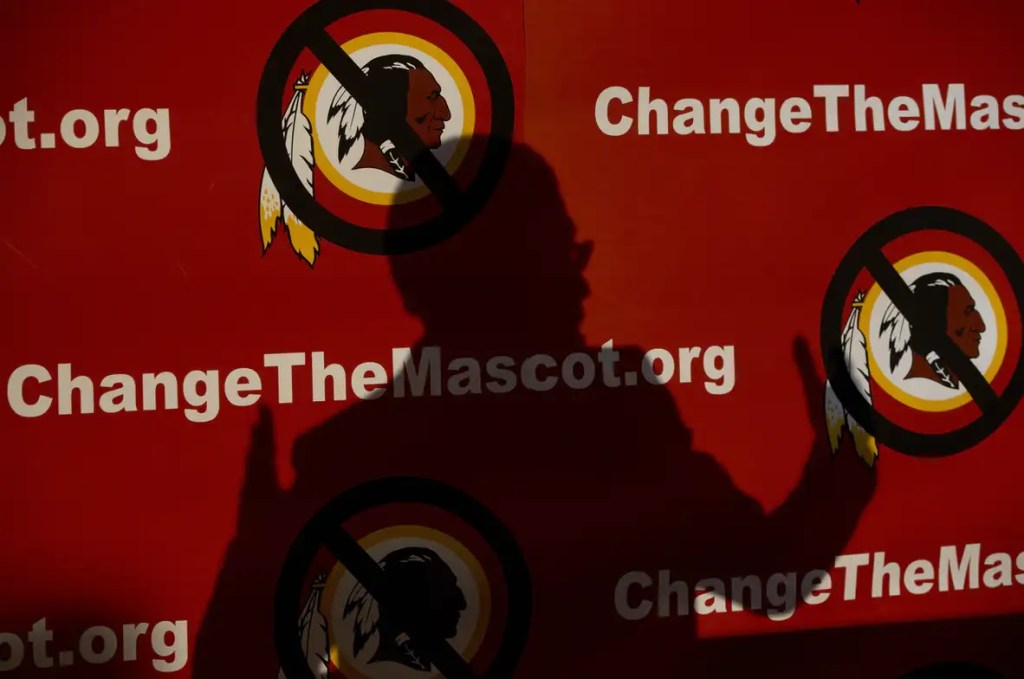
The Washington NFL team dumped its controversial mascot earlier this year and now, it appears it has dumped its foundation created to help Native people.
The team will no longer make contributions to the Original Americans Foundation and will instead focus its charitable efforts on the Washington Football Charitable Foundation, USA Today reported this week. The Washington Football Charitable Foundation will continue to assist Native communities, according to the newspaper, but it’s unclear how.
“As part of our evolution into a franchise of the future, the Washington Football Team’s new leadership is reviewing our philanthropic strategy,” read a team statement to USA Today.
A spokeswoman for the foundation confirmed the shift away from the Original Americans Foundation and a new philanthropic strategy to Indian Country Today.
Julie Jenson said part of the strategy is working with advisors and leadership within the Native American community that is long term and sustainable. Strategy specifics haven’t been built out yet, she said.
In July, the team said it was retiring its logo and nickname, a dictionary-defined racial slur, after mounting pressure from activists and sponsors. It hasn’t made a public decision on a new name and is competing in this NFL season as the Washington Football Team.
The team launched the Original Americans Foundation in 2014. An announcement on its website from that time outlined its goals and cited its ability to “provide resources that offer genuine opportunities for tribal communities.”
According to the post, Synder and his staff traveled to 26 reservations in 20 states and met with 400 tribal leaders.
“The fact is, too many Native American communities face much harsher, much more alarming realities,” Snyder said in the announcement. “I’ve listened. I’ve learned. And frankly, it’s heart wrenching. It’s not enough to celebrate the values and heritage of Native Americans. We must do more.”
It also noted the foundation had given a new backhoe to the Omaha Tribe of Nebraska, among 40-plus projects being processed that year.
USA Today reported that the foundation donated $3.7 million in its first year, $1.6 million in the second, $650,000 in the 2017 fiscal year, $303,000 in the 2018 fiscal year, and $0 in 2019. It’s unclear where the money was spent or which tribes benefited.
The NFL franchise is facing sexual harassment claims that were recently exposed by the Washington Post. The report names Original Americans Foundation Executive Director Gary Edwards as one of the franchise employees accused of sexual harassment.
Story has been updated to include comment from Washington Football Charitable Foundation
Dalton Walker, Red Lake Anishinaabe, is a national correspondent at Indian Country Today. Follow him on Twitter: @daltonwalker Walker is based in Phoenix and enjoys Arizona winters.
Indian Country Today is a nonprofit news organization. Will you support our work? All of our content is free. There are no subscriptions or costs. And we have hired more Native journalists in the past year than any news organization ─ and with your help we will continue to grow and create career paths for our people. Support Indian Country Today for as little as $10.
“At its heart, dam removal is about healing and restoration for the river, for the salmon, and for our people,” Yurok Tribe chairman Joseph James said. “We have never wavered from this obligation, and we are pleased to see dam removal come closer to reality through this agreement.”
In this March 3, 2020, file photo, is the Iron Gate Dam, powerhouse and spillway are on the lower Klamath River near Hornbrook, Calif. (AP Photo/Gillian Flaccus, File)
The Associated Press
Nov 17, 2020
Tribes hope the dam removal will allow the salmon to come back
Gillian Flaccus Associated Press
PORTLAND, Ore. — An agreement announced Tuesday paves the way for the largest dam demolition in U.S. history, a project that promises to reopen hundreds of miles of waterway along the Oregon-California border to salmon that are critical to tribes but have dwindled to almost nothing in recent years.
If it goes forward, the deal would revive plans to remove four massive hydroelectric dams on the lower Klamath River, emptying giant reservoirs and reopening potential fish habitat that’s been blocked for more than a century. The massive project would be at the vanguard of a trend toward dam demolitions in the U.S. as the structures age and become less economically viable amid growing environmental concerns about the health of native fish.
Previous efforts to address problems in the Klamath Basin have fallen apart amid years of legal sparring that generated distrust among tribes, fishing groups, farmers and environmentalists. Opponents of dam removal worry about their property values and the loss of a water source for fighting wildfires.
“It is bleak, but I want to have hope that with dam removal and with all the prayers that we’ve been sending up all these years, salmon could come back. If we just give them a chance, they will,” said Chook Chook Hillman, a Karuk tribal member who’s been fighting for the dam removal for years. “If you provide a good place for salmon, they’ll always come home.”
A half-dozen tribes spread across Oregon and California, fishing groups and environmentalists had hoped to see demolition work begin as soon as 2022. But in July, U.S. regulators stalled those plans when they questioned whether the nonprofit entity formed to oversee the project could adequately respond if there were cost overruns or accidents.
The new plan makes Oregon and California equal partners in the demolition with the nonprofit entity, called the Klamath River Renewal Corporation, and adds $45 million to the project’s $450 million budget to ease those concerns. Oregon, California and the utility PacifiCorp, which operates the hydroelectric dams and is owned by billionaire Warren Buffett’s company Berkshire Hathaway, will each provide one-third of the additional funds.
Parties to the new agreement shared details with The Associated Press in documents and interviews ahead of a news conference scheduled Tuesday.
The Federal Energy Regulatory Commission must approve the deal. If accepted, it would allow PacifiCorp and Berkshire Hathaway to walk away from aging dams that are more of an albatross than a profit-generator, while addressing regulators’ concerns. Oregon, California and the nonprofit would jointly take over the hydroelectric license from PacifiCorp until the dams are decommissioned, while the nonprofit will oversee the work.
Buffett called the reworked deal a solution to a “very complex challenge.”
“I recognize the importance of Klamath dam removal and river restoration for tribal people in the Klamath Basin,” Buffett said in a statement. “We appreciate and respect our tribal partners for their collaboration in forging an agreement that delivers an exceptional outcome for the river, as well as future generations.”
Removed would be the four southernmost dams in a string of six constructed in southern Oregon and far Northern California beginning in 1918.
They were built solely for power generation. They are not used for irrigation, not managed for flood control and have no “fish ladders,” or concrete chutes that fish can pass through.
They have blocked hundreds of miles of potential fish habitat and spawning grounds, and fish populations have dropped precipitously in recent years. Salmon are at the heart of the culture, beliefs and diet of a half-dozen regional tribes, including the Yurok and Karuk — both parties to the agreement — and they have suffered deeply from that loss.
Coho salmon from the Klamath River are listed as threatened under federal and California law, and their population in the river has fallen anywhere from 52 percent to 95 percent. Spring chinook salmon, once the Klamath Basin’s largest run, has dwindled by 98 percent.
Fall chinook, the last to persist in any significant numbers, have been so meager in the past few years that the Yurok canceled fishing for the first time in the tribe’s memory. In 2017, they bought fish at a grocery store for their annual salmon festival.
“At its heart, dam removal is about healing and restoration for the river, for the salmon, and for our people,” Yurok Tribe chairman Joseph James said. “We have never wavered from this obligation, and we are pleased to see dam removal come closer to reality through this agreement.”
PacifiCorp has been operating the dams under an extension of its expired hydroelectric license for years. The license was originally granted before modern environmental laws and renewing it would mean costly renovations to install fish ladders. The utility has said energy generated by the dams no longer makes up a significant part of its portfolio.
In the original deal, PacifiCorp was to transfer its license and contribute $200 million to bow out of the removal project and avoid further costs and liability. An additional $250 million comes from a voter-approved California water bond.
U.S. regulators, however, agreed only on the condition that PacifiCorp remain a co-licensee along with the Klamath River Renewal Corporation — a nonstarter for the utility.
Residents have been caught in the middle. As tribes watched salmon dwindle, some homeowners around a huge reservoir created by Copco Dam, one of those slated for removal, have sued to stop the demolition.
They say their waterfront property values are already declining because of news coverage associated with demolition and they worry about losing a water source for fighting wildfires in an increasingly fire-prone landscape. Many also oppose the use of ratepayer funds for the project.
On Tuesday, some Oregon lawmakers issued statements saying Gov. Kate Brown had violated her authority by authorizing the deal without legislative approval.
Further upstream, farmers who rely on two other dams are watching carefully. The removal of the lower four dams won’t affect them directly, but they worry it could set a precedent for dam removal on the Klamath.
More than 1,720 dams have been dismantled around the U.S. since 2012, according to American Rivers, and 26 states undertook dam removal projects in 2019 alone. The Klamath River project would be the largest such project by far if it proceeds.











 Water is Life