Canadian Pipline Protests

https://www.theglobeandmail.com/opinion/article-where-are-the-solidarity-protests-for-the-first-nations-that-support/

Where are the solidarity protests for the First Nations that support Coastal GasLink?

The demonstrations you’re thinking of – such as this one seen on Feb. 8, 2020 – were in solidarity with Wet’suwet’en hereditary chiefs, who oppose the $6-billion, 670-kilometre pipeline across northern B.C. It’s

Dirk Meissner/The Canadian Press

There have been no major demonstrations this week in solidarity with the First Nations people along the Coastal GasLink route who are waiting for change to come to their communities.

There have been no blockades disrupting VIA Rail trains; nothing in midtown Toronto; no one outside the B.C. Legislature; no disruptions on the Reconciliation Bridge in Calgary; no stopping of traffic in downtown Ottawa; and no protests along busy Vancouver intersections.

The demonstrations you’re thinking of were in solidarity with Wet’suwet’en hereditary chiefs, who oppose the $6-billion, 670-kilometre pipeline across northern B.C. It’s their slogans that have been broadly adopted, their opinions that are being mirrored in protest and their case that has been taken up so fervently by supporters all across Canada.

Wet’suwet’en chiefs vs. Coastal GasLink: A guide to the dispute over a B.C. pipeline

Opinion: What is happening on Wet’suwet’en territory shows us that reconciliation is dead

The voices of band members from 20 First Nations along the Coastal GasLink project route who want it to continue – those who have indicated, through elections or other means, that they want construction on the natural gas pipeline to move ahead – have been eclipsed by the views of a small group of Wet’suwet’en hereditary chiefs, who hold jurisdiction over just a portion of the land the pipeline will cover.


The inconvenient truth for pipeline supporters: root causes of this revolution will not be televised

https://www.straight.com/news/1360051/inconvenient-truth-pipeline-supporters

That’s to say nothing of the importance of the Unist’ot’en Healing Center in decolonizing Wet’suwet’en people by reconnecting them to the land.

Here’s another inconvenient truth: there’s probably never been a pipeline project in Canada that the vast majority of Postmedia columnists haven’t adored.

In 1970, musician Gil Scott-Heron recorded “The Revolution Will Not Be Televised”—and the slogan’s origins date back to the Black Power movement of the 1960s.

In a similar manner, those rebelling against the fossil-fuel industry shouldn’t expect to see sympathetic treatment from media outlets in these rebellious times.

That’s because the root causes of this climate and Indigenous revolution will not be televised. To borrow a phrase from Scott-Heron, this revolution will be live


Action Needed in Canada!


All eyes on Wet’suwet’en
Mon, Feb 10, 2020 12:01 pm
Cherri Foytlin (leauestlaviecamp@gmail.com)To:you Details
Greetings Water Protector Family,

We are writing to pass along some urgent updates from our Wet’suwet’en relatives whose unceded territories are currently being invaded by Canada’s national police, known as the RCMP. Over the past four days the RCMP has been laying siege upon indigenous land defenders and acting as a military escort for TC Energy (which is TransCanada’s new name) as they attempt to build their Coastal Gas Link pipeline. The information below comes directly from the front lines and we strongly encourage everyone to take action and stand in solidarity with the land defenders of the Unist’ot’en camp. Please follow the links below.

EXCERPT FROM UNIST’OT’EN PRESS RELEASE
Unist’ot’en demands the RCMP will not evict the Unist’ot’en Healing Centre. The RCMP has no jurisdiction to enter the Healing Centre without our Free, Prior, and Informed Consent. Even under colonial law, the RCMP cannot enter or search our Healing Centre without a warrant.

International public support is called for to ensure the safety of the Healing Centre. People living and receiving treatment there are not in violation of CGL’s injunction, nor is the Healing Centre itself in violation of the injunction. The Healing Centre exists to support the self-determination and healing of our people and is unrelated to CGL’s work and the injunction.

Unist’ot’en is outraged over the use of excessive force by the RCMP, including the unnecessary use of heavily armed tactical teams deployed by helicopters to surround Gidimt’en camp at 44 km, use of snipers, and deployment of K9 units. We know that in January 2019, RCMP were authorized to use genocidal lethal force, arrest children and grandparents, and apprehend Wet’suwet’en children in response to our peaceful presence on our lands.

Throughout the enforcement of CGL’s injunction, media and legal observers were illegally corralled and threatened with detention and arrest for doing their jobs. Freedom of the press is protected under Canadian law but journalists were prevented from documenting the RCMP militarized raids on Gidimt’en territories. The RCMP attempted to evict residents from Chief Woos’s cabin. The RCMP and Coastal GasLink also partially dismantled Gidimt’en camp infrastructure and property. This property belongs to the Gidimt’en Clan and the RCMP has no legal authority to destroy it.

On February 8, the exclusion zone was illegally expanded from the 27 KM to the 4 KM mark, and now encompasses the majority of Gidimt’en territory. As a result, eleven people including legal observers were illegally arrested from the 27 km cabin. The exclusion zone has been created by the RCMP to force Wet’suwet’en land defenders off ourland. It is a colonial and criminalizing tool to illegally and arbitrarily extend RCMP authority onto our lands. The massive exclusion zone, completely under RCMP authoritarian discretion, falls outside the injunction area. Chiefs and Wet’suwet’en people are illegally being denied access to their own territories.

We urge Canada to adhere to the UN Committee for the Elimination of Racial Discrimination (UN CERD) directives and to halt the Coastal Gaslink project, seek Free, Prior, and Informed Consent from the Wet’suwet’en Hereditary Chiefs, withdraw RCMP from our territories and ensure that no lethal weapons or force be used to forcibly evict Wet’suwet’en people from our lands.

TODAYS UPDATES FROM THE FRONT LINES:8:40 am – RCMP on megaphone at #Unistoten bridge: “This is the RCMP. This airspace is now restricted. Do not operate any drone in this area. This restriction is approved by transport Canada.” Freda Huson: “This is not Canada! You are invaders! LEAVE!”

8:39 am – RCMP officers climbing snowbank

8:35 am – RCMP approaching bridge at 66km. 3 SUVs, one large van, line of trucks behind. Matriarchs are drumming and singing on the bridge, walking through the red dresses of their stolen sisters.

8:22 am – Unist’ot’en matriarchs drumming on bridge, as RCMP convoy advances.

8:16 am – RCMP and CGL convoy is now passing the 44 km mark on the way to Unist’ot’en (66km)

7:21 am – RCMP convoy is rolling up towards 66km now from 4km mark.

7:01 am – Convoy of 16 RCMP vehicles, mostly tactical stopped at 3km. 4 snowmobiles. Headed to Unist’ot’en.

6:50 am – Convoy of RCMP tactical vehicles just left the community hall in town and are headed down Hwy 16.

________________

Even if FB and Twitter feeds go down, this page on the website will still be updated: http://unistoten.camp/feb10

#WetsuwetenStrong #ReconciliationIsDead #alleyesonWetsuweten #waterislife #shutdowncanada #unistoten #gidimten #landback #thetimeisnow
Wet’suwet’en Supporter Toolkit: http://unistoten.camp/supportertoolkit2020

Unist’ot’en Legal Fund: https://actionnetwork.org/fundraising/unistoten2020legalfund

Call out for Solidarity Actions:
http://unistoten.camp/alleyesonwetsuweten/

Thank you for your support of indigenous resistance. Please continue to follow live updates as they come and please do what you can to organize an action in solidarity with the Unist’ot’en camp.

Hope to see you on the front lines,
Cherri Foytlin

Facebook
Twitter
Link
Website
Copyright © 2020 The No Bayou Bridge Solidarity Campaign, All rights reserved.
Thank you for signing up to stop Energy Transfer Partners and their toxic oil pipelines.

Our mailing address is:

The No Bayou Bridge Solidarity Campaign

PO Box 112

Rayne, LA 70578

Add us to your address book

Want to change how you receive these emails?
You can update your preferences or unsubscribe from this list.

Email Marketing Powered by Mailchimp

Reply Reply All Forward
AdChoices

News from Canada: Action Now!

https://newsmaven.io/indiancountrytoday/the-press-pool/royal-canadian-mounted-police-raid-unceded-wet-suwet-en-land-six-arrested-POEHsecli0W1zx2fo8p8XA?utm_source=maven-coalition&utm_medium=salish&utm_campaign=email&utm_term=notification&utm_content=unread-notification


Royal Canadian Mounted Police raid unceded Wet’suwet’en land, six arrested


edited

International day of solidarity with the Wet’suwet’en Monday February 10

News Release

Indigenous Environmental Network

Early this morning, the Royal Canadian Mounted Police (RCMP) raided Wet’suwet’en territories to push forward the unwanted Coastal GasLink pipeline. Six Indigenous peoples and their allies were arrested.

The Wet’suwet’en have been very clear that they do not want the C$6.6 billion, 416 mile long CGL pipeline going through their unceded and sovereign lands. Coastal GasLink/TC Energy (formerly TransCanada) is pushing through a 670-kilometer fracked gas pipeline that would carry fracked gas from Dawson Creek, B.C. to the coastal town of Kitimat, where LNG Canada’s processing plant would be located. LNG Canada is the single largest private oil and gas investment in Canadian history.

Royal Canadian Mounted Police officers with night vision and automatic weapons raided the camp in the dead of night. Much like at Standing Rock — the raid was highly militarized — dogs were used, media was banned from filming arrests, Royal Canadian Mounted Police smashed the windows of the camp’s communications van.

You can support camp by donating here:
https://actionnetwork.org/fundraising/unistoten2020legalfund

Download the Wet’suwet’en Supporter Toolkit 2020 here
http://unistoten.camp/supportertoolkit2020/

Hold a solidarity action:

Pictured: "International days of solidarity with the Wet’suwet’en" flyer.
Pictured: “International days of solidarity with the Wet’suwet’en” flyer.(Image: Indigenous Environmental Network)

Find A Solidarity Action Near You:
https://www.facebook.com/events/186688865753897/

Disgusting Action

https://www.yahoo.com/news/sacred-native-american-arizona-blasted-043614389.html

Sacred Native American site in Arizona blasted for border wall construction

Rafael Carranza, Arizona Republic

TUCSON, Ariz. – The contractor that is building President Donald Trump’s border wall in southwestern Arizona began blasting this week through a site that the Native American O’odham people consider sacred to make way for newer, taller barriers.

U.S. Customs and Border Protection confirmed the contractor started blasting through the site called Monument Hill at Organ Pipe Cactus National Monument west of Lukeville “in preparation for new border wall system construction within the Roosevelt Reservation.”

The Roosevelt Reservation is a 60-foot-wide swath of federally owned land along the border in Arizona.

Since construction began in August, crews have been clearing that 60-foot swath – relocating certain plants, including the state’s iconic saguaros, to other parts of the national park.

Border wall construction in Organ Pipe Cactus National Monument at the Arizona-Mexico line.

Border wall construction in Organ Pipe Cactus National Monument at the Arizona-Mexico line.

COVER.Trans-Mountain-Reconciliation.jpg

https://thetyee.ca/Opinion/2020/02/05/Federal-Court-Trans-Mountain-Ruling-Betrays-Reconciliation/

Federal Court’s Trans Mountain Ruling Betrays Principles of Reconciliation

The decision found Trudeau government met the minimum legal requirements. For Indigenous peoples, that’s not enough.

Judith Sayers 5 Feb 2020 | TheTyee.ca Judith Sayers (Kekinusuqs) is from the Hupacasath First Nation in Port Alberni, B.C. She President of the Nuu-chah-nulth Tribal Council and is an adjunct professor at the University of Victoria in Business and Environmental Studies.


The Federal Court of Appeal’s decision to uphold federal government approval for the Trans Mountain pipeline expansion project is devastating for the First Nations that launched the legal challenge.

The nine nations argued they had not been consulted properly before Prime Minister Justin Trudeau’s cabinet approved the pipeline. The second attempt at consultation was the result of an earlier court decision rejecting a first round of consultations as flawed.

Rueben George of the Tsleil-Waututh First Nation summed up the impact.

“Reconciliation stopped today,” he said.


The “Rule of Law”?

https://ricochet.media/en/2904/untangling-the-rule-of-law-in-the-coastal-gaslink-pipeline-standoff

When B.C. premier John Horgan said “the rule of law applies” in reference to the Coastal GasLink pipeline conflict, he meant that he would abide by an injunction granted by a provincial court to allow the company to enter and operate on Wet’suwet’en territory.

In doing so, he discounted a number of legal elements — and even an entire system of law — that arguably supercede the B.C. courts.

When it comes to injunctions, the deck is stacked. The Yellowhead Institute reviewed over 100 injunction cases late last year. They found that corporations succeeded in 76 per cent of injunctions filed against Indigenous nations, whereas requests for injunctions filed by Indigenous nations against governments and corporations were denied in over 80 per cent of cases.

And thus he also unwittingly raised larger questions about the legal aspects of the conflict.

Whose laws apply? And which laws?

The rule of law is far more complicated in this case than simply following an injunction. A pre-existing system of Indigenous governance, Supreme Court of Canada decisions, and a United Nations declaration all bring into question the legal validity of the injunction granted to Coastal GasLink.


from: Ricochet

                                                                           Copyright 2020. All rights reserved.

Regarding Nuclear Waste Storage

First Nation votes ‘no’ on nuclear waste storage in Bruce County, Ont.

Published Friday, January 31, 2020 12:07PM EST Last Updated Saturday, February 1, 2020 11:06AM EST

SOUTHAMPTON, ONT. —

First Nation votes ‘no’ on nuclear waste storage in Bruce County, Ont.

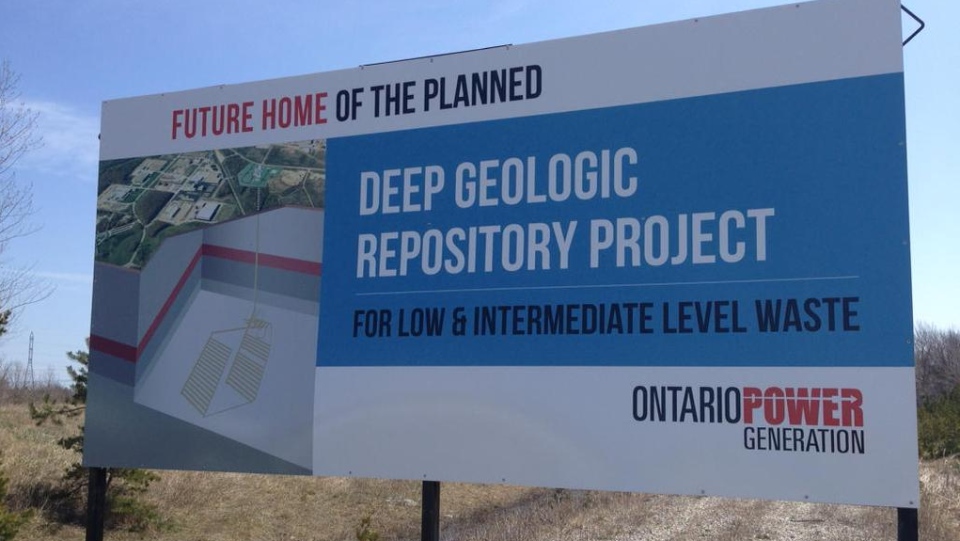
Members of the Saugeen Ojibway Nation (SON) have voted down plans to bury Ontario’s low- and intermediate-level nuclear waste within 1.2 kilometres of Lake Huron.

In 2013, Ontario Power Generation (OPG) said they wouldn’t build the $2.4 billion underground facility under the Bruce Power site without the SON’s approval.

On Friday,  1,232 members of the First Nation band voted. The vote results saw 1,058 ‘no’ votes, with 170 ‘yes’ and 4 spoiled ballots.

It means Canada’s first permanent nuclear waste facility will need to be built somewhere else in Ontario.

OPG will now have to start searching for a new host community to house over 200,000 cubic metres of low- and intermediate- level nuclear waste.

OPG says finding a new site may set the project back 20 to 30 years.

Concerns over the project’s proximity to Lake Huron ultimately doomed the nuclear waste plan.

Support for the project was strong in Bruce County, but largely panned around the Great Lakes, where over 200 municipal resolutions opposed the project.

Ontario Power Generation say while they are disapointed with the outcome of the vote, they respect S.O.N.’s decision and will not proceed with plans to build the storage facility in Saugeen Territory.

RELATED IMAGES


  • Nuclear waste DGRAn illustration shows the plan for a nuclear waste burial project on the Bruce Power site.

  • Nuclear waste burialA sign is visible at the site proposed to bury nuclear waste near Lake Huron, Ont., Wednesday, May 6, 2015. (Scott Miller / CTV London)

Indigenous Rights Challenged

What you need to know about the Coastal GasLink pipeline conflict

Dispute in Wet’suwet’en territory over natural gas line has high economic and political stakes

Wet’suwet’en hereditary chiefs from left, Rob Alfred, John Ridsdale and Antoinette Austin, who oppose the Coastal Gaslink pipeline, take part in a rally in Smithers, B.C., on Jan. 10. (Jason Franson/Canadian Press)

The conflict over a natural gas pipeline in northwestern British Columbia is the latest flashpoint between resource development and Indigenous rights and title in a province where large swaths of territory are not covered by any treaty.

At the centre of the conflict is a multi-billion dollar natural gas project — touted as the largest private sector investment in Canadian history — and an assertion by Wet’suwet’en hereditary chiefs that no pipelines can be built through their traditional territory without their consent.


Missing and Murdered Women

https://newsmaven.io/indiancountrytoday/news/striving-to-make-indigenous-women-girls-feel-safe-in-alaska-bMROecUEz0-uo4-yMFzg2g


MM

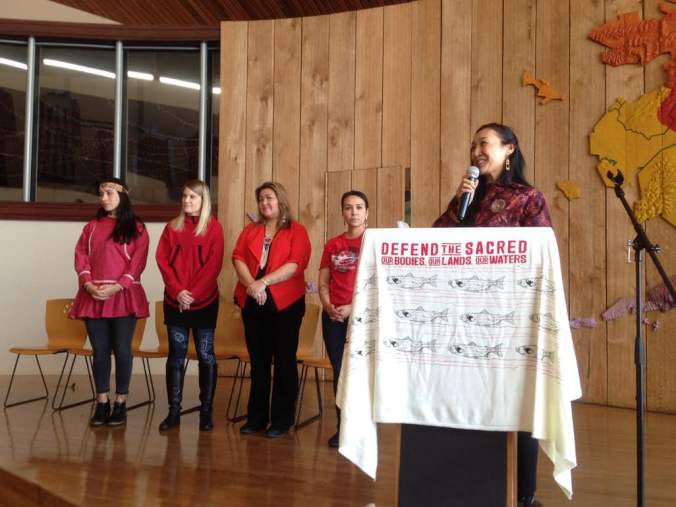
Organizers of the Vigil and Heartbeat of the Drums for Missing and Murdered Indigenous Women and Girls shown here left to right: Ruth Miller, Dena’ina Athabascan, Communications Organizer, Native Movement; Rochelle Adams, Athabascan, Indigenous Engagement Coordinator, Native Peoples Action; Kendra Kloster, Tlingit, Executive Director, Native Peoples Action; Charlene Akpik Apok, Inupiaq, Gender Justice and Healing Coordinator, Native Movement; Kelsey Wallace, Yup’ik, Communications Director, Native Peoples Action; and (not pictured), Emily Edenshaw, Executive Director, Alaska Native Heritage Center. (Photo by Joaqlin Estus)

edited

‘We face total negligence… when it comes to prosecuting attackers or murderers of our women’

As the names of more than 200 missing and murdered Indigenous women and girls were read, people listened in silence, many staring into space or at the carpeted floor of the Alaska Native Heritage Center in Anchorage. A few quietly wiped away tears. Healers burned braids of sweet grass and bunches of sage, waving the smoke onto the half-dozen men reading the names.

Charlene Akpik Apok, Inupiaq, director of gender justice and healing for the nonprofit community advocacy and training organization Native Movement, was emcee of the Vigil and Heartbeat of the Drums for Missing and Murdered Indigenous Women and Girls. She told the audience of more than a hundred people she had asked men to read the names to remember and honor allies in the fight against the loss of Indigenous women.”


Saving Lake Huron

https://www.counterpunch.org/2020/02/04/saugeen-ojibway-nation-has-saved-lake-huron-from-a-nuclear-waste-dump/

Photograph Source: Kevin M Klerks – CC BY 2.0Lake Huron

Saugeen Ojibway Nation Has Saved Lake Huron From a Nuclear Waste Dump

A major victory for Canada’s First Nations has just been won in Ontario. On January 31, the Saugeen Ojibway Nation (SON) overwhelmingly voted down the proposed deep geological repository (DGR) for storage of low- and intermediate-level radioactive nuclear waste next to Lake Huron. The DGR had long been proposed by Ontario Power Generation (OPG), but in 2013 OPG had committed to SON that it would not build the DGR without their support.