Wounded Knee

Lakota Law

Dear Renee,

51 years ago last week, my relatives powerfully announced themselves on the world stage. In response to the ongoing subjugation of our people, more than 200 Oglala Lakota and American Indian Movement (AIM) activists occupied the town of Wounded Knee, right down the road from me, here on the Pine Ridge Indian Reservation. You probably know some of what happened next. The armed standoff with federal government agents lasted more than two months, garnering regular coverage on the nightly news and waking people across the planet to our struggle in a new way.

Today, I encourage you to become more familiar with what this occupation meant at the time and explore its lasting legacy. Please read my article on Last Real Indians from a few years back and watch this video from my daughter, Lakota Law spokesperson and organizer Tokata Iron Eyes, who was on the ground (and horseback) for the anniversary last week.

Watch: Tokata talks Wounded Knee liberation.

More than 50 years after the fact, I still have questions — some similar to those my relatives must have asked at the time they rose up in 1973. How could the U.S. government expect traditional people to live under the conditions colonialism forced upon us? How could such treatment escape the accountability of the law, and how could we be expected to forgive it? And, now, as we continue to fight for basic things like clean water and meaningful input — and as we continue, too often, to question one another — what will be the legacy of AIM, and of our resistance decades later against the Dakota Access pipeline? 

Those are hard questions to answer, but I do know one thing. Without a doubt, the United States is responsible for all of it. This is how colonization works. An occupying force gains by instigating, arming, funding, and providing legal cover for murder. It gains by dividing and conquering. It gains land, minerals, and wealth. Our continued subjugation and our infighting are good for the colony. 

About two years after the occupation ended, on the very day that FBI agents Ronald Williams and Jack Coler were killed on the Jumping Bull compound (for which AIM activist Leonard Peltier was later falsely convicted), the Oglala Sioux Tribe signed over a huge chunk of land containing mineral deposits to the United States. Consider that colonizers often use diversionary tactics and counterinsurgency measures to lower the cost of extracting whatever minerals the corporations want — and to eliminate opposition.

In the 1970s, that opposition was coming domestically from hippies, Black nationalists, the Brown Berets, the Student Nonviolent Coordinating Committee, the Weathermen, AIM, the National Indian Youth Council, and so forth. America was still openly racist, people were dying, and BIPOC (Black/Indigenous/People of Color) had no choice but to take public stands to shed light and call attention to the conditions we faced, regularly enforced by a government that either didn’t care or wanted us gone.

Thus, in our lexicon, we say that AIM liberated Wounded Knee. We celebrate Feb. 27 as “Liberation Day.” To this day, we remember the liberators with pride — and we remember that we are always susceptible to manipulation by outside forces. That’s exactly why we rose up once again at Standing Rock in 2016. And while it’s troubling that we continue to have to make such stands, I also see reason for hope.

More and more Americans are beginning to understand that most of their elected leaders have little interest in defending our country from extractive and/or war-profiteering corporations. Many Americans find themselves on our side now; they see corporate encroachment invading every aspect of their lives. I’m grateful that you recognize we must celebrate liberation, celebrate a patriotism which defends sacred lands and waters — and, by extension, ourselves, our birthrights, and our constitutional rights.   

Wopila tanka — thank you for supporting Indigenous sovereignty!
Chase Iron Eyes
Director and Lead Counsel

Coalition Building

Lakota Law

You’ve heard from me a few times already this year about the importance of coalition building to achieve a new level of effectiveness — not just in our own work, but in the work my Indigenous relatives are undertaking at tribal nations across Turtle Island. To that end, today I share with you about a trip I took to spend a few days earlier this month with people I greatly respect at the Wind River Reservation in so-called Wyoming.

The seventh largest reservation in the U.S., the Wind River Nation encompasses more than 2 million acres of incredible wildlands, and it’s home to people from both Northern Arapaho and Eastern Shoshone tribes. I went to visit a few friends there, including Wes Martel, who you may remember from his keynote speech at the Great Plains Water Alliance’s Winter Water and Climate Conference, featured in our 20th Dakota Water Wars chapter. I also spent time with Jason Baldes, a central figure helping to return American Buffalo to Wind River and other tribal nations. I encourage you to watch “Homecoming,” a short documentary on PBS, about his wonderful work.

Watch: Buffalo return to Wind River in “Homecoming,” a PBS short documentary featuring the voice and good work of Jason Baldes.

To you, the inextricable link between Native people and buffalo is likely no mystery. Jason speaks to this eloquently in the documentary.“To restore that animal to our communities means that we can begin to heal,” he says. “From atrocities of the past, from loss of land, from loss of culture, loss of language. It’s foundational to who we are.”

That’s just one example of good Indigenous storytelling emanating from Wind River. While there, I also discovered the great music of Christian Wallowing Bull, a talented Northern Arapaho singer-songwriter featured in the new documentary film “Lone Wolf,” which premiered in California a few days ago. I then spoke with Dave Herring, the film’s director. I hope that you’ll watch their film and be as inspired by Christian’s story as I was. 

As you can see, we’re taking extra time this year to build connections with people, organizations, and tribal nations. In order to create a better society, it’s critical to advance not just our own priorities as Lakota People, but also those of all our relatives with their own traditional knowledge systems, art, and dreams. Between us, we’ve got much more in store to share with you. Stay tuned!

Wopila tanka — My continued thanks for supporting all Indigenous people, art, and culture.
Chase Iron Eyes
Director and Lead Counsel

The Lakota People’s Law Project

Let's Green CA!

Lakota People’s Law Project
547 South 7th Street #149
Bismarck, ND 58504-5859

Return of Land

Lakota Law

Greetings from Las Vegas, where I stopped to observe the mayhem of Super Bowl week. As my dad wrote to you a few days ago, we remain committed to changing the Kansas City Chiefs team name — and all racist characterizations of our people in the sports world. Also, I want to take a moment to say that because we are all human, and no matter how big our differences, I offer my sincere condolences to the Kansas City community in the wake of yet another instance of senseless gun violence. I pray for the day when we find better ways to listen to one another, discover common ground and understanding, and stop killing each other.

On a happier note, on my way to Vegas, I journeyed through some spectacular, sacred places. These included some of the Trail of the Ancients and traditional homelands of the Diné (Navajo) and Ute Peoples, including Monument Valley and Bears Ears National Monument — where something wonderful has occurred. I encourage you to watch my short video, recorded onsite, to hear about the recent gift of land back to Indigenous stewardship in Cottonwood Canyon.

Watch: I visited the sacred lands of the Ute and Diné Peoples to see Cottonwood Canyon and share with you about the importance of Landback efforts like the one in Cottonwood Canyon.

In many ways, the process undertaken with Cottonwood Canyon can serve as a model elsewhere across Turtle Island. A nonprofit organization bought available land and synched with a consortium of Native Peoples to preserve a beautiful place featuring rare views of spectacular rock formations and ancient dwelling sites. That’s something I dearly hope we can eventually replicate on a much larger scale with the Black Hills — but I’m also happy anytime we see the return of sacred lands to Indigenous care.

I’ll also say that the model isn’t perfect. Such transfers shouldn’t come with conditions. Isn’t the point of Native stewardship to respect our traditional knowledge systems regarding the land? So, while I appreciate the intent behind a condition of the transfer that will limit access to the site, I would also suggest that it shouldn’t be about eliminating human contact. Human beings should, in fact, have the opportunity to visit sacred places and relearn how to live in harmony with them, just as my relatives and ancestors have done for time immemorial. Even our allies can learn something here: please stop holding us to rules designed by colonizers.

In any case, a win is a win! Ultimately this gift will ensure that a special place displaying the ingenuity of our relatives’ ancestors and the vistas they loved will remain unspoiled for generations to come. And for that, I am truly grateful.

Wopila tanka — thank you for supporting landback efforts!
Tokata Iron Eyes
Spokesperson & Organizer
The Lakota People’s Law Project

Let's Green CA!

Lakota People’s Law Project
547 South 7th Street #149
Bismarck, ND 58504-5859

The Lakota People’s Law Project is part of the Romero Institute, a nonprofit 501(c)(3) law and policy center. All donations are tax-deductible.

Climate Alteration: Words Are Important

Global Warming: a very passive title to address a very lethal problem.
Example: It is getting a little warm outside, nothing to worry about.

Climate Change: a perfect setup to generate perfect rebukes.
Example: The climate is always changing. climate is just doing what climate has always done and human activity has nothing to do with it.

Climate Crisis: a very selective term. It is only a crisis for the people immediately affected. Also falls into the maligned category of ¨alarmist¨

The term I adopted:
Climate Alteration: A very pointed terminology to address the impact human activity is having on the global climate. Our activities are altering climate systems on a global scale causing extreme weather events. Yes, temperatures on average across the globe are rising and this disturbance is causing extreme temperatures (hot and cold) extreme drought, extreme flooding, and extreme storms. The rise in global temperature has upset the balance. This alteration has been building up slowly as the oceans absorbed most of the extra heat. But now, plain to see for everyone paying attention to weather-related news or looking out their own windows, extreme weather is pushing organisms and plants to extinction. Our crops are being destroyed. The range of many insects, birds, and animals has shifted.
Here on this thread are the thousands of articles, references, and comments that illustrate Climate Alteration. We have documented how some are being innovative in developing mitigation strategies. Some are also being manipulative and stupid and we are intelligent enough to research and decide for our communities what we need to do if our governments do not act.

As animals and plants are forced to shift their range because of extremes in weather, so do people.

Lakota Law

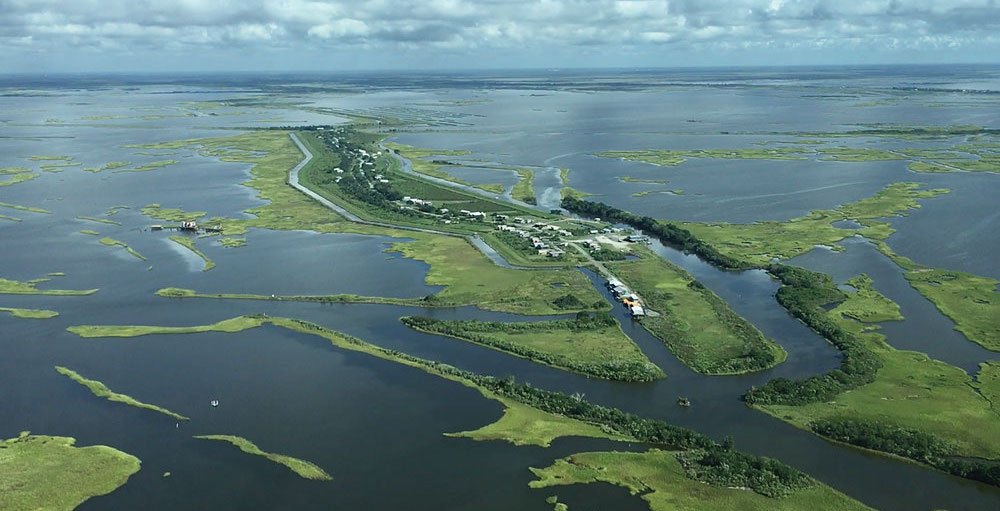
By now, you’re likely well aware of the climate crisis and its significant dangers to Indigenous communities the world over. The problem is especially magnified on islands and in coastal regions, where sea level rise can wipe away traditional homelands and make climate refugees of those who have been displaced. That’s true even right here on Turtle Island, where hundreds of Native communities — in South Dakota, Alaska, Florida, Hawai’i, Washington, and Louisiana — face existential threats.

And now, the first community to supposedly be moved from harm’s way — the Jean Charles Choctaw Nation — is facing a new set of problems. Just before the new year, the tribe filed a landmark civil rights complaint with the U.S. Department of Housing and Urban Development (HUD) against the state of Louisiana. In 2016, HUD granted Louisiana $48 million in aid to resettle the tribe. But, its complaint asserts, Louisiana failed to properly implement the grant and has ethnically and racially discriminated, violated tribal sovereignty, excluded cultural components central to a proper relocation program, and provided poor replacement housing.

The Jean Charles Chactaw Nation has always lived here, on the Isle de Jean Charles. The climate crisis and resultant rising sea levels have endangered the tribe’s homeland and forced many members to move to inadequate replacement housing in a new location. Photo credit: Chantel Comerdelle.

The Jean Charles Choctaw Nation has resided on the Isle de Jean Charles for five generations, since the ancestors of its citizens escaped the Trail of Tears in the early 1830s amid President Andrew Jackson’s Indian Removal Act. Its homelands and burial grounds are located in a region facing perpetual devastation and erosion by storms and sea level rise. Since 1955, the Jean Charles Choctaw Nation has lost over 98 percent of its lands to the encroaching ocean.

It’s also worth noting that the tribe is located in Terrebonne Parish, a region notorious for oil extraction, high pollution rates, and environmental justice violations. The Parish and over 90 percent of its property are largely controlled by non-local fossil fuel and chemical companies. The infamous “Cancer Alley” is just upstream.

Watch this short documentary detailing the tribe’s relocation.

By filing its complaint with HUD, the Jean Charles Choctaw Nation is looking to the federal agency to investigate the grant-funded resettlement program, currently run by Louisiana’s Office of Community Development (OCD). The tribe hopes HUD will order OCD to respect tribal needs and authority as the program’s implementation proceeds. 

The lawsuit is also significant in that, while the tribe has state recognition from Louisiana, it does not have federal recognition, which would extend access to more grants, disaster assistance, and various legal powers — including constitutional protections and self-governance recognized by the United States. Lakota Law will keep an eye on this case and report back to you. As always, we’re grateful to you for standing in solidarity with every community of color on the frontlines of environmental justice.

Wopila tanka — thank you for your unwavering dedication!
Chase Iron Eyes
Director and Lead Counsel

The Lakota People’s Law Project

Today: Special Screening

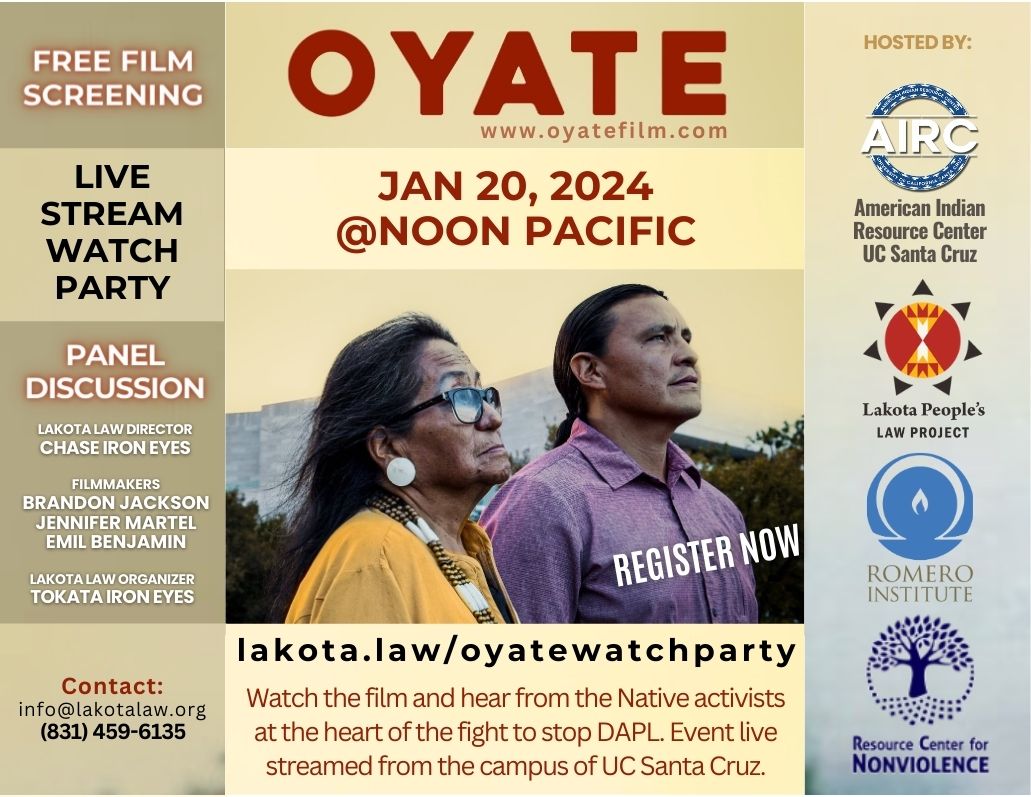
Oyate watch party at Noon Pacific Time on January 20th

Lakota Law

I’m looking forward to a new year working together for Native sovereignty and justice with you. It’s appropriate that our first 2024 event is gathering to watch a crucial film contextualizing the movement to stop the Dakota Access pipeline. You may have heard that we’ve joined with local Santa Cruz groups and the filmmakers of “Oyate” to host our in-person screening at UC Santa Cruz on Jan. 20 at noon PST, which will also be streamed online in real time!

To quickly update you, my daughter Tokata and I will present at the event, joined by the film’s producer/director and the two other producers. Please note that the event’s venue has been moved to the Merrill Center on the UC Santa Cruz campus, and we’ll stream all the festivities from there.

RSVP to join our worldwide watch party of “Oyate,” streaming online on Jan. 20.

Lakota Law

We’ll send you reminders with the link for your party to join our livestream. Look out for those the day before and on the morning of this very special event, Jan. 20!

“Oyate” elevates the voices of Indigenous activists, organizers, and politicians, offering our perspectives on our complicated history and present-day circumstances and illuminating the interconnectivity among the issues facing Indigenous People today. It features excellent music, tells some of our personal stories, and delves deeply into our movement for Native and environmental justice.

In the ongoing spirit of wopila — a meaningful acknowledgment of our gratitude and a desire to share the best of ourselves with you — we offer this opportunity to come together, watch, learn, and move forward with purpose. We thank UCSC, the American Indian Resource Center, and the Resource Center for Nonviolence for making this event possible, and we hope you’ll join us on Jan. 20!

Wopila tanka — thank you for your support and attention!
Chase Iron Eyes
Director and Lead Counsel
The Lakota People’s Law Project

The Water is Life Banner: A Look Back

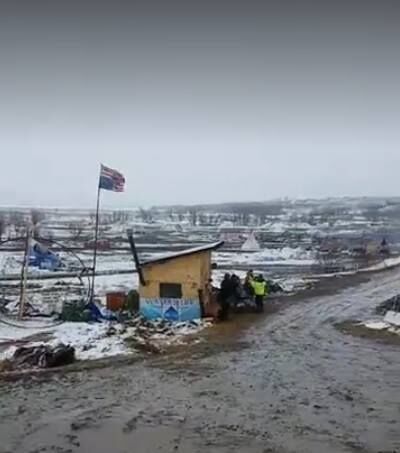
I did not even imagine that my trip to Standing Rock, North Dakota from Sacramento, California with a banner signed by members of the elementary school would end up on the front of the guard shack at the main entrance to the camp.

It is a story.

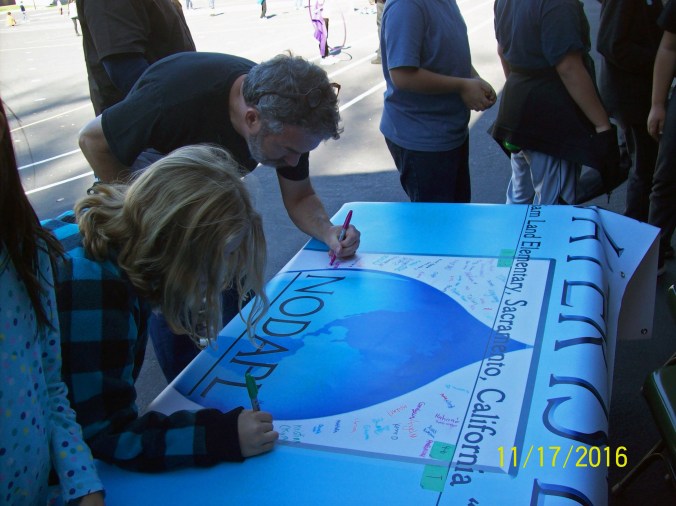
After watching the news of attacks on peaceful protestors and reading about the oil pipeline being rapidly approved, I felt that I must act. I designed a banner, had it printed, and scheduled a signing party at the elementary school where I taught. Everyone at William Land Elementary placed their signatures on the banner during the event on November 17, 2016.

When I arrived in Bismark, I had one mission. I needed to deliver the banner to the tribe.

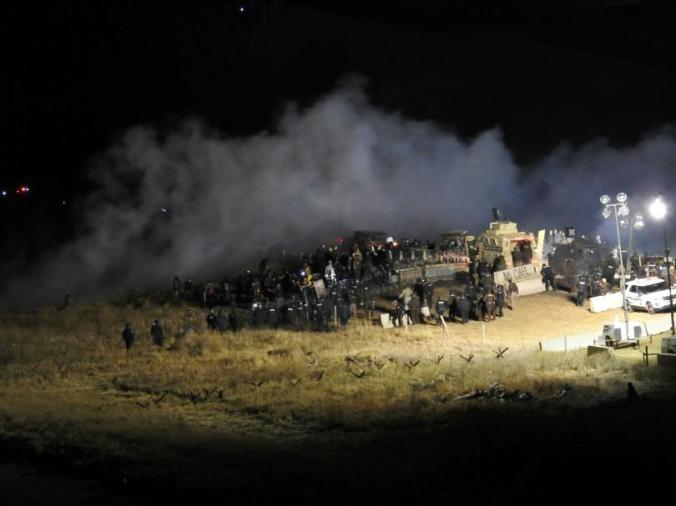
I was in contact with a woman on Facebook who said she had a friend who was on her way to Standing Rock. This friend, her name was Katie, was going to meet me at the hotel but was delayed. I met her instead at the main gate in Standing Rock. I witnessed the live feed of a major action against the water protectors the night before.

Katie (not her name) had a friend (Billy) come with us to pick up supplies from the Walmart in Bismarck. I found the guy to be very untrustworthy – he shoplifted a hat in Walmart. He did not seem to have the spirit of a person participating in prayer vigils or protest of an oil pipeline. I found Katie to also be very suspect. I thought they might be agents of some sort. I found out on our drive into town that they had already been in Standing Rock and had been involved in the action the night before. They were still coughing from the tear gas.

We delivered the supplies to the various tents at camp: medical, food, and school.

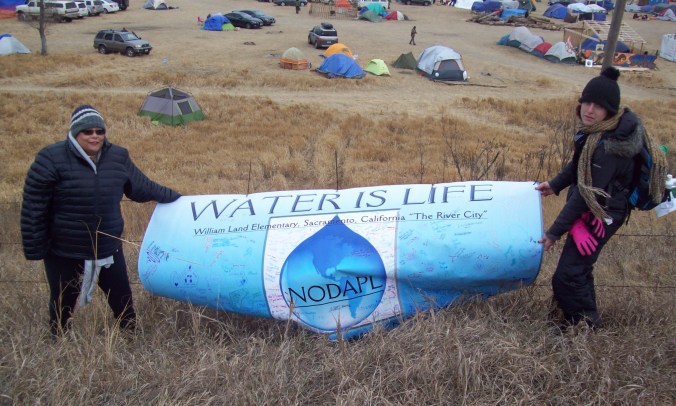
On the third day at Standing Rock, I was able to formally present the banner to the tribal chief. I had purchased tobacco in Bismarck to give as a gift first. Then I handed the chief the banner and asked him to accept it from all the signatories in Sacramento. He accepted it and told me that I had permission to hang it at the front gate. There were hundreds of banners from around the world and around the country in the camp. Each had to get permission from the tribal council to be hung. I was very lucky to get to hang ours on the front gate near the main entrance. In the video it is fleetingly visible, the third banner to the left of the large EnbridgeLies banner.

Unknown water protector, Katie, and Billy with the banner.
Me and Katie with the banner.

I felt I was supposed to be there. None of the staff of my school had even heard about what was happening at Standing Rock. The mainstream media was not covering what was happening. Here I was, able to deliver a signed banner all the way from California to Bismarck, North Dakota!

I found out from Katie that Billy was kicked out of camp for not complying with camp rules.

On the day I left Standing Rock, I heard that people were told to evacuate the camp. I worried about the banner and I called and asked Katie to take it down and send it to the tribal offices on the reservation. She told me that she found two guys who would deliver it because she was on her way out of the camp also.

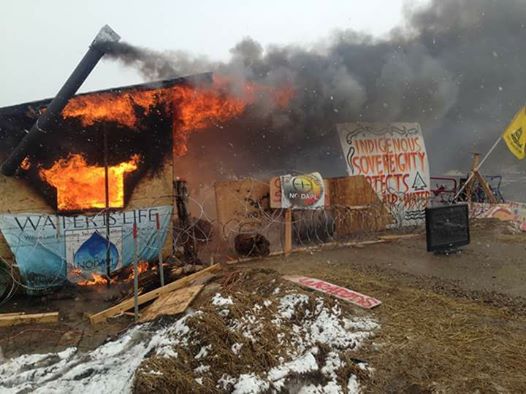
Katie sent me this photo. But instead of delivering the banner to the reservation, they hung it in front of the guard shack! I can only speculate that they put it there temporarily and that it would be taken to the reservation later. I did not know of the ritual burning of everything in the camp as it was evacuated. I left on the 28th.

So, by the time I got back to Sacramento, imagine my shock to see images of our school banner being burned up!

William Land Elementary School in Sacramento, California is forever part of history.

Massacre of Wounded Knee

Opinion

Poisonous Words and the Massacre of Wounded Knee

Levi Rickert

Thu, December 28, 2023 at 11:01 PM CST·3 min read

430

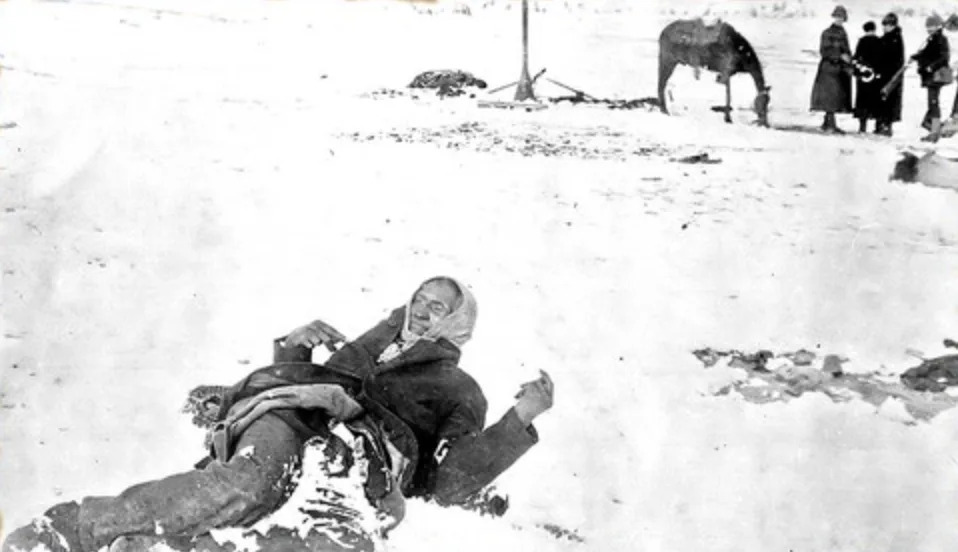
An iconic photo of Big Foot left frozen from the 1890 massacre at Wounded Knee of a dead and frozen Big Foot. (Photo/Public Domain)

An iconic photo of Big Foot left frozen from the 1890 massacre at Wounded Knee of a dead and frozen Big Foot. (Photo/Public Domain)

Opinion. Today marks the 133rd anniversary of the Massacre of Wounded Knee during the wintry week between Christmas and New Years back in 1890.

Nine days before the massacre that left hundreds of Sioux men, women, and children dead, an obscure weekly newspaper in South Dakota ran an editorial about the death of the Hunkpapa Lakota leader Sitting Bull. In the opinion piece, L. Frank Baum, publisher of the Saturday Pioneer, wrote:

“The Whites, by law of conquest, by justice of civilization, are masters of the American continent, and the best safety of the frontier settlements will be secured by the total annihilation of the few remaining Indians. Why not annihilation? Their glory has fled.”

Early in the morning on Dec. 29, 1890, across the state of South Dakota at Wounded Knee Creek, the Sioux, who were captured the previous afternoon by members of the US 7th Cavalry Regiment, were surrendering their weapons. A shot was fired. The Calvary proceeded to shoot unarmed and innocent Sioux elders, women, and children. While an accurate account will never be known, it is believed between 250 and 300 Sioux were massacred that day.

Snowfall was heavy that December week. The Sioux ancestors killed that day were left on the frigid wintery plains of the reservation before a burial party came to bury them in one mass grave.

Never miss Indian Country’s biggest stories and breaking news. Click here to sign up to get our reporting sent straight to your inbox every weekday morning.

After the mass killing of Natives, Baum picked up his poisonous pen again and wrote another editorial for his Saturday Pioneer newspaper. This time, he wrote:

“The Pioneer has before declared that our only safety depends upon the total extirmination [sic] of the Indians. Having wronged them for centuries we had better, in order to protect our civilization, follow it up by one more wrong and wipe these untamed and untamable creatures from the face of the earth. In this lies future safety for our settlers and the soldiers who are under incompetent commands. Otherwise, we may expect future years to be as full of trouble with the redskins as those have been in the past.”

Ten years later, Braum wrote a children’s book called The Wonderful Wizard of Oz. Yes, that one. It was eventually made into one of the most famous movies of all time. When I was a youth, my siblings and I would make popcorn and sit and watch the movie when it was broadcast yearly. As an adult, I discovered Baum’s hatred and poisonous racism towards Native Americans. Suffice it to say, I stopped watching the film.

Now, I realize Braum did not single-handedly cause the genocide of Native Americans. But, he contributed to it with his editorials and his calls for the extermination of Native people. His family later apologized for Baum’s racist editorials.

This is why history matters. If you know your history, you know your place in this world.

In recent weeks, the Republican presidential front-runner, former president Donald Trump, has stated in his stump speech that immigrants entering the U.S. illegally are “poisoning the blood of our country.” There has been pushback that Trump borrowed the line from Adolf Hitler’s rhetoric in his autobiographical manifesto Mein Kampf, which set the principles behind Nazi Germany’s genocide of more than six million Jews.

Trump denies reading the book. I don’t doubt his claim because he is known for not being a reader. But I’m guessing that some of his speech writers and political advisers may have — and they certainly play a role in the words that come out of candidate Trump’s mouth.

I suspect most Americans don’t subscribe to the belief that immigrants are poisoning the blood of our country.

I also believe that most Americans would agree that racism has been a true poison in our country throughout the last two centuries, though it’s not something we’ve been able to eradicate.

That’s why it’s important we remember the Massacre of Wounded Knee, as well as the rhetoric and words used to justify it. Because it’s a potent reminder of what racism has led to in this country: the death of innocent Native people whose ancestors lived on this land since time immemorial.

Thayék gde nwéndëmen – We are all related.

About the Author: “Levi \”Calm Before the Storm\” Rickert (Prairie Band Potawatomi Nation) is the founder, publisher and editor of Native News Online. Rickert was awarded Best Column 2021 Native Media Award for the print\/online category by the Native American Journalists Association. He serves on the advisory board of the Multicultural Media Correspondents Association. He can be reached at levi@nativenewsonline.net.”

Contact: levi@nativenewsonline.net

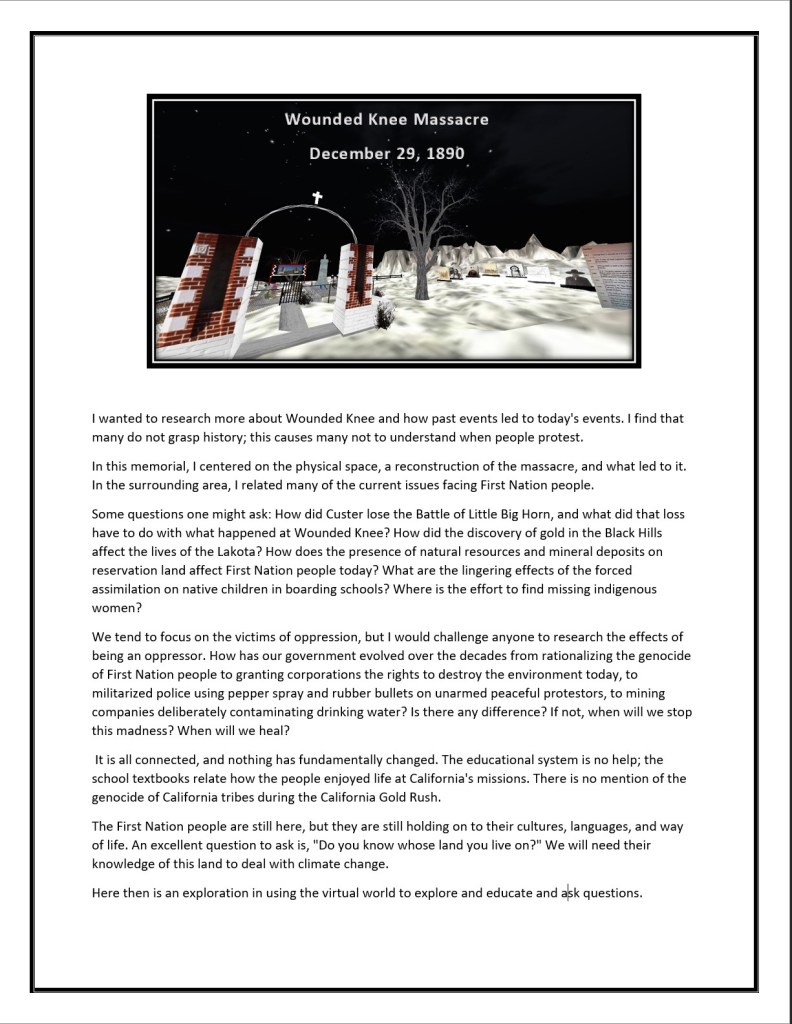
Wounded Knee Massacre December 29, 1890  
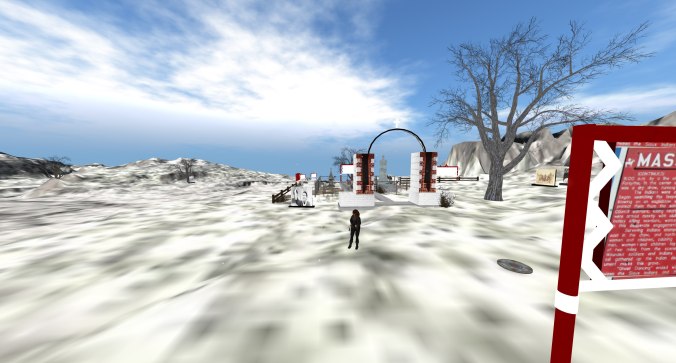
by Renee Michel 2020 Second Life Virtual Wounded Knee Memorial

I wanted to research more about Wounded Knee and how past events led to today’s events. I find that many do not grasp history; this causes many not to understand when people protest.

In this memorial, I centered on the physical space, a reconstruction of the massacre, and what led to it. In the surrounding area, I related many of the current issues facing First Nation people.

Some questions one might ask: How did Custer lose the Battle of Little Big Horn, and what did that loss have to do with what happened at Wounded Knee? How did the discovery of gold in the Black Hills affect the lives of the Lakota? How does the presence of natural resources and mineral deposits on reservation land affect First Nation people today? What are the lingering effects of the forced assimilation on native children in boarding schools? Where is the effort to find missing indigenous women?

We tend to focus on the victims of oppression, but I would challenge anyone to research the effects of being an oppressor. How has our government evolved over the decades from rationalizing the genocide of First Nation people to granting corporations the rights to destroy the environment today, to militarized police using pepper spray and rubber bullets on unarmed peaceful protestors, to mining companies deliberately contaminating drinking water? Is there any difference? If not, when will we stop this madness? When will we heal?

 It is all connected, and nothing has fundamentally changed. The educational system is no help; the school textbooks relate how the people enjoyed life at California’s missions. There is no mention of the genocide of California tribes during the California Gold Rush.

The First Nation people are still here, but they are still holding on to their cultures, languages, and way of life. An excellent question to ask is, “Do you know whose land you live on?” We will need their knowledge of this land to deal with climate change.

Why the Current Paradigm Does Not Work

“A lot of people from American society don’t understand our connection, our intergenerational connection, and how deep it runs within us to the land and the Earth,” Logan said.

Logan described a thanksgiving speech, or Ganö:nyök, that the Seneca recite to recognize the natural world around them.

“We start at the Earth and we go all the way up to the sky, to the creator, and it covers everything from the water, the plants, food, medicine, trees, birds, animals, everything in the natural environment,” Logan said. “If any one of those things goes away, eventually we will perish.”

https://insideclimatenews.org/news/22112023/new-york-clean-hydrogen-indigenous-nation-sees-threat/

Creating sustainable energy does not mitigate the problem.
I used to get into these tremendous arguments with my father about progress.
To summarize my stance: I used to take the bus because I did not have a car. I suffered through strange men groping me, people smoking, waiting in the rain for late busses, limiting my shopping because I could not carry a lot of stuff. It was sometimes unbearable.
I was able to buy a car and at first, it was incredible. I had freedom! I had safety! It was convenient and I could go shopping in many places and load everything in the trunk!

But then one rainy day I drove by a crowded bus stop and realized all I had done was trade some problems for other problems. I now had a vehicle in which I had a traffic accident: someone ran into me and the car had to be repaired. I could get parking tickets so I always had to hunt around for parking space, and in some places, I had to pay for parking. I had insurance to pay, and I had to spend my Sundays washing the car. I had maintenance and car repairs. Instead of a monthly bus pass, I now had a car loan to pay off. I had a driver’s license to renew at the DMV. I had a yearly car registration to renew. I had to have a car inspection to get the registration renewed. I worried about someone trying to steal the car, so I bought an expensive car alarm system. Instead of being able to dose off when riding in the bus, I had to stay alert at all times when driving the car. I now got stuck in traffic jams on the freeway and ended up taking a longer time to get home from work than if I had taken the bus!
When I added it up, I actually had more problems than when I rode the bus.

Energy is not created or destroyed – it just changes form.

https://energyeducation.ca/encyclopedia/Law_of_conservation_of_energy

IMHO

I think this law applies to everything we do. There is no such thing as progress. We just change out one set of actions for another, one set of problems for another. We are not getting anywhere from where we started. We are making things worse.

We used to know how to make the things we needed, but now we are dependent on people and systems for everything.

We used to be able to drink water from the rivers and fish/hunt for our food.
Now we use self-checkout at stores that sell us contaminated and processed unnutritious food.

We used to work in our fields growing the food from sun up to sundown.
Now we sit in cars in traffic for hours to get to work and then back home so we can afford a gym membership to try and stay fit.

We used to sit on our front porches on hot summer evenings because we had no air conditioning and would talk to our neighbors to get the daily gossip.
Now we are isolated in air-conditioned homes with security systems behind locked doors.

So, back to the article I cited. Little has changed in relation to the land and indigenous people. They have a pristine forest with old-growth trees. How are they able to still live there and the land has not been destroyed? – that is the big question.

We are clearly missing some knowledge.
We come along and want to build a potentially polluting ¨Green¨ plant right next to their land because, you know, progress.

We live an unsustainable, nonregenerative lifestyle. That is why their forest is beautiful and all the other land is polluted, exploited, and dead.

11/14 – Seven Years After My Visit to Standing Rock

Standing Rock: What is happening now…

https://www.sierraclub.org/sierra/new-hope-shutting-down-dakota-access-pipeline

A New Hope for Shutting Down the Dakota Access Pipeline

An unusual, after-construction public comment period opens the door for correcting a grave mistake

By Juliet Grable November 14, 2023

Reckless development proposals such as mines, mega-dams, and oil pipelines have a way of coming back from the dead. The controversial Keystone XL pipeline is a recent and classic example: a zombie project that just wouldn’t die. Now, in North Dakota, environmental groups and Native American tribes are seizing on a rare opportunity to shut down a fossil fuel project that’s already up and running—the fiercely fought Dakota Access Pipeline. 

Earlier this month, tribal members and environmentalists gathered in Bismarck, North Dakota, to give public testimony on the draft environmental impact statement for a critical section of the Dakota Access Pipeline. Before the hearing, activists who had traveled by bus from the Twin Cities rallied on the sidewalk with members of the Cheyenne River and Standing Rock Sioux Tribes, which for years have led opposition to the oil pipeline. 

https://apnews.com/article/dakota-access-pipeline-north-dakota-standing-rock-f808b5a63ecfc1f89c7dd38c4ae59e04

Format of public comment meetings for Dakota Access oil pipeline upsets opponents

Updated 11:28 AM CST, November 2, 2023

BISMARCK, N.D. (AP) — Opponents of the Dakota Access oil pipeline are taking issue with the format of private oral testimony in meetings for public comment on a draft environmental review of the controversial pipeline.

The U.S. Army Corps of Engineers is in the midst of two public comment meetings in Bismarck, North Dakota, the first held Wednesday, the second set for Thursday. People wishing to give testimony may do so orally in a curtained area with a stenographer, or do so in writing at tables.

The Standing Rock Sioux Tribe has long opposed the pipeline due to the risk of an oil spill contaminating the tribe’s drinking water supply. The four-state pipeline crosses under the Missouri River just upstream of the tribe’s reservation.

The long-awaited draft environmental review, released in September, outlines five options for the pipeline’s fate. Those include denying the easement for the controversial crossing and removing or abandoning a 7,500-foot (2,286-meter) segment, or granting the easement with no changes or with additional safety measures. A fifth option is to reroute the pipeline north of Bismarck, which would require new state, local and federal permits.

https://www.npr.org/2023/09/08/1198492185/dakota-access-pipeline-river-crossing-environmental-review

Future of controversial Dakota Access pipeline’s river crossing remains unclear

September 8, 20233:14 PM ET By The Associated Press

BISMARCK, N.D. — Federal officials on Friday released a draft environmental review of the Dakota Access oil pipeline, but said they’re waiting for more input before deciding the future of the line’s controversial river crossing in North Dakota.

The draft was released over three years after a federal judge ordered the environmental review and revoked the permit for the Missouri River crossing, upstream of the Standing Rock Sioux Tribe’s reservation. The tribe is concerned a pipeline oil spill could contaminate its water supply.

They Almost Made the Step in the Right Direction…Almost

Lakota Law

Over this last weekend, as news channels and social media were inundated with tragic reports out of Gaza, Australia’s electorate voted down a key referendum of vital concern to Indigenous Peoples the world over. The referendum would have created a national advisory board to counsel parliament on Indigenous issues, but 60 percent of the Australian electorate rejected what could have been an important advancement for Indigenous representation at the highest levels of government.

The board was proposed to include Indigenous representatives from Australia’s six states and two territories. Each would have been voted in by local Indigenous community member-electors. A majority of Indigenous voters polled supported the proposal, and although the board would have “non-binding advice” on issues affecting Indigenous Australians, many saw it as a step in the right direction toward reconciliation.

Australian Prime Minister Anthony Albanese and Minister for Indigenous Australians Linda Burney deliver a statement on the outcome of the Voice Referendum at Parliament House in Canberra, Australia October 14, 2023. AAP Image/Lukas Coch via REUTERS

The referendum, supported by the Prime Minister and Indigenous leaders, nevertheless faced opposition from both sides. Some Indigenous Australians and allies saw its goals as insufficient. Grassroots Indigenous sovereignty activists have said they want more significant reconciliation efforts, such as a formal treaty. On the conservative side of the fence, many Australians’ no votes seem to indicate they care little about following a path of truth, justice, and healing in regards to the nation’s Indigenous citizens, who comprise nearly 4 percent of the country’s population of 26 million.

Let me be clear with you: Aboriginal Peoples of Australia and Indigenous Peoples of the Americas share a collective experience of genocide and exploitation at the hands of settler-colonial interests. We both have resisted, gradually carving out a space to practice our cultures and exercise sovereignty. On Turtle Island, we at least have had the benefit of treaties (though, as you probably know, the U.S. government has never been known for honoring them). British settlers never even gave lip service to the Aboriginal Peoples of Australia, which is one reason any advancement in their status (the Australian Constitution fails to even recognize their existence) would have been welcome.

Indigenous Australians weren’t even allowed to vote until 1962, and the Australian state’s genocidal policies have repeatedly targeted them. Throughout the 1800s, they faced an onslaught of settler violence and dispossession of their homelands — a period parallel to the “manifest destiny” era here on Turtle Island. Continuing through the 1900s, Christian and white supremacist institutions such as boarding schools, missions, reservations, and corrupt child welfare systems abused Aboriginal children and families. I urge you to read more about the “Stolen Generations,” Indigenous children removed from their homes by the Australian government and other institutions in an attempt to eliminate the nation’s Indigenous population.
 
I may hail from the Standing Rock Sioux Tribe, but I have spent my life advocating for the rights and humanity of Indigenous Peoples on the international stage. While one failed referendum might seem insignificant when placed along the Australian state’s lengthy timeline of violence and dispossession of Indigenous Peoples, it is nevertheless a crucial marker of a settler-colonial society’s inability to take accountability and respectfully listen to Indigenous voices. I stand with my Indigenous relatives on the Australian continent, and I call on you to join me. Let’s show solidarity with all Indigenous people in their various struggles against settler-colonialism and genocide.

Wopila tanka — my gratitude to you.
Phyllis Young
Standing Rock Organizer
The Lakota People’s Law Project