When I was a little girl, I lived in paradise. I would roam out from my family’s cabin along the banks of the Mni Sose — the Missouri River — and drink straight from her waters. Around our allotment, the Standing Rock Nation was home to one of the most glorious forests on Turtle Island. Our gardens had every fruit tree you could want, and berries to nourish our growing bodies and souls. We were healthy in that place. Our homelands and the river provided for us — and then everything changed.
Before I tell you the rest of the story, I want to share a new video that Lakota Law has produced for the Standing Rock Sioux Tribe. The second chapter in our “Water Wars” series, it follows the first video, which highlighted the uniting of tribes from across the Oceti Sakowin to stop the Dakota Access pipeline (DAPL). This installment gives you more background and history, detailing the U.S. government’s refusal to honor the treaties that should preserve and protect our homelands.
Watch: In the new video we produced for Standing Rock, I address other leaders from across the Oceti Sakowin to inspire #NoDAPL action.
What happened to the paradise of my youth? In 1958, I was ten years old when the government completed construction of the Oahe Dam and flooded my home to create Lake Oahe. That same lake now provides our tribe’s drinking water, and it’s under that precious resource that DAPL dangerously crosses — without an adequate leak detection system — threatening to devastate our lives once again.
After the flood, for several years, we children lived on white bread, bologna, and hard cheese. We developed vitamin deficiencies and sores on our hands. We no longer had cherries, plums, grapes, wild onions, and all the things that came from the land. We could no longer find many of the medicinal plants that used to grow wild and abundantly in the riverbed and forest. No more could we collect the mushrooms we called “ears of the tree.” When they flooded our homelands — some of the richest in the world — it was an act of pure cruelty. They took our land and the food we grew up on, and they replaced it all with a welfare state.
This was, of course, illegal under both our Indigenous laws and those of the United States. The Fort Laramie Treaties of 1851 and 1868 guaranteed that we would retain our sacred He Sapa, the Black Hills, forever. Those treaties and subsequent agreements also protected 14 million acres in North Dakota. Today, we call these “taken lands,” the spoils of manifest destiny and the dam’s construction.
That’s why we fight. DAPL is only the latest in a long line of projects meant to benefit the colonizer without regard for the original peoples of this land. But with your help, we’ll resist, we’ll sue, we’ll work to replace fossil fuels with Native-run renewable projects, and we’ll use the media to make ourselves heard. And when, at last, our lands are returned, our sacred sites respected, and our treaties honored, I will invite you to come sing with us. Because, despite everything, I still believe we can restore justice together.
Wopila tanka — thank you for standing with Standing Rock and Lakota Law. Phyllis Young Standing Rock Organizer The Lakota People’s Law Project
For generations, the He Sapa (Black Hills) have been revered by the Oceti Sakowin as sacred grounds. As Indigenous Peoples, we are the original stewards of this land, and we have never relinquished that right. That’s why it’s so important for us to take a stand against harmful extraction in our homelands — like the mining interests currently tearing up and poisoning the He Sapa.
Click the pic to read our blog, then please take action to protect the Black Hills!
Over the past weeks, I’ve been working closely with the good people of the Black Hills Clean Water Alliance to understand and help communicate the scope and urgency of the mining problem in the Black Hills. We collaborated to create a blog for you to read, which explains the situation in more detail, and the action you can take to convince Secretary Haaland and the U.S. Department of the Interior to intervene.
At present, 184,000 acres of mining claims litter the Black Hills, covering 15 percent of our sacred grounds, and water system contamination caused by mining represents the greatest threat to the area. And, of course, the mining companies routinely walk away after tearing up the land and contaminating the water, leaving waste behind — forcing taxpayers to cover the clean up costs.
It’s long past time to return the sacred by honoring treaty rights with Indigenous nations and treating Unci Maka — our grandmother Earth — with utmost respect. So, please read our blog and then take action to protect the He Sapa. You can help make a huge difference for our homelands and our people.
Wopila tanka — thank you for your action and care! DeCora Hawk Field Organizer The Lakota People’s Law Project
Lakota People’s Law Project 547 South 7th Street #149 Bismarck, ND 58504-5859
The Lakota People’s Law Project is part of the Romero Institute, a nonprofit 501(c)(3) law and policy center. All donations are tax-deductible.
We remain 100 percent focused on our ongoing fight to end the Dakota Access pipeline (DAPL), despite the turmoil in the world around us. As you’ll see in a new video we co-produced with Standing Rock, a strong coalition among South Dakota’s tribal nations has formed to get it done.
Watch on Standing Rock’s Vimeo page: Standing Rock Chair Janet Alkire is joined by leaders from across the Oceti Sakowin to coordinate the current #NoDAPL strategy.
In the video, you’ll hear from Standing Rock Sioux Tribe Chairwoman Janet Alkire, Oglala Sioux Tribe President Kevin Killer, and Cheyenne River Sioux Tribe Chairman Harold Frazier. It’s the first in a planned series that will delve more deeply into the complex issues faced by the tribes in their fight to stop DAPL — a pipeline which continues to operate without a permit for its crossing under Lake Oahe just north of the Standing Rock Nation.
Chairwoman Alkire has been actively relaying tribal concerns directly to Michael Connor, Assistant Secretary of the Army for Civil Works. She recently returned from a meeting with him, in which she discussed the lack of transparency concerning DAPL’s oil spill response plan for the Missouri River and the terrible safety track record of its parent company, Energy Transfer. As detailed in a press release from the tribe, over a recent 8-year period, nine pipelines owned and controlled by Energy Transfer and its affiliated companies experienced nearly 300 spills — including 50 large ones in vulnerable areas like Lake Oahe.
Until this pipeline has a valid Environmental Impact Statement and federal permit, it is operating in violation of the laws designed to safeguard our people, our delicate water systems, and our sacred homelands. We must keep the pressure on U.S. leaders to do the right thing and shut DAPL down. Please watch our video, stay tuned for the next chapters, and be ready when the time comes to take action together.
Wopila tanka — thank you for standing with Standing Rock and the entire Oceti Sakowin! Chase Iron Eyes Co-Director and Lead Counsel Lakota People’s Law Project
Lakota People’s Law Project 547 South 7th Street #149 Bismarck, ND 58504-5859
The Lakota People’s Law Project is part of the Romero Institute, a nonprofit 501(c)(3) law and policy center. All donations are tax-deductible.
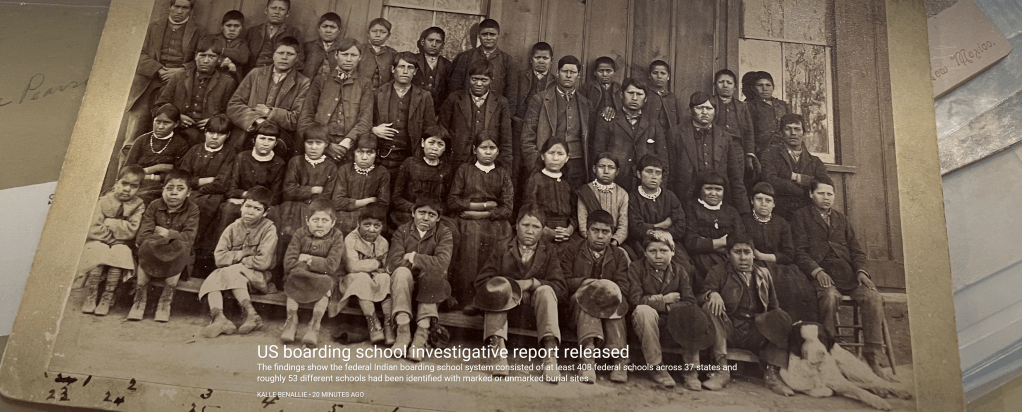
This July 8, 2021 image of a photograph archived at the Center for Southwest Research at the University of New Mexico in Albuquerque, New Mexico, shows a group of Indigenous students who attended the Ramona Industrial School in Santa Fe. The late 19th century image is among many in the Horatio Oliver Ladd Photograph Collection that are related to the boarding school. (AP Photo/Susan Montoya Bryan)
The U.S. Department of Interior released its investigative report Wednesday on the Federal Indian Boarding School Initiative. It’s being called the first volume of the report and comes nearly a year after the department announced a “comprehensive” review.
Deb Haaland, Interior secretary, Bryan Newland, assistant secretary for Indian Affairs, and Deborah Parker, chief executive officer of the National Native American Boarding School Healing Coalition were scheduled to speak at a news conference in Washington announcing the report’s findings.
“The consequences of federal Indian boarding school policies—including the intergenerational trauma caused by the family separation and cultural eradication inflicted upon generations of children as young as 4 years old — are heartbreaking and undeniable,” Haaland said in a statement. “We continue to see the evidence of this attempt to forcibly assimilate Indigenous people in the disparities that communities face. It is my priority to not only give voice to the survivors and descendants of federal Indian boarding school policies, but also to address the lasting legacies of these policies so Indigenous Peoples can continue to grow and heal.”
Newland led the over 100-page report, which includes historical records of boarding school locations and their names, and the first official list of burial sites.
The findings show from 1819 to 1969, the federal Indian boarding school system consisted of 408 federal schools across 37 states, some territories at that time, including 21 schools in Alaska and seven schools in Hawai’i. Some of these schools operated across multiple sites. The list includes religious mission schools that received federal support, however, government funding streams were complex therefore, all religious schools receiving federal, Indian trust and treaty funds are likely not included. The final list of Indian boarding schools will surely grow as the investigation continues. For instance, the number of Catholic Indian boarding schools receiving direct funding alone is at least 113 according to records at the Bureau of Catholic Indian Missions.
Approximately 53 different schools had been identified with marked or unmarked burial sites. The department expects the number to increase as the investigation continues.
FILE. Interior Secretary Deb Haaland visits the Grand Junction Air Center Complex on Friday to discuss her agency’s response to wildfires and the Bureau of Land Management headquarters move to Grand Junction on Friday, July 23, 2021, in Grand Junction, Colo. (McKenzie Lange/The Grand Junction Daily Sentinel via AP)
In June 2021, Haaland announced an Interior investigation in federal Indian boarding schools to make “a comprehensive review of the troubled legacy of federal boarding school policies” from as early as the 19th century.
She said the initiative was created after the discovery of 215 unmarked graves of Indigenous children by Canada’s Tk’emlúps te Secwépemc First Nation at the Kamloops Indian Residential School in May 2021.
The first volume of the report highlights some of the harsh conditions children endured at the schools. Children’s Indigenous names were changed to English names; children’s hair were cut; the use of their Native languages, religions and cultural practices were discouraged or prevented; and the children were organized into units to perform military drills.
The report cites findings from the 1928 Meriam report in which the Interior acknowledged “frankly and unequivocally that the provisions for the care of Indian children in boarding schools are grossly inadequate.
Examples included descriptions of accommodations at select boarding schools such as the White Earth Boarding school in Minnesota where two children slept in one bed, the Kickapoo Boarding School in Kansas where three children shared a bed and the Rainy Mountain Boarding School in Oklahoma where, “single beds pushed together so closely to preclude passage between them and each bed has two or more occupants.”
The 1969 Kennedy Report, cited in the Department investigation, noted that rampant physical, sexual and emotional abuse: disease; malnourishment; overcrowding,; and lack of health care at Indian boarding schools are well-documented.
It also found schools focused on “manual labor and vocational skills that left American Indian, Alaska Native, and Native Hawaiian graduates with employment options often irrelevant to the industrial U.S. economy, further disrupting Tribal economies.”
Federal boarding schools first started with the Indian Civilization Act of 1819 when the government enacted laws and policies to establish and support Indian boarding schools. For more than 150 years, Indigenous children were taken from their communities and forced into boarding schools that focused on assimilation. An unknown number of religious Indian boarding schools, funded by private and government funds, predate the Civilization Act by at least 100 years.
In a major finding, the report documents the use of tribal trust and treaty funds for the federal boarding school system as well as mission schools operated by religious institutions and organizations. Although the total amount of these funds used to directly fund schools is unknown, according to an investigation by Indian Country Today, more than $30 million in today’s dollars were siphoned away during a nine year period by Catholic schools alone.
The U.S. also set apart tracts of Native lands for use by religious institutions and organizations. According to an ongoing investigation by Indian Country Today, a large portion of this land may still be held by churches.
Indeed, the relationship between major religious denominations and the federal government regarding Indian mission schools is described as “an unprecedented delegation of power to church bodies that were given the right to nominate new agents, direct educational and other activities on the reservations.
Members of the Sicangu Youth Council help provide a formal burial at the Rosebud Indian Reservation on July 17, 2021, for some of the nine Rosebud students who died at Carlisle Indian Industrial School in the 1880s. The children’s remains were finally returned to their homelands after 140 years, wrapped in a buffalo robe bundle and placed in a cedar box. Earth collected at the Carlisle graves were added to the children’s final resting places. (Photo by Vi Waln for Indian Country Today)
Although the report makes little mention of accountability for religious organizations that operated boarding schools, it does indicate that non-federal entities will be given support in releasing their records associated with the schools.
As part of the initiative and in response to recommendations from the report, Haaland announced the launch of “The Road to Healing” year-long tour. It’ll consist of a tour across the country to allow boarding school survivors to share their stories, help connect communities with trauma-informed support and to gather a permanent oral history.
The report also points to the 2019 watershed Running Bear studies, funded by the National Institute of Health. This research contains the first medical studies to systematically and quantitatively show that the Indian boarding school system experience continues to impact the present day health of adult boarding school survivors.
Newland cited the need for more investigation because of the COVID-19 pandemic and its resulting closures of federal facilities that affected obtaining and reviewing documents and the department’s limited funds at that time.
The second volume will be aided by a $7 million investment from Congress through fiscal year 2022. Newland recommended for it to include a list of marked and unmarked burial sites at federal Indian boarding schools — with names, ages, tribal affiliations of the children at those locations — an approximation of the total amount of federal funding used to support the boarding school system and to further probe the impacts on Indigenous communities.
“This report presents the opportunity for us to reorient federal policies to support the revitalization of Tribal languages and cultural practices to counteract nearly two centuries of federal policies aimed at their destruction,” Newland said in a statement. “Together, we can help begin a healing process for Indian Country, the Native Hawaiian Community and across the United States, from the Alaskan tundra to the Florida everglades, and everywhere in between.”
Opportunity to submit stories
On Thursday, members of Congress are holding a hearing at 1 p.m. ET, for the bill “Truth and Healing Commission on Indian Boarding School Policies in the US.” Rep. Sharice Davids, Ho-Chunk, is the lead sponsor of the bill.
The National Boarding School Healing Coalition is requesting people who attended a boarding school or are a descendent of a boarding school attendee to submit their written testimonies to the House of Natural Resources Committee by May 26. Email submissions to HNRCDocs@mail.house.gov and CC NABS at info@nabshc.org.
The National Boarding School Healing Coalition has an available template to use here.
ICT’s Mary Annette Pember contributed to this report.
Our stories are worth telling. Our stories are worth sharing. Our stories are worth your support. Contribute $5 or $10 today to help Indian Country Today carry out its critical mission. Sign up for ICT’s free newsletter.
Kalle Benallie, Navajo, is a reporter-producer at Indian Country Today’s Phoenix bureau. Follow her on Twitter: @kallebenallie or email her at kbenallie@indiancountrytoday.com. Benallie was once the opening act for a Cirque Du Soleil show in Las Vegas.
At the world’s largest gathering of Indigenous leaders, women are talking about how to hold financial institutions accountable for fueling climate catastrophe through investments in the extractive industry.
Michelle Cook, Navajo, was among those who offered powerful testimonies focused on the women at the frontlines of extractive projects, the boardrooms of financial institutions, and the halls of governments. Speaking at a side event hosted by Women’s Earth and Climate Action Network at the 21st session of the U.N. Permanent Forum on Indigenous Issues in New York, Cook described the work as being part of a sacred obligation.
“That’s what we’re doing, fulfilling a prayer for the world – for nature – with love, compassion, and with courage. No other weapon than that, the truth,” Cook, the founder of Divest Invest Protect, said. “For some, that is so terrifying. Indigenous women will not give up … We will not be intimidated, shamed or be afraid just for being who we are.”
The international forum side events offer participants the opportunity to continue thematic dialogues outside of the forum’s schedule, which is more limited than previous years due to the pandemic and is operating on a hybrid format this year. Summer Blaze Aubrey, Cherokee and Blackfeet, is a staff attorney for the International Indian Treaty Council and also spoke on the panel. She noted that racism and genocide are at the center of human rights violations around the world. Atrocities are ongoing and fueled by the extractive industry, she added, even with “green energy” initiatives moving forward. She pointed to the White House’s rhetoric on Russia and the Defense Production Act, which was enacted to jump start new mines or expand existing ones.
“Engaging in the extractive industry isn’t moving forward, it’s not going to help in the long run. It’s part of capitalism,” Aubrey said. “It is not helpful…We see throughout the extractive industry on Turtle Island it’s linked to violence against women. It’s so nuanced and interconnected that you cannot speak on one without speaking on the other.”
Women on the panel maintained that due diligence must occur continuously through development projects, not just during the initial phases. But ultimately, they say, society needs to divest from the extractive industry altogether.
“Indigenous people are providing the answers,” Aubrey said, referencing traditional knowledge and science. “We understand how to live symbiotically with the environment. How to feed people. We already have systems in place that will protect us and the world.”
She added that corporations and financiers need to recognize that and be engaged in those principles and strategies. The panel called out BlackRock, the world’s largest asset manager, saying the investment company has an insatiable appetite for feeding its bottom line. BlackRock presently does not have an Indigenous rights policy, a shortcoming that Women’s Earth and Climate Action Network founder Osprey Orielle Lake said should change immediately.
Like countless others during the first week of the Permanent Forum, the panel consistently returned to the matter of free, prior and informed consent (FPIC). FPIC specifies that developers must engage with impacted Indigenous communities to ensure their participation and consultation. However, despite the international human rights principle being widely adopted by U.N. member states via the Declaration on the Rights of Indigenous Peoples, many experts and leaders have identified that the articles are not being recognized or applied effectively, leaving the land and people vulnerable to exploitation. Among the other solutions highlighted, included investing in climate justice frameworks that center traditional ecological knowledge.
Watch: ICT reporter Carina Dominguez talks UN Permanent Forum on Indigenous Issues on ‘ICT Newscast with Aliyah Chavez’
For women like Maria Violet Medina Quiscue, from Pueblo Nasa in Colombia, it takes courage to speak out on these issues – especially on a global scale – because land and human rights defenders are being murdered, meaning that publicly criticizing the institutions, corporations and nations behind them places her life on the line. Quiscue described the deeply entrenched racism against Indigenous people in Colombia, which has been on full display as of late.
For the last seven months, roughly 2,000 Indigenous people have been living at an encampment at Bogota National Park after being displaced by extractive industries and paramilitary groups. Anti-Indigenous rhetoric from Colombian politicians has created a hostile environment for Indigenous people, with grocers and store owners refusing to serve Indigenous people. Quiscue says racism in Bogota ramped up after Mayor Claudia Lopez Hernandez unleashed a slew of attacks against Indigenous people at the encampment.
Quiscue says the discrimination they are currently facing is rooted in colonization. Maria and the other panelists made it clear that Indigenous people maintain both the legal right to say “no” to extraction as well as a sacred obligation to stand up against current and future developments. At an event featuring numerous policy solutions and calls to action, this was the line that the women seeking to hold financial institutions accountable consistently returned to: you cannot be a climate leader when you expand extraction.
Carina Dominguez, Pascua Yaqui, is a correspondent and producer for Indian Country Today. Previously she worked for CBS Television Network. Carina’s work has appeared in news outlets like The Arizona Republic, The Billings Gazette, Casper Star-Tribune, The Tucson Sentinel, Navajo-Hopi Observer and CBS News. CarinaDominguez@indiancountrytoday.com, Twitter: @Carinad7, Instagram: @CarinaNicole7
I wish you a happy Earth Day! Here’s an anniversary (unlike some others) that I think we can all celebrate. We all care deeply about Unci Maka, our Grandmother Earth, and when I joined the Lakota Law staff a couple months back, part of the reason was because this organization is never afraid to take on the biggest environmental issues in Indian Country and beyond. Big Oil — which has been knowingly killing this world and lying about it to the public for decades — must be held accountable. Our methodology to make that happen doesn’t stop at resisting pipelines. We mean to end harmful extraction entirely.
I urge you to follow all the work of the Romero Institute — home to both Lakota Law and Let’s Green CA!, a statewide initiative which aims to make California a model of equitable climate action. You’ll see that we have an effective, multipronged approach to winning environmental justice.
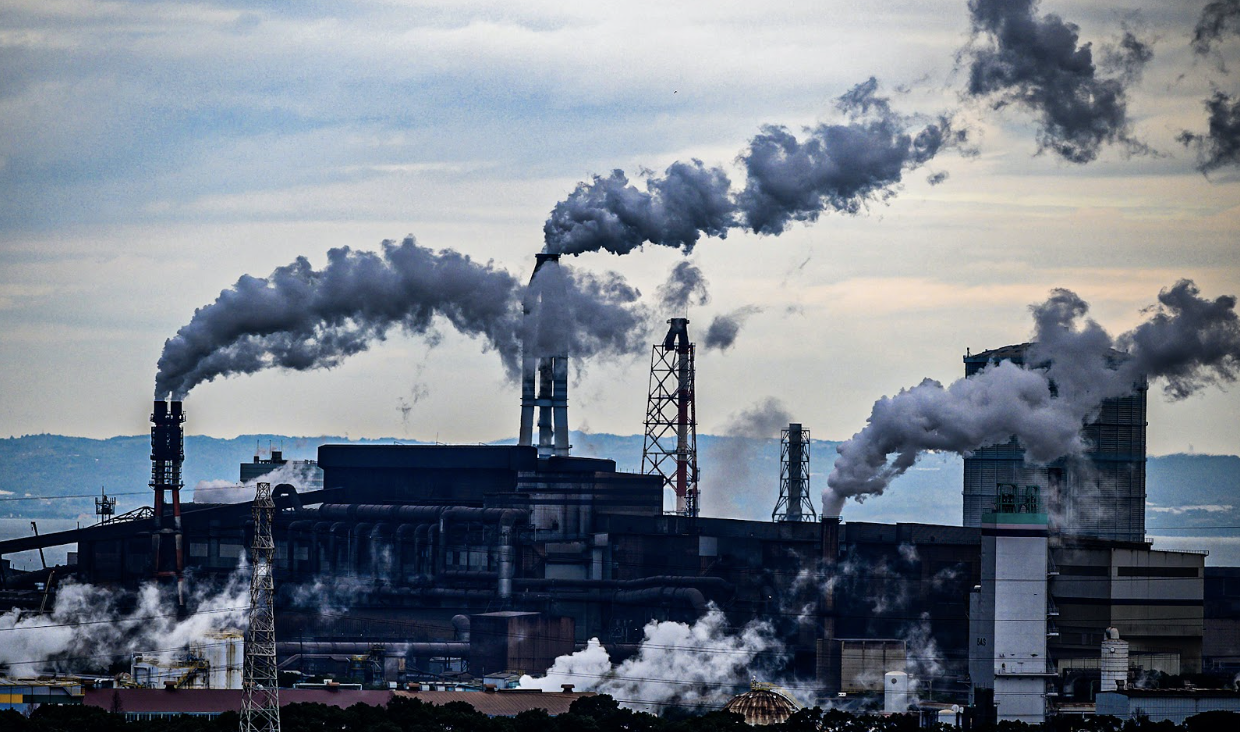
Here’s that all-too-familiar vista of another oil refinery belching toxic filth into the atmosphere. This is why we’re taking polluters to task and working to pass green legislation.
This week, Let’s Green CA! Is celebrating a big victory with the passage of SB 1230 out of the California Senate’s Committee on Environmental Quality. Romero’s staff — in partnership with legendary activist Dolores Huerta and the Dolores Huerta Foundation — has worked very hard to make this clean transportation legislation a reality, from the ground up. Sponsored by State Senator Monique Limón, the bill would rapidly cut greenhouse gas emissions, reduce toxic air pollution, and support green jobs by accelerating a just transition to clean cars in the largest state in our country and the fifth largest economy in the world. I applaud our sister program!
Meanwhile, the Romero Institute’s legal team is drafting a 300-page Racketeer Influenced Corrupt Organization Act (RICO) criminal complaint against the six major oil companies presently doing business in California. It’s designed to stimulate filings by state attorneys general and U.S. Attorneys against corporations, their CEOs, management officials, principal shareholders and financiers, and the American Petroleum Institute, which conspired with the oil leaders to lie to the American public about the known dangers of fossil fuel emissions causing climate change. I encourage you to watch this excellent, new documentary by PBS Frontline to learn more.
As you can see, we’re not taking our responsibilities to Unci Maka lightly. Our Lakota way is not to look at what we can do for ourselves, but to ask how we can be of service to our relatives — including this beautiful world that holds us all in her embrace. So, today, let’s celebrate her. Then, every day from here on, let’s make sure we’re doing better by her.
Wopila tanka — thank you for fighting for environmental justice! DeCora Hawk Field Organizer The Lakota People’s Law Project
ODANAH, Wisconsin — It was the blue ceiling that got me.
Although St. Mary’s Catholic Church is tiny, its vaulted ceiling soars to an unexpected height. It’s an impossible robin’s egg blue or the hue of a blue sky that could never exist. Unexpectedly, it drove my heart into my throat, where it stayed for several minutes. That blue color obliterated journalistic objectivity, placing me back into a wordless, needy childhood.
I realized at last that the ceiling was the same color as the little blue Virgin Mary medal that lived between my mother’s breasts, fixed to her brassiere with a safety pin. That medal would gaze back at me when we laid down in bed together for afternoon naps, at bedtime or just to visit. Those were the times she told me the Sister School stories, her life at St. Mary’s Catholic Indian boarding school and her childhood on the Bad River Ojibwe Reservation in Wisconsin.
The little church is all that remains now of the mission school buildings.
Aƞpétu wašté from the Cheyenne River Nation. As you know, the welfare of our children has been a longstanding issue for Native communities. Centuries of colonization means we’re always in the crosshairs. As I discuss with my granddaughter in today’s video, our people are marginalized — especially our young parents and grandparents — by the State of South Dakota and the Department of Social Services, and our children are taken from us at an alarming rate.
Watch our video to learn more about our work for the children.
We have worked to solve this problem for decades, and we have specifically confronted issues surrounding the Indian Child Welfare Act. In my work with Lakota Law, I’ve seen a lot of grandparents raising their grandchildren. This ultimately spurred me and others to create the Wasagiya Najin (Standing Strong) Grandmother’s Group at Cheyenne River. Wasagiya Najin focuses on what’s happening to our grandchildren, and we dedicate our time to improving our communities’ health and wellbeing from a Lakota perspective.
Our vision encompasses both a Children’s Village on Cheyenne River and a plan to create a Tribal Department of Child Welfare. I’m happy to share with you that we’re well on our way with the village — a place where siblings can stay together and children won’t be lost to the system or worry about aging out. We already have three homes and kinship parents (we don’t use the term “foster parents”). We’re doing all this with support from the tribe, but it is a community-based and operated children’s village, not run by our tribal government.
A tribally-run Department of Child Welfare will be the next big step for us. A centrally-located, multi-service center, it would offer needed support for our parents and grandparents. Right now, it’s far too complicated for parents to access services and resources from the State of South Dakota, which is the only entity handling foster care and adoption on the rez. Our vision will make things easier, give tribal members more autonomy, and also hold us accountable. It’s not our way to terminate parental rights. Instead, we promote family restoration. Children want to be with their families and their people. If we approach it from a Lakota perspective, we can make that happen for many young ones.
We take the pandemic seriously out here, and that has slowed things down. But right now, we’re organizing on the ground and distributing a one-page, anonymous survey identifying family circumstances and gathering feedback about the potential for a tribally-run Child Welfare Office. This data will help us request a reservation-wide hearing and present effectively to our tribal government, which is willing to work with organizers and hear testimony. We’re not looking for approval or permission. We grandmothers have heart for our people and our children, and that’s all we need to get it done!
It’s an exciting time, with positive change happening now and more on the horizon. We’ll have much more to tell you as we move ahead, so please stay with us.
Wopila tanka — thank you for supporting our children! Madonna Thunder Hawk Cheyenne River Organizer The Lakota People’s Law Project
Lakota People’s Law Project 547 South 7th Street #149 Bismarck, ND 58504-5859
The key to life and liberty is access to water, Water is Life. The clue to what is happening across the world as a certain class seeks to totally control is what is being done in Standing Rock. There, in 2016, the government was able to try out their new military-grade weapons to control the peaceful protest. There in Standing Rock, we witnessed a rehearsal for complete control and domination. Now, the water is being confiscated.
This is environmental warfare.
The Dakota Access pipeline’s threat level is at an all time high for the people of the Standing Rock Nation. In a new video we made in partnership with Standing Rock, you’ll see the distressingly low water levels in the Mni Sose, our sacred Missouri River. You’ll also hear Chairwoman Janet Alkire address the oil company’s lack of adequate emergency response planning for the pipeline’s inevitable spill. It’s critical you stay with us and be ready to assist as soon as the Army Corps of Engineers releases DAPL’s Environmental Impact Statement (EIS).
Standing Rock Chairwoman Janet Alkire addresses DAPL’s inadequate emergency plan, the Missouri River’s low water levels, and the elevated threat to her people.
As you heard a few weeks back, an Army representative came to Standing Rock to meet with tribal leaders from across the Oceti Sakowin. He listened to presidents and chairpersons, elders and community members, and he told us he heard our concerns. We hope that’s true. But since that day, it’s been a game of wait and see, with no movement from the Army and no release of the EIS — which, of course, was prepared by a pro-oil firm. It’s almost as if they know we’re not going to be happy unless the pipeline is shut down, and that we have a legion of supporters ready to engage in favor of an honest process.
In my dual capacities as Lakota Law’s co-director and a special consultant to the chairwoman’s office, I’m here to amplify your voices and those of my people. Lakota Law’s communications and technical teams have been hard at work for months helping the Alkire administration upgrade the tribe’s digital infrastructure and outreach capabilities. As part of that, we also collaborated with the tribe’s Game and Fish Department to access remote areas of the reservation and film 30 miles of the river, capturing first-of-its-kind, comprehensive drone footage near DAPL’s crossing. As you’ll see, the footage shows clearly that water levels are dangerously low, and that any spill would pose a special threat right now.
We will continue to do whatever we can to support Standing Rock and all those within the Great Sioux Nation to push back against Big Extraction. And, of course, we’ll keep you updated on developments. Please stay tuned and ready to take action!
Wopila tanka — thank you for always standing with Standing Rock. Chase Iron Eyes Co-Director and Lead Counsel The Lakota People’s Law Project
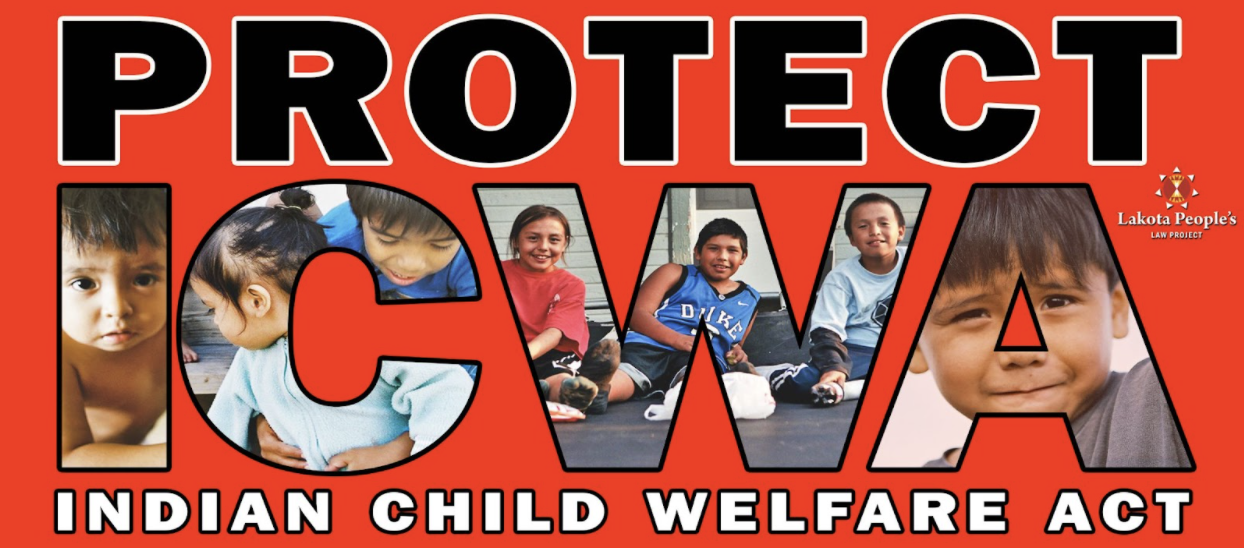
As we’ve been reporting to you for some time, Big Oil’s most powerful attorneys are attacking the Indian Child Welfare Act (ICWA) at the Supreme Court level. The legal effort is being led by Gibson Dunn, a firm notorious for helping fossil fuel goliaths evade environmental protections. With the Brackeen v. Haaland lawsuit, Gibson Dunn is attempting to eliminate tribes’ rights to keep Native kids in Native care. As you know, Lakota Law is fighting back against this frightening attack on Indigenous sovereignty.
We’re preparing an amicus curiae brief — more details on that below — for the Supreme Court’s consideration during its next session. We also recently had a strategy meeting in New York City with attorney Steven Donziger, another of Gibson Dunn’s targets. On behalf of Indigenous People in the Amazon, Donziger won a landmark judgment against Chevron for dumping billions of gallons of toxic waste into the rainforest. Gibson Dunn then used every dirty trick in the book to turn the tables on him, and now he’s been under house arrest for years. We’ll work to connect Steven to resources that can help him find solutions to his legal problems.
In South America and North America alike, as Indigenous people, we’ve seen a blatant disregard for our lives played out for hundreds of years. That’s why we’re doing everything we can to ensure ICWA is protected, right now. We know this law inside and out. Former South Dakota Senator James Abourezk, who chairs Lakota Law’s Board of Advisors, was the principal author of ICWA, and a decade ago we were contacted by the Justice Department to propose implementation guidelines.
Our amicus brief will make three arguments designed to counter flawed positions taken by Gibson Dunn and the rest of the opposition’s legal team. First, our lawyers will explain that granting tribes the sovereign right to determine what happens to their children is not reverse racism. Second, we will say there is no violation of the U.S. Constitution or the Tenth Amendment when states are required to enforce federal law. And finally, federal, executive branch agencies — in this case, the Bureau of Indian Affairs — must be able to publish and enforce rules and regulations under their purview.
ICWA is a well-intentioned, well-written law with enforcement guidelines we know to be solid. Since going into effect more than 40 years ago, it has helped countless children remain with family, live healthy lives, and maintain a deep understanding of who they are and where they’re from. We can’t go back to the days of government-mandated mass cultural erasure. We must continue to stand together for the Earth and our future generations against the fossil fuel industry and its high-powered attorneys, whatever the costs. It’s up to all of us, and your friendship and care mean we can keep fighting for justice, every day.
Wopila tanka — thank you for supporting our legal work! Chase Iron Eyes Co-Director and Lead Counsel The Lakota People’s Law Project




 Here’s that all-too-familiar vista of another oil refinery belching toxic filth into the atmosphere. This is why we’re taking polluters to task and working to pass green legislation.