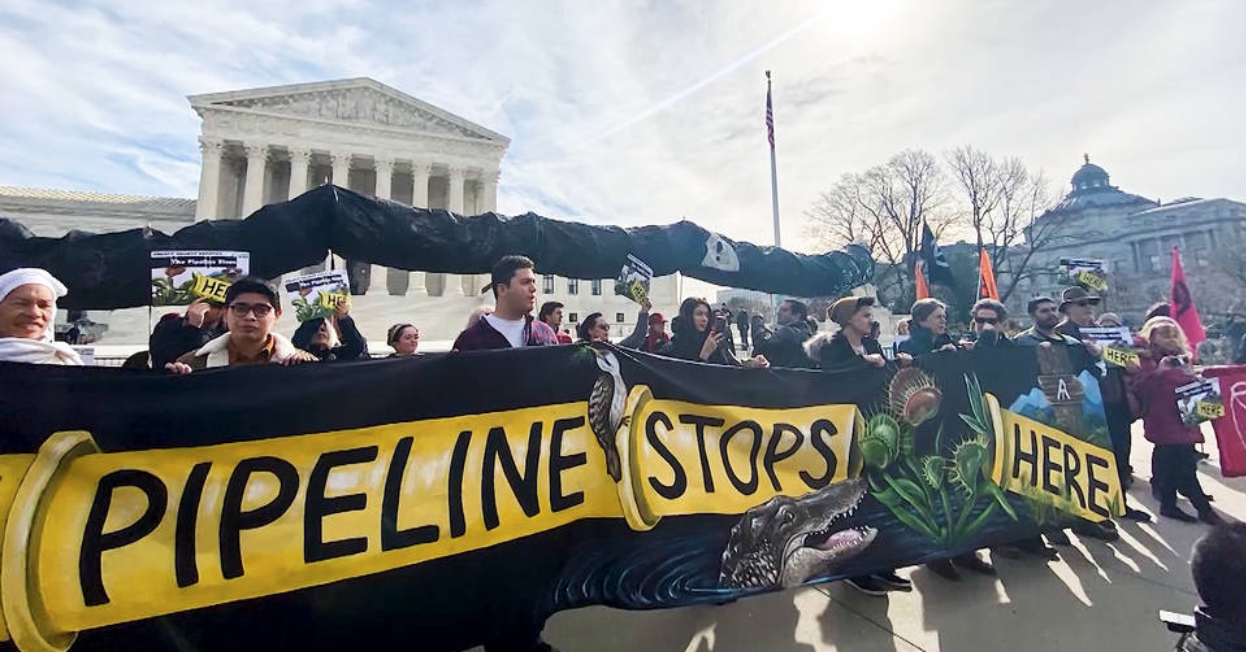
An April decision by U.S. District Judge Brian Morris of Montana invoked the Endangered Species Act to limit KXL crossing domestic waterways. That ruling, thankfully, put the pipeline behind schedule and kept my people safer during the COVID-19 pandemic, but everything could change as soon as next week.
Photo credit: Julia Peter
Despite recent, somewhat surprising decisions upholding rights for the LGTBQ and immigrant communities, the Court can’t be relied upon to continue ruling in favor of the people — or the environment — with its current conservative majority.
We expect a ruling from SCOTUS before it leaves session — at the latest, in early July. Justice Elena Kagan, who oversees the 9th District, set today as the deadline for submission of all legal arguments. Without her diligent oversight, the Court might already have given the green light. Now, the environmental groups who brought the suit at least have a fighting chance.
But the reality is, we can’t bank on a third pleasant surprise. As I wrote to you earlier this week, oil companies are adept at finding every end-run available to circumvent proper pipeline procedures. That includes tapping their friends in the Trump administration and Bill Barr’s Department of Justice to try calling in last-ditch favors from the highest court in the land.
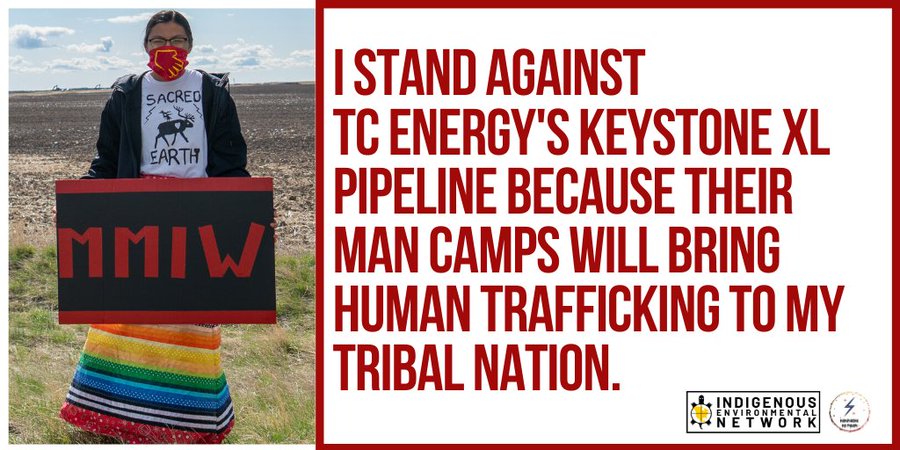
As you probably remember, KXL will bring two-man camps — temporary housing for oil workers — near to our reservation borders. These destructive dens of machismo endanger our families by exacerbating the epidemic of missing and murdered Indigenous women and girls. In the age of the coronavirus, contact with pipeline workers could bring even more peril, a key reason why we set up health and safety checkpoints on roads entering our reservations.
So, we prepare again to fight. We’ll maintain our checkpoints at all costs. And, of course, we’ll keep engaging allies from other environmental groups and tribal nations (for instance, we’re already working with a Blackfoot activist in Montana to survey ongoing construction near the Canadian border). We remain vigilant, and I ask that you stay ready to assist us in the likely event that SCOTUS reverts to its troubling pattern of enabling this corrupt, racist White House.
Wopila tanka — Thank you for standing with us to protect our water, our land, and our families!
Madonna Thunder Hawk
Cheyenne River Organizer
The Lakota People’s Law Project
Court rules to cancel energy lease on land sacred to Blackfeet
The Associated Press
‘The Badger-Two Medicine is more than just land; it’s an entire way of life’Associated Press
HELENA, Mont. — A federal appeals court ruled Tuesday to cancel a long-disputed oil and gas lease on land in northwestern Montana considered sacred to tribes in the U.S. and Canada.
The three-judge panel of the U.S. Court of Appeals for the District of Columbia Circuit overruled a judge’s 2018 decision that had allowed a Louisiana company to keep its lease within the Badger Two-Medicine area of Lewis and Clark National Forest.
That area near Glacier National Park is the site of the creation story of the Blackfoot tribes of southern Canada and Montana’s Blackfeet Nation.
John Murray, the Blackfeet’s tribal historic preservation officer, said the court’s decision will close a “long and painful chapter in the history of our people.”
“These leases should never have been issued in the first place,” Murray said. “Today’s ruling shows that these companies and their lawyers were not just on the wrong side of history but were also on the wrong side of the law when they waged their 40-year crusade to drill our ancestral land.”
“Our traditional practices and traditional lands are the firm ground underfoot that we need to push off into the future,” said Tyson Running Wolf. Running Wolf is a Montana state legislator, former Blackfeet Tribal Business Council member, hunting outfitter and leader among Blackfeet traditionalists. “This is how we heal ourselves, how we heal our communities, how we move forward into success. The Badger-Two Medicine is more than just land; it’s an entire way of life.”
Tim Preso, Earthjustice attorney, argued the case on behalf of intervenors including Blackfeet Headwaters Alliance, Pikuni Traditionalist Association, Glacier-Two Medicine Alliance, Montana Wilderness Association, National Parks Conservation Association and The Wilderness Society. These organizations have since joined the Blackfeet Nation in calling for permanent protection of the Badger-Two Medicine.
The lease owned by Solenex LLC was the last active exploratory lease of about 45 issued in the Badger-Two Medicine area since the 1980s.
“We’re obviously very disappointed in the panel’s decision today, particularly their refusal to engage with any of the arguments we raised on appeal,” said David McDonald, attorney for Solenex, which is owned by Sidney Longwell. “We fully intend on continuing to fight for Solenex and the Longwell family, and we’re currently considering all available avenues to do so.”
The company has held the lease for more than 30 years. It had not yet drilled because of bureaucratic delays within the U.S. departments of Interior and Agriculture, prompting the company to sue in 2013.
The U.S. government canceled the lease in 2016, saying a proper environmental analysis had not been conducted, a decision Solenex challenged. A federal judge sided with the company in 2018, saying the long amount of time between the lease being issued and canceled violated federal law.
The three-judge appellate panel ruled the judge’s findings were wrong and that the the government had considered Solenex’s interests.
“Delay by itself is not enough to render the lease cancellation arbitrary or capricious,” the ruling said.
Mashpee Wampanoag Tribe and Native Organizations Encouraged by Recent Decision in Mashpee v. Bernhardt and Now Call on DOI for Recommitment to Tribal Sovereignty
Yesterday, the United States District Court for the District of Columbia rendered a decision in favor of the Mashpee Wampanoag Tribe in the case of Mashpee Wampanoag Tribe v. Bernhardt. In its opinion, Judge Paul L. Friedman ruled:
The Court will grant the Mashpee Tribe’s motion for summary judgment and deny the federal defendants’ and defendant-intervenors’ motions for summary judgment. Furthermore, because the Secretary of the Interior’s September 7, 2018 Record of Decision is arbitrary, capricious, an abuse of discretion, and contrary to law, the Court remands the matter to the Secretary of the Interior for a thorough reconsideration and re-evaluation of the evidence before him consistent with this Opinion, the 2014 M-Opinion, M-37209 – its standard and the evidence permitted therein – and the Department’s prior decisions applying the M-Opinion’s two-part test.
For the first time since the termination era, the Department of the Interior (DOI) attempted to disestablish a Tribal reservation, ordering the homelands of the Mashpee Wampanoag Tribe to be taken out of trust. The order from DOI Secretary David Bernhardt came on March 27, 2020, as the Tribal Nation worked to respond to the COVID-19 public health emergency, during active litigation on the status of the land, and following the rescission of the 2014 Carcieri M-Opinion and the issuance of a new 4-part test to qualify under the first definition of “Indian” in the Indian Reorganization Act (IRA). On March 30, 2020, the Mashpee Wampanoag Tribe asked the Court to issue an emergency restraining order to prevent DOI from taking immediate action to disestablish its reservation.
“The DC District Court righted what would have been a terrible and historic injustice by finding that the Department of the Interior broke the law in attempting to take our land out of trust,” said Mashpee Wampanoag Tribal Chairman, Cedric Cromwell. “We will continue to work with the Department of the Interior — and fight them if necessary — to ensure our land remains in trust.”
“On behalf of the National Congress of American Indians, we congratulate the Mashpee Wampanoag Tribe on their historic victory. We consider this a win for all of Indian Country,” said NCAI President Fawn Sharp. “The Mashpee Wampanoag relationship with the United States is one of political equality, derived from their inherent sovereignty, powers, and authority that long predates the United States. No federal agency or civil servant has the authority to diminish or in any way undermine that unique political relationship and standing. We will remain vigilant and stand united with Mashpee who have shaped and supported this country from the arrival of the first European settlers and will coexist as sovereign equals for generations to come.”
USET SPF and NCAI share a profound commitment to Tribal sovereignty and the restoration of Tribal homelands. In light of this commitment, we have been advocating for a fix to the Supreme Court decision in Carcieri v. Salazar since it was handed down in 2009. Carcieri has created a deeply inequitable 2-class system, in which some Tribal Nations have the ability to restore their homelands and others do not. This 2-class system serves to deny these Tribal Nations a critical component of the trust relationship, vital aspects of the exercise of inherent sovereignty, and the opportunity to qualify for several government programs.
We continue to call for the immediate passage of a fix that contains the two features necessary to restore parity to the land-into-trust process:
(1) A reaffirmation of the status of current trust lands; and
(2) Confirmation that the Secretary has authority to take land into trust for all federally recognized Tribal Nations.
While this decision is an important step toward righting centuries of wrong against the Mashpee Wampanoag Tribe, our collective work is not finished. We urge and await a positive determination from DOI on Mashpee’s homelands once and for all. Our organizations will continue to fight for the restoration of Tribal homelands and the full delivery of trust and treaty obligations. We call upon DOI to recommit itself to the restoration of homelands, the trust obligation, and Tribal sovereignty.
###
About the Mashpee Wampanoag Tribe:
The Mashpee Wampanoag Tribe, also known as the People of the First Light, has inhabited present day Massachusetts for more than 12,000 years. After an arduous process lasting more than three decades, the Mashpee Wampanoag were re-acknowledged as a federally recognized tribe in 2007. In 2015, the federal government declared 150 acres of land in Mashpee and 170 acres of land in Taunton as the Tribe’s initial reservation, on which the Tribe can exercise its full tribal sovereignty rights. The Mashpee tribe currently has approximately 2,700 enrolled citizens.
About the National Congress of American Indians:
Founded in 1944, the National Congress of American Indians is the oldest, largest and most representative American Indian and Alaska Native organization in the country. NCAI advocates on behalf of tribal governments and communities, promoting strong tribal-federal government-to-government policies, and promoting a better understanding among the general public regarding American Indian and Alaska Native governments, people and rights. For more information, visit www.ncai.org.
About the USET Sovereignty Protection Fund (USET SPF):
Established in 2014, the USET Sovereignty Protection Fund (USET SPF) is a non-profit, inter-Tribal organization advocating on behalf of thirty (30) federally recognized Tribal Nations from the Northeastern Woodlands to the Everglades and across the Gulf of Mexico. USET SPF is dedicated to promoting, protecting, and advancing the inherent sovereign rights and authorities of Tribal Nations and in assisting its membership in dealing effectively with public policy issues.
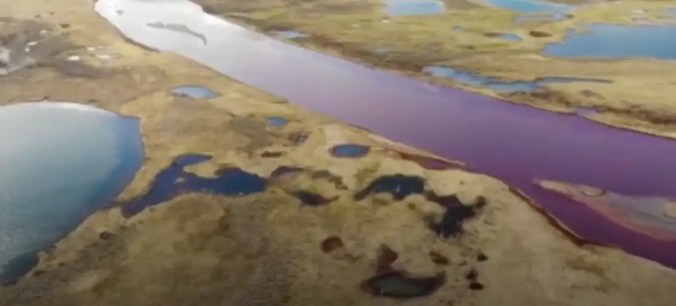
Diesel pollutes waters that will drain into the Arctic OceanMOSCOW (AP) – Russian President Vladimir Putin has declared a state of emergency in a region of Siberia after an estimated 20,000 tons, or 5.7 million gallons, of diesel fuel spilled from a power plant storage facility and fouled waterways.
The spill took place Friday at a power plant in an outlying section of the city of Norilsk, 2900 kilometers (1800 miles) northeast of Moscow.
Booms were laid in the Ambarnaya River to block the fuel. The river feeds a lake from which springs another river that leads to the environmentally delicate Arctic Ocean. The area where the spill occurred is closer to the traditional homelands of the Nenets and northern Norway than Alaska. However, the fish and marine mammals of the Arctic Ocean and its interrelated coastal seas are an important source of food for Inuit and other Arctic Indigenous peoples.
You may recall that, in late March, the Standing Rock, Oglala, Yankton, and Cheyenne River Sioux Tribes won a key round in their legal battle against the Dakota Access pipeline (DAPL). In a reversal of his prior decision, D.C. District Court Judge James Boasberg ruled that the pipeline hadn’t undergone proper environmental review. Though logic would dictate a subsequent cease to DAPL’s operations, Boasberg hasn’t taken that step. That’s why, last week, the Lakota Law team joined an Earthjustice-led effort and submitted an amicus curiae (friend of the court) brief to the judge, a strong legal argument that the oil flow must stop immediately.
For a comprehensive picture of the history of DAPL and current legal landscape, check out our in-depth blog, which also features our television ad targeted to the D.C. market in 2017 arguing for a full Environmental Impact Statement.
It’s not complicated. Because Boasberg’s latest decision voids the easement granted for DAPL, it should no longer be permitted to carry oil, at least until we’ve seen an Environmental Impact Statement (EIS) compliant with the National Environmental Policy Act. We’ve been arguing for a proper EIS since the beginning, recognizing that — given the oil company’s horrendous safety track record — it may be impossible to produce.
As you know, the Obama administration agreed that a comprehensive review was needed in late 2016, shutting down construction as thousands cheered at Standing Rock during the #NoDAPL protests. Sadly, everything changed when Trump took office. One of his first executive orders fast-tracked the pipeline without the EIS. Then, when Standing Rock took legal action, Judge Boasberg cited an exception in the law allowing construction despite known, potential hazards.
Boasberg’s latest ruling has changed the game again, this time in our favor. In our brief, LPLP Chief counsel Daniel Sheehan argues that if the oil flow doesn’t stop now, the Court will send a perilous message that litigation against the government is “meaningless and tantamount to a bait and switch designed to fool those naïve enough to believe that the rule of law still has efficacy.”
We’re not alone. Democrats on the House Natural Resources Committee have also joined U.S. senators including Kamala Harris and Elizabeth Warren to submit a powerful amicus brief. Their legal argument was prepared by Rep. Raúl M. Grijalva (D-AZ) and endorsed by Alexandria Ocasio Cortez, both of whom met face-to-face with our team in recent months.
We are aligned with powerful people, and the support you have shown to the Lakota means we can keep fighting nonstop to cancel pipelines and forward justice. The tide may be turning. I hope that if you stay with us, we can bring additional legal victories — and safety — back to our homelands.
Wopila tanka — Thank you for your friendship and your support,
Chase Iron Eyes
Lead Counsel
The Lakota People’s Law Project
We’re hosting an urgent call to provide updates on the status of Keystone XL, what we’re doing to fight back in the midst of COVID-19, and how we can win in November.
Sign up below to join our call on Thursday, May 14th at 8pm ET/5pm PT to hear from Bill McKibben, key partners, and members of the 350.org team about what’s next.
If you can, please have some paper and a marker or pen available to participate in a quick activity during the call.
Time
May 14, 2020 07:30 PM in Eastern Time (US and Canada)
A federal judge on Monday denied the U.S. Army Corps of Engineers’ request to amend his earlier ruling regarding TC Energy’s Keystone XL pipeline, reaffirming that a permit issued by the Army Corps was invalid.
Chief U.S. District Judge Brian Morris ruled again that the U.S. Army Corps of Engineers (USACE) violated the Endangered Species Act when it issued Nationwide Permit 12, which allows companies to construct energy projects at water crossings.
“The court rightly ruled that the Trump administration can’t continue to ignore the catastrophic effects of fossil fuel pipelines like Keystone XL.”
—Jared Margolis, Center for Biological Diversity
Climate action and Indigenous rights campaigners have for years fought the construction of the Keystone XL pipeline, which if built would cross bodies of water hundreds of times along its nearly 1,200-mile route from Alberta to Nebraska. TC Energy plans to send tar sands oil along the route, which opponents say would put Indigenous communities as well as wildlife at risk for dangerous leaks and exposure to toxic waste.
“The court rightly ruled that the Trump administration can’t continue to ignore the catastrophic effects of fossil fuel pipelines like Keystone XL,” said Jared Margolis, senior attorney with the Center for Biological Diversity, in a statement. “Constructing pipelines through rivers, streams, and wetlands without analyzing the impacts on imperiled species is unconscionable.”
The USACE had asked Morris to narrow his April 15 ruling, but the judge only changed his decision on Nationwide Permit 12 to allow non-pipeline construction, such as electrical transmission lines, to move forward.
“Our courts have shown time and time again that the law matters,” said Cecilia Segal, Natural Resources Defense Council (NRDC) attorney. “Today’s ruling makes clear that climate-busting pipelines like Keystone XL cannot be built until the federal government does its job and properly analyzes these projects’ devastating effects on their surrounding communities and wildlife. If that analysis is based on science and facts, pipelines like Keystone XL will never see the light of day because they remain, and always will be, a dire threat to our water, wildlife, and climate.”
‘The industry was on a tremendous roll right up until the last month or two. That reversal is stunning and problematic.’
Cathy Bussewitz, John Flesher and Patrick Whittle
Associated Press
NEW YORK (AP) — The U.S. renewable energy industry is reeling from the new coronavirus pandemic, which has delayed construction, put thousands of skilled laborers out of work and sowed doubts about solar and wind projects on the drawing board.
In locked-down California, some local agencies that issue permits for new work closed temporarily, and some solar companies furloughed installers.
In New York and New Jersey, SunPower CEO Thomas Werner halted installation of more than 400 residential solar systems, fearing for his workers’ safety.
As many as 120,000 jobs in solar and 35,000 in wind could be lost, trade groups say.
“There are many smaller companies going out of business as we speak,” said Abigail Ross Hopper, president of the Solar Energy Industries Association. “Up to half our jobs are at risk.”
Leaders are confident the future is bright. But the worldwide slowdown is delaying a transition to cleaner energy that scientists say is not happening quickly enough to curtail climate change.
Even as some states move toward reopening, executives fear diminished incomes and work disrupted by layoffs and social distancing will do lasting damage.
The wind industry is plagued by slowdowns in obtaining parts from overseas, getting them to job sites and constructing new turbines.
“The industry was on a tremendous roll right up until the last month or two,” said Tom Kiernan, CEO of the American Wind Energy Association. “That reversal is stunning and problematic.”
Residential solar business has been hit especially hard, Hopper said, with door-to-door sales no longer feasible and potential customers watching their wallets. Deals with commercial buyers also have slumped.
New solar installations could be 17% lower worldwide than expected this year, and wind turbine manufacturing could fall up to 20%, according to consulting firm Wood Mackenzie.
“Pre-pandemic, there were great dreams and aspirations for a record-setting year,” said Paul Gaynor, CEO of Longroad Energy, a utility-scale wind and solar developer. “I’m sure we’re not going to have that.”
Fossil fuels such as natural gas and coal remain the leading providers of the nation’s electricity, with nuclear power another key contributor, according to the U.S. Energy Information Administration.
But renewable sources — wind, solar, hydroelectric, biomass and geothermal — have jumped in the last decade as production costs have fallen and many states have ordered utilities to make greater use of renewable energy to reduce greenhouse gas emissions. Renewables produced nearly one-fifth of the country’s energy last year.
The EIA predicts renewable energy, despite recent setbacks, will grow 11% this year — an indication of the sector’s strong surge before the economy tanked. Meanwhile, coal-fired power is expected to decline 20% and gas generation to grow just 1%.
The setback for renewable energy still has been painful — even in California, where residential solar demand took off due to frequent blackouts and state laws requiring to new homes to produce as much energy as they consume.
“A lot of companies are just trying everything they can to just limp along and keep their workforce,” said Bernadette Del Chiaro, executive director of the California Solar and Storage Association.
All 20 employees were temporarily furloughed at Cinnamon Energy Systems, which sells residential and commercial solar systems in Northern California.
“I’m sure we’ll bounce back, just smaller,” CEO Barry Cinnamon said, adding that people might not spend as much as they once did, because their income will likely be down. “Whether that’s months or years, nobody knows.”
Luminalt, a San Francisco solar company, furloughed most of its 40 employees. And when work resumes, CEO Jeanine Cotter expects that projects will take longer and cost more to keep installers safe.
“Think about working on a roof with a mask,” Cotter said. “And think about not being able to pass a power tool to somebody unless you disinfect it before you pass it on.”
Since his furlough in mid-March, Luminalt solar technician Tom Hicks has been collecting benefits but no salary — and he’s worried about mortgage payments.
“My 401k got crushed by 30% just like everyone else,” said Hicks, 55. “How much time do I have to recover?”
Still, there are hopeful signs. The Boston-based developer Longroad recently began a utility-scale solar project in California and secured new financing for another in Texas.
Sunnova Energy International, a Houston-based residential solar and energy storage service provider, is doing more videoconferencing and fewer in-person dealings with customers. But CEO John Berger said, “Our installations are still moving ahead, service is still moving ahead, we still see customers paying us.”
In eastern Kansas, construction has continued at Southern Power’s 200-megawatt Reading Wind Facility despite delayed parts shipments, company spokeswoman Helen Northcutt White said. Sixty-two turbines are planned for the facility, scheduled to go online in mid-May.
The wind and solar industries have asked lawmakers and federal agencies for help, including an extension of their four-year deadlines for completing projects without losing tax benefits. Similar assistance was granted during the 2008-09 recession.
The renewable energy industry’s health is crucial to improving the climate and to a strong economic recovery, said Matthew Davis, legislative director for the League of Conservation Voters.
“These businesses, these workers deserve immediate relief,” Davis said.
It’s important to push for more responsible energy use as the economy reopens worldwide, said Andrew Pershing, chief scientific officer with Gulf of Maine Research Institute in Portland, Maine, which studies climate change and oceans.
“My hope is that we would use this as an opportunity to build toward an economy that doesn’t depend on burning coal and oil and that is more resilient to the climate impacts that are heading our way,” Pershing said.
___
Flesher reported from Traverse City, Mich. and Whittle reported from Portland, Me.
John Chao created this beautiful photography book and has a chapter about Standing Rock. Check it out. People who were there have their names listed. I am listed there and am very proud to say that I was there, I was a witness, I contributed, and I tried to help in any way I could by waking up my school community on Sacramento to what was going on in North Dakota.
The struggle continues as we battle through a rogue government and a pandemic.
It will always be the artist, writers, and educators who will document and tell the tale.
Navajo Nation President Jonathan Nez and Vice President Myron Lizer met with the Chinle Service Unit Command Team and Federal Emergency Management Administration (FEMA) Region 9 representatives Josh Allan and Ricardo Zuniga on March 31, 2020 to evaluate local facilities in Chinle, Arizona, to discuss the establishment of a federal medical station to help fight the spread of COVID-19. (Photo courtesy of Navajo Nation President Jonathan Nez and Vice President Myron Lizer, Facebook)
Indian Country Today
Data, story summaries, lists of closures, resourcesIndian Country Today
COVID-19 Tracker in the United States
April 16, 2020 9:15 pm EDT
Cases confirmed in the Indian health system: 1,397
Good news: Two Phoenix-area women who were living in the U.K. when coronavirus cases began skyrocketing in Europe say they’re relieved to be back with family
Two pueblos in New Mexico have some of the highest infection rates in the United States. The numbers are stark. Zia Pueblo has 31 confirmed positive cases with a population of 900 people. And San Felipe has 52 cases with a population of 2,200.
‘Congress said ‘any’ small business can get paycheck protection for its people, the SBA has no right to say anything less to small tribal gaming businesses’
COVID-19 pandemic threatens health in Alaska Native villages and the thousands of workers who usually arrive for the short, lucrative Bristol Bay fishery.
Navajo Nation is an Indian Country COVID-19 hotspot, as medical supplies are dwindling nationally. A summary of COVID-19-related news for Saturday April 4, 2020
Ravn Air carried passengers, food, freight and mail to more than 120 communities announced it’s ending service to all but 11 villages. Ravn Air sent the message at 6 a.m. telling employees to stop operations that day.
New Mexico Gov. Michelle Lujan Grisham said there are “’incredible spikes” of coronavirus cases in the Navajo Nation and that the virus could “wipe out” some tribal nations, according to a recording of a call between Trump and the nation’s governors obtained by ABC News.
“We’re seeing incredible spikes in the Navajo Nation, and this is going to be an issue where we’re going to have to figure that out and think about maybe testing and surveillance opportunities,” Grisham said.
Indian Country Today Reporters’ Roundtable, March 30
Another Monday. Another tranche of global COVID-19 cases on National Doctors Day. There are now more than 122,000 cases in the United States, resulting in 2,112 deaths. And in Indian Country there are 190 cases with at least 10 deaths confirmed.
The Lummi Nation in Washington state reported the sharpest increase so far this week. There are now 16 positive cases, 12 of them being Lummi citizens, and nine people who live on the Lummi Reservation. Two of the cases include members of the Lummi Business Council. The identified cases are likely to go up — there are 22 more cases pending, according to the tribe’s public health department.
Meskwaki Nation among others in Indian Country with confirmed cases
Weekends are usually days when people take time off. Not these days as the number of positive coronavirus cases continue to grow in Indian Country. Over the weekend, tribal nations reported new numbers, instituted new curfews and organizations asked for more donations to send to both students and community members. Others used this time to connect on social media. In Iowa, a 31-year-old Meskwaki woman was confirmed positive for the virus, the Times Republican reported. She has been identified as Lindsey Johnson.
‘Three weeks ago we were doing great! And now we’re done.’
It’s a sparse lunch crowd at the Bee Line Cafe in Payson, Arizona. Only four tables have guests seated and eating. Business has slowed considerably in the past week says owner Kassie Sexton.“People are not wanting to come in because they’re afraid they’re going to get cooties.” She laughs nervously as she looks around her nearly empty cafe.
The sweeping bill that President Donald Trump signed will help better equip health care systems that serve Native Americans, improve the emergency response time on tribal lands, provide economic relief for tribal members, and help with food deliveries to low-income families and the elderly.
Tribes have been lobbying Congress to help address shortfalls in an already underfunded health care system and to ensure the federal government fulfills its obligation to them under treaties and other acts. While the $10 billion for tribes in the $2.2 trillion package is less than they requested, tribes say it represents progress.
The number of coronavirus cases is growing globally.
On Saturday, 103,321 cases were reported in the United States by the Centers for Disease Control and Prevention, making the U.S. the country with the highest number of confirmed cases and 1,668 people have died from coronavirus-related complications.
Italy’s death toll from the coronavirus pandemic is the highest in the world, with over 10,000 fatalities.
Federal and state services include monetary and food assistance, unemployment benefits, and more. The National Retail Federation also has over 70 corporations looking for workers
Updated: New coronavirus cases on the Navajo Nation have increased by 20 on Wednesday, from 49 to 69
Tribes in Minnesota are the latest across Indian Country to fall under a statewide stay-at-home order in the fight to prevent the coronavirus spread.Minnesota Gov. Tim Walz signed an executive order on Wednesday ordering Minnesota residents in nonessential jobs to stay at home. The order begins midnight Friday and is scheduled to run through April 10.
The Senate and White House reached an agreement on the bailout funds for America, the largest in history. The $2 trillion relief package includes $8 billion for tribal governments and $2 billion for emergency supplemental funding for federal Indian programs.
The Senate vote on the agreement is set to happen this afternoon. Even if passed by the Senate, they would need House approval.
Two Arizona tribes in the Phoenix valley see their first COVID-19 cases while the Navajo Nation adds 20 more reports. The Salt River Pima-Maricopa Indian Community reported its first case and the Gila River Indian Community has two positive cases.
These new cases bring the total number of COVID-19 cases in the Indian health system to 64 and two deaths. Eight out of 10 deaths due to the coronavirus in the U.S. have been people 65 and older, according to the CDC.
Salt River Pima-Maricopa Indian Community President Martin Harvier made the announcement Tuesday afternoon on the tribal government’s Facebook page.
Generations and generations … have had to deal with these pandemics and these viruses, and they’ve also had to get up in the morning and feed themselves, and make things run for society’
Alaska Governor Mike Dunleavy announced a mandatory 14-day quarantine for people arriving from out of state to slow the spread of COVID-19. On Sunday Hawaii Governor David Ing took the action for travelers headed there.
Surgeon General: ‘America … It’s going to get bad’
This morning U.S. Surgeon General Dr. Jerome Adams said on national television, “I want America to understand this week, it’s going to get bad.” As if he needed proof, the number of positive cases for COVID-19 listed on the Centers for Disease Control and Prevention doubled over the weekend. There are now 33,404 cases and 400 people across the country have died.
Minnesota Lt. Gov. Peggy Flanagan: Someone feeling well could still be carrying the virus … ‘then you walk past the next Ron, my big brother, in public’
Indian Country Today Reporters’ Roundtable, March 24
Zibaaska’iganagooday is the exploding sound in the Ojibwe language and it has a long history of healing
Community song and dance have always been a part of healing and prayer for Native people. In this time of social distancing, however, people are putting a digital spin on these healing traditions. People all over Indian Country are organizing virtual powwows and other social dances via social media as a means to offer hope and spiritual support during the Covid19 pandemic
Swords, rez dogs, Indian Country adventures and more
Bored at home? Nonsense. Practicing safe social distancing during the coronavirus pandemic can also mean opportunity. We can finally catch up on all the streaming shows, Native YouTubers, read all the books we never have time for and listen to all the saved podcast episodes tucked away on our devices.
Native artists, musicians, comedians, actors and writers speak on careers affected by the COVID-19 virus. Freelance Artist Resources website hopes to provide relief
American Indians and Alaska Natives clustered in camps or on the streets; ‘It’s been a crazy time’
Every major city has a virtual suburb for the homeless. Homes consisting of tents, scrap wood, shopping baskets and cardboard boxes. In shelters, a family dwelling might have a common kitchen and bedrooms with bunk beds. Others may have a large room filled with dozens of bunk beds or canvas cots. Some have dozens of rubber-coated thick pads placed a foot apart in rows laid across a concrete floor.
The number of positive COVID-19 cases in the Navajo Nation has grown to 14, a dramatic increase from the three confirmed cases reported only a day ago.
The announcement came hours after a 55-year-old Cherokee Nation citizen was the first coronavirus related death in Oklahoma. Before the Navajo Nation announcement late Thursday, March 19, there were nine cases confirmed in the Indian health system.
The Cherokee Nation and Oklahoma have confirmed the first COVID-19 related death, according to the Cherokee Phoenix. A 55-year-old Cherokee man died on March 18 after fighting a cold and then contracted the coronavirus disease.
The death of a tribal citizen that has been confirmed is one of the nine cases reported in the Indian health system as of March 19. On Wednesday, the Navajo Nation confirmed its third case, a 62-year-old Navajo man.
The Lummi Nation in Washington state has confirmed three positive COVID-19 cases, according to Tony Hillaire, chief of staff of the Lummi Indian Business Council. This adds to the total of seven within the Indian health system; one in the Portland Area of the Indian Health Service, one in the Great Plains area and two in the Navajo region.
Of the three Lummi cases, one is a Lummi citizen who resides on the reservation. The other two cases are residents of King and Whatcom counties.






 John Chao created this beautiful photography book and has a chapter about Standing Rock. Check it out. People who were there have their names listed. I am listed there and am very proud to say that I was there, I was a witness, I contributed, and I tried to help in any way I could by waking up my school community on Sacramento to what was going on in North Dakota.

