Day #3 Oceti Sakowin Camp and the Drive back to Bismarck.

I met Ashley and her friend, both were still suffering from the night before, and we presented the Sioux elders with the banner. They really loved the blue color and how large it was with all of the students’ signatures. We were told to hang it on the front fence of Oceti Sakowin Camp. So, with another water protector, off we went to look for a spot. Class, know that your banner is hanging on the front fence to Oceti Sakowin, making history, supporting the water protectors here.

000_0003000_0004

It is not allowed to take photos and videos in the camp, but I think you can see that there are thousands here. As the day wore on and we came back later, there were even more people coming and beginning to set up camp.

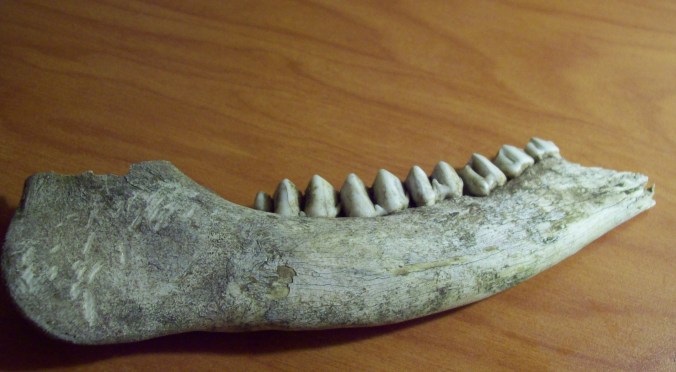
This item was found by the banner in the tall grass, they said it was a coyote jaw bone.
000_0009

On the way to Bismarck to pick up supplies, we stopped at a pizza restaurant in Mandan, because Ashley’s friend was wanting pizza for days. It kind of broke the tension from the attack the night before. Both said their throats hurt from the mace and pepper spray, both complained of their skin still burning, and Ashley’s friend was very sore from the rubber bullets he took.

https://drive.google.com/open?id=1G8I6XXFHuF8EV3u04v_bmwLt86OAHtDtAQ

We could still find something to laugh about, which is our strength.

When we reached the Walmart in Bismarck, I met Vince again. He was happy to see me! We also saw some fellow water protectors in the store shopping for supplies. All of the people in the store were looking at us like we were from another planet. I made friends with another employee, he was from Liberia, Africa. He said he had only been in North Dakota for a few months. We bought first aid items like saline solution, beef, bacon, a large turkey, paper, pens, and markers, . Also, greens, lemons, honey, apple cider vinegar, coffee, coconut oil, scarves, and toilet paper. Basically, items for the three major units of the camp; the kitchen, the first aid tent, and the banner/poster group. In addition, we bought tobacco for gifts to the elders. The tradition is, if you want to speak to an elder you give them a gift. Natural tobacco and sage is considered appropriate. The total came to over $300.00. I also cash advanced $60.00 for gas and purchased lens wipes, extra batteries, and the all useful backscratcher.

Then there was the long drive back to the Oceti Sakowin Camp. I got turned around in Mandan, used the opportunity to get gas, then found my way again. It is truly dark, the clouds kept the stars covered and I could only see as far as the headlights on parts of the road. I dropped Ashley, her friend, and the supplies off, then I drove the very long way back to Bismarck. I got home at 12.45 a.m. It had been a very long day.

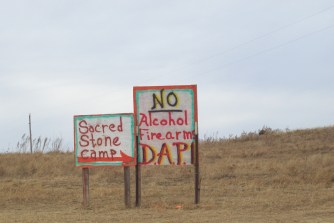
Day#3 Sacred Stone Camp, North Dakota

Monday, November 21, 2016   It was a cold somber day. I had been up all night watching the horrible actions of the Morton County Sheriff’s Department and DAPL mercenaries, and National Guard?(really, our National Guard) firing on innocent civilians. I felt very worried about my new friend and how she was since she had just arrived at the camp that evening. I decided to drive out after making some calls, my personal finance stuff, and deliver the banner my school had signed. I left the hotel around 12:30 p.m. and it was a very long drive. North Dakota is a very vast landscape. There was a little blue sky peeking out from mostly a cloudy sky as I drove the roundabout way to the camp. This issue of roads will come up again. The main road 1806 is closed by DAPL and Morton County. Why? In order to protect the drill site and maintain an access route for delivering their equipment. What this means is that the bridge is barricaded and the route 1806 is closed. No emergency equipment can go straight through from Standing Rock to Bismarck which puts lives in jeopardy when and if there is a medical or natural emergency.  I had to take 94 north and go through Mandan, then take 6 south to 21 through Solen, then take 1806 north from the south to Sacred Stone main camp near Cannonball. The Oceti Sakowin camp is just a mile north of the main camp. What might be a 30 -40 minute trip is a little over an hour now.

Oceti Sakowin. Seven Council Fires. The proper name for the people commonly known as the Sioux is Oceti Sakowin, (Och-et-eeshak-oh-win) meaning Seven Council Fires. The original Sioux tribe was made up of Seven Council Fires.

Oceti Sakowin – Akta Lakota Museum & Cultural Center

aktalakota.stjo.org/site/News2?page=NewsArticle&id=8309

map-of-bismarcknd

from: Google Maps


000_0001

000_0002

I arrived at the Sacred Stone main camp. I was met at the gate and a young woman gave me an orientation about the camp. It is very beautiful there, overlooking the Missouri River. While we spoke a police helicopter flew overhead. I was told where I could drop off the clothing I had brought. I drove on down the hill through the camp. Everyone was fixing their shelters, I saw very many vehicles from many states of the country, Wisconsin, Florida, Nevada, to name a few. There are no weapons allowed in the camp – that is stated on a sign right at the entrance. Everyone entering is greeted and asked what they are there for. You are encouraged to be self-sufficient and bring something to share. However, if you have nothing, others will share with you and you will not be turned away. I saw two women at the clothing drop off and spoke to them as I gave them the clothes I donated. They said there would be a ceremony on Sunday and that they would be at the concert at the Prairie Knights Casino http://prairieknights.com/ in Standing Rock.

casino

I was given directions to get to the Oceti Sakowin camp and was driving when I got a call from Ashley. She said she would meet me at the gate with her friend.

https://drive.google.com/open?id=1bSUk_5hCwcchIDkTX61Ax5IHagzvEMN_Ig


Whose Land (Water) is it Anyway…

Read and prepare to be upset. This is the mild version of events. Long ago, I wandered the stacks at college and read the primary source material, fort logs, memoirs, journals. It is not for the faint of heart. The land we are destroying, polluting, developing (into what?) is all stolen land. Taken by force and taken by trickery. It does not belong to us. It is here for all to care for and protect, and this is the message of Standing Rock. Once people understand this, they will totally “get it.” There are no protestors, there are water protectors. They are making a stand to help us change our paradigm of ownership and destruction, a paradigm that is literally killing us and not providing for the seventh generation.

http://ic.galegroup.com/ic/uhic/ReferenceDetailsPage/ReferenceDetailsWindow?failOverType=&query=&prodId=UHIC&windowstate=normal&contentModules=&display-query=&mode=view&displayGroupName=Reference&limiter=&currPage=&disableHighlighting=false&displayGroups=&sortBy=&search_within_results=&p=UHIC%3AWHIC&action=e&catId=&activityType=&scanId=&documentId=GALE%7CCX4019400066&source=Bookmark&u=oak30216&jsid=664cf2effc578c7cb615d3d53e5a1ae1

Seven generation stewardship is a concept that urges the current generation of humans to live and work for the benefit of the seventh generation into the future.[citation needed] It originated[citation needed] with the Iroquois – Great Law of the Iroquois – which holds appropriate to think seven generations ahead (about 140 years into the future) and decide whether the decisions they make today would benefit their children seven generations into the future. It is frequently associated with the modern, popular concept of environmental stewardship or ‘sustainability’ but it is much broader in context (see the quotation below relative to “in ALL your deliberations …”.

“In every deliberation, we must consider the impact on the seventh generation… even if it requires having skin as thick as the bark of a pine.” This is an often repeated saying, and most who use it claim that it comes from “The Constitution of the Iroquois Nations: The Great Binding Law.”

In fact, the original language is as follows: “In all of your deliberations in the Confederate Council, in your efforts at law making, in all your official acts, self-interest shall be cast into oblivion. Cast not over your shoulder behind you the warnings of the nephews and nieces should they chide you for any error or wrong you may do, but return to the way of the Great Law which is just and right. Look and listen for the welfare of the whole people and have always in view not only the past and present but also the coming generations, even those whose faces are yet beneath the surface of the ground – the unborn of the future Nation.”

Oren Lyons, Chief of the Onondaga Nation, writes: “We are looking ahead, as is one of the first mandates given us as chiefs, to make sure and to make every decision that we make relate to the welfare and well-being of the seventh generation to come. … What about the seventh generation? Where are you taking them? What will they have?” [1]https://en.wikipedia.org/wiki/Seven_generation_sustainability

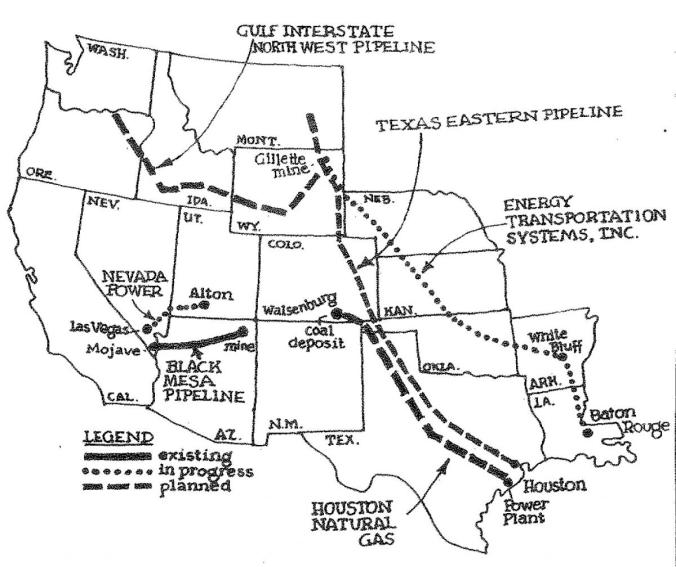
ETSI: Energy Transportation Systems, Inc. and Energy Transfer Partners, L.P.

Executives of the railroads, which until then shipped out all Powder River Basin coal, were not enthusiastic. ETSI was a joint venture of Bechtel, Lehman Brothers Kuhn Loeb, Kansas-Nebraska Natural Gas Co., United Energy Resources and Atlantic Richfield.[1] Frank Odasz, who was ETSI’s chief representative and lobbyist in the Rocky Mountain region for the project, explained Burlington Northern Railroad was initially a minor investor. “I think they did it just to spy on us,” he said.[2]

http://www.wyohistory.org/essays/coal-slurry-idea-came-and-went

coalslurry3

Look familiar????

http://law.justia.com/cases/federal/appellate-courts/F2/606/934/441399/

A copy of law documents from litigation between ETSI and Union Pacific Railroad.

This is a link to the environmental impact study by ETSI in 1981. The coal slurry pipeline project.  https://archive.org/details/finalenvironmentim01unit


What happened to ETSI?  http://www.wrlj.com/about-us-2/history/

Find out here: http://www.wrlj.com/  They just transport water!     

Energy Transfer Partners, L.P wants to take up what ETSI left behind; the fight to run pipelines through land that does not belong to them. http://www.energytransfer.com/ownership_overview.aspx

https://en.wikipedia.org/wiki/Dakota_Access_Pipeline

http://www.daplpipelinefacts.com/

Click to access DAPL_States_Counties.pdf